This is a repository copy of
Macroergomonics’ contribution to the effectiveness of
collaborative supply chains
.
White Rose Research Online URL for this paper:
http://eprints.whiterose.ac.uk/87116/
Version: Accepted Version
Proceedings Paper:
Mejias Herrera, SH and Huaccho Huatuco, LD (2012) Macroergomonics’ contribution to
the effectiveness of collaborative supply chains. In: WORK. 18th World Congress on
Ergonomics (IEA 2012), 12-16 Feb 2012, Recife, Brazil. IOS Press , pp. 2695-2700.
https://doi.org/10.3233/WOR-2012-0513-2695
(c) 2012 – IOS Press and the authors. All rights reserved. This is an author produced
version of a paper published in WORK. Uploaded in accordance with the publisher's
self-archiving policy.
[email protected] https://eprints.whiterose.ac.uk/
Reuse
Unless indicated otherwise, fulltext items are protected by copyright with all rights reserved. The copyright exception in section 29 of the Copyright, Designs and Patents Act 1988 allows the making of a single copy solely for the purpose of non-commercial research or private study within the limits of fair dealing. The publisher or other rights-holder may allow further reproduction and re-use of this version - refer to the White Rose Research Online record for this item. Where records identify the publisher as the copyright holder, users can verify any specific terms of use on the publisher’s website.
Takedown
If you consider content in White Rose Research Online to be in breach of UK law, please notify us by
Macroergomonics’ contribution to the
effectiveness of collaborative supply chains
Sandra Mejias Herrera
a,*and Luisa Huaccho Huatuco
baDepartamento de Ingeniería Industrial, Universidad Central “Marta Abreu” de Las Villas, Prolongación de
Colón Edif. 3 apt. 2 Santa Clara, Villa Clara Cuba.
b Leeds University Business School, University of Leeds, Woodhouse Lane, Leeds, LS2 9JT, UK
Abstract. This article presents a conceptual model that combines Macroergonomics and Supply chain. The authors combine their expertise on these individual topics, building on their previous research. The argument of the paper is that human factors are key to achieve effective supplier-customer collaboration. A conceptual model is presented, its elements and their interac-tions are explained. The Content-Context-Process model is applied as a departing point. Macroergonomics aspects considered are: a systemic approach, participatory ergonomics, forming ergonomics teams and evaluation of ergonomics projects. The expected outcomes are: (a) improvement of production and productivity levels, (b) improvement of the product quality, (c) reduction of absenteeism, (d) improvement in the quality of work life (from the employees’ perspective), and (e) increase in
the employees’ contribution rate of ideas for improvement. A case study was carried out at a vitroplant production organization incorporating environmental aspects to obtain sustainable benefits.
Keywords: Macroergonomics, supplier-customer collaboration, effectiveness, supply chains
*Corresponding author. E-mail: [email protected] 1. Literature review
It is rare the literature that covers the joint investi-gation of Macroergonomics and Supply Chain [2]. Macroergonomics was defined in [4] as the Human Factors/Ergonomics interface at organizational level. Ergonomics can provide an understanding on the complexity of business processes and their emergent behaviour [12]. They argue that supply chain pro-cesses in Small and Medium Enterprises (SMEs) can be less of an issue because they have one site, their processes are co-located and there is only one domi-nant process, whereas for larger companies: opera-tions can be on several sites (globally distributed), the process has to be tailored to accommodate these differences (regional, cultural and legal) among other reasons.
Previously these authors [11] had pointed out that the identification of processes and the infrastructure on their own cannot provide the required behaviour, i.e. it is people who produce the behaviour. The er-gonomics issues of importance in relation to supply chain they identified as being: control, communica-tion, compatibilities and culture. Regarding commu-nication, the role of information flows were
dis-cussed especially the case of ‘imperfect information’ and ‘excluded information’ in supply chain. It is in
this supply chain context that ‘trust’ is paramount, i.e.
According to [1] organizations that adopt an open and collaborative attitude are likely to do so both externally (with other companies) as well as internal-ly (within their own company). Performance measures proposed are: product quality, productivity, on time and in full dispatch and flexibility. The re-sults of their research point out the different factors that facilitate collaboration: multinational groups, great number of competitors and size (the smaller the organization the better).
The conceptual model presented by [9] consisting of “Content, Context and Process” terminology coin-cides with [5] who emphasized the need to consider supply chain within Context-Practice-Performance. They argued that both research theory and the organ-izational studies could be valuable for an integral understanding of the problem (conceptualizing) and its subsequent operationalization and modelling.
The research proposes that it is possible to gain ef-fectiveness of collaborative supply chains if the Mac-roergonomics focus and their variables in its design are considered. These include focusing on supplier-customer interaction at different levels [6], together with [9] Content, Context and Process.
- The Content (the What?) refers to the objectives, purposes and targets of the supplier-customer collab-oration. These are the information and material flows exchanged between supplier and customer. For ex-ample, in the case of information flows, it considers the information from the quote request to the pay-ment of the final products. In the case of material flows, this could be the dispatch/reception of prod-ucts and inventory management.
The Context (the Where?) refers to the environ-ment in which the collaboration is embedded. For example, the type of supply chain within its econom-ic, social and political environment. It is worth men-tioning that the environment can be of internal (with-in the collaboration) or external (outside the collabo-ration) nature. For example, internally the type of contract, the contractual and normative relationships. Whereas externally, we could consider sustainability issues and environmental impact by including aspects such as: economic, political and cultural key charac-teristics, for example.
The Process (the How?) refers to the actual im-plementation of the supplier-customer collaboration. Out of the three dimensions listed above, it is the Process that is the most difficult to tackle.
It is argued here that in order to make the Process of the Supplier-Customer collaboration effective, the following Macroergonomics aspects should be con-sidered:
(a) A systemic and integral approach, which de-parts from the identification and analysis of the vari-ables that affect job roles, work systems and organi-zations within the supplier-customer collaboration. Then, the implementation of ergonomic projects which would allow solving and obtaining improve-ments in their effectiveness should follow.
(b) The participation of all people involved in the supplier-customer collaboration, independently of hierarchical level, i.e. Participatory Ergonomics sup-ported by case studies and action research as a meth-odologies to implement the interventions in the learn-ing organizations. This implies the involvement of employees at all levels as well as the management in the identification, analysis and improvement pro-posals.
(c) The establishment of ergonomics teams as an essential part of the establishment for the identifica-tion and analysis of improvement proposals. This complements the previous Macroergonomics aspects above since it is not possible to obtain effective re-sults if people are not organized in ergonomics teams which are distinguished by their systemic an integral approach from the variables involved to the integral solutions.
(d) The evaluation of effectiveness of the ergo-nomic projects which could warrant continuity of the ergonomic practices, such as the evaluation of the impact of the improvements of the results obtained. This constitutes an opportunity to continue the ac-tions of the ergonomic projects.
These Macroergonomics aspects should in turn provide the following expected outcomes [7]: (a) improvement of production and productivity levels, (b) improvement of the product quality, (c) Reduc-tion of absenteeism, (d) improvement in the quality
of work life (from the employees’ perspective), and
(e) increase in the employees’ contribution rate of
ideas for improvement.
A common missing element in previous macroer-gonomic programmes was the evaluation of effec-tiveness. Some authors, such as [10] indicated that sometimes interventions cause more harm than good. Because of this, it is necessary that programmes have some measure of their effects [3,4,13].
This paper proposes a Macroergonomics Interven-tion Programme in a vitroplant producInterven-tion organisa-tion for the improvement of working systems, em-phasising the combination of two topics of the
au-thors’ research interests: Macroergonomics and
Sup-ply chains.
con-tribute to the effectiveness of collaborative supply chains?
2.Methodological formulation
The stated problem as well as previous research by the authors, urgently lead to define conceptual mod-els to figure out procedures for macroergonomics interventions. The result has entailed to establish the following definition:
“A conceptual model should show a set of
struc-tured and interrelated concepts with a systemic per-spective to establish the proposed macroergonomics procedure to obtain solutions for increasing well-being and productivity based on continuous
im-provement” [8].
The foundation for designing the model is intro-duced as follows:
It avoids errors such as proposing changes
with-out a systemic approach.
It is not limited to the Macroergonomics focus.
The future projection and adequate management
system designed for ergonomic programmes should increase its effectiveness.
Self-development of the organisation.
Dialectic approach to express a continuous
im-provement process.
Sets, organizes and manages the organisation
based on processes and analyses each sub-process in detail, those that could improve the ef-ficiency and performance level of the
organisa-tion’s Human Capital.
The design of the model [3] and the different ap-plications carried out through the years allowed to observe the need to adapt the conceptual model to a consultancy procedure. The reasons are based on the modern organisations and researchers are facing a period of transformation, which is evident in their increased use of consultants for intervention in dif-ferent areas. This is due to the many problems faced
by managers, who know that they need to “do som
e-thing” but they do not know exactly “what” and “how” to do it, looking for solutions with the help of consultants.
The general design for the consultancy procedure with a macroergonomics focus is presented in Figure 1.
Stage 1: “Definition of the ergonomic
require-ments” refers to the Why? i.e. where to focus in
terms of the definition of the object of study and the problem.
In Stages 2 to 5 the intervention is carried out by answering to the questions What to do? and How to do it?
Stage 6 “Feedback and control” guarantees the
cy-clical maintenance of improvements.
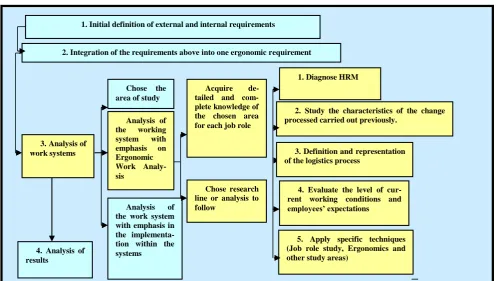
In Figure 2 we can see the details of the consultan-cy procedure (Stage 1) with emphasis on Ergonomic Work Analysis. Its application will meet the existing
ergonomic demand starting by diagnosing the study’s
object system work.
In order to fulfil this objective, the starting point begins by establishing the initial definition of exter-nal and interexter-nal requirements referred as to the stra-tegic context as well as to the problems related with the work system and the supply chain that causes negative effects in the relevant enterprise, area or sector.
The results are analyzed integrally obtaining one or more requirements, ergonomic controls or through a group effort. It must express the order of im-portance of requirements derived from choosing a method of weighting.
The analysis of work system continues where two important steps are carried out with the purpose of obtaining different results:
Chose the area of study.
Analysis of the working system with emphasis
on Ergonomic Work Analysis. In Figure 2, this has been highlighted with boxes of different col-ours joined by arrows.
Lastly, the analysis of results is done by integrat-ing the causes of the detected problems systemically. The rest of the phases are also worth explaining. Their adequate development will guarantee the bene-fits that are to be obtained with the ergonomic inter-vention.
Stages 2 and 3 show an intervention project with the design of the research customised to the problems detected in the area of study.
Figure 1. General design for the consultancy procedure with a macroergonomics focus
Figure 2. Definition of requirements and ergonomic needs (Stage 1)
Acquire
de-tailed and com-plete knowledge of the chosen area for each job role
2. Integration of the requirements above into one ergonomic requirement
3. Analysis of work systems
Chose the area of study
Analysis of the working system with emphasis on Ergonomic Work Analy-sis
Analysis of the work system with emphasis in the implementa-tion within the systems
1. Initial definition of external and internal requirements
Chose research line or analysis to follow
1. Diagnose HRM
2. Study the characteristics of the change processed carried out previously.
4. Evaluate the level of cur-rent working conditions and
employees’ expectations
5. Apply specific techniques (Job role study, Ergonomics and other study areas)
4. Analysis of results
3. Definition and representation of the logistics process
Stage 1
Definition of the ergonomic
require-ments
Stages 2 and 3
Strategic formulation of ergonomic actions
Stages 4 and 5
Implementation and evaluation of the
strat-egies for ergonomic actions
Stage 6
Feedback and control
Intervention
[image:5.595.64.562.392.673.2]It is possible then to carry out the intervention (Stages 4 and 5) by adapting the intervention project to the application, if necessary. For example, if the obtained results in the control work indicate that modification in the designed action is critical.
3.Case study
The Biotechnological Institute of Plants researches and produces vitroplants for national consumption and for export. The bio-factory has 34 employees and it is leading at national level due to its research re-sults. However, in spite of the showing the best in the country’s productivity result, utilisation of produ c-tion capacity was not good.
Which are the defined ergonomic requirements? To improve the quality of working conditions and the productivity level of the operations in the cabins of laminar fluid.
What was the response derived from the ergonom-ic programme? The activities were planned in the intervention programme, including actions that al-lowed workers:
To know the productive process developing
dif-ferent training courses and improving the rela-tionships with management and participation in the decision making, such as the Redesign of the working system.
To know the different consequences of repetitive
and monotonous tasks, establishing and adequate design of breaks during the working day. At the same time, a manual to evaluate the work-ing conditions in the production area was designed. Additionally, the performance evaluation system was also designed. And the design of the cabins was im-proved in order to comply with ergonomics princi-ples.
Thus, the supply chain analysis contributed to es-tablish a system of recommendations related with the flow of the process and the exchange with the clients. The objective was to increase the effectiveness of the supply chain and its sustainability.
The aspects above affected the quality of working conditions, which made them perform poorly under the expectation of the employees (See Figure 3).
4.Critical evaluation
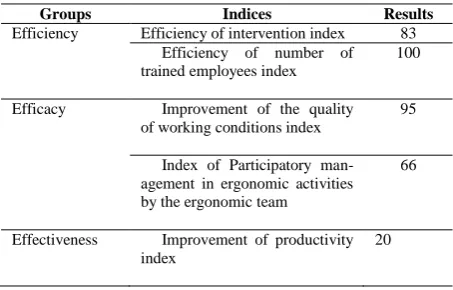
The benefits were analyzed and the results when finalizing the first intervention programme are shown in the Table 1.
The analysis of the context and the flow of the chain also showed the satisfactory results in order to improve the relationship with the clients and also to have them connected with the conceived actions within the intervention program
[image:6.595.308.543.255.386.2]A second intervention program which included the experience obtained from this program was designed. Thus, a group of actions at superior levels were pro-jected to improve the results, as well as the process related to the quality of working life.
Figure 3. Real level and expectations regarding quality of working life.
Table 1. Results of the first intervention
Groups Indices Results
Efficiency Efficiency of intervention index 83 Efficiency of number of trained employees index
100
Efficacy Improvement of the quality of working conditions index
95
Index of Participatory man-agement in ergonomic activities by the ergonomic team
66
Effectiveness Improvement of productivity index
20
5.Conclusion
The macroenorgomic approach applied the collabora-tive supply chains constitutes an important interdis-ciplinary link as to put into practice that comprises different satisfactory results in the quality of the working life, the productive results and the proper relations that are established within the chain supply. The developed actions showed how a process design considering both the technical and human factors aspects, it is possible improve the competences of the
0 20 40 60 80 100
1 23456 789101112131415161718 Variables %
Actual (pre-test)
Expected
[image:6.595.306.533.441.586.2]employees and the competences of the processes at the end of the intervention.
References
[1] Bayo-Morriones, A. and J. Merino-Díaz de Cerio. 2004. Em-ployee Involvement: Its Interaction with Advanced Manufac-turing Technologies, Quality Management, and Inter-Firm Collaboration. Human Factors and Ergonomics in Manufac-turing. 14: 117-134.
[2] García Acosta, G. and K. Lange Morales. 2008. Macroergo-nomics study of food sector company distribution centres. Applied Ergonomics. 39: 439-449.
[3] Hendrick, H. W. 2003. Determining the cost-benefits of ergo-nomics projects and factors that lead to their success. Applied Ergonomics. 34: 419-427.
[4] Hendrick, H. W. 2008. Applying ergonomics to systems: Some documented "lessons learned". Applied Ergonomics. 12: 418-426.
[5] Ho, D. C. K., K. F. Au and E. Newton. 2002. Empirical re-search on Supply Chain Management: a critical review and recommendations. International Journal of Production Re-search. 40(17): 4415-4430.
[6] Kerr, M. and L. Huaccho Huatuco. 2006. A framework to assess the effectiveness of collaborative supplier relationships. Proceedings of the 13th Annual International EurOMA Con-ference. Moving up the value chain. University of Strathclyde, Glasgow, 18th – 21st June 2006. Vol. I:. 995-1004.
[7] Mejias Herrera, S. H. and L. Huaccho Huatuco. 2011. Macro-ergonomics Intervention Programmes: Recommendations for their design and implementation. Human Factors and Ergo-nomics in Manufacturing. 21: 227-243.
[8] Mejias Herrera, S. (2003). Herramienta de intervencion mac-roergonomica para elmejoramiento de los sistemas de trabajo. PhD thesis, Universidad Central Marta Abreu de Las Villas, Cuba.
[9] Pettigrew, A. M. and R. Whipp. 1991. Managing change for competitive success. Oxford: Blackwell Business.
[10]Shannon, H. and S. Guastello. 1997. Workplace Safety Measures – What Can we Say About What Works? Proceed-ings of the 13th Triennial Congress of the International Ergo-nomics Association. Tampere, Finland: 650 – 653.
[11]Siemieniuch, C. E. and M. A. Sinclair. 2000. Implications of the Supply Chain for Role Definitions in Concurrent Engi-neering. Human Factors and Ergonomics in Manufacturing. 10: 251-272.
[12]Siemieniuch, C. E. and M. A. Sinclair. 2002. On complexity, process ownership and organizational learning in manufactur-ing organisations, from an ergonomics perspective. Applied Ergonomics. 33: 449-462.