This is a repository copy of
Mutation Testing for Jason Agents
.
White Rose Research Online URL for this paper:
http://eprints.whiterose.ac.uk/78890/
Version: Accepted Version
Proceedings Paper:
Huang, Zhan, Alexander, Rob orcid.org/0000-0003-3818-0310 and Clark, John Andrew
orcid.org/0000-0002-9230-9739 (2014) Mutation Testing for Jason Agents. In: Proceedings
of the 13th International Conference on Autonomous Agents and Multiagent Systems. 13th
International Conference on Autonomous Agents and Multiagent Systems, 05-09 May
2014 IFAAMAS , Richland, SC .
[email protected] https://eprints.whiterose.ac.uk/ Reuse
Items deposited in White Rose Research Online are protected by copyright, with all rights reserved unless indicated otherwise. They may be downloaded and/or printed for private study, or other acts as permitted by national copyright laws. The publisher or other rights holders may allow further reproduction and re-use of the full text version. This is indicated by the licence information on the White Rose Research Online record for the item.
Takedown
If you consider content in White Rose Research Online to be in breach of UK law, please notify us by
Mutation Testing for Jason Agents
Zhan Huang, Rob Alexander, and John Clark
Department of Computer Science, University of York, York, United Kingdom {zhan.huang,robert.alexander,john.clark}@cs.york.ac.uk
Abstract. Most multi-agent system (MAS) testing techniques lack empirical evidence of their effectiveness. Since finding tests that can reveal a large pro-portion of possible faults are a key goal in testing, we need techniques to assess the fault detection ability of test sets for MAS. Mutation testing offers a direct and powerful way to do this: it generates faulty versions of the program follow-ing mutation operators then checks if the tests can distfollow-inguish the original pro-gram from those versions. In this paper, we propose a set of mutation operators for the Jason agent-oriented programming language, and then introduce a muta-tion testing system for individual Jason agents that implements some of our proposed mutation operators. We use our implemented mutation operators to assess the tests for a small Jason system, and show that the tests that meet a combination of existing coverage criteria do not kill all mutants.
Keywords: Test Evaluation, Mutation Testing, Agent-Oriented Programming, Jason
1
Introduction
Multi-agent systems (MAS) are getting increasing attention in academics and industry as an emerging paradigm for engineering autonomous and distributed systems. In MAS engineering, testing is a challenging activity because of the increased complexi-ty, large amount of data, irreproducibilicomplexi-ty, non-determinism and other characteristics involved in MAS [9]. Although many techniques have been proposed to address the difficulties in MAS testing, most of them lack empirical evidence of their effective-ness [10].
Effective testing requires tests that are capable of revealing a high proportion of faults in the system under test (SUT). It can be difficult to find real faulty projects to verify the real fault detection ability of the tests, however, test coverage criteria or simulation of real faults can be used to evaluate it.
coverage criteria for Prometheus agents [2], and Miller et al.Õs protocol and plan based coverage criteria for agent interaction testing [3].
Simulation of real faults offers a more direct way to assess the fault detection abil-ity of the tests than test coverage criteria: faults can be hand-seeded or seeded by mu-tation [12], which is a systematic and automatic way of generating modified versions of the SUT (ÒmutantsÓ) following some rules (Òmutation operatorsÓ). After seeding faults, each test is executed against first the original SUT then each faulty version of the SUT. For each faulty version, if its behaviour differs from the original SUT in at least one test, it will be marked as ÒkilledÓ to indicate that the faults in it can be de-tected by the tests. Therefore, the fault detection ability of the tests can be assessed by the Òkill rateÓ Ð the ratio of the killed faulty versions to all generated faulty versions: higher the ratio is, more effective the tests are.
Mutation is more commonly used to seed faults than the hand-seeded way because it has solid theoretical foundation, and empirical studies suggest that it provides an efficient way to seed faults that are more representative of real faults than hand-seeded ones [13]. However, the mutation operators used to guide mutant generation may lead to a huge number of mutants so that comparing the behaviour of each mu-tant with that of the original SUT in each test is computationally costly. Another prob-lem is that mutation unpredictably produces equivalent mutants Ð alternate implemen-tations of the SUT which are not actually faulty, and thus which must be excluded from test evaluation. Generally, excluding equivalent mutants is a laborious manual process.
This process of using mutation to assess tests is called mutation testing. The key to success is to design an effective set of mutation operators that can simulate an ade-quate set of realistic faults in a reasonable (computationally tractable) number of gen-erated mutants.
There is some preliminary work on mutation testing for MAS. Nguyen et al. [4] use standard mutation operators for Java to assess tests for JADE agents (which are implemented in Java). In contrast to standard operators for existing languages, it is likely that MAS-model-specific mutation operators will better simulate MAS-specific faults. In this vein, Adra and McMinn [5] propose a set of mutation operator classes for agent-based models. Saifan and Wahsheh [6] propose and classify a set of muta-tion operators for JADE mobile agents. Similarly, Savarimuthu and Winikoff [7, 8] systematically derive a set of mutation operators for the AgentSpeak BDI agent lan-guage and another set for GOAL agent lanlan-guage. None of the above papers on MAS-specific mutation operators, however, actually implement and evaluate their operators except [8].
proposed mutation operators; in Section 4 we show the use of our implemented muta-tion operators in assessing and enhancing the tests for a Jason project; we end with a summary of our work, a discussion of the relationships to previous related work and some suggestions for where this work could go in the future.
2
Mutation Operators for Jason
Mutation operators are rules to guide mutant generation. For instance, a mutation operator for procedural programs called Relational Operator Replacement (ROR)
requires that each occurrence of one of the relational operators (<, ≤, >, ≥, =, ≠) is replaced by each of the other operators [11]. A mutant usually only contains a sim-ple, unary fault (e.g., in the above examsim-ple, each generated mutant only replaces a single relational operator by another), because of the two underlying theories [12] in mutation testing: the Competent Programmer Hypothesis states that programmers create programs that are close to being correct; the Coupling Effect states that tests that can detect a set of simple faults can also find complex faults.
Since mutation is typically performed at source code level, a set of mutation opera-tors is specific to a given programming language (C, Java, etc.). To design mutation operators for a programming language, it is common to start by proposing a large set on the syntax and features of the language, and then to refine an effective set through evaluation.
Savarimuthu and Winikoff [7] applied the guidewords of HAZOP (Hazard and Operability Study) into the syntax of AgentSpeak, to systematically derive a set of mutation operators for AgentSpeak. Now we build on their work: we propose muta-tion operators for an implementamuta-tion of AgentSpeak called Jason [14], which imple-ments AgentSpeakÕs operational semantics and extends AgentSpeak with various features useful for practical agent implementation. In contrast to their systematic method that may produce a large amount of mutation operators, we have used our judgment and borrowed the ideas of existing mutation operators to refine our operator set so as to preferentially implement and evaluate it, in the hope of avoiding imple-menting some ineffective operators. It can be seen that our mutation operators contain some shared with Savarimuthu and Winikoff for the core AgentSpeak language and others for the Jason specific features.
We base our work on JasonÕs Extended BackusÐNaur Form (EBNF), where a list of production rules is defined that describe JasonÕs grammar. The EBNF we use is a simplified version that excludes some advanced features of Jason such as the use of
2.1 High-Level Mutation Operators for Jason
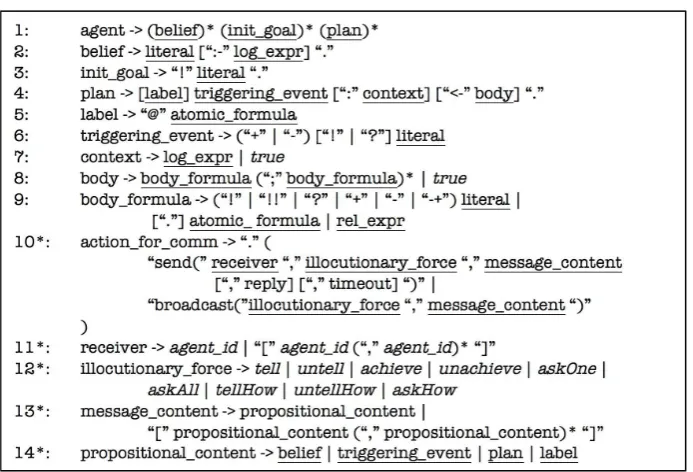
[image:5.595.126.473.200.436.2]Fig. 1 shows the high-level production rules in JasonÕs EBNF; from this, we have derived 13 high-level mutation operators.
Fig. 1. High-level production rules in JasonÕs EBNF (Rule 1Ð9 are adapted from [14], 10Ð14 are we add for specifying Jason agent communication)
Production rule 1 states that an agent is specified in terms of beliefs, initial goals and plans. From this rule we derive the following three mutation operators:
¥ Belief Deletion (BD): Each belief in the agent is deleted.
¥ Initial Goal Deletion (IGD): Each initial goal in the agent is deleted.
¥ Plan Deletion (PD): Each plan in the agent is deleted.
Production rule 2 states that a belief can be a literal representing some fact, or a rule representing some fact will be derived if some conditions get satisfied. The introduc-tion of rules enables Jason to perform theoretical reasoning [16]. From this produc-tion rule we derive the following mutaproduc-tion operator:
¥ Rule Condition Deletion (RCD): The condition part of each rule is deleted.
A rule that RCD is applied to will only have its conclusion part Ð a literal Ð left, as a belief held by the agent regardless of whether the (now deleted) conditions get satis-fied.
addition (+!), achievement goal deletion (-!), test goal addition (+?) and test goal dele-tion (-?). It can be seen that an event that can be handled by Jason plans represents a change Ð addition or deletion (represented using + or Ð operator respectively) Ð to the agentÕs beliefs or goals. From this rule we derive the following mutation operator:
¥ Triggering Event Operator Replacement (TEOR): The triggering event opera-tor (+ or -) of each plan is replaced by another operaopera-tor.
Production rule 7 states that the context of a plan can be a logical expression or set
true (the latter is equivalent to the context not being specified at all). The plan context defines the condition under which the plan that has been triggered becomes a candi-date for commitment to execution. From this production rule we derive the following mutation operator:
¥ Plan Context Deletion (PCD): The context of each plan is deleted if it is non-empty or not set true.
Production rule 8 states that the body of a plan can be a sequence of formulae, each of which will be executed in order, or set true (the latter is equivalent to the body not being specified at all). From this rule we derive the following three mutation opera-tors:
¥ Plan Body Deletion (PBD): The body of each plan is deleted if it is non-empty or not set true.
¥ Formula Deletion (FD): Each formula in the body of each non-empty plan is de-leted.
¥ Formulae Order Swap (FOS): The order of any two adjacent formulae in the body of each plan that contains more than one formula is swapped.
In many cases, PBD is equivalent to PD (Plan Deletion). However, since the plan context can contain internal actions that may cause changes in the agentÕs internal state, the plan that PBD is applied to may still have an effect on the agent although its body has been deleted, in this case PBD is not equivalent to PD.
Production rule 9 states that a body formula can be one of the six types: achievement goal (!literal or !!literal), test goal (?literal), achievemental note (+literal, literal, -+literal), action (atomic_formula), internal action (.atomic_formula) and relational expression. The former three types are involved in generating internal events that correspond to changes in achievement goals, test goals and beliefs respectively. Simi-lar to how we derived Triggering Event Operator Replacement (TEOR) operator, from this production rule we derive the following mutation operator:
¥ Formula Operator Replacement (FOR): The operator of each achievement goal formula (! or !!) is replaced by another operator, so is that of each mental note formula (+, -, -+).
goal. In the latter case, the two plans can compete for execution due to the normal intention selection mechanism.
Production rules 10Ð14 (marked with asterisks) are the ones we added for specify-ing Jason agent communication. It can be seen that two internal actions: .send and
.broadcast, are used by Jason agents to send messages. The main parameters in these actions include the message receiver(s) (only used in .send action) that can be a single or a list of agents identified by the agent ID(s), the illocutionary force (tell, untell,
achieve, etc.) representing the intention of sending the message and the message con-tent that can be one or a list of propositional concon-tents. From these production rules we derive the following three mutation operators:
¥ Message Receiver Replacement (MRR): The receiver or the list of receivers in each .send action is replaced by another agent ID (or some subset of all the agent IDs in the MAS). If the action is .broadcast, it will be first converted to its equiva-lent .send action and then applied this mutation operator.
¥ Illocutionary Force Replacement (IFR): The illocutionary force in each action for sending messages is replaced by another illocutionary force.
¥ Propositional Content Deletion (PCD2): Each propositional content in the mes-sage content is deleted.
It is worth noting that a propositional content is some component of another type (e.g., belief, plan, etc.). Therefore, the mutation operators for these components can also be applied for mutating agent communication.
2.2 Low-Level Mutation Operators for Jason
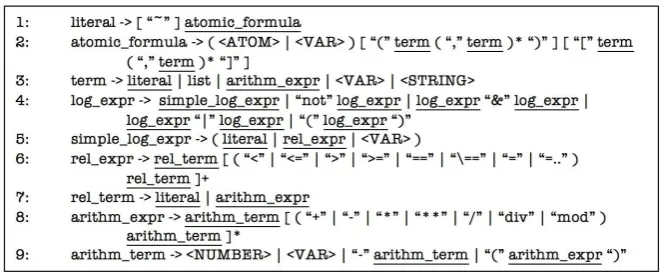
[image:7.595.132.464.501.638.2]Fig. 2 shows the low-level production rules in JasonÕs EBNF; from this, we have derived 11 low-level mutation operators, most of which are borrowed from the exist-ing ones for conventional programs.
Fig. 2. Low-level production rules in JasonÕs EBNF (Source: [14])
programming: an agent can explicitly express that something is false by using strong negation, or express that it cannot conclude whether something is true or false using default negation (i.e. by the simple absence of a belief on the matter). From this pro-duction rule we derive the following mutation operator:
¥ Strong Negation Insertion/Deletion (SNID): The form of each literal (affirmative or strong negative) is transformed to the other form.
Production rule 2 and 3 state that an atomic formula consists of a relation followed by a list of annotations. Annotations can be used to provide further information about the relation, e.g., source is an important annotation that is appended to some atomic for-mulae automatically by Jason is used to represent where the atomic forfor-mulae (or its represented component) come from by taking one of the three parameters: percept,
self or an agent ID. For instance, belief likes(rob, apples)[source(tom)] implies the information that rob likes apples comes from agent tom. From these production rules we derive the following two mutation operators:
¥ Annotation Deletion (AD): Each annotation of each atomic formula is deleted, if one exists.
¥ Source Replacement (SR): The source of each atomic formula is replaced by another source, if it exists.
Production rule 4 and 5 define logical expressions. From these rules we derive the following three mutation operators:
¥ Logical Operator Replacement (LOR): Each logical operator (& or |) is re-placed by the other operator.
¥ Negation Operator Insertion (NOI): The negation operator (ÒnotÓ) is inserted before each (sub) logical expression.
¥ Logical Expression Deletion (LED): Each sub logical expression is deleted.
Production rule 6 and 7 define relational expressions. From these rules we derive the following two mutation operators:
¥ Relational Operator Replacement (ROR): Each relational operator (Ò<Ó, Ò<=Ó, Ò>Ó, Ò>=Ó, Ò==Ó, Ò\==Ó, Ò=Ó, Ò=..Ó) is replaced by another operator.
¥ Relational Term Deletion (RTD): Each relational term in each relational expres-sion is deleted.
Production rule 8 and 9 define arithmetic expressions. From these rules we derive the following three mutation operators:
¥ Arithmetic Operator Replacement (AOR): Each arithmetic operator (Ò+Ó, Ò-Ó, Ò*Ó, Ò**Ó, Ò/Ó, ÒdivÓ, ÒmodÓ) is replaced by another operator.
¥ Arithmetic Term Deletion (ATD): Each arithmetic term in each arithmetic ex-pression is deleted.
3
muJason: a Mutation Testing System for Jason Agents
[image:9.595.137.448.282.668.2]We have developed a mutation testing system for individual Jason agents called mu-Jason1, where we have implemented the 13 high-level mutation operators via Jason APIs and Java reflection, both of which can be used to access and modify the archi-tectural components of the agents and the state of the MAS at runtime. The class dia-gram and the user interface of muJason are shown in Fig. 3 and Fig. 4 respectively. Next we will introduce muJason from the perspective of the users.
Fig. 3. The class diagram of muJason
Fig. 4. The user interface of muJason
1
A user can launch muJason by running the MutationSystem class and passing the name of the Jason project configuration file (postfixed with Ò.mas2jÓ) as the parame-ter. Then muJason will load the Jason project and display the mutation testing control panel (as shown in Fig. 4), where the user can configure, start and observe a mutation testing process.
Before initiating a mutation testing process, the user needs to specify the tests that need evaluation, the killing mutant criterion for each test and the TTL (Time to Live) of the original agent and each mutant for each test in the deploy(testID), isMu-tantKilled(testID) and getAgentTTL(testID) methods provided by the TestBed class (as shown in Fig. 3), respectively. Each of these methods is described as follows:
¥ deploy(testID): this method sets up the initial configuration of the Jason system prior to each test run. The method is called each time by taking an ID identifying one of the tests, and the user can write code to set up the tests corresponding to the passed test IDs.
¥ isMutantKilled(testID): this method is used to determine whether a mutant under some test is killed. It is called after each mutant terminates, and is passed the ID of the current test. Therefore, in this method the user can write code to check whether the mutant has been killed by each individual test. An alternate approach would have been to compare all the behaviour of the original agent and that of the mutant, but that would have been computationally expensive and prone to declaring mu-tants ÒkilledÓ when the behaviour variation was of no consequence. With the ap-proach taken here, the user can just specify the important aspects that need obser-vation and comparison, via Jason APIs or Java reflection that can access the state of the MAS, or other techniques.
¥ getAgentTTL(TestID): this method is used to specify the lifetime of the original agent and its mutants as the return value for each test. Since agents usually run in-definitely, the original agent or each mutant can only be allowed to run for a cer-tain period of time so that the next one can run. The whole Jason project will re-start as soon as the original or mutated agent terminates, so that next time the agent can be observed from (and mutated at) the (same) initial point of the MAS. The lifetime or TTL of an agent is measured by the number of the reasoning cycles the agent can perform; it must be enough for the agent to expose all the behaviour in-volved in the process of killing mutants. The TTL for a test is actually part of the killing mutant criterion for that test. Although there may be ways to automatically evaluate the TTL or to automatically terminate the mutant once it is observed being killed, for simplicity in the beginning, the TTL for each test is fixed and manually set depending on the userÕs experience.
After specifying the tests, the killing mutant criteria and the TTL, the user can config-ure and start a mutation testing process in the mutation testing control panel through the following steps (as shown in Fig. 4):
ap-plied into. He can ignore the agents/components unnecessary for testing, e.g., the GUI agent and the plans pre-defined by Jason for enabling agent communication, etc.
2.Select the mutation operators. After specifying the mutation domain of an agent, the user can select the mutation operators that will be applied into the mutation domain.
3.Start the mutation testing process. After configuration, the user can start the muta-tion testing, observe its process in the mutamuta-tion testing control panel and wait for its result. The mutation testing process can be described using the following pseu-do-code:
1: For each defined testID:
2: Set up the test identified by the testID 3: Get the specified TTL for the test
4: Run the original Jason project for the TTL 5: Restart the Jason project
6: Create a mutant generator taking the selected agent, mutation domain and mutation operators 7: While the generator can generate another mutant: 8: Generate the next mutant
9: Run the modified Jason project for the TTL 10: Check if the mutant is killed under the current test, if so mark it ÒkilledÓ 11: Restart the Jason project
4
Evaluation
To perform a preliminary evaluation of our implemented mutation operators, we use them to guide the generation of the mutants for an agent in a Jason project, then ex-amine whether a test set designed using some existing agent test coverage criteria can kill all the non-equivalent mutants. If it cannot kill all those mutants, that means this test set cannot reveal the faults simulated by the non-killed non-equivalent mutants, thereby demonstrating that our operators are effective in finding the weaknesses of this test set.
The Jason project we choose is available on the Jason website2, and is called
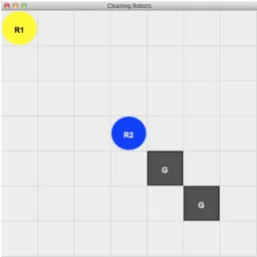
Cleaning Robots. It involves a cleaner agent, an incinerator agent and several pieces of garbage located in a gridded area as shown in Fig. 5 (R1 represents the cleaner agent, R2 represents the incinerator agent, G represents the garbage). When this pro-ject is launched, the cleaner agent will move along a fixed path that covers all grid squares (move from the leftmost square to the rightmost one in the first row, then ÒjumpÓ to the leftmost square in the second row and move to the rightmost one, and so on). If it perceives that the square it is in contains garbage, it will pick it up, carry it and then move to the square where the incinerator agent is along the shortest path
2
(diagonal movement is allowed). The cleaner agent will drop the garbage in the incin-erator agent for burning, and after that it will return to the square where it just found the garbage along a shortest path (diagonal movement allowed), then continue mov-ing along the fixed path until it reaches the last square.
Fig. 5. The Cleaning Robots example
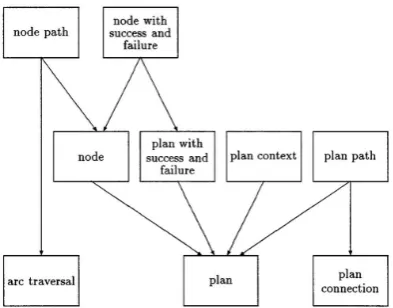
In order to test the cleaner agent, we generate tests that each describe a different envi-ronment for the cleaner agent. We design the tests according to the test coverage crite-ria proposed by Low et al. [1]. Their critecrite-ria are based on plans and nodes (actions) in BDI agents, which are suitable for Jason agent paradigm. Fig. 6 shows the subsump-tion hierarchy of their criteria, from which it can be seen the topmost criteria represent the most rigorous ones. Since this Jason project is simple and doesnÕt concern plan and action failure, after analyzing the AgentSpeak code of the cleaner agent we de-sign ten tests that collectively meet the node path coverage criterion, the plan context coverage criterion and the plan path coverage criterion (we use 0-1-many rule for cyclical path coverage), and accordingly we extract three variables from each test: the location of the incinerator agent, the locations of garbage and the probability the cleaner agent has to pick up each piece of garbage successfully when it attempts to.
[image:12.595.200.397.523.677.2]Since the environment is hard-coded into a java file, we use text replacement and class reload techniques in the deploy(testID) method to implement and deploy each test. We consider a mutant to be killed by a test if, at the end of the test, there is any garbage uncollected (in contrast, the non-mutated version always collects all the gar-bage). To implement this, we use Jason APIs and Java reflection in ifMu-tantKilled(testID) method to check whether all the squares in the environment are empty except the two taken by the cleaner agent and the incinerator agent respective-ly. In addition, in getAgentTTL(testID) method, for each test, we set the lifetime of the original agent and each mutant to an amount that is just enough for the cleaner agent to finish cleaning.
Next we configure a mutation testing process for the cleaner agent as shown in Fig. 4: first we choose r1 which is the name of the cleaner agent, and then all of its three beliefs, one initial goal and nine non-predefined plans; next we check all the imple-mented operators that will be applied into the chosen mutation domain. After these we start and observe the mutation testing itself.
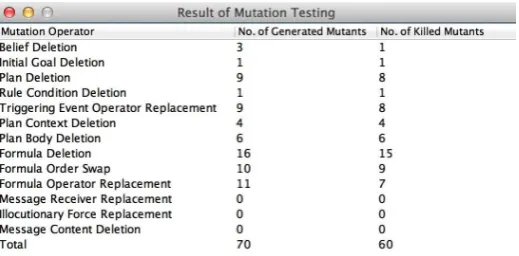
[image:13.595.169.429.435.563.2]After the mutation testing, the result is displayed, as shown in Fig. 7. From the re-sult we can see that the three operators for agent communication Ð Message Receiver Replacement (MRR), Illocutionary Force Replacement (IFR) and Propositional Con-tent Deletion (PCD2) Ð are not useful because this Jason project doesnÕt concern agent communication. We also observe that some mutants are not killed. We track these non-killed mutants in the log of the mutation testing process and analyze their corresponding changes in the code. It appears that many of them are equivalent mu-tants under the killing mutant criteria and TTL we set.
Fig. 7. The result of the mutation testing
The above mutation is a fault, because it means that the agent will end up with sev-eral versions of Òlast location at which I found garbageÓ stored in its memory. In many cases, this is not a problem. When the cleaner agent has finished at the incinera-tor agent, it will try to take the shortest route back to the last location where it found garbage. To do this, it queries for its belief about the last location, and it will always retrieve the correct one because JasonÕs default belief selection mechanism will al-ways select the matching one that is added to the belief base most recently.
After each movement step, however, the agent will query "does my current loca-tion correspond to the last localoca-tion I found garbage" i.e. should it stop fast movement and go back to its slow side-to-side sweep of the map? If the agent is at any location where it previously found garbage, Jason's belief query mechanism will cause the answer to that question to be "yes" - all of the "last garbage location" beliefs will be checked for a match. At that point, it will go back into its slow sweep, even though (in this simple world) there's no chance of finding new garbage before it reaches the ac-tual last garbage location. As a consequence, the whole collection process will take longer and the agent may not collect all the garbage within its specified time-to-live.
This fault cannot be detected by any of our tests designed for the cleaner agent, be-cause in our tests (by chance) it never passes through a previous garbage location when returning to the last collected garbage location (Fig. 5 shows an example where it would happen). In order to detect this fault, we add a test that satisfies the following three conditions:
¥ A piece of garbage G1, is located in a shortest path between the incinerator agent and another piece of garbage G2.
¥ G1 is found prior to G2. This requires G1 and G2 must be located after where the incinerator agent is along the fixed path for the agent to check all the squares.
¥ G1 and G2 are not in the same row. This enables us to observe that the agent does indeed return to where G1 was found after dropping either garbage for burning.
[image:14.595.233.362.548.677.2]Fig. 8. shows a case in which the fault of multiple last locations can be detected. In this case, the cleaner robot will always return to the location where the garbage closer to the incinerator agent is after dropping either garbage, it will then continue moving along the fixed path from this location.
5
Discussion and Conclusion
In this paper we presented our preliminary work on mutation testing for multi-agent systems: we proposed a set of mutation operators for the Jason agent-oriented pro-gramming language; we described a mutation testing system called muJason for indi-vidual Jason agents, which implements the high level subset of our operators. We then used our implemented operators to assess a test set (for an example agent) that satis-fies the coverage criteria proposed by Low et al. [1], and found a non-equivalent mu-tant that was not killed. We were hence able to add a test to the test set for killing this mutant (and, probably, similar mutants or faults).
Our work draws on and expands that of Savarimuthu and Winikoff [7]: we pro-posed mutation operators for a specific implementation of AgentSpeak, implemented some of them and performed a preliminary empirical assessment. Their method for deriving mutation operators was very systematic, while ours has been more informal: we selected our operators using our judgment so that we can preferentially implement and assess them, in the hope of avoiding implementing some ineffective ones. It can be seen that their operator set contains ours for the core AgentSpeak, but ours contain some to cover Jason-specific features useful for practical agent implementation, such as Rule Condition Deletion (RCD), Annotation Deletion (AD) and Source Replace-ment (SR).
Another related work is Adra and McMinnÕs [5]. Although they used a rather dif-ferent agent model, some of their ideas are relevant to our work. They proposed four mutation operator classes, among which their class for agent communication (Mis-communication, Message Corruption) corresponds to our operators for agent commu-nication (Message Receiver Replacement, Illocutionary Force Replacement, Proposi-tion Content DeleProposi-tion and other involved high- and low-level operators), and their class for an agentÕs memory corresponds to our operators for beliefs (Belief Deletion, Rule Deletion and other involved low-level operators). Their mutation operator class for agentÕs function execution does not directly correspond to our operators since our agent model adopts the BDI reasoning mechanism, while theirs does not. As to their mutation operator class for the environment, it is not relevant in our operators for agents, although agent environments are an important dimension of MAS that act as the input source of agents, and we plan to mutate environments in future work.
In the future, we will derive mutation operators for JasonÕs advanced features (e.g., the use of directives, etc.), and implement them (along with the low-level ones we proposed in this paper but did not implement in muJason so far). We will also apply our approach to more Jason systems, and generate tests using other existing test eval-uation criteria to further evaluate the effectiveness of our proposed mutation opera-tors. There are challenges here Ð it is difficult to implement the low-level mutation operators because we need to extract the logical representations that these operators are applied into from different agentÕs architectural components. We have also not yet found any publicly-available Jason projects that are truly complex.
the mutant. After that we will expand muJason to support JaCaMo [15], which is a complete MAS programming paradigm that adopts Jason for programming agents, Moise for programming organizations and CArtAgO for programming environments. This will allow us to explore the mutation of organizational and environmental di-mensions of MAS.
References
1. Low, C.K., Chen, T.Y., Ršnnquist, R.: Automated test case generation for BDI agents. In: Autonomous Agents and Multi-Agent Systems, vol. 2, pp. 311Ð332 (1999)
2. Zhang, Z., Thangarajah, J., Padgham, L.: Automated unit testing for agent systems. In: 2nd International Working Conference on Evaluation of Novel Approaches to Software Engi-neering (ENASE-07), pp. 10Ð18 (2007)
3. Miller, T., Padgham, L., Thangarajah, J.: Test coverage criteria for agent interaction test-ing. In: Weyns, D., Gleizes, M.P. (eds.) Proceedings of the 11th International Workshop on Agent Oriented Software Engineering, pp. 1Ð12 (2010)
4. Nguyen, C.D., Perini, A., Tonella, P.: Automated continuous testing of multi-agent sys-tems. In: The fifth European Workshop on Multi-Agent Systems (2007)
5. Adra, S.F., McMinn, P.: Mutation operators for agent-based models. In: Proceedings of 5th International Workshop on Mutation Analysis. IEEE Computer Society (2010)
6. Saifan, A.A., Wahsheh, H.A.: Mutation operators for JADE mobile agent systems. In: Pro-ceedings of the 3rd International Conference on Information and Communication Systems, ICICS (2012)
7. Savarimuthu, S., Winikoff, M.: Mutation operators for cognitive agent programs. In: Pro-ceedings of the 2013 International Conference on Autonomous Agents and Multi-Agent Systems (AAMASÕ13), pp. 1137Ð1138 (2013)
8. Savarimuthu, S., Winikoff, M.: Mutation Operators for the Goal Agent Language. In: Cos-sentino, M., Seghrouchni, A.E.F., Winikoff, M. (eds.) Engineering Multi-Agent Systems. Lecture notes in computer science, vol. 8245, pp. 255Ð273. Springer, Heidelberg (2013) 9. Houhamdi, Z.: Multi-agent system testing: a survey. In: International Journal of Advanced
Computer Science and Applications (IJACSA), 2(6), pp. 135Ð141 (2011)
10. Nguyen, C., Perini, A., Bernon, C., Pav—n, J., Thangarajah, J.: Testing in multi-agent sys-tems. In M.P. Gleizes, & J. Gomez-Sanz (eds.) Agent-oriented software engineering X. Lecture notes in computer science, vol. 6038, pp. 180Ð190. Springer, Heidelberg (2011) 11. Ammann P., Offutt J.: Introduction to Software Testing. Cambridge University Press
(2008)
12. Mathur, A.P.: Foundations of Software Testing. Pearson (2008)
13. Andrews, J.H., Briand, L.C., Labiche, Y.: Is mutation an appropriate tool for testing exper-iments? In: International Conference on Software Engineering (2005)
14. Bordini, R.H., HŸbner, J.F., Wooldridge, M.: Programming Multi-Agent Systems in AgentSpeak using Jason. John Wiley & Sons (2007)
15. Boissier, O., Bordini, R.H., HŸbner, J.F., Ricci, A., Santi, A.: Multi-agent oriented pro-gramming with JaCaMo. In: Science of Computer Propro-gramming (2011)