This is a repository copy of
End-to-End Schedulability Tests for Multiprocessor Embedded
Systems based on Networks-on-Chip with Priority-Preemptive Arbitration
.
White Rose Research Online URL for this paper:
http://eprints.whiterose.ac.uk/93367/
Version: Submitted Version
Article:
Soares Indrusiak, Leandro orcid.org/0000-0002-9938-2920 (2014) End-to-End
Schedulability Tests for Multiprocessor Embedded Systems based on Networks-on-Chip
with Priority-Preemptive Arbitration. Journal of systems architecture. pp. 553-561. ISSN
1383-7621
https://doi.org/10.1016/j.sysarc.2014.05.002
[email protected]
https://eprints.whiterose.ac.uk/
Reuse
Items deposited in White Rose Research Online are protected by copyright, with all rights reserved unless
indicated otherwise. They may be downloaded and/or printed for private study, or other acts as permitted by
national copyright laws. The publisher or other rights holders may allow further reproduction and re-use of
the full text version. This is indicated by the licence information on the White Rose Research Online record
for the item.
Takedown
If you consider content in White Rose Research Online to be in breach of UK law, please notify us by
End-to-End Schedulability Tests for Multiprocessor
Embedded Systems based on Networks-on-Chip with
Priority-Preemptive Arbitration
Leandro Soares Indrusiak
Real-Time Systems Group - Department of Computer Science University of York - York, United Kingdom
[email protected]
ABSTRACT
Simulation-based techniques can be used to evaluate whether a particular NoC-based platform configuration is able to meet the timing constraints of an application, but they can only evaluate a finite set of scenarios. In safety-critical applications with hard real-time constraints, this is clearly not sufficient because there is an expectation that the application should be schedulable on that platform in all possible scenarios. This paper presents a particular NoC-based multiprocessor architecture, as well as a number of analytical methods that can be derived from that architecture, aiming to allow designers to check, for a given platform configuration, whether all application tasks and communication messages always meet their hard real-time constraints in every possible scenario. Experiments are presented, showing the use of the proposed methods when evaluating different task mapping and platform topologies.
Categories and Subject Descriptors
C.3 [Special-purpose and Application-based Systems]: Real-time and embedded systems.
General Terms
Performance, Design.
1.
INTRODUCTION
Embedded systems typically have to fulfil timing constraints that are related to their application domain and usage scenarios. Constraints are usually specified as the deadline to perform specific functions. For example, a high-definition video recorder must be able to capture, compress and store 25 video frames per second. In safety-critical applications, such constraints are said to be hard real-time constraints, as there is an expectation that they have to be met by the system in all possible scenarios. Therefore, embedded systems designers must be able to evaluate which design alternatives can fulfil those constraints and, for safety-critical applications, guarantee real-time behaviour.
In this paper, we present analytical methods to evaluate whether a multicore embedded system based on a Network-on-Chip (NoC) can fulfil all its timing constraints. A NoC-based system can have tens to hundreds of processing cores interconnected by an on-chip packet-switching network that allows data to be transferred between the local caches of each core and from/to external memory. Section 2 of the paper provides more detail on this type of system architecture. It will then become clear that the performance of the NoC interconnect is as critical as the
performance of the processing cores when it comes to meet timing constraints.
Throughout this paper, we will use the terms end-to-end timing constraint or end-to-end deadline of an application task-chain. Those terms denote constraints derived from the application domain (e.g. every video frame must be processed in 40 ms or less) that must be met by specific components of the application (i.e. chains of communicating tasks). Our goal is to establish whether all task-chains of an application have their end-to-end deadlines met by a particular NoC-based platform configuration, and this problem is referred in this paper as end-to-end schedulability test. Such test must consider the end-to-end latency of each task of a task-chain: the time it takes for a processing core to execute that task (computation latency) plus the time it takes for the NoC to transfer all data produced by that task to the next one on the chain (communication latency). In Section 3, precise definitions of all those concepts will be given, followed in Section 4 by formulations of end-to-end schedulability tests that are tailored to NoC-based multicores with priority arbitration.
Some of the schedulability tests presented in this paper are based on classic Response Time Analysis (RTA) [1] and on NoC traffic flow schedulability analysis [2]. Individually, those analyses cannot be used to evaluate and improve the schedulability of a NoC system. For example, the traffic flow schedulability analysis from [2] has been used in [3] to produce fully schedulable task mappings, but authors had to artificially limit the number of tasks mapped to each core, as the analysis does not directly consider the different interference patterns resulting from mapping the source of the traffic flows to different cores. Without a limitation on the maximum number of tasks per core, the mapping optimisation process would lead to solution with all tasks mapped to the same core (so all communications are local, instantaneous and therefore schedulable). Likewise, the evaluation of NoC schedulability using only RTA would be oblivious to the delays caused by network contention. Therefore, in this paper we discuss how to compose those two analytical methods to achieve correct upper bounds to the end-to-end latency, and show that the resulting analytical model is useful as a test to evaluate whether a specific task mapping is schedulable.
that can be evaluated and the portion of the application lifetime that can be considered. Secondly, simulation can only verify whether constraints are met within the scenarios that are explicitly simulated. In complex embedded systems, the set of possible scenarios is too vast to be exhaustively covered, so it is not possible to check whether constraints are always met. For example, if application tasks can suffer release jitter, it would be necessary to simulate each and every possible value of jitter for each task in order to make sure that the timing constraints are met in every case. In Section 5, we use a number of benchmarks to evaluate the proposed schedulability tests, we compare the obtained figures with those obtained with simulation, and propose a design flow that benefits from the joint use of both techniques.
2.
NOC-BASED MULTICORES
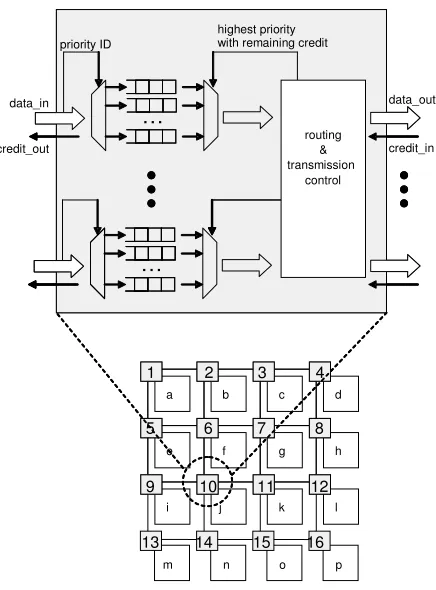
NoCs are a common architectural template for processors with dozens of cores, and it has the potential to scale with the increase of the core count up to hundreds or thousands. Figure 1 shows a simplified representation of a NoC architecture. It has 16 cores, each of them represented together with their own local cache as a white rectangle. Cores are directly connected to NoC switches (grey rectangles), which route data packets towards a destination (which may be another core, an interface to off-chip memory, a custom hardware accelerator, etc.).
[image:3.612.56.274.399.694.2]Many components of the NoC template can be parameterized to better meet design goals, such as the number and type of cores, buffering, routing and arbitration policies, among others. In this paper, our choice of a specific subset within such a large number of alternatives was based on three criteria: (i) adopt architectural features that are widely used in industry and academia, (ii) use on-chip resources efficiently, and (iii) privilege techniques that are amenable to the type of schedulability tests we are investigating.
Figure 1. NoC architecture with detail of the router structure
Following criterion (i), we concentrate on the widely used 2D mesh topology [5][6][7][8]. Criterion (ii) motivates the use of wormhole switching, as its buffer overhead is much smaller than store-and-forward (SAF) approaches, and its link allocation is more efficient than circuit switching approaches: there is no need to reserve the complete path of a packet, and NoC links are only allocated on the segments of the path where there is data ready to be transferred. Finally, criterion (iii) requires some level of predictability on resource sharing policies, so we limit our approach to NoCs with non-adaptive routing and priority arbitration such as QNoC [7] or Hermes [9]. The most common implementation of priority arbitration is based on virtual channels (VCs) [10], which allow packets with higher priority to preempt the transmission of low priority ones, making it easier to predict the outcome of network contention scenarios. Figure 1 shows a detailed view of a NoC switch with priority-arbitrated VCs: in each input port, a different FIFO buffer stores data words (flits) of packets arriving through different VCs (one for each priority level). The routing component assigns an output port for each incoming packet according to their destination. A credit-based approach [10] guarantees that data is only forwarded from a router
to the next when there’s enough buffer space to hold it at the right VC. At any time, a flit of a given packet will be sent through its respective output port if it has the highest priority among the packets being sent out through that port, and if it has credits (that is, buffer space on the respective buffer of the neighbouring node
connected to that output port). If the highest priority packet can’t
send data because it is blocked elsewhere in the network, the next highest priority packet can access the output link.
3.
SYSTEM MODEL AND NOTATION
In this paper, we investigate ways to determine whether application tasks executing and communicating over a specific NoC-based multicore can meet all application-specific timing constraints. Therefore, we need a system model that covers the application as well as the NoC-based platform and its configurations.
For the application model, we recall the sporadic task model and define an application as a taskset = {1, 2,…, n} where each task i is a 6-tuple {Ci, Ti, Di, Ji, Pi, i} indicating respectively its
worst case computation time, period (i.e. minimum inter-release time interval), deadline, release jitter and priority. The sixth element of the tuple is the only proposed addition to the sporadic
task model, and represents a communication message sent by i.
Our initial assumption is that each task produces a single message
i which is sent immediately after it finishes its computation. The
message is defined as a 3-tuple { d , Zi, Ki} representing its
destination task, size and maximum release jitter. A task-chain
= { 1, 2,…, x} is an ordered subset of where each task sends a
message to the subsequent task in X, and all of them have the same period Tx. We assume that all task-chains in a particular
application are disjoint subsets of , and that loops are not allowed (i.e. the sixth element of the tuple of the final task x of
every task-chain is the empty set ø).
The model of the NoC platform is composed of a set of processing cores = { a, b,…, z}, a set of switches = { 1, 2,…, m}, and a set of unidirectional links = { a1, 1a, 12, 21,…, zm, mz}.
Links can connect cores to switches, or switches with each other, allowing for all possible direct and indirect NoC topologies. For
example, the architecture shown in Fig. 1 has 16 cores a … p, each of them connected to one of the 16 switches 1 … 16 via two unidirectional links (e.g. a1 and 1a). The switches, in turn, are
priority ID
…
highest priority with remaining credit
data_in data_out
credit_in
…
routing & transmission
control
e f g h
i j k l a b c d priority ID
…
highest priority with remaining credit
…
routing & transmission
control
m n o p
1 2 3 4
5 6 7 8
9 10 11 12
13 14 15 16
connected to each neighbouring switch by two links (e.g. 21, 12, 23, 32, 26and 62are the links attached to switch 2).
NoCs forward packets from source to destination according to a routing algorithm. We define a function route( a, b) = { a1,
12,…, mb} denoting the subset of used to transfer packets from
core ato core b. A route will include links connecting the source
and destination cores to their respective switches, and all the links between switches along the way. The cardinality of a route is
defined as |route( a, b)| and will be informally referred as its hop
count. For the example in Fig. 1, route( e, g) = { e5, 56, 67, 7g}
and |route( e, g)| = 4 for most commonly used routing
algorithms.
Task mapping is a critical part of the design of multicore systems. It defines which application tasks should be mapped onto which processing core (i.e. on which core each task will execute). Many different approaches to task mapping have been proposed, taking into account the time when the mapping occurs, whether tasks can be remapped (or migrated) during execution, and which metrics should be considered when making a mapping decision. We therefore define a surjective function map( i) = a to denote the
core onto which a task is mapped. Its inverse is defined as map-1( a) = { i,…, n} and represents the tasks mapped to a given
core. Likewise, the mapping of a message map( i) =
route(map(i), map( d)) denotes the route of its packets over the
NoC, and the inverse map-1( ) = { i,…, n} represents the
messages mapped over a given link.
Once the mapping of all tasks of is defined, it is possible to
calculate the basic communication latency Li of every message i.
It represents the time taken by the message to be completely transferred from its source to its destination, assuming no contention over the NoC links (i.e. as if the message is the only
one using the NoC). The actual value of Li will depend on
implementation-specific characteristics of the NoC (e.g. link width, time required for a packet header to cross a router, and for a flit to cross a link). A common formulation is the following: Li = |map( i)| . lhop + (|map( i)| -1) . lrouter + (Zi / width). lhop,
where the first term represents the time it takes for the packet header to traverse all the NoC links, expressed as the product of the message hop count and the latency lhop for the header to
traverse a single link; the second term represents the time it takes for the packet header to traverse all NoC routers, and is expressed as the product of the number of routers along the path (which is usually the number of hops minus one in most direct networks) and the latency lrouter for the header to traverse a router; the third
term represents the time taken by the packet payload to follow the header in a wormhole fashion all the way to the destination, expressed by the message length Zi (in bits) divided by the link
width (which results in the number of payload flits), multiplied by the single link latency lhop.
4.
END-TO-END SCHEDULABILITY
TESTS FOR NOC-BASED MULTICORES
A schedulability test is able to discern system configurations that are schedulable, that is, able to meet their timing constraints even in the worst case scenario. In this paper, we assume that a system is schedulable iff all its task chains meet their end-to-end deadlines. To check this property, we first revisit a number of existing techniques that can be used as necessary schedulability tests.
4.1
Schedulability of tasks over a processing
core
A processor utilisation test can be used to check whether all tasks
mapped to a particular core a do not exceed its capacity:
This test is necessary but obviously not sufficient because even
though the core a may be capable to run all the tasks, it may not
be able to run all of them within their deadlines. Response Time Analysis (RTA) [1] is the standard technique to evaluate how much the interference from higher priority tasks can delay the
completion time of task i:
where the function hp( i) denotes the set of all tasks that can preempt i: those mapped to the same core and that have a higher
priority. Formally, hp(i) includes every task j where map(i)
= map(j) and Pi < Pj. With the help of Eq. 2, it is possible to
calculate the longest possible time interval between the release of
i and its termination. This is done by adding i‘s computation
time and the computation times of all releases of tasks j that
could preempt it. The result of that sum is referred as i’s worst
case response time and is represented by . As appears in both
sides of Eq. 2, an iterative solution was proposed in [1]. RTA has been widely used to test schedulability of uniprocessor and statically mapped multiprocessor systems with fixed priorities.
More advanced tests have been reviewed in [11], considering more advanced task models that support task migration (global scheduling), dynamic priorities and different constraints on deadlines. However, the tests described and referenced above do not explicitly consider inter-task communication. Instead, most assume that all communication latencies can be combined with the worst case computation time Ci of the respective tasks. For
uniprocessor systems with uniform memory access times, such assumption can be acceptable as the communication overhead can be predictable and usually small compared with the computation time. In NoC-based systems, however, the communication latency introduced by the NoC when tasks access memory or exchange messages depends heavily on the task mapping, the application communication patterns and resulting network congestion (which is particularly hard to predict in the case of wormhole switching NoCs). This leads to high variability in communication latencies, which can be of the same order of magnitude of the computational
time Ci of the tasks (or even higher). Therefore, we make a case to
explicitly consider communication times when analysing schedulability of NoC-based systems.
4.2
Schedulability of packets over a NoC and
end-to-end schedulability of communicating
tasks
To address the schedulability of packets transmitted over a NoC, we rely on the work proposed by Shi and Burns [2], which in turn builds on RTA. Their work assumes that packets are released into the NoC sporadically, i.e. a series of packets (referred in [2] as a traffic flow) has a minimum inter-release interval which is known at design time. The maximum size of each packet is also known a priori. On the platform side, the main assumption is that the NoC
routers perform deterministic routing, and that the link arbiters can preempt packets when higher-priority packets request the output link they are using. Such assumption is valid for the type of NoC architectures described in Section 2. The worst case latency of a packet transmitted over such a NoC can be found using Eq. 3, which has been rewritten from the original in [2] to follow the notation presented in Section 3. To simplify the notation, we assume that there is a one-to-one relationship between application messages and packets sent over the NoC, and therefore use the
same symbol for both.
The function interf( i) denotes the direct interference set of i,
which is the set of all packets that can preempt i, which are those
whose routes at have at least one NoC link in common with i‘s
route and that have higher priority. Formally, interf( i) includes
every packet j where map( i) map( j) and Pi < Pj. The
intuition behind Eq. 3 is similar to what was presented for Eq. 2.
The value of can be found by adding i‘s basic latency and
the latencies of all releases of packets j that could preempt it.
The same iterative solution proposed in [1] can be used here.
It is worth noticing that the release jitter of j can influence how
many times it can preempt i. In Eq. 3, we consider two types of
release jitter: which is caused by the execution of the task j
that releases j, and which is caused by indirect interference
(i.e. packets that can preempt j but cannot interfere on i because
they don’t share any links, see [2] for a detailed definition).[2][1]
Since the value of must be the maximum amount of time
elapsed between the start of j‘s period and its actual release, and
since we have defined that a packet is released immediately after its respective task has finished computation, we can clearly state
that = . Finally, from [2] we have that .
Thus, the worst case end-to-end response time of a task i is given
by , which composes its worst-case computation
response time and its worst case communication latency (Figure 2). Its end-to-end schedulability can be tested by checking
whether .
4.3
End-to-end schedulability of task chains
To test the schedulability of a task chain X, we need to consider
the individual end-to-end response times of all tasks .
Before we can do that, we must discriminate three modes of execution for task chains over multiple processing elements: sequential, parallel and pipelined.
In a sequential execution, a task chain will be executed completely, in one or more processors, before it can be executed
again. In other words, only a single task can be executing
at a given point in time.
[image:5.612.326.550.58.189.2]In a parallel execution over multiple processors, there are no constraints over the execution of task chains, and arbitrarily many jobs of a task chain can be executing at the same time.
Figure 2. End-to-end response time of a communicating task
A pipelined execution is a special kind of parallel execution which allows multiple jobs of the same task chain to be executed simultaneously over different processors, but disallows the simultaneous execution of more than one job of the same task. A common pattern for pipelined execution is to have a number of jobs of a task chain X running concurrently, each of them released
after Tx time units after the preceding one, in a phase-shifted way.
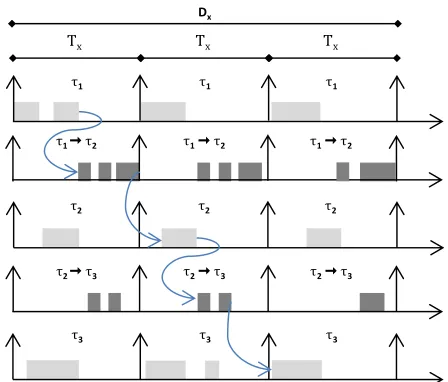
We refer to this pattern as a synchronous pipeline. Figure 3 shows an example of a task chain executing as a synchronous pipeline. It includes three tasks 1, 2 and 3 running on separate cores (each of
them represented on a separate timeline), their respective communications over NoC links (also shown over separate timelines), occasionally suffering interference from higher priority tasks and packets (not shown in the figure). Curved arrows show the functional dependencies between the computation and communication components of one chain, making it easier to see that those dependencies will always be satisfied as long as each task meets its end-to-end deadline constraint.
Figure 3. Example of a 3-task chain executed in a synchronous pipeline over 3 processors
In this paper, we concentrate on the synchronous pipeline case. We argue that it can be analysed by the end-to-end schedulability test described in subsection 4.2. Let us assume that the end-to-end deadline Dx of a synchronously pipelined task chain X, which is
the maximum tolerated amount of time elapsed between the release of its first task and the delivery of the output of its last task, is equal to the number x of tasks in the chain multiplied by the chain period Tx. In a synchronous pipeline, we can partition
2 2 2
3 3 3
1 1 1
Dx
x x x
1 2 1 2 1 2
2 3 2 3 2 3
period T
computation response time R
communication latency S
end-to-end response time EER
execution time C communication time L
computation interference
communication interference
[image:5.612.324.548.408.599.2]Dx equally among all tasks of the chain, so the end-to-end
deadline Di of each individual task is equal to Tx. This enables a
task chain X with x tasks to produce its output x periods after its release, but once the pipeline is filled each of its jobs will produce an output at every period.
The schedulability test for this particular case is a simple check of
whether . This assumes that there will be
acceptable deadline misses for the first x jobs of the task chain X while the pipeline is being filled, and guarantees that the system will never miss a deadline after that. The intuition behind this
approach is that each task of the chain will be triggered every Tx
time units, and has to finish computing and communicating with the next task of the chain before the end of the period, so that the following task will have all the data it needs before it can run at the next periodic tick.
4.4
Link utilisation tests
Similarly to Eq. 1, a utilisation test can be applied to each of the NoC links, aiming to check whether the messages mapped to each of them will not exceed their bandwidth:
Again, this test is necessary but not sufficient because even
though the link a1 may be capable to transmit all messages
mapped to it without starvation, they might not meet their deadlines.
By considering the multi-hop nature of NoCs, we identify another utilisation test that addresses the direct interference set interf( i)
of a message i:
The intuition behind this test is the following: if a message j can
interfere and hinder the progress of another message i over the
NoC, this happens regardless of the link where the contention happens. In other words, the complete route of a message can be seen as a single resource with exclusive access, and if a higher priority message needs to use any part of that route the whole
transmission of i will be halted. For example, if i is routed over
n different links and it suffers interference from j which also uses
one or more of those links and has a higher priority, the time i
waits for the shared link(s) will be the same if they share link 1,
2, …, n, or any combination of them, as in every case i will not
be able to progress in a pipelined fashion towards its destination. The same intuition can be extended to other higher priority
messages that share any possible combination of links with i.
Therefore, we conclude that the direct interference set interf( i)
determines all contenders for the route of a message i, and the
overall utilisation of that route has to be less than 1 due to the exclusive access.
The proof that this test is tighter than the test in Eq. 4 lies on the fact that the direct interference set interf( i) is a superset of each
of the sets including the messages that share any of the links i is
mapped to, and that can interfere with it: map( i),
hp(map-1( )) interf( i), where hp({ i… n }) denotes the subset
of messages that have higher priority than i. Actually, from the
definition given in Section 4.2 it is easy to see that the direct interference set is actually the union of all those sets:
. Thus, the utilisation
test given in Eq. 5 will cover, when applied to the lowest priority message of each link, the test given in Eq. 4.
In any case, both utilisation tests identified in this subsection are necessary, but not sufficient. While they are useful to discriminate unschedulable mappings, they cannot guarantee schedulability. They are nonetheless useful to prune large mapping spaces, as they are less computationally expensive than the tests described in subsections 4.2 and 4.3.
5.
EXPERIMENTAL WORK
To evaluate the correctness and usefulness of the schedulability tests described in the previous section, we devised two types of experiment. In subsection 5.1, we will compare the figures for computation and communication response times found using the proposed schedulability tests with figures obtained through simulation of predefined configurations of a NoC-enabled embedded system. In subsection 5.2, we will then show that the proposed tests can be used as a fitness function within a search-based optimisation heuristic.
5.1
Joint end-to-end schedulability analysis
and simulation
In this series of experiments, we analyse the schedulability of a benchmark application over a specific NoC-based embedded platform.
The platform follows the architecture described in Section 2, with homogeneous cores running priority-preemptive task schedulers, distributed memory, 2D-mesh NoC interconnect with XY dimension routing, credit-based flow control, 8 virtual channels with 3-flit input buffers per port and priority-preemptive link arbitration. It is worth noticing that the schedulability tests proposed in Section 4 would support alternatives on most of those architectural choices, but priority-preemptive arbitration at the cores and NoC links is a requirement.
The chosen benchmark application is based on the autonomous vehicle (AV) introduced in [12], including 39 communicating tasks performing functionality such as navigation control, vibration control and obstacle detection through stereo photogrammetry. Task periods vary between 0.04 to 1 second, and communication volumes vary between 1 and 76 kbytes.
To model the benchmark as task chains, a number of tasks of the original application had to be partitioned (i.e. to break tree-like structures when a task receives data from multiple sources).
Furthermore, we had to introduce the notion of “sink tasks” to
model DMA transfers to the local memory of the core where specific tasks are mapped to. In those cases, the destination task does not require any computation overhead (e.g. last task of a chain writes to a memory-mapped actuator, so it does not load the destination core, but used the bandwidth of the NoC links all the way to the destination interface).
To maintain the realism of the benchmark, we constrained all mappings used in the paper in such a way that all partitions of a task, as well as its respective sink, are mapped to the same core (so that only possible mappings of the application were considered). Table I shows the complete set of tasks, showing which chain they belong to (chains have lengths between 2 and 5 tasks), their names (first four letters indicate the original task name from [12], with an appendix if the task is a partition or a sink of one of the original tasks), destination task, computation
(4)
time (in milliseconds), period (in milliseconds), priority, and communication volume (in bytes).
Table I – Autonomous Vehicle benchmark
task chain name dest task
comp (ms)
period (ms)
pri comm (bytes)
1 A POSI-A 2 5 500 31 2048
2 A NAVC-A 3 10 500 32 4096
3 A OBDB-A 42 150 500 33 32768
4 B OBDB-B 33 150 1000 34 65536
5 C NAVC-C 40 20 100 24 1024
6 C SPES-C 5 5 100 25 1024
7 D NAVC-D 40 10 100 26 2048
8 E FBU3-E 47 10 40 1 76800
9 F FBU8-F 48 10 40 2 76800
10 G VOD1 42 20 500 3 1024
11 H VOD2 42 20 500 4 1024
12 I FBU1 20 10 40 5 76800
13 J FBU2 21 10 40 6 76800
14 K FBU3 22 10 40 7 76800
15 L FBU4 23 10 40 8 76800
16 M FBU5 24 10 40 9 76800
17 N FBU6 25 10 40 10 76800
18 O FBU7 26 10 40 11 76800
19 P FBU8 27 10 40 12 76800
20 I BFE1 28 20 40 13 4096
21 J BFE2 43 20 40 14 4096
22 K BFE3 43 20 40 15 4096
23 L BFE4 43 20 40 16 4096
24 M BFE5 29 20 40 17 4096
25 N BFE6 44 20 40 18 4096
26 O BFE7 44 20 40 19 4096
27 P BFE8 44 20 40 20 4096
28 I FDF1 30 10 40 21 16384
29 M FDF2 51 10 40 22 16384
30 I STPH 43 30 40 23 8192
31 Q POSI-Q 43 5 500 35 2048
32 R USOS 43 5 100 27 2048
33 B OBMG-B 41 20 1000 37 8192
34 S TPMS 36 5 500 36 4096
35 T VIBS 38 5 100 28 1024
36 S STAC-S 46 10 1000 38 4096
37 U SPES-U 45 5 100 29 2048
38 T STAC-T 44 10 100 30 2048
39 V OBMG-V 41 0.5 1000 39 4096
40 sink DIRC-X - - - - -
41 sink OBDB-X - - - - -
42 sink NAVC-X - - - - -
43 sink OBMG-X - - - - -
44 sink THRC-X - - - - -
45 sink STAC-X - - - - -
46 sink TPMS-X - - - - -
47 sink VOD1-X - - - - -
48 sink VOD2-X - - - - -
49 sink FDF1-X - - - - -
50 sink FDF2-X - - - - -
51 sink STPH-X - - - - -
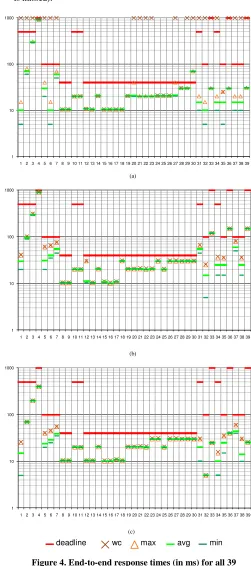
We selected one platform configuration (a 4x4 mesh) and three different task allocations, and applied equations 2 and 3 to find the worst-case end-to-end response time of each of the 39 communicating tasks under each mapping. Figures 4.a, 4.b and 4.c show the results for mappings M1, M2 and M3 respectively.
The worst-case end-to-end response time of each task is plotted with a brown cross, and their individual deadline is shown as a red horizontal line. Mappings M2 and M3 are fully schedulable, as all EER values are below the respective deadlines. M1, however, has a number of unschedulable tasks, denoted by the brown crosses plotted at the upper margin of Figure 4.a (the actual worst case
response times in those cases were not found, as our implementation stops iterating towards a solution once a deadline is missed).
(a)
(b)
(c)
Figure 4. End-to-end response times (in ms) for all 39 communicating tasks under alternative mappings: (a) M1, (b)
M2 and (c) M3.
We then used the tool flow presented in [13] and the simulation models presented in [14] to obtain latency figures for the execution of the benchmark application over the platform under all three mappings. We simulated each scenario for a target time
1 10 100 1000
1 2 3 4 5 6 7 8 9 10 11 12 13 14 15 16 17 18 19 20 21 22 23 24 25 26 27 28 29 30 31 32 33 34 35 36 37 38 39
1 10 100 1000
1 2 3 4 5 6 7 8 9 10 11 12 13 14 15 16 17 18 19 20 21 22 23 24 25 26 27 28 29 30 31 32 33 34 35 36 37 38 39
1 10 100 1000
1 2 3 4 5 6 7 8 9 10 11 12 13 14 15 16 17 18 19 20 21 22 23 24 25 26 27 28 29 30 31 32 33 34 35 36 37 38 39
[image:7.612.51.295.110.588.2]of 200 seconds, which allows for a good coverage of the application lifetime (the shortest period is of the video processing tasks, that must execute every 0.04 seconds to achieve 25 VGA frames per second, and the longest period is of 1 second for the tyre pressure control task). Figure 4 also shows, for each mapping, the best, worst and average end-to-end latency observed during simulation for each of the 39 communicating tasks. The plots show that the worst case response times found by our schedulability tests are effectively an upper bound to all results found with simulation. They also show that while M2 and M3 are fully schedulable mappings, M2 has higher worst case and maximum observed latencies (specially in communications 4, 7 and 37). Taking that into account, mapping M3 would be preferable as its results allow for larger safety margins.
5.2
Using end-to-end schedulability tests as
fitness within search-based optimisation
As shown in Figure 4, the end-to-end timeliness of applications is affected by the way tasks and flows are mapped onto the NoC platform. Finding optimal mappings, or even acceptable ones, is a challenge in most NoC systems, and a significant amount of research was dedicated to this topic [15]. Heuristic search-based mapping is one of the mapping techniques reviewed by [15], and its distinctive feature is a fitness function to evaluate solutions over a given search space, aiming to converge towards solutions with increasing fitness. A common practice in such cases is to simulate the NoC platform with a given mapping for a specific amount of time, and use some aggregate of the latencies of all packets obtained through the simulation as the fitness of that mapping [16]. This process is then repeated for many different mappings across the search space until a mapping is found that fulfils the requirements (e.g. average latency of all packets below a given threshold).
In this subsection, we show that the schedulability tests described in Section 4 can be used to solve two problems found in search-based mappers with simulators as fitness function, specifically when it comes to optimise hard real-time systems. As discussed in Section 1, simulators cannot easily find worst-case packet latencies, and the time they take to run can be very high when evaluating complex NoCs. In search-based mappers, the second problem is particularly severe, because the search heuristic may have to simulate hundreds or thousands of different mapping before an acceptable solution can be found.
To solve those problems, we have implemented a search-based algorithm that uses the approach described in subsection 4.3 to find whether, given a particular mapping, how many of an
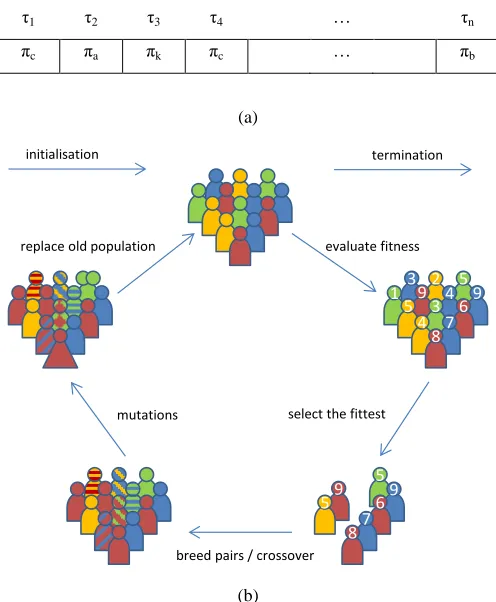
application’s tasks are end-to-end schedulable. Like in [16], our search-based heuristic follows an evolutionary approach, modelling a particular mapping as a chromosome representing on each gene the processing core where each task should be mapped (Figure 5.a). The evolution is performed across generations of a population of 100 individuals, each represented by one of such chromosomes. The initial population can be randomly generated, but subsequent generations are produced by applying crossover and mutation operations over the fittest chromosomes of the preceding one (Figure 5.b). In our implementation, crossovers were implemented by creating a new chromosome from the first and second halves of two existing chromosomes. Similarly, mutations created new chromosomes by swapping the contents of any two genes of an existing chromosome. The chosen chromosomes for crossover and mutation were those that, when
evaluated using the technique described in 4.3, would have the lowest number of unschedulable tasks.
Ideally, after a number of generations the population will contain at least one individual with a chromosome representing a mapping that meets our constraints, i.e. has zero tasks that are end-to-end unschedulable. A detailed study on how different chromosome formats, population sizes, mutation and crossover styles and rates affect the convergence of the genetic algorithm towards a full schedulable solution can be found in [17].
1 2 3 4 … n
c a k c … b
(a)
[image:8.612.314.562.156.457.2](b)
Figure 5. Evolutionary mapping: (a) chromosome format and (b) evolutionary search process.
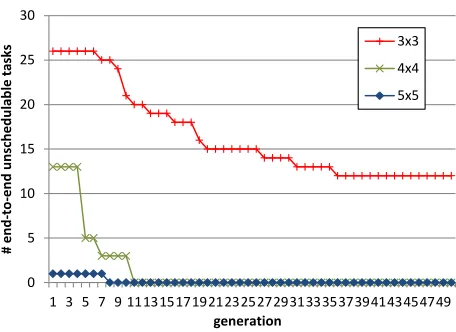
We have used this evolutionary mapping algorithm to search for schedulable mappings of the AV application over 3x3, 4x4 and 5x5 mesh NoC platforms. Figure 6 shows the number of end-to-end unschedulable tasks of the best mapping of each generation. It can be seen that mappings for the 5x5 platform can be found very easily (as there are more resources and therefore less interference), reaching a fully schedulable mapping in 8 generations. For the 4x4 platform, the situation is slightly more difficult, but the evolutionary mapper is capable to find a fully schedulable mapping in 11 generations. Finally, for a 3x3 platform, the evolutionary mapping cannot find a fully schedulable mapping after 50 generations (because the utilization of the application exceeds the available capacity of the 3x3 platform), but it can clearly show improvements over generations, reaching a minimum of 12 end-to-end unschedulable tasks.
5 3 2
9 4
1 9
5 3 6 4 7
8
5
9 9
5 6
7 8
initialisation termination
evaluate fitness
select the fittest
breed pairs / crossover mutations
Figure 6. Number of end-to-end unschedulable tasks at each generation of the evolutionary mapping, for three different
NoC platforms: 3x3, 4x4 and 5x5.
5.2.1
Performance comparison
The performance of the proposed schedulability test, when used as a fitness function of a search-based heuristic, shows a significant improvement over simulation-based fitness functions such as those used by [16]. A simple Java-based implementation of the proposed test takes 0.13 seconds to evaluate the schedulability of a single mapping of the AV application over a 4x4 NoC. This is at least one order of magnitude faster than simulation, as reported in [14], and consistently reinforced by our experiments reported in subsection 5.1. The time it takes to simulate 2 seconds of a single mapping of the AV application is 7.89 seconds, for a fast simulator operating at TLM (Transaction Level Modelling) level. For a cycle-accurate simulation of the same scenario, the time elapsed is 2895.69 seconds.
Such numbers show that even if it would be feasible to identify the worst-case release scenario for all tasks and packets, a state-of-the-art NoC simulator would take 60 times longer (or up to 20000 times longer, if full accuracy must be achieved) to evaluate the fitness of one specific mapping. Recalling that in a typical search-based mapping heuristic one must check the fitness of thousands of mappings, we can clearly see the advantage of the proposed approach (e.g. in the experiments described above we needed 1100 application of the fitness function to find a fully schedulable mapping for a 4x4 platform, i.e. 11 generations of a population of 100 individuals).
6.
RELATED WORK
Besides RTA and its derivatives, other analytical models have also been used to evaluate schedulability in NoCs.
Beekooij et al. [18] have proposed an extension to dataflow analysis (originally proposed by Lee and Messerschmitt [19]) that can model the behaviour of a homogeneous synchronous dataflow (HSDF) application performing computation and communication over a specific type of NoC (i.e. statically scheduled time-division multiplexing of links). They assume that the worst-case computation time of each application task is known (just like in this paper, as referred as Ci in Section 3). However, due to the
nature of their underlying NoC architecture, they can assume that there is no contention over NoC links, and thus the delay
introduced by the NoC to each data transfer can be established independently for each task chain. Therefore, the worst case end-to-end latency of a task-chain can be found by dataflow analysis, which can calculate the latest arrival time of the data token at the output of the last task of the chain.
Qian et al. [20] proposed the use of network calculus [21] to calculate worst-case packet latency bounds in wormhole NoCs, as long as all traffic can be modelled as an arrival curve and all NoC routers can be modelled by a service curve. Such curves abstract the actual behaviour of the application and the NoC by the bandwidth required or provided, respectively, at each point in time. The calculation of latency bounds is done through algebraic operations over all arrival curves at a given router, as well as the
router’s service curve. The main challenge of this approach is to
represent the behaviour of a sequence of specific routers (with their particular buffering and arbitration schemes) as a service curve. The modelling of the application traffic as arrival curves is
also challenging, specially if the variations on the source task’s
execution are taken into account (e.g. execution time variability or interference from tasks running on the same core), and this is currently an open problem preventing the use of network calculus on the evaluation of NoC end-to-end schedulability.
Other approaches to evaluate NoC schedulability are surveyed by in [22], all of them based on dataflow analysis, network calculus or RTA. The survey also states the difficulty to compare different analytical methods based on distinct formalisms, as they have fundamentally different assumptions. Still, they provide a summary of strengths and weaknesses of each type of analysis. Their assessment of dataflow and network calculus models has similar views as the ones we provided above, emphasizing the restrictions that must be imposed on the application behaviour and the NoC resource sharing disciplines. Their assessment of RTA and its derivatives, however, states that the main weakness is the inability to represent dependencies between flows, which is an issue that we have directly addressed in this paper and solved for the restricted case of synchronous pipelines.
7.
CONCLUSIONS AND FUTURE WORK
In this paper, we investigated ways to determine whether application tasks executing and communicating over a specific NoC-based multicore can meet all application-specific timing constraints. We have identified a number of schedulability tests, and have shown their utility within distinct steps of an embedded system design flow. By combining them with simulation, designers can obtain a more detailed understanding of the overheads that are needed to guarantee performance in the worst case, as opposed to the average case. And by using them as fitness in search-based optimisation, we enabled a faster coverage of the typically large design spaces given by the multiple design alternatives in this kind of system.
For the sake of simplicity, we assumed an application model where tasks require all data to be available locally before they execute, and can send a single message only after they finish their computation. While restrictive, this model supports the widely used Actor model (i.e. read-execute-write) and can represent applications based on task chains. A more general formulation that allows tasks to send an arbitrary number of messages can be easily derived, but was left to future work, and would enable the representation of and tree-like structures. Even in the case of simple task chains, we have only addressed the restricted case of
0 5 10 15 20 25 30
1 3 5 7 9 1113151719212325272931333537394143454749
#
e
n
d
-t
o
-e
n
d
u
n
sc
h
e
d
u
la
b
le
t
a
sks
generation
synchronous pipelines. Extensions to the presented tests to address general pipeline and sequential execution are currently under investigation, and so is the use of deadline decomposition approaches (such as in [23] and [24]) and schedulability tests supporting release offsets (such as [25]).
Additional future work can take advantage of the utilisation tests presented in subsections 4.1 and 4.4 to accelerate the design space exploration by quickly pruning away mappings with over-utilised cores or links. Such approach could improve even further the performance reported in subsection 5.2.1, where the substantially heavier schedulability test presented in subsection 4.3 was used throughout the whole optimisation.
Finally, the proposed platform model assumes homogeneous cores, switches and links. Interesting avenues of research can also be opened by lifting such restrictions.
8.
ACKNOWLEDGEMENTS
The author would like to thank Zheng Shi, Alan Burns, Osmar Marchi dos Santos and Borislav Nikolic for the discussions on the tests presented in Section 4; and Paris Mesidis, Adrian Racu and Norazizi Sayuti for the discussions and help with the experimental work supporting subsection 5.2.
9.
REFERENCES
[1] N. Audsley, A. Burns, M. Richardson, K. Tindell, and A. J.
Wellings, “Applying new scheduling theory to static priority pre
-emptive scheduling,” Software Engineering Journal, vol. 8, no. 5, pp. 284–292, 1993.
[2] Z. Shi and A. Burns, “Real-Time Communication Analysis for
On-Chip Networks with Wormhole Switching,” in ACM/IEEE Int Symposium on Networks-on-Chip (NOCS), 2008, pp. 161–170. [3] Z. Shi and A. Burns, “Schedulability analysis and task mapping for
real-time on-chip communication,” Real-Time Syst, vol. 46, no. 3, pp. 360–385, Sep. 2010.
[4] N. Genko, D. Atienza, G. De Micheli, L. Benini, J. M. Mendias, R.
Hermida, and F. Catthoor, “A novel approach for network on chip emulation,” in IEEE Int Symposium on Circuits and Systems (ISCAS), 2005, pp. 2365–2368 vol. 3.
[5] F. Moraes, N. Calazans, A. Mello, L. Möller, and L. Ost,
“HERMES: an infrastructure for low area overhead packet
-switching networks on chip,” Integration, the VLSI Journal, vol. 38, no. 1, pp. 69–93, Oct. 2004.
[6] A. Agarwal, “The Tile Processor: A 64-Core Multicore for
Embedded Processing,” in 11th Annual Workshop on High Performance Embedded Computing (HPEC), Lexington, Massachusetts, USA, 2007.
[7] E. Bolotin, I. Cidon, R. Ginosar, and A. Kolodny, “QNoC: QoS
architecture and design process for network on chip,” Journal of Systems Architecture, vol. 50, no. 2–3, pp. 105–128, Feb. 2004. [8] D. Wiklund and Dake Liu, “SoCBUS: switched network on chip for
hard real time embedded systems,” in Int Parallel and Distributed Processing Symposium (IPDPS), 2003.
[9] A. Mello, L. Tedesco, N. Calazans, and F. Moraes, “Virtual channels in networks on chip: implementation and evaluation on
hermes NoC,” in 18th Annual Symposium on Integrated Circuits and Systems Design (SBCCI), Florianopolis, Brazil, 2005, pp. 178–183. [10] T. Bjerregaard and J. Sparso, “Virtual channel designs for
guaranteeing bandwidth in asynchronous network-on-chip,” in Norchip Conference, 2004, pp. 269–272.
[11] R. I. Davis and A. Burns, “A survey of hard real-time scheduling for
multiprocessor systems,” ACM Comput. Surv., vol. 43, no. 4, pp. 35:1–35:44, Oct. 2011.
[12] Z. Shi, A. Burns, and L. S. Indrusiak, “Schedulability Analysis for Real Time On-Chip Communication with Wormhole Switching,” IJERTCS, vol. 1, no. 2, pp. 1 – 22, Jun. 2010.
[13] L. S. Indrusiak, I. Quadri, I. Gray, N. Audsley, and A. Sadovykh, “A MARTE subset to enable application-platform co-simulation and schedulability analysis of NoC-based embedded systems,” in 2012 7th International Workshop on Reconfigurable Communication-centric Systems-on-Chip (ReCoSoC), 2012, pp. 1–7.
[14] L. S. Indrusiak and O. M. dos Santos, “Fast and Accurate Transaction-Level Model of a Wormhole Network-on-Chip with Priority Preemptive Virtual Channel Arbitration,” in Proc Design Automation and Test in Europe (DATE), Grenoble, France, 2011, pp. 1089–1094.
[15] P. K. Sahu and S. Chattopadhyay, “A survey on application mapping strategies for Network-on-Chip design,” Journal of Systems Architecture, vol. 59, no. 1, pp. 60–76, Jan. 2013.
[16] G. Ascia, V. Catania, and M. Palesi, “A Multi-objective Genetic Approach to Mapping Problem on Network-on-Chip,” Journal of Universal Computer Science, vol. 12, no. 4, pp. 370–394, 2006. [17] A. Racu and L. S. Indrusiak, “Using genetic algorithms to map hard
real-time on NoC-based systems,” in 2012 7th International Workshop on Reconfigurable Communication-centric Systems-on-Chip (ReCoSoC), 2012, pp. 1–8.
[18] M. Bekooij, R. Hoes, O. Moreira, P. Poplavko, M. Pastrnak, B. Mesman, J. Mol, S. Stuijk, V. Gheorghita, and J. Meerbergen,
“Dataflow Analysis for Real-Time Embedded Multiprocessor
System Design,” in Dynamic and Robust Streaming in and between Connected Consumer-Electronic Devices, 2005, pp. 81–108. [19] E. A. Lee and D. G. Messerschmitt, “Synchronous data flow,”
Proceedings of the IEEE, vol. 75, no. 9, pp. 1235–1245, 1987. [20] Y. Qian, Z. Lu, and W. Dou, “Analysis of worst-case delay bounds
for best-effort communication in wormhole networks on chip,” in 3rd ACM/IEEE International Symposium on Networks-on-Chip, 2009. NoCS 2009, 2009, pp. 44–53.
[21] J.-Y. Le Boudec and P. Thiran, Network Calculus: A Theory of Deterministic Queuing Systems for the Internet. Berlin, Heidelberg: Springer-Verlag, 2001.
[22] A. E. Kiasari, A. Jantsch, and Z. Lu, “Mathematical Formalisms for Performance Evaluation of Networks-on-chip,” ACM Comput. Surv., vol. 45, no. 3, pp. 38:1–38:41, Jul. 2013.
[23] T. F. Abdelzaher and K. G. Shin, “Combined task and message scheduling in distributed real-time systems,” IEEE Transactions on Parallel and Distributed Systems, vol. 10, no. 11, pp. 1179–1191, 1999.
[24] M. Saksena and S. Hong, “An engineering approach to decomposing end-to-end delays on a distributed real-time system,” in 4th Int Workshop on Parallel and Distributed Real-Time Systems, 1996, pp. 244–251.
[25] I. Bate and A. Burns, “Schedulability analysis of fixed priority real