Strathprints Institutional Repository
Kougioumtzoglou, Maria A. and Lazakis, Iraklis (2015) Developing a risk
analysis and decision making strategy for an offshore wind farm. In: 5th
International Symposium on Ship Operations, Management and
Economics (SOME), 2015-05-28 - 2015-05-29. ,
This version is available at http://strathprints.strath.ac.uk/53927/
Strathprints is designed to allow users to access the research output of the University of Strathclyde. Unless otherwise explicitly stated on the manuscript, Copyright © and Moral Rights for the papers on this site are retained by the individual authors and/or other copyright owners. Please check the manuscript for details of any other licences that may have been applied. You may not engage in further distribution of the material for any profitmaking activities or any commercial gain. You may freely distribute both the url (http://strathprints.strath.ac.uk/) and the content of this paper for research or private study, educational, or not-for-profit purposes without prior permission or charge.
Any correspondence concerning this service should be sent to Strathprints administrator: [email protected]
Developing a Risk Analysis and Decision Making Strategy for an
Offshore Wind Farm
Maria A. Kougioumtzoglou
(1), Iraklis Lazakis
(2)1) Cyprus Sea Lines Co Ltd., Greece, [email protected]
2) Department of Naval Architecture, Ocean and Marine Engineering, University of Strathclyde, Scotland,
Abstract
The renewables sector and particularly offshore wind energy is a fast developing industry over the last few years. Especially activities related to the Installation, Operation and Maintenance (O&M) of offshore wind turbines becomes a challenging task with inherent risks. This paper assesses the risks related to the above stages of a wind farm lifecycle using the FMECA (Failure Mode, Effects and Criticality Analysis) and HAZID (Hazard Identification) methods. The full-scale offshore installation and O&M tasks are considered together with the wind turbine main components. An integrated risk analysis methodology is presented addressing personnel Safety (S), Environmental impact (E), Asset integrity (A) and Operation (O). The above is supplemented by a cost analysis with the aid of BBN (Bayesian Belief Networks) method in order to assist the decision making process related to installation and O&M tasks. All major risks and critical wind turbine components are identified as well as measures are suggested in order to prevent or mitigate them. Moreover, a thorough inspection and maintenance plan can be elaborated for the mentioned activities.
Keywords: Risk analysis (O&M); Offshore wind
farm; FMECA; HAZID; BBN
1. Introduction
Wind power is known to humans since ancient times. It is a form of energy that not only has no time or place restrictions but it also contributes in reducing greenhouse gases emission and busting the economy of countries that depend on oil and gas imports for the energy coverage (Ftenakis, Kim 2009). These characteristics makes it appealing to industry that tries to exploit it by developing more and more onshore or offshore wind farms (Windustry 2014).
The rapidly expanding number of wind farms makes quantifying and managing the different elements of risk that are present in each of the instalment, operation and maintenance stages of a wind turbine necessary. In this respect, risk analysis and decision making can be a key that will enable fast growth, investments, further technological development and reasonable cost of energy.
This paper presents the study regarding the investigation and assessment of the risk and reliability features of offshore wind turbines at different stages of its lifetime and identification of the critical components in terms of
their operation in order to increase their availability and operability characteristics. A thorough review and examination of the past and current risk analysis methods in the offshore renewables and oil and gas sectors is carried out in section 2. The description of wind turbine with its components is explained and demonstrated in section 3, as well as the overall risk analysis methodology, including the HAZID and FMECA approaches, which are complemented with risk matrices for various consequence categories. Also, the cost benefit analysis with BBNs is presented in the same section. Section 4 presents the results of the analyses including the potential high-risk areas and the most costly components. The discussion, conclusions and future actions to be followed on the current study are finally shown in section 5.
2. Literature Review
The subject of risk analysis, risk assessment and overall risk management is a widely explored field with various studies contributing to its thorough examination. Effective risk mitigation is desirable by all individuals and companies, and risk management is or should be applied to all stages of a project lifetime. Especially in the maritime and offshore industry the aim is to reduce the risks from major hazards that could jeopardize the integrity of the offshore structure and the health and safety of the workforce and ensure the protection of the environment (Lazakis et al 2012). The correct identification of the hazards and their consequences is a key issue in providing information to aid decision making and increase the level of a project success. Thus there are many tools, processes, techniques and methodologies developed nowadays to cover this need. Indicatively mentioned are the following; Australian Standards/New Zealand Standards: 4360 (AS/NZS: 4360, 2004), Association for Project Management (2004), Project Risk Analysis & Management (PRAM), Project Management Institute (2008), ISO/ IEC 31010 (2009) standards.
More specifically for offshore wind farms, the UK Health and Safety Executive (HSE) introduced the Safety Case approach in 1992 (HSE 2006), in which guidelines are given on what operators of each offshore installation need to do in order to “reduce the risks from major accident hazards to the health and safety of the workforce employed on offshore installations or in connected activities”. After that, many standards and codes have been established the last years as guidelines for this purpose. Although they refer mainly to the oil
industry, they can be also applied on wind industry. The most important standards are mentioned in BS/ISO standard 17776 (2002), HSE (2006), Det Norske Veritas (DNV 2001, 2003), International Maritime Organiastion (IMO, 2007), American Bureau of Shipping (ABS, 2003), Offshore Reliability Database handbook (OREDA 2002) and Norsok (2013).
Apart from standards there are various software tools for risk analysis valuable for the industry based on a quantitative approach of risk assessment. These are the RBM (Risk Based Management) II released from the Dutch Government, PHAST and Synergi Life Risk Management from DNVGL, SHEPHERD a software property of Shell Global Solutions, RISKCURVES that is an integrated Quantitative Risk Assessment (QRA) software from TNO, EFFECTS that is a consequence analysis and damage calculation software from the Dutch research organization TNO, HAMSAGARS which is another QRA software from HAMS-GPS, a quantitative risk analysis training software called RISKANamong others (Lewis, 2005).
The most known techniques of hazard identification are Expert Judgment, Codes and Standards, Check Lists and the structured techniques HAZID (Hazard Identification), PHA (Process Hazard Analysis), What-IF Method, FTA (Fault Tree Analysis), ETA (Event Tree Analysis), FMEA/FMECA (Failure Mode, Effects and Criticality Analysis), HAZOP (Hazard and Operability), Monte Carlo Simulation and Risk Ranking Matrix (Shafiee, Dinmohammadi 2014). All of them can be applied in our area of interest; offshore installations and more specifically offshore wind farms, with FMECA and HAZID, the two methods that are used in this study, being two of the most popular.
After all the necessary information about possible risks is gathered, risk evaluation is executed. The most well-known method of risk evaluation is ALARP (As Low As Reasonably Practical). The idea in this method is that the risk should be minimized to a point where it is acceptable but without expending grossly disproportionate cost, time and effort (Melchers 2001). Regarding decision making, in the frame of risk mitigation and ALARP, one of the strongest tools that decision makers have to front the problems raised is Bayesian Belief Networks (BBNs) a tool for modeling under uncertainty by using conditional probabilistic calculations and graphical representation of the logical relationships between variables.
All the above show in the most explicit way the development carried out in the offshore renewable field in the last few years as well as the promising outcomes to be generated in the near future. With all this in mind, the section that follows next presents the risk analysis methodology suggested for implementation on a wind farm.
3. Methodology
In this section of the paper, the suggested risk analysis methodology is presented. The first step is to
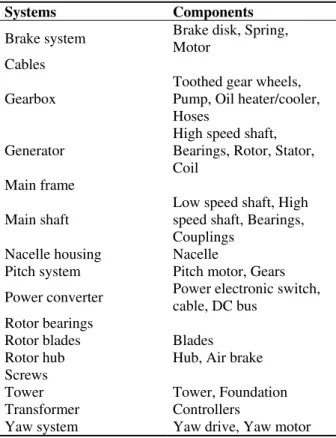
decompose a wind turbine and identify its main components as well as the activity areas that we are interested in. The next stage is the determination of the acceptance criteria, so that the results of the risk analysis are compared with some predefined standards. After this stage, the risk analysis’ main part takes place. At first hazard identification and hazard assessment is done. Then the risk management is conducted, where the potential hazards have to be eliminated or prevented from occurring, and the effects have to be mitigated. These actions can be done by adopting the proper pro-active measures which will be later assessed regarding their cost-benefit value on whether they will be applied or not. This decision is then used as a feedback to the risk analysis in order to improve the procedure. More specifically, after the first step a set of sixteen sub-assemblies and main parts was extracted (Table 1). Later on, the activity areas that we are interested in are identified and more specifically installation, operation and maintenance of an offshore wind turbine. Keeping these in mind we can now proceed with the risk identification using FMECA and HAZID methods. With the FMECA we identified the most critical components of a wind turbine since this method reviews the ways in which a system can fail and then the consequences of these failures.
Table 1: Components of a wind turbine
Systems Components
Brake system Brake disk, Spring, Motor
Cables
Gearbox
Toothed gear wheels, Pump, Oil heater/cooler, Hoses
Generator
High speed shaft, Bearings, Rotor, Stator, Coil
Main frame
Main shaft
Low speed shaft, High speed shaft, Bearings, Couplings
Nacelle housing Nacelle
Pitch system Pitch motor, Gears Power converter Power electronic switch,
cable, DC bus Rotor bearings
Rotor blades Blades Rotor hub Hub, Air brake Screws
Tower Tower, Foundation
Transformer Controllers Yaw system Yaw drive, Yaw motor
A consequence as well as a probability Table is developed showing the various levels of consequence, probability and detection rankings accordingly. For the consequence table we will evaluate the hazards and rank them into five categories that in our case, for computational reasons, will be represented from numbers 1 to 5 representing: 1 (minor), 2 (marginal), 3
(major), 4 (critical) and 5 (catastrophic). It can be assumed here that one major injury is equal to 10 minor injuries while one fatality is equal to 10 major injuries. As far as the probability ranking is concerned, this is divided into five categories as explained in the previous chapter: 1 (extremely unlikely), 2 (remote), 3 (occasional), 4 (probable) and 5 (very frequent). Also, the detection index that shows how likely is for the design system to identify any possible hazards is divided into five categories: 1 (almost impossible), 2 (low), 3 (moderate), 4 (high), 5 (almost certain). The Risk Priority Number (RPN) can also be calculated as a product of the probability index, the detection index and the severity index. In this way we can create risk levels out of the possible outcomes that vary from low to high and are illustrated with a range of different colors as in Table 2.
Table 2: Risk index table Risk index table
Low (negligible risk)
Moderate (tolerable risk)
Significant (tolerable, specific measures in place)
High (intolerable risk)
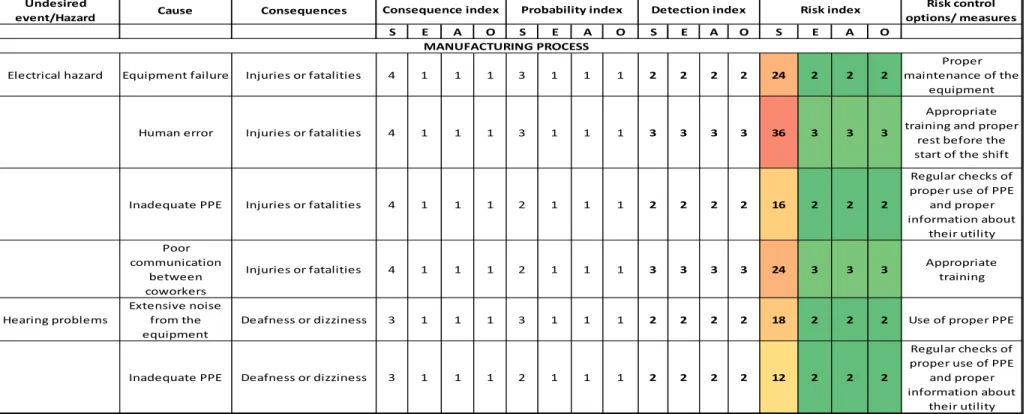
The consequence, probability, detection and consecutively risk and RPN index are examined in terms of Personnel safety (S), Environmental protection (E), Asset integrity (A) and Device operation (O). Finally a risk matrix is formed as shown in Table 4 where the potential risks and failure modes of the sub-assemblies are identified. The HAZID method is used to identify the potential hazards during manufacture, transportation, installation, operation and maintenance. These hazards can be directly related to the turbines, such as lifting operations and occupational dangers, or indirectly, for example bad weather or fire.We repeat the same procedure for the HAZID method with the difference that a Risk Index instead of the RPN Index is now calculated. The form of the matrix is used shown in Table 5.
For a complete representation of all the potential risks involved in these activities, the direct as well as the indirect hazards are analyzed. Direct hazards involve the ones directly related to the wind turbine such as lifting operations, occupational and health hazards, operation of ROVs (Remotely Operated Vehicles) etc. Indirect hazards involve the ones related to the overall installation activity including the installation vessel and its crew (e.g. fire on board the vessel, hot weather, etc.). After the identification and assessment of the potential hazards, the risk management stage takes place. In this case, the higher ranked risks are dealt with in terms of designing-out the potential hazards in the initial stages of the wind turbine, preventing the hazards from occurring, mitigating the effects of the hazards in case
they occur or finally be pro-active for emergency response actions. Finally, a cost benefit analysis of the repair costs based on the output of the risk assessment will be carried out. This will be done using Bayesian Belief Networks with the aid of HUGIN software.
4. Results
In this section of the present paper, the results of the FMECA, HAZID and BBN analysis are shown. It is important to mention that for the presentation of the highest-ranked critical components and hazards that originated from the FMECA and HAZID analysis, not only those with the highest RPN or Risk Index are mentioned but also those with lower indices but severe consequences like multiple injuries, fatalities or collapse of the systems.
4.1 FMECA Results
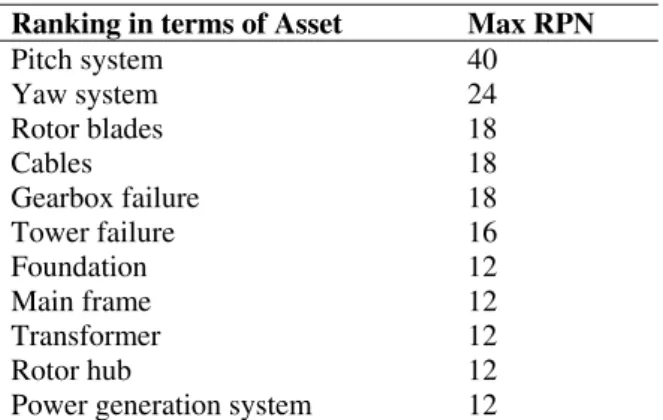
After ranking the components in terms of Safety, Asset, Environment and Operation, based on their RPN, as shown for example in Table 5, we can summarize the results in one total ranking of components as well as their RPN Index:
Table 3: FMECA analysis-Ranking of components in terms of Asset
Ranking in terms of Asset Max RPN
Pitch system 40 Yaw system 24 Rotor blades 18 Cables 18 Gearbox failure 18 Tower failure 16 Foundation 12 Main frame 12 Transformer 12 Rotor hub 12
Power generation system 12
The basic results obtained from the analysis performed are as follows:
The most sensitive component of the wind turbine in terms of Safety is Tower as the consequences of a potential collapse would be catastrophic in case of fatalities. Furthermore, the absence of sensors at the tower increases the possibility of undetected flaws that could lead to a possible failure compared to other components.
Foundation is the most failure prone component of the wind turbine in terms of Environment since foundation is in close contact with the sea and the seabed and again there is lack of sensors.
As far as Asset is concerned, the most sensitive component of the wind turbine is Pitch system not only due to high probability of failure but also because its failure means low energy production and thus less money earned for the company.
Pitch system is the most susceptible component of the wind turbine in terms of Operation for the same reasons.
In total, we can say that the most critical component of an offshore wind turbine based on FMECA is the pitch system, due to high probability index. It is common that electrical equipment is more sensitive to failure than the mechanical components. This is followed by rotor blades and foundation that have a high RPN due to high consequence index since a potential failure of the blades will have an impact on the energy production and a failure of the foundation can eventually lead to fatalities.
4.2 HAZID Results
As far as the HAZID analysis is concerned again the hazards are evaluated in terms of Safety, Asset, Environment and Operation and summarized for each category. An example of risk evaluation regarding the transportation stage is shown next (risk indexes shown in brackets).
During the transportation process:
o In Safety terms,
collision between CTV (Crew Transfer Vehicles) and FSV (Field Support Vessels) or wind turbines during worker’s transportation due to bad weather (36) or human error (24)
load falls during unload due to bad weather (27), human error (24), or poor communication between workers. (24)
o In terms of Environment,
load falls during unload due to poor communication between workers (24)
o In Asset terms,
load falls during unload due to poor communication between workers (24) and bad weather (27)
collision between FSV and Jack-up vessels during component transportation due to bad weather conditions (24) and human error (24)
collision between FSV and Jack-up vessels or wind turbines during component transportation due to bad weather conditions (24) and human error (24)
collision between helicopter and wind turbine during component transportation due to bad weather conditions (24) and human error (24)
o In Operation terms,
collision between FSV and Jack-up vessels during component transportation due to bad weather conditions (24) and human error (24)
collision between FSV and Jack-up vessels or wind turbines during component transportation due to bad weather conditions (24) and human error (24)
collision between helicopter and wind turbine during component transportation due to bad weather conditions (24) and human error (24)
The risks that are present in each of the wind farm’s life stages can be summarized as follows:
In the case of manufacturing, it is observed that the biggest hazard is electrical shock since most of the manufacturing processes are automated and electricity is the only source of hazard that workers may come in touch with.
In the case transportation is concerned it is seen that collision between means of transportation is the most common hazard as a great number of transportation means is used.
During the installation process the major hazards regard safety as it is the only stage of a turbine’s life that a large number of workers are involved.
Weather conditions, are the main failure causes during the operation process. Weather is a considerable risk factor as all assembly techniques can only be done in calm sea. Work becomes extremely difficult or dangerous in rough sea and project delays may occur. These temporary interruptions of work mean huge increases in the construction cost of offshore wind farms
In the case of maintenance it is noticed that most of the hazards are in common with the installation stage.
4.3 BBN Results
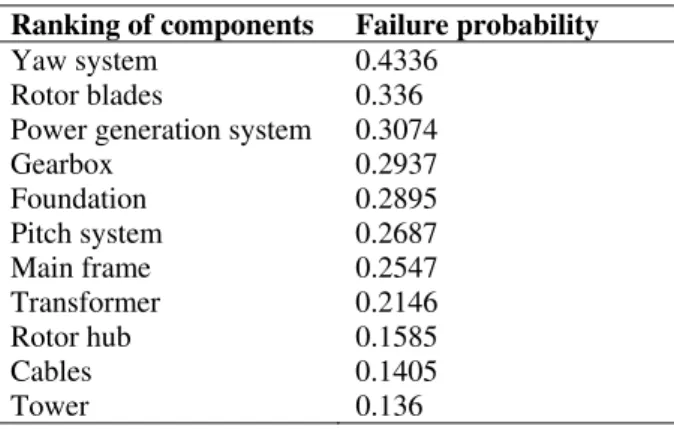
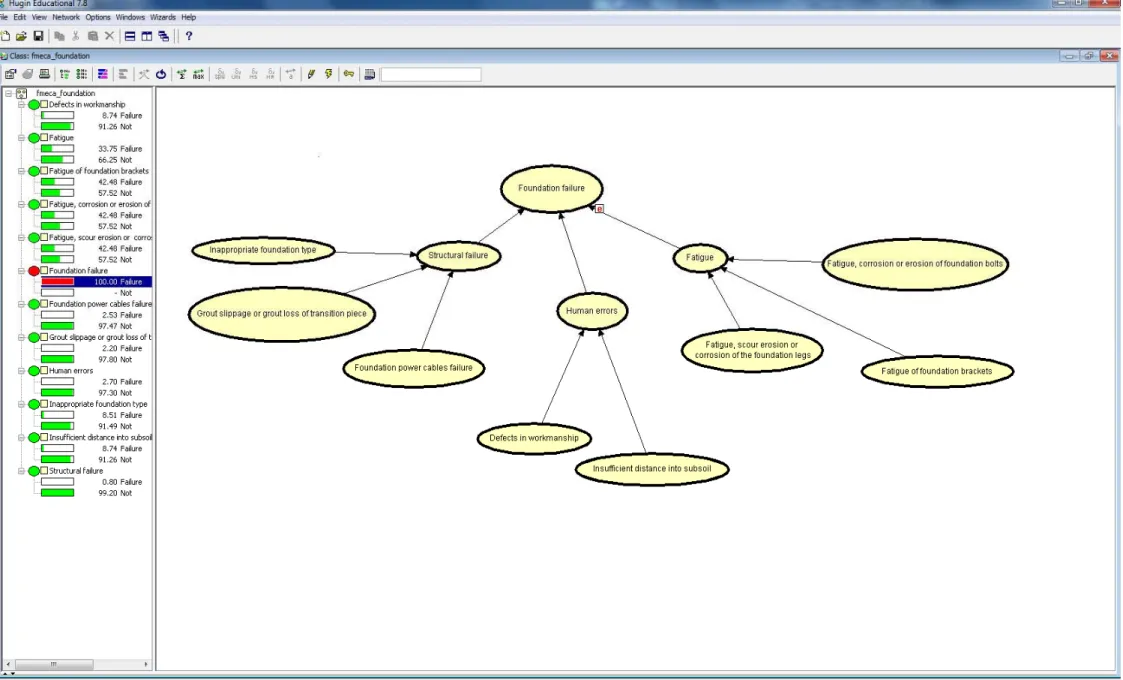
BBN can be quite complex and it may be necessary to break it down to subcategories as shown in Figure 1. In this case, we avoid computational intensive and time consuming process. In our approach we divided the main system into 11 subsystems as mentioned in Table 6. When necessary, in complicated systems, a further division was made to simplify the calculations into categories such as electrical failure, structural failure, human error and external parameters. Through this process we identified and ranked the most critical components and their probability of failure. In the final stages of our approach we incorporated the cost estimate for each component in order to get an approximation of the total cost in case of failure.
Table 4: BBN analysis-Failure probabilities of the components
Ranking of components Failure probability
Yaw system 0.4336 Rotor blades 0.336 Power generation system 0.3074
Gearbox 0.2937 Foundation 0.2895 Pitch system 0.2687 Main frame 0.2547 Transformer 0.2146 Rotor hub 0.1585 Cables 0.1405 Tower 0.136
Table 5: Part of FMECA Matrix
Table 6: Part of the HAZID Matrix
Undesired event/Hazard Cause Consequences
Risk control options/ me asure s
S E A O S E A O S E A O S E A O
1.Brake system failure
Breaking power lost from overheating of the metal in brake rotors or drums
System disruption, blade damage, fire or shutdown
2 1 3 3 1 1 1 1 3 3 3 3 6 3 9 9
Proper design, monitoring and inspection Brake damage due to
grease or oil on brakes
System disruption, blade damage, fire or shutdown
2 1 3 3 1 1 1 1 3 3 3 3 6 3 9 9
Proper design, monitoring and inspection Breaking power loss
due to brake pads wearing thin
System disruption, blade damage, fire or shutdown
2 1 3 3 1 1 1 1 3 3 3 3 6 3 9 9 Proper design, monitoring and inspection Consequence index Probability index Detection index RPN Undesired
event/Hazard Cause Consequences
Risk control options/ measures
S E A O S E A O S E A O S E A O
Electrical hazard Equipment failure Injuries or fatalities 4 1 1 1 3 1 1 1 2 2 2 2 24 2 2 2
Proper maintenance of the
equipment
Human error Injuries or fatalities 4 1 1 1 3 1 1 1 3 3 3 3 36 3 3 3
Appropriate training and proper
rest before the start of the shift
Inadequate PPE Injuries or fatalities 4 1 1 1 2 1 1 1 2 2 2 2 16 2 2 2
Regular checks of proper use of PPE
and proper information about their utility Poor communication between coworkers
Injuries or fatalities 4 1 1 1 2 1 1 1 3 3 3 3 24 3 3 3 Appropriate
training
Hearing problems
Extensive noise from the equipment
Deafness or dizziness 3 1 1 1 3 1 1 1 2 2 2 2 18 2 2 2 Use of proper PPE
Inadequate PPE Deafness or dizziness 3 1 1 1 2 1 1 1 2 2 2 2 12 2 2 2
Regular checks of proper use of PPE
and proper information about
their utility
Consequence index Probability index Detection index Risk index
For the Wind turbine as a total we can summarize the following after implementing the cost data for the components into the BBN network (Lazakis et al 2013, Dalgic et al 2013, Fingersh et al 2006).
Table 7: Summary of the results for the wind turbine Wind turbine
Total probability of failure 0.6098 Total cost in case of failure 115,398.75$ Total gain in case of not failure 67,985.37$
For each one of the components, given that they fail, we can see in Figure 1 the top failure modes for the foundation component analytically as they came out from the HUGIN program. Here we present the ranked failure modes for the most critical component:
Table 8: Failure modes and probabilities for the yaw system
Yaw system
Insufficient torque to drive motor from
internal leakage or valve failure 0.425 Failure to pinion rotation from blockage
or foreign object between gear teeth, sheared shaft or cracked pinion housing and bearing
0.0424
So in total we can summarize the following regarding the BBN analysis:
The values used in the calculations are taken from the OREDA Handbook that it is more specifically for oil and gas industry. Since offshore wind turbines are a relatively new way of producing energy there is a lack of accurate data regarding risk and criticality analysis so there is a parameter of error in the calculations.
The system with the highest failure probability is yaw system and is followed by rotor blades and power generation system. At some point this is justified as all of them are electrical systems and they are more sensitive to failures than mechanical systems or structures.
The overall failure probability of the wind turbine is relatively high. This can be due to data error since the values are taken from the OREDA handbook which is more specifically used for oil and gas industry.
The overall cost of the wind turbine in case of failure is relatively low comparing to the components’ costs respectively, since the top critical subsystems are relatively cheap.
The ranking of the critical components verifies at a satisfactory level the results of the HUGIN program in comparison with FMECA analysis. Yaw system, power generation system and gearbox are in both ranking amongst the first places. One major difference is the position of pitch system that is on the top of one list and rather low at the other.
5. Conclusions
Reliability prediction is considered as a crucial measure to understand system performance for minimizing maintenance cost and mitigate unnecessary downtime. In addition, imperfect maintenance is identified as one of the typical drawbacks in operation and maintenance practices that reduce system reliability. In this work we used a combined research methodology for the risk analysis and the prediction of the long-term reliability of an offshore wind turbine’s sub-systems. The key elements carried out and presented in this report are the following:
• Review of risk analysis and risk assessment methods and tools in the renewables, maritime and other industrial sectors
• Presentation of a risk analysis and decision making methodology to be followed for the offshore wind turbine
• A novel technique for predicting system reliability is provided through this approach by using HAZID, FMECA and BBN analysis. • Development of a thorough risk matrix to be
used for the installation, operation and maintenance activities of the wind turbine as well as for the critical components.
• Identification of the hazards in the installation, operation and maintenance activities of the turbine.
• Identification of the high-ranked hazardous areas for the mentioned activities and components.
• Identification of the most costly components of a wind turbine.
In addition to the above, the research study conducted herein provides a rigid foundation for expanding into further research in the mentioned areas. The main recommendation that may enhance the proposed methodology is a further investigation in order to gather more accurate information about the offshore industry since implementation of the onshore data can lead to significant errors. Furthermore, more maintenance details could be implemented in the BBN networks so that more informative and proper decisions can be made on behalf of the decision makers about the maintenance strategy. In order to obtain more realistic reliability result it is also suggested that the different kinds of maintenance strategy (i.e. planned, preventive, corrective, breakdown) is taken into consideration.
Also, BBN analysis could be implemented for the HAZID analysis as well, so that the costs, in case the most critical operations occur, could be calculated. Finally, Future research could include a more elaborate, sophisticated risk based analysis considering the explicit formulation of a numerical optimization problem to be solved for the global minimum (optimal solution). Further, the time dependent character of the problem would be
explicitly considered by modeling the involved dynamics via non- stationary stochastic processes(Au & Beck, 2001), (Kougioumtzoglou, Spanos 2013), (Kougioumtzoglou, Spanos 2014).
References
ABS (2003) “Guide for risk evaluations for the classification of marine-related facilities”, Publication 117, Houston
AS/NZS: 4360, (2004), “The Australian and New Zealand Standard on Risk Management”, 3rd edition. Australian and New Zealand Standard
Association for Project Management (2004), “Project Risk Analysis and Management (PRAM) Guide (2nd Edition)”, Princes Risborough, UK: Association for Project Management
Au S.K., Beck J.L., (2001), “First excursion probabilities for linear systems by very efficient importance sampling”, Probabilistic Engineering Mechanics 16, 193-207
BS/ISO (2002) “Petroleum and natural gases industries-Offshore production installations-Guidelines on tools and techniques for hazard identification and risk assessment”, BS/ISO standard 17776, Brussels, 2002 Dalgic, Y., Lazakis, I. & Turan, O (2013). Vessel charter
rate estimation for offshore wind O&M activities, 15th Congress of Intl. Maritime Assoc. of Mediterranean (IMAM), 14-18 October, A Coruna, Spain.
DNV (2001) “Marine risk assessment”, Offshore technology report prepared for the UK HSE, London DNV (2003) “Risk management in marine and subsea
operations”, RP-H101, Hovik, Norway
Fthenakis V.; Kim H. C. (2009). "Land use and electricity generation: A life-cycle analysis". Renewable and Sustainable Energy Reviews 13 (6–7): 1465.
HSE (2006) “Assessment principles for offshore Safety Case”, HSE publications, London
IMO “Formal Safety Assessment (FSA): Consolidated text of the guidelines for Formal Safety Assessment (FSA) for use in the IMO rule-making process”, MSC/Circ. 1023, 2007
International Organization for Standardization ISO /IEC 31010:2009. 2009, “Risk management – Risk assessment techniques”, Geneva, Switzerland: International Organization for Standardization
Kougioumtzoglou A. Ioannis, Spanos D. Pol (2014), “Survival Probability Determination of Nonlinear Oscillators Subject to Evolutionary Stochastic Excitation”, Journal of Applied Mechanics, ASME, May 2014, Vol. 81
Kougioumtzoglou A. Ioannis, Spanos D. Pol, (2013), “Response and First-Passage Statistics of Nonlinear”, Journal of Engineering Mechanics, ASCE / September 2013, 139:1207-1217
L. Fingersh, M. Hand, and A. Laxson, “Wind turbine Design Cost and Scaling Model”, 2006
Lazakis I., Turan O. and Rosendahl T., 2013. Modelling of vessel and equipment cost for the maintenance activities of an offshore tidal energy array, Proceedings of the PRADS2013, 20-25 October, 2013, CECO, Changwon City, Korea. Lazakis, I., Turan, O., & Rosendahl T. (2012), “Risk
assessment for the installation and maintenance activities of a low-speed tidal energy converter”, In Marine & Offshore Renewable Energy 2012, Royal Institution of Naval Architects)
Lewis S., (2005), “An Overview of Leading Software Tools for QRA”, American Society of Safety Engineers –Middle East Chapter (161), 7th Professional Development Conference & Exhibition, March 18-22, Kingdom of Bahrain Melchers, R.E., (2001), “On the ALARP Approach to
Risk Management, Reliability Engineering and System Safety”, Vol. 71, pp. 201-208
NORSOK N-004 (2013) “Design Of Steel Structures, Annex K Special Design Provisions For Jackets” OREDA (2002) “Offshore Reliability Database
handbook”, 4th edition, DNV, Norway, 2002 Project Management Institute (2008), “A guide to the
project management body of knowledge (PMBOK Guide)”, Chapter 11
Shafiee M., Dinmohammadi F., (2014), “An FMEA-Based Risk Assessment Approach for Wind Turbine Systems: A Comparative Study of Onshore and Offshore”, Special Issue Wind Turbines
WINDUSTRY (2014), “Why wind energy”, http://www.windustry.org/wind-basics/why-wind-energy, (accessed May 15, 2014)