Rochester Institute of Technology
RIT Scholar Works
Theses
Thesis/Dissertation Collections
7-22-1970
Ceramic tea service
Patricia K. Swyler
Follow this and additional works at:
http://scholarworks.rit.edu/theses
This Thesis is brought to you for free and open access by the Thesis/Dissertation Collections at RIT Scholar Works. It has been accepted for inclusion
in Theses by an authorized administrator of RIT Scholar Works. For more information, please contact
Recommended Citation
CERAMIC
TEA
SERVICE
Patricia
K.
Swyier
Candidate
for
the
Master
ofFine
Arts
in
the
College
ofFine
andApplied
Arts
of
the
Rochester
Institute
ofTechnology
July 22,
197u
11.
TABLE
OF
CONTENTS
Chapter
I
-introduction
rageI
Chapter
Ii
-Development
ofthe
Thesis
Project rage3
"The
Tea
Pot"'.
Page
7
"Lids" rage
8
"Spouts"
rage
9
"The
Foot" ragelu
"Handles"
rage
12
"Other
Treatments
ofForm
andSurface"...
..Page 14"Di
sappointments"i*age
19
Chapter
Iii
-Clay
Bodies
andGlazes
page21
Chapter
IV
-Inspirations
andinfluences
rage25
Chapter
V
-Conclusion
page29
Chapter
VI
111.
INDEX
OF
PLATESPlate
1
Weed
pot withimpressed
texture
tback view/Plate
2
Weed
pot with open mouth and extendedtongue
Plate
3
Slab
goblet withthrown
base
Plate
4
Thrown tea
pot with slab spoutPlate
5
Raku
goblet madefrom
pressed coilsPlate
6
.The plaster moldsPlate
/.Tea
pot constructedfrom
pressed coils^
carved spout;rlate
8
"The
Goblin"- sugar
bowl
with curledfeet
rlate
9
....Rakutea
potsPlate
lu
"Queen
Victoria,
The
Prin'cess
andHandmaidens"
Plate
11..
.."HeadHedgehog"
-
tea
pot withimpressed
texture
Plate
12
Slab
tea
potPlate
13
Tea
pot and sugarbowl
- pressed slabs and coilsflate
14
....Tea pot withindented
seamrlate
15
"Tea
For
Two"Plate
16
"Tea
For
Three"Plate
17
Series
of rakutea
pieces -bisque
warePlate
IS
"Four
Goblets"by
Ruth
Duckworth
Plate
19
Thrown
Tea
Service
Plate
2u
"Fat
Tea
Service"Plate
21
"Hedgehog
tFamily"
Plate
22...
'.'Snobbish
Tea
Group"Plate
23
"The
Survivors Tea
Group"Plate
24
"Three
Stoneware
Bottles"by
Robert
andPaula
Winokur
rlate
25
Japanese
stoneware tea-jar
Plate
26...
Japanese
storagejar
-Kamakura
period
plate
27
"Two
Tatooed
Baby
Dolls"by
Micheie
Doner
Plate
28
"Storage
Jar"by
Wayne
Higby
Plate
2y
..Designfor
cover of"At
The
Relton
Arms"
by
Aubrey
Beardsley
rlate3w.
.Stoneware coveredbowl
-Chinese
Plate
31
Stoneware
cup
by
Patricia
Kazi
Plate
32
Hinged
containersby Nancy
Jurs
rlate
33
Raku
tea
pot with unglazed areaCHArTER
I
1.
In his book
Ceramics.
Glenn
Nelson
states,
"The
tea
set
is
one ofthe
moreinteresting
projectsfor
the
potterboth
in
design
andin
technique.
Within
the
limits
dictated
by
function,
aninfinite variety
ofform
is
possible."*This
unlimitedvariety
of possibleforms
within agroup
of related pieces was a
factor
that
suggested a projectof challenge and
long
term
interest
to
me.When
deciding
to "explore
the
functional
and aesthetio possibilities ofthe
tea
service,"however,
ibecame
excitedby
the
idea
that
tea
pots mightpersonify
living
creatures andthe many
pieces
in
atea
setthe
members ofthe
tea
pot'sfamily.
Although
functional
problems oftea
setswere,
ofnecessity,
a major area of
concern,
my
intention
has
alwaysbeen
to
suggest a
family
group
of piecesthat
might,
in
the
userRsabsence,
hold
conversationsamong
themselves
and walk about.in
orderto
do
this
afree,
lively
treatment
ofthe
clay
is
necessary.
One
ofmy
major objectiveshas
been
to
find
building
methodsthat
will createthis
humorous
impression
but
allowthe
piecesto
performtheir
functions
successfully.
Spherical
tea
potforms
seemedto
suggestbest
the
fat
funny
kinds
of creaturesthat
might rule overthe
dwarfish
families
i wishedto
form,
inhis
book Stoneware
andPorcelain.
Daniel
Rhodes
writesthat
some ofthe
mostexciting
pottery
forms
look
asif
they
were"puffed
out like a balloon."2This
is
the
look
1
wantedto
achieve;
but
throwing,
whichRhodes
advises,
did
not allow meto
createthe
richintricate
surface
textures
ifelt
werenecessary
adornmentfor
the
tea
families
especially
since some ofthem
were meantto
be
royalty.Much
ofmy
early
work revolved around a searchfor
a methodthat
would enable meto
form
full-blown
roundedshapes
that
wererichly
textured.
After
numerous experiments withform
andtechnique
I
successfully
produced afew
completefamilies
oftea
creatures.Several
entire setsfailed
because
of glaze problems, inmy
later
workI
have
become
moreinterested in
tea
potsin
particular and
have
concentrated on groups ofthem
whichare of royal
lineage.
Some
ofthese
hold very high titles
and
travel
only
withtrusted
servants or advisors whichhave
been
provided.
CHArTER
II
3.
Functional
forms
have
been
my
main area ofinterest
since
my
first
summer atthe
School
For
American
Craftsmen.
rlacing
emphasis onincreasing
my
throwing
skillduring
the
summers of1967
and196a
gave me anopportunity
to
makemany
utilitarian objectsthat
l could usedaily.
Through
constant use of -these piecesfunctional
imperfections
became
more
apparent,
but
1
alsofound
it
much more enjoyableto
servefrom
ordisplay
piecesthat
possessedhumorous
qualities.Such
a piece was a small onecup
tea
pot ithrew
during
the
summer of
196Y.
Almost
totally
unsuccessfulfunctionally
vthe
lid
falls
off,
the
spoutdrips,
it
has
just
oneopening
inside
the
spoutinstead
of a strainer;it
seemedto
have
alife
ofits
own.This
piece,
as well as somelater
experiments,
stirredmy
interest
in
the
area oftea.
Attending
evening
collegeduring
the
fall
andspring
of
1967-68,
allowed meto
explore some possibilitiesfor
constructing
animated utilitarianforms,
i attachedthrown
bases
to
hand
built
pieces madefrom
textured
slabs.
These
were stamped with
bisque
stamps or pressed ontointeresting
surfaces opiate
1,.
The
thrown
bases
afforded afoot
orleg-like
attachmentthat
often madethe
sectionresting
onthe
base
suggestive of atorso.
Alternately
this
combinationPlate
1
Weed
pot withimpressed
texture
Plate
2
Plate
2
n
huhhsb
'2tSSlI
H 1
4.
a slab roiled over a coiled pattern opiate
3>.
This
technique
was
successful
on gobletforms
sincethe
coil patternbecame
more
evident
asthe
slab was manipulatedto
form
the
cup.During
the
summer of19e8,
l constructed ahand built
tea
setin
an attemptto
combine some ofthe
ideas
1had
been
working
withduring
the
year.Placing
slabs over aballoon
enabled meto
form
a puffed out shape onto whichi pressed
coils.
These
did
not showup
aseffectively
asthe
coils onthe
goblet shapes sincethey
neededto
be
paddledin
orderto
join
ontothe
body
ofthe
pot.The
paddling
caused some coils
to
disappear
completely.Cups
and saucerswere made
by
paddling
slabs overclay
forms.
Functionally,
the
cups werethe
most successful pieces ofthis
first
tea
service, v.
Cream
and sugar containers were not constructedwith
this
group;.The
tea
potlid
slipped out whenpouring
because
it
had been
cutfrom
the
body
ofthe
pot with abeveled
edge
<
figure
1).
cross section of
tea
potfigure
1
The
pot could notbe
completely
filled
because
the
spout wasplaced
too
low.
Aiso,
because
the
spout was not quitesharp
Plate
3
IKHi
hhi
9 I
MlHH
HM*
SHI
InHni
In
spite ofits
practical
shortcomingsthis
short narrowspout
shape
resembled awhistling
mouthgiving
the
potan
animated
quality.Consequently,
I
continuedto
usethis
spout
form,
or onevery
closeto
it,
on othertea
pots opiate4;
The
tea
potin
this
group
was ratherflaccid
in
appearancebecause
I
had
notfound
asatisfactory
methodfor
con- estructing
andattaching
abase
that
would raisethe
potsufficiently
to
create an animatedform.
Further,
the
pot was set upright on
its
foot
before
the
body
wasleather
hard; thus,
the
foot
(.made
from
acoil;
sankinto
the
potenough
to
giveit
a collapsed appearance.This first
experiencein constructing
tea
sets sparkedmy
interest
in
forming
piecesthat
would evokeimages
ofliving
creaturesand still
be
functional.
Further
experiments withtea
pot shapes were carriedout
in
rakutoward
the
end ofthe
1968
summer.These
werealso constructed over
balloons
but
much morefreely
than
the
previouspot.
For
these
rakutea
pots alarger
roll ofclay
was used as afoot
andthis
seemedto
raisethe
body
ofthe
pot sufficiently.Textured
surfaces were not usedon
these
pots sinceI
had
notdeveloped
a successfultechnique
for
preserving
the
coil shapesI
wanted whilePlate
4
6.
this
area
led
meto
continue raku experimentsin the
fall
of
1968.
I
tried
pressing
coilsinside
wine glassesto
form
goblets
v plate5).
This
technique
worked wellfor
small
forms
andI
decided to
try
constructing
tea
potshapes
in
this
manner.Plaster
of Paris was poured over aballoon
to
form
the
negative of ahemisphere.
Coils
ofclay
were pressedinside
this
hemisphere
asin
the
wine glass.My
initial
experiment
withthis
mold provedthat
the
coil patternsI
desired
couldbe
preservedif
the
clay
werecarefully
joined
only
onthe
inside.
But
removing
the
clay
hemisphere
from
the
mold wasdifficult.
Further
experiments withthis
procedure showed
that
best
resultsfor
joining
coils,
retaining
textures
onthe
outsides ofthe
hemispheres,
andremoving
shapes
intact
were obtained whenthe
clay
wasvery
soft andhad
no grog.Many
problems were encounteredin
the
process oftrying
to
join
the
two
hemispheres,
*f
the
clay
weretoo
soft,
the
rounded shape could notbe
preserved xvhenhandling
the
joined
pieces,if
too
hard,
the
seambetween
the
hemispheres
would not
join
well.It
wasfinally
determined
that
if
both
hemispheres
were allowedto
dry
to
the
leather
hard
state
they
couldbe
handled
withoutdanger
ofchanging
their
shape.
To
increase
the
opportunity
for
the
seamto
join
Plate 5
7.
together
firmly
andthe
seamarea
wasjoined
with afettling
knife
and
then
beaten
with afiat
stick
to
perfectthe
shapeof
the
sphere.
The
opening
for
the
lid
was cut afterallowing
time
in
the
damp
roomfor
moisture contentto
even.Through
the lid
opening
the
inside
seam wasjoined
with an"egote"^
figure 2>.
"egote"
figure
2
Once
I
arrived atthe
method mentioned abovei
began
to
castplaster
moldsto be
usedfor
the* other pieces ofthe
tea
service.
Cup
and saucer shapes werethrown
onthe
wheel.The
foot
onthe
cup
forms
wastrimmed
to fit
into
the
recessionin
the
saucerform.
These
softclay forms
werethen
coatedwith
plaster.
Small balloons
were used asthe
positiveforms
for
casting
the
hemispheres
to be
usedfor
cream pitcher andsugar
bowl
molds opiate6,.
The
Tea
Pot
A teapot
is
aboutthe
mostdifficult
articlea potter
is
called uponto
make.In
comparison with a vase of equal size
it
requiresin
addition,
alid,
ahandle,
aspout,
and perforations
to
retainthe
tea
leaves.
Each
one of
these
partsmay
take
aslong
to
make asthe
potitself,
andto
assemblethem
-successfully
requires considerableforesight.
uf all
the
piecesin
the
tea
service,
the
tea
pot presentedthe
greatest number offunctional
problems.
During
the
summer of1969
I
concentrated onsolving
these,
3jLeach,
Bernard,
A
Potter's
Book
(Hollywood,
Fla.
,1967
>
Plate
6
i SiiitS
I
believed
that
the
tea
potwas
the
dominant
member ofthe
family
groups
to be
constructed andthat
solving
its
problems
wouldfacilitate
construction ofthe
othertea
group
members.
JLids
The
snug fit
oflids
is
a matter whichdeserves
special
attention,
for
it
gives a particular satisfactionto
the
user andis
an evidence ofcompetent workmanship.4
During
the
summer of1969,
I
wasinterested
in
keeping
the
tea
potform
as closeto
a sphere as waspossible,
soI
cutthe
lids
from
the
roundbodies
ofthe
pots and addedslab
flanges
to
them.
Even
withvery
long
flanges, however,
I
experienceddifficulty
in
keeping
lids
in
place whilepouring.
This
difficulty
stemmedfrom
the
beveled
angleat which l was
cutting
into
the
pots
as mentionedearlier.
To
solvethis
problemI
cutvertically
into
the
clay to
form
the
lid,
added aledge
below
this
vertical cut on whichthe
lid
couldrest,
andthen
attachedthe
flange,
forming
it
to
fit
snugly
inside the
ledge
(figure
3>.
cross section of
tea
potfigure
3
This
method worked wellfor fit
and allowed meto
keep
4
the
roundness
ofform
I
desired.
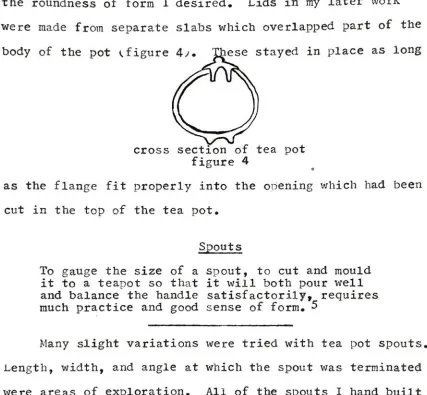
Lidsin my
later
workwere made
from
separate slabs which overlapped part ofthe
body
ofthe
pot (.figure4/.
These
stayedin
place aslong
cross section of
tea
potfigure
4
as
the
flange
fit properly into
the
opening
whichhad
been
cut
in
the
top
ofthe
tea
pot.Spouts
To
gaugethe
size of aspout,
to
cut and mouldit
to
ateapot
sothat
it
willboth
pour welland
balance
the
handle
satisfactorily,
requiresmuch practice and good sense of
form.
5
Many
slight variations weretried
withtea
potspouts.
Length,
width,
and angle at whichthe
spout wasterminated
were areas of exploration.
All
ofthe
spoutsI
hand
built
and
threw
weresimilar,
however,
in
that
they
had
very
narrow openings.
I
believed
a smallopening
projectedthe
image
of awhistling
or puckered mouth.Spouts
madefrom
slabs ivere constructed
by
cutting
a semi-circle ofclay
and
folding
it
to
create afunnel
shape.Unce
the
seam
ofthe
funnel
wasjoined,
its
widest part was stretched outwardslightly.
After
joining
the
spoutto
the
body
ofthe
pot
.in which strainer
holes
had been drilled
with afettling
knife;
the
lip
ofthe
spout wastrimmed
horizontally
and5
[image:28.544.47.474.69.464.2]lu,
the
edge
sharpened.
This
edge wasleft
unglazedto
keep
it
sharp
asinsurance
againstdribbling.
The
spout
wasjoined to
the
potin
a positionthat
allowed
its
lip
to
be
even withthe
top
ofthe
tea
pot orslightly
higher in
orderthat
the
pot mightbe
filled
to
the
brim.
After
firing
sometea
pots withthrown
spoutsit became
obviousthat
they
unwound afew
degrees
in the
kiln.
To
remedy
this,
terminal
points of spouts were cut*
slightly
offthe
horizontal
sothey
wouldbe
straightafter
the
glazefiring.
Many
unsuccessful attempts were madeto
constructspouts
from
coils sothey
might relatebetter
to
the
bodies
of
the
pots.All
seemedto
fail
because
ofthe
difficulty
in
handling
these
small shapes.Finally,
designs
werecarved
into
leather
hard
spouts afterthey
had
been
joined
to
the
bodies
ofthe
pots.
Carving deeply
then
rubbing
the
clay
to
round offthe
edges of carvedlines
produced asurface similar
to
the
body
ofthe
pot.This
method wasmuch
too
time
consuming
to
usefor
an entire pot and alsonot quite as agreeable
in
appearance asthe
pressedcoils;
but
it
did,
afterglazing,
help
producethe
appearance ofan
entirely
coiled shape v plate7;.
The Foot
A
smallfoot for
grace,
abroad
onefor
stability.0Plate
7
Tea
potconstructed
from
pressed coilsWri*
Srv
11.
The
thing
I
believed
could contribute mostto
creating
an
animated
set oftea
creatures wasthe design
ofthe
foot.
A
small
high
foot
raised each creatureinto
the
air andsuggested
legs but
did
not give enough stability.To
overcome
this,
four
small wads ofclay
werejoined
ontothe
bottom
ofthe
tea
potforms
being
constructed.These
were widest at
the
point wherethey
joined
the
pot.When
the
leather
hard
pot was setgently
onthese
soft wads ofclay
they
bulged
slightly
atthe
point of contact.On
some pots
feet
were curled upwardbefore
setting.These
wads of
clay
truly
suggestedfeet
of animalsor,
whencurled,
goblins.To
increase
the look
ofstability,
Professor
Cowies
suggestedthat
five
feet
be
used sothat
at least
three
wouldbe
seenfrom
any
view possible whenthe
tea
pot was placed at eyelevel.
This
improved
the
appearance of
the
pots andtheir
actualstability
(.plate
8;.
The
treatment
ofthe
foot
mentioned above waseventually
used on
tea
pots,
creampitchers,
sugarjars
andsaucers.
The
cups were pressedinto
a moldthat
had been
castfrom
awheel
turned
foot.
This
wasdone
in
orderthat
they
might
fit
the
saucers moresecurely.
Also,
1feit
that
putting
"legs"
on
every
form
in
atea
service
wouldbe
overpowering. (The user might get
the
feeling
that
one ofthese
creatures could runaway
before
he'd drunk his
tea;
Plate
8
"The
Goblin"Mj>p-12.
Slab
and pulledtreatments
ofthe
foot
weredeveloped
to
fit
the
character
of newforms.
These
willbe
discussed
in
conjunction
withthe
development
ofthe
forms.
Handles
Handles,
spouts andknobs
are alltell-tale
adjuncts of pots...7in
planning
the
handles
for
tea
pots and creampitchers
I
wasinterested
in
creating
variety through
the
use of a material otherthan
clay.Reed
was usedin
allmy
tea
groups exceptthose
completedduring
my
last
summer.Experiments
with varied points of attachment were made, uf
these,
the
mdstfunctionally
successful were produced when
handles
were attached atfour
points (plate15;
or at either side ofthe
pot witha
finial for
lifting
atback.
Round
andflat
reeds ofvarying
thickness
were usedfor
constructing
handles.
These
were soakedin
warm waterfor
ten
to
twenty
minutesto
soften.
When
pliable,
a roundreed was woven
between
the
staples.Sometimes
it
wasnecessary
to
use morethan
one,
especially
for
the
potsthat
had
three
orfour
staples,
if
points of attachmentwere located at
front
andback
ofthe
pot enough round reedwas used
to
completely
fill
allthe
clay
loops.
This
wasdone
sothe
handle
could not wiggle whencompleted.
On
pots whose attachment points were on
the
sides enough space13.
was
left
in
each staple sothe
handle
mightslip
easily
when
the back
ofthe
pot was raisedfor
pouring.After
completing
the
work with round reed a piece ofmasking
tape
waswound
aroundthe
center ofthe
handle
skeletonto
keep
it
in
place.
Next,
aflat
reed was wrappedtightly
around
the
outside ofthe
round reed core (.figure5;.
rag?-flat feed
-Static Of-/ocf>
attaching
the
flat
"reed
figure
5
End
pieces offlat
reed at all attachment points weretucked
into
the
wound section ofthe
handle
and pulledtightly.
Extra
length
wasthen
clipped.A
free
technique
based
onthe
above procedure wasused
to
constructhandles
for
raku pots(.plate
9).
Here
very
heavy
round reed was usedto
form
the
handle
skeleton.Several
widths offlat
reed were wound aroundthis
skeletonsimultaneously.
End
pieces onthese
handles
werelooped
and undipped.
Handles
for
"Queen
Victoria"and
"The
Princess" wereconstructed
from
yarns,
reeds and costumejewelry
(platelu;,
These
handles
were madedetachable
sothe
pots couldbe
Plate
9
Plate
lo
1-#3^%j:.^i
HM^UB mMinffl
*V'*:*4^s?&>
WWmH
#iftSir
*xZ0$$&
14.
Other Treatments
ofForm
andSurface
Pressing
coiledforms inside
a mold gives anexciting
surface
but
also
consumes muchtime.
After
constructing
many
pieces
withthis
method,
I
began
searching
for
something
that
would yield aninteresting
surface more quickly.Some
ofmy early
experiments with slabs pressed onto carvedsurfaces vplate
1;
provedto
be
useful,immediately
aftercasting
a newhemisphere
in
plasterI
carved adesign
into
its
surface.
Working
withthis
mold was quicker andproduced a raised
texture
which1
found
pleasant.
Cup,
cream
pitcher,
andsugar
jar
molds were also carved with asimilar
pattern.
Saucer
molds were allowedto
remainun-textured
for
contrast.With
this
moldi
was ableto
produce
some ofmy
mostinteresting
surfaces(plate
11;.
This
method ofworking
alsoled
meto
develop
a newtea
potform.
On
aflat
slab of plasterI
carved a newdesign.
Onto
this
surfaceI
pressed circular slabs of clay.Using
these
flat
circular piecesto
construct parts of atea
pot presented aninteresting
problem.
My
first
tea
potconstructed
in
this
manner resembled a shortcylinder
turned
on
its
side (plate12;.
While
the
impressed
slabs were stillvery
plasticthey
were pushed out with a ribto
givethe
pota more
lively
appearance.After
doing
this
it
seemedunfortunate
that
I
had
not carvedthe design
on a concavePlate
II
"Head
Hedgehog"Plate
12
.'i-1 1.Ji >4 I.-ii.Ji.Jj
: i
'
I
H
1
*'v.:*:. . 1
isls
H1H
15.
challenging
and continued experimentsbrought
more successfulaesthetic
andfunctional
results(plate
lu;.
All
ofthe
forms
1
constructed
this
way
had
puffed sides sinceI
wasn't ableto
find
a shape withflat
sidesthat
lookedlively
enough.A
different
kind
offoot
seemednecessary
for
this
newpot shape and at
this
pointI
turned
to
slabforms.
Slabs
about
two
inches
in
length
andapproximately
the
same widthas
the
pot were curled atthe
ends andthen
attachedto
front
andback
ofthe
pot.
The
same method was usedfor
constructing
ahandle
for
the
lid.
It
worked wellfor
allthe
finials
exceptthe
foot.
These
slabsbecame
quitedistorted
when
the
pot was set upright.After
successivetrials,
this
problem was solved
by
waiting
untiljust
before
the
foot
slabs
became
leather
hard
to
setthe
pot right side up.I
thought
this
new method ofconstructing
finials
wouldbe
animproved
Variation
onmy
roundedforms.
I
returnedto
them
anddeveloped
atechnique
ofcombining
pressed slabsand coils
(plate
13/.
Professor Mc Endarfer
suggestedthat
these
forms
mightbe
improved
by
emphasizing
the
division
between
the
two
joined
hemispheres.
This
wasdone
by
pressing
in
onthe
soft seamimmediately
afterjoining
the
two
sections.
This
shape workedsuccessfully
withthe
slab method of constructing
two
curledfeet,
sincethey
also emphasizedthe
two
sections ofthe
form
(plate14/.
A
disadvantage
ofthis
foot
treatment wasits
instability
which couldonly be
corrected
Plate
13
Tea
pot and sugarbowl
vSEBmNm
m
^
rlate
14
Tea
pot withindented
seam:JtSf
16.
By
the
end ofthe
summer of1969,
i
had
constructedseveral
tea
servicesusing
the
methodsdiscussed.
These
l
believed
were successfulin
form
and would perform wellfunctionally,
i
neededonly
to
finish
firing
them
as soonas
the
opportunity
presenteditself.
Thus,
l
felt
ready
to
try
a new approachto
the
tea
service.The
Mad
Hatter
ofLewis
Caroll's Alice
in
Wonderland
poured
tea
into
several cups at once.The
practical
problemsinvolved
in
this
task
intrigued
me.As
an exerciseto
solvethis
problem,
during
the
fall
of1969,
I
very
carefully
threw
closedforms
onthe
wheel and attachedtwo
andthree
spouts
to
these
aftertrimming
the
forms
andturning
them
ontheir
sides.
Openings
for
lids
were cutin
what nowbecame
tops
ofthe
pots.These
were measured afterthe
lids
had been
thrown
andtrimmed.
The
slab method mentioned above was usedfor
some ofthe
finials
onthe
"Tea
For
Two"service
(plate
15;.
Very
narrowcup
forms
andtiny
saucers werethrown
-in orderthat
they
might sit close enoughtogether
for
the
tea to
be
directed
properly
from
the
spouts.
A
cream pitcher andsugar
bowl
were also madefrom
thrown
spheresto be
used withthe
"Tea
For
Two" service.A
semicircular slab was attachedas a spout
for
the
cream pitcher,i
imagined
numerousproblems
that
could occur wheni
wouldfinally
get a chanceto
pour
from
these
curiouspots;
but,
to my
amazement,
they
poured
perfectly.
Attachments
v/ere madeto
hold
corksfor
spoutsPlate
15
Plate
16
Hi
.iiHSjf
17,
that
pouring
several cups oftea
at once waspossible,
1
felt
surel
would wantto
returnto
this
project laterto
develop
afreer
building
approach.Evening
college classes were encouragedto
work withraku
clay
during
the
fall
of1969.
Continuing
withthe
method of
throwing
spheres lhad
usedto
constructthe
multiple spout
sets,
I
began
to
form
thicker
moreirregular
shapes.
I
also emphasizedthe
areas wheretwo
pieces ofclay
had been
joined
together
such asthe
seambetween
the
spout and
the
body
of atea
pot.
This
wasdone
by
adding
wads of
clay
andallowing
heavy
finger
marksto
show.Lids
were constructed
from
slabs ofclay
that
were pinched andbeaten
to
resemblehats
or crown^likeforms.
Several
narrow coils of
clay
werejoined
to
the
leather
hard
bodies
of
the
potsfor
legs.
These
were curled and wiggled whilevery
soft.The
pots were set upright onthese
coilsimmediately
which causedthem
to
wiggle even more.Many
related
tea
pots,
creampitchers,
sugarbowls
and cups wereconstructed (plate
17/.
These
forms
were quitelively
andtheir
constructionhelped
meto
treat
thrown
forms
withmore abandon.
After
seeing
a set of porcelain gobletsby
Ruth
Duckworth
in
the
show"Objects
U.
S.
A."
opiate
18/,
l
became
very
excited about
creating
irregular
thrown
forms.
Using
stoneware again
1
threw
many
relatedtea
pieces withvery
soft clay.
I
madethe
walls ofthese
pieces quitethin
soPlate
17
Series
of rakutea
piecesBsH
1
rOj5
A A
v
s
4T
Plate
18
"Four
Goblets"by
18,
handled
when wet and alsoin
the
firing.
When
the
pieceswere
almostleather
hard
I
scraped off excessclay
from
their
foot
sections with atextured
knife
and added along
roll of
clay
to
each ofthe
smallpieces.
This
roll ofclay
was pulled
like
ahandle
andthen
coiled.The
coiled pieceof
clay
raisedthe
cupshigh
into
the
air,
andI
decided
atthis
point notto
usethe
saucersI
had
thrown
sincethe
cups
had
an almost goblet-like appearance. -Thetea
potswere
too
symmetricto
echothe
distortions
in
the
cups soI
presseddown
onthe
outside sections oftheir
lids
andmade slits
in
their
sides whichI
pushed openfrom
the
inside
(plate
19;.
Although
functionally
successful,
these
pieces
did
notpossess
the
animated qualities of some ofmy
earlier work.
The
cups werethe
most life-like of allthese
tea
pieces sincethey,
because
ofsize,
were constructed withmore narrow raised
foot
sectionsthan
the
tea
pots.The
problem of
altering
thrown
forms
held
my
interest
andled
me
to
experimentfurther
in
this
areaduring
the
summer of197o.
1
find it
naturalfor
my
previous areas of workto
help
me
develop
newforms.
During
my
last
summer atthe
School
For
American
Craftsmen
I
have
combined work with carvedmoids,
throwing,
and atechnique
newto
mepaddling
softcoiis of
clay
to
edges andjoints
offorms.
This
newway
of
working
has
been
usefulin
forming
more complex animatedrlate
19
ly.
suggest
families
ofroyalty
andtheir
servants and advisors.A
group
offorms
in
which1
believe
this
attempthas
succeeded
is
shownin
platelu,
which pictures"Queen
Victoria,"
"The
Princess,"and
their
"Handmaidens."The
sides ofthese
tea
pots were madefrom
slabs pressed onto a carvedbat.
These
were attachedto
athrown
center section."Queen
Victoria*s"ornate appearance
developed
from
the
addition of paddled coils at seam areas.
During
this
last
summerI
also completed projectsbegun
the
summerbefore
andduring
the
year opiate2u;.
Raku
pottery
andthrown
stonewareformed
during
the
winter wasglazed.
A
creampitcher,
sugarbowl
and new saucersfor
the
"Hedge
Hog
Family"were completed opiate
21/.
The
first
set of saucers
had
warped centers which causedthe
cupsto
wiggle.
This
resultedfrom
distortion
occurring
whenthe
slabs were pulled
from
the
saucer mold.To
correctthis
problem
the
centers were scraped with aflat,
sharp
tool
whenthe
clay
wasbone
dry.
Happily,
afterthe
glazefiring
the
additional pieces
for
this
set matchedthe
originalgroup
weil enough
to
form
a complete servicefor
four.
Disappointments
Since
the
fired
teapot
must also matchthe
restof
the
setin
colour as wexl asshape,
it
willbe
readily
understoodthat
tea
setsinvolve
the
studio potter
in
troublesome
and unremunerativework.8
Plate
2u
"Fat Tea
Service"HI
890! IHI
Plate
21
"Hedgehog
Family"constructed
from
slabs2u,
Many
successfully formed
tea
services never survivedthe
glazefirings.
This
wasespecially
disappointing
sinceit
resultedin
ahigh
mortality
rateamong
formerly
lively
tea
creatures.
Because
there
were some periods whenkilns
were not available
to
me,
many
glazefirings
had
to
be
delayed
until atime
wheni
was nolonger
working
in
the
manner of
the
setsto
be
fired;
thus,
it
wasunlikely
that
new creatures of
the
same style would ever replacethose
lost
in
the
kiln.
The
majority
ofmy
losses
vfour completetea
services;
occurredbecause
of an unusual mishap.I
suspect,
aftermany
tests,
that
one ofthe
glazeingredient
bins
may
have
been
refilledincorrectly.
Only
afew
piecesof
these
tea
services survived: a sugarjar
(plate8;
and
the
tea
pot,
creamer and sugar groups shownin
plate22
and plate
23.
These
all performtheir
functions
wellbut
Plate
22
"Snobbish
Tea
Group"- pi?
HI
HHH
HHH
HBH
*#
Plate
23
"The
Survivors
Tea
Group'CHAPTER
III
21.
S.
A.
C.
Stoneware
was usedfor
the
major part ofthe
thesis
work:Kentucky
"Special "Ball
Clay
lOu
lbs.
"X
X"Sagger
Clay...,
100
lbs.
North
American
Fire
Clay
25
lbs.
Cedar
Heights
Redart
Clay
So
lbs.
Bentonite
2.5
lbs.
Iron
was omittedfrom
this
recipe sothe
surface wouldbe
slightly
lighter
in
reduction.This
omission also gavemore contrast
between
the
clay
body
andthe
turquoise
glazeused at cone nine
in
oxidation(plate
lu/:
MC
532A Turquoise
-Cone
8
to
lu
Barium
carbonate. ...60 gramsNepheline
syenite13u
gramsKaolin
.14 gramsFlint
16
gramsLithium
Carbonate
4
gramsCopper
Carbonate.
lu
gramsThe
above glaze wasthe
cause ofthe
disasters
mentionedearlier.
For
an unknownreason,
after much successful useit
began
to
pitseverely
andbecome
quitedry.
As
acorrection,
professorCowles
suggested a series oftests
which resulted
in
the
addition oftwo
partskaolin,
sixparts
flint
and one partlithium
carbonate.These
additionsimproved
the
surface and changedthe
coloronly
slightly
(thin
areasbecame
abit
more green;.When
a newbatch
ofthe
originalformula
was mixed at adifferent
time
of yearit
performedsuccessfully
again.This
led
usto
believe
aglaze
bin had been
incorrectly
filled.
Nevertheless,
9Ball,
F.
Carlton,
Making
Pottery
Without
A
Wheel
(N.
Y.,
1965;
22.
Professor
Cowles1suggested additions were
kept
in
the
recipefor
a more pleasant surfacein
thin
areas.The
revisedbatch
recipe
follows:
Barium
Carbonate
6u
gramsNepheline
Syenite
13*/
gramsKaolin
...16 gramsFlint
22
gramsLithium
Carbonate
5
gramsCopper
Carbonate
lu
gramsOne
attractivequality
ofthis
glazeis
its
tendency
to
turn
the
clay
orange or red orange atthe
edges of glazedportions.
This
quality
led
meto
useit
ontextured
potsthat
wouldhave
much unglazed area.These
surfaces werefirst
dipped
in
glaze which wasthen
scrubbedfrom
the
high
spots with a sponge.All
raised areas tvere orangeor red-orange after
the
firing
in
contrastto
aturquoise
or
blackish
color which remainedin
the
deep
spots whereglaze collected.
Application
mustbe
thick
to
obtain abright
turquoise
color.Glaze
techniques
for
the
majority
ofthe
thesis
workwere geared
to
emphasizing
the
surfacetextures
ofpots.
Often
oxides mixed with water werebrushed
ontothe
textured
surfaces and scrubbed off
the
high
spots with a sponge.Over
these
areas athin
coat of one ofthe
following
glazebases
was poured:
JO^ -
Cone
7
to 9
reductionKaolin
16
gramsWhiting
15
gramsClinchfield
Feldspar.
.. .41 gramsTalc
8
gramsBone
Ash
lu
gramsDolomite
lu
gramsFlint..
9
grams23.
With
six
per
centiron
this
glazebecomes dark
brown
with redflecks
or,
in
heavy
reduction,
red with greenflecks.
The
surface
is
a pleasantwaxy
matt.G-23
-Cone
5
to
9
oxidation or reduction
Frit
G-23
27.2
gramsDolomite
.18.2 gramsNepheline Syenite
18.2
gramsKaolin
18.2
gramsFlint
18.2
gramsTin
7.3
gramsWith
two
per centiron
this
glazeis
closely
flecked
withdark
brown
and redspots.
An
addition offour
per centiron
and one and onehalf
per cent cobaltto
the
base
glazecauses
it
to become
metallicblue-brown.
Although
it
has
a
long
and variedfiring
range,
G-23
producesits
mostpleasant matt surface at cone seven or eight reduction.
In
oxidationit
is
very bright
and canbe
unpleasant exceptover
black
slip
whereit
rangesfrom
dark
brown
to
blue-green
where
thick.
S.
A.
C.
Black
Slip
Cedar
Heights
Redart
Clay
8u
gramsBlack
Copper Oxide
5
gramsRed
Iron Oxide
5
gramsManganese
Dioxide.
5
gramsCobalt
Oxide
...2.5 gramsUsually
finials
were glazedto
contrast withthe
bodies
of pots.
These
weredipped
in
one ofthe
above glazes withcolorants added after
the
oxideshad
been
scrubbedfrom
textured areas.
When
dry
the
finials
were coated with waxresist
before
the
base
glaze was poured overthe
remaining
24.
For
raku potsthe
following
glazes were appliedby
pouring
ordipping:
R-3B
-Cone
u8 raku -White
Crackle
Soda
Ash
44.2
gramsColemanite
3u.9
gramsBoric
Acid
18.6
gramsKaolin
24.
u gramsFlint
65.
U gramsTin
Oxide
6.u
gramsR-5
-Cone
u8Raku
-Transparent
Soda
Ash
74
gramsColemanite.
.31u
gramsKaolin
38
gramsFlint
144
gramsWith
an addition offour
per cent red copper oxidethis
glaze
becomes
abeautiful
metallic red where reduced.Unhappily,
I've
discovered
this
red reoxidizes afew
days
after
the
firing
becoming
yellow-green with reddish spots.1-B
-Cone
uluRaku
-Gold
Soda
Ash
....44.2 gramsGerstley
Borate.
3u.9
gramsKaolin
24.
b
gramsFlint
65.
u gramsBismuth
1.6
gramsSilver
Nitrate
orSilver
Carbonate
...1.6 gramsIf
fired
too
high
this
glazeloses
its
metallicquality but
retains a pleasant yellow-orange color.
The
above glazes were used overthe
following
rakuclay
body:
A.
P.
Green
Fire
Clay...
5v lbs.
Cedar
Heights
Redart
Clay..
...5ulbs.
Kentucky
"Special"Ball
Clay
5v
lbs.
Grog.
5u
lbs.
CHAPTER
IV
25.
Books,
visitsto
artgalleries,
suggestions madeby
my
instructors,
and afilm
i sawmany
years agohave
allinfluenced
my
work.
Some
ofthese
sourceshave
left
their
mark
clearly
onparticular
pieces;
othershave
impressed
me
strongly
yetonly
subtle evidence oftheir
impression
remains on
my
final
products,
inthis
chapterI
willtrace
the
sourcesthat
causedmy
workto
take
particulardirections.
Several
yearsbefore
entering
graduate s.choolI
sawthe
"22nd Ceramic
National"show when
it
wasin
New York
City.
This
showleft
me with anabsorbing interest
in
surfacetextures
whichI
began
to
pursueearly
in
my
work.Three
small
bottles
by
Robert
and PaulaWinokur
(plate 24;1,Jwere
the
sourceto
whichi
turned
whenbeginning
to
carveplaster surfaces
for
pressing
slabs.The
wheel-like shapesused on
these
bottles
appear onthe
wfeed potin
plate1.
Similar
shapes also appear onthe
tea
potin
plate11,
but
my
own variations are apparent.These
tiny
bottles
the
tallest
only
aboutfive
inches--gave
methe
convictionthat
small
forms
couldbe
just
as expressive asthose
of giganticproportions.
In
addition,
small shapes might possess awhimsical
quality
not possiblein
larger
forms.
Reinforcement
ofmy
size preference camefrom
many
sources.
One
ofthese
was a visitto
the
Royal
Ontario
Museum in
Toronto,
On
display
was a collection ofJapanese
ceramicsin
which aPlate
24
"Three
Stoneware
Bottles"trS^ty/^mmo
26.
stoneware
tea
jar
very
similarto
the
onein
plate 2511was
shown.
This
jar
wasonly
about
sixinches
in
height.
it
wasvery
freely
thrown
and glazed alively
piece.Similar
shapes,
some ofthem
muchlarger,
which I've seenin
Daniel
Rhodes*book,
Tamba
Pottery
(plate26
>12have
been
contributing factors
toward
my
recentinterest
in quickly
thrown
forms.
These
pots emphasizedistortions
occuring
in
handling
andfiring.
This
interest
was,
Tiowever,
originally inspired
by
a visitto the
show"Objects:
U.
S.
A.,rHere
I
sawdistorted
thrown
gobletsby
Ruth
Duckworth
(plate
18;
that
caused meto
changemy
method of working.Also displayed
atthis
show were severaltextured
piecesl
found very
exciting.I
noticed similaritiesin my
treatment
of pressed coils withthe
surfaces of"Tatooed
Baby
Dolls" opiate27)
and"Storage
Jar"(plate
28;.
These
pieceshave
not yetdirectly
influenced
any
ofmy
work.My
treatment
of surfaceshas,
however,
gonethrough
atransition
because
of a suggestionby
Professor
Cowles.
After
seeing
some ofmy
carved plasterbats
he
pointed outtheir
similarity
to
the
work ofthe
Art
Nouveau
period.
This
led
meto
investigate
the
drawings
ofAubrey
Beardsley
opiate
29
/.i3The
carvedbat
usedfor
"Queen
Victoria,
the
princess and Handmaidens"is
done
in
the
manner ofBeardsley,
^Rhodes,
Daniel,
Clay
andGlazes
for
the
Potter
(Phila.,
1957/
p.
145.
l2Rhodes,
Daniel,
Tamba
Pottery
(Palo
Alta,
197u;
p.17.
Plate
25
aRE#
Plate
26
Japanese
storagejar
Plate
27
"Two
Tatooed
Baby
Dolls"by
HH
;#5|R:R
Plate
28
"Storage
Jar"by
MMiH
fHiB
Plate
29
Design
for
cover of"At The
Relton
Arms"
by
HIHHHHHHHHJ HHHHHHJHHHJ
27.
Oriental
ceramics
have
strengthened
my
preferencefor
certain
forms.
The
Chinese
covered
bowl
shownin
14
piate
3u
ismy
source of referencefor
roundedforms
on raised
bases.
This bowl
also
is
of modest sizeless
than
seveninches
yetit
has
"a
senseof scale and
monumentally."15
i
do
not>
howeVer,
feel
that
my
workhas
muchresemblance
to
that
ofthe
Oriental
tea
masters.They
"...cultivated
an appreciation ofextremeley
unpretentious
andseverely
simpleware.
. .usually undecoratedand
bearing
asingle-colour
glaze."16Much
ofmy
wareis
very
ornateparticularly
in
surfacetreatment.
The tea
service
in
plate19
exemplifies
the
simplesttreatment
ofform
with whichI
have
worked.
When
pulling
Handles
for
the
abovetea
servicei
attempted
to
getthe
fluid
quality
that
Patricia
Kazi
has
in
her
cup handles
vplate31/.
l7
In
the
processI
came
to
the
conclusionthat
these
multipleHandles
did
notwork
functionally
oraesthetically
withthe
forms
I nadthrown.
Nevertheless,
afterseeing
this
photomy
ideas
about
shaping
handles
changed. 1 was more alertfor
accidental nuances
that
might addto
the
liveliness
ofmy
forms.
l4Rhodes,
Daniel,
Stoneware
and!>orceiain
(Phiia.,
195y/
p.113.
15
Ibid.
1 f\
Sanders,
Herbert
H.
,The World
ofJapanese
Ceramics
,Palo
Alto,
196/
pp.189-I9u.
17"Young
Americans
1969,"Plate
3u
Stoneware covered
bowl
Chinese
% itSBS
HHHHBHH
Hi
BHhH]
Si
n
HI
^^^^S^e^fi^ BiaEaBa^BiaBw
Plate
31
Stoneware
cup
by
H^HJ
1
II
111
28.
Working
with rakuclay
andfiring
techniqueshas
aisohad
aliberating
effect