Journal of Chemical and Pharmaceutical Research, 2014, 6(2):688-694
Research Article
CODEN(USA) : JCPRC5
ISSN : 0975-7384
Characteristics of Pu'er tea compounded with the Chinese traditional food
materials and its evaluation on cellular immune function
in vitro
Xiaoqiang Chen
1†, Fangfang Huang
2†, Wei Huang
3†, Chuanbai Tan
4, Heng Wei
5, Ke
Zhang
1, Miaomiao Ying
6*, Zhifa Zhang
7*, Haitong Wan
8*, Jin Zhao
9*, Xiaolu Xu
10*,
Zhengqi Wu
1and Jiehong Yang
8*
1Hubei Collaborative Innovation Center for Industrial Fermentation, Hubei University of Technology, Wuhan,
China
2Technology Center, China Tobacco Zhejiang Industrial Co. Ltd, Hangzhou, China 3Hubei Institute for Food and Drug Control, Wuhan, China
4Hubei Technology Center of Tea Deep Processing Engineering, Yichang, China 5Department of Neurology, Xinhua Hospital of Hubei Province, Wuhan, China
6Wenzhou Vocational College of Science & Technology, Wenzhou, China 7Tongji Medical College, Huazhong University of Science and Technology, Wuhan, China
8Zhejiang Chinese Medical University, Hangzhou, China 9China Jiliang University, Hangzhou, China 10Zhejiang Shuren University, Hangzhou, China
† contributed to the paper equally * corresponding author
_____________________________________________________________________________________________
ABSTRACT
Pu'er tea served as main ingredient in conjunction with extracts of chrysanthemum, bamboo leaves and tremella was developed to be pie-shaped compound Pu’er tea, compound Pu'er tea bags and instant compound Pu'er tea. The sensory evaluation of the compound Pu'er tea and its feedstock were carried out,and their quality and texture chemicals such as tea polyphenols, free amino acid , caffeine water-soluble saccharides, crude fiber and total ash was assayed. The hydroxyl radical scavenging rates of the compound pu’er tea reached levels of 47-70%.The splenocyte treated with instant compound Pu'er tea had significantly lower splenocyte proliferative responding to ConA (P < 0.01), which did not yet perform in a dose-dependent manner.
In this study, Pu'er tea was served as main ingredient in conjunction with extracts of chrysanthemum, bamboo leaves and tremella, and developed to be novel compound products. The sensory characteristic, physicochemical properties, antioxidant effects and cellular immune function of the Pu'er tea compounds were also investigated. This study provided a new method especially for the development of low-grade pu’er tea and was very important to raise its economic value added.
EXPERIMENTAL SECTION
2.1 Materials and reagents
The Pu'er tea, chrysanthemum, bamboo leaves, tremella and other raw materials were produced in Dehong autonomous prefecture, Yunnan province ,China. Luminol was also acquired (≥98%, Suzhou Industrial Park Subfamily Chemical Reagent Co., LTD). Fetal calf serum (FCS) was provided by Hangzhou Sijiqing Corp. (China).All reagents were analytically pure.
2. 2 Processing methods of compound Pu'er tea
Pu'er tea was taken as the main ingredient; chrysanthemum, bamboo and tremella were taken as auxiliary materials. Based on the quality of the Pu'er tea, an orthogonal test was adopted to perform formulation and process optimization. The extracts of Pu'er tea, chrysanthemum, bamboo and tremella were prepared from the pharmaceutical company’s GMP workshop for Chinese herbal medicine extraction.
Three forms of compound Pu'er tea were designed, i.e. pie-shaped tea, tea bags and instant tea. Their quality specifications were 5 g/bag, 2 g/bag and 0.5g/bag, respectively.
The processing of bamboo-chrysanthemum -tremella extracts:
chrysanthemum, bamboo and tremella→ sorting, rinse→ drying→ crush, extraction→ preliminary filtration→ fine filtration→ spray drying→ bamboo-chrysanthemum- tremella extracts
The processing of pie-shaped compound Pu’er tea:
The processing of instant compound Pu'er tea:
Pu'er tea extract → preliminary filtration → fine filtration → spray drying→ Pu'er tea extracts
2.3 Sensory evaluation of the compound Pu 'er tea and its feedstock
In accordance with the method on sensory evaluation of tea (GB/T23776-2009), the three varieties of compound Pu'er tea and its feedstock samples were professionally reviewed through a blind peer-review. 250 ml of boiling water was respectively added to 5 g of feedstock Pu'er tea and pie-shaped compound Pu'er tea, which were steeped for 5 minutes. 150 ml of boiling water was added to a compound Pu'er tea bag (2 g) which was steeped for 5 minutes. 150 ml of boiling water was respectively added to bamboo-chrysanthemum-tremella extracts (powder, 0.5g) and instant compound Pu'er tea (powder, 0.5g) which were steeped for 3 minutes. The aroma and taste quality of these tea samples were subsequently assessed.
2.4 Quality and texture chemicals in the compound Pu 'er tea and its feedstock
temperature. Around 100 µL of hydrogen peroxide (8.4%, v/v) was injected into the quantitative ring through a six-way valve. Then, the filtrate was mixed with the current-carrying phase of phosphate buffer solution (pH 7.4, 0.05 mol/L) containing Luminal (2. 0 x 10-4mol/L), Fe2 +- EDTA (6.0 x 10⁻²mol/L) and the sample. The mixture was
subsequently taken into the photomultiplier tube. Chemiluminescence signals were then recorded. A control experiment was also performed using water to replace the test samples. The luminescent system (Fe2 + - H
2O2
-Luminal system) was inhibited to assess the scavenging capacity. Meanwhile, a luminescent analysis was conducted using a IFFM-E flow injection chemiluminescence analyzer (Xi'an Ruimai Analysis Instrument Co., LTD.). The luminous inhibition rate (%) was also calculated using the following formula:
luminous inhibition rate (%)=( Fa-Fb)/Fa x100
Where Fa is the luminous intensity of control sample, and Fb is luminous intensity of the tested sample.
2.6 Splenocyte proliferation assayin vitro
2.6.1 Preparation of splenocytes suspension
Spleen of ICR mice was collected in Hank’s balanced salt solution (HBSS, Sigma) under aseptic conditions. A homogeneous cell suspension was obtained from the minced spleen with its erythrocytes lysed by using ammonium chloride and then filtered through a steel mesh. The cells were washed twice with HBSS, collected and suspended with RPMI 1640 medium. When the survival ratio of splenocytes reached to above 95%, the concentration was diluted to 1×10⁷cells /ml with the RPMI 1640 medium supplemented with 10% FCS, 12 mM HEPES (pH 7.1), 100
IU/ml penicillin, 100µg/ml streptomycin, and 0.05 mM 2-mercaptoethanol.
2.6.2 Splenocytes Proliferation
In the case of cell-based treatments, 100ul of Splenocytes were seeded into 96-well plates complemented with 50ul of ConA (final concentration of 2.5 µg/ml) .After the addition of 50ul of RPMI 1640 medium with the diverse concentrations of instant compound Pu'er tea (final concentration of 12.5,25, 50, 100 and 200 µg/ml), a final
volume of 200µl came into being.
The another treatment ( 100ul of Splenocytes,50ul of ConA and 50ul of RPMI 1640 medium without instant compound Pu'er tea ) served as the normal control.
100ul of Splenocytes and 100ul of RPMI 1640 medium with the diverse concentrations of instant compound Pu 'er tea (final concentration of 12.5,25,50,100 and 200µg/ml) were regarded as non-stimulated cultures.
The cells were incubated with 5% CO2at 37℃in a humid atmosphere for 44 h,and then 50µl of MTT solution
(2mg/ml) were added to each well, following by 4 h of incubation and the centrifugation of (1000rpm,10min). The supernate were discarded carefully by pipetting, 200µl of a DMSO working solution (192µl DMSO with 8µl 1 N HCl) was added to each well, and the absorbance at 570 nm was recorded in an ELISA reader after 15 min.
The stimulation index (SI) was calculated based on the following formula: SI = the absorbance value for mitogen-cultures divided by the absorbance value for non-stimulated mitogen-cultures.
2.6.3 Statistical analysis
All of the experimental data were analyzed by one-way ANOVA and Newman-Keul Multiple Comparison Test (Prism, GraphPad Software, San Diego, CA).
RESULTS
3.1 Sensory evaluation of compound Pu'er tea and its feedstock
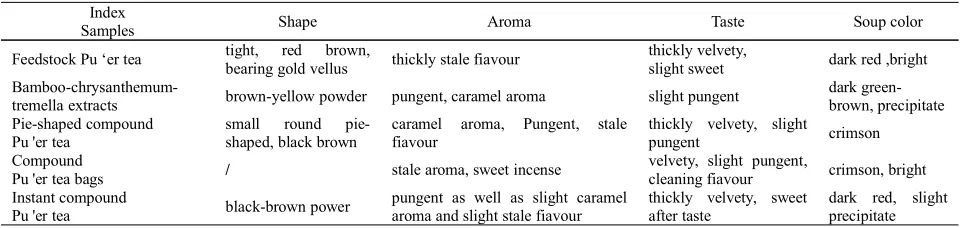
The results of the sensory quality assessment of compound Pu'er tea and its raw materials are shown in Table 1. Bamboo-chrysanthemum-tremella extracts were shown to have a distinctively fresh and pungent taste, caramel aroma, deep brown-green color and soup-like texture. While in contrast, feedstock Pu'er tea had a typical aged aroma, alcoholic taste, red color and a thick soup-like texture.
characteristics of taste and soup color of traditional Pu'er tea as well as embracing the smell of bamboo leaves, chrysanthemum and tremella.
3.2 Quality chemicals in compound Pu 'er tea and its feedstock 3.2.1 Tea polyphenols, free amino acid and caffeine
The polyphenol contents of pie-shaped compound Pu'er tea, compound Pu'er tea bags, feedstock Pu'er tea and bamboo-chrysanthemum-tremella extracts ranged between 7-11%. Instant compound tea reached 18%, which could be attributed to the concentration and enrichment in the extraction processes. Meanwhile, the polyphenol content of bamboo-chrysanthemum-tremella extracts could be ascribed to the flavonoid elements in bamboo leaves and chrysanthemum. Caffeine was not detected in bamboo-chrysanthemum-tremella extracts nevertheless 3-4% of caffeine existed in feedstock Pu ‘er tea, pie-shaped compound Pu'er tea and compound Pu'er tea bags. It reached levels of 6% in instant compound tea, which is roughly similar to levels in instant tea powder currently seen on the market. The contents of free amino acid in the three kinds of compound Pu'er tea were all about 0.5%, which were significantly lower than green tea, red tea and oolong tea[12]. This could be ascribed to the significant degradation of free amino acids especially for theanine during the pile fermentation process of Pu'er tea[13].
3.2.2 Tea water-soluble saccharides
The contents of water-soluble saccharides in feedstock Pu'er tea and the compound Pu'er tea were around 3.0%, while higher levels were found in bamboo chrysanthemum- tremella extracts and instant compound Pu'er tea powder. The saccharides content of the former was largely as result of the tremella. However, the concentration and enrichment of the preparation processes were also contributory factors.
3.3 Texture chemicals in compound Pu'er tea and its feedstock
The texture chemicals in the compound Pu'er tea and its feedstock are shown in Table 3. The content of water extract in tea reflects the level of soluble matter, indicating the tea taste of thick or light. The content of water extract in the pie-shaped compound pu’er tea and the compound Pu'er tea bags were close to that of the feedstock Pu'er tea. The content of the total nitrogen and crude fiber reflected the tenderness of raw material to some extent; the former was positively related to the sample tenderness while the latter was negatively related. As shown in the results, there were no significant differences between the total nitrogen and crude fiber content of feedstock Pu'er tea and compound Pu'er tea. The total nitrogen content in bamboo-chrysanthemum-tremella extracts and instant compound Pu'er tea was largely a result of water-soluble proteins, which was lower than in the raw material, compound pu’er tea bags and pie-shaped compound tea; the latter also included water-insoluble protein.
The high levels of total ash content could be attributed to the crude old plant tissue. As a result of the enrichment in the extraction process, the ash content of instant compound Pu'er tea and bamboo-chrysanthemum-tremella extracts was significantly higher than in other kinds of compound Pu'er tea and feedstock Pu'er tea.
The ash content of the compound pu’er tea bags and pie-shaped compound pu’er tea showed similar levels and slightly higher than that of feedstock Pu'er tea, which could be attributed to the contribution from the ash content of bamboo-chrysanthemum-tremella extracts.
3.4 Hydroxyl radical scavenging capacity
DISCUSSION
Based on the theory of the Chinese traditional dietary therapy, Pu'er tea, chrysanthemum, bamboo leaves and tremella had been developed to be a compound product possessing a remarkable sensory characteristic of traditional Pu'er tea.
Pu'er tea has a significant bioactivity in hypolipidemic as well as tremella possessing hypoglycemic, antitumor and bamboo leaves having the prominent function in hypolipidemic and anti-fatigue [4,14-16]. Modern pharmacological studies have shown that chrysanthemums has the prevention of cardiovascular disease, antibacterial, anti-cancer, anti-aging activities,et al.[17-20].These compounded traditional food materials may have significantly multifaceted and synergistic effects.
[image:6.595.66.548.285.399.2]In addition, the physicochemical property and sensory characteristics of raw materials and its products provided the guidance to quality control of the process. The research on the cellular immune function of compound Pu'er tea laid the foundation for its subsequent animal experiment on some activities such as immunoregulation, hypolipidemic, anti-aging et al. This study showed that the compound Pu'er tea had the potential to be health tea.
Table 1 the sensory evaluation of compound Pu'er tea and its feedstock
Index
Samples Shape Aroma Taste Soup color
Feedstock Pu ‘er tea tight, red brown,
bearing gold vellus thickly stale fiavour
thickly velvety,
slight sweet dark red ,bright
Bamboo-chrysanthemum-tremella extracts brown-yellow powder pungent, caramel aroma slight pungent
dark green-brown, precipitate Pie-shaped compound
Pu 'er tea
small round pie-shaped, black brown
caramel aroma, Pungent, stale fiavour
thickly velvety, slight
pungent crimson Compound
Pu 'er tea bags / stale aroma, sweet incense
velvety, slight pungent,
cleaning fiavour crimson, bright Instant compound
Pu 'er tea black-brown power
pungent as well as slight caramel aroma and slight stale fiavour
thickly velvety, sweet after taste
[image:6.595.67.562.427.494.2]dark red, slight precipitate
Table 2 the quality chemicals of the compound Pu'er tea and its feedstock
[image:6.595.84.529.524.592.2]N.D., not detected.
Table 3 the texture chemical composition of compound Pu 'er tea and its feedstock
Feedstock Pu'er tea Bamboo –chrysanthemum - tremella extracts
Instant compound Pu'er tea
Compound Pu'er tea bags
Pie-shaped compound Pu'er tea
water extract %) 39.7 / / 33.4 39.1
total nitrogen(%) 5.1 2.9 3.7 5.0 4.9
crude fiber (%) 11.3 / / 12.9 10.7
total ash(%) 7.4 24.2 20.2 9.2 8.9
moisture(%) 10.7 3.5 8.2 9.8 7.0
Table 4. Effect of instant compound Pu'er tea on ConA-stimulated splenocyte proliferationin vitro
Dosage (ug/ml) SI 12.5 25 50 100 200
instant compound Pu'er tea 1.36±0.05** 1.40±0.07** 1.33±0.06** 1.29±0.10** 1.30±0.06**
NC 1.81±0.17
Note:Compared with control group, * stand for P<0.05;** stand for P<0.01. The treatment without instant compound Pu 'er tea ) served as the normal control(NC).
Acknowledgements
This research was jointly supported by the Scientic Research Start-up Fund for Doctors of Hubei University of Technology (BSQD13007) and Zhejiang Provincial Public Technology Application Research Project (2011C22050)
REFERENCES
[1] JS Gong; WP Chen ;HJ Zhou;ZJ Dong; YF Zhang,Journal of Tea Science,2007,27,201~210
Feedstock Pu'er tea Bamboo- chrysanthemum-tremella extracts Instant compound Pu'er tea Compound Pu er tea bags
Cake-type compound Pu'er tea
Polyphenols(%) 10.8 7.6 18.2 8.0 8.1
free amino acid (%) 0.5 0.4 0.6 0.5 0.4
water-soluble saccharides(%) 3.2 5.2 10.4 3.4 2.6
[2] DJ Yang ; LS Hwang,J Chromatography A,2006, 1119,277-284 [3] X Xu; M Yah ; Y Zhu,Engineering in Life Sciences,2005,5,382-386.
[4] KL Kuo;MS Weng; C Chiang,J Agric Food Chem.,2005, 53, 480-489.
[5] HP Lv; JP Gu; Z Lin; L Guo; JF Tan ; QH Peng,Journal of Tea Science,2007,27, 8-18 [6] XQ Chen; Z Lin; Y Ye; JF Yin;YW Jiang ; HT Wan,Carbohydrate Polymers,2010, 82,28–33
[7] XQ Chen; Y Ye; H Cheng; YW Jiang ; YL Wu,J Agric Food Chem.,2009,57, 5795–5798 [8] Singh R B,J. Chem. Pharm. Res.,2012, 4(8), 3765- 3768
[9] P Arulpriya ; P Lalitha,J. Chem. Pharm. Res.,2012, 4(2),1042-1047
[10] GJ Chandrashekar; M Gopal; D Vaigundan,J. Chem. Pharm. Res.,2011,3(5),340-347 [11] AM AL-Mowali ; F M Al-Jabri1,J. Chem. Pharm. Res.,2011, 3(4),76-83
[12] XQ Chen; Y Ye; H Cheng; JF Yin ; C Sun,Food research and development,2007,28, 141-144 [13] GM She; XL Zhang; KK Chen; YJ Zhang ; CR Yang,Acta Botanica Yunnanica 2005,27, 572-576 [14] GL Jie; Z Lin; LZ Zhang; HP lv; PM He ; BL Zhao,J Agric Food Chem.,2006, 54,8058-8064.
[15] FF Chen ; DL Cai,Journal of Chinese Integrative Medicine,2008, 6,862-866
[16] Y Li; XL Liu; SP Pei; Y Shi ; DL Cai,Chinese Journal of Clinical Nutrition,2005,13,228-231 [17] J Mu; T Uehara; JZ Li; T Furuno,Forestry Studies in China,2004, 16,1-5
[18] MH Kweon; H J Hwang; H CSung,J Agric Food Chem.,2001,49,4646 -4655 [19] QH Zhang; L Zhang,Food and Drug,2007, 9,60-63