Cisco CCNA Exam #640-607
Certification Guide
Wendell Odom, CCIE #1624
Cisco Press
201 West 103rd Street
ii
Cisco CCNA Exam #640-607 Certification Guide
Wendell Odom
Copyright© 2002 Lacidar Unlimited, Inc. Published by:
Cisco Press
201 West 103rd Street Indianapolis, IN 46290 USA
All rights reserved. No part of this book may be reproduced or transmitted in any form or by any means, electronic or mechanical, including photocopying or recording, or by any information storage and retrieval system, without written permission from the publisher, except for the inclusion of brief quotations in a review.
Printed in the United States of America 5 6 7 8 9 0 Fifth Printing July 2002
Library of Congress Cataloging-in-Publication Number: 2001098200 ISBN: 1-58720-055-4
Warning and Disclaimer
This book is designed to provide information about CCNA Exam #640-607. Every effort has been made to make this book as complete and accurate as possible, but no warranty or fitness is implied.
The information is provided on an “as is” basis. The authors, Cisco Press, and Cisco Systems, Inc. shall have neither liability nor responsibility to any person or entity with respect to any loss or damages arising from the information contained in this book or from the use of the discs or programs that may accompany it. The opinions expressed in this book belong to the author and are not necessarily those of Cisco Systems, Inc.
Trademark Acknowledgments
All terms mentioned in this book that are known to be trademarks or service marks have been appropriately capitalized. Cisco Press or Cisco Systems, Inc. cannot attest to the accuracy of this information. Use of a term in this book should not be regarded as affecting the validity of any trademark or service mark.
Feedback Information
iii
Reader feedback is a natural continuation of this process. If you have any comments regarding how we could improve the quality of this book, or otherwise alter it to better suit your needs, you can contact us through e-mail at [email protected]. Please be sure to include the book title and ISBN in your message. We greatly appreciate your assistance.
Publisher John Wait
Editor-In-Chief John Kane
Cisco Systems Program Manager Michael Hakkert
Executive Editor Brett Bartow
Production Manager Patrick Kanouse
Development Editor Christopher Cleveland
Project Editor Marc Fowler
Copy Editors Gayle Johnson
Krista Hansing
Technical Editors David Barnes
Tim Faulk Steven Kalman Barb Nolley
Team Coordinator Tammi Ross
Book Designer Gina Rexrode
Cover Designer Louisa Klucznik
Composition Scan Communications Group, Inc.
Indexer Tim Wright
Corporate Headquarters Cisco Systems, Inc. 170 West Tasman Drive San Jose, CA 95134-1706 USA
http://www.cisco.com Tel: 408 526-4000
800 553-NETS (6387) Fax: 408 526-4100
European Headquarters Cisco Systems Europe 11 Rue Camille Desmoulins 92782 Issy-les-Moulineaux Cedex 9
France
http://www-europe.cisco.com Tel: 33 1 58 04 60 00 Fax: 33 1 58 04 61 00
Americas Headquarters Cisco Systems, Inc. 170 West Tasman Drive San Jose, CA 95134-1706 USA
http://www.cisco.com Tel: 408 526-7660 Fax: 408 527-0883
Asia Pacific Headquarters Cisco Systems Australia, Pty., Ltd
Level 17, 99 Walker Street North Sydney
NSW 2059 Australia http://www.cisco.com Tel: +61 2 8448 7100 Fax: +61 2 9957 4350
Copyright © 2000, Cisco Systems, Inc. All rights reserved. Access Registrar, AccessPath, Are You Ready, ATM Director, Browse with Me, CCDA, CCDE, CCDP, CCIE, CCNA, CCNP, CCSI, CD-PAC, CiscoLink, the Cisco NetWorks logo, the Cisco Powered Network logo, Cisco Systems Networking Academy, Fast Step, FireRunner, Follow Me Browsing, FormShare, GigaStack, IGX, Intelligence in the Optical Core, Internet Quotient, IP/VC, iQ Breakthrough, iQ Expertise, iQ FastTrack, iQuick Study, iQ Readiness Scorecard, The iQ Logo, Kernel Proxy, MGX, Natural Network Viewer, Network Registrar, the Networkers logo, Packet, PIX, Point and Click Internetworking, Policy Builder, RateMUX, ReyMaster, ReyView, ScriptShare, Secure Script, Shop with Me, SlideCast, SMARTnet, SVX, TrafficDirector, TransPath, VlanDirector, Voice LAN, Wavelength Router, Workgroup Director, and Workgroup Stack are trademarks of Cisco Systems, Inc.; Changing the Way We Work, Live, Play, and Learn, Empowering the Internet Generation, are service marks of Cisco Systems, Inc.; and Aironet, ASIST, BPX, Catalyst, Cisco, the Cisco Certified Internetwork Expert Logo, Cisco IOS, the Cisco IOS logo, Cisco Press, Cisco Systems, Cisco Systems Capital, the Cisco Systems logo, Collision Free, Enterprise/Solver, EtherChannel, EtherSwitch, FastHub, FastLink, FastPAD, IOS, IP/TV, IPX, LightStream, LightSwitch, MICA, NetRanger, Post-Routing, Pre-Routing, Registrar, StrataView Plus, Stratm, SwitchProbe, TeleRouter, are registered trademarks of Cisco Systems, Inc. or its affiliates in the U.S. and certain other countries.
All other brands, names, or trademarks mentioned in this document or Web site are the property of their respective owners. The use of the word partner does not imply a partnership relationship between Cisco and any other company. (0010R)
Cisco Systems has more than 200 offices in the following countries. Addresses, phone numbers, and fax numbers are listed on the Cisco Web site at www.cisco.com/go/offices
iv
About the Author
Wendell Odom, CCIE #1624, is a senior instructor with Skyline Computer. Currently, he is project leader for Skylabs, a service offering access to lab gear and exercises for Cisco Certification Exam practice (http://www.skylinecomputer.com/skylabs.htm). Wendell has worked in the networking arena for 19 years, working in pre- and post-sales technical consulting, teaching, and course development. He has authored portions of over 12 courses, including topics such as IP routing, MPLS, Cisco WAN switches, SNA protocols, and LAN troubleshooting.
About the Technical Reviewers
David Barnes manages Cisco’s Advanced Services Team in Richardson, Texas. He is CCIE #6563, CCDP, MCSE+I, Master CNE, and a Certified Technical Trainer. The organization he manages specializes in network consulting for many of Cisco’s largest customers. He designed, implemented, and managed networks for numerous Fortune 500 companies in the 10 years before he joined Cisco Systems, Inc. in 1999.
Tim Faulk is a professor and curriculum developer in the networks department of American Intercontinental University in Atlanta, GA. He holds a master’s degree in education and a Cisco Certified Network Professional certification. He teaches Cisco technology, TCP/IP-related courses, and security courses. He is presently developing a master’s program in network security.
v
Dedications
To the little boys and girls of our Cisco Press team who missed seeing their daddies for the final month it took to plow through the updates for this edition: I pray a blessing of more time with your daddies the next time we change the book! For my precious Hannah Grace, and for Matthew Christopher Cleveland, I thank you for your sacrifices!
Acknowledgments
I can write a 1000-page book, but I can’t find enough words to describe the credit Chris Cleveland deserves for what is good about this book. Michael Jordan, Wayne Gretsky, Chris Cleveland—a list of the absolutely best at what they do! Chris, thanks for putting up with the hand-drawn figures, for meeting my schedule requirements, and for working hard during the holidays. Your ability to edit my style of writing and revising makes my job a breeze. I still refuse to write a book unless you develop it!
Brett Bartow steered the project as executive editor. In his usual unflappable way, he dealt with all the planning and changes with content issues, business issues, and the flow of information to us from Cisco—without ever getting rattled. In the process of hurry up and wait, and then really hurry up, Brett provided calm. Thanks for that, Brett!
For Tammi Ross, who handles a lot of the administrative tasks, thanks for handling things quickly and correctly. It’s great to ask for something at a moment’s notice, and things happen, no problems!
Behind the scenes at Cisco Press is a vast array of talented people—all of whom are shielded from us authors by the development editor, who was Chris Cleveland again in my case. These are people who take figure changes with scribbled notes and make something meaningful and nice-looking out of them. People who fix my English—I never made an A in an English class in high school or college! People who do the meticulous tasks that make the whole book come together—making sure figures fit on the same page as the text that refers to them, making sure the index is complete and accurate, and the like. I have the easy job in this arrangement. Many thanks to you all for the hard and good work!
vi
Finally, my boss at Skyline Computer, Mike Zanotto (a.k.a. Mike Z), Managing Director, helped this project by letting me schedule the new CCIE Skylabs remote lab offering to go live the same day I had to have this book’s manuscript completed! Seriously, Z always helped by finding a way to give me the time I needed to work on this book and by making sure the job was fun. Thanks, Mike!
vii
Contents at a Glance
Chapter 1 All About the Cisco Certified Network Associate Certification 3
Chapter 2 Cisco IOS Software Fundamentals 27
Chapter 3 OSI Reference Model and Layered Communication 79
Chapter 4 LANs, Bridges, and Switches 145
Chapter 5 Intermediate LANs: Spanning Tree, VLANs, and Trunking 215
Chapter 6 TCP/IP and IP Routing 267
Chapter 7 Routing and Routing Protocols 407
Chapter 8 Understanding Access List Security 489
Chapter 9 WAN Protocols and Design 533
Chapter 10 Frame Relay Concepts and Configuration 605
Chapter 11 Novell IPX 677
Chapter 12 Scenarios for Final Preparation 759
Chapter 13 Hands-on Lab Exercises 823
Appendix A Answers to the “Do I Know This Already?” Quizzes and Q&A Sections 851
Appendix B Decimal to Hexadecimal and Binary Conversion Table 933
Appendix C Subnetting Practice: 25 Subnetting Questions 943
Appendix D Hands-on Lab Exercises: Solutions (included in PDF format on the CD for
this book)
viii
Table of Contents
Chapter 1 All About the Cisco Certified Network Associate Certification 3
Overview of Cisco Certifications 4 Exams Required for Certification 6 Other Cisco Certifications 7 What’s on the CCNA Exam 8
Cross-Reference Between Exam Topics and Book Chapters 16
Cross-Reference Between Chapter and Exam Topics 17 Recommended Training Paths for CCNA 17
How to Use This Book to Pass the Exam 19 I’ve Taken ICND—Now What? 22
I’ve Taken the Cisco Networking Academy Courses—Now What? 22
I’m New to Internetworking with Cisco, I Will Not Be Taking the ICND Course, and This Book Is My Only Reference—Now What? 23
I’m New to Internetworking with Cisco, I Will Not Be Taking the ICND Course, and I Bought the Interconnecting Cisco Network Devices Book as Well— Now What? 24
I’ve Learned a Lot About CCNA Topics Through Experience, but I Will Not Be Taking the ICND Course—Now What? 24
Conclusion 24
Chapter 2 Cisco IOS Software Fundamentals 27
How to Best Use This Chapter 27 “Do I Know This Already?” Quiz 28
The Cisco IOS Software Command-Line Interface 32 Access to the CLI 32
CLI Help Features 35 Syslog and debug 37
Configuring Cisco IOS Software 39 Example Configuration Process 40
ix
Upgrading Cisco IOS Software and the Cisco IOS Software Boot Process 50 Upgrading an IOS Image into Flash Memory 50
The Cisco IOS Software Boot Sequence 53 Scenario 2-1 70
Questions on Scenario 2-1 71 Scenario 2-2 72
Questions on Scenario 2-2 72 Scenario 2-1 Answers 75 Scenario 2-2 Answers 76
Chapter 3 OSI Reference Model and Layered Communication 79
How to Best Use This Chapter 79 “Do I Know This Already?” Quiz 80
OSI: Concepts, Layers, and Encapsulation 84 OSI Reference Model: Origin and Evolution 84 OSI Layers 85
Layering Concepts and Benefits 89 Interaction Between OSI Layers 90 Data Encapsulation 94
The TCP/IP and NetWare Protocols 97 OSI Transport Layer Functions 98
Connection-Oriented Versus Connectionless Protocols 98 Error Recovery 99
Flow Control 102
OSI Data Link Layer Functions 105 Data Link Function 1: Arbitration 106 Data Link Function 2: Addressing 107 Data Link Function 3: Error Detection 109
Data Link Function 4: Identifying the Encapsulated Data 109 Summary: Data Link Functions 113
OSI Network Layer Functions 114 Routing 114
Network Layer (Layer 3) Addressing 118 Scenario 3-1 136
x
Answers to Task 1 for Scenario 3-1 139 Answers to Task 2 for Scenario 3-1 139 Answers to Task 3 for Scenario 3-1 141
Chapter 4 LANs, Bridges, and Switches 145
How to Best Use This Chapter 145 “Do I Know This Already?” Quiz 146 LAN Overview 150
10-Mbps Ethernet 151 LAN Addressing 157 LAN Framing 158
Fast Ethernet and Gigabit Ethernet 161 LAN Standards 162
Bridging and Switching 164 Transparent Bridging 165 LAN Switching 170
Comparison of LAN Segmentation Using Bridges, Switches, and Routers 175
Bridging and Switching 164 LAN Switch Configuration 178
Basic 1900 Switch Configuration 179 Scenario 4-1: LAN Switch Configuration 203 Scenario 4-2: LAN Switch Concepts 204
Answers to Scenario 4-1: LAN Switch Configuration 206 Answers to Scenario 4-2: LAN Switch Concepts 210
Chapter 5 Intermediate LANs: Spanning Tree, VLANs, and Trunking 215
How to Best Use This Chapter 216 “Do I Know This Already?” Quiz 216 Spanning-Tree Protocol 220
xi
Virtual LANs 230
VLAN Trunking Protocol (VTP) 237 VLAN and Trunking Configuration 240
Basic VLAN Configuration 241
Scenario 5-1: LAN Switch Configuration 257
Answers to Scenario 5-1: LAN Switch Configuration 257
Chapter 6 TCP/IP and IP Routing 267
How to Best Use This Chapter 267 “Do I Know This Already?” Quiz 268 TCP/IP Protocols 272
Overview of a Sample TCP/IP Network 272 Transmission Control Protocol 277
User Datagram Protocol 284 Address Resolution Protocol 286 Internet Control Message Protocol 287 FTP and TFTP 294
IP Addressing and Subnetting 296 IP Addressing and Subnetting 297
Four Steps to Answering IP Addressing Questions 309 CIDR, Private Addressing, and NAT 337
IP Configuration 342
Using Secondary Addresses 355
IP Addressing with Frame Relay Subinterfaces 357 MTU and Fragmentation 360
IP Naming Commands and Telnet 361
Default Routes and the ip classless Command 365 Cisco Discovery Protocol 370
Scenario 6-1: IP Addressing and Subnet Calculation 393 Scenario 6-2: IP Subnet Design with a Class B Network 396 Scenario 6-3: IP Subnet Design with a Class C Network 397 Answers to Scenario 6-1: IP Addressing and Subnet Calculation 398 Answers to Scenario 6-2: IP Subnet Design with a Class B Network 399
xii
Answers to Scenario 6-3: IP Subnet Design with a Class C Network 402 Answers to Task 1 for Scenario 6-3 402
Answers to Task 2 for Scenario 6-3 403 Answers to Task 3 for Scenario 6-3 404
Chapter 7 Routing and Routing Protocols 407
How to Best Use This Chapter 407 “Do I Know This Already?” Quiz 408 Distance Vector Routing Protocols 412
Overview of Routing Protocols 413
Distance Vector Routing Protocol Behavior 416 Configuring RIP and IGRP 429
Basic RIP and IGRP Configuration 430 Advanced RIP and IGRP Configuration 439 Troubleshooting Routing and Routing Protocols 453 Scenario 7-1: IP Configuration 1 471
Scenario 7-2: IP Configuration 2 472
Scenario 7-3: IP Addressing and Subnet Derivation 474 Answers to Scenario 7-1: IP Configuration 1 480
Answers to Task 1 for Scenario 7-1 480 Answers to Task 2 for Scenario 7-1 481 Answers to Task 3 for Scenario 7-1 481 Answers to Task 4 for Scenario 7-1 482 Answers to Task 5 for Scenario 7-1 482 Answers to Scenario 7-2: IP Configuration 2 483
Answers to Task 1 for Scenario 7-2 483 Answers to Task 2 for Scenario 7-2 484 Answers to Task 3 for Scenario 7-2 484 Answers to Task 4 for Scenario 7-2 485
Answers to Scenario 7-3: IP Addressing and Subnet Derivation 485 Answers to Task 1 for Scenario 7-3 485
Answers to Task 2 for Scenario 7-3 486 Answers to Task 3 for Scenario 7-3 486
Chapter 8 Understanding Access List Security 489
xiii
Standard IP Access Lists 494
Standard IP Access List Configuration 498 Extended IP Access Lists 503
Extended IP Access Lists: Example 1 506 Extended IP Access Lists: Example 2 508 Extended IP Access Lists: Example 3 508 Named IP Access Lists 512
Controlling vty Access with IP Access Lists 515 IP Access List Summary 516
Scenario 8-1: IP Filtering Sample 1 527 Scenario 8-2: IP Filtering Sample 2 528 Scenario 8-3: IP Filtering Sample 3 528
Answers to Scenario 8-1: IP Filtering Sample 1 529 Answers to Scenario 8-2: IP Filtering Sample 2 529 Answers to Scenario 8-3: IP Filtering Sample 3 530 Exam Topics in This Chapter 532
Chapter 9 WAN Protocols and Design 533
How to Best Use This Chapter 533 “Do I Know This Already?” Quiz 534 Point-to-Point Leased Lines 538
HDLC and PPP Configuration 541 WAN Cabling Standards 546 ISDN Protocols and Design 548
ISDN Channels 548 ISDN Protocols 549
ISDN Function Groups and Reference Points 551 Typical ISDN Configurations 555
PAP and CHAP 557 Multilink PPP 558
Dial-on-Demand Routing 560 Comparison of WAN Options 571
xiv
Answers to Scenario 9-1: Point-to-Point Verification 600 Answers to Scenario 9-2: Point-to-Point Configuration 601
Chapter 10 Frame Relay Concepts and Configuration 605
How to Best Use This Chapter 605 “Do I Know This Already?” Quiz 606 Frame Relay Protocols 609
Virtual Circuits 612
LMI and Encapsulation Types 614 DLCI Addressing Details 616
Network Layer Concerns with Frame Relay 621 Frame Relay Configuration 627
Fully-Meshed Network with One IP Subnet/IPX Network 629
Partially-Meshed Network with One IP Subnet/IPX Network Per VC 637 Partially-Meshed Network with Some Fully-Meshed Parts 641
Scenario 10-1: Frame Relay Verification 656 Scenario 10-2: Frame Relay Configuration 662
Scenario 10-3: Frame Relay Configuration Dissection 664 Answers to Scenario 10-1: Frame Relay Verification 667 Answers to Scenario 10-2: Frame Relay Configuration 669
Answers to Scenario 10-3: Frame Relay Configuration Dissection 674
Chapter 11 Novell IPX 677
How to Best Use This Chapter 677 “Do I Know This Already?” Quiz 678 Novell IPX Concepts 682
IPX Addressing 683 Encapsulation 687 RIP and SAP 690 IPX Configuration 693
xv
SAP Filters 718
Named IPX Access Lists 721 Scenario 11-1: IPX Examination 741 Scenario 11-2: IPX Configuration 747 Scenario 11-3: IPX Filtering 748
Answers to Scenario 11-1: IPX Examination 751 Answers to Scenario 11-2: IPX Configuration 752
Answers to Task 1 for Scenario 11-2 752 Answers to Task 2 for Scenario 11-2 753 Answers to Scenario 11-4: IPX Filtering 754 Answers to Task 1 for Scenario 11-4 754 Answers to Task 2 for Scenario 11-4 755 Answers to Task 3 for Scenario 11-4 756
Chapter 12 Scenarios for Final Preparation 759
How to Best Use This Chapter 760 Scenario 12-1 761
Scenario 12-1, Part A: Planning 762
Solutions to Scenario 12-1, Part A: Planning 765 Scenario 12-1, Part B: Configuration 766
Solutions to Scenario 12-1, Part B: Configuration 767 Scenario 12-1, Part C: Verification and Questions 768
Solutions to Scenario 12-1, Part C: Verification and Questions 777 Scenario 12-2 779
Scenario 12-2, Part A: Planning 780
Solutions to Scenario 12-2, Part A: Planning 782 Scenario 12-2, Part B: Configuration 783
Solutions to Scenario 12-2, Part B: Configuration 783 Scenario 12-2, Part C: Verification and Questions 785
Solutions to Scenario 12-2, Part C: Verification and Questions 795 Scenario 12-3 797
Scenario 12-3, Part A: Planning 797
Solutions to Scenario 12-3, Part A: Planning 800 Scenario 12-3, Part B: Configuration 802
Solutions to Scenario 12-3, Part B: Configuration 803 Scenario 12-3, Part C: Verification and Questions 806
xvi
Chapter 13 Hands-on Lab Exercises 823
Options for Gaining Hands-on Skills 824 About the Labs in This Chapter 824 Equipment List 825
List of Labs 826
Lab 1: Router Command-Line Interface Familiarization 827 Lab 1: Objectives 827
Lab 1: Step-by-Step Instructions 828 Lab 1: Hints 830
Lab 2: 1900 Series Switch Command-Line Interface Familiarization 831 Lab 2: Objectives 831
Lab 2: Step-by-Step Instructions 832 Lab 2: Hints 835
Lab 3: 1900 Series Switch VLANs, Trunks, and Spanning Tree 836 Lab 3: Objectives 836
Lab 3: Step-by-Step Instructions 837
Lab 4: Basic Router IP Configuration and Management Navigation 838 Lab 4: Objectives 838
Lab 4: Step-by-Step Instructions 838 Lab 5: IP Routing Configuration 840
Lab 5: Objectives 841
Lab 5: Step-by-Step Instructions 841 Lab 6: IP Access List Configuration 842
Lab 6: Objectives 843
Lab 6: Step-by-Step Instructions 843 Lab 7: WAN Configuration 844
Lab 7: Objectives 844
Lab 7: Step-by-Step Instructions 845 Lab 8: Novell IPX Configuration 848
Lab 8: Objectives 848
xvii
Appendix A Answers to the “Do I Know This Already?” Quizzes and Q&A Sections 851
Answers to the Chapter 2 “Do I Know This Already?” Quiz 851 Answers to the Chapter 2 Q&A Section 853
Answers to the Chapter 3 “Do I Know This Already?” Quiz 858 Answers to the Chapter 3 Q&A Section 860
Answers to the Chapter 4 “Do I Know This Already?” Quiz 865 Answers to the Chapter 4 Q&A Section 867
Answers to the Chapter 5 “Do I Know This Already?” Quiz 872 Answers to the Chapter 5 Q&A Section 873
Answers to the Chapter 6 “Do I Know This Already?” Quiz 877 Answers to the Chapter 6 Q&A Section 880
Answers to the Chapter 7 “Do I Know This Already?” Quiz 897 Answers to the Chapter 7 Q&A Section 899
Answers to the Chapter 8 “Do I Know This Already?” Quiz 903 Answers to the Chapter 8 Q&A Section 906
Answers to the Chapter 9 “Do I Know This Already?” Quiz 912 Answers to the Chapter 9 Q&A Section 913
Answers to the Chapter 10 “Do I Know This Already?” Quiz 918 Answers to the Chapter 10 Q&A Section 920
Answers to the Chapter 11 “Do I Know This Already?” Quiz 923 Answers to the Chapter 11 Q&A Section 925
Appendix B Decimal to Hexadecimal and Binary Conversion Table 933
Appendix C Subnetting Practice: 25 Subnetting Questions 943
25 Subnetting Questions 943
Suggestions on How to Attack the Problem 944 Question 1: Answer 946
xviii
Question 3: Answer 950 Question 4: Answer 952 Question 5: Answer 954 Question 6: Answer 956 Question 7: Answer 957 Question 8: Answer 959 Question 9: Answer 961 Question 10: Answer 962 Question 11: Answer 964 Question 12: Answer 965 Question 13: Answer 967 Question 14: Answer 969 Question 15: Answer 970 Question 16: Answer 972 Question 17: Answer 973 Question 18: Answer 975 Question 19: Answer 976 Question 20: Answer 978 Question 21: Answer 980 Question 22: Answer 981 Question 23: Answer 983 Question 24: Answer 985 Question 25: Answer 987
Appendix D Hands-on Lab Exercises: Solutions (included in PDF format on the CD for
this book)
Lab 1: Router Command Line Interface Familiarization
Lab 2: 1900 Series Switch Command Line Interface Familiarization Lab 3: 1900 Series Switch VLANs, trunks, and Spanning Tree Lab 4: Basic Router IP Configuration and Management Navigation
Lab 5: IP Routing Configuration Lab 6: IP Access List Configuration Lab 7: WAN Configuration
Lab 8: IPX Configuration
xix
Foreword
Cisco CCNA Exam #640-607 Certification Guide is a complete study tool for the Cisco Certified Network Associate exam. It helps you to assess your knowledge, identify areas to concentrate your study, and master key concepts to help you succeed on the exam and in your daily job. The book is filled with features that help you master the skills to install, configure, and operate LAN, WAN, and dial-access services for small networks—skills you must master to become an effective CCNA professional. This book was developed in cooperation with the Cisco Internet Learning Solutions Group. Cisco Press books are the only self-study books authorized by Cisco for CCNA exam preparation.
Cisco Systems and Cisco Press present this material in a text-based format to provide another learning vehicle for our customers and the broader user community in general. Although a publication does not duplicate the instructor-led or e-learning environment, we acknowledge that not everyone responds in the same way to the same delivery mechanism. It is our intent that presenting this material through a Cisco Press publication will enhance the transfer of knowledge to a broad audience of networking professionals.
Cisco Press will present study guides on existing and future exams through these Exam Certification Guides to help achieve Cisco Internet Learning Solutions Group’s principle objectives: to educate the Cisco community of networking professionals and to enable that community to build and maintain reliable, scalable networks. The Cisco Career Certifications and classes that support these certifications are directed at meeting these objectives through a disciplined approach to progressive learning. In order to succeed on the Cisco Career Certifications exams, as well as in your daily job as a Cisco certified professional, we recommend a blended learning solution that combines instructor-led, e-learning, and self-study training with hands-on experience. Cisco Systems has created an authorized Cisco Learning Partner program to provide you with the most highly qualified instruction and invaluable hands-on experience in lab and simulation environments. To learn more about Cisco Learning Partner programs that are available in your area, please go to www.cisco.com/go/training.
The books that Cisco Press creates, in partnership with Cisco Systems, meet the same standards for content quality demanded of the courses and certifications. Our intent is that you will find this and subsequent Cisco Press certification and training publications of value as you build your networking knowledge base.
Thomas M. Kelly
Vice President, Internet Learning Solutions Group Cisco Systems, Inc.
xx
Icons Used in This Book
Throughout this book, you will see the following icons used for networking devices:
The following icons are used for peripherals and other devices:
DSU/CSU
Router Bridge Hub DSU/CSU
Catalyst Switch
Multilayer Switch
ATM Switch
ISDN/Frame Relay Switch
Communication Server
Gateway Access
Server
PC PC with
Software
Sun Workstation
Macintosh
Terminal File Server
Web Server
Cisco Works Workstation
Printer Laptop IBM
Mainframe
Front End Processor
xxi
The following icons are used for networks and network connections:
Command Syntax Conventions
The conventions used to present command syntax in this book are the same conventions used in the IOS Command Reference. The Command Reference describes these conventions as follows:
•
Vertical bars (|) separate alternative, mutually exclusive elements.•
Square brackets ([ ]) indicate optional elements.•
Braces ({ }) indicate a required choice.•
Braces within brackets ([{ }]) indicate a required choice within an optional element.•
Boldface indicates commands and keywords that are entered exactly as shown. Inconfiguration examples and output (not general command syntax), boldface indicates commands that are manually input by the user (such as a show command).
•
Italic indicates arguments for which you supply values.Introduction: Overview of Certification and How
to Succeed
Professional certifications have been an important part of the computing industry for many years and will continue to become more important. Many reasons exist for these
Network Cloud Token
Ring
Token Ring Line: Ethernet
FDDI
FDDI Line: Serial
xxii
certifications, but the most popularly cited reason is that of credibility. All other considerations held equal, the certified employee/consultant/job candidate is considered more valuable than one who is not.
Objectives and Methods
The most important and somewhat obvious objective of this book is to help you pass the CCNA exam (#640-607). In fact, if the primary objective of this book were different, the book’s title would be misleading. However, the methods used in this book to help you pass the CCNA exam are also designed to make you much more knowledgeable about how to do your job. Although this book and the accompanying CD together have more than 500 questions, the method in which they are used is not to simply make you memorize as many questions and answers as you possibly can.
Key methodologies used in this book are to help you discover the exam topics on which you need more review, to help you fully understand and remember those details, and to help you prove to yourself that you have retained your knowledge of those topics. So, this book does not try to help you pass by memorization, but by truly learning and understanding the topics. The CCNA exam is the foundation for many of the Cisco professional certifications, and it would be a disservice to you if this book did not help you truly learn the material. Therefore, this book helps you pass the CCNA exam by using the following methods:
•
Helping you discover which test topics you have not mastered•
Providing explanations and information to fill in your knowledge gaps•
Supplying exercises and scenarios that enhance your ability to recall and deduce the answers to test questions•
Providing practice exercises on the topics and the testing process via test questions on the CDWho Should Read This Book?
This book is not designed to be a general networking topics book, although it can be used for that purpose. This book is intended to tremendously increase your chances of passing the CCNA exam. Although other objectives can be achieved from using this book, it was written with one goal in mind: to help you pass the exam.
xxiii
Cisco. To prove that you know the topic, if you learned through on-the-job training (OJT) rather than from taking the prerequisite classes. Or one of many other reasons.
Others who might want to read this book are those considering skipping Cisco’s
Interconnecting Cisco Network Devices (ICND) course to take Cisco’s Building Scalable Cisco Networks (BSCN) or Building Cisco Multilayer Switched Networks (BCMSN) courses. If you can answer a high percentage of the questions in this book, you should be ready for those courses.
Strategies for Exam Preparation
The strategy you use for CCNA preparation might vary from strategies used by other readers, mainly based on the skills, knowledge, and experience you already have obtained. For instance, if you have attended Cisco’s ICND course, you need to take a slightly different approach compared to someone who has gained Cisco knowledge through on-the-job training. Chapter 1, “All About the Cisco Certified Network Associate Certification,” includes a strategy that should closely match your background. Regardless of the strategy you use or your background, this book is designed to help you get to the point where you can pass the exam with the least amount of time required. For instance, there is no need for you to practice or read about IP addressing and subnetting if you fully understand it. However, many people like to make sure that they truly know a topic and thus read over material they already know. Several of this book’s features help you gain the confidence you need to be convinced that you know some material already. The features also help you know which topics you need to study more.
How This Book Is Organized
This book contains 10 core chapters—Chapters 2 through 11. Each chapter covers a subset of the topics on the exam. Along with these core chapters, three other chapters help you succeed on the CCNA exam. Chapter 1 helps you understand how to use this book to efficiently and effectively study for the CCNA exam. Chapter 12 is full of lab scenarios that force you to think about all the topics in the book, which helps you with final preparation. And, if you can get access to some lab gear, read Chapter 13—it’s full of topical lab exercises.
The core chapters cover the following topics:
xxiv
The Cisco IOS™ Software runs on a variety of Cisco products, particularly in routers and in some LAN switches. This chapter covers many of the features and functions of the Cisco IOS Software, as well as its command-line interface (CLI). Also included in this chapter are details about router hardware.
•
Chapter 3, “OSI Reference Model and Layered Communication”The OSI reference model is mainly used today for comparison to other protocol architectures. This chapter discusses the purposes and meanings behind the use of a layered model. The features typically implemented at the various layers are covered, and sample protocols for each layer are given. Much of this information is conceptual and is not necessarily needed in order to implement networks, but it is covered on the exam. Also covered in Chapter 3 are the concepts involved in the typical operation of the OSI network and data link layers. This conceptual discussion is vital to a complete understanding of OSI Layer 2 and Layer 3 operation.
•
Chapter 4, “LANs, Bridges, and Switches”LANs, particularly the various forms of Ethernet, are covered in this chapter. It also covers the concepts behind LAN segmentation using bridges, switches, and routers— a popular set of exam topics, according to the list of exam topics posted on Cisco’s Web site. Basic bridge and switch operation is also covered, along with the concepts of collision domains and broadcast domains. The chapter ends with coverage of the Cisco 1900 series LAN switch CLI.
•
Chapter 5, “Intermediate LANs: Spanning Tree, VLANs, and Trunking” Most LANs with multiple interconnected switches have redundant Ethernets between the switches. For such a LAN to be usable, Spanning-Tree Protocol (STP) must be used. The first topic in this chapter describes how STP prevents loops while allowing the redundancy to be used for backup purposes. EtherChannel, a feature that helps optimize STP, is also covered.The second section in this chapter covers virtual LANs (VLANs). VLANs allow the engineer to create multiple broadcast domains in a single switch, or spanning multiple interconnected switches. When you use VLANs, interconnected switches need to use VLAN trunking, which is also covered in this chapter. The chapter ends with coverage of configuration details for all these features.
•
Chapter 6, “TCP/IP and IP Routing”xxv
You also need solid skills with IP addressing and subnetting to succeed as a network engineer, or on the CCNA exam. The second section of this chapter details IP addressing and subnetting, including some tricks that make the math required to answer test questions a bit easier.
Finally, you need to be able to configure TCP/IP in a Cisco router. Actually, that part of the chapter is a bit anticlimactic, because configuring IP is pretty easy. Included in that section are some additional features about how to troubleshoot and manage an IP network.
•
Chapter 7, “Routing and Routing Protocols”This chapter deals with the concepts and configuration required to fill a router’s routing table. Cisco expects CCNAs to demonstrate a comfortable understanding of the logic behind the routing of packets and the different-but-related logic behind a routing protocol. This chapter focuses on routing protocols—the protocols used to discover routes.
The CCNA exam covers the details of distance vector logic, so this topic is covered in the first section of this chapter. This is the logic used by the Routing Information Protocol (RIP) and Interior Gateway Routing Protocol (IGRP), as well as IP RIP. Along the way, alternative routing protocol algorithms (link-state and Diffusing Update Algorithm [DUAL]) are mentioned briefly. Implementation details of RIP (Version 1 and Version 2) and IGRP are covered next. Because EIGRP configuration is similar to IGRP, it is also covered briefly.
•
Chapter 8, “Understanding Access List Security”Cisco expects CCNAs to understand security from the perspective of filtering traffic using access lists. Access lists are important to CCNA candidates because practically every network uses them. If you do more than basic filtering, access lists can become very tricky. Access lists are likely to remain a core competency issue for router support personnel for a long time. Also, several other IOS features call on access list logic to perform packet-matching features.
This chapter covers standard and extended IP access lists, as well as named IP access lists.
•
Chapter 9, “WAN Protocols and Design”This chapter covers the two popular data link protocols used on point-to-point links— HDLC and PPP. HDLC is pretty simple, but PPP has a few more interesting features. ISDN concepts and configuration are also covered, with a fair number of samples covering dial-on-demand routing, which is one way of causing a dialed ISDN connection to be established between routers.
xxvi
Engineers deploy Frame Relay more than any other WAN protocol today, so it is no surprise that Frame Relay is an important topic for the CCNA exam. This chapter reviews the details of how Frame Relay accomplishes its goal of delivering frames to multiple WAN-connected sites. This chapter covers all the terminology and concepts of Frame Relay that are covered on the exam. This chapter also describes Frame Relay configuration, with its many options.
•
Chapter 11, “Novell IPX”Routing for IP and IPX is similar, so if you understand IP routing, you probably will find IPX routing easy to grasp. Routing protocols for IP and IPX are also similar. However, unlike TCP/IP, Novell relies on the ability for clients to find their servers, so Novell uses protocols such as Service Advertisement Protocol (SAP) to advertise information about servers. This chapter briefly reviews the concepts that are similar to TCP/IP, details the concepts that are specific to Novell, and helps you refine your retention and recall of the configuration with questions and scenarios. This chapter also describes Novell access lists.
When you are finished with the core chapters, you have several options as to how to finish your exam preparation. Additional scenarios in Chapter 12 provide a method of final preparation with more questions and exercises. If you have access to lab equipment, Chapter 13 provides some lab exercises that can guide you through the hands-on learning experience. You can review the questions at the end of each chapter, and you can use the CD’s testing software to practice the exam.
The core chapters have several features that help you make the best use of your time:
•
“Do I Know This Already?” Quiz and Quizlets—Each chapter begins with a quiz thathelps you determine the amount of time you need to spend studying that chapter. The quiz is broken into smaller sections called “quizlets,” which correspond to a section of the chapter. If you follow the directions at the beginning of the chapter, the “Do I Know This Already?” quiz directs you to study all or particular parts of the chapter.
•
Foundation Topics—These are the core sections of each chapter. They explain the protocols, concepts, and configuration for the topics in that chapter.xxvii
•
Q&A—Each chapter ends with a Q&A section that forces you to exercise your recall of the facts and processes described inside that chapter. The questions are generally harder than the actual exam, partly because the questions are in “short answer” format, instead of multiple choice. These questions are a great way to increase the accuracy of your recollection of the facts.•
Extra Credit—Network engineers need to know more than the CCNA exam covers to build networks. Most chapters contain a few more advanced topics that are not on the CCNA exam, but that are very important when building networks with the technologies described in that chapter. The book denotes these short sections as “extra credit”—ignore them if you are focusing only on the exam, but read them if you are preparing to use this knowledge in your job soon.•
Scenarios—Located at the end of most chapters, the scenarios allow a much more in-depth examination of a network implementation. Rather than posing a simple question asking for a single fact, the scenarios let you design and build networks (at least on paper) without the clues inherent in a multiple-choice quiz format.xxviii
Approach
Retention and recall are the two features of human memory most closely related to performance on tests. This exam preparation guide focuses on increasing both retention and recall of the exam topics. The other human characteristic involved in successfully passing the exam is intelligence, but this book does not address that issue!
Adults’ retention is typically less than that of children. For example, it is common for 4-year-olds to pick up basic language skills in a new country faster than their parents. Children retain facts as an end unto itself; adults typically either need a stronger reason to remember a fact or must have a reason to think about that fact several times to retain it in memory. For these reasons, a student who attends a typical Cisco course and retains 50 percent of the material is actually quite an amazing student.
Memory recall is based on connectors to the information that needs to be recalled. The greater the number of connectors to a piece of information, the better the chance and speed of recall. For example, if the exam asks what ARP stands for, you automatically add information to the question. You know the topic is networking because of the nature of the test. You might recall the term “ARP broadcast,” which implies that ARP is the name of something that flows in a network. Maybe you do not recall all three words in the acronym, but you recall that it has something to do with addressing. Of course, because the test is multiple-choice, if only one answer begins with “address,” you have a pretty good guess. Having read the answer “Address Resolution Protocol,” you might even have the infamous “aha” experience, in which you are then sure that your answer is correct (and possibly a brightly lit lightbulb is hovering over your head). All these added facts and assumptions are the connectors that eventually lead your brain to the fact that needs to be recalled. Of course, recall and retention work together. If you do not retain the knowledge, it will be difficult to recall it.
This book is designed with features to help you increase retention and recall. It does this in the following ways:
•
By providing succinct and complete methods of helping you decide what you recall easily and what you do not recall at all.•
By giving references to the exact passages in the book that review the concepts you did not recall so that you can quickly be reminded of a fact or concept. Repeating information that connects to another concept helps retention, and describing the same concept in several ways throughout a chapter increases the number of connectors to the same piece of information.xxix
•
By pulling the entire breadth of subject matter together. Chapter 12 contains scenarios and several related questions that cover every topic on the exam. It gives you a chance to prove that you have mastered the subject matter. This reduces the connectors implied by questions residing in a particular chapter and requires you to exercise other connectors to remember the details.C
H
A
P
T
E
R
1
All About the Cisco Certified
Network Associate Certification
Congratulations! You have taken your first step toward becoming a member of the group of network professionals who are Cisco Career Certified. The credibility you gain by becoming a Cisco Certified Network Associate (CCNA) is the first important key step to opening doors for career advancement in networking.
In case you have already heard some things about the exam, be forewarned—the exam format has changed, as compared with the other Cisco exams, including the old CCNA exam. The latest CCNA exam (test number 640-607) includes the usual types of questions— multiple-choice, single-answer; multiple-choice, multiple-answer; fill-in-the-blank; and drag-and-drop questions. However, for the first time, Cisco is including router and switch simulations on the exam. So, your ability to not just remember command syntax but also know what commands to use will be very important. This book is filled with lots of extensive examples as well as complete topical lab scenarios at the end of the chapters designed to help you prepare for the hands-on portions of the exam, even if you do not have lab equipment. If you can get access to some equipment, this book includes a specific lab exercise chapter in addition to more than 20 lab scenarios throughout Chapters 2 through 11. So, you have lots of different scenarios and lab exercises that you can perform on your own gear or using a lab rental service.
You can take the exam either from Vue (www.vue.com) or from Sylvan Prometric (www.2test.com). In the past, Cisco has changed the number of questions and passing score without notice, so, over time, the duration and number of questions per exam will vary. The older version of the test, 640-507, used a point-scoring system in which your score was between 300 and 1000, with a passing score being 849 or better.
Cisco generally succeeds in making the exam truly prove that you know the topic. The exam questions are painstakingly formulated to reduce the number of clues to giving away the correct answer. The test adapts to you—if you answer a question wrong, you will get more questions on that topic. Currently, there are 65 questions and 75 minutes in which to answer them—not a lot of time. And you cannot go back and change earlier answers— when you click on the Next button, you’re done with that question!
4 Chapter 1: All About the Cisco Certified Network Associate Certification
The “read the book and pass the test” method of certification does not typically work with CCNA. So much of networking relates to how the concepts, protocols, and configurations interact, so it is easy for Cisco to create questions that test your understanding more than just asking for a simple fact. Every vendor, including Cisco, hopes to create certification tests that do not become too easy and, therefore, meaningless. Cisco’s philosophy is that, by passing the exam, you fully understand the concepts. More important, Cisco wants to be sure that passing the exam proves that you have the skills to actually implement the features, not just talk about them—that’s why simulations are included. From a statistical perspective, those of you who use routers and switches every day have a better chance of passing because more of you will easily remember the commands needed for the simulation questions. But do not despair—CCNA certification can be achieved through study, plus some hands-on experience. In the end, if Cisco succeeds in maintaining the difficulty of the CCNA exam, your CCNA certification will remain valuable.
Overview of Cisco Certifications
Cisco measures the technical readiness of channel partners (resellers) and professional services partners partially by requiring specific numbers of certified employees. For instance, Premier, Silver, and Gold Channel Partners are required to have either two or four CCNAs on staff, along with Cisco professional- and expert-level certified individuals. (see http://www.cisco.com/ warp/public/765/partner_programs/certification/requirements.shtmlfor details). Cisco fulfills only a small portion of its orders through direct sale from Cisco; most often, a Cisco reseller is involved. Also, Cisco has not attempted to become the primary source for consulting and implementation services for network deployment using Cisco products; instead, the company prefers to use partners as much as possible. With that business model, a great need arose to certify the skill levels of the partner companies.
The Cisco Certified Internetworking Expert (CCIE) program was Cisco’s first foray into certifications. Introduced in 1994, the CCIE was designed to be one of the most respected, difficult-to-achieve certifications. To certify, a person must pass a written test (also given at Sylvan Prometric centers) and then pass a one-day, hands-on lab test administered by Cisco. Cisco does not publish numbers on pass/fail rates for CCIE or the other certifications, but rumors have it that the failure rate on all lab test takers is more than 50 percent, with failure rate for first-time lab takers at more than 80 percent; a typical CCIE reportedly takes the lab test three times before passing.
Overview of Cisco Certifications 5
Historically, CCIE was the first and only Cisco certification for about four years (1994 to 1998). As Cisco’s base of channel partners grew, The CCIE certification did not provide enough flexibility toward the goal of certifying resellers. For instance, there are around 6,909 CCIEs worldwide (as of January 2002) and about 3,000 resellers—and not all the CCIEs work for resellers, of course. More important, some resellers did not need a CCIE on staff, except to get a better discount. Thus, Cisco needed certifications that were less rigorous than CCIE, which would allow Cisco more granularity in judging the skills of the staff at a partner company. So, Cisco created several additional certifications, with CCNA included. Figure 1-1 shows the CCIE and career certifications for routing and switching.
Figure 1-1 Cisco Routing and Switching Certifications
Instead of instituting just one level of certification besides CCIE, Cisco created two additional levels: an associate level and a professional level. CCNA is the more basic, and CCNP is the intermediate level between CCNA and CCIE. CCDA, CCDP, and CCIP are a few of the more closely related certifications. You can view these details at Cisco’s Web site:
www.cisco.com/warp/public/10/wwtraining/certprog/lan/course.html www.cisco.com/warp/customer/10/wwtraining/certprog/c_and_s/ccip/ www.cisco.com/warp/customer/10/wwtraining/certprog/lan2/course.html.
Cisco created two categories of certifications: one to certify implementation skills and the other to certify design skills. Resellers working in a presale environment need more design skills, whereas services companies need more implementation skills. So, the CCNA and CCNP certifications provide implementation-oriented certifications, whereas the CCDA and CCDP certifications provide design-oriented certifications.
Several of the certifications require other certifications as a prerequisite. For instance, CCNP certification requires CCNA as a prerequisite. Also, CCDP requires both CCDA and CCNA certification. CCIE, however, does not require any other certification before the written and lab tests, mainly for historical reasons.
CCNA proves implementation skills for simple networks CCDA proves design skills for simple networks
CCNP proves implementation skills for intermediate networks CCDP proves design skills for intermediate networks CCIE proves implementation skills for complex networks CCIP proves implementation skills for infrastructure access solutions
Network Support
Cisco Certified Internetwork Expert Cisco Certified Network Professional Cisco Certified Network Associate
Network Design
Cisco Certified Design Professional Cisco Certified Network Associate
Cisco Certified Design Associate
Internetwork Support
6 Chapter 1: All About the Cisco Certified Network Associate Certification
The Cisco Certified Internetworking Professional (CCIP) is a more recent addition to the Cisco series of certifications. Cisco’s customers fall into several categories, the largest two being what Cisco terms “enterprise” and “service provider.” The CCIP certification is a professional-level certification, like CCNP, that is more oriented toward service provider personnel. Although CCIP does not require CCNA certification first, it is strongly recommended.
Cisco certifications have taken on a much larger role in the networking industry. From a career standpoint, Cisco certification certainly can be used to help you get a new job. Or, you can add certification to your performance-evaluation plan and justify a raise based on passing an exam. If you are looking for a new job, not only might certification help you land the job, but it actually might help you make more money!
Exams Required for Certification
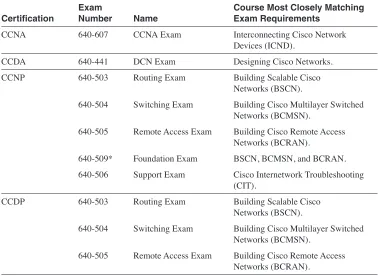
[image:34.612.122.500.404.680.2]To certify for CCNA, a single exam is required: Cisco exam number 640-607. For CCDA, a single exam is required as well. Multiple exams are required for the professional-level certifications—CCNP, CCIP, and CCDP. The exams generally match the same topics that are covered in one of the official Cisco courses. Table 1-1 outlines the exams and the courses with which they are most closely matched.
Table 1-1 Exam-to-Course Mappings
Certification
Exam
Number Name
Course Most Closely Matching Exam Requirements
CCNA 640-607 CCNA Exam Interconnecting Cisco Network
Devices (ICND).
CCDA 640-441 DCN Exam Designing Cisco Networks.
CCNP 640-503 Routing Exam Building Scalable Cisco
Networks (BSCN).
640-504 Switching Exam Building Cisco Multilayer Switched Networks (BCMSN).
640-505 Remote Access Exam Building Cisco Remote Access Networks (BCRAN).
640-509* Foundation Exam BSCN, BCMSN, and BCRAN.
640-506 Support Exam Cisco Internetwork Troubleshooting (CIT).
CCDP 640-503 Routing Exam Building Scalable Cisco
Networks (BSCN).
640-504 Switching Exam Building Cisco Multilayer Switched Networks (BCMSN).
Overview of Cisco Certifications 7
*Exam 640-509 meets the same requirements as passing these three exams: 640-503, 640-504, and 640-505.
Other Cisco Certifications
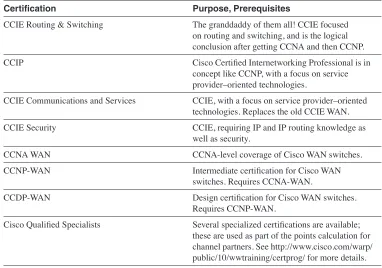
Cisco has many other certifications as well, as summarized in Table 1-2. Refer to Cisco’s Web site at www.cisco.com/warp/public/10/wwtraining/certprog for the latest information.
Certification
Exam
Number Name
Course Most Closely Matching Exam Requirements
640-509* Foundation Exam BSCN, BCMSN, and BCRAN.
640-025 CID Exam Cisco Internetwork Design (CID).
CCIP 640-900 BSCI Building Scalable Cisco
Internetworks.
640-905 Mcast+Qos Exam Implementing Cisco Multicast.
Implementing Cisco QoS.
Various Elective exam(s). Topics include MPLS, CDN, cable, DSL, metro, packet telephony, and security.
Table 1-2 Additional Cisco Certifications
Certification Purpose, Prerequisites
CCIE Routing & Switching The granddaddy of them all! CCIE focused on routing and switching, and is the logical conclusion after getting CCNA and then CCNP.
CCIP Cisco Certified Internetworking Professional is in
concept like CCNP, with a focus on service provider–oriented technologies.
CCIE Communications and Services CCIE, with a focus on service provider–oriented technologies. Replaces the old CCIE WAN.
CCIE Security CCIE, requiring IP and IP routing knowledge as well as security.
CCNA WAN CCNA-level coverage of Cisco WAN switches.
CCNP-WAN Intermediate certification for Cisco WAN
switches. Requires CCNA-WAN.
CCDP-WAN Design certification for Cisco WAN switches.
Requires CCNP-WAN.
[image:35.612.163.545.427.695.2]8 Chapter 1: All About the Cisco Certified Network Associate Certification
What’s on the CCNA Exam
Every test taker would like to know exactly what is on the CCNA exam as well as the other Cisco certification exams. Well, to be honest, exactly what is on the exam is a very closely guarded secret. Only those who write the questions for Cisco and who have access to the entire question database truly know what is really on the exam.
Cisco makes fairly general CCNA exam content available to the public at the Web site www.cisco.com/warp/public/10/wwtraining/certprog/testing/current_exams/640-507.html.
In fact, this direct quote from the Cisco Web site summarizes the exam:
CCNA certified professionals can install, configure, and operate LAN, WAN, and dial access services for small networks (100 nodes or fewer), including but not limited to use of these protocols: IP, IGRP, IPX, Serial, AppleTalk, Frame Relay, IP RIP, VLANs, RIP, Ethernet, Access Lists.
Well, a lawyer might have been involved in crafting that message. “Including but not limited to” is a telling phrase—technically, anything is fair game. All of us would like to study and understand exactly the topics that are on the test. I strive to meet that goal, but keep the following perspective in mind—the exam that you take will not include questions on every topic in Cisco’s CCNA question database. Someone else may get topics that you will not. Many topics are covered on each exam, but with far fewer than 100 questions, it would be impossible to cover all the topics.
So what did we do to help? Well, in this book, we err on the side of covering everything that is fair game on the exam. So, we operate under the following self-imposed rules:
•
If we at Cisco Press believe that a topic is definitely on the exam, it is covered in Chapters 2 through 11. If it’s in the exam question database, even though you might not get it on your individual test, it’s covered in these chapters!•
If we at Cisco Press believe that a topic is simply not in the Cisco CCNA question database, it is not covered in this book.•
If the topic is in the exam question database, but it has a low likelihood of being on the exam, the book notes the corresponding section with an “extra credit” icon.Start Extra Credit
Studying these sections might help, but spend time on these topics only after you have mastered the most important topics.
What’s on the CCNA Exam 9
Cisco posts the list of exam topics on its Web site, www.cisco.com/warp/public/10/wwtraining/ certprog/testing/current_exams/640-507.html.
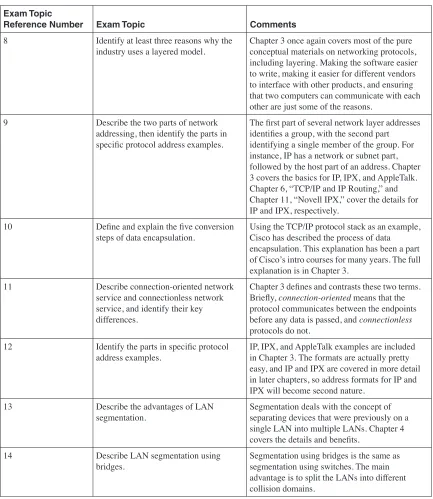
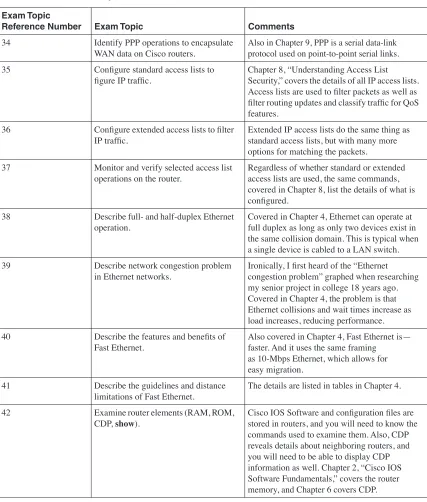
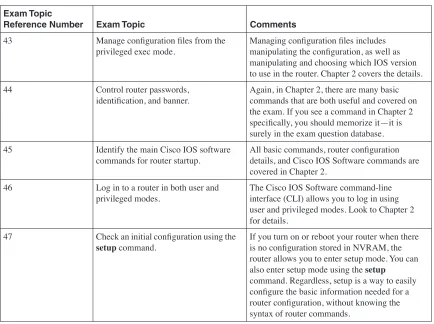
[image:37.612.115.544.252.625.2]These topics provide the greatest insight into what is covered on the exam. The topics are listed in bullet format on the Cisco Web site. To refer to the topics more easily in the book, I have numbered the exam topics. Table 1-3 lists the exam topics, their respective numbers, and an interpretation.
Table 1-3 CCNA Exam Topics and Comments
Exam Topic
Reference Number Exam Topic Comments
1 Name and describe two switching
methods.
Cut-through and store-and-forward are the two types referred to, with a third type being FragmentFree. Chapter 4, “LANs, Bridges, and Switches,” covers the details.
2 Distinguish between cut-through and store-and-forward LAN switching.
Deal with differences in internal processing by a LAN switch. Details are found in Chapter 4.
3 Describe the operation of the Spanning Tree Protocol and its benefits.
STP prevents frames from looping around LANs when physically redundant links exist. Chapter 5, “Intermediate LANs: Spanning Tree, VLANs, and Trunking,” covers the details.
4 Describe the benefits of virtual LANs. Also in Chapter 5, VLANs allow one switch to create multiple broadcast domains instead of requiring a different switch for each different broadcast domain.
5 Describe data link and network
addresses and identify key differences between them.
This topic relates more to the concepts behind addressing, as defined in the OSI reference model. Network addresses are (typically) not correlated to a particular type of physical network, whereas data-link addresses are. Details appear in Chapter 3, “OSI Reference Model & Layered Communication.”
6 Define and describe the function of a MAC address.
Media Access Control (MAC) addresses are used to address LAN network interface cards. These addresses include unicast (addressing a single card), broadcast, and multicast.
7 List the key internetworking functions of the OSI Network layer.
Too much to list here—see Chapter 3 for a complete long list and another shorter, easy-to-memorize list.
10 Chapter 1: All About the Cisco Certified Network Associate Certification
Exam Topic
Reference Number Exam Topic Comments
8 Identify at least three reasons why the industry uses a layered model.
Chapter 3 once again covers most of the pure conceptual materials on networking protocols, including layering. Making the software easier to write, making it easier for different vendors to interface with other products, and ensuring that two computers can communicate with each other are just some of the reasons.
9 Describe the two parts of network addressing, then identify the parts in specific protocol address examples.
The first part of several network layer addresses identifies a group, with the second part identifying a single member of the group. For instance, IP has a network or subnet part, followed by the host part of an address. Chapter 3 covers the basics for IP, IPX, and AppleTalk. Chapter 6, “TCP/IP and IP Routing,” and Chapter 11, “Novell IPX,” cover the details for IP and IPX, respectively.
10 Define and explain the five conversion steps of data encapsulation.
Using the TCP/IP protocol stack as an example, Cisco has described the process of data encapsulation. This explanation has been a part of Cisco’s intro courses for many years. The full explanation is in Chapter 3.
11 Describe connection-oriented network service and connectionless network service, and identify their key differences.
Chapter 3 defines and contrasts these two terms. Briefly, connection-oriented means that the protocol communicates between the endpoints before any data is passed, and connectionless protocols do not.
12 Identify the parts in specific protocol address examples.
IP, IPX, and AppleTalk examples are included in Chapter 3. The formats are actually pretty easy, and IP and IPX are covered in more detail in later chapters, so address formats for IP and IPX will become second nature.
13 Describe the advantages of LAN
segmentation.
Segmentation deals with the concept of separating devices that were previously on a single LAN into multiple LANs. Chapter 4 covers the details and benefits.
14 Describe LAN segmentation using
bridges.
[image:38.612.69.502.167.666.2]Segmentation using bridges is the same as segmentation using switches. The main advantage is to split the LANs into different collision domains.
What’s on the CCNA Exam 11
Exam Topic
Reference Number Exam Topic Comments
15 Describe LAN segmentation using
routers.
The main advantage is to split the LANs into different collision and different broadcast domains.
16 Describe LAN segmentation using
switches.
Segmentation using switches is the same as segmentation using bridges. The main advantage is to split the LANs into different collision domains.
17 Describe the benefits of network segmentation with bridges.
This exam topic and the next two are really simply reworded versions of the previous three topics. All are covered in Chapter 4.
18 Describe the benefits of network segmentation with routers.
This exam topic, like the one before and after it, is really a simply reworded version of the previous three topics. All are covered in Chapter 4.
19 Describe the benefits of network segmentation with switches.
This exam topic, like the two before it, is really simply a reworded version of the previous three topics. All are covered in Chapter 4.
20 Describe the different classes of IP addresses [and subnetting].
This topic covers all details of IP addressing. If you want to work in networking, you need to know this well. Chapter 6 describes the details.
21 Identify the functions of the TCP/IP network-layer protocols.
There are many parts of the TCP/IP protocol suite, including IP. This topic implies that you need to know the various components and their functions—such as TCP, UDP, ICMP, and ARP. Chapter 6 discusses all these protocols.
22 Identify the functions performed by ICMP.
ICMP has many functions, including the ICMP echo and echo reply messages sent when the ping command is used. Chapter 6 covers the details.
23 Configure IP addresses. Configuration of IP addresses is straightforward when you know the format of IP addresses. Configuration is covered in Chapter 6.
[image:39.612.113.546.169.646.2]24 Verify IP addresses. Several show commands list information about the configured IP addresses and whether the corresponding interfaces are up and working. Chapter 6 lists the commands.
Table 1-3 CCNA Exam Topics and Comments (Continued)
12 Chapter 1: All About the Cisco Certified Network Associate Certification
Exam Topic
Reference Number Exam Topic Comments
25 List the required IPX address and encapsulation type.
Chapter 11 covers all the details of IPX, including encapsulation types. When a router forwards a packet, it creates a new data-link header. On LANs, there are several alternative types of headers or encapsulation types. Be sure to memorize these types.
26 Define flow control and describe
the three basic methods used in networking.
Flow control is normally performed by OSI Layer 4 protocols, but, in some cases, it is performed by protocols from other layers. The basic methods are all covered in Chapter 3.
27 Add the RIP routing protocol to your configuration.
RIP configuration and the concepts behind this distance vector protocol are covered in Chapter 7, “Routing and Routing Protocols.” RIP is a routing protocol that fills the IP routing table with routes.
28 Add the IGRP routing protocol to your configuration.
Likewise, IGRP configuration and concepts are covered in Chapter 7. IGRP is an alternative routing protocol.
29 Recognize key Frame Relay terms
and features.
Chapter 10, “Frame Relay Concepts and Configuration,” is devoted to all Frame Relay concepts and configuration. The terms and features are covered in the first section of the chapter.
30 List commands to configure Frame
Relay LMIs, maps, and subinterfaces.
Frame Relay can be configured in several different ways, depending on the network design and the Frame Relay provider. Cisco expects CCNAs to be able to configure all the options.
31 List commands to monitor Frame
Relay operation in the router.
The commands are listed, with examples, in Chapter 10. Cisco will test you on these commands with multiple-choice questions as well as with the simulations on the exam.
32 State a relevant use and context for ISDN networking.
Chapter 9, “WAN Protocols and Design,” covers the details of ISDN concepts and configuration. ISDN is used as a dial technology, both for occasional access and for dial backup.
33 Identify ISDN protocols, function groups, reference points, and channels.
[image:40.612.69.505.169.676.2]What’s on the CCNA Exam 13
Exam Topic
Reference Number Exam Topic Comments
34 Identify PPP operations to encapsulate WAN data on Cisco routers.
Also in Chapter 9, PPP is a serial data-link protocol used on point-to-point serial links.
35 Configure standard access lists to figure IP traffic.
Chapter 8, “Understanding Access List Security,” covers the details of all IP access lists. Access lists are used to filter packets as well as filter routing updates and classify traffic for QoS features.
36 Configure extended access lists to filter IP traffic.
Extended IP access lists do the same thing as standard access lists, but with many more options for matching the packets.
37 Monitor and verify selected access list operations on the router.
Regardless of whether standard or extended access lists are used, the same commands, covered in Chapter 8, list the details of what is configured.
38 Describe full- and half-duplex Ethernet operation.
Covered in Chapter 4, Ethernet can operate at full duplex as long as only two devices exist in the same collision domain. This is typical when a single device is cabled to a LAN switch.
39 Describe network congestion problem in Ethernet networks.
Ironically, I first heard of the “Ethernet congestion problem” graphed when researching my senior project in college 18 years ago. Covered in Chapter 4, the problem is that Ethernet collisions and wait times increase as load increases, reducing performance.
40 Describe the features and benefits of Fast Ethernet.
Also covered in Chapter 4, Fast Ethernet is— faster. And it uses the same framing
as 10-Mbps Ethernet, which allows for easy migration.
41 Describe the guidelines and distance limitations of Fast Ethernet.
The details are listed in tables in Chapter 4.
42 Examine router elements (RAM, ROM,
CDP, show).
[image:41.612.114.541.165.667.2]Cisco IOS Software and configuration files are stored in routers, and you will need to know the commands used to examine them. Also, CDP reveals details about neighboring routers, and you will need to be able to display CDP information as well. Chapter 2, “Cisco IOS Software Fundamentals,” covers the router memory, and Chapter 6 covers CDP. Table 1-3 CCNA Exam Topics and Comments (Continued)