6-1958
Ion-exchange separation of metals by a single-pass
method
Richard T. Oliver Iowa State College J. S. Fritz Iowa State College
Follow this and additional works at:http://lib.dr.iastate.edu/ameslab_iscreports Part of theChemistry Commons, and theMetallurgy Commons
This Report is brought to you for free and open access by the Ames Laboratory at Iowa State University Digital Repository. It has been accepted for inclusion in Ames Laboratory ISC Technical Reports by an authorized administrator of Iowa State University Digital Repository. For more information, please [email protected].
Recommended Citation
Oliver, Richard T. and Fritz, J. S., "Ion-exchange separation of metals by a single-pass method" (1958).Ames Laboratory ISC Technical Reports. 205.
Abstract
A single-pass method for the ion-exchange separations of binary mixtures of metals is described, and experimental applications are presented. The method consists of complexing each of the components in the mixture with a separate complexing agent at a pH sufficient to ensure maximum coordination of the metals. The complexing agents are chosen such that the metal complexes formed are of opposite charge. The mixture is then passed through an ion-exchange resin which absorbs one species completely, allowing the other to be collected in the effluent. An anion-or cation-exchange resin is used.
Disciplines
Chemistry | Metallurgy
1
I
sc.
AL
rsc.-1/JS/o
CHEMISTRY -GENERAL
UNITED ENERGY COMMISSION
ION-EXCHANGE SEPARATION OF METALS BY A SINGLE-PASS METHOD
By
Richard T. Oliver J. S. Fritz
June 1958
AJnes Laboratory Iowa state College AJnes, Iowa
Work performed under Contract No. W-7405-Eng-82.
LEGAL
NOTICEThis report was prepared as an account of Government sponsored work. Neither the United States, nor the Commission, nor any person acting on behalf of the Commission:
A. Makes any warranty or representation, express or implied, with respect to the accuracy, completeness, or usefulness of the information contained in this report, or that the use of any information, apparatus, method, or process disclosed in this report may
not infringe privately owned rights; or
B. Assumes any liabilities with respect to the use of, or for damages resulting from the use of any information, apparatus, method, or process disclosed in this report.
As used in the above, "person acting on behalf of the Commission" includes any em-ployee or contractor of the Commission to the extent that such emem-ployee or contractor prepares, handles or distributes, or provides access to, any information pursuant to his employment or contract with the Commission.
This report has been reproduced directly from the best available copy.
Printed in USA. Price $1.25. Available from the Office of Technical Services, Department of Commerce, Washington 25, D. C.
ISC-1056
ION-EXCHANGE SEPARATION OF METALS BY A
SINGLE-PASS METHOD*
Richard T. Oliver and J.
s.
FritzABSTRACT
A single-pass method for the ion-exchange separations of
binary mixtures of metals is described, and experimental
applica-tions are presented. The method consists of complexing each of the
components in the mixture with a separate complexing agent at
a pH sufficient to ensure maximum coordination of the metals.
The complexing agents are chosen such that the metal complexes
formed are of opposite charge. The mixture is then passed
through an ion-exchange resin which absorbs one species completely,
allowing the other to be collected in the effluent. An
anion-or cation-exchange resin is used.
Sulfosalicylic acid was used to form a negative complex
with iron, uranium, aluminum, thorium, zirconium, and yttrium.
Ethylenediamine was used to form a positive complex with copper,
zinc, nickel or cadmium. Quantitative separations of binary
mixtures containing one metal from each of these groups were
performed at pH values ~ 9, and 10 using Dowex-50xl2, NH4 form
(nuclear sulfonic cation exchange resin) and amberlite IRA-401
(quaternary amine anion-exchange resin).
*
This report is based on an M.S. thesis by Richard T. Oliversubmitted June, 1958, to Iowa State College, Ames, Iowa. This
TABIE OF CONTENTS
INTRODUCTION
BASIS OF THE METHOD
EXPERIMENTAL NECESSITIES
Reagents Solutions Apparatus
EXPERIMENTAL
Preparation of the Ion-Exchange Resins
Cleaning Regeneration
Preparation of Ion-Exchange Columns for Separations
Preparation and Treatment of Samples Analysis of Samples
Data
Uranium Iron
Copper, zinc, nickel, and cadmium
DISCUSSION
LITERATURE CITED
INTRODUCTION
Analytical chemistry is the study of methods for
de-termining elements and compounds as well as the application
of these methods to practical problems. These elements and
compounds can exist individually or in mixtures. In the
ideal situation methods of analysis are sought that are
specific for the individual component without interference
from foreign ions. This situation, although occurring
frequently, is still absent in a great number of analyses.
For this reason the analytical chemist 1s continually
search-ing for methods by which interfersearch-ing constituents can be
re-moved prior to analysis, or better yet, rere-moved from the
reacting system without being physically withdrawn, as by a
masking agent. The primary purpose of this research is to
use ion exchange for the separation of metal cations based
upon the ability of different metals to form complexes of
opposite charge with separate complexing agents. A second
indirect purpose is to employ ion exchange for the separation
of anions and cations in order to systematize qualitative and
quantitative analysis.
Ion exchange is by no means a new process, having been
used for many years for the softening of water. The
litera-ture prior to
1955
has been adequately dealt with by Kunintheoretical and practical applications of aqueous and
non-aqueous ion exchange. A group of papers covering the theory
and application of ion exchange has been published by the
Society of Chemical Industry in London
(33).
AnalyticalChemistry reviewed the subject in
1956
(56).
The last twovolumes of the Annual Review of Physical Chemistry (29, 101)
have included review articles covering all aspects of the
theory of ion exchange and ion-exchange resins as well as a
large number of analytical separations. other worthwhile
reviews of the uses of ion exchangers in analytical
chemis-try
(35-37),
analytical separations(76),
and general uses(54, 55,
57)
have appeared during the past two years.Addi-tional review articles are scheduled to appear shortly
(4,
25).
Samuelson
(74,
p. vii) divides the applications of ionexchange for analytical separations into two classes:
(1) Separatio~s of ions from each other due to
differences in exchangeability (ion-exchange
chromatography) •
(2) Separations of exchangeable ions from
non-exchangeable ions (single-pass method).
In the chromatographic method all ions are first absorbed at
the top of the resin bed and then caused to be desorbed
(eluted) differentially. This method can be subdivided into
"true ion-exchange chromatography" and "the displacement of
a single component." In the single-pass method the
ability of the ionic species is altered prior to loading the
resin. Thus when the sample solution is being percolated
through the resin bed only exchangeable ions are absorbed
while the non-exchangeable ions pass into the effluent
there-by effecting the desired separation.
True ion-exchange chromatography using constant elution
conditions is probably best illustrated by the work of
Sped-ding and co-workers
(81-86)
who completely resolved the rareearths into the pure elements. The rare earths were loaded
onto a hydrogen form cation-exchange resin and eluted with a
dilute solution of citric acid at a low pH. Later, the
sepa-ration was improved by using a copper form resin and eluting
with EDTA ~ethylenedinitrilo)tetraacetic aci~ (91). Macro
amounts of the spectrographically pure rare earth elements
were obtained. They also developed the quantitative theory
involved in their work
(82-85).
Hollack and Hartinger (31, 32) have investigated the
dependence of the separation of the cerium earths on
complex-forming elutrients and the type of exchanger employed. The
use of EDTA and nitrilotriacetic acid as eluting agents were
investigated by Topp (103) and Fitch and Russel (19, 20).
Freiting and Bunney
(21)
found that lactic acid at 87°C. gavea better separation for europium and samarium than did citric
acid. They also used a discontinuous gradation in eluant
strength for the separation of terbium and gadolinium from
of elutrients sometimes varied as a function of pH and flow
rates. Choppin and Silva
(14)
found a-hydroxy-isobutyricacid better than EDTA with respect to flow r~te and better
.than citric and lactic acids with respect to separation
factors. Mazza and Galitti
(62)
made a study of thein-fluence of salt type and the speed of introduction into the
column.
Ion-exchange chromatography has been used extensively
for the separation of the Lanthanides from Actinides
(5, 15,
95, 109).
Brown and Rieman(12)
separated titanium,zirco-nium, and thorium using citric acid. Separations of iron and
gallium (38), hafnium and zirconium (8, 59), strontium,
barium, and radium
(60, 102),
and magnesium and calcium(13)
have also been reported. Anion separations of halides
(6)
and condensed phosphates (9) were also accomplished by
ion-exchange chromatography.
The best illustration of the displacement of a single
component is in the work of Kraus and his associates
(39-50,
64, 67-69).
In this work the absorbing characteristics ofvirtually all the elements in the periodic chart on
ion-exchange resins were studied as a function of hydrochloric
acid concentration. The usefulness of this separation is
dependent upon the ability of metals to form anionic
com-plexes whose strengths vary as a function of chloride ion
concentration. The metals to be separated are absorbed onto
concentration of acid is decreased slightly and the metal
forming the weakest complex dissociates enough to be
chro-matographically eluted. The other metals either remain on
the resin uneffected or are moved down the column slightly.
Successive species are eluted with decreasing acid
concentra-tions. Mixed solutions of hydrochloric and hydrofluoric
acids are used for the refractory metals
(39,
41-43,
46).
Aperiodic chart showing the anion-exchange behavior of the
elements in hydrochloric acid had been prepared (101).
Mil-ler and Hunter
(63)
have separated rhenium from aluminum andmagnesium using this method. Helwig et al. (30) separated
iron from cobalt, zinc and nickel. A large number of
specif-ic separations are tabulated with references in a recent
re-view article
(76).
Many interesting separations based on the displacement
of a single component but employing different eluting agents
have appeared in the literature. Schubert et al.
(78)
sepa-rated micro amounts of beryllium from calcium, uranium and
copper by elution from a cation resin with sulfosalicylic
acid at pH 3 to
4.5.
Ryabchinkov and Bukhetarov (72)sepa-rated copper from aluminum and iron by cation exchange.
Sali-cylate at pH 10 was used to remove copper1 and hydrochloric
acid was used to remove the iron and aluminum. Uranium was
separated from cadmium
(17)
by eluting the uranium withoxalic acid followed by the removal of the cadmium with
In order to employ the single-pass method of ion
ex-change the ions present in solution must have charges of
opposite sign or one of the components must be neutral.
Um-breit (104) was able to separate thorium from the lighter
rare earths by cornplexing the thorium with EDTA at pH 2. The
thorium formed a. neutral complex with the EDTA thus allowing the
thorium to pass into the effluent while the rare earths, unable to
complex at this low pH, are retained by a cation exchanger.
Gor-don et al. (28) performed a similar separation. Using the
same complexing agent,Taketatsu
(97, 98)
separated bismuthfrom zinc, cadmium, and lead at pH less than 1, and barium
from lead at pH
4
to4.5.
The ion pairs cadmium-lead,iron-manganese, aluminum-beryllium, and bismuth-zinc were also
sep-arated using a suitable pH
(96).
Nadkarni et al.(66)
removedberyllium from aluminum and iron at pH
3.5,
while Bovy andDuychaerts (10) separated strontium and barium at pH
7
to9.
Alimarin and Tsintsevich (3) used tartarate at pH 9 to 10 to
separate gallium from zinc. He also found that
sulfosali-cylic acid or EDTA could be used equally as well. Golovatyi
(26) was able to separate iron, aluminum, or chromium from
some or all of the following metals by using a mixture of
thiocy-anide and EDTA: manganese, zinc, beryllium, magnesium, barium,
calcium, lithium, and potassium. Thompson separated
1
micro quantities of rare earths from a macro matrix of
urani-um and some iron impurities.
}1any investigators employing ion exchange for
separa-tions have used the selectivity of a single complexing agent
to reverse the charge on ionic species. Wheelwright and
Spedding (108) separated a crude rare earth mixture into
heavy and light fractions by adding a calculated amount
of EDTA to complex the heavier rare earths_, allowing them to
pass through a cation-exchange resin. The lighter,
uncom-plexed rare earths were absorbed by the resin. Usatrenko
and Datsenko (105) separated calcium and magnesium from iron
and aluminum using tartaric acid to form anionic complexes
with the latter elements. MacNevin and Crummett (61)
sepa-+2 ' 3
rated the Pd(NH3 )
4
cation from Irc16- • Other separationsusing cation-exchange resins are zirconium from iron and
nickel using nitric acid at pH
0.5
to 1.95 (1), molybdenumfrom iron in a sulfuric acid-peroxide solution (2), and
rho-dium from irirho-dium using thiourea (79). Freund and Miner (22,
23) used an anion-exchange resin to separate aluminum from
iron in a dilute hydrochloric, hydrofluoric acid mixture.
The uncomplexed aluminum passes into the effluent while the
iron-halide complex absorbs on the resin. This same
separa-tion was also accomplished with acid thiocyanate solusepara-tions
(99, 100). Calcium, aluminum, and iron were resolved by a
combination of a single pass of the solution through the
and iron with varying hydrochloric acid concentrations
(75).
The separation of iron and chromium from thiocyanate or
thio-sulfate solutions has also been accornp lished ( 106) • Murthy
+2 -1
(65)
was able to remove all the vanadium from auo
2 ,vo
3
mixture by the use of sodium carbonate and an anion-exchange
resin. Small amounts of the vanadium adhered to the resin
but were washed free with a carbonate solution.
The single-pass method considered in this report employs
two complexing agents to form stable complexes with different
cations so that the charges of the species formed are
oppo-site in sign. A number of separations using this principle
have been reported recently. Golovatyi (27) performed a
group separation by complexing iron, aluminum, and chromium
as negatively charged phosphates and copper, zinc, cobalt,
nickel and cadmium as positively charged amine complexes and
passed them through a cation-exchange resin. Individual
separa-tions were also reported. Belyavskaya and Fadeeva
(7)
usedammonium carbonate in ammoniacal solution to separate
beryl-lium from copper and nickel, while others used tartrate or
citrate in ammoniacal solutions for a copper-lead separation
(52).
Ryabchinkov and Osysova(73)
reported the separationof copper, aluminum, and magnesium; iron, and nickel or
manganese; iron chromium, and manganese based upon the
vary-ing complexvary-ing abilities of the cations concerned with
BASIS OF THE METHOD
The single-pass separation of a binary mixture of metals
can only be accomplished when one metal exists as a cation
(either complexed or free) while the other metal is an
an-ionic or neutral complex. There are several possible ways
to alter the metal cations to satisfy the above conditions:
(1) Use a complexing agent that will react with only one of
the metal cations. Examples--Polyamines react with zinc,
copper, cadmium, etc., but not with iron, aluminum, calcium,
thorium, etc. Cyanide reacts with zinc, but not with
magne-sium. This procedure generally works only in acid solutions because of precipitation of the hydrated oxides of the
unre-acted metal. (2) Use a non-selective complexing reagent that
forms neutral or anionic complexes with both metals but to
varying degrees depending upon pH. Examples-- EDTA forms a
stable, neutral complex with thorium at a pH of 2 but does
not react with the rare earths. Salicylate complexes
beryl-lium at pH 3 but not the alkali earths. Here work is
general-ly confined to a low pH range due to formation of stable
com-plexes with both metals in less acidic solutions.
(3)
Twocomplexing agents may be employed simultaneously; the first
to form a positively-charged complex with one metal and the
second to form a neutral or negatively-charged complex with
the other. Examples-- Carbonate and ethylenediamine can be
copper ethylenediamine cation (CuEn2+2 ). Tartrate and
1,10-phenanthroline may be used for the separation of
alumi-num and iron (II). The double complexing agent procedure is
useful in both alkaline and acid solutions, with the lower
limit of acidity a function of the dissociation of the
com-plexes.
Of the three ways to prepare a binary metal solution for
a single-pass separation, the "double complexing agent"
meth-od is the most versatile. The first method is limited in ap··
plicability by a lack of completely selective complexing
agents forming soluble complexes and the precipitation of the
non-reacted metal in slightly acid or basic solutions. The
second method, although very useful, is confined to mixtures
in which the components form complexes with the same reagent
at various pH values. Often the stabilities of the metal
complexes are so close together that pH control within narrow
limits is essential. The double complexing method is not
hampered by precipitation of the metal hydrated oxides
be-cause these metals are also complexed. Narrow limits of pH
control are avoided because most complexes are stable over
a fairly wide pH range. It must be kept in mind, however,
that the single-pass ion-exchange separation is a composite
of all three methods, neither one functioning as a complete
means of separating all metal combinations.
A basic knowledge of the complexes formed in aqueous
necessary for the oelection of reagents in the
double-complexing procedure. Other than the trial and error method,
a knowledge of the formation constants of the metal with each
of the two reagents would be helpful. Since an excess of
complexing agents is usually present to ensure complete
co-ordination of the metals, there is the possibility that one
of the metals would form a complex with each of the reagents
and thus appear in both the effluent and eluant. If the
absolute difference in the log k values is less than
4,
thatis !log k 1 - log k2
j<
4,
where k 1 is the stability constant of the maximum coordinated complex between the metal underconsideration and one complexing agent, and k 2 is the sta-bility constant for the same metal with the second complexing
agent, then this is likely to happen. However, if the
spe-cies being absorbed by the resin has the greater log k then
absorption by the resin would tend to give a larger apparent
stability complex, resulting in the dissociation of the
non-absorbed complex between the metal and the second complexing
agent and the appearance of the component in the effluent
being negligible. If the species not absorbed has the higher
log k value then Alog k would have to be somewhat greater
than
4
depending on the equilibrium absorption constantsEXPERIMENTAL NECESSITIES
Reagents
Ion-exchange resins: Dowex-lx2, Cl form, 40-100 mesh
and Amberlite IRA-401, Cl form, 20-50 mesh, both strongly
basic resins of the quaternary amine type,and Dowex-50xl2,
NH
4
form, 50-100 mesh (a nuclear sulfonic acid resin)wereused throughout this work unless otherwise noted.
EDTA [disodium
dihydrogen(ethylenedinitrilo)tetraace-tate di-hydrat~ : Sequestrene Na 2 recrystallized, as
marketed by Geigy Industrial Chemicals Co.
Zinc: Primary standard zinc for melting point
determi-nation obtained from the National Bureau of Standards.
Sodium formate: Baker and Adamson reagent grade.
Sulfosalicylic acid: J. T. Baker Chemical Co.
"ana-lyzed reagent".
Hydrochloric acid: Baker and Adamson reagent grade.
Perchloric acid: Baker and Adamson reagent grade.
Nitric acid: Baker and Adamson reagent grade.
Sodium hydroxide: J. T. Baker Chemical Co. "analyzed
reagentu.
Pyridine: Fisher Scientific Company "certified reagent 11 •
Ammonium acetate: J. T. Baker Chemical Co. "analyzed
reagent".
..
Ethylenediamine: Eastman Kodak practical grade.
Triethylenetetramine: Eastman Kodak technical grade.
Ferrous sulfate heptahydrate: Merck reagent grade.
1,10-Phenanthroline monohydrate: G. Fredrick Smith
Chemical Co •
Naphthyl azoxine
[7-(1-naphthylazo)-5-sulfo-8-hydro.xyquinolineJ : Supplied by Analytical Group II of the
Ames Laboratory. The preparation and properties of this
indicator are given by Fritz, Lane, and Bystroff
(24).
Ceric ammonium nitrate: G. Fredr1ck Smith Chemical Co.
reagent grade.
Lead: J. T. Baker Chemical Co. nanalyzed reagent".
Water: All water used in preparing solutions and
carry-ing out separations was distilled and deionized.
The metal ions investigated in this work were obtained
from the following sources: Uranium and yttrium from the
Ames Laboratory of the United States Atomic Energy
Commis-sion. All others except those specifically noted above were
reagent grade laboratory chemicals.
Solutions
EDTA (0.05 ~): Dissolve 18.6 g. of reagent grade EDTA
in one liter of water. Standardize against a standard zinc
solution (see below) using eriochromeblack T indicator and
Zinc (0.05 m): Pure zinc metal is weighed out on a
triple-beam balance and etched in 1:1 nitric acid-water to
remove the oxide coating. The zinc is removed from the acid
after 1 to 2 minutes, washed with water then acetone. It is
dried, accurately weighed, and dissolved in a small amount
of 1:1 nitric acid-water in a covered beaker. lVhen all the
zinc has dissolved, the solution is quantitatively transferred
to a 1 liter volumetric flask and diluted to the mark with
water. 3.2690 g. of zinc are required for an exactly 0.05
m
solution.
Eriochromeblack T: Prepare the indicator for use by
mixing the powdered dye with sodium chloride in a 1:20 w/w
ratio. The indicator thus prepared is stable indefinitely.
The dye-salt mixture is added to the titration vessel by means
of a small spatula in an amount sufficient to give a color
in-tensity that makes the end point easily discernible.
Ammonia-ammonium chloride buffer:
67.5
g. of ammoniumchloride is mixed with
570
ml. of concentrated ammoniumhy-droxide and diluted to 1 liter. One ml. of this buffer
solu-tion is used for each titrasolu-tion on the EDTA standardization.
Naphthyl azoxine (1%): One g. of the indicator is
dis-solved in 99 g. of dimethylformamide.
Ammonium acetate-acetic acid buffer:
77
g. of ammoniumacetate is mixed with 60 ml. of concentrated acetic acid and
diluted to 1 liter. One ml. of this buffer solution is used
Formate buffer: Approximately 0.1 g. of sodium formate
is added to the titration vessel and the pH adjusted to the
desired value with perchloric acid or ammonium hydroxide.
Lead reductor: The lead reductor was prepared according
to the procedure of Sill and Peterson (80).
Sulfatoceric acid (0.05 ~): The sulfatoceric acid was
prepared and standardized according to the procedure of Diehl
and Smith (16, p. 273 ) •
Ferroin indicator (0.025 m): Ferroin indicator was
pre-pared by mixing 1.4866 g. of 1,10-phenanthroline monohydrate
with 0.6951 g. of ferrous sulfate heptahydrate and dissolving
in 100 ml. of water.
Metal ion solutions (0.05 ~): The required amount of the metal, oxide of the metal, or salt of the metal is
dis-solved in water or acid, as required, and diluted to 1 liter
with water.
Apparatus
Burettes: Kimble "normax" burettes were used throughout
this work.
Pipettes and volumetric glassware: Kimble 11exax11
pi-pettes and volumetric glassware were used throughout this
work.
Stirrer: A magnetic stirrer was used rrith
pH meter: All pH measurements were made on a Beckman
model-G pH meter equipped with a Beckman 1190-80 glass
elec-trode and a Beclanan 1170 calomel reference elecelec-trode.
Stand-ard Beckman buffers were used to standStand-ardize the instrument.
Ion-exchange columns: The ion-exchange columns were
prepared in the following way: A course sintered-glass disc
was sealed into a 25 mm. glass tubing approximately 10 mm.
from the end. The end was tapered down and sealed to a short
length of
6
mm. tubing. The 25 mm. tubing was cut off4
inches above the sintered disc and joined to a
50
mm. diame-ter extension tube. This larger tubing was cut two inchesfrom the seal giving an overall height of six inches. A
three inch piece of tygon tubing fitted with an eye dropper
(for a tip) and a screw clamp was placed on the lower end of
the column to complete the setup. A regular 60° filtering
funnel with a short stem was inserted into a no. 6 1-hole
rubber stopper and placed in the top of the column. This
served as a reservoir for influent solutions.
Lead reductor: The lead reductor column was prepared
in the same manner as the ion-exchange columns. However, a
30 inch length of 25 mm. tubing made up the stem of the
EXPERIMENTAL
Preparation of the Ion-Exchange Resins
It is essential that the ion-exchange re$ins for use
in analytical chemistry be reagent grade matePials. Rohm
and Haas Co. supplies analytical grade Amberlite resins
that are ready for regeneration into the desired form.
The Dowex resin~ on the other hand, are known to contain
con-siderable quantities of metallic impurities (a teflon-covered
stirring bar actually picked out slivers of iron from a batch
of Dowex-1) and have to be cleaned prior to use. Once the Dowex
resin is free from impurities it will remain reagent
grade under constant use provided that the resin is properly
re-generated after each use. The procedures for regeneration
should be adhered to rigorously as any deviation in treatment of
the resin during a series of investigations might alter the
re-sults. Samuelson
{74,
p.60 )
discusses the general aspects of regeneration in his book on ion-exchange. For morespe-cific information about regeneration for analytical purposes
consult the work of Djurfeldt and Samuelson (18).
The resin is treated in two steps: First, it is freed
of any contamination (the cleaning step) and second,it must
be generated into the desired form (the regeneration step}.
For resins designated as analytically pure the first step can
Cleaning
Approximately 250 g. of moist resin is rinsed into a large column similar to that described in the previous sec-tion. This column is
7
em. in diameter and 30 am. high with a course glass frit sealed into its base and the glassta-pered to 15 mm. below the frit. A 10 em. length of 13 mm. rubber tubing is fitted to the glass taper and a screw clamp placed on the rubber tubing. The purpose of the clamp is to
control the flow of liquid from the column. The resin is
backwashed to remove the fines and any other loose
non-resinous material. A backwash flow rate sufficient to cause a
5o%
resin bed expansion was used. When the water above the resin is free from fines and all air bubbles are excluded from the column the back flow is discontinued and the water allowed to drain to within 2 em. from the top of the resin bed. From this point on until after the regeneration stepthe liquid level is not allowed to fall below the level of the
resin bed. A 500 ml. separatory funnel fitted with a no. 13
1-hole rubber stopper is then placed into the top of the col-umn and filled with 1 ~ hydrochloric acid. The funnel stop-cock and screw clamp are opened and 250 ml. of the acid is allowed to percolate through the resin at maximum flow rate. This operation rapidly replaces the water with acid. The remaining acid is passed through the resin at a flow rate of
5
to 8 ml. per min.,· the rate is controlled by means of thescrew clamp while the stopcock is held open. When the acid
reaches the stem of the funnel the screw clamp is closed and the process repeated with 1 ~ sodium hydroxide. The percola-tion of acid then base is continued until one liter of base is used. A final 250 ml. of acid is used to neutralize the base in the resin and one liter of water percolated through to remove any excess acid.
Passage of blank samples through fractions of the cleaned resin showed negligible titers when analyzed with cerium (IV) or EDTA according to previously described procedures. Alter-native procedures are also available. Umbreit (104, p. 21) used a 10% w/w ammonium citrate solution to remove tri- and tetravalent ion contaminants. Iron was removed from anion resins by Thompson1 who added 1,10-phenanthroline and
hydrox-ylammonium chloride to a slurry of resin, which was then filtered
and washed to remove excess reagents and the ferrous
1,10-phe-nanthroline complex.
Regeneration
Used resin that is to be regenerated should be placed in the column and backwashed, as described above, to effect a loosely packed resin bed free of channels.
500 ml. of 3
m
ammonium chloride is placed in the separatory funnel following the final water wash of the cleaning step and allowed to percolate through the resin1 Thompson, J., Ames, Iowa. Ion-exchange separation of
bed at maximum flow rate. After half of the salt solution has been used the flow rate is reduced to
5
to8
ml. per min. When the last of the ammonium chloride solution reaches the stem of the separatory funnel, the funnel is refilled with more of the same without interrupting the flow rate. This is repeated once more so that 1250 ml. of 3 m ammonium chloride has passed through the resin at the5
to 8 ml. per min. flow rate. The flow rate may be increased if desired but at least one hour of contact time between resin and fresh ammonium chloride solution should be maintained. Finally, the resin is backwashed to remove the excess salt solution. A drop of silver nitrate added to a fraction of the backwash effluent acidified with nitric acid serves as a test for the complete removal of chloride ion. The wet resin is transferred to a wide mouth jar and the excess water decanted off. The resin is used directly from the jar with no further treatment.Preparation of Ion-Exchange Columns for Separations
Dowex-lx2 and Amberlite IRA-401, both strongly basic quater-nary ammonium type anion-exchange resins, and Dowex-50xl4 a
nuclear sulfonic acid cation-exchange resin, all prepared as di-rected, were used throughout this work except where otherwise noted. For column separations, eight grams of air dried
resin is weighed into a 150 ml. beaker and water is added to
columns to which 10 ml. of water has been added. After the
resin has settled the column is tapped lightly to level the
resin. The height of the resin bed is measured and all
col-umns marked with a red band at that height. The markings
serve as a guide for taking approximately the same amount of
resin for each separation without having to dry the moist
resin and weigh it out each time. An exact measurement of
the amount of resin used is not necessary in these
single-pass separations. It is only necessary that the resin be in
excess of the ionic equivalent in the sample solution. Next,
the water level is adjusted to within one em. above the resin
bed and the filter funnel attachment inserted so that the tip
of the funnel just touches the surface of liquid in the
col-umn. The pH of a wash solution lo-
3
m in bothcomple~ing
agents is adjusted to the desired value and
50
ml. pouredinto the funnel and allowed to percolate through the resin
at a rate of
5
to 10 ml. per min., the flow rate beingad-justed by the screw clamp at the base of the column. When
the solution level drops to the stem of the funnel an
addi-tional
50
ml. of the wash solution is added. This is repeateduntil the effluent pH is within 0.3 pH units of that of the
influent solution. This usually requires less than 100 ml.
When the proper pH conditions have been satisfied the liquid
is allowed to drain to the funnel stem and the screw clamp
The preparation of resin for batch operation is somewhat
simpler. The required amount of wet resin is transferred to
a 150 ml. beaker and 100 ml. of wash solution added•
The pH is then adjusted to the desired value while the
resin is being stirred vigorously with a may1etic stirrer.
After the desired pH has been obtained the resin is allowed
to settle out and the excess solution decanted off. The
res-in is used in this condition.
Preparation and Treatment of Samples
The composition of the samples is dependent upon the
in-formation sought. For example, if the exchange behavior of
a single metal ion in the presence of one or both complexing
agents is being studied, the other metal of the binary sample
may be left out along with the second complexing agent. The
preparation and treatment of binary metallic solutions will be
described here; however, the treatment of all samples will be
the same.
Five ml. aliquots of the 0.05
m
stock solutions of eachmetal to be separated are pipetted into a 150 ml. beaker
con-taining a teflon covered stirring bar. Twenty ml. of
dis-tilled water are added and the pH checked with hydrion paper.
The solution should be strongly acid as a result of the
man-ner in which the stock solutions were prepared. Thirty ml.
ml. of
0.5
~ ethylenediamine. For the cation-exchangesepa-rations two ml. of ethylenediamine are added. The mixture is
placed on a magnetic stirrer, stirred, and the pH adjusted to
~ the desired value using ammonium hydroxide or perchloric acid. Part of the solution is quantitatively transferred to the funnel
on top of the ion-exchange column and allowed to pass through
the resin at maximum flow rate into a 250 ml. beaker. Without
interrupting the flow rate or allowing the liquid level to fall
below the stem of the funnel, transfer the remainder of the
sample is transferred into the funnel. The beaker is rinsed
three times with the wash solution; the washings are poured into
the funnel each time. Fifty ml. of water are added after the
washing and the screw clamp closed when the water level reaches
the funnel stem. The effluent is saved for analysis.
When the species absorbed by the resin is of no interest
the resin is placed in a collection jar for regeneration at a
later time. In the cation-exchange separations where the
ab-sorbed species are to be analyzed the resin is eluted as
fol-lows: fifty ml. of 3 ~hydrochloric acid are poured into the
funnel above the resin and percolated through the resin at a
flow rate of 1 to 2 ml. per min. followed by
50
ml. of water.The eluate is collected in a
250
ml. beaker and saved foranalysis.
For the batchwise separations the solution is prepared
in the same manner as described above. A stirring bar and
sample beaker and the contents stirred magnetically. The pH
is checked while stirring, and adjusted to the desired value
if any deviation occurs. The solution and resin are mixed
vigorously for five minutes. The sample is removed from the
stirrer and its contents quantitatively filtered using normal
filtering techniques. The resin is washed several times with
wash solution and all filtrates collected in a 250 ml. beaker
for analysis.
Analysis of Samples
Uranium
Uranium is analyzed by a method of Sill and Peterson (80)
which was modified slightly. The uranium (IV) resulting from
the reduction of uranium (VI) in a lead reductor is collected
in an excess of ferric chloride and the resulting ferrous
iron determined as described below.
Iron is analyzed by titration with sulfatoceric acid as
described in Diehl and Smith
(16,
p.276).
The reduction offerric iron is carried out in a lead reductor as described
above for uranium.
Copper, zinc, nickel, and cadmium
These metals were analyzed by the method of Fritz, Lane
Data
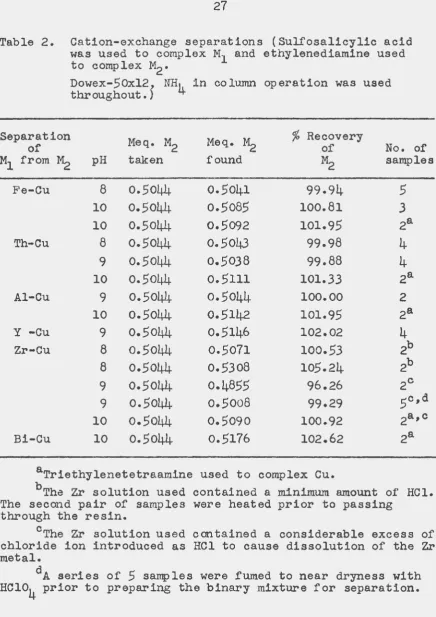
A summary of the ion-exchange separations performed is
tabulated in Tables 1 and 2. Uranium, iron, thorium,
alumi-num, yttrium, zirconium, and bismuth were complexed with
sulfosalicylic acid while copper, zinc, nickel, and cadmium
were complexed with ethylenediamine. Dowex-lx2, Cl and
Amber-lite IRA-401, Cl, both strongly basic quaternary amine resina
and Dowex-50xl2, NH
4,
a nuclear sulfonic acid resin wereJusedthroughout. The anion-exchange separations were performed in
batch and column operations with equal ease and flexability.
The batch technique is especially convenient since it
re-quires no special equipment for its use. The column method
was used exclusively throughout the cation-exchange
separa-tions because the absorbed copper had to be eluted prior to
analysis.
The success of each separation was determined by the
re-covery of the metal forming a complex with ethylenediamine.
For the anion-exchange separations the effluents were analyzed
for zinc, copper, nickel, or cadmium (Column six, Table 1) to
determine the efficiency of the separation. For the
cation-exchange separations the copper was eluted from the resin and
analyzed to determine the extent of separation. That a
sin-gle analysis is truely a measure of the completeness of the
anion-exchange separations was shown by absorption studies of
Table 1. Anion-exchange separations (Sulfosalicylic acid
used to com)lex M1 and ethylenediamine used to
complex M2 •
"
Separation "
of Meq. M2 Meq. ~ %Recovery No. of M1 from M2 Resin pH taken fotmd of M2 samples
U-Zn IRA-40la 9 0.88.50 0.8712 98.44 3b
Dowex-lx8c 9 0.88.50 0.8736 98.71 1
Dowex-lx2° 9 0.6019 0 • .5983 99.40 2
Dowex-lx2° 10 0.88.50 0.8841 99-90 1
10 2.213 2.200 99-41 1
Fe-Zn Dowex-lx2a 10 0.6019 0.6014 99.92 2
u
-cu IRA-40la 8 0 • .5044 0 • .5037 99.87 3IRA-40la 10 0 • .5044
o •
.5oo8 99.28 3U -Ni IRA-40la 8 0-4.53.5 0.4489 98.99 4
Dowex-lx2° 10 0.4917 0.4892 99-49 1
U -Cd Dowex-lx2c 8 0 • .5344 0 • .5283 98.86 2
Dowex-lx2° 10 0 • .5344 0 • .5228 97.82 2
aBatchwise operation.
bA turbidity resulted when resin and solution were mixed.
[image:32.562.63.489.86.509.2]Table 2. Cation-exchange separations (Sulfosalicylic acid
was used to complex M1 and ethylenediamine used
to complex ~·
Dowex-50xl2, NH
4
in column operation was used throughout.)Separation of
M1 from~
Meq. M2
pH taken
Meq. M2
found
%
Recovery ofM2
No. of samples
Fe-Cu
Th-Cu
Al-Cu
Y
-cu
Zr-Cu
Bi-Cu
8
0.504410
0.5044
10
0.5044
8
0.5044
9
0.5044
10
0.5044
9
0.5044
10
o.5o44
9
o.5o44
8
0.5044
8
0.5044
9
0.5044
9
0.5044
10
0.5044
10
0.5044
0.5041
0.5085
0.5092
0.5043
0.5038
0.5111
o.5044
0.5142
0.5146
0.5071
0.5308
0.4855
o.5oo8
o • .5090
0.5176
99.94
100.81
101.95
99.98
99.88
101.33
100.00
101.95
102.02
100.53
105.24
96.26
99.29
100.92
102.62
aTriethylenetetraamine used to complex Cu.
5
3 2a4
4
2a 2 2a4
2b 2b 2c5c,d
2a,c 2abThe Zr solution used contained a minimum amount of HCl. The second pair of samples were heated prior to passing
through the resin.
cThe Zr solution used contained a considerable excess of chloride ion introduced as HCl to cause dissolution of the Zr
metal.
[image:33.561.64.501.37.655.2]Table 3. Cation-exchange behavior of Cu and Fe on
Dowex-50xl2, NH4 as a function of sulfosalicylic acid
(SSA) and ethylenediamine (en) concentrations
Ml. 0.05.!!! Ml.
o.o5
m Ml. 0.1 m Ml.0.5
m%
RecoveryCu Fe SSA En pH of Cu
0 10 20 10 10 1.84
5
10 20 10 10 101.845
0 10 10 10 100.005
0 20 10 10 100.195
0 0 10 10 100.005
0 0 10 10 100.005
0 10 0 10 98.855
0 2 0 10 99.245
10 30 2 10 100.785
10 30 2 8 100.285
10 30 1 8 99.88metals are intensely colored and form sharp bands at the top
of the light yellow resin bed. Effluents from these columns
contained no trace of uranium or iron when the solutions
were reduced in a lead reductor and titrated with cerium (IV).
During the early stages of the cation-exchange
separa-tions high results were obtained after eluting the resin and
[image:34.561.56.491.115.449.2]the effect of the complexing agent concentration on the
ab-sorption of iron and copper. The results are listed in
Table
3.
After an increase in the sulfosalicylateconcen-tration the copper recoveries were quantitative both from
binary mixtures and when copper was used alone. This
indicated that a single copper analysis would be sufficient
DISCUSSION
The anion-exchange separations reported in Table 1 are
best performed using Dowex-lx2 in column operation.
Amber-lite IRA-401 when used batchwise gave a quantitative
separa-tion of uranium from copper but only a fair separasepara-tion of
uranium from nickel. Cadmium was not quantitatively
re-covered from the effluent of a Dowex-lx2 column. Evidence
is not complete enough to be able to compare the
anion-exchange behavior of Dowex-1 and Amberlite IRA-401~ Tbe
failure of Dowex-lx2 to effect a separation of uranium and
cadmium while doing so for zinc appears anomalous since zinc
and cadmium from complexes of very similar stability.
In the cation-exchange separations (Table 2) some
dif-ficulty was encountered with the first system investigated.
Preliminary exchange behavior experiments were carried out
on both copper and iron in the presence of their respective
complexing agents. The results indicated that all the copper
was absorbed by the resin and all the iron was collected in
the effluent. However, when both metals and both complexing
agents were mixed a high copper recovery was obtained after
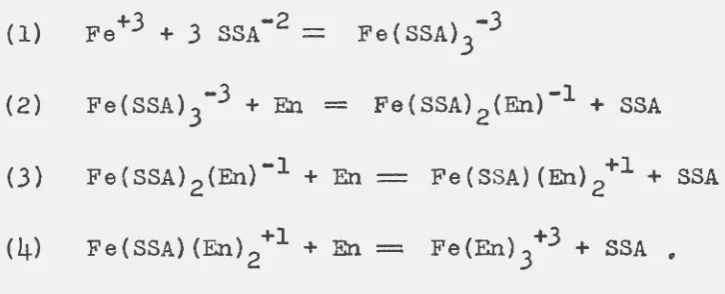
each separation. The formation of a mixed
iron-ethylenedi-amine-sulfosalicylate complex is proposed as a possible
ex-planation for the high recovery of copper. Equilibria
in-volving iron, ethylenediamine, and sulfosalicylate are as
(1) Fe+3 +
3
SSA- 2==
Fe(SSA) 3 -3
(2) Fe(SSA) 3-3 +En
=
Fe(SSA) 2 (En)-l + SSA(3) Fe(SSA) 2 (En)-l +En Fe(SSA)(En) 2+l + SSA
Fe(SSA)(En) 2+l +En-- Fe(En) 3+3 + SSA •
The existence of a cationic species represented by reaction
(4)
is highly unlikely since iron precipitates in thepres-ence of ethylenediamine and no trace of precipitation was
observed during the experiments when sulfosalicylate was
present. The singly charged cation of reaction (3) might
exist and would be absorbed along with the
copper-ethylene-diamine complex. An increase in sulfosa1icylate
concentra-tion and a decrease in ethylenediamine concentration would
tend to surpress the formation of the mixed iron complexes
leading to a more efficient separation. The absorption
be-havior of copper and iron on Dowex-50xl2 as a function of
the concentrations of complexing agents shows this postulate
to be valid. The results for the copper-iron separation in
Table 2 were obtained using a minimum ethylenediamine
concen-tration.
Several other points concerning the cation-exchange
separations are to be noted. Triethylenetetramine was used
as a complexing agent for copper in a number of separations.
[image:37.560.98.461.68.215.2]Triethylenetetraamine is a slightly stronger complexing agent
than ethylenediamine and would be expected to form more
stable mixed complexes than ethylenediamine. This results in a situation not unlike the copper-iron system mentioned
above.
The high results of the copper-yttrium separation proba-bly indicate a weak yttrium sulfosalicylate complex. A 1:1
complex between yttrium and sulfosalicylate would be absorbed
by the resin.resulting in high copper recoveries •
. /
Zirconium-copper mixtures that were heated prior to
separation showed a considerable increase in the apparent
copper recovery. This may possibly have been a result of a
polymerization of zirconium. Raby (71) showed that
polymeri-zation of zirconium is a possibility by preparing a fresh
solution of zirconium and standardizing it immediately by
(l) precipitating the oxide and (2) an EDTA titration. The
re-sults were identical. As the solution aged, however, the
EDTA titer decreased while the precipitation method showed
no loss of zirconium. The polymer was not reacting with the
complexing agent (EDTA). Heating of solutions prior to the
separation could well initiate polymerization of the
zirco-nium. The polymerized zirconium then would not react with
the sulfosalicylate and be absorbed by the resin. The 3 ~
hydrochloric acid used in eluting the resin is sufficient to
An attempt to separate iron and zinc from a citrate ethylenediamine solution using a cation resin was
unsuc-cessful while the separation using
sulfosalicylate-ethylenediamine and an anion resin was successful (Table 1).
Zinc was not quantitatively absorbed on a cation resin in
the presence of citrate even v-rhen ethylenediamine was added.
The complex stability constants for zinc and citrate are not
known but are probably sufficiently strong to cause some
loss of zinc through non-absorption by the resin. The
forma-tion of a zinc sulfosalicylate complex does not play an
im-portant role in the anion-exchange separations for two
rea-sons. The first is that a large excess of ethylenediamine is present during the anion-exchange separations; this would
favor the formation of the positively charged amine complex.
Secondly, as the solution passes through the anion resins
the sulfosalicylate concentration is reduced due to
absorp-tion by the resin. This would tend to dissociate any zinc
sulfosalicylate that had formed.
The weakly basic Dowex-3 and the weakly acid Amberlite
IRC-50 were investigated for possible value in separations.
Dowex-3 being a weak base exchanger was of no use in a basic
media. Amberlite IRC-503on the other hand,retained copper
ethylenediamine quantitatively under similar conditions.
Dif-ficulty was encountered, however, when the resin was used in
batch or column operation, because the resin is not at all
either clogged the pores of the filter or passed into the
filtrate carrying some absorbed copper with them. In column
operation channelling occurred during the elution step
and pockets of copper were retained in the resin
bed. Considerable time and eluting agent were needed to
LITERATURE CITED
1. Alimarin, I. P., Belyavskaya, T. A., and Rostotskaya, N. M. Vestnek Moskov. Univ. 11 Ser. Fiz.-Mat. 1 Estestven. Nauk. No. 2, 67-r1956). (Original not available for examinationt abstracted in Chern. Abstr.
21,
4092 (1957).)2. and Medvedva, A. M. Trudy Komissii Anal. Khim., Akad. Nauk S.S.S.R., Inst. Geokhim. i Anal. Khim. 6, 351 (1955). (Original not
avail-able for examination; abstracted in Chem. Abstr •
.2.Q,
127L~l ( 1956).)3.
and Tsintsevich, E. P. Zavodskaya Lab. 22, 1276 (1956). (Original not available for exami-nation; abstracted in Anal. Abstr. ~' 1780(1957).)
4.
Argersinger,w.
J., Jr. Ion-Exchange Resins andMem-branes. (Not yet published; cited in Ann. Rev.
Phys. Chern. 8, vi (1957).)
5.
Armstrong, D. E., Asprey, L. B., Coleman, J.s.,
Keenan,T. K., Lamar, L. E. and Penniman, R. A. Am. Inst. Chern. Engrs.
l,
286 (1957).6. Atteberry, R. W. and Boyd, G. E. J. Am. Chern. Soc.
Ig,
4805 ( 1950).7. Belyavskaya, T. A. and Fadeeva, V. I. Vestnik Moskov. Univ. 11, Ser. Fiz.-Mat. i Estestven. Nauk. No.
4,
73 TI956). (Original not available for exami-nation; abstracted in Chern. Abstr.2!,
11162(1957).)
8. Benedict, J. T., Schumb,
w.
c.
and Coryell,c.
D. J.Am. Chern. Soc. 76, 2036 (1954).
9. Beukenkamp, J., Rieman,
w.,
III and Lindenbaum,s.
Anal. Chem. 26,5o5 (
1954).10. Bovy, R. and Duychaerts, G. Anal. Chem. Acta.
11,
134 ( 1954).11. Brooks, J. D. Bull. Brit. Coal Utilization Research
12. Brown,
w.
E. and Rieman,w.,
III. J. Am. Chern. Soc.~~ 1278 (1952).
13. Campbell, D. N. and Kenner,
c.
T. Anal. Chern. 26, 560 ( 1954).14. Choppin, G. R. and Silva, R. J. J. Inorg. Nuclear Chem. 3, 153 (1956) •
15. Coleman, J. S., Pennem.a.n, R. A., Keenan, T. K., Lamar, L. E., Armstrong, D. E. and Aspre¥, L. B. J. Inorg. Nuclear Chem.
3,
327 (1956).16. Diehl, H: and Smith, G. F. 11C:~uantitative Analysis,11
John vliley and Sons, Inc., New York. { 1952).
17. Dizdar,
z.
Rec. trav. inst. recherckes structure matiere. 2, 85 ( 1953). (Original not availablefor examination; abstracted in Chern. Abstr. ~'
6817 (1953).)
18. Djurfeldt, R. and Samuelson,
o.
Acta Chern. Scand.l:b
165 (1950).19. Fitch, F. T. and Russel, D.
s.
Anal. Chern. 23, 1469 (1951).20. and • Can • ~T • Chern. 29, 363 (1951).
21. Freitin~, E.
c.
and Bunney, L. R. J. Am. Chem. Soc.L,
1021 < 1954>.22. Freund, H. and Miner, F. J. Anal. Chem. ~~' 1229 ( 1952).
23.
---
and---
Anal. Chern.25,
564 (1953).24. Fritz, J.
s.,
Lane,w.
J., and Bystroff, A.s.
Anal. Chern. 29, 821 (1957).25.
Fundamental Developments in Analysis, Control, and Instrumentation. (Not yet published; cited in Anal. Chem. 29, 6A (1957).)26. Golovatyi, R. N. Dopovidi ta Povidomlennya, L'vivs'k. Univ. 6, 131 (1955). (Original not available for examination; abstracted in Anal. Abstr. ~'
27.
Naukovi Zapiski, L'viv. Derzhav. Univ. im. I. Franka •.JJ±,
Ser. Iiliem. No.4, 118 (1955).
(Original not available for examination; ab-stracted in Chern. Abstr.
21,
10294 (1957).)
28.
Gordon, L., Firshing, F. H. and Shava, K. J. Anal. Chern.28, 1476 (1956).
29.
Gregor, H. P. Ann. Rev. Phys. Chern.8, 463 (1957).
30.
Helwig, H. L., Asbekava, J. K. and Smith, E. R. United States Atonuc Energy Commission, Report No.UCRL-2655
(University of California Radiation Labora-tory)(1954).
(Office of Technical Services,u. s.
Department of Commerce, Washington,25,
D. c.)31.
Holleck, L. and Hartinger, L. Angew. Chern.2£,
586
(1954).
32. and •
---
---
Angew. Chern.68, 412 (1956).
33. "Ion Exchange and Its Applications." Society of Chemi-cal Industries, London
(1955).
34.
Jeng-Tsong, Y. J. chim. phys.11,
805
(1950).
35.
Jentzsch, D.z.
anal. chem.148, 321 (1955).
36.
•
z.
anal. chem.1$0, 241 (1956).
37.
z.
anal. chem.152, 134 (1956).
38.
Korkisch, J. and Hecht, F. Mikrochim. Acta.1956,
1230.
39.
Kraus, K. A. and Moore, G. E. J. Am. Chern. Soc.71,
3263 (1949).
40.
41.
42·
and • J. Am. Chern. Soc. ]1,
3855
...,.,=19'4 9) •
-a n d - - - - · J. Am. Chern. Soc. 73,
9 (1951).
and
.,(r::1951) .
-and
:(1'"':'1951) .
-J. Am. Chern. Soc. 73,
13
44-
and • J. Am • Chem. Soc.1..2.,
1457 ( 195 3).45. and J. Am.
( 1953).
Chem. Soc.
J.2.,
146046. and J. Am.
{ 1955). Chem. Soc.
77,
138347.
,
and Nelson, F. J. Am. Chem. Soc.'78,
2692 (1956).48. and Nelson, F. J. Am. Chem. Soc.
J..!2..,
984 (1954).49·
,
, Clough, F. B. and Carlston, R.c.
J. Am. Chem. Soc. 77, 1391 ( 1955).
5o.
,
and Moore, G. E. J. Am. Chern. Soc.1'7
3972 ( 19:55)._,
51.
,
and Smith, G.w.
J. Phys. Chern.2§0,
11 (1954>.52.
Kreshkov, A. P. and Sayushkina,E. N.
Trudy Moskov. Khimi.-Tekhnol. Inst. im. D. I. Mendeleeva.1926, 116. (Original not available for examina-tion! abstracted in Chem. Abstr- ~~ 16197
(195r) .)
53.
Kressman, T. R. E. "Ion Exchange and Its Applications." Metcalfe and Cooper, Ltd., London (1955).54. Kunin, R. and McGarvey, F. Anal. Chem. 26, 104 (1954).
55.
and • Ind. Eng. Chem.&r,
565 (1955).56. , ~~,...-- and Farren, A. L. Anal. Chem. 28,
---·,'1"!:.'29 (1956).
57.
--~s"":':'o7 Tl95'7) • and
----
• Ind. Eng. Chern.1J2,
58.
and Myers, R. J. "Ion Exchange Resins," John Wiley and Sons, Inc., New York (1950).59. Larsen, E. M. and Wang, P. J. Am. Chern. Soc.
1£,
6223 (1954)..
-61.
MacNevin, W. M. and Crummett,w.
B. Anal. Chim. Acta.10,
323 (1954).
62.
Mazza, L. and Galitti, N. E. Ann. chim. (Rome). ~~781 ( 1955) •
63.
Miller,c. c.
and Hunter, J. A. Analyst.79, 483
(1954).
64.
Moore, G. E. and Kraus, K. A. J.Am.
Chern. Soc. ~~843 (1952).
65.
Murthy, T. K.s.
Anal. Chim. Acta.1£,
25 (19.57).
66.
Nadkarni, M. N., Varde, M.s.
and Athavale,v. s.
Anal. Chim. Acta. ~'421 (1957).
67.
Nelson, F. and Kraus, K. A. J. Am. Chem. Soc.76,
5916 (1954).
68.
and J. Am. Chern. Soc.1]_,
801
(1955).
69.
and J. Am. Chem. Soc.77, 4508
{19.55).
7o.
Osborn, G. H. "Synthetic Ion-Exchangers," Chapman andHall, Ltd., London
(1955).
71.
Raby, B. A. Wright Air Development Center, Technical Report56-455,
AD130797
(Astia Document)(1957).
(Office of Technical Services,
u. s.
Department of Commerce, Washington,25,
D. D.)72.
Ryabchinkov, D. I. and Bukhetarov,v.
E. Zhur. Anal. Khim.7, 377 (1952).
(Original not available for examination; abstracted in Chern. Abstr. ~~4787
(1953).)
73.
and Osysova, V. F. Zhur. Anal. Khim.11, 278
{1956).
(Original not available for examination; abstracted in Chem. Abstr.50, 15333 (1956).)
74.
Samuelson, 0. nion Exchangers in Analytical Chemistry," John Wiley and Sons, Inc., New York(1953).
75.
----~~ and Sjoberg, B. Anal. Chim. Acta. ~~121
(19.56).
77.
Schubert, J. Ann. Rev. Phys. Chern.2,
413
(1954).
78.
---~' Lindenbaum, A. and Westfall,vi.
Chemia (Switz.).11,
50
(1957).
79.
Senn, W. L. and Berg, E.w.
Anal. Chem.26, 1851
(1954).
80.
Sill,c.
W. and Peterson, H. E. Anal. Chern. ~'1175
( 1952).
81.
Spedding, F. H. and Dye, J. L. J. Am. Chem. Soc.72,
5350 {
1950).
82.
,
Fulmer, E. I., Ayers, B., Butler, T. A.,Powell, J., Tevebaugh, A. D. and Thompson, R.J.
J. Am. Chern. Soc.
70, 1671 (1948).
83.
,
,
Butler, T. A., Gladrow, E. M.,84.
85.
86.
87.
88.
89.
90.
91.
92.
93.
Gobush, M., Porter, P.
E.,
Powell, J. E., and Wright, J. M. J. Am. Chern. Soc. 69~2812 (1947).
,
,
and Powell, J. E. J. Am.Chern. Soc.
72 2349 (1950).
_,
,
'
and J. Am.Chern. Soc.
_,
'12
2354 (1950).
,
,
Powell, J. E., Butler, T. A., and Laffe, I .s.
J. Am. Chern. Soc.lJ.,
4840 ( 1951).
and Powell, J. E. J. Am. Chern. Soc.
l!h
856
(1952).
and J. Am.
(1952).
Chern. Soc.Tib
857
and • J. Am • Chern. Soc.
76, 2545
( 1954).
and • J. Am •
( 1954).
Chem. Soc.76,
2550
,
and Wheelwright, E. J. J. Am. Chern. Soc.'76,
612 (1954).
,
and • J. Am • Chem. Soc.'76
2~~7(1954).
_,
,
Voigt'
A. F., Gladrow, E. M. and Sleight,N. R. J. Am. Chern. Soc.