The formation, evolution, and
survivability of discs around
young binary stars
By
Rajika Lakmali Kuruwita
A thesis submitted for the degree of Doctor of Philosophy
of The Australian National University
Research School of Astronomy and Astrophysics
June 2019
c
Rajika Lakmali Kuruwita, 2019.
Declaration
I hereby declare that the work in this thesis is that of the candidate alone, except
where indicated below or in the text of the thesis. The work was undertaken between
February 2015 and January 2019 at the Australian National University (ANU),
Canberra. It has not been submitted in whole or in part for any other degree at this
or any other university.
This thesis has been submitted as a Thesis by Compilation in accordance with
the relevant ANU policies. Each of the three main chapters is therefore a completely
self-contained article, which has been published in, or submitted to, a peer-reviewed
journal. The thesis has been excellent preparation for post-doctoral research, as
the candidate has experienced the full scientific process from planning and running
simulations through to statistical analysis and producing peer-reviewed publications.
The status of each article and extent of the contribution of the candidate to the
research and authorship is indicated below:
• Chapter 2: Kuruwita R. L., Federrath C. and Ireland M., Binary star formation and the outflows from their discs, 2017, MNRAS, 470, 1626-1641.
RLK ran the simulations and analysed them with the guidance of CF and MI.
RLK also wrote the paper with feedback from CF and MI.
• Chapter 3: Kuruwita R. L. and Federrath C., Role of turbulence during the formation of circumbinary discs, 2019, MNRAS, 486, 3647-3663. RLK ran
the simulations and analysed them with the guidance of CF. RLK also wrote
the paper with feedback from CF.
• Chapter 4: Kuruwita R. L., Ireland M., Rizzuto A., Bento J. and Federrath C., Multiplicity of disc-bearing stars in Upper Scorpius and Upper
Centaurus-Lupus, 2018, MNRAS, 480, 5099-5112. RLK carried out the majority of
ob-servations, with observations also taken by MI, AR, and JB. Targets were
identified using the work of AR. All reduction and analysis of observations
were done by RLK. All sections, bar Section 2.1, were written by RLK with
iii
The candidate also made contributions to the following articles during the course
of the candidature:
• Kuruwita R. L., Staff J., De Marco, O., Considerations on the role of
fall-back discs in the final stages of the common envelope binary interaction, 2016,
MNRAS, 461, 486-496.
• Green J. D., Kraus A. L., Rizzuto A. C., Ireland M. J., Dupuy T. J., Mann A. W., Kuruwita R. L., Testing the binary trigger hypothesis in FUors, 2016,
ApJ, 830, 29.
• Childress et al., The ANU WiFeS SuperNovA Programme (AWSNAP), 2016,
PASA, 33, 29.
• Gerrard I., Federrath C.,Kuruwita R. L.The role of magnetic field structure
in the launching of protostellar jets, 2019, MNRAS, 485, 5532-5542.
Acknowledgements
Firstly, I would like to thank my family. Thank you to my parents. I was a stubborn
child, and when they finally realised I wanted to be an astronomer and not a medical
doctor, they encouraged me to study hard and pursue my dream. Hey, at least I’m
the other kind of doctor? I also want to thank my brother. It’s probably because
of him that I was blind to the social biases against women in STEM. My brother
was into computers, science, and games, and I thought that was so cool, and I just
wanted to be doing what he as doing. My brother also thought it was pretty cool
that I was also into that stuff, and always encouraged me to keep it up and keep
being curious. I realise that I am very lucky for the nurturing environment that my
family provided. I can only hope to be a role model and provide such an environment
to today’s children, and encourage an interest in STEM.
I would like to thank Jo˜ao Bento. You have been the most important person in
my life for the past four years. You helped me through some of my toughest times
and I am so grateful to have had you there. You have helped me grow, both as an
person and as a scientist. We have gone on the best adventures together, and I feel
pretty darn lucky to have crossed off so many bucket list items with you (including
completing this doctorate).
To Jack Collins for motivating me to be the best version of myself. You have
always reminded me how awesome my work is, and it has been very motivating. I
have also enjoyed being able to take a break from the stress of PhD life and have
you around makes my day-to-day so nice. I look forward to many more adventures
with you as I embark on the post-doc years.
To my officemates Adam Rains, Adam Thomas, Eloise Birchall, and Matthew
Alger. I love how eccentric we all are and how that translated to creating a colourful
(mostly pink), exciting, and hilarious work environment. We have also provided solid
emotional support for each other, and that has really helped. I can only hope to
share future offices with people as cool as you.
To my weekly board games group. Our games nights were, on many occasions,
the most exciting part of the week. Even when I was having some pretty tough days
I could always look forward seeing you lot.
To the folks at the Research School of Astronomy and Astrophysics for providing
fun social times and lunchtime banter. To the RSAA department and the city of
Canberra for being such a diverse and accepting place. To my parents’ cat Ginger,
who passed away last year. You were my best friend growing up and I will always
remember you. To my cat Luna who has always been source of affection and joy.
To my housemates for making home feel like home.
Finally, to my supervisors Christoph Federrath and Michael Ireland. We’ve had
some fun times, but also some tough times. Thank you for taking me on and being
patient. You made the transition from being a student to being a collaborator easy
by asking me what I wanted to achieve from this research and helped to build a
new mentality as a scientist. I might have been a little scared to take the lead in
the beginning, but at the end of it all, I believe you have both given me a solid
foundation for establishing myself as an astronomer. I look forward to continuing
to work with both you in the future. I am pretty proud of the work that we have
Abstract
In the age of the Kepler space telescope and other exoplanet finding missions, a
variety of exotic planets have been discovered. Some of these planets have been found
to be in binary star systems — systems which have historically been overlooked in
planet formation models. This is due to the single star scenario being simpler to
model than binaries, as well our anthropocentric bias towards single stars like our
Sun. However, planet formation around binary stars is an important topic because
a large fraction (∼50%) of stars form in binary systems.
In this thesis I investigated the physics that influences the creation, stability,
and survivability of discs around binary stars with the broad understanding that
the longer the lifetime of a disc (around a single or binary star) the higher the
likelihood of producing planets.
The theoretical work of this thesis was conducted using the ideal
magnetohydro-dynamical numerical simulation programFLASH. I simulated the collapse of molecu-lar cores until the formation of protostars and followed the early evolution of these
systems. For the first theoretical project I investigated the influence that binarity
had on the global evolution of a young stellar system. This included studying
mech-anisms such as accretion, jets and outflows, and dynamical interactions. I found
that binary stars produce weaker outflows when considering the transport of mass,
linear momentum, and angular momentum. For the second theoretical project I
in-vestigated the formation of discs in binary stars with the inclusion of turbulence in
the initial conditions. I found that the turbulence helped to build large circumbinary
discs which restructured the magnetic fields for efficient outflow launching, but too
much turbulence may also disrupt this organisation of magnetic fields. Given the
environment where binary stars form (turbulent molecular cores), it appears that
the formation of circumbinary discs should be common place, however circumstellar
discs could also be destroyed quickly in these same environments.
My observational work aimed to determine the typical survivability of discs
around binary star systems. This work was carried out by using the Wide Field
Spectrograph (WiFeS) on the Australian National University 2.3 m Telescope to search for radial velocity variation in disc-bearing members of the 11 Myr and 17 Myr
old star-forming regions Upper Scorpius and Upper Centaurus-Lupus. I found that
the binary fraction of disc-bearing stars in these regions do not differ significantly
from the field star binary fraction. I hypothesised that this is due to two competing
factors: circumstellar discs are disrupted by companions and are dispersed quickly,
but circumbinary discs are more common than equivalently sized discs around single
stars. These results suggest that the typical lifetimes of discs in single and binary
stars are comparable.
Overall, I found that in some scenarios binary stars may produce hostile
en-vironments for planet formation via the destruction of circumstellar discs, but the
formation of large circumbinary discs is likely to be a common occurrence. This
sug-gests that planet formation is as likely around binary stars as single stars. Therefore,
planet formation around binary stars needs to be considered to understand overall
Contents
Acknowledgements v
Abstract vii
1 Introduction 1
1.1 Star formation . . . 2
1.1.1 Class 0 . . . 3
1.1.2 Class I-III . . . 5
1.1.3 Observed properties of circumstellar discs around young stars 7 1.1.4 Disc evolution mechanisms . . . 13
1.1.5 Planet formation . . . 20
1.2 Binary star formation . . . 23
1.2.1 Class 0 multiple star evolution . . . 24
1.2.2 Class I-III multiple star evolution . . . 25
1.2.3 Planets in binary star systems . . . 36
1.3 Previous simulations of binary star formation . . . 40
1.4 Aim of this thesis . . . 43
1.4.1 Overview of chapters . . . 43
2 Effect of binarity on the global evolution of molecular core collapse 45 2.1 Abstract . . . 45
2.2 Introduction . . . 46
2.3 Method . . . 48
2.3.1 FLASH . . . 48
2.3.2 Sink particles . . . 50
2.3.3 Simulation set-up . . . 51
2.4 Results . . . 52
2.4.1 Time evolution of the systems . . . 52
2.4.2 Morphology of the outflows . . . 53
2.4.3 Time evolution of outflow quantities . . . 55
2.4.4 Evolution of the accreted mass . . . 58
2.4.5 Disc structure . . . 59
2.5 Discussion . . . 65
2.5.1 Jet launching mechanisms . . . 65
2.5.2 Caveats . . . 68
2.6 Summary and conclusion . . . 71
2.7 Acknowledgments . . . 72
3 Turbulence and disc formation in binary star systems 73 3.1 Abstract . . . 73
3.2 Introduction . . . 74
3.3 Method . . . 76
3.3.1 FLASH . . . 76
3.3.2 Simulation setup . . . 77
3.4 Results and discussion . . . 79
3.4.1 Time evolution of the binary star system . . . 79
3.4.2 Morphology of outflows and launching mechanism . . . 84
3.4.3 Measurement of the outflows . . . 88
3.4.4 Disc structure . . . 92
3.5 Limitations and caveats . . . 99
3.5.1 Numerical resolution . . . 99
3.5.2 Radiation effects . . . 100
3.5.3 Non-ideal MHD effects . . . 102
3.6 Summary and conclusion . . . 103
Contents xi
4 Survivability of discs in binary star systems 107
4.1 Abstract . . . 107
4.2 Introduction . . . 108
4.3 Method and observations . . . 110
4.3.1 Upper Scorpius and Upper Centaurus-Lupus membership prob-ability . . . 110
4.3.2 IR excess to identify discs . . . 111
4.3.3 Spectroscopic observations to obtain radial velocities . . . 114
4.3.4 Hα as a youth indicator . . . 120
4.4 Results and statistical analysis . . . 121
4.4.1 Simulating systems . . . 122
4.4.2 Bayesian statistics . . . 123
4.4.3 Bayesian priors . . . 126
4.5 Discussion . . . 128
4.5.1 Binary fraction and implication on disc lifetime . . . 128
4.5.2 Caveats . . . 130
4.6 Summary and conclusion . . . 131
4.7 Acknowledgements . . . 131
5 Conclusion 133 5.1 Summary of theoretical work: the early evolution of binary stars . . . 133
5.2 Summary of observational work: survivability of discs in binary star systems . . . 136
5.3 Summary of thesis . . . 139
5.4 Future work . . . 140
5.4.1 Radiation feedback on the evolution of discs in binary systems 140 5.4.2 Episodic accretion in young binary star systems . . . 141
5.4.3 Disc evolution during three-body interactions . . . 144
5.5 Final remarks . . . 145
6 Appendix 149 A Convergence tests for numerical simulations . . . 149
C Compilation of observation epochs . . . 156
1
Introduction
“For a moment it seemed that nothing was happening, then a brightness glowed at the edge of the huge screen. A red star the size of a small plate crept across it followed quickly by another one - a binary star system. Then a vast crescent sliced into the corner of the picture - a red glare shading away into deep black, the night side of the planet.
‘I’ve found it!’ cried Zaphod, thumping the console. ‘I’ve found it!’
Ford stared at it in astonishment. ‘What is it?’ he said.
‘That...’ said Zaphod, ‘is the most improbable planet that ever existed.’ ”
—Douglas Adams, The Hitchhiker’s Guide to the Galaxy
Science fiction has always been inspired by science, and continues to inspire
scien-tific progress by imagining possibilities well before technology enables the gathering
of evidence. Extrasolar planets (or exoplanets) had long been a thing of science
fiction until the observations and discovery of planets around other stars in the
1990s. Some planets discovered had not been anticipated before by science fiction,
such as planets around pulsars (Wolszczan & Frail 1992), however others have since
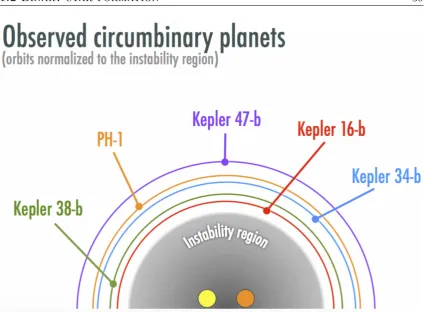
been confirmed such as the existence of circumbinary planets. Circumbinary planets
are planets that orbit around two stars, imagined in pre-51 Peg b fiction, such as
the famous Tatooine from Star Wars, or Gallifrey from Dr Who. The circumbinary
planet Magrathea from Hitchhiker’s Guide to the Galaxy was described as “the most
improbable planet that ever existed”, but was it really?
To date we know of ∼24 circumbinary planets with ∼16 of those being around main sequence binaries1. Therefore, the evidence suggests that Magrathea is not
“the most improbable planet that ever existed”, but the question remains open as
to whether it is the unlikely or the common planet? What is the likelihood of planet
formation around binary stars compared to single stars?
To answer these questions, I looked at the material that will eventually form
these planets: the protoplanetary discs around binary star systems. My work was
primarily concerned with understanding the creation, stability and lifetime of discs
in binaries with the general understanding that the longer the lifetime of a
pro-toplanetary disc, the higher the likelihood of forming planets. To understand the
formation of planets around binary stars we must first understand star formation
and disc evolution around single stars.
1.1
Star formation
In the following sections I will review the pre-main sequence evolutionary stages
of a single star. After reviewing these stages, I will review what is known about
the influence of multiplicity on these pre-main sequence classes. The evolutionary
classes of protostellar evolution is described in terms of empirically defined classes
numbered 0, I, II and III (Lada 1987; Andre et al. 1993).
Stars are formed in turbulent giant molecular clouds. The turbulence, coupled
with gravity, causes the cloud to further fragment and the densest regions become
the molecular cores where stars are born (McKee & Ostriker 2007). The cores that
fragment from giant molecular clouds are pervaded by the magnetic field of the
parent cloud (Han 2017). While the molecular core is rotating and collapsing, the
magnetic field is pinched around the rotation axis of the core, creating an hourglass
1.1 Star formation 3
shape. This structure of the magnetic field has been confirmed by the observations
of magnetic field polarisation (Girart et al. 2006; Ching et al. 2016). Based on
ob-servations of Zeeman splitting, the magnetic field strength within molecular cores is
too weak for magnetic pressure to prevent core collapse (Crutcher et al. 2009; Cortes
et al. 2016). The mass-to-flux ratio,M/Φ, is often employed to describe the degree of magnetic support within a molecular core. The critical mass-to-flux ratio, (M/Φ)crit,
which defines whether a molecular core will collapse, was calculated by Mouschovias
& Spitzer (1976) to be (M/Φ)crit = 0.53/(3π)(5/G)1/2 = 487 g cm−2G−1. If the
mass-to-flux ratio of a molecular core is greater than this value, the core is
mag-netically super-critical and gravity overcomes the force produced by the magnetic
pressure gradient, such that the cloud collapses along the direction of the magnetic
field vector.
1.1.1
Class 0
Initially, the collapse of a molecular core is isothermal because the gas is optically
thin. While the core collapses, gravitational potential energy is converted to heat
and is radiated away. When the collapse progresses until the cloud density is high
enough that it is optically thick, the molecular core is called a Class 0 object in the
protostar classification created by Lada (1987) and Andre et al. (1993). The spectral
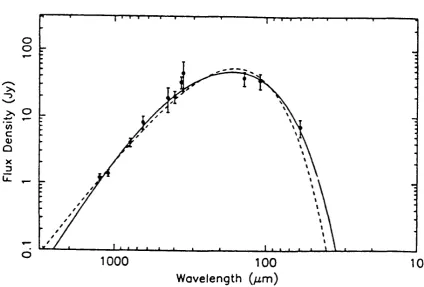
energy distribution (SED) of a Class 0 object is a blackbody spectrum of the core
peaking in the infrared (IR), typically at temperatures of 6−12 K (Larson 2003). An example of the SED of a Class 0 object is shown in Figure 1.1. The temperatures
of these cores are greater than the cosmic microwave background temperature (3 K)
because they are located in molecular clouds that are in proximity to recent massive
star formation. Most calculations of core collapse (including those in this thesis)
assume an initial temperature within this 6−12 K range. The thermal pressure (Pth)
of the gas, powered by the heating of the core due to gravitational contraction, can
be described by a polytropic equation of state:
Pth ∝ρΓ, (1.1)
Figure 1.1: The spectral energy distribution (SED) of the Class 0 protostar B335. The dashed line is the observed SED, and the solid line is the best fit model assuming the gas is optically thick. Taken from Barsony (1994).
The density increases as the core collapses and the gas becomes optically thick
to thermal radiation. When the optical depth (τ) is equal to one, the collapse transitions from being isothermal to fully adiabatic. The gas temperature begins
to increase and radiative feedback becomes important. In the adiabatic regime,
Γ = 7/5 = 1.4, however, Γ does not change directly from 1.0, in the isothermal collapse, to 1.4, during the adiabatic collapse. There is a transitional regime between when the gas temperature begins to increase, and the optical depth reaching unity.
During this transitional period the core radiates away energy less efficiently than
when the gas was optically thin. For a typical cloud mass of 1 M and opacity
κ = 0.1 cm2g−1 (taken from Semenov et al. (2003)), this transition from optically
thin to optically thick occurs over the density range of∼10−16−10−12g cm−3. Based
on radiation-hydrodynamical simulations of molecular core collapse, Masunaga &
Inutsuka (2000) found that Γ = 1.1 is appropriate to describe this less efficient radiative cooling during the transitional density range of ∼10−16−10−12g cm−3.
1.1 Star formation 5
continues to increase. When the density and temperature are ρ ≈ 10−7g cm−3
and T ≈ 2000 K, molecular H2 begins to dissociate into atomic hydrogen. The
breaking of the molecular bonds absorbs energy and the core is able to cool with
Γ∼1.1 (Masunaga & Inutsuka 2000). The H2dissociation is complete at densities of
ρ ≈10−2g cm−3. Beyond these densities, the core is primarily composed of atomic
hydrogen and behaves like an ideal gas (i.e. Γ = 5/3).
During the collapse stages of the Class 0 phase, the molecular core is rotating
(Bate 1998). Therefore, as the core is collapsing, a disc is formed around the central
protostar due to conservation of angular momentum. This disc is formed within
∼104yr (Yorke et al. 1993; Hueso & Guillot 2005) and material is accreted through this disc onto the protostar. The Class 0 object transitions into a Class I object.
1.1.2
Class I-III
The Class 0 collapse and disc formation opens up cavities above and below the
protostar and disc system, producing a Class I object. This opening up of a cavity
is shown in simulations (Machida & Hosokawa 2013; Federrath et al. 2014; Offner
& Arce 2014; Offner & Chaban 2017) and inferred from observations which find an
excess in mid-IR emission compared to that of more spherically — and centrally —
concentrated and obscured cores (Jorgensen et al. 2005). In this phase the SED is
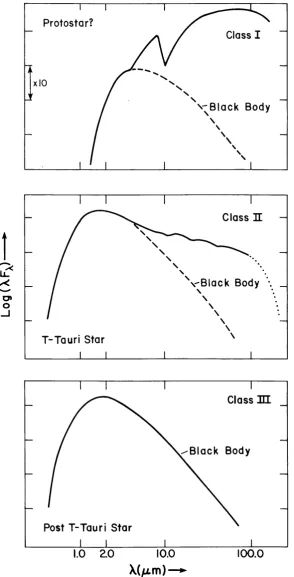
dominated by the core envelope, and thus has a large IR excess over the black body
emission of the protostar, as shown in the top panel of Figure 1.2.
The envelope surrounding the Class I object is eventually completely depleted
after ∼0.5 Myr, either via infall or being blown away by winds (Offner & Chaban 2017). When the protostar becomes optically visible it is classified as a Class II
object. Spectral typing of the star can be carried out, even if the disc is edge-on,
because there is often sufficient scattering of the stellar spectrum for characterisation
(Appenzeller et al. 2005). The SED of this object, shown in the middle panel of
Figure 1.2, is not dominated by the IR emission from the disc, however disc emission
remains significant.
During the Class II phase, the protoplanetary disc is unlikely to grow larger, and
will begin to disperse via accretion onto the star, disc winds, and photoevaporation
1.1 Star formation 7
is believed to be near the minimum mass solar nebula (MMSN) from which planets
will form. The MMSN is the lowest necessary mass needed in a protoplanetary disc
to form a solar system. It is derived from the chemical composition of the planets
and host star, and is scaled to cosmic abundances by adding the necessary hydrogen
and helium mass (Kusaka et al. 1970). For our solar system, Weidenschilling (1977)
estimated a MMSN of 0.01−0.07 M, but other solar systems, such as those with massive hot Jupiters, would require a larger MMSN.
A Class III object is formed when the gas disc has been dispersed and the SED
emission is primarily the blackbody emission from the protostar (see bottom panel
of Figure 1.2). At this stage there may be some minor IR excess caused by a debris
disc.
Protostar evolution happens concurrently with circumstellar disc evolution, which
funnels material onto the protostar as it ages. This process is discussed in the
fol-lowing sections.
1.1.3
Observed properties of circumstellar discs around young
stars
In the following sections I will summarise observed properties of circumstellar discs
around young stars, including their mass, radii, and disc structure.
Disc masses
The discs surrounding Class I protostars have masses ranging from ∼0.02−0.1 M with a median near 0.04 M (Jorgensen et al. 2009). These masses may be underes-timated because they were derived from sub-millimetre fluxes. This underestimation
may occur because grains that have grown to millimetre or larger sizes emit weak
sub-millimetre flux per unit mass, with a negligible effect on the total sub-millimetre
flux (Hartmann et al. 2006; Natta et al. 2007). Estimations also typically assume a
cosmic dust-to-gas ratio of 1:100, despite this ratio evolving as the protostellar disc
evolves. The gas fraction will change as gas is photoevaporated away and the dust
fraction will change as planets are formed. Therefore, an assumed dust-to-gas ratio
of 1:100 is problematic when determining gas masses of protostellar discs.
The disc mass range between Class 0 and I protostars is very similar, however
0 protostars having an envelope mass of ∼1 M compared to an envelope mass of
∼
<0.1 M for Class I protostars (Jorgensen et al. 2009). This indicates that the mass
from the envelope must be quickly transported through the disc onto the protostar
to prevent the disc from growing faster than the star (Vorobyov & Basu 2010).
Additionally, it is found that envelope infall rates are an order of magnitude higher
than disc accretion rates in Class I protostars (Eisner et al. 2005), implying that mass
builds up in the disc until a large amount of material is accreted quickly, producing
a burst event. A survey of five nearby molecular clouds (Cha II, Lupus, Perseus,
Serpens and Ophiuchus, Evans II et al. 2009) concluded that stars gain half of their
final mass in∼3.5×10⁴yr, implying very quick accretion of mass onto the protostar.
Bursts of accretion are used to explain ’the luminosity problem’ which occurs because
Class I protostars are an order of magnitude less luminous than expected if the
potential energy from the infalling material was radiated away steadily (Kenyon
et al. 1990). This is because accretion events can periodically increase the luminosity
while maintaining a low quiescent luminosity between accretion events.
The mass of discs around Class II objects are also measured using sub-millimetre
observations as mentioned previously. From a survey of the star-forming regions
Taurus-Auriga (Beckwith et al. 1990; Andrews & Williams 2007) and Ophiuchus
(Andre & Montmerle 1994; Andrews & Williams 2005, 2007) using millimetre and
sub-millimetre wavelengths, it was found that Class II objects have a median disc
mass of 5 MJup with the star containing 99.1% of the total mass of the system.
The uncertainty due to grain sizes mentioned previously also applies here. The
assumption of a cosmic dust-to-gas ratio introduces uncertainties because the ratio
has been altered by as a large amount of gas being removed from the system.
Disc sizes
The discs surrounding Class I protostars have very large radii, up to 1000 AU, with
a mean radius of 200−300 AU (Jorgensen et al. 2005; Andrews & Williams 2007). Direct measurement of the radius of protoplanetary discs by looking at silhouettes
of Orion proplyds (large protoplanetary discs) by Vicente & Alves (2005) found radii
ranging from 50−200 AU, with a couple of outliers with radii 338 AU and 621 AU. Vicente & Alves (2005) note that their sample only accounts for half the stars in
1.1 Star formation 9
smaller discs. Ansdell et al. (2018) observed 22 protoplanetary discs in Lupus using
ALMA and found that the radius of gas discs was about twice that measured for
millimetre dust discs. They measured the radii of dust and gas discs to range from
∼40−330 AU and∼70−460 AU respectively. Cieza et al. (2019) found that the radii
of dust discs around 147 Ophiuchus Molecular Cloud objects were heavily weighted
towards compact discs. 85% of the discs detected have radii < 15 AU. Barenfeld et al. (2017) also found discs around 57 Upper Scorpius objects to be compact with
the median dust disc radii being 21 AU.
By fitting IR emission to millimetre SEDs and resolved millimetre maps, Andrews
et al. (2009, 2010) found gas disc radii ranging from 14−198 AU, and no dependence on the properties of the host star. Schaefer et al. (2009) observed Taurus-Auriga
stars and also found no dependence on the disc sizes with the central star. However,
measurements of the disc mass of Class II objects confirmed that lower mass discs are
found around lower mass stars with a typical disc-to-star mass ratio ofMd/M∗ ∼0.01, but this relationship breaks down for high mass O stars (Williams & Cieza 2011).
Using SED fitting on a sample of stars in Taurus-Auriga, Isella et al. (2009)
found radii ranging from 30−230 AU and showed that older discs tend to be larger. The larger radii for older discs may be caused by viscous spreading of the material
as angular momentum is being transported away from the disc, increasing the disc
radius between the Class I and Class II stages (Lynden-Bell & Pringle 1974; Najita
& Bergin 2018).
Disc structure
The distribution of mass, or surface density, of discs is described by a power law,
Σ∝R−p, where Σ is the surface mass density, R is the radius in the disc, and p is an exponent typically in the range of 0−1.5 (Mundy et al. 1996; Lay et al. 1997; Wilner et al. 2000; Kitamura et al. 2002; Andrews & Williams 2007; Williams &
Cieza 2011).
The stability of a differentially rotating disc is given by the Toomre Q param-eter (Toomre 1964). This paramparam-eter is derived from the interplay of gravitational
collapse, angular momentum and thermal pressures keeping a disc from collapsing.
Q= csΩ
πGΣ (1.2)
where cs is the sound speed, Ω is the angular frequency and Σ is the surface mass density. If this parameter is greater than one, the disc is considered to be stable, and
if it is less than one, then it is considered to be unstable. Such unstable discs are
susceptible to the growth of density perturbations which can lead to local collapse.
This parameter is generally much greater than 1 for Class II objects suggesting
their discs are gravitationally stable at all radii (Isella et al. 2009; Andrews et al.
2010). However, determining surface densities near the star (< 10 AU) has been difficult because observations are limited to resolutions down to 20 AU. It is crucial
to understand the environment in this inner region because this is where planets
will form. The densities in the disc mid-plane can be so high that ionisation due
to radiation and cosmic rays may not be possible, and the region is shielded from
magnetorotational instability (Bai & Stone 2013). However, there are other sources
of ionisation within this layer which could also affect how the disc evolves, such as
radioactive decay (Cleeves et al. 2013).
It is important to understand the thermal, chemical, and ionisation structure in
protoplanetary discs in order to understand how various accretion mechanisms and
photoevaporation may work within the disc. Protoplanetary discs are understood
to have a flared geometry, based on observations giving larger IR excesses than
could be accounted for if the discs had a flat geometry (Kenyon & Hartmann 1987).
The interplay of thermal pressure of the disc against the stellar gravity determines
the scale height of the disc. The thermal pressure of the disc is dependent on the
radiation the disc receives, either from the host star or nearby stars. The scale
height, like the surface density, also follows a power law as a function of radius
(Chiang & Goldreich 1997): H ∝ Rh where H is the scale height, and h is from
≈ 1.3 −1.5 (Chiang & Goldreich 1997; D’Alessio et al. 1998; Dullemond et al. 2002). However, observations of mid-IR emission, which traces the dust in discs, is
less than expected from the flaring described by the scale height power law. This
can be attributed to the settling of dust towards the mid-plane, resulting in less
reflected stellar emission than if the dust was uniformly distributed throughout the
1.1 Star formation 11
Figure 1.3: Shows the observed disc fractions of various star forming regions from the work of Haisch et al. (2001) and Mamajek (2009). The disc fraction falls to half after approximately 2−3 Myr. This age range is accepted as the typical protoplanetary disc lifetime. Taken from Pfalzner et al. (2014).
Observations of young Class I objects indicate that early discs follow a Keplerian
profile down to the optically thick layers (Brinch et al. 2007; Lommen et al. 2008;
Jorgensen et al. 2009). During the early stages of disc evolution, the gas disc is
sub-Keplerian in the mid-plane because the gas pressure contributes to supporting
the disc (Weidenschilling 1977). By the Class II phase, the velocity profiles of
protoplanetary discs are expected to be Keplerian because the mass of the disc is
very small compared to the mass contained within the star. The velocity profiles
of these discs are difficult to determine because they are relatively small and faint,
however, profiles of discs that have been measured are shown to be Keplerian (Dutrey
et al. 1994; Mannings et al. 1997; Duvert et al. 1998; Guilloteau & Dutrey 1998).
The lifetime of the inner disc may be estimated by studying the fraction of stars
Figure 1.4: The spectral energy distribution of the transitional disc IRAS 04125+2902. Red data is the original measurements. Blue points are dereddened data. Black solid line is the disc model fit. The bluer wavelengths originate from the black body emission from the star, and the excess at redder wavelengths is the emission from the transitional disc. Taken from Espaillat et al. (2015).
stars in various star forming regions, Haisch et al. (2001) and Mamajek (2009) found
the typical protoplanetary disc lifetime to be 2−3 Myr, with the majority of discs dissipating within 10 Myr. The results from these two works are shown in Figure 1.3.
The disc disperses in an inside-out fashion based on the observations of discs that
show a lack of near-IR (λ ∼< 2µm) emission, but show mid-IR (λ ∼> 2µm) excess. These objects are called transitional discs. An example of an SED from an object
known to be a transitional disc is shown in Figure 1.4. Due to the rarity of these
transitional discs, it is implied that once the inner disc is no longer being accreted
onto the star, the outer disc is rapidly lost (Andre & Montmerle 1994; Andrews &
1.1 Star formation 13
1.1.4
Disc evolution mechanisms
Various mechanisms play a role in the evolution and dispersal of circumstellar discs
during star formation. These mechanisms include accretion of disc material onto
the protostar, jets and outflows, and photoevaporation.
Accretion
Protostars grow as they evolve through the protostellar stages and gas from the
molecular envelope moves quickly through the circumstellar disc onto the protostar
(Vorobyov & Basu 2010). A number of mass transportation mechanisms have been
proposed such as hydrodynamical, magnetic, and gravitational stresses (McKee &
Ostriker 2007).
The angular momentum of the molecular cores that form protostars is
signifi-cantly greater than the maximum angular momentum that can be contained by a
single star. About 99% of the angular momentum of the molecular core must be
transported out of the system to produce the angular momentum values observed
for single stars. It is not understood how this high proportion of angular momentum
can be removed and this is known as the ‘angular momentum problem’ (Mestel &
Spitzer 1956; Spitzer 1968; Bodenheimer 1978, 1995; Frank et al. 2014). As a result,
the investigation into accretion mechanisms typically consider angular momentum
transport when determining the plausibility of the mechanism.
Accretion mechanisms have generally been investigated via numerical
hydrody-namic simulations. Many of these simulations have implemented the α-disc model of angular momentum transport. In this regime, a shear stress tensor,T, is defined
which describes the viscous torque between rings in a differentially rotating disc
(Shakura & Sunyaev 1973; Lynden-Bell & Pringle 1974; Pringle 1981). The shear
torque between rings at radius R and R+ dR with orbital frequencies of Ω and Ω + dΩ respectively is given by:
T=µdlnΩ
dlnR (1.3)
to the gas pressure,P. Thusµcan be expressed asµ=αP, whereαis a dimension-less factor between 0 and 1. Since the torque describes angular momentum transport
between shear layers, we can calculate the total change in angular momentum by
integrating over the torques between all layers. With this α-disc prescription it is possible to follow angular momentum transport through a disc.
Determining realistic values of α is difficult. Hartmann et al. (1998) found
α∼10−2for discs on the scale of∼10−100 AU, which is incompatible with Rozyczka
et al. (1994) who found values of α∼10−3 for radii larger than 0.5 AU.
When considering this α-disc prescription and planet formation, the MMSN (discussed in Section 1.1.2) is likely too small, and the protoplanetary disc that
formed the solar system was much more massive and had a large radius to account
for planetary migration (Crida 2009).
We now review various angular momentum transport mechanisms and the values
of α found by these mechanisms:
Hydrodynamic mechanisms: Turbulence is created in circumstellar discs through
heat, convection, and shearing of different moving layers; and even via infall of
en-velope material. Simulations of discs with convection such as those done by Ryu &
Goodman (1992); Stone & Balbus (1996) and Johnson & Gammie (2006) all show
that the angular momentum transport is inwards, i.e. angular momentum is being
deposited into the inner disc, which can be problematic for accretion.
When considering instabilities caused by shearing in the Keplerian disc, large
transient growths are found in simulations (Chagelishvili et al. 2003; Umurhan &
Regev 2004; Johnson & Gammie 2005; Afshordi et al. 2005). If this turbulence
caused by shearing could be maintained, angular momentum could be transported
outwards (Lithwick 2007). But, these growths formed between shearing layers
ap-pear to dissipate quickly, and Ji et al. (2006) found that Keplerian-like rotation
pro-files are very inefficient in angular momentum transport, corresponding toα <10−6. Another consideration is that the discs are born with initial perturbations due to
the infall of material from the envelope. 3D simulations show that these large
per-turbations can be destroyed quickly (Shen et al. 2006), although some off-mid-plane
instabilities can live longer (Barranco & Marcus 2005). Generally these simulations
1.1 Star formation 15
transport, however further investigation is needed as continual mass injections could
maintain the instabilities and produce α∼10−2 (Hartmann et al. 1998).
Magnetohydrodynamic mechanisms: Balbus & Hawley (1991) realised that
weakly or moderately magnetised, differentially rotating discs are subjected to a
powerful local shear instability, commonly referred to as magnetorotational
instabil-ity (MRI). Numerical simulations in 3D show that MRI maintains turbulence in the
disc and that angular momentum transport is outwards (Brandenburg et al. 1995;
Hawley et al. 1995; Matsumoto & Tajima 1995; Gellert et al. 2012; Kunz & Lesur
2013). The efficiency of angular momentum transport via MRI is dependant on a
number of factors, but in general angular momentum and mass transport primarily
occurs at pericentre in eccentric discs (Chan et al. 2018), or in the inner regions
in circular discs. It is also found that the value of α is dependent on the average vertical magnetic flux through the disc, which evolves over the lifetime of the disc
(Stone & Balbus 1996; Sano et al. 2004; Pessah et al. 2007).
Though MRI likely plays an important role in accretion in young protoplanetary
discs, the extent to which it is effective is dependent on the ionisation of regions
throughout the disc. Portions of protoplanetary discs may have ionisation fractions
that are too low for MRI to be effective, creating a ‘dead zone’ (Gammie 1996;
Jin 1996; Glassgold et al. 1997; Igea & Glassgold 1999). However, Gole & Simon
(2018) find that even in regions of low ionisation ambipolar diffusion dominant
regions, MRI can persist as long as there is no ionized surface layer generating
strong toroidal fields. Recent ALMA observations have shown that the magnetic
field in the outer regions of discs have weak vertical components, and ionisation
levels should be relatively low (Simon et al. 2018), therefore, MRI is not likely to be
effective in the outer disc. Within a MRI dead zone, angular momentum transport
would follow that described in the hydrodynamic regime (Hertfelder & Kley 2015).
MRI can operate effectively at radiiR ∼<0.1 AU, where temperatures are∼2000 K and the gas is sufficiently ionised. However, further out, ionisation of the disc is more
complex. If column densities in these regions are low enough, gas can be ionised by
X-rays or cosmic rays, but the extent of the instability is sensitive to the size and
distribution of dust grains. If dust grains are well mixed into the disc, MRI can
et al. 2000; Fromang et al. 2002; Salmeron & Wardle 2005). If the surface of the
disc is ionised sufficiently such that MRI is effective, but a dead zone is sandwiched
between the two active surface layers, mass can build up in the dead zone until it
becomes dynamically unstable (Landry et al. 2013). This dynamical instability may
lead to gravitational stresses transporting angular momentum outwards, while the
built up mass is accreted, leading to an outburst (Gammie 1996; Armitage et al.
2001). Episodic accretion onto a star can also occur in cases where the rotation rate
of the magnetised star is greater than that of the inner disc, and material builds up
in the inner disc until a massive accretion event occurs (Lii et al. 2014).
Gravitational mechanisms: Numerical simulations of discs with cooling
func-tions where the disc radiates away energy due to mass accretion show that discs can
reach a semi-steady state with Toomre parameter Q ∼1. This is provided that
tcoolΩ, where tcool is the cooling time for the disc, is not too small. If the disc cools
rapidly it will fragment (Gammie 2001; Lodato & Rice 2004; Mej´ıa et al. 2005; Rice
et al. 2005).
For hotter discs, the sound speed is higher, thus increasing the Q parameter when compared to cooler discs. For hot discs, the effect of gravitational instability
is dependent on the surface densities in the regions. In regions where Q ∼> 1.4, gravitational stresses are present but are not strong enough to cause fragmentation
of the disc.
For discs with temperatures similar to those observed (50−150 K Boss 1998), more massive discs (∼>0.1 M) are likely to have significant mass transport due to gravitational stresses (Mayer et al. 2014). Due to the relatively high mass fraction
between the disc and protostar, bursts of accretion due to gravitational stresses are
likely to be present early in the protostellar evolution (Laughlin & Bodenheimer
1994; Vorobyov & Basu 2005, 2006; Zhu et al. 2009). Many protostars have already
been observed to experience bursts of activity due to high accretion possibly caused
by large gravitational instabilities. Such events include FU Orionis outbursts (named
after the first identified case) and it is estimated that low-mass protostars experience
about ten or so phases during their formation (Hartmann & Kenyon 1996; Dunham
1.1 Star formation 17
Jets and outflows
High velocity jets and lower velocity outflows are launched from a protostellar system
as the disc material is accreted. The jets produced by young stellar objects are
typically observed to be strongly collimated. The “aspect ratio” is used to quantify
how collimated a jet is, and is defined as the ratio of the length of the jet to its
width. Many jets are observed to have aspect ratios of at least 10, sometimes as
high as 100, with some jets extending as far as a parsec from the source (Bally et al.
2007).
When the jets and outflows of a protostar are observed to produce shocks in
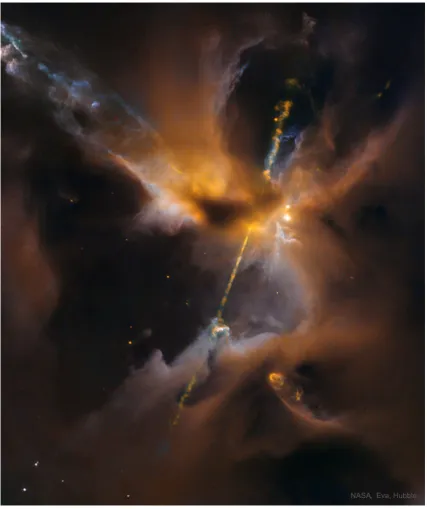
the surrounding gas, the object is termed a Herbig-Haro object (Ambartsumian
1954; Hoyle 1956). An example of a Herbig-Haro object is shown in Figure 1.5.
Herbig-Haro objects are characterised by bipolar jets of ionised gas travelling at
∼
>100 km s−1 and outflow of molecular gas at approximately 10−50 km s−1. When
probing near the sources of the jets, both the high velocity jet component and low
velocity outflow component are observed (Hartigan et al. 1995; Hirth et al. 1997;
Bacciotti et al. 2000; Pyo et al. 2005).
The range of velocities implies that the winds that produce Herbig-Haro objects
are launched from different radii in the disc. The high velocities of the jets indicate
that jets originate in the inner part of the disc. The low-velocity molecular outflows
are likely material entrained by the disc winds. Jets from protostars tend to exhibit
a series of knots that are consistent with shock heating. The shock velocities are a
few tens of kilometres per second, associated with post-shock temperatures of 104K (Hartigan et al. 1987, 1994). The series of bow shocks and knots in jets suggest that
the protostar experiences a series of ejections (Lee et al. 2002), possibly caused by
accretion events.
The currently accepted mechanism for the launching of jets is a result of magnetic
stresses. The momentum of these outflows is too large for the jets to be driven by
radiation pressure alone (Lada 1985). The disc wind model (Blandford & Payne
1982; Konigl & Pudritz 2000), the magnetic tower (Lynden-Bell 2003) and
“X-wind” model (Shu et al. 1994) are the main models that have been proposed to
explain the launching of these jets and outflows.
1.1 Star formation 19
through much larger regions of the disc. The winds produced from this model are
much slower, with velocities that reflect the rotation profile of the disc. Blandford
& Payne (1982) calculated that centrifugally driven outflows can be launched from
a disc if the poloidal component of the magnetic field makes an angle of less than
60◦ with the disc surface. The velocities produced by this mechanism are similar to
those observed and thus, suggested to be the source of the disc winds in protostars
(Pudritz & Norman 1983).
The magnetic tower describes the launching of jets via a magnetic pressure
gra-dient. Lynden-Bell (2003) use highly coiled up magnetic structures and the pinching
of magnetic fields to produce strong pressure gradients away from the disc,
produc-ing a force that significantly overcomes the gravitational force. Many ideal MHD
simulations of molecular core collapse and protostar formation find that this
mech-anism is what drives the initial jet launching (Banerjee & Pudritz 2006; Machida &
Matsumoto 2012).
The X-wind model mainly concerns regions in the inner disc where the
magneto-sphere of the star and the disc are corotating. Because protostars are fast rotators,
the winds launched by the X-wind mechanism have velocities of a few 100 km s−1,
similar to velocities observed in protostellar jets. It was previously thought that it
is a combination of the disc wind and X-wind model that work together to produce
the outflow features observed in protostars, with the X-wind producing the highly
collimated jet and the disc-wind producing the lower velocity outflow. However,
Desch et al. (2010) find that the observed rotation of protostellar jets do not match
that predicted by the X-wind model. Observations also find that particles within
the launching radii for the X-wind model (<0.1 AU, Shu et al. 2001) cannot escape being accreted.
Photoevaporation and radiation feedback
The objects that are found with mid-IR excess and no near-IR excess are called
transitional discs (Strom et al. 1989), and the mass of the disc at this stage is
∼
<1−2.5 MJup (Andrews & Williams 2005, 2007; Cieza et al. 2008, 2010). The SED
of young stars at this phase of disc dispersal look like that in Figure 1.4, where
we see two large black body components caused by the star and the outer disc.
and mass flows inward in the disc to feed this accretion. When accretion stops, the
outer disc photoevaporates rapidly due to UV and X-ray radiation that originates
from the host star or nearby stars. The photoevaporation rate is greater for higher
mass stars because the X-ray luminosity produced by accretion is higher (Preibisch
& Feigelson 2005; G¨udel et al. 2007; Kastner et al. 2016). As a result, the disc
lifetime is likely to be shorter around higher mass stars. This effect is supported by
observations that show a mass dependence on disc occurrence, with discs being less
frequent around higher mass stars of the same age (Kennedy & Kenyon 2009).
Photoevaporation becomes significant in clearing the disc when the migration of
mass inwards that feeds accretion is too slow and the gas in surface layers is heated
such that its thermal velocity surpasses its escape velocity. The protoplanetary disc
is eroded from the inside out creating the SED shown in Figure 1.4. The “UV
switch” models (Alexander et al. 2006b,a) demonstrate this quick dispersal of the
disc via photoevaporation, on a time scale much less than 1 Myr once accretion has
stopped.
Giant planet formation best explains the low accretion and steep rise in the
mid-IR excess observed in these objects. Formation of giant planets may reduce
accretion, triggering the photoevaporation of the disc (Rosotti et al. 2013). When
the gas disc has dispersed and all that remains is a debris disc, the system has
reached the Class III phase, in which the SED only has a small IR excess (as seen
in Figure 1.2).
1.1.5
Planet formation
Planets are formed within the protoplanetary discs around young stars. The first
step of planet formation is the growth of dust grains. Within the protoplanetary
disc, grains are initially swept along with the gas, but as they grow, they are subject
to larger drag forces and settle into the mid-plane of the disc. This dust settling
encourages further grain growth because the dust densities are greater.
Observa-tions show that small grains are persistently present throughout all the protostellar
stages and therefore must be continually replenished. Dullemond & Dominik (2008)
conclude the continuous production of dust comes as a balance of dust coagulation
1.1 Star formation 21
be explained via coagulation, however explaining growth beyond this size remains a
challenge. Metre-sized clumps suffer significantly from being destroyed in collisions
and also rapidly fall inwards towards the star due to drag against gas in the disc
(Weidenschilling 1977).
A possible solution to this ‘metre barrier problem’ is that rather than coagulation,
planetesimals quickly grow via an instability. Planetesimals are objects that are
approximately a kilometre in size, and their motion is predominantly influenced by
gravity as opposed to dynamical drag. Goldreich & Ward (1973) proposed that
with the settling of dust into the mid-plane of the disc, the concentration becomes
large enough that the dust is unstable to its own gravity. This scenario was initially
thought to require low turbulence which may be difficult to achieve, however high
turbulence may aid the formation of planets by creating temporary overdensities
(Johansen et al. 2006; Cuzzi et al. 2008). These overdensities could collapse to
planetesimals with sizes already between 100−1000 km (Morbidelli et al. 2009).
The growth of planetesimals to protoplanets is typically believed to be via the
accretion of smaller planetesimals onto larger planetesimals (Goldreich et al. 2004).
The growth from protoplanets to giant planets is understood to follow one of two
proposed theories. The first is the core-accretion model (Pollack et al. 1996), where
once a protoplanet has grown to ∼10 M⊕, it begins to rapidly accrete a gaseous envelope. The initial growth of the envelope increases the gravitational capture
radius of the planet, allowing more planetesimals to be captured, thus increasing
its core mass. The increasing core mass also enhances the capture radius allowing
more gas to be accreted. This runaway growth continues until most of the nearby
gas and debris is accreted onto the giant planet. The time scale necessary for the
core accretion model of giant planet formation is often taken to be ∼1−10 Myr (Pollack et al. 1996), however other models are able to simulate the growth of a
Jupiter mass planet via core accretion in 1 Myr (Hubickyj et al. 2005). The other
giant planet formation model is gravitational collapse (Boss 2001; Rafikov 2005),
which suggests that gaseous planets form from an instability in the disc leading to a
gravitationally bound clump which becomes a giant planet on a time scale of 104yr.
This mechanism requires a massive disc, and thus is believed to occur early in the
is challenged by the lack of giant planets observed by direct imaging (Vigan et al.
2017).
Another giant planet formation model considers the formation of large giants
at large radii (Bate et al. 2002). This model considers giant planets represent the
lowest mass end of the brown dwarf populations and these types of giants are formed
from molecular cloud fragmentation. The time scale for giant planet formation via
this pathway is significantly shorter, being on the order of thousands of years (Boss
2002).
With the number of proposed giant planet formation mechanisms, it is clear that
there are still many mysteries to solve on this front. This picture of star and planet
formation is also very single star centric because the single star scenario is simple,
and the vast majority of planets discovered to date orbit single stars. But a large
portion of stars are in binary star systems, with more massive stars being more likely
to host other stellar companions, as shown in Figure 1.6 (Moe & Di Stefano 2017).
We have also discovered planets in binary star systems. The formation of these
planets should also be studied and can help to determine likely planet formation
pathways. To begin understanding planet formation around binaries, we should
1.2 Binary star formation 23
1.2
Binary star formation
The fraction of all stars that are members of binary systems depends on the mass
of the system as shown in Figure 1.6. When studying multiple star formation the
multiplicity fraction (MF) is often employed to quantify how many multiple star
systems are within a population. The multiplicity fraction is defined as:
M F = B+T +Q+...
S+B+T +Q+... (1.4)
where S, B, T, Q are the number of single, binary, triple, quadruple, etc. systems (Reipurth & Zinnecker 1993). For solar type stars with effective temperature
be-tween 4800 K and 6550 K, the multiplicity is approximately 50−60% (Duquennoy & Mayor 1991; Raghavan et al. 2010), while lower mass stars and dwarfs have a
mul-tiplicity of 30% down to 10% (Lada 2006; Basri & Reiners 2006; Ahmic et al. 2007).
The prevalence of binary systems is important, and the consequence of multiplicity
[image:35.595.117.538.419.732.2]on protoplanetary disc evolution and planet formation should be understood.
In the following sections we will review how multiple star formation may affect
the protostellar stages discussed in Section 1.1.
1.2.1
Class 0 multiple star evolution
The formation of binary star systems is believed to be triggered by the fragmentation
of protostellar cores as they collapse (Offner et al. 2010; Murillo et al. 2016). Chen
et al. (2013) carried out a survey for 33 Class 0 objects and found a multiplicity of
M F = 0.64±0.08 for separations ranging from 50−5000 AU. However, these results should be taken as a lower limit because they do not probe smaller separations. The
work of Chen et al. (2013) and other surveys show that the multiplicity of young
stars actually decreases with protostellar stage (Connelley et al. 2008). This is shown
in Figure 1.7. This high multiplicity at early stages implies core fragmentation
yields a high initial multiplicity rate (Duchˆene et al. 2007) with each core producing
approximately 2−3 stars (Goodwin & Kroupa 2005).
1.2 Binary star formation 25
The formation of binary systems requires the loss of 99−99.9% of the initial an-gular momentum contained within the molecular cores (Frank et al. 2014). Anan-gular
momentum can be carried out of the system via jets and outflows as mentioned
pre-viously, or via the ejection of a third companion (Armitage & Clarke 1997; Reipurth
2000; Reipurth et al. 2014). The formation of the binary star system is then thought
to broadly follow the single star birth described in Section 1.1.
1.2.2
Class I-III multiple star evolution
Another proposed pathway of multiple star formation is the fragmentation of
mas-sive discs into stellar companions with separations<100 AU. Initial hydrodynamical simulations found this pathway to be as plausible as core fragmentation, however
when considering radiation feedback this pathway becomes less viable due to
radi-ation increasing the fragmentradi-ation scale (Offner et al. 2010). Therefore, it is likely
that most multiple star systems form via the fragmentation of the initial molecular
core.
The well documented decreasing multiplicity fraction over protostellar class (see
Figure 1.7) implies that powerful dynamical processes must occur to disperse these
multiple star systems (Reipurth et al. 2014). In the following sections we will review
the formation of binaries, what is known about discs and planets in binary systems.
Dynamical evolution of young multiple star systems
The ejection of a tertiary or multiple companions has often been cited as a pathway
for forming close binaries with separations of∼1−200 AU (Armitage & Clarke 1997; Reipurth 2000). Many theoretical works show that during the dynamical evolution
of a three-body system, the lightest companion is ejected, either into a wider orbit
creating hierarchical configurations where the separation of the third body is greater
than ∼10 times the separation of the inner binary, or out of the system entirely (Anosova 1986; Sterzik & Durisen 1998; Umbreit et al. 2005). This hypothesis has
also been investigated observationally by Connelley et al. (2009), who found that
every young binary system that they observed with a close companion (<200 AU) also had another protostar within 25,000 AU projected separation. These results are interpreted to be strong evidence that many close binaries form via ejections.
binary systems with separations of a few tens of AU but struggles to solely explain
the formation of spectroscopic binaries which often have a separation on the order
of <0.1 AU. The orbital separation of these spectroscopic binaries is much smaller than the initial hydrostatic core that collapses to form the protostar (∼5 AU), thus binaries of separations <10 AU cannot form in situ during collapse. These binaries with semi-major axisa <10 AU likely form via the in-spiral of a wide binary possibly via viscous evolution through a disc (Gorti & Bhatt 1996; Stahler 2010; Korntreff
et al. 2012) or the Kozai-Lidov mechanism (Kiseleva et al. 1998). The ejection of a
companion may enhance or initiate these processes. During viscous evolution with
surrounding circumstellar gas or discs, the angular momentum of the binary can be
transferred to the gas, shrinking the orbit of the binary.
The Kozai-Lidov mechanism requires a three-body system to operate. This
mechanism describes the exchange between orbital eccentricity and inclination for
the inner binary and the outer third body. During the formation of close binaries, it
is believed that the third body drives the inner binary to have higher eccentricity to
the point at which tidal forces become significant at periastron. These tidal forces
lead to the decay of the orbit to shorter periods (Moe & Kratter 2018). This
forma-tion pathway for close spectroscopic binaries is strongly supported by observaforma-tional
evidence finding 63±5% of spectroscopic binaries being in higher order multiple star systems (Tokovinin et al. 2006). This fraction increases to 96% for periods less
than 3 days (Tokovinin et al. 2006).
Discs in binary star systems
During the formation of binary stars, discs may form around individual components
as “circumprimary” and “circumsecondary” discs, or around both stars as a
“cir-cumbinary” disc. As mentioned previously, it is believed that young binary stars
would spiral inwards towards each other through viscous evolution. During this
evolution the binary system may shrink to a separation at which material in
cir-cumstellar discs is redistributed to form one circumbinary disc (Reipurth & Aspin
2004).
The truncation of discs in binary systems has been observed extensively (Harris
1.2 Binary star formation 27
companion can influence the evolution of protostellar discs. Figure 1.8 shows
mea-sured millimetre fluxes for a large number of protostellar discs. Millimetre flux is
used as a proxy for disc mass, with larger discs producing greater flux. This proxy
is under the assumption that the disc is completely optically thin which is not true
in reality, but it still provides a good comparison between different binary
config-urations. The distribution of disc sizes around single stars is shown as the black
points to the right of the figure. For binary systems of projected separations greater
than 300 AU, the distribution of disc sizes follows that of the single stars. However,
for binaries with projected separations less than 300 AU, disc sizes are smaller, with
smaller separations producing less flux. This effect is attributed to the truncation
of the circumstellar discs by the binary companion (Artymowicz & Lubow 1994).
The trend of smaller discs for smaller separation binaries does not appear to apply
to circumbinary discs. In Figure 1.8, the circumbinary discs (the purple points) are
very large and comparable to the largest discs around single stars.
The data raises questions: are circumbinary discs generally very large compared
to most circumstellar discs (around both single and binary stars)? What are the
implications of massive discs for= planet formation? Would more massive discs
pro-vide more material to build planets? Massive discs are necessary for fragmentation
via gravitational instability to be possible, as a result, could giant planets or stellar
companions form via gravitational instabilities in these discs?
Another peculiar characteristic of some circumbinary discs is the observed ages.
There are a number of known circumbinary discs that have very old ages (>10 Myr); for example HD 98800 B (10±5 Myr, Furlan et al. 2007), AK Sco (18±1 Myr, Czekala et al. 2015), V4046 Sgr (12−23 Myr, Rapson et al. 2015) and St 34 (also known as HBC 425, ∼25 Myr, Hartmann et al. 2005). As discussed in Section 1.1.2, the typical lifetime of a protoplanetary disc is 2−3 Myr, and most discs are expected to dissipate within 10 Myr. The ages of these circumbinary discs are significantly
older than the typical lifetime of a protoplanetary disc. From these known objects
it is difficult to determine whether circumbinary discs are longer lived compared to
circumstellar discs, or whether these objects are statistical outliers.
If circumbinary discs generally have longer lifetimes with respect to circumstellar
Figure 1.8: Shows a comparison of millimetre flux densities (as a proxy for disc mass) from potentially interacting pairs as a function of the projected pair separation. Single stars are shown to the right of the plot as black points for reference. The pair population can be distinguished into four clear sub-categories: wide (ap>300 AU),
medium (ap = 30−300 AU), and small (ap <30 AU) pairs, and circumbinary discs
(purple). Taken from Harris et al. (2012).
Section 1.1.5 two theories of giant planet formation were discussed: the core
accre-tion mechanism and gravitaaccre-tional instability. The consensus is that the formaaccre-tion
of close (within a few tens of AU separation) giant planets is likely via the core
accretion mechanism, despite the time scale for this mechanism (on the order of
millions of years (Pollack et al. 1996; Hubickyj et al. 2005)) being barely compatible
with the typical protoplanetary disc lifetime. If circumbinary discs are longer lived,
would this provide the opportunity for larger giant planets to form since the gas disc
survives longer allowing the accretion of a larger planetary atmosphere? Or would
1.2 Binary star formation 29
opportunity for planetesimal formation and accretion?
In order to understand how binarity can affect disc lifetimes, we need to
in-vestigate how binarity affects the various disc evolution mechanisms described in
Section 1.1.2 (i.e. accretion, jets and outflows, and photoevaporation). A review of
the effect of binarity on these mechanisms is presented below.
Accretion of discs in binaries
Many circumbinary disc hosting systems are shown to still be accreting. Most of
these show accretion events that are correlated with the periastron of the binary (for
example, DQ Tau (Mathieu et al. 1997; Tofflemire et al. 2017), AK Sco (G´omez de
Castro et al. 2013) and TWA 3A (Tofflemire et al. 2017)). An example of these
periodic accretion events is shown in Figure 1.9. In the top panel we see the measured
accretion rate for the binary system TWA 3A phase-folded around its orbital period.
At periastron (i.e. orbital phase of 0.0 and 1.0), the accretion rate increases to up to
∼5 times the quiescent accretion rate. This suggests that the accretion of the disc
is triggered by the binary companion (Green et al. 2016).
Some of the earliest work on circumbinary disc evolution was carried out by
Artymowicz & Lubow (1994), who simulated the evolution of a smooth thin disc,
supported by gas pressure, aligned with the orbital plane of a binary star. They
showed from simulations that the disc around each stellar component is truncated at
the outer edge, whereas circumbinary discs are truncated along the inner edge. For
circular orbits, the circumstellar disc is truncated at ∼ a/2, and the circumbinary disc is truncated at∼2a. Higher eccentricities will lead to greater dynamical erosion of the discs, thereby varying the sizes of circumstellar and circumbinary discs. In
general, it was found that for smaller separations, the circumstellar discs are smaller,
which is consistent with observations (Cieza et al. 2009; Duchˆene 2010; Harris et al.
2012; Cox et al. 2017). Circumstellar discs can also be absent in binaries with very
small separation as suggested by close binaries having relatively little sub-millimetre
and millimetre flux (Jensen et al. 1994, 1996; Andrews & Williams 2005).
Circumbinary discs can produce SEDs which are similar to those of transitional
discs because of millimetre flux absence. For example, CoKu Tau 4 was classified as a
transitional disc, but was found to be a circumbinary disc surrounding a binary with
that the fraction of objects that are classified as transitional discs but are actually
circumbinary discs is 0.38±0.09.
Lindblad resonances are caused by the differential angular velocity between the
binary system and the inner disc (Mu˜noz et al. 2019). Within circumbinary discs,
Lindblad resonances can cause material in the disc to prefer certain orbital periods
that are multiples of the binary orbit’s epicyclic frequency (the rate at which
peri-astron precession occurs). Lindblad resonances are caused by gravitational torques
between the binary star system and the disc. Much like the Kozai-Lidov mechanism,
the Lindblad resonances describe how eccentricity and inclination are exchanged
between the components. If the angular velocity of a circular binary star orbit is