arXiv:1205.6410v2 [hep-lat] 30 Jul 2012
ADP-12-24/T791 DESY 12-079 Edinburgh 2012/06 Liverpool LTH 945 July 30, 2012
A Lattice Study of the Glue in the Nucleon
R. Horsley
a, R. Millo
b, Y. Nakamura
c, H. Perlt
d,
D. Pleiter
ef, P. E. L. Rakow
b, G. Schierholz
f g,
A. Schiller
d, F. Winter
aand J. M. Zanotti
h– QCDSF-UKQCD Collaboration –
a School of Physics and Astronomy, University of Edinburgh,
Edinburgh EH9 3JZ, UK
b Theoretical Physics Division, Department of Mathematical Sciences,
University of Liverpool, Liverpool L69 3BX, UK
c RIKEN Advanced Institute for Computational Science,
Kobe, Hyogo 650-0047, Japan
dInstitut f¨ur Theoretische Physik, Universit¨at Leipzig,
04109 Leipzig, Germany
e J¨ulich Supercomputer Centre, Forschungszentrum J¨ulich,
52425 J¨ulich, Germany
f Institut f¨ur Theoretische Physik, Universit¨at Regensburg,
93040 Regensburg, Germany
g Deutsches Elektronen-Synchrotron DESY,
22603 Hamburg, Germany
h CSSM, School of Chemistry and Physics, University of Adelaide,
Adelaide SA 5005, Australia
Abstract
1
Introduction
One of the earliest experimental indications that the nucleon consists not only of three quarks, but also has a gluonic contribution came from the measurement of the fraction of the nucleon momentum carried by the quarks. That this did not sum up to 1 as is required from the energy–momentum sum rule gave evidence for the existence of the gluon. Denoting hxif as the fraction of the nucleon momentum carried by partonf we have
X
q
hxiq+hxig = 1, (1)
where for the quarks f ≡ q = u, d, . . . and for the gluon f ≡ g. Experimentally hxiu+d ∼ 0.4 so the missing component is large ∼ 50% of the total nucleon momentum. Both hxiq and hxig have similar definitions and so analogously to the definition ofhxiq we have, with Mdenoting Minkowski space
hN(~p)|[ObM(g)µ1µ2 − 1
4η
µ1µ2ObM(g)α
α]|N(~p)i= 2hxig
pµ1pµ2 − 1
4η µ1µ2m2
N
, (2)
where
OM(g)µ1µ2 =−tr
cFMµ1αFMµ2α, (3)
(where O(t) = R d3x O(t, ~x) and with normalisation hN(~p)|N(~p′)i = 2E
Nδ(~p−
~p′)). Note that we can generalise from a nucleon to an arbitrary hadron (averaging
over polarisations if necessary). Higher moments can also be considered, by inserting covariant derivatives between the Fs. These occur when using the Wilson operator product expansion which relates them to moments of structure functions in a twist expansion.
There have been many lattice estimates of the quark momentum fractionhxiq both for the nucleon (see e.g. [1, 2] for a review) and the pion e.g. [3, 4], but few attempts for the gluon part, hxig [5, 6, 7]. This is due to the fact that a lattice simulation must compute a quark line disconnected term, which is extremely noisy and gives a poor signal. These are direct calculations; in this letter we propose a new method using the Feynman-Hellmann theorem, to determine the gradient of
EN as a function of a parameter of an operator which has been introduced into the actionS →S(λ) =S+λSO. An obvious disadvantage of this method is that it requires dedicated simulations for each operator of interest, but the gain, as we shall see, is a much cleaner signal.
While the method is general, we shall demonstrate its practicability here by determining hxig in the quenched case.
2
The Feynman–Hellmann theorem
parameter λ, so S → S(λ). Now as by definition the (Euclidean) correlation function is given by
hN(t)N(0)iλ ≡
R
[dU]N(t)N(0)e−S(λ)
R
[dU]e−S(λ) , (4)
(the unpolarised case for the nucleon and where we make the obvious replacements
N by H and N by H† for other hadrons), then we have
∂
∂λhN(t)N(0)iλ=−
N(t)
∂S(λ)
∂λ − h ∂S(λ)
∂λ iλ
N(0)
λ
. (5)
We now use the transfer matrix formalism on both sides of this equation. Ignoring finite size effects this gives
hN(t)N(0)iλ =AN(λ)e−EN(λ)t+ exp. smaller terms. (6)
so on the LHS of eq. (5),
∂
∂λhN(t)N(0)iλ =−
∂EN(λ)
∂λ hN(t)N(0)iλt+ exp. smaller terms. (7)
Furthermore, if Ω(τ) is any operator (local in time), then using the transfer matrix formalism again the associated 3-point function gives
hN(t)Ω(τ)N(0)iλ
hN(t)N(0)iλ =
( 1
2EN(λ)hN|Ωb|Niλ+ exp. small terms 0≪τ ≪t
exp. small terms otherwise . (8)
Note that we have inserted a 2EN in the denominator of the RHS to account for the mis-match of normalisations, i.e. to agree with those of eq. (2). Hence summing overτ also gives a linear term in t. Thus from this equation, replacing
P
τΩ(τ) by the operator in the RHS of eq. (5), and together with eq. (7) we have the Feynman–Hellmann theorem
∂EN(λ)
∂λ =
1 2EN(λ)
*
N
:
\
∂S(λ)
∂λ :
N
+
λ
, (9)
3
The lattice method
3.1
Gluon operators
Before considering the lattice, let us first Euclideanise the gluon operators1 to
give us an indication of what we might add to the action. Defining
Oµν =−trcFµαFνα, (10)
(trcF2 = 12Fa2) this then gives the two obvious operator choices (a) and (b),
Oa i = Oi4 = trc(E~ ×B~)i
Ob = O44− 13Ojj = 23trc(−E~2+B~2) (11)
(OMa (g) →iOa and O
M(g)
b →Ob). The relation tohxig is given by
hN(~p)|Oba i|N(~p)i = −2iENpihxig
hN(~p)|Obb|N(~p)i = 2(m2N +43~p 2)hxi
g, (12)
with
b
Oa i= trc(~E ×b ~Bb)i, Obb = 23trc(−~Eb 2
+~Bb
2
). (13)
Both choices have their difficulties: operator (a) always needs a non-zero mo-mentum ~p, while operator (b) requires a delicate subtraction between two terms similar in magnitude.
Note that, because of Euclideanisation (footnote 1) theenergy has a negative E2 term, while theaction (see section 3.2) has a positive E2 term.
3.2
The action
We now turn to the lattice. We shall use the Wilson gluonic action
S = 1 3β
X
x µ<ν Re trc
1−U µν(x)
, (14)
(i.e. sum over plaquettes), with β = 6/g2. As
Re trc
1−U µν(x)
= 1 4a
4g2Fa
µν(x)2+. . . , (15) 1
Our conventions follow [3]. So EMi =FMi0
→ iFi4 ≡ iEi and BMi =−12ǫijkFMjk →
1
this motivates the simplest definition of electric and magnetic field on each time slice as
1 2E
a2(τ) = 1 3β 1 a X ~ x i
Re trc
1−U i4(~x, τ)
1 2B
a2(τ) = 1 3β
1
a
X
~x i<j Re trc
1−U ij(~x, τ)
, (16)
respectively. For the action we thus take
S(λ) = aX
τ 1 2[E
a2(τ) +Ba2(τ)]−λaX τ
1 2[−E
a2(τ) +Ba2(τ)], (17)
or in terms of the gauge plaquettes
S(λ) = 1
3β(1 +λ)
X
i
Re trc
1−U i4(~x, τ)
+1
3β(1−λ)
X
i<j
Re trc
1−U ij(~x, τ)
. (18)
Of course forλ= 0, then this reduces to the standard action, eq. (14).
3.3
Gluon moment
Comparing the results of sections 3.1 and 3.2 we see that they can be applied to operator (b) only; operator (a) would require the clover definition of the field strength tensor. Using eq. (11) together with eq. (12) and eq. (9) gives from the Feynman–Hellmann theorem
∂EN(λ)
∂λ =−
1 2EN(λ)
hN(~p)|1 2(−Eb
a2+Bba2)|N(~p)i
λ, (19)
which leads to
∂EN(λ)
∂λ λ =0
=− 3 2EN
m2N + 43~p
2hxilat
g , (20)
where the lat
superscript on hxilat
g signifies that it is now the lattice operator. The vacuum term which appears in section 2 has been dropped, because
h0|1 2(−Eb
a2+Bba2)|0i= 0. (21)
This follows from rotation symmetry. In the Euclidean vacuum the time and space directions are equivalent, so the average trace of the chromo-electric plaquettes,
U
4
Lattice results
We work with quenched Wilson clover fermions atβ = 6.0,csw = 1.769 and κ = 0.1320, 0.1324, 0.1333, 0.1338, 0.1342 on a 243×48 lattice with antiperiodic time
boundary conditions for the fermion. We have generated O(500) configurations for each ensemble. We use standard nucleon interpolating operators together with Jacobi smeared source/sink as in e.g. [3]. The results were generated using the Chroma program suite, [8]. We have only considered the case ~p =~0 so eq. (20) reduces to
hxilat
g =− 2 3amN
∂amN(λ)
∂λ
λ
=0
. (22)
To estimate the gradient atλ= 0, we have generated data atλ=−0.03333, 0.0, 0.03333 which enables us to straddle the λ = 0 point. The raw data results are given in Table 1.
[image:6.612.195.388.566.655.2]κ λ =−0.03333 λ = 0 λ= 0.03333 0.1320 1.0033(29) 0.9772(33) 0.9564(34) 0.1324 0.9537(30) 0.9283(34) 0.9077(36) 0.1333 0.8357(33) 0.8117(40) 0.7923(41) 0.1338 0.7649(38) 0.7413(47) 0.7236(47) 0.1342 0.7044(47) 0.6799(62) 0.6647(55)
Table 1: Nucleon masses,amN, as a function ofλfor five quark masses,κ, calculated
on ensembles with fixedβ = 6.0 andcsw = 1.769.
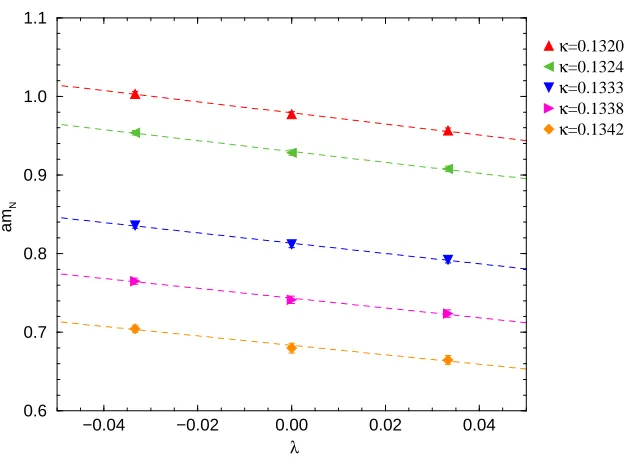
In Fig. 1 we plot the nucleon mass, amN, against λfor the five quark masses. The data show no O(λ2) effects for the λ values chosen. These gradients (at
λ= 0) together with the nucleon masses (again at λ = 0) determine hxilat
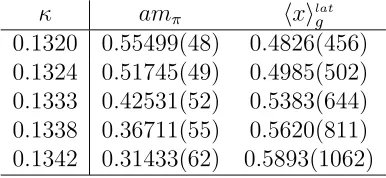
g from eq. (22) which are given in Table 2.
κ amπ hxilatg 0.1320 0.55499(48) 0.4826(456) 0.1324 0.51745(49) 0.4985(502) 0.1333 0.42531(52) 0.5383(644) 0.1338 0.36711(55) 0.5620(811) 0.1342 0.31433(62) 0.5893(1062)
Table 2: The pion mass andhxilat
−0.04 −0.02 0.00 0.02 0.04 λ
0.6 0.7 0.8 0.9 1.0 1.1
am
N
κ=0.1320
κ=0.1324
κ=0.1333
κ=0.1338
[image:7.612.154.467.105.337.2]κ=0.1342
Figure 1: The nucleon mass against λfor the fiveκ values, together with a linear fit for each κvalue.
5
Renormalisation
As gluon operators are singlets, they can mix with the quark singlet. However there exists a combination of singlet operators with vanishing anomalous dimen-sion. (This is due to the conservation of the energy-momentum tensor, eq. (1).) We follow [6] and first write
hxibare
g +
X
q
hxibare
q = 1 +O(a2), (23)
where
hxibare
g =Zghxi
lat
g , hxi
bare
q =Zqhxi
lat
q . (24)
Together with the change to a scheme (here taken asMS)
hxiM S
g (µ)
P
qhxi
M S
q (µ)
=
ZM S
baregg(µ) 1−Z
M S bareqq(µ) 1−ZM S
baregg(µ) Z
M S bareqq(µ)
hxibare
g
P
qhxi
bare
q
, (25)
this completes the renormalisation procedure. As we are considering quenched QCD only there is a simplification as ZM S
baregg= 1,
hxiM S
g (µ) = hxi
bare
g + [1−Z
M S bareqq(µ)]
X
q
hxibare
q
hxiM S
q (µ) = Z
M S
bareqq(µ)hxi
bare
(ZM S
bareqq(µ) is common for all the quarks). We thus need to determine Zg, Zq and ZM S
bareqq(µ). We can find Zg by following [10] in considering an alternative interpretation of the action (18). We motivated this action by adding a multiple of the gluonxoperator to the standard action, but we could also write the action as
S= 1 3βt
X
i
Re trc
1−U i4(~x, τ)
+ 1 3βs
X
i<j
Re trc
1−U ij(~x, τ)
. (27)
which is the standard way of writing a gluon action on an anisotropic asymmetric lattice, with differing spatial and temporal lattice spacings, as 6=at. This action has been studied in detail, in particular the way in which the anisotropy ξ =
as/at depends onβs andβt is known both perturbatively and non-perturbatively [11]. At tree-level the anisotropy is given by ξ2
tree = βt/βs. Zg can be found by comparing the anisotropy actually produced by splittingβsandβt with this tree-level value. The result isZg = 1−g
2
2 (cσ−cτ) where the anisotropy coefficientscσ
and cτ are defined in [11]. Using the perturbative values forcσ,τ [12] yields Zg = 1−0.16677g2+· · ·as the 1-loop perturbative Z
g. In [9] this result was combined with non-perturbative determinations of cσ,τ, [11], to give a Pad´e expression
Zg =
1−1.0225g2+ 0.1305g4
1−0.8557g2 , β ≥5.7, (28)
(with an error of ∼1%). So for β = 6.0 this gives Zg = 0.748.
To estimate Zq we use the results for hxilatg from Table 2 together with those for hxilat
u , hxi
lat
d from [13] (i.e. v2b) together with eqs. (23) and (24). In Fig. 2 we plot2 hxilat
u +hxi
lat
d against hxi
lat
g . From eq. (23) we would expect that the
y-intercept is given by 1/Zg and the x-intercept is given by 1/Zq. At present we do not have enough results for a determination, so we shall just check for consistency by fixing the y-intercept as 1/0.748 and the x-intercept as 1, [6]. This gives consistency so we shall adopt hereZq = 1 together with a 10% error.
Also from [13], we have forµ= 2 GeV,
ZM S
bare qq(µ= 2 GeV)Zq = Z
RGI
v2b ×[∆Z M S
v2 (µ= 2 GeV)]−1
= 1.45×0.732(9) = 1.06(1), (29)
where the second equation uses the notation of that article (the non-perturbative
RI −MOM scheme is converted to an RGI form and then back to the MS
scheme). Further values of ∆ZM S
v2 (µ) are also given in [13]. With Zq this then gives ZM S
bare qq.
2
The total contribution tohxiq from sea quarks has the formNf×(disconnected term). So,
0.0 0.2 0.4 0.6 0.8 1.0 1.2 1.4 <x>latu+<x>latd
0.0 0.2 0.4 0.6 0.8 1.0 1.2 1.4
<x>
g
[image:9.612.152.432.106.345.2]lat
Figure 2: hxilat
u +hxilatd against hxi
lat
g for the five κ values, together with the line
y= (1−x)/0.748.
6
Results and conclusion
We are now in a position to determinehxiM S
g (µ= 2 GeV). Using the first equation in eq. (26) together with eq. (28) (evaluated at β = 6.0) and eq. (29) gives hxiM S
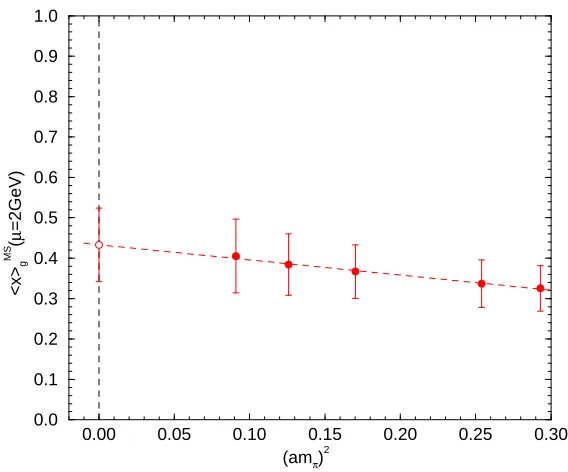
g (µ = 2 GeV). In Fig. 3 we plot using eq. (26), hxi
M S
g (µ = 2 GeV) versus (amπ)2. This gives a value for hxiM Sg (µ= 2 GeV) of
hxiM S
g (µ= 2 GeV) = 0.43(7)(5), (30)
as our final result, where the first error is in the determination of hxilat
g and the second is due to the renomalisation procedure. This is a significant improvement of our previous estimate 0.53(23) based on generating O(5000) configurations, [5] (with error given just for hxilat
g ).
0.00 0.05 0.10 0.15 0.20 0.25 0.30 (amπ)2
0.0 0.1 0.2 0.3 0.4 0.5 0.6 0.7 0.8 0.9 1.0
<x>
g
MS
− (µ
[image:10.612.149.433.106.342.2]=2GeV)
Figure 3: hxiM S
g (µ= 2 GeV) versus (amπ)2for the fiveκvalues, together with a linear
chiral extrapolation.
Acknowledgements
The numerical calculations were performed on the SGI ICE 8200 at HLRN (Berlin–Hannover, Germany). This investigation has been supported partly by the DFG under contract SFB/TR 55 (Hadron Physics from Lattice QCD) and by the EU grant 283286 (Hadron Physics3). RM is supported by the EU grant 238353 (ITN STRONGnet) and JMZ by the Australian Research Council grant FT100100005. We thank all funding agencies. We would also like to thank W. Bietenholz for a careful reading of the manuscript and V. M. Braun and M. G¨ockeler for discussions on renormalisation.
References
[1] D. B. Renner, PoS (LAT2009) 018, arXiv:1002.0925.
[2] Ph. H¨agler, Phys. Rept. 490 (2010) 49, [arXiv:0912.5483[hep-lat]].
[4] M. Guagnelli, K. Jansen, F. Palombi, R. Petronzio, A. Shindler, and I. Wetzorke, Eur. Phys. J. C40 (2005) 69, [arXiv:hep-lat/0405027].
[5] M. G¨ockeler, R. Horsley, E.-M. Ilgenfritz, H. Oelrich, H. Perlt, P. E. L. Rakow, G. Schierholz, A. Schiller and P. Stephenson, Nucl. Phys. Proc. Suppl. 53 (1997) 324, arXiv:hep-lat/9608017.
[6] H. B. Meyer and J. W. Negele, Phys. Rev. D76 (2008) 037501,
[arXiv:0707.3225[hep-lat]].
[7] K. F. Liu, M. Deka, T. Doi, Y. B. Yang, B. Chakraborty, Y. Chen, S. J. Dong, T. Draper, M. Gong, H. W. Lin, D. Mankame, N. Mathur and T. Streuer, PoS (Lattice 2011) 164,arXiv:1203.6388.
[8] R. G. Edwards and B. Jo´o, Nucl. Phys. Proc. Suppl. 140 (2005) 832,
arXiv:hep-lat/0409003.
[9] H. B. Meyer,Phys. Rev. D76 (2007) 101701, [arXiv:0704.1801[hep-lat]].
[10] C. Michael,Phys. Rev. D53 (1996) 4102, [arXiv:hep-lat/9504016].
[11] J. Engels, F. Karsch and T. Scheideler, Nucl. Phys. B564 (2000) 303,
[arXiv:hep-lat/9905002].
[12] F. Karsch, Nucl. Phys. B205 (1982) 285.
[13] M. G¨ockeler, R. Horsley, D. Pleiter, P. E. L. Rakow and G. Schierholz,Phys. Rev. D71 (2005) 114511, [arXiv:hep-ph/0410187].
[14] R. Horsley, Y. Nakamura, H. Perlt, D. Pleiter, P. E. L. Rakow, G. Schierholz, A. Schiller, H. St¨uben, F. Winter and J. M. Zanotti,Phys. Rev. D85 (2012) 034506, [arXiv:1110.4971[hep-lat]].
[15] G. S. Bali, Ch. Schlichter and K. Schilling, Phys. Lett. B363 (1995) 196,
[arXiv:hep-lat/9508027].