
This is a repository copy of
A comparative study on global wavelet and polynomial models
for nonlinear regime-switching systems
.
White Rose Research Online URL for this paper:
http://eprints.whiterose.ac.uk/74599/
Monograph:
Wei, H.L. and Billings, S.A. (2006) A comparative study on global wavelet and polynomial
models for nonlinear regime-switching systems. Research Report. ACSE Research Report
no. 940 . Automatic Control and Systems Engineering, University of Sheffield
[email protected] https://eprints.whiterose.ac.uk/ Reuse
Unless indicated otherwise, fulltext items are protected by copyright with all rights reserved. The copyright exception in section 29 of the Copyright, Designs and Patents Act 1988 allows the making of a single copy solely for the purpose of non-commercial research or private study within the limits of fair dealing. The publisher or other rights-holder may allow further reproduction and re-use of this version - refer to the White Rose Research Online record for this item. Where records identify the publisher as the copyright holder, users can verify any specific terms of use on the publisher’s website.
Takedown
If you consider content in White Rose Research Online to be in breach of UK law, please notify us by
A Comparative Study on Global Wavelet and Polynomial
Models for Nonlinear Regime-Switching Systems
H. L. Wei and S. A. Billings
Ema
Research Report No. 940
Department of Automatic Control and Systems Engineering
The University of Sheffield
Mappin Street, Sheffield,
S1 3JD, UK
A Comparative Study on Global Wavelet and Polynomial NARX
Models for Nonlinear Regime-Switching Systems
Hua-Liang Wei and Stephen A. Billings
Department of Automatic Control and Systems Engineering, University of Sheffield Mappin Street, Sheffield, S1 3JD, UK
September 8 2006
Abstract—A comparative study of wavelet and polynomial models for nonlinear regime-switching
(RS) systems is carried out. Regime-switching systems, considered in this study, are a class of
severely nonlinear systems, which exhibit abrupt changes or dramatic breaks in behavior, due to
regime switching caused by associated events. Both wavelet and polynomial models are used to
describe discontinuous dynamical systems, where it is assumed that no a priori information about the
inherent model structure and the relative regime switches of the underlying dynamics is known, but
only observed input-output data are available. An orthogonal least squares (OLS) algorithm interfered
with by an error reduction ratio (ERR) index and regularised by an approximate minimum description
length (AMDL) criterion, is used to construct parsimonious wavelet and polynomial models. The
performance of the resultant wavelet models is compared with that of the relative polynomial models,
by inspecting the predictive capability of the associated representations. It is shown from numerical
results that wavelet models are superior to polynomial models, in respect of generalization properties,
for describing severely nonlinear regime-switching systems.
Keywords—NARX models; Nonlinear system identification; Regime-switching systems; Wavelets.
1. Introduction
Nonlinear regime-switching (RS) systems, considered in this study, are a class of severely
nonlinear dynamical systems, which
exhibit abrupt changes or jumps in behavior,
due to
regime switching driven by associate
d events. Nonlinear regime-switching behaviour exists widelyin both engineering and non-engineering processes. More often, both the inherent model structure and
the relative regime switches of the underlying processes are totally unknown or very little is known
about them, but observations for the system inputs and outputs are available. System identification
techniques can thus be applied to obtain an equivalent input-output representation for the underlying
systems. General modelling frameworks including the ARX and ARMAX models (Ljung 1987,
Söderström and Stoica 1989), the NARMAX model (Leontaritis and Billings 1985a, 1985b, Chen and
networks (Harris et al. 2002), and other techniques (Cherkassky and Mulier 1998), can be used to
construct such an equivalent input-output representation. In cases where the main objective of system
modelling is focused on stability analysis and controller design, some specific model types, for
example multiple models or multimode models (Sontag 1981, Billings and Voon 1987, Murry-Smith
and Johansen 1997, Bemporad et al. 2000) may be more appropriate for regime-switching dynamical
systems, but to obtain such a specific model some a priori information on the inherent model structure
and the relative individual regime switches of the underlying systems may be required. These specific
model types will not be the pivot of this study; on the contrary, global model types will be used to
describe the input-output behaviour of given regime-switching systems, under an assumption that
either the inherent model structure or the relative regime switches for the underlying processes are
totally unknown.
One of the most commonly used approaches for modelling a structure-unknown nonlinear system
is to construct a nonlinear model using some specific types of functions including polynomials, kernel
functions, wavelets and other candidate basis functions. In practice, most types of functions can only
be used to approximate certain nonlinear relationships effectively. In some cases, however, the
nonlinear dynamics can not sufficiently be represented by a given class of functions because of the
lack of good approximation properties. It is generally recognized that the basis functions used for
representing general nonlinear functions should offer some flexibility in adapting to the complexity of
the model structure so that the model can match, as closely as possible, the underlying dynamics.
Wavelet techniques are one of the most popular and powerful tools for complex nonlinear signal
processing. Compared with other basis functions, wavelets with localization in both the time and the
frequency domains, possess several uniquely attractive properties and offer a flexible capability for
approximating arbitrary functions.
This study introduces a new wavelet based modelling framework for nonlinear regime-switching
systems, where polynomial models may lack good approximation properties. Wavelet models are
constructed using wavelet basis functions selected from a prescribed dictionary. The dictionary may
consist of a large number of candidate bases, but in many cases only a small number of significant
bases need to be included in the wavelet model for a given nonlinear identification problem. An
orthogonal least squares (OLS) algorithm interfered with by an error reduction ratio (ERR) index
(Billings et al. 1989, Chen et al. 1989) and regularised by an approximate minimum description length
(AMDL) criterion (Saito 1994, Antoniadis et al. 1997) , is used to select significant bases (model
regressors). The performance of the resultant sparse wavelet models is compared with that of
polynomial models, by inspecting the predictive capability of the associated representations. As will
be seen, wavelet models are superior to polynomial models, in respect of generalization properties, for
2. Regime-switching systems and the NARX model
Regime-switching systems, considered in this study, are a class of complex nonlinear dynamic
systems, where possibly there exist discontinuities. Assume that the problem is defined in the space S,
referring to as the problem space. Let S1,S2,,Spbe a partition of S, with
p i i S S 1 =
= and Si
Sj =∅if i≠ j . Due to the effects of changes in either the internal state variables or exogenous input
variables, the underlying system may present different local dynamics at each subspace Si∈S, and
often needs to be described using different local models. Such a system can be represented using the
multiple model form below
, ) ), ( , ), 1 ( ), ( , ), 1 ( ( ), ), ( , ), 1 ( ), ( , ), 1 ( ( ), ), ( , ), 1 ( ), ( , ), 1 ( ( )
( 2 2
2 1 1 1 ∈ − − − − ∈ − − − − ∈ − − − − = p p u y p u y u y S n t u t u n t y t y f S n t u t u n t y t y f S n t u t u n t y t y f t y (1)
where fi(⋅)(i=1,2, ..., p) are different linear or nonlinear functions, which are often unknown and
which need to be identified from given observations of the input u(t)and the outputy(t),
n
uandn
yare the maximum input and output lags, e(t) is the noise sequence, is a vector formed by part or all
of the lagged input and output variables {y(t−1),y(t−ny),u(t−1),,u(t−nu)}, iis the associated
parameter vector of the ith local model.
If a priori information on the inherent local model structure and the individual regime switches of
the underlying systems are available, the multiple model (1), may be identified directly from given
input-output data. If, however, the underlying processes are totally structure-unknown in either the
local model structure or the regime switches, global model types then need to be considered to
describe the input-output behaviour of given regime-switching systems.
A wide class of input-output nonlinear dynamical systems can be represented by the NARX
(Nonlinear AutoRegressive with eXogenous inputs) model of the form (Leontaritis and Billings
1985a, 1985b, Pearson 1999)
) ( )) ( , ), 1 ( ), ( , ), 1 ( ( )
(t f y t y t n u t u t n e t
y = − − y − − u + (2)
where the nonlinear mapping f is often unknown and needs to be identified from given observational
data of the input u(t)and the output y(t),
n
u ,nyande(t) are defined as in (1). The nonlinearmapping f can be constructed using a variety of local or global basis functions including polynomials,
kernel functions, splines, radial basis functions, neural networks and wavelets. One of the most
Billings 1985a, 1985b), which takes the form below
∑
∑ ∑
= = = + + + = d i d i i i i i i d i iix t x t x t t
y
1 1
0
1 2 1
2 1 2 1 1 1
1 ( ) ( ) ( )
)
( θ θ θ ( ) ( ) ( ) ( )
1 2 1 2 1 1 1 t e t x t x t x i d i i i i i i i d i + +
∑
∑
− = = θ (3)
where + = ≤ ≤ + + − ≤ ≤ − = u y y y y k n n d k n n k t u n k k t y t x 1 ), ( 1 ), ( )
( (4)
The nonlinear degree of the polynomial model (3) is referred to be , which is determined by the
highest order of all the candidate model terms. A more general representation for the multivariate
nonlinear function f in the NARX model (1) is to decompose f into a number of functional
components via the well-known functional analysis of variance (ANOVA) expansions (Friedman
1991, Chen 1993, Li et al. 2001, Wei and Billings 2004)
) (t
y
∑
∑
≤ < ≤ = + = d j i j i j i d i i
i x t f x t x t f 1 , 1 )) ( ), ( ( )) ( ( +
∑
+ ≤ < < ≤i j k dk j i k j
i x t x t x t f 1 , , ( ( ), ( ), ( ))
∑
≤ < < ≤ + d i i i i i i i i m m m x t x t x tf 1 2 1 2 1 1 , ,
, ( ( ), ( ), , ( ))+e(t) (5)
where m≤d, im∈{1,2,,d} and the function fi1,,im (j=1,2, …,d ) does not contain terms that are
included in functional components with an order smaller than m. Detailed discussions on the
functional ANOVA expansion (5) can be found in Billings and Wei (2005).
Many types of functions can be employed to express the functional components
m
i i
f1,, in model
(5). In this study, however, wavelet decompositions will be used to approximate each of these
functional components. Experience shows that the representation of up to second order of functional
components in model (5), using wavelet decompositions, can often provide a satisfactory
approximation for many high dimensional problems providing that the input variables are properly
selected (Wei and Billings 2004, Wei et al. 2004a, Billings and Wei 2005).The presence of only low
order functional components does not necessarily imply that the high order variable interactions are
not significant, nor does it mean the nature of the nonlinearity of the system is less severe.
It is known that wavelet decompositions are based on a mother wavelet prototype function, and
temporal analysis is performed using some contracted, high-frequency versions of the same function.
Data analysis can thus be implemented using the corresponding wavelet coefficients. The ANOVA
expansion (5), where each functional component is approximated using wavelet decompositions, can
thus be easily converted into a linear-in-the-parameters form
) ( ) ( ) ( 1 t e t t y M m m m + =
∑
= φwhere x(t)=[x1(t),x2(t),,xd(t)]Tis the ‘input’ (predictor) vector, φm(t)=φm(x(t)) are the model
regressors, θmare the model parameters, and M is the total number of candidate regressors.
The initial wavelet model (6) often involves a large number of candidate model terms. Experience
suggests that most of the candidate model terms can be removed from the model, and that only a small
number of significant model terms are needed to provide a satisfactory representation for most
nonlinear dynamical systems. The orthogonal least square type algorithms (Billings et al. 1989, Chen
et al. 1989) can be used to select significant model terms. The initial OLS-ERR type algorithms,
however, cannot automatically determine the model size. To ameliorate the agility and enhance the
capability of the OLS-ERR algorithm, an approximate minimum description length (AMDL) criterion
(Saito 1994, Antoniadis et al. 1997), will be introduced to aid the determination of the associated
model size, and this is described below.
3.
The OLS-ERR algorithmConsider the term selection problem for the linear-in-the-parameters model (6). Let
N t d
y t
y
t), ( )): , } 1
(
{(x x∈R ∈R = be a given training data set and y=[y(1),,y(N)]Tbe the vector of the
output. LetI ={1,2,,M}, and denote by Ω={φm:m∈I} the dictionary of candidate model terms in
an initially chosen candidate regression model similar to (6). The dictionary Ω can be used to form a
variant vector dictionaryD={ m:m∈I}, where the mth candidate basis vector m is formed by the
mth candidate model termφm∈Ω, in the sense that
T m
m
m=[φ (x(1)),,φ (x(N ))] . The model term
selection problem is equivalent to finding, from I, a subset of indices,In={im:m=1,2,,n,im∈I}
wheren≤M, so that so that y can be approximated using a linear combination of
n
i i
i1, 2,, .
3.1 The forward orthogonal search procedure
A non-centralised squared correlation coefficient will be used to measure the dependency between
two associated random vectors. The non-centralised squared correlation coefficient between two
vectors x and y of size N is defined as
∑
∑
∑
= ==
= =
= N
i i N
i i N i i i T
T T T
y x
y x C
1 2 1
2 1
2 2
2 2
2 ( )
) )( (
) ( || || || ||
) ( ) , (
y y x x
y x y
x y x y
x (7)
It has been shown in Wei et al. (2004b) that the above squared correlation coefficient is closely related
to the error reduction ratio (ERR) criterion (a very useful index in respect to the significance of model
terms), defined in the standard orthogonal least squares (OLS) algorithm for model structure selection
(Billings et al.1989, Chen et al. 1989).
)} , ( { max arg 1 1 j M j≤ C y
≤
=
(8)
where the functionC(⋅,⋅)is the correlation coefficient defined by (7). The first significant basis can thus
be selected as
1
1= , and the first associated orthogonal basis can be chosen as q1= 1. The model
residual, related to the first step search, is given as
1 1 1 1 0 1 q q q q y r r T T −
= (9)
In general, the mth significant model term can be chosen as follows. Assume that at the (m-1)th
step, a subsetDm−1, consisting of (m-1) significant bases,
1 2
1, ,, m− , has been determined, and the
(m-1) selected bases have been transformed into a new group of orthogonal bases q1,q2,,qm−1via
some orthogonal transformation. Let
∑
− = − = 1 1 ) ( m k k k T k k T j j m j q q q qq (10)
)} , ( { max
arg ( )
1 1 , m j m k j m C k q y − ≤ ≤ ≠ =
(11)
where j∈D−Dm−1, and
1
−
m
r is the residual vector obtained in the (m-1)th step. The mth significant
basis can then be chosen as
m
m= and the mth associated orthogonal basis can be chosen as
) (m m qm
q = . The residual vector r at the mth step is given by m
m m T m m T m m q q q q y r
r = −1− (12)
Subsequent significant bases can be selected in the same way step by step. From (12), the vectors
m
r and q are orthogonal, thus m
m T m m T m m q q q y r r 2 2 1
2 ( )
|| || ||
|| = − − (13)
By respectively summing (12) and (13) for m from 1 to n, yields
n n m m m T m m T r q q q q y y
∑
= + = 1 (14)∑
= − = n m m T m m T n 1 2 22 ( )
|| || || || q q q y y
r (15)
The model residual r will be used to form a criterion for model selection, and the search procedure n
will be terminated when the norm ||rn||2satisfies some specified conditions. Note that the quantity
) , (
brought by including the mth basis vector
m
m= into the model, and that
∑
=n
m 1C( qy, m) is the
increment or total percentage that the desired output variance can be explained by 1, 2,, n
.
Note that some tricks can be used to avoid selecting strongly correlated model terms. Assume that
at the (m-1)th step, a subsetDm−1,consisting of m-1 significant bases,
1
1,, m− , has been determined.
Also assume that j∈D−Dm−1is strongly correlated with some bases inDm−1, that is, j is a linear
combination of 1,, m−1. Thus, ( ) 0 ) ( )
( m =
j T m j q
q . In the implementation of the algorithm, the
candidate basis jwill be automatically discarded if <δ ) ( ) (
)
( jm
T m j q
q , where δ is a positive number
that is sufficiently small. In this way, any severe mullticolinearity or ill-conditioning can be avoided.
3.2 M
odel size determination
The determination of model size is critical in dynamical modelling because neither an over-fitting
nor an under-fitting model is desirable. For problems in the real world, however, the true model size is
generally unknown and needs to be estimated from the data. Model selection criteria are often
established on the basis of estimates of prediction errors, by inspecting how the identified model
performs on future (never used) data sets.
In the present study, an approximate minimum description length (AMDL) criterion developed by
Saito (1994) and Antoniadis et al. (1997), on the basis of the Rissanen’s MDL criterion (Rissanen
1983), will be used to determine the model size. For the case of single regression model, AMDL is
defined as
N N n n
n 2
2
log 5 . 1 )] [MSE( log
5 . 0 )
AMDL( = +
N N n N
n 2
2 2
log 5 . 1 || || log 5 .
0 +
= r (16)
where MSE is the mean-square-error from the associated model, N is the length of the associated
training data set, n is the number of model terms, and r is the associated model residual. A similar n
strategy has been employed in Wei et al. (2006), where a Bayesian information criterion (BIC)
criterion was used.
3.3 Parameter estimation
It is easy to verify that the relationship between the selected original bases 1, 2,, n, and the
associated orthogonal basesq1,q2,,qn, is given by
n n n Q R
A = (17)
whereAn =[ 1,, n], Q is an n N×nmatrix with orthogonal columnsq1,q2,,qn, and R is an n
n
n× unit upper triangular matrix whose entries uij(1≤i≤ j≤n) are calculated during the
model with respect to the original bases, can be calculated from the triangular equation Rn n=gn
withgn=[g1,g2,,gn]T , where ( )/( k) T k k T k
g = y q q q for k=1,2, …, n.
4. Numerical examples
This section presents three examples to demonstrate that wavelet models, produced by the forward
orthogonal regression (OLS-ERR) algorithm, can be used to effectively describe severely nonlinear
regime-switching systems where possibly there exist discontinuities. As will be seen, resultant wavelet
models are superior to polynomial models, in respect of generalization properties, for nonlinear
regime-switching systems considered in the examples.
Note that in the polynomial model identification procedure the original observational data were
directly used to construct the model. In the wavelet modelling procedure, however, the original
observed data, if not in [0,1], were initially normalized to [0,1] via a transform
) /( ) ) ( ~ ( )
(t x t a b a
x = − − , where ~ tx( ) indicate the initial observations, and a and b represent the
prescribed boundary for the associated observations. The identification procedure was therefore
performed using normalized values x(t). The outputs of an identified model were then recovered to the
original measurement space by taking the associated inverse transform.
The model predicted output (MPO) were used to measure the model performance of the identified
models. For an identified model y(t)= fˆ(x(t)) , the model predicted output is defined as
)) ( ˆ ( ˆ ) (
ˆ t f t
y = x , implying that yˆ t( ) is produced from the identified model iteratively, where
T d t x t x t x
t) [ ( ), ( ), , ( )]
( = 1 2
x is defined by (3) and (5), and xˆ(t)=[xˆ1(t),,xˆny(t),xny+1(t),xd(t)]Tis
the predicted value of x(t).
4.1 Example 1.
Consider a two-input piecewise finite impulse response (FIR) model below
∈ − + − ∈ − − − ∈ − + − = 3 2 1 2 1 2 2 1 2 1 1 2 1 2 1 2 1 ) , ( ), 1 ( 2 ) 1 ( 3 ) , ( ), 1 ( 2 ) 1 ( ) , ( ), 1 ( ) 1 ( )) ( ), ( ( S x x t u t u S x x t u t u S x x t u t u t x t x
f , (18)
wherex1(t)=u1(t−1),x2(t)=u2(t−1), and the three regimes (subspaces) S1, S2andS are defined as 3
below: } 5 . 0 , 1 0 : ) ,
{( 1 2 1 2 2
1= x x ≤x ≤x ≤ x ≤
S , } 1 , 5 . 0 , 1 0 : ) ,
{( 1 2 1 2 1 2
2 x x x x x x
S = ≤ ≤ < ≤ + ,
} 1 , , 5 . 0 : ) ,
{( 1 2 1 1 2 1 2
3= x x x ≤ x <x x +x <
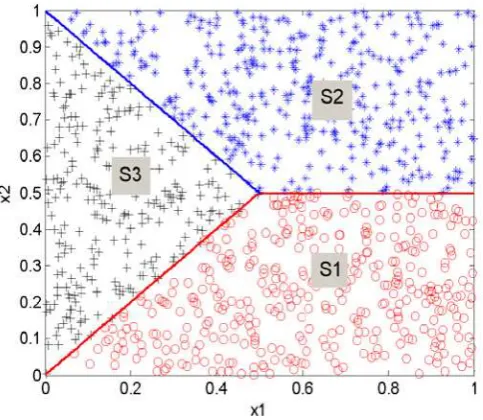
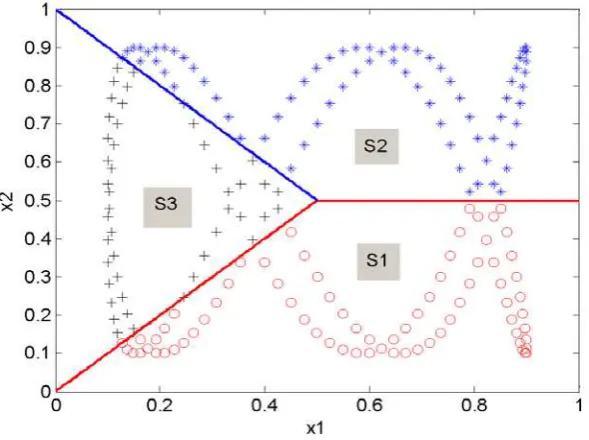
Clearly,S1S2S3=[0,1]×[0,1], see Figure 1 for a clearer visualisation. One thousand data points
were generated from (18) by setting y(t)= f(x1,x2)+e, where the two input variables u1(t) and
) (
2 t
u were uniformly distributed in [0,1], and e was a Gaussian noise with zero mean and standard
derivation 0.1. The distribution of the 1000 input data points in the three subspaces S1, S2andS is 3
shown in Figure 1, and the first return map formed by the 1000 data points is shown in Figure 2. The
predictor vector (the ‘input’ vector) was chosen to be x(t)=[x1(t),x2(t)]T, and the initial polynomial
and wavelet model was respectively chosen to be
∑
∑ ∑
= = = + + + = = 2 1 2 2 1 01 2 1
2 1 2 1 1 1
1 ( ) ( ) ( )
)) ( ( ˆ ) (
i i i
i i i i i i
i x t x t x t t
f t
y x θ θ θ
∑
∑
= =
+ 2 2
1 5 4 1 5 1 5
1 ) ( ) ( i i i i i i i t x t x
θ (19)
and )) ( ( ˆ )
(t f t
y = x
∑ ∑ ∑
= ∈ ∈ = 4 0 2 1 , ; , ; 1 2 2 1 2
1 ( ( ), ( )) j k B k B
k k j k k j j j t x t x
c ψ (20)
whereBj ={k:−3≤k≤2+2j},cj;k1,k2 are coefficients,ψj;k1,k2(x1,x2) 2 (2 x1 k1,2 x2 k2) j
j
j − −
= ψ are
the dilated and translated versions of the 2-D truncated Mexican hat wavelet, ψ(x1,x2), that has been
proposed in Billings and Wei (2005) and is defined as below:
− × − ∈ − = − otherwise , 0 ] 3 , 3 [ ] 3 , 3 [ , ) || || 2 ( ) ( 2 || || 2 1 2 x x x x e
ψ (21)
The total number of candidate model terms (basis functions) involved in the initial polynomial model
(19) and the initial wavelet model (20) was 21 and 893, respectively. Based on the 1000 data points,
the OLS-ERR algorithm was applied to select significant model terms for both the polynomial and the
wavelet model identification. The AMDL criterion, shown in Figure 3, suggested that the number of
model terms for the polynomial and wavelet models was 17 and 36 respectively.
To inspect and compare the performance of the identified 17-term polynomial model and 36-term
wavelet model, both models were simulated by choosing the two input variables u1(t) and u2(t)as
below:
• Both u1(t) and u2(t) were uncorrelated random sequences, with 500 data points, uniformly
distributed in [0,1], but note that the test data was different from the data used for model
estimation.
• u1(t)=0.5+0.4sin(πt/50) andu2(t)=0.5+0.4sin(πt/20+π/3) for t=1,2,…,500. The 500
input data points in the three subspaces S1, S2andS is shown in Figure 4. 3
Model predicted outputs, from both the identified polynomial and wavelet models, were compared
above two test cases, are shown in Figures 5 and 6, respectively, where only a fraction of the data
points is displayed for a closer visualisation. For the first test case, the mean-square-error (MSE), for
the model predicted outputs from the identified polynomial and wavelet models, was calculated to be
0.2768 and 0.0923, respectively, over all the 500 test data points. For the second test case, the MSE
was calculated to be 0.3719 and 0.1073, respectively, over the test data set. Clearly, the identified
wavelet model is significantly superior to the polynomial model for the regime-switching system
[image:12.595.173.415.234.444.2]described by (18).
Figure 1. The three subspaces S1, S2andS3, and the distribution of the 1000 input data points used for model estimation described in Example 1.
[image:12.595.172.418.526.722.2]Figure 3. AMDL index versus the number of model terms for the polynomial models (the plot at the top) and the wavelet models (the plot at the bottom) identification described in Example 1.
[image:13.595.145.440.464.684.2]Figure 5. A comparison of the model predicted outputs produced by the identified polynomial and wavelet models, with the true values produced by the noise-free model (18), driven by the input in the first test case described in Example 1. Circles present the true values, dots present the model predicted output from the wavelet model, and crosses present the model predicted output from the polynomial model.
[image:14.595.134.433.463.665.2]4.2 Example 2
A nonlinear system was described by the following model
< − − + − + − + − + − + − − ≥ − − + − + − + − + − − − − = , 0 ) 2 ( ) 1 ( if ), ( ) 1 ( )] 2 ( ) 1 ( [ 10 )] 2 ( 5 . 0 ) 1 ( )[ 2 ( , 0 ) 2 ( ) 1 ( if ), ( ) 1 ( )] 2 ( ) 1 ( [ 10 )] 2 ( 5 . 0 ) 1 ( )[ 1 ( ) ( 2 / 1 2 2 2 / 1 2 2 t x t x t t u t x t x t x t x t x t x t x t t u t x t x t x t x t x t x ξ ξ (22a) ) ( ) ( )
(t x t t
y = +η (22b)
whereξ(t)and η(t)were Gaussian white noise with zero mean and standard deviationσξ=0.1 and
η
σ =0.5, respectively. By choosing the input u(t) as a random sequence that was uniformly distributed
in [-10,10], model (22) was simulated and 500 input-output data points were collected after the system
has settled down.
The predictor vector was chosen to be x(t)=[x1(t),x2(t),x3(t)]T
T t u t y t
y( 1), ( 2), ( 1)]
[ − − −
= . The
initial polynomial model was chosen to be
∑
∑ ∑
= = = + + + = = 3 1 3 3 1 01 2 1
2 1 2 1 1 1
1 ( ) ( ) ( )
)) ( ( ˆ ) (
i i i
i i i i i i
i x t x t x t t
f t
y x θ θ θ
∑
∑
= =
+ 3 3
1 4 3
4 1 4 1 1 ) ( ) ( i i i i i i i t x t x
θ (23)
A total of 35 candidate model terms was involved in this polynomial model. The initial wavelet model
was chosen to be
y(t)= fˆ(x(t))
∑
∑ ∑
= = = + = 2 1 3 2 3 1 )) ( ), ( ( )) ( ( p q q p pq p p
p x t f x t x t
f (24)
where the univariate functions f were of the form below p
∑ ∑
= ∈ = 5 0 ; ; ( ( )) )) ( (j k A
p k j k j p p j t x c t x
f φ (25)
where Aj ={k:−4≤k≤3+2j}, cj;k are coefficients,φj;k(x)=2j/2φ(2jx−k) are the dilated and
translated versions of the 1-D truncated Mexican hat wavelet, φ(x), defined as below (Billings and
Wei 2005): − ∈ − = − otherwise 0 ] 4 , 4 [ ) 1 ( ) ( 2 / 2 2 x e x x x
φ (26)
The bivariate functions fpq were approximated using the 2-D truncated Mexican hat wavelets similar
to (20). A total of 3012 candidate wavelet basis functions were involved in the initial wavelet model
) /( ) ) ( ~ ( )
( i i i i
i t x t a b a
x = − − , where ~ txi( ) indicates the initial observations, andai =−15,bi=15for
i=1,2 (corresponding to the output variables), andai =−10,bi =10for i=3 (corresponding to the input
variable). The identification procedure was performed using the normalized values of xi(t). The
outputs of an identified model were then recovered to the original measurement space by taking the
associated inverse transform.
Based on the 500 estimation data points, the OLS-ERR algorithm was applied to select significant
model terms for both the polynomial and the wavelet model identification. The AMDL criterion,
shown in Figure 7, suggested that the number of model terms for the polynomial and wavelet models
was 8 and 18 respectively.
To inspect and compare the performance of the identified 8-term polynomial model and the
18-term wavelet model, both models were simulated by choosing the input as a random sequence, with
500 data points, that was uniformly distributed in [-10,10]. Model predicted outputs, from both the
polynomial and wavelet modes, were compared with that produced by the true model (22), and these
are shown in Figure 8, where again only part data points were displayed. The MSE was calculated to
be 0.7588 and 0.6870, respectively, with respect to the model predicted outputs from the identified
polynomial and wavelet models, over the all 500 test data points. Clearly, the identified wavelet model
[image:16.595.159.427.445.663.2]is apparently superior to the polynomial model for the regime-switching system described by (22).
Figure 8. A comparison of the model predicted outputs produced by the identified polynomial and wavelet models, with the true values produced by model (22), described in Example 2. Circles present the true values, dots present the model predicted output from the wavelet model, and stars present the model predicted output from the polynomial model.
4.3 Example 3
A nonlinear system model was given by
∈ − + − − − − ∈ − + − − − + ∈ − − − − − + − = 3 2 1 0 2 2 1 0 1 2 1 0 ), 1 ( ) 2 ( ) 1 ( ), 1 ( ) 2 ( ) 1 ( ), 1 ( ) 2 ( ) 1 ( ) ( S t u t x b t x b b S t u t x b t x b b S t u t x a t x a a t
x , (27a)
) ( ) ( )
(t x t e t
y = + (27b)
where
a0 =10,
a1=0.25,
a2 =0.75,
b0 =20,
b1=0.6,
b2=0.8, e(t) was a noise signal,
)] 2 ( ), 1 ( [ − −
= x t x t
, and
the three subspaces S1, S2andS are defined as below: 3} 25 . 0 : ) ,
{( 1 2 2 12
1 x x x x
S = ≥
,
{( , ): 0.25 , 1 0}2 1 2
2 1
2 = x x x < x x ≤
S
,
{( , ): 0.25 , 1 0}2 1 2
2 1
3= x x x < x x >
S
,
Clearly the union of S1, S2andS is the whole plane in the 2-D space. By setting e(t) to be Gaussian 3
white noise with zero mean and standard deviationσe=5, and by choosing the input u(t) as a random
sequence that was uniformly distributed in [-5,5], model (27) was simulated and 2500 input-output
data points were collected after the system has settled down. The first 500 data points was used for
model estimation and the remaining 2000 data points were used for model validation. The first return
maps produced by the 2000 noisy test data and the associated noisy-free data are shown in Figures 9
Figure 9. The first return map formed by the 2000 noisy training data points generated by model (27) in Example 3.
[image:18.595.145.436.447.685.2]-
Note that the output of the model (27a) was sensitive to the model parameters. For example, a
small disturbance in the parameter b may lead to a dramatic difference in the model response under 2
the same input. Figure 11 presents this phenomenon, where the differenceε(t)= y(t;b2+δ)−y(t;b2),
with b =0.8 and2
4
10−
=
δ , was displayed. Clearly, with the process going on, a small discrepancy in
the parameter b produces significant difference in the model response. This means that it might be 2
difficult to identify a model that can produce accurate long term predictions.
The predictor vector, the initial polynomial model, and the initial wavelet model were chosen
exactly the same as in Example 2. The original observed data were initially normalized to [0,1], by
settingai=−80andbi =80for i=1,2 (corresponding to the output), andai =−5and bi=−5for i=3
(corresponding to the input). The identification procedure was performed using normalized values of
) (t
xi . The outputs of an identified model were then recovered to the original measurement space by
taking the associated inverse transform. Based on the 500 data points, the OLS-ERR algorithm was
applied to select significant model terms for both the polynomial and the wavelet model identification.
The AMDL criterion suggested that the number of model terms for the polynomial and wavelet
[image:19.595.152.426.431.659.2]models was 12 and 21 respectively.
Figure 10. The differenceε(t)=y(t;b2+δ)−y(t;b2)produced by the noise-free model (27a), described in
Example 3, where 4
10−
=
It was known that the original model given by (27) is sensitive to the associated model parameters,
it was thus difficult to obtain accurate long term predictions. This means that a simple comparison of
long term predictions may not be a good measurement of model quality. As an alternative, the
performance of the identified 12-term polynomial model and the 21-term wavelet model was inspected
by calculating the associated first return maps. The first return maps, produced by the model predicted
outputs, with respect to the identified polynomial and wavelet models, are presented in Figures 12 and
13, respectively. Clearly, the first return map produced by the identified wavelet model, compared
with that produced by the polynomial model, provides a much closer representation for the first return
map formed by the original measurements. This means that the identified wavelet model is superior to
[image:20.595.183.404.288.461.2]the associated polynomial model for the nonlinear regime-switching system described by (27).
Figure 12. The first return map produced by the model predicted output of 2000 data points from the identified polynomial model, driven by a random sequence that was uniformly distributed in [-5,5].
[image:20.595.180.403.536.706.2]5. Conclusions
A new wavelet based modelling approach has been introduced for nonlinear regime-switching
system identification, where it was assumed that the inherent model structure and relative regime
switches of the underlying systems are totally unknown. For this type of severely nonlinear systems,
where a priori knowledge on the model structure is unavailable, identifying a global input-output
model, from available data, may be a good initial step towards further understanding of the underlying
dynamics. It has been demonstrated that wavelets, with local properties in both the time and the
frequency domains, are powerful for constructing global nonlinear models for regime-switching
systems. The performance of the resultant wavelet models, as has been shown, is much superior to that
of the associated polynomial models for dealing with the identification problems described in the
examples.
At first sight, a wavelet model may involve a large number of candidate model terms for high
dimensional problems. In most cases, however, most of the candidate model terms are redundant and
only a small number of significant model terms are necessary to include in the final model to describe
the nonlinear dynamics with a good accuracy. More fortunately, an efficient model structure and term
selection algorithms including the forward orthogonal regression (OLS-ERR) algorithm, coupled with
the AMDL criterion (or other efficient criteria), can be employed to determine which model terms and
how many model terms should be included in the model and finally a parsimonious model can be
obtained.
Wavelet bases, in dynamical wavelet modelling, involve two key parameters: the scales (the
dilation parameter) and the positions (the translation parameter). While it is believed that the higher
the scales the more accurate the wavelet model is, experience from numerous case studies has shown
that the dilation parameter need not to be chosen very high. As a rule of thumb, setting the scale
parameter to values up to 2 or 3 can often work well.
Acknowledgements
The authors gratefully acknowledge that this work was supported by EPSRC(UK).
References
A. Antoniadis, I. Gijbels, G. Gregoire, “Model selection using wavelet decomposition and
applications”, Biometrika, 84(4), pp. 751-763, 1997.
A. Bemporad, G. Ferrari-Trecate, and M. Morari, “Observability and Controllability of piecewise
affine and hybrid systems”, IEEE Trans. Auto. Control, 45(10), pp. 1864-1876, 2000.
S. A. Billings and S. Chen, “The determination of multivariable nonlinear models for dynamic systems
using neural networks”, In C.T. Leondes (Ed.), Neural Network Systems Techniques and
S. A. Billings, S. Chen, S., and M. J. Korenberg, “Identification of MIMO non-linear systems suing a
forward regression orthogonal estimator”, Int. J. Control, 49(6), pp. 2157-2189, 1989.
S. A. Billings and W. S. F. Voon, “Piecewise linear identification of non-linear systems”, Int. J.
Control, 46(1), pp.215-235, 1987.
S. A. Billings and H. L. Wei, “A new class of wavelet networks for nonlinear system identification”,
IEEE Trans. Neural Networks, 16(4), pp. 862-874, 2005.
S. Chen and S. A. Billings, “Representations of non-linear systems - the NARMAX model”, Int. J.
Control, 49(3), pp.1013-1032, 1989.
S. Chen, S. A. Billings, and W. Luo, “Orthogonal least squares methods and their application to
non-linear system identification”, Int. J. Control, 50(5), pp.1873-1896, 1989.
Z. H. Chen, “Fitting multivariate regression functions by interaction spline models”, J. R. Stat. Soc.
Ser. B-Methodol., 55(2), pp. 473-491, 1993.
V. Cherkassky and F. Mulier, Learning from Data, New York: John Wiley & Sons, 1998.
J. H. Friedman, “Multivariate adaptive regression splines”, Ann. Stat., 19(1), pp. 1-67, 1991.
C. J. Harris, X. Hong, and Q. Gan, Adaptive Modelling, Estimation and Fusion from Data: A
Neurofuzzy Approach, Berlin: Springer-Verlag, 2002.
I. J. Leontaritis and S. A. Billings, “Input-output parametric models for non-linear systems—part 1:
deterministic non-linear systems
”, Int J. Control, 41(2), 303-328, 1985a.I. J. Leontaritis and S. A. Billings, “Input-output parametric models for non-linear systems—part 2:
Stochastic Non-Linear Systems”, Int J. Control, 41(2), 329-344, 1985b.
L. Ljung, System Identification : Theory for the User, Englewood Cliffs : Prentice-Hall, 1987.
G. Li, C. Rosenthal, and H. Rabitz, “High dimensional model representation”, J. Physical Chemistry,
105(33), pp. 7765-7777, 2001.
G. P. Liu, Nonlinear Identification and Control: A Neural Network Approach, Berlin:
Springer-Verlag,
2001.
R. Murry-Smith and T. A. Johansen (ed.), Multiple model approaches to modelling and control,
London
: Taylor & Francis,
1997.
R. K. Pearson, Discrete-Time Dynamic Models, Oxford: Oxford University Press, 1999.
J. Rissanen, “A universal prior for integers and estimation by minimum description length”, Ann. Stat.,
11, pp. 416-431, 1983.
N. Saito, “Simultaneous noise suppression and signal compression using a library of orthonormal
bases and the minimum description length criterion”, In Wavelet in Geophysics,
Foufoula-Georgiou, E. and Kumar, P., Eds, New York: Academic, pp. 299-324, 1994.
E. D. Sontag, “Nonlinear regulation: the piecewise linear approaches”, IEEE Trans. Auto. Control,
26(2), pp. 346-358, 1981.
H. L. Wei and S. A. Billings, “A unified wavelet-based modelling framework for nonlinear system
identification: the WANARX model structure”, Int. J. Control, 77(4), pp. 351-366, 2004.
H. L. Wei, S. A. Billings, and M. A. Balikhin, “Prediction of the Dst index using multiresolution
wavelet models”, J. Geophys. Res, 109(A7), A07212, doi:10.1029/2003JA010332, 2004a.
H. L. Wei, S. A. Billings, and J. Liu, “Term and variable selection for nonlinear system
identification”, Int. J. Control, 77(1), pp. 86-110, 2004b.
H. L. Wei, S. A. Billings, and M. A. Balikhin, “Wavelet based nonparametric NARX models for




![Figure 12. The first return map produced by the model predicted output of 2000 data points from the identified polynomial model, driven by a random sequence that was uniformly distributed in [-5,5]](https://thumb-us.123doks.com/thumbv2/123dok_us/8086293.230199/20.595.180.403.536.706/figure-produced-predicted-identified-polynomial-sequence-uniformly-distributed.webp)
