This is a repository copy of The Effects of Parking Control on Destination Choice – Pilot Studies.
White Rose Research Online URL for this paper: http://eprints.whiterose.ac.uk/2333/
Monograph:
Turvey, I.G. (1985) The Effects of Parking Control on Destination Choice – Pilot Studies. Working Paper. Institute of Transport Studies, University of Leeds , Leeds, UK.
Working Paper 218
[email protected] https://eprints.whiterose.ac.uk/
Reuse
Unless indicated otherwise, fulltext items are protected by copyright with all rights reserved. The copyright exception in section 29 of the Copyright, Designs and Patents Act 1988 allows the making of a single copy solely for the purpose of non-commercial research or private study within the limits of fair dealing. The publisher or other rights-holder may allow further reproduction and re-use of this version - refer to the White Rose Research Online record for this item. Where records identify the publisher as the copyright holder, users can verify any specific terms of use on the publisher’s website.
Takedown
If you consider content in White Rose Research Online to be in breach of UK law, please notify us by
White Rose Research Online
http://eprints.whiterose.ac.uk/
Institute of Transport Studies University of Leeds
This is an ITS Working Paper produced and published by the University of Leeds. ITS Working Papers are intended to provide information and encourage discussion on a topic in advance of formal publication. They represent only the views of the authors, and do not necessarily reflect the views or approval of the sponsors.
White Rose Repository URL for this paper: http://eprints.whiterose.ac.uk/2333/
Published paper
Turvey, I.G. (1985) The Effects of Parking Control on Destination Choice – Pilot
Studies. Institute of Transport Studies, University of Leeds. Working Paper 218
THE EFFECTS OF PARKCNG ackpIROL IOL DESTINATION CHOICE.
-
P I W STUDIESITS tarking Papers are intended to povide infbnnation and encourage discussion on a topic in advance of formal publication. They represent onlythe view of
the
authorsand do not necessarily reflect the views or apprwal of
spnsors
.
TURVEY; I.G. (1985) The Effects of Parking Control on Destination Choice
-
Pilot Studies. Mrking-paper-218; Institutefor
Transprt Studies; University of Leeds.The aim of the ~ o j e c t has been to develop a methodology to study the process of destinaticm choice resulting £ran clmqes in parking control. A nunber of alternative approaches have keen utilised such as 'before' and 'after' interviews &or
LIST
a
FIGUS LIST OF TABLES1.1 W
-1.2 O B J E c r I V E S a m P ~ 1.3 CURFZNT RESEPXH
1.3.1 TRAFE'IC RESTRAINT (PARKENG) 1.3.2 BEEAVIOURIV, SURVEY TJEBlIQvES 1.3.3 MCDELtING TECHNIWS
1.4 OUTLINE OF THE KEWIIT 2. PAWJNG SURVEYS
2.1 PARKING SUPPLY
2.2 PARKMG USACE
2.3 OTHER P m N G SURW TEKWIQUES 2.4 PARKING INDICES
3. CASE STUDIES
3.1 SELECTION OF SUITABLE SITES 3.2 CASE SPUDY SITES
3.3 PW)JECP TIMETm
4.1 INTERVIEW
4.2 QUESTIONNAIRE:
4.3 APPRAlSAL OF ~ D O L O G Y
4.3.1 INTERVIEXnl
4.3.2 OUEST1mRE:
4.3.3 APPRAISAL OF WESTIONS 5. CAR PARKING IN
m m
5.1 WKGROUND
5.2 BEFORE: S W 5.3 AFTER SPUDY
5.4 RESULTS
5.4.1 BEFORE STUDY
5.4.2 AFTER SlUDY 6 - CAR PARKENG IN lQJARESBOWXTBI
PAGES
l l 0
6.1 WKGGROUND
6.2 THE MAIN SURVEYS
6.3 TOURIST IKTERVIEWS 6.4 RESULTS
7. SURVEY COSTS
7.1 REPLY P m QUESTIONNAIRE 7.2 LONG 1NTEaVI.W
7.3 SHORT INTERVIEW 7.4 POSTAL Q U J s T 1 m R E 7.5 S m Y
8.1 SURVEY MEI'HOC6 8.2 GEhlERAL
9. EQ3MENXTIONS FOR F'URTHER WORK
REFERENCES (1 ) SURVEY DESIGN
(2) TRQ'FIC I7ESTRAINT ( P A P H E )
( 3 ) -P (-)
(4 ) PARKCNG SURVEYS
(5 ) ORIGIN~DESPINATI~ SURVEYS (6) MQ)ELZ,ING TECHNIQUES
APPENDIX 1 : STATISTICAL BJALYSIS
APPENDIX 2 : PAWING PFOVISION AND cXNTR3L
APPENDIX 3 : PFchJEcr C O m A m s APPENDIX 4 : PIIMP STUDIES (LEE=)
APEm'DIX 5 : FcfmmaM STUDIES
APPENDIX 6 : I(NARESB0FOUGH STUDIES
PACES
UST-OF-FIGURES
FIGURE 1.1 : PARKING RFSTRAINT MEASURES FIGUF?E 3.1 : PRDJECP TIMFPABIE
LIST -OF-TABLES
TABW 3.1 : POSSIBLE CASE STUDY SITES
TABIE 5.1 : CAR PARKING IN ROTHERHAM
TABLE 5.2 : BEFORE STUDY BY LCCATION AND W Y TABIE 5.3 : 2XTUAL IONS TO PARKTNG LZllWGEs
TABLE 6.1 : PARKING SPACES I N ~ B O ~ U AND CONTFOL G H
TABIE 6.2 : CAR P M WCUPAKCY WVEW
TABLE 6.3 : QUESTIONNAIRE DISTRIBWION (ALL VERSIOHS)
TABIE 6.4 : DISTRIBUI'ION OF EACH 'lfARIATION OF lXlESTIONNAIRE TABLE 6.5 : CAR ~P~
TABLE 6.6 : CaMPARISON OF STATED PREFEWXE RESPONSE
T U 6.7 : CCMPARISON OF WATK TIMES FRCM PARKING LOCATION TO FINRL DESTINATION
In response to changes i n parking controls it may be pstulated that the driver w i l l a l t e r h i s parking habits and behmriour to minimise the effects of such a change on himself. Changes i n parking control which especially affect peak pericd travel; such as the parking location; mode chosen (Gantvmrt
; 1984) and the
time of the t r i p (My; 1985) are frequently analysed. Wwever ; other effects of chaqe such as the frequency of v i s i t and the choice of the final destinatica; may have particular relevance to off peak and particularly showing journeys. There i s ofken concern over l o s t trade as a result of destination changes so providing bath the pressure for parking impovcments and the opposition to parking restrictions. L i t t l e is kmm, h o m e r ; about the extent to thich drivers do change destination i n response to changes i n parking control. Such information muld be useful to:(1) Design controls M c h avoid unnecessary adverse effects.
(2) Assess the merits of expenditure on parking f a c i l i t i e s designed to a t t r a c t custaners.
!W Institute for Transport Studies; funded internally by the University of Leeds; is involved in developing a methodology to stu3y such destination choice resulting f m changes i n parking control. Initially; it was imprtant to identify the f i r s t and second order effects of a possible change in policy and t o decide how best to measure such an effect.
First order effects particularly relevant to peak period parking are:
1 ) Changes in the parking location.
2) Changes
in
the mode of travel. 3) Changes i n the timeof travel. 4) Changes i n the frequency of v i s i t .5) Changes in the choice of the final destination.
NB: (4) and (5) are also relwant t o off peak journeys (especially shopping)
.
Sec& order effects of a change of policy may be:
1) Changes i n the level of through t r a f f i c (and q e s t i o n effects).
2) Changes in walk times.
3) Changes i n pedestrian vehicle conflicts. 4) Changes in the degree of supressed demand.
Through t r a f f i c and congestion effects alcng w i t h the occurance of pedestrian-vehicle conflicts f a l l outside the bolnds of this
be identified throwh walking times and further direct interview/ questionnaire techniques. Such m e W s enable sane degree of information to be collected regarding m r k i n the CBD may h e l l
allow identification of any business effects and changes in the degree of supressed demand *ere p r c e i v d supply is exceeded by expressed d d to park.
It was i n i t i a l l y proposed to use a canbination of '&fore1 and ' a f t e r ' surveys of implanented changes w i t h purely hypothetical stated preference techniques. Hower; the project ms s e t a t h e l i m i t of 12 m t h s for survey developnent
and
within t h i s time contraint it wmed imp3ssible to obtain study s i t e parking i n f o m t i o n sufficiently early to be able to plan our studies.A l a ; few authorities in the
mrth
of hgland planned to wen consider parking policy chatqes within the duration of o w study and lack of finance and time preclded a wider search for suitable s i t e s wer the r e s t of the country.1. ~ d e n t i f y free standing tows in the Mrth of England a c h plan t o introduce parking policy changes before September/ October 1985.
2. Cbnstruct a survey instrunent to identify and attempt to quantify f i r s t order effects of my change i n parking policy; especially variations i n destination choice.
3. Cbndmt pilot studies using the chosen surveymethod.
4. Carry out before and after studies in a free stark3it-g
town
v h r e a p l i y change has taken place.
5. M e reccannendations for further research relwant to the Transport and W &search I a b r a t o r y propsed p r o g r m e of research into parking policy.
6. Should time -it; Utilise survey data together w i t h local authority occupar~y a r d accunulation data/inventmy data to develop a predictive model of &ice between alternatives. The model to be based on time; cost and the attractiveness of alternative optims and to be tested a t several locations.
m e m s t can~gehensive source of literature references available is the IRRD system. A search was initiated in early October 1984 £ran the miversity library in tm specific areas of Transprtation research:
(1 ) TRAFFIC FESTRAINl' AND PARKING (2 ) DESPINATICN- CHOICE SLmVCIS.
.-. ..
search vhich were to appear i n either the t i t l e or abstract of a relwant article. n e s e keywords were selected £ran the IRRD index and yielded 200 of the most recent articles; dating back to about 1980.
A further manual search; back to 1976; W mde of the GLC
AOCElWS bibliography and current transport p e r i d i c a l s held a t
the WLversity of Leeds.
Althoqh m single a r t i c l e was fowd bhich related directly to off peak changes i n parking control and consequent effects cm destination choice; references w r e identified bhich have sane bearing on this project. ?he references f a l l into 3 broad areas:
(1 ) Traffic restraint involving parking control.
(2) Eehavioural survey techniques.
(3) Itdelling techniques (destination choice; parking)
.
l. 3. l TRAFFIC- RESTRAfNP ( PARKfNG)Delays; accidents; increased travel costs; noise; snells; dzrmqe t o the urban fabric; trade loss etc. have a l l been seen to enanate frcm increased t r a f f i c congestion ( ~ a y n e ; 1984) and gradually there has becane a ccntmn acceptance that restraint or control measures m u s t be introdwed i n the major tow and c i t i e s . The tactics which may be enployed by an authority to control parking may be identified as those affecting cm street supply; off s t r e e t supply in activity centres; pricirq; enforcement and ad jdication; fringe and corridor par3dng; and marketing (Direnzo; 1981). Figure 1.1 describes the methcrls that may be enploqed under each of these general headirqs.
To achieve the urban goals specified by Wyne six general categories may 3~ ansidered %hen assessing the likely impcts of parking policy ( WShane; 1982)
.
They are:(A) Healthy econanic c l h a t e ; and a bminess m m i t y able to suppport local enploynent needs.
(B) Wst efficient use of existing transportation; land and other public resources.
(C) Ease of mability and accessibility of resources.
( D ) Equity of resource distribution and preferential allocation of sane resources.
(E) ESnrirotnnental goals; especially redwed air ~ o l l u t i o n and the related goal of minimised energy consunpticn.
(F) hhanced amenity and cultural attractiveness (pesemation of character).
amentiy and attractiveness related -1s are less quantifiable
FIGURE - 1.1 P ~ ~ ~ N P N P M E a S U R E S
SOURCE: DIREbZO (1981)
cxGWEm' - SUPPLY 0 RESIDENTIAL PARKTNG PElWITS
0 CAR POOLING
OFF-STReET - SUPPLY 0 CONSTRUCTION CIF NEW PARKING FACILITIES
(1 ) PRIVATELY
CmmD
FRING.3 ' PARRING 0 PARK AND RIDE
0 CAR POOLING
PRICING 0 INCREASE PARKING RATES
0 MFE'EFWTIAL PRICING PROGRAMS (1) SHOm
TERM
PARKING (2) GEXxmmIrn( 3 ) TEMPORAT, (4) CARSHARING o FREE PARKING
0 PARKING TAX
0 AGGRESSIVE TICI<ETING
and rely on attitudinal and behavioural studies to demonstrate policy effectiveness. It is i n this area of behavioural research particularly relating to parking policy changes that l i t t l e is
kmm. No stulies have been revealed; for exanple; that lcak a t puhlic reaction t o policy changes. An mderstanding of the decisionmaking process involved i n deciding &ere to park and a t *t centre; for say a shopping trip; is imprtant i n the final. assessnent of the validity of any parking policy. No wwk has
been done i n this area.
Quantitative assessment of individcal prking f a c i l i t i e s is m11 docunented
.
Parking a t superstores ( Aitken; 1977 ) ( ~ e l l y , 1979 )and Universities (Ratcliffe; 1985) are discussed in tenns of lmw best to satisfy dgnand and ways of minimising additicnal Wessure on the highway netwxk. Studies have also been conrlucted of m h c i p a l parking f a c i l i t e s . Kmze (1981 ) carried out a study of the impacts of substantial parking fee increases in dbwntown
Chicago. Ccmnuter t r a f f i c was fomd to decrease by 72% with an associated increase i n short stay municipal parking. These changes i n parking patterns *re still evident 17 mths a f t e r the change in parking policy. hhilst it was observed that a substantial element of m u t e r t r a f f i c was transferred to public transport no investigation was made into the parking habits of off peak shoppers -&m it may be assumed =re attracted to the centre as a direct result of the increased availability of spaces. The main aim of reducing peak congesticm had been achieved here and it was f e l t unnecessary t o consider wider implications. The respnse of the London Borough of Redbridge to the sane cannuter problms in the peak was to consider a tm fold approach (Andrews
;
1985 ).
Firstly bigger and better carparks a t cannuter stations were planned. These 'gateway' car parks were thougM t o be £undamental in prsuading amnuter
t r a f f i c to transfer f ran car to public transport. The second
strand was an expnsion of an already tested parking m e concept canprising -king day waiting restricticms; park* meters and
free parking bays. Problems of cost and enforcement e r e evident
w i t h hoth solutions. Wright (1982) suggests that the relaticmship b e t e n enforcanent effort
and
driver acmpliance is p t e n t i a l l y unstable. %en canpliance f a l l s the t r a f f i c wardens need m e time to deal w i t h each vehicle (kecause of writing out a ticket). Their r a t e of coverage i s reduced and as a result mm-amplying drivers are less likely to h caught. clmpliance f a l l s a l i t t l e further;and
so an. !the solution in Redbridge tvasto adopt a t r i a l scheme using waiting restrictions &ich oprated for just one hour during the middle of the day. This muld best s u i t the small t r a f f i c =den h r c e and was intended to deter all-day cannuter parking without seriously inconveniencirq residents. It was fomd that carmuters tended to respect wait* restrictions more than ather parkers and although intense enforcement was required then the ' m e ' was introduced it could be reduced a f t e r a matter of a few web.
Disc m e parking as employed in Bmogate; North Yorbhire and
O'Cinneide (1977) fomd that the introdwtion of a disc system had the effect of reducing the volune of t r a f f i c entering the disc
zone
area because of the displacement of Long term parkers. Tnis increased the supply of short term spaces. Once again thisappears t o have achieved the goals of redwing p a k congestion and increasing the attractiveness of the centre to short tern parkers. No studies have been carried out &ich seek to exmine the effectiveness of such a schane when enforcgnentbreaks cbwn
or homes W a c t i c a b l e for m a n i c reasons. For ccmnuter t r a f f i c it i s largely assuned that parking restrictions of thatever form w i l l lead to an increase in ridesharing or the use of public transport (Higgins; 1985)
.
For the off peak shopper these opticms may not be so attractive and the i m p l i c a t i m for the centre may be m e widespread than transport related i n terns of the impcts of redwed t r i p making on the econanic welfare of the catmunity. Tnis idea i s supported by Gmtvoort (1984) when studying the effects of a parking restraint measure on mcde choice. He concludes that where motorists have a public transport alternative; then public transport is cnly a 2nd choice. Ihe quality of public transport is often a deterrent to its use.~n s i t e surveys of parking f a c i l i t y accunulation; ducaticm of stay and usage are =l1 dccunented and described i n &apter 2.
m w e r
information akout the behaviour patterns of parkersis necessary for a detailed understanding of parking requirements. Pearce (1979) acknowledges that cmnnuters and shoppers are notoriously impatient and so speed and simplicity are essential elements i n the design and implementation of questionnaires/ interviews. 'Ib supplanent ticket sales r e d s parkers w e asked just
t m
questiuns.(1) tdny did you cane to
...
?( 2 ) HOW many people cane to
...
with you?This enabled t r i p purpose; nuuber of vehicles parking; duration of stay; occupancy of each car; occupancy of car park to be detewined. The technnique was designed for use i n multi-storey car parks and achieved a t low cost; a high response rate in
excess of 88%. In order t o assess the implications of possible icing policies an
car
parking demand; r e l a t i m h i p s bethen pricesand
the use of the car parks wsre investigated. Fadors h o w e r , such as i n m e levels; local m e r c i a l activity;car
ownership and availability of on-street parkirg which are of imprtance i n determining parking demand; were not m i d e r e d . Short term indicators such as the price of parking; petrol and public transport m e used instead. Wltiple linear regression t e s t s suggested that of these three the price of par- vas by far the most important (indeed simple linear regression of parking price against use was also acceptable).
A s a result short term parking demand s h o d a steady pxdicted grovkh of 2%studied. Wwver Sturday parking ms fbmd to be less sensitive to price than m s lcng term wekday parking. Assuning the sane inflation rate of 10%; an increase of 7%
in
long term parking denand ms expected t o occur over the sane tm year p e r i d .Another survey technique &ich aims a t canbining traditional data collection with a behavioural assesment is VISTA ( m VISTAPARK) ; a micro ccmpter based video analysis system developed by Wxkton Jeffreys and partners (&om; 1982). Seen as an alternative to conventional registration matchiq techniques 'VISAPARK' was used by West Sussex Cbunty Lbuncil to supplement parking inventcry data with classfied vehicle comts; ducation of stay data and behavioural infonnaticm. Ihe cost of such a system may be prohibitive £or me& parking survey m r k and hence the r e l i a b i l i t y of panel technqiues and mail return questionnaires is imprtant i f a qualitative rather than quantitative assessment of policy change is to be made. Galin (1980) suggests that prwided the applied mail-return questiannaire i s mainly factual and of a short and easy-tc-fill format; the respcnderrts form an unbiased sample of the p p l l a t i o n surveyed. The l a t t e r *uld be
&ut
three times the desired sanple of respmdents (then reminder l e t t e r s and other 6311ow up methods are not used)
.
m e n n o r e Galin fbund that larger distribution allows l a t e responses to be discarded, still resulting i n an unbiased sample. In the design of attitudinal or behavioural questionnairesthen
the m k of oppenheim (1966) is foremost; especially in theemmsis
placed on the need t o study and control bias by canparing socio-ec~noim~ characteristics of respondents and the ppiLation a t large and by conparing early and l a t e resp3nses.Panel studies are seen by Smart (1984) as the only studies thich truely permit studies of individual change. They may be needed
nut only for comting the fjseu~lncy of m e s but also fbr
research on the d y n d c s and causation of relationships. Also in
m k carried out by Tyne and W a r Cbunty Cbmcil in 1983 it was fbund that panel studies were a more econanic and accurate form of data collection than the usual data collection and rndelling techniques of the 1970's; often involving single sanple surveys; periodic surveys and cantinmus measurement.
Ihe act of making a t r i p requires the person involved to make
several choices. For exanple; the mode of travel to use; the route to take and the location of the final destination. 'Ihe estimation of origiwdestination matrices and the simulation of route c b i c e are thereSore fundamental to the developent of conprehensive t r a f f i c managanent models. It is often d i f f i c u l t
Polak (1981) vim used simulation
and
gm+ techniques to predict route chaice and Hqwcd (1985) whD describes survey techniques used to assess the impct of t r a f f i c managenent measures on drivers route choice. On the basis that the car driver becanes a pdestrian d e n he/she leaves the vehicle, and accepting that a pedestrian i s m r e likely to choose the shortest path route for a t r i p du? to the physical effbrt required d e n walking and fever constraints to mxranent; the wwk of Seneviratne (1985) is imprtant also i n the developnent of t r a f f i c managanent mcdels. Senwiratne analysed the factors affecting the choice of route of pedestrians. An understanding of pedestrian issues of t h i s Eortis important i n d e t e r m m r e a m for driver destinaticn choice
and parking location choice relative to that final destination. bbertson (1979) describes how the choice of route; mode; origin and destination may be calculated and simulated by t r i p assignnent m e w s where travellers are free to choose betmen alternatives. Langdon (1983) l& a t the methods of estimating choice probabilities betwen multiple alternaitves and identifies models (such as the l c g i t and multinaninal probit) bhich are particularly suitable. Typically route choice and origin- destination data is utilised in conventional transport assigment models. Eldin (1981) tcok this approach
cne
step further andamsidered the interaction b e t m parking s u ~ l y ; by type and
location; and the vehicular t r a f f i c assigned to an urban street netmrk. 'Ihe model m s strwtured to i n c l d e a generalised mst
function; route choice and t r a f f i c assignnent, and consisted of four zones; tm of d i c h contain parking f a c i l i t i t e s . Jmplanentation of the mile1 on a hypthetical netmck indicated that the minimun route changes according to the parki? managenent schane applied t o each
m .
Consequently,significant changes are observed i n tht? assigned link volune i n tvm cases tested. Case 1 represented the current parking conditions d e r e illegal parking was present du? to a wak system of parking control and regulation. In case 2; parking was assuned to be fully controlled in the tm central zones. It was suggested that this may be achieved by:
(1 ) Eliminating
free
and illegal parking. (2) Increase on s t r e e t meters by 75%. (3) Increase off street supply by 300%.Such attempts a t modelling changes in parking policy are rare. Wdels do hower look a t parking recpiranents; particularly a t
centres of t r a f f i c attracticn. A parking requirenent prediction mcxlel; based on sho~ping centre size and car m e r s h i p i n catckment area; has been developed and evaluated by C033 (1983)
.
A gravity mcdel was selected for dwelopnent because it could be easily calibrated fran survey data using multiple linear regression analysis. 'Ihe study conclded that there was little t o justify existing parking standards. ha er it wasgoes on to identify factors; not modelled; which were having an effect and so helped render his model only marginally more accurate than the use of simple sliding scale parking standards.
If driver choice is also to be modelled then the techniques to be utilised have been largely confined to the use of logit models. M s t practical transport modelling has used the simplified model approach such as the multinaninal logit model or more recently the
'
state of the art' hierarchical l c g i t (Iatqdcn; 1983). !theneed to supply sane behavioural simplifying assunptions has p e n a more effective course here
than
the extended use of a more sophisitcated multinaninal probit which may be often affected by extraneous errors. Pqainst this; Bonsall (1980)soqht to extend the inflwnce of parking policy bzyond the minor
role which it existed i n conventional parking S-els. A hierarchical lcgit d e l has proposed based on the wmk of Willims (1977) and Ortuzar (19DO). EBmer a 'discrete' choice model vas preferred as it vas better suited to the bcnched nature of c i t y centre parking stock. The model output sbws b w parking p l i c i e s (such as charges; location of f a c i l i t i e s and the s p l i t betwen long and short stay spaces) w i l l affect peak p e r i d modal
s p l i t ; road ccs~gestion and parking capacity usage. Therehre fmn an input of an origin-destination matrix; a detailed netwmk assigment and a dynamic record of parking accunulation ws output. The wmk has corducted within an existing simulation- assigment package (SATURN) a t the Institute for Transport
Studies; University of Leeds (Hall; 1980). Mlst the model was calibrated on data which related to: duration of stay; preferential parking f a c i l i t i e s available; timing of journeys; location of car park; journey distance; access to car a t m r k and a nunber of uther variable no aspect of enforcement vas included in the model. O'Cinneide (1982) adapted the existing stage of parking d e l s covering specific aspects of the park* problm and created a model which attempted to describe the detection and prosecution process defined by:
p ( p i s h e n t ) = P (detection). P (prosecution)
.
P (fine) Inherent i n such a model; the questicm of the probability of a parker doing so illegally and the probability of him being detected i n such a case; i s discussed. &an this; the perceived risk of detection is derived and an 'aversion' (to being @shed) factor is calculated.1.4 (XTPLINE OF
-m
-REFORT'Ihe followiq chapters deal with:
( I ) A resume of the various methods by &ich parking data i s collected (Chapter 2)
.
(11) A shortlist of suitable sites £or -er study and the proposed fonnat for further tmrk (Chapter 3 )
.
(111) A review of the p i l o t studies &wt& i n Leeds i n 1984 giving an appraisal of the formulated questions
and an insight into the methodology adopted (Chapter
4).
(IV) A discwsion of the baclqrotnd t o and results of studies carried out in Fotherhm (Chapter 5) and Knaresboroqh ( Chapter 6 )
.
(V) An appraisal of survey costs and methcds of analysis
(Chapter 7).
(m
) Conclwions £ran the project ( Chapter 8 ).
( V I I ) Ffeccmendations for further tmrk (Chapter 9).
(~111) References.'Ihis section canpiles lists of references; £ran a nunber of subject areas; which may ke useful i n future studies of this kind.
(A) Survey design
(B) Traffic restraint (purking) ( C ) Parking (general)
( D ) parking surveys
(E) Origin/destinatim surveys
Few toms exprience no t r a f f i c congestion and car parking problens. Streets designed t o cope w i t h tra£fic prior to the motor car age
now
have t o cater for large volunes of vekicles.Resultant effects influence the extent t o whir& the motor car is provided for i n the tom. These effects f a l l into four areas:
Aesthetic deterioration is often associated with parked
vehicles and direction signs or signs £or vehicle control. This may cause an environmental disamenity (Homrth; 1982);
(TEST; 1967)
.
C m e r c i a l irrterests consider that they are directly affected by the parking situation and it is often regarded that packed kerbs are necessary visual evidence of trade prosperity (Weaver; 1983). The net result i s that business mmnmities often view parking controls w i t h contempt.
( 3 ) ACCESSIBILITY AND aONGESTION
Traffic congestion is an imprtant consideraticn affecting
the viability of any shopping centre. In direct m n f l i c t to ( 2 ) b e ; m e way of redwing wngestion is to control parking a t the roadside and so enhance capacity (Aitken; 1977 )
;
(Gillen; 1978).Vehicles parked a t ; or manoe~ering into
or
out of; kerb parking spacescan
he an important cause of accidents( H a l l q i s t
;
1990);
(Todid; 1990).
Parking surveys are carried out in order to obtain the information necessary to provide an assessment of the parking problem i n the area(s) being studied. Types of survey f a l l i n t o tw categories: parking supply and parking usage surveys ( C a r r ; 1979 ):
Parking supply surveys are mcerned with obtaining detailed infornation regarding those on-street and off-street features vhich i n f l ~ n c e the pravision of parking space; the existing situation w i t h regard to parking space; and h w it is controlled. 'Ihere are three main inventories:
(1) An o+street space inventory. (2) An off-street space inventory.
2.2 PrnEJG -USACE -sURVEPS
The main cxmpnents are:
-
Determines where vehicles park and also the actual nunber parked a t any given instant a t a l llocations within the survey area. E.g. cordcm counts
;
patrol surveys.(11) DURATION SURVEY (Hague; 1980)
-
Determines the length of time that vehicles are "stored" within the survey area.-
lhese are the most expensiveand
canprehensive of plrldq surveysand
normally involve interviewiq motorists a t their place of parkiq regard*:o The origin of t r i p s j u s t cxmpleted o Primary destinations
o Trip p n p s e
Cbmntration and ducation data may als, bs collected dcnring this
survey a l q w i t h perscmal particulars of the driver; e .g. sex; age; status; etc.
An evalmtion of t r i p origins
and
destinations i n relation t o a facility enables catchnent areas t o be defined and sane indicaticm of parkiq denand for the various t r i p purpses to be estimated. Origins/destinations have been estimated&an
f l o w and link valunes (Bell; 1983) and by simulatiq t r i p choice (Robertson; 1994).
EBwver; mare c o r n r e n t i d l y it is by household interview ( m y ; 1983) or roadside interview (Withriqton; 1984) that such data is obtained. The anphasis of such surveys has tendedtomrd the analysis of route choice characteristics
(I1 ) THE PARK AM) VISIT SURVEY ( b y ; 1985 )
The park and v i s i t survey was designed to measure time spent searching for parking spaces and talking &an
them t o a final destinaticn. In additicn; it prwides a mmsure of the need to search fjor parking spaces and hence of the a u n t of searching t r a f f i c ; and also p w i d e s an alternative source of journey times m a selected route.
(111) VEWCIE ETLLlWm SURVEY ( b y ; 1985)
The vehicle following survey was designed to detect vehicles searching 6 r parking spaces and record the time which they spent doing so. It p w i d e s information an the amomt of t h r o q h t r a f f i c a t certain p i n t s and an indirect measure of travel time.
Data £can parking surveys may be used to generate a nunber of parking indices £or planning and assessment pwpses.
-
'Ihe nuober of parked vehicles i n an area a t a specified the.(11 ) PARKING VDLCME
-
The n&r of vehicles in a specified time pricd. The parking duration is the time a vehicle spendsparked a t a p r t i c u l a r location. (I11 ) PARKING TLImDVER
-
The rate of use of parking spaces.PARKIEX; VDLCME
mm
= --. . . . . . . ~. . .---
NUMBER @' SPACES ( I V ) PARKING INDEX
-
A measure of the use of street length expessed as a percentage of the theoretically available 6m lengths of kerb space ( P ) actually occupied by parked vehicles ( p).
Therefore; amventional swvey techniques explain the current situation and the relationship hetwen the supply of; and danancl
.-. ..
3. CASE'STllDIES
3.1 sm10M-OF 'SUITABLE -SITES
In planning a project
;
mich has a maximun time constraint of 12 months; one of the major poblens is that of obtaining information on intended changes i n parking p l i c y sufficiently early to be able to plan the'
before' surveys. Therefire;
i n October 1984; a b u t 20 local authorities e r e contacted in the North of Ehgland to determine i f freestamling towns within their dcmain =re suitable for our study. The search ues limited tothe N o r t h of Ehgland t o minimise survey travel costs; and for the same reason (and to aid the analysis procedure) the ideal tom
s was degned
t o
be of a ppulaticm of a b u t 25;000-85;OM).Pppendix 3 shows the range of local autrhorities that e r e
contaded.
A shortlist of p s s i b l e study t o m vas dram up and is given i n Table 4.1. A &llow up l e t t e r was then sent to a l l the authorities responsible for shortlisted towns. !the l e t t e r gave a brief outline of the terms of reference of the project
and
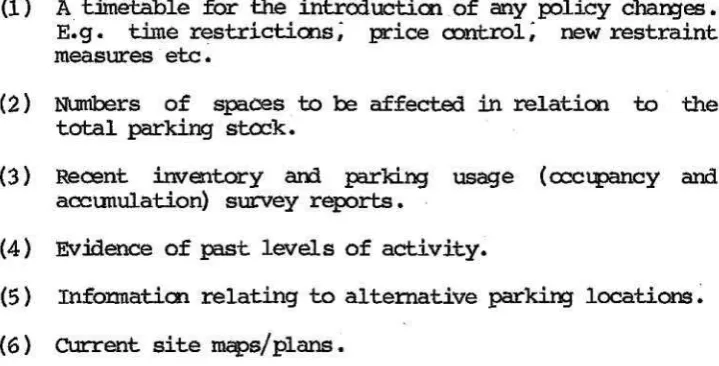
the propsed timetable and stressed the need to gain the following data i t a s a t the e a r l i e s t p s s i b l e date:(1) A timetable for the introducticn of any policy changes. E.g. time restrictions; price control; new restraint measures etc.
( 2 ) m r s of spaces to ke affected in relation to the t o t a l parking s w k .
(3) Recent inventory and parking usage (cccupancy and accunulation) survey reports.
(4) Evidence of past levels of activity.
(5 ) mfomaticn relating t o alternative parking locations.
( 6 ) Current s i t e maps/plans.
The response to the l e t t e r ues good. All the authcrrities concerned =re willing to discuss further the parking situaticm
in their areas. By mid Wfmber the 13 shortlisted toms had been reduced t o
s i x
possible case stuly sites. Nanely:(1) Fatherham (2) Leeds
(3 ) Castleford (4) Khareshoroqh (5 ) Harrogate
(6 ) W e r s f i e l d
Otley; Ilkley and Ripon m r e rejected du? to the vagw mture of the parking policy review vhich was planned
fm
early 1985. Similarly; in York; a review of c i t y parking was p l m e d totake
- .
[image:23.599.112.472.370.553.2]SUR\IFIS R- W
SITE RTUATI(XU PARKING N I C I P A W CHMCL PILOT BEFWE AFTFR PBRMCND A B R M ~ W D / C L W E ~ CCNiACT DATA
R V A W
-,
74,730 YES INTmWcncxu OF * ~ c x u W W YSarm VaaYuRE P A W I S m8(5 OF W W C I EAFtSSY MTiNm.
SPRLNt 1986
m, 84,m YES INWJWCTIaU OF * * t MIHNl
Sam( -IRE
~~~
ROTHUlWEl'587171
..--
SHEFFI~D 5 1 1 W YES ~wm.4~- i C E M R E T C O ~ . ~SSSJMSIS SWIH Y W W I R E STAY PND WTI- M SPECIFIC DATE SHEFFIDil
STCRM UEE fOl INlROOUClICN TY7PZ
LEDS
~ 0 . m
M C R R D P ~ t h CENFSTCOLARB. LEEDSWFST YLWLMIRE S C m FwNm FUICYDRCPPED l&l%
-
CASlLEFCAD, 3i,H YES N k X U C T M I OF < * IMROOWB) 1110184 R LPU
M YLWLMIRE PAY .W OISFlAY W E F I K D
SWElSMT m 1 - m m
IllhBLS STRIKE
VAKEfIQD, 58,450 M CRRD PAlMINj
*
R l I N O R e P P E D D R U UKST YLXWIRE SCHBiE FwNW WKEFIED 3im1
k'WEWWA, 11,780 YES 1) W I M O F DISC + t R W W
NJrm Y W I R E PARKIPG S W * w m x 4 T E
2) T(UIIS3 P W N (T[UIlST) (6%6
-E, %M) YES 1) W I E W OF DISC
*
ASDASTCREMT lRCMmLEWUH Y M W I R E PARKINi scW€ OWV 11/85 w m x 4 T E
L ) ~ A S O A S m R E 68%6
- -
HDMRSFELD, ro,m YES M
-
POYIQE * W RBYJIW PR BWplace
over
the next 5 years and it vas anticipated that should parking controls be altered; then a radical change was unlikely.In Ieeds and k k e f i e l d car parking schemes; proposed i5r 1985; met w i t h political o p p s i t i o n and so these c i t i e s were of l i t t l e
£urther v a l ~ to our study. Leeds; bwzver; WBS retained as a
possible s i t e £or p i l o t s t d y mrk.
In
%South Yackshire both Barnsley and Eheffield had been potential sites for survey w k . 'Ihe s t e k of parking meters %as due to be vastley expanded in Barnsley i n mid 1985 and Eheffield expcted to adopt a p l i c y of encouraging short stay and multi-storeycar
park use i n the c i t y centre. Both schgnes %re abandoned early i n 1985 h e n political and business influence was exerted to &ismurage policy refonns &ich may deter t r i p s by car to the central area. 'Ihe thencurrent coal miners strike had reduced travel to the centre of mt tow in Yorkshire; and this policy reversal was a reflection of the wider impacts of the miners acticn.
Tne remaining six tow ( w i t h the exception of beds) a l l had
populations b l o w the desired maximm l i m i t of 85;OOO.
(A) The six selected s i t e s for case study m r k were redwed to the following:
(1) Leeds
-
pilot study m r k( 2 ) mtherham
-
'before' and '&er1 studies (3) m a r e s b r o q h-
before survey; tourist survey.In addition; FBrrogate vas retained
as
a possible s i t e i f time has available towards the end of the project. A newFsda superstore dus for o w i n g i n &tober/~av&r 1985 was planned to provide 200 free parking spaces close t o the centre. %is muld be useful to study in terms of any r& location of parkers after the superstore was opened. A decision on Farmgate vas deferred until closer to the opening date.
(B) The remaining tm tow
-
Huddersfield and Qstleford-
were not stulied. Huddersfield; h e r e no policy changews
everanticipated; is still attractive as a control study s i t e p w i d i i n g that similar case s t d y s i t e s can be matched i n terms of topqraphy; dm-ography etc. hb such conditions existed in the remaining s t d y areas and as the terns of reference really dfmand pilot w k to develop a survey methodology there was l i t t l e point i n going into a large
tow w e plblic interest was not already aroused by an iminent policy change.
In many =nays Castleard ws an ideal s i t e for study. Prior t o 1984 parking i n the mall centre (ppulation 37;650) was
real redwtion of 5% LE to a 1984 spare capacity a t p a k
times of 15%. The introdwtion of koth schanes was
tos
early t o permit before and after s t d i e s by ITS. Bwwer
retrospective p s t i m i r e s or interview w r e discussed; and prwisionally timetabled &c Kt~enber 1984 and January 1985. The effect of the miners strike an Qstleford was to reduce trips; especially shopping trips; to the tom centre by up to 50%. This deemd the p l i c y effects negligible a t that time due t o the n-rs of &ee spaces still available cm-street
.
No study was therefore carried out.3.3 PIOJECT - TIMETABLE
[image:26.595.62.544.224.769.2]The organisation of survey mrk was planned as follow: FIGURE 3.1 PFOJlEC-TINETABLE
.. .... ... - - ... -
TIME SURVEYS SURVEY
TYPE
..
...
1985 JANUARY F E B R r n Y
MARCH APRIL
my
JUNE JULY AUZSTLEEDS PILOT S T m Y
LEECG
-
P I r n STUDY(BEFORE)
COLJXCI'ION OF PARKCM2 DATA; SELECTION OE' SITES; ~ T E R A T I m SEXRCEI.
EWMWTION CF QUESTIONS.
IrnvIEW
QUESTIONNAIRE (RP) . .
IWTERVC~I
PILOT S ~ V E Y SQUESTIONNAIRE (RP)
1
Fummwm
SURVEYS
FINAL REIDRT/KNARESBORWQH ... " " ...
NOTES:
1) RP = REPLY PAID
2)
*
= INPRODUePION CF NEW PNCUNG PDLICY I N I70THERHAM3) A CONPINUED E F F O R T W A S ~ M L C C A T E F U R T H E R S I T E S W H E B E A ~ IN
PARKLNG POLICY WUJLD ENRBIE E W U L BEFORE
AND
AFER SPUDIES ?D BEA questi-ire was canpiled and a series of interview were cmducted on Friday 8 February 1985 a t the Schofields hdp
car
park i n central Ieds. Although it was remgnised that futuresurveys wuld be caducted mainly a t grade; the main priority here was to gauge plblic reacticm to specific questions and to
identify problens in presentation and questionnaire design. The car park had tw advantages for pilot studies:
(1) It is very canpact and a l l o w easy transfer of survey staff b e t e n park levels. This minimises the time
taken t o locate and approach parking motorists.
( 2 ) It has a high tumwer of v&icles. Q1 an average e k d a y afternoon a
car
parks w q 75 seccads.
This determines that the intervieher can be kept involvedfor the whole of the survey period.
Aim; being d e r mver
;
interview are not interrupted by badweather and aremade more attractive to bath survey staff and the
parking plblic. Wtorists were approached on parking or on returning t o their cars i n the period 12 noon t o 4.30 pm. The interview b a t is given i n
-ix
4 (A).
The same lccaticm
a d
survey t i m e s were used to distribute reply paid questionnaires t o both parking and returning driverscm
Wnday 11 Febrmry 1985. This format involved appoaching the r e s p d e n t and explaining i n a canprehetlsive yet concise my:
(1) The objectives of the study
(2) The involvenent of the University and ITS
(3) How the questionnaire h u l d be filled in and returned to the University.
In addition survey staff were asked to collect information relating t o vehicle typ; nunber of mupants;
and
time of day etc. (Section 1 of A p p d i x 4 (B) ).
The questi-ire hrmat (Secticn 2 cmwards) is given inm
i
x
4(B).
Ebr both theinterview and the questionnaire reference has M e to the parking locations given i n Figure 4.1.
4.3.1
m m m
( e x c l d i g section 3 )car park cnly 10% m p l e t e d the f u l l interview. 4% m p l e t e d the h r l l interview when leaving the car park. In t o t a l 62% of those approached refused to take prt i n a survey. Of the remaining 388, 4 out of 5 decided that
they
did not w i s h to canplete the interview. ALthoqh sane problems were exprienced i n dealingw i t h individual questions (see 4.3.3) perhaps the major factor i n such a high failuce rate was dve to the 9.5 minute average time taken t o canplete the interview. Fefusals during canpletion tended to occur ammd the 4 minute mark.
kkmwledging the problm of time taken in canpleticn it was
decided t o continw intervie% cm a sectional basis to test how appropriate individual questions were. For each of the sections of questions used (Section 3; q u e s t i m 1; 2; 4; 9; 10; 11:
questions 1; 5; 6; 7; 8) the respnse time was 4 minutes cu less. A s a result terminations i n the middle of a sectional interview were reduced fran 82% t o 8.8%.
4.3.2 REPLY PAID -QUESTIONhTAUW
?he i n t r c d ~ t i o n given by survey staff to respondents vhilst handing over a questionnaire to he returned to the University by 'Freepst' took approximately
tw
minutes to oanplete. ?his allows for the distribution of Mween 18 and 22 questionnaires per hour p r person. 39% of the 200 questionnaires were returned over a period of 5 wseks (30% were returned within 2 t o 3 3 k s ) . In general the quality of respmse was very good. It slxmld also be noted; &en referring to m d i x 4(B);
that the actual fonnat of the distributed questionnaires was as an A5 h k l e t . Thisboth impraved the presentation of the 'package' and aided
the
ease of distribution. ?he q u e s t i d r e content remained the sane on both aunts,. Tnis A5 format was subsequently used in the -erham and Knaresbroqh surveys
.
Were a question is not referred to then m problems m e encomtered i n interpreting the respmses given.
(1) In general the response to 'vhy have you chosen to shop i n the centre of
. .
.'
;
was very v q w . Ebr exanple:'
live here' or' m
f a c i l i t i e s '.
If a m e ccncise answer is required; then a stated preference versicn using the answs given i n this m r k as a basis £Or the formulaticm of options;
muld he more effective.(2) hhen asked 'vhy did you chose to p r k a t this lcoation' the main reply was 'nearness t o shops'. mwwer a further ansher often supplied : it was the
'
m s t convenient space' &uld be included inthe
list.(3) k h i l s t the options given i n questicm 5; 6; 7; 8; are canprehensive; other replies are to be expected depending on the centre involved. In Leeds
'
search for a meter space1 was often used as an alternative reply. It was notprceived as a variation of
'
search longer for a cheaper space'.
Ebr questions 5; 6; 7; 8 there was often confusion wer 'are there any of these options that p u muld never consider'
.
It is d i f f i c u l t to j d g e &an the q u e s t i d r e i f no options applied o r i f the question was not d e r s t c x d .
(4) The m* question continmlly caused respondents poblems. Much enmuragement and pressure had to be put on the respondent to canplete this question in the interview stages. Almys
the
desire was for a map that tnas of alarger scale and hi& had shop and other land mark marked
on.
( 5 ) The questions abut ualk time e r e ell ansmred but it wis generally perceived that the furthest fran a location that a p r s o n muld ever consider parking and valking muld be 7-10 minutes; depending u p terrain.
( 6 ) r the frequency of v i s i t to a centre then the main difficulty arose due to people needing more divisions ketwen ' m e than twice p r wsek' and ' m e than twice p r mmth'
.
For exanple: twice per m i g h t is not alvaysonce
per wsek.( 7 ) There was a Icesic problem i n getting p o p l e to give their hane address. None of those being i n t e r v i e w were willing to supply this informaticn and only 50% of Ulose involved in the reply paid survey gave a hane address. A price incentive by ~ i c h a person has
to
give a a t a c t address to qualify may resolve this problem.( 8 ) Respondents are very vary of answering questicms about the cost of travel. lhey also tend to make wild guesses based seembgly cm no r a t i c ~ l a l julgengrt. !!%is proved to ke a very t h e consuning element of the interview fonnat.
(9 ) Nobody indicated that they made m e trips to the central area than they did 12 months ago. lhe vast majority of r e w e s indicated an unchanged pattern of t r i p maldng
.
Ofthose who indicated that they made less t r i p s than 12 months ago; the main reason was that their children
e r e
getting older and get fed up more easily. Hence the reducticn. In m n d i x 4 a nunber of maps of Leeds centre are presented to&W the variety of approaches that may ke used tvhen asking a
Fotherham; w i t h a p3pllation of over 84; 000; is located t e l v e miles south of Barnsley and thirteen m i l e s best of Emcaster t o the muth of the mrnty of South Yorkshire. 'Ihe tom is also close t o the M 1 motmmy which separates it frcm the c i t y of Sheffield; six miles to the muth wst. Mrket day is m bath a Mcnday and a Saturday and early closing i s on a Thursday.
The tom centre is canpct and to a large extent pedestrianised
w i t h a l l parking f a c i l i t i e s forming a radial collar a r o d the D . Figure 5.1 show; the location of parking f a c i l i t i e s . No charge has ever been made in Rotherham £or on-street parking; but; off-street parking has been subject to a ckrarge e r a nMber of years w i t h the exception of the Main Street car park (there are still approximately 100 free spaces there). A nunber of car parks are
'
short stay' with a pay and display ticket machines. 'Ihe multi-storey c a r park is long stay with m e p n n i t parking f a c i l i t i e s . There are 160 on-street parking spaces and 1781 off- street parking spacss ( i n c l d i n g the pfivately owed Hillards superstore).
Parking meters affecting the 160 on-street spaces e r e introdwed i n early April 1985 with a charge of l0p/hr.Table 5.1 indicates the use of the parking f a c i l i t i e s fran survey data taken in June 1984. Ebr a typical m s d a y in that m t h maximun occupamy (98%) occurred between 9.30 a .m. and 10 a .m.; and remained above 93 8 m t i l 12 noon. Although m e recent survey data was not available it was anticipated that
cn
days other than market days the n d r s of trips (and therekre the nunters of parked cars) to the central area in April 1985 hadTABLE-5.1 CAR-PARHING IN-ROTHERHAM (TUESDAY 26.6.84)
LOCATION MlMBER OF W F O L OCCUPAEY AV. DURATION OF S'WY SPACES (lOmG4pn) (MINS) (lOaG4pn)
" . . . ~ . . ~ . . . " . . . ~ . . . . ~ A - - . . - - - - . . - . . . ~ . . .
COREORATION ST MOORGATE
SHIPHILL
MARKET SQUARE
+OTHERS
Wl7G ON STREET: OFF-STREET:
I X M C N D ST IXMINE IANE (XIREORATION ST
(-1
CY)RPORATION ST
( ~LIDDLE THE CFOFTS HI-
MULTISTOREY
+
POLICE STATION+
NOI(FOLK HOUSETOTAL OFF S T E W : . . .
43 FReE
19 FREE 32 FRE
2 FREE 64 FEE 160 SPACES
240 25~12 hrs 53 25p/2 hrs
50 25p/2 hrs 41 25p/2 hrs 400 FREE* 775 30p/da~ 100 FREE
88 25~12 hrs 1781 SPACES
. . .- -
SOURCE OF DATA: RTHERWl TOWN COUNCIL; PARKING SURVEYS JUNE 1%.
prior to the introduction of parking meters in April 1985; a series of interview/questionnaire surveys
were
carried out at the major on and off street parking locations s u r r o d i n gthe
tom(A) SMTPION 1:
?b be cunpleted by the intervieker. Questims relate to:
-
Lky; date; time-
Location-
Parking type-
Vehicle t p-
Mmber of mupants (B) SEcrIoN 2:I n i t i a l l y it was envisaged that this section m d d h c d u z t e d i n an on s i t e intewiew format Wan i n i t i a l reactim it was decided that this was not a pcactical propsition and this s e d i c n along w i t h Section 3 was given out i n a reply
paid
format accan@ed by an an s i t e verbal intrduction t o the questionnaire. Questions relate to:Trip
plrmse
-
-
Trip origin Duration of stay-
Reasan for choice of location Frequency of t r i p-
Variations i n t r i p making-
Status; bus&ld Characteristics.(C) SECTION 3: Reply paid a m a t .
It was decided to ask the i n t e r v i e w
to
mnplete a W c h e r series of reply paid questions i f it was deemed that he/she m s interested i n the issues raised and therefore liWey to return .the questiannaiw.A
L25 free draw incentive wasalso used. The r e s p n d a t was informed of the
p i z e
draw a t the end of the questionnairenut
cn s i t e before he/she ha3 qreed to take W e r part i n the survey.In fact both sections tm and three
wrc
mndwted in this hay for the majority of the survey pericd. Questions relate to:-
percepticn of d k distance/time-
perception of journey cost-
Alternative &ice of journey opticns given-
v a r i a t i a in parking policy-
~ s p o n d e n t s ddress.A map of the central area of Wtherhan was exlosed for use i n answring the questions about w l k distance and alternative parking locations.
Four survey staff *re used each day; for three days Zran 10 am. t o 4 pm.
i.e. W a y 4/3/85 (market day)
%=day 5/3/85 Wednesday 6/3/85
%e staff viere organised such that they each covered a designated parking area.
e.g.: (i) The Crofts and Exnine Iane (off street)
(ii) %e t m car parks cn Corpraticn Street (off street)
(iii)
D r m c n d Street (off street)( i v ) Ship Hill/khrgate and Corporation Street (cn street).
After d m t i r q surveys a t a l l these sites on the Mmday morning
it m s decided that the survey method owht to be revised to
wermne the high nunbers of pople the were refusing to We
part in the i n i t i a l interview. Also very
few
cars were parked towrds the lover end of Oorpraticn Street (koth cn and off street) and hence; subsequently this car park was not surveyed. This then enabled surveys to ke carried out a t the long stay multi-storey car park (Mcnday pm.) and also at the privately omed Eillards superstore car p r k ( W e s d a y p m . ) .A t the multi-storey car park another variaticn cn the survey meUlod W anploysd. Only section 3 of the f u l l
interview/questic~maire has attached with the reply paid envelops to the windgreens of parked cars. Table 5.2 shorn the distribution of questionnaires and the numbers of returns and
CORPORATION
m
(TOP) 34
C O R P O ~ I O N
m
( MIDDLE ) 50
mm
LANE
53THE CROFTS 41
r.l?MOM, STREET 240
MULTI
mm
7 7 5HILLWDS SUPERS'IY)RE 400
O R A T I O N Sl?RET 43
MOORGATE 19
SHIP HILL 3 2
MARI(ET S T 11
m:
**
FENDAYm
ONLY(mm;
WPLY PAID)*
AM ONLY (INPWVIEW+
Q U E S T I O ~ R E )mlloving the installation of parkitq meters and the associated price adjustments a t off street car parks; a follow up suwey was
condwted i n July 1985. The m r k was carried out by an MSc
stu3ent a t the Institute fcxr Transprot Stulies; Uhiversity of Leeds and the farm of his questionnaire is given i n Appendix 5(B). Of those respondents cjbr, indicated their address on the orgiml s m e y fo~ms; then one hundred bere sent the after questionnaire and a reply paid emrelop. Further details of the survey and the use of this panel technique are given in the student' s dissertation (Raine
;
1985 ).
1069 questionnaires were distributed during the three survey days. 34.5% of these were returned as canplete. %is figure may have been inflated had the prformance of the interview and windscreen distribution methods been higher. QiLy 16% of the questionnaires attached to windsreens in the multi-storey car park were returned; often poorly andor partially canpleted. In the interview situation the refusal rate cn approach trkis 40%. Of
the rest cmly 53% ccmpleted that was a six minute interview.
Wan the 369 returns (56% were ccmpleted by male drivers)
;
it has revealed that 76% of trips t o a l l central area car parks had originated fran e r pstal districts. 15% came &an Sheffield. %en asked £or a reascpl forthe
choice of parking lccation 36% gave 'nearness to shops' as the main issue with 'ease of access' (26%) seccnd. 'Availability of spaces' wascited by 12% of respondents. 55% of parkers stayed for less than one hour and 85% stayr?d less
than
t m hours. 75% of r e s m e n t s said that they visited the centre a t least twice p r week. men asked i f parking caulitions in M e r h a m had dmqed over recent years; 27% said yes; conditions had impovd. 35% said ccnditiasls had deteriorated. mere a r e s m e n t waswham
with his/& parking location and an alternative nme desirable facility was indicated; the major reasons for not mcxritq to thel a t t e r were
'too
e x p s i v e ' (12%) d ' m spaces available'(22%). Respcndents were largely cmly prepared t o walk for 15 minutes fran their wkiq location to final destination. Qlly
7% of respadents muld be prepared to walk further.
The m c t i o n s to kiq asked the cost of the current t r i p were varied; 32% refused t o answer the questicn. 17% failed to
inclule the cost of petrol in their i n i t i a l estimation and +his accounts £or the cost variations which range &an l p t o £30.
further fran the centre and mlking in. Cnly 7% would mnsider visiting another centre.
a one hundred of the original respndeats selected to t a e
part i n the after stuiy; 61 replied to the p s t a l questionnaire. Table 5.3 s m a r i s e s their responses :-
(A) PARK AT ALTERWTIVE LaCATION
P A R K r n S A M E ~ O N
(B) VISIT TCkJN
m
LESS WTEN NO I N FF3QUEEY OF VISIT (C) VISIT AJAERNATIVE c2mrR.E M m wTE!NVISIT ALTERJGlTIVE
m
LESS OFTENmcHmGE
... . - ...
Fran these results it can ke noted thta although over 80% of responaents have been totally unaffected by the intrducticm of -king meters; i n their t r i p making habits; a nunber of respmdeats may have altered their frequency of t r i p makiq to the central area of Fatherham. The reason for this may involve elements of shopping choice rather than just the effects of
wkiq control. Qle obvious effect is that the intrcdmtim of parking meters has not increased t r i p making to the centre. Further than this it is difficult to cunplre the expessed reactions of resp-dants in the before s t a y with the follow up questionnaire 'actual' reactions because simply the p l i c y charges implemented do not canpare on a scale w i t h the state3 pceference opticm offered in the former case. The lack of
interest i n parking p l i c y charges as an issue to users of the central area is alss reflected by the low (61%) resp3nse rate to the follow up stuiy.
Of the alternative centres; Sheffield (34%); D3ncaster (14%); Wcorksop (14%); W t b y (5%) and Barnsley (2%) were the main
If parking prices througbut the centre of IdDtherhmn were &&led
then the percentage of drivers likely to seek an alternative t r i p location increased to 13%. 26% were willing to pay the additioml cost and 34% t h o q h t that they may attenpt to find a cheaper nm central space. Given a major r e s t r i c t i m of spaces
w i t h i n the centre 21% of resmdents muld go elsehere; 23% muld search for a space i n the centre ard 31% would park *er
frcan the centre and halk in.
Ebr a l l the questions relating to potential parking restrictions then a chatqe of mode; especially to bus; has not a favourable option. 28% of respndents identified park and ride as an opticbl that they muld not consider.
The introdmticm of a ' p i z e drawa if the respndent canpleted the full questionnaire/interview did not increase the total percentage of returns. However the nunber of prsons giv* their hane address; and therefore enabling us to emtact t h a n in