This is a repository copy of
State Transition Induced by Self-Steepening and Self
Phase-Modulation
.
White Rose Research Online URL for this paper:
http://eprints.whiterose.ac.uk/106779/
Version: Accepted Version
Article:
Jing-Song, H., Shu-Wei, X., Ruderman, M.S. et al. (1 more author) (2014) State Transition
Induced by Self-Steepening and Self Phase-Modulation. Chinese Physics Letters, 31 (1).
ARTN 010502. ISSN 0256-307X
https://doi.org/10.1088/0256-307X/31/1/010502
[email protected] https://eprints.whiterose.ac.uk/
Reuse
Unless indicated otherwise, fulltext items are protected by copyright with all rights reserved. The copyright exception in section 29 of the Copyright, Designs and Patents Act 1988 allows the making of a single copy solely for the purpose of non-commercial research or private study within the limits of fair dealing. The publisher or other rights-holder may allow further reproduction and re-use of this version - refer to the White Rose Research Online record for this item. Where records identify the publisher as the copyright holder, users can verify any specific terms of use on the publisher’s website.
Takedown
If you consider content in White Rose Research Online to be in breach of UK law, please notify us by
J.S. He1,2, S.W. Xu3, M.S. Ruderman4 and R. Erd´elyi4
1
Department of Mathematics, Ningbo University, Ningbo, Zhejiang 315211, P.R.China.
2
DAMTP, University of Cambridge, Cambridge CB3 0WA, UK
3
School of Mathematics, USTC, Hefei, Anhui 230026, P.R.China
4
Solar Physics and Space Plasma Research Centre, University of Sheffield, Sheffield, S3 7RH, UK
We present a rational solution for a mixed nonlinear Schr¨odinger (MNLS) equation. This solution has two free parameters a and brepresenting the contributions of self-steepening and self
phase-modulation (SPM) of an associated physical system. It describes five soliton states: a paired bright-bright soliton, single soliton, a paired bright-grey soliton, a paired bright-black soliton, and a rogue wave state. We show that the transition among these five states is induced by self-steepening and SPM through tuning the values of a and b. This is a unique and potentially fundamentally
important phenomenon in a physical system described by the MNLS equation.
KEYWORDS: Mixed nonlinear Schr¨odinger equation, state transfer, Alfv´en wave, ultra-short
light pulse, rational solution.
PACS numbers: 05.45.Yv, 42.65.Re, 52.35.Sb,02.30.Ik
Introduction. The mixed nonlinear Schr¨odinger (MNLS) equation [1],
qt−iqxx+a(q∗q2)x+ibq∗q2= 0, (1)
has been derived by the modified reductive perturbation method to describe the propagation of e.g. the Alfv´en waves with small but finite amplitude along the magnetic field in the cold plasma approximation widely applica-ble in solar, solar-terrestrial, space and astrophysics[2, 3]. Later it has been shown [4–6] that the MNLS equation also provides an accurate modelling of ultra-short light pulse propagation in optical fibers. In eq. (1) the complex quantityq represents the magnetic field perturbation in the case of Alfv´en waves, and the electrical field envelope in the case of waves in optical fibres. The asterisk de-notes complex conjugate, a and b are two non-negative constants determined by the unperturbed state, and the subscriptx(t) denotes the partial derivative with respect to the spatial coordinatex(timet). The MNLS equation reduces to the Nonlinear Schr¨odinger (NLS) equation whena= 0, and to the Derivative Nonlinear Schr¨odinger (DNLS) equation whenb= 0. Because the MNLS equa-tion is applicable even in the case where the lengths of the envelope wave and the carrier wave are comparable [1], it is more general than the nonlinear Schr¨odinger equa-tion in the modelling of waves in optical fibres. The last three terms in eq. (1) describe the group velocity disper-sion (GVD), self-steepening and self phase-modulation (SPM), respectively.
The Lax pair for the MNLS equation provides the mathematical basis for the solvability of this equation by the inverse scattering method and Darboux transfor-mation (DT), the latter being defined by the Wadati-Konno-Ichikawa (WKI) spectral problem and the first non-trivial flow [7]
∂xψ= (−aJ λ2+Q1λ+Q0)ψ≡U ψ,
∂tψ= (−2a2J λ4+V3λ3+V2λ2+V1λ+V0)ψ≡V ψ,
with the reduction conditionr=−q∗. Here the complex
quantityλis the eigenvalue (or spectral parameter), and ψ= (φ, ϕ)T is the eigenfunction associated withλ. The
superscriptTdenotes transposition. There are also other methods to show the integrability of the MNLS equation
and to obtain its exact solutions [8–11]. Various types of solutions of the MNLS equation, including a soliton and a breather have already been obtained in [12–21]. The decay of soliton solution for a perturbed MNLS system has been demonstrated numerically [22]. Small pertur-bations of the MNLS equation have been studied either by a direct method [23], or using the inverse scattering transform [24, 25].
Up to now, all known solutions of the MNLS equation represent rather common nonlinear wave solutions, like solitons and breathers. These are similar corresponding ones to their ancestors — the NLS and DNLS equation, so they do not describe any specific properties of either the Alfv´en waves in magnetised plasmas, or ultrashort light pulses in optical fibres. Thus, it is a long-standing problem to find unique phenomena related to the simulta-neous effects of self-steepening and SPM that can be de-scribed by the explicit analytical solutions of the MNLS equation.
In this letter we present novel rational solutions of the MNLS equation. These solutions describe five states of the associated systems: a paired bright-bright soliton state, a single soliton state, a paired bright-grey soliton state, a paired bright-dark soliton state, and a rogue wave state. We also show that the transition between these five states is induced by the self-steepening and SPM through tuning the values ofaand bdetermined by the physical properties of the background state.
Analytical form of rational solution. By the one-fold DT and Taylor-expansion, according to a similar procedure demonstrated by [26–30] for constructing the rational rogue wave (RW) of the NLS, DNLS, Hirota and NLS-Maxwell-Bloch equations, a novel rational solution of the MNLS equation is given as follows
q[1]=−exp[i(−x−tb−t+ta)]r1r2 r∗
1
2 , (2)
r1=X+ 1 + 2ia[(3a−2)t−x],
r2=X−3 + 2i[(−6a+ 3a2+ 4b)t−ax],
X= 2(a−b)[(−2b+ 3a2−6a+ 4)t2+ 4(1−a)xt+x2].
We omit the tedious calculation of this solution. The validity of this solution has been confirmed by symbolic computation. By lettingx→ ∞andt→ ∞it is easy to
2
show that |q[1]|2 → 1, and |q[1]|2(0,0) = 9. So, q[1] de-notes a rational solution on a non-zero background with a unit height. This is a new and wide class of solutions for the MNLS equation because it can encompass five kinds of solution.
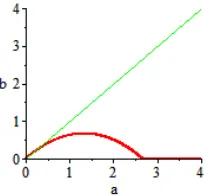
Transition between five states. We are now in the position to explore the properties of q[1] with more de-tails. The trajectory of |q[1]|2 in the (x, t)-plane is de-fined by the location of the ridge (or vale) of its profile. A good approximation of the trajectory for|q[1]|2is given through a simple equation X + 1 = 0 in general. By a straightforward but tedious calculation of the stationary point of |q[1]|2 in the (x, t)-plane we find, that, q[1] de-scribes five solutions associated with five regions in the upper-right quadrant on the (a, b)-plane (see Figure 1), as follows
I ( b > a). There is only one saddle point of |q[1]|2 at (0,0), and there are two simultaneous trajectoriesX1and X2on the (x, t)-plane. Note that the trajectories are not two straight lines as usual in the case of double solitons. If the height of soliton |q[1]|2 is increasing as it evolves alongX1, then it will decrease as it evolves onX2. The asymptotic height of|q[1]|2 isH
1=H1(a, b) as t=−∞, andH2=H2(a, b) ast= +∞ onX1; |q[1]|2 approaches to H2 as t =−∞and to H2 as t = +∞ onX2. Thus, when (a, b)∈region I,q[1]is called a paired bright-bright soliton becauseH2> H1>1 and the appearance of two peaks (i.e. an increasing peak and a decreasing one). Obviously, there exists energy exchange between the two bright peaks propagating alongX1andX2in accordance with the energy conservation. In particular, the distance between the two peaks is proportional to √δ1t2+δ2 in contrast to a linear function oftfor the known two peaks in the case of a double soliton. Here δ1 and δ2 are two real functions ofaandb.
II(b=a). |q[1]|2takes its maximum value 9 when (x, t) is on the linex= (−2+3a)t. This line is also the trajectory of|q[1]|2. This is a single soliton solution.
III (a > b > max[0, a− 38a2]). There is only one ex-tremum of|q[1]|2 at (0,0) on the (x, t)-plane. Most fea-tures of the obtained solution are similar to those of region I except H2 > 1 > H1 > 0. Thus, in this re-gion,q[1]is called a paired bright-grey soliton. Note that a−38a2<0 ifa > 8
3.
IV(b=a−3 8a
2,a∈[0,8
3]). There is only one extremum of|q[1]|2at (0,0) in the (x, t)-plane. The solution resem-bles that of region III except that H2 > 1 > H1 ≥ 0. Thus, in region IV of the (a, b)-plane, q[1] is called a paired bright-dark soliton.
V (0 < b < a − 3 8a
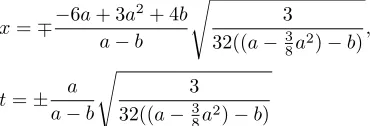
2). For |q[1]|2, there is only one maximum at (0,0), where |q[1]|2 = 9, and two minima, where |q[1]|2= 0. The two minima are located with the coordinates given by
x=∓−6a+ 3a
2+ 4b
a−b s
3 32((a−3
8a2)−b) ,
t=± a
a−b s
3 32((a−3
8a2)−b)
at the points in the (x, t)-plane. When (a, b) is region V,
|q[1]|2is localised both in thexandtdirection, and thus q[1]is a rogue wave solution of the MNLS equation.
The main difference between the grey and dark soliton is that the minimum of the solution may or may not reach zero [31] for the grey one.
For a physical system modelled by the MNLS equation, each solution presented above gives a particular phase state. So, it is rather interesting to observe in Figure 1 that there exists the state transition induced by tuning the self-steepening and SPM, which can be realised by adjusting the values ofaandb. For example, by setting a = 1
2 and varying b, the system will evolve consecu-tively through a paired bright-bright, a single, a paired bright-grey, a paired bright-dark soliton states, and the rogue wave state asbdecreases from a value larger than 1
2 to one that is smaller than 13
32. Moreover, for a given b > bc(= 23), the system passes through the first three
(i.e. I-III) states asaincreases fromzeroto a sufficiently large value; for b = bc, the system now passes through
the first four (i.e. I-IV) states, and it passes through the paired bright-grey soliton state twice; finally, forb < bc,
the system passes through all five states and will be in paired bright-grey and paired bright-dark soliton states twice. This newly discovered unique state transition phe-nomenon is not described by the rational solutions of the NLS and DNLS equations because they do not describe two different nonlinear effects simultaneously. Thus, we have now solved the long-standing problem mentioned in the Introduction.
Particular cases. In what follows we use two methods to visualise function|q[1]|2. The first method consists of plotting the profile of |q[1]|2 which is the graph of this function of two variables in three dimensions. The sec-ond method is similar to drawing the level lines of this function, however, not using the lines but various colours instead. The figure obtained this way is called the den-sity plot of the function|q[1]|2. In this plot each colour corresponds to a definite value of|q[1]|2.
To illustrate the general results we investigate the evo-lution of the rational soevo-lution for a fixeda=12 and vary-ingb. In Figure 2 the profile (left panel) and density plot (right panel) of|q[1]|2are shown for a paired bright-bright soliton withb= 1. In Figure 3 the energy exchange (left panel) for two peaks along the two trajectories (right panel) is plotted. The limit heights in Figures 2 and 3 are H2= 21 + 4
√
5≈29.9 andH1= 21−4
√
5≈12.1. Note that the height of the background in Figure 2 is equal to 1. On the right panel of Figure 3, the explicit equa-tions of trajectoriesX1(red line) andX2(green line) are
−t+1 2
√
5t2+ 4 =xand−t−1 2
√
5t2+ 4 =x, respectively. The distance between the two peaks at a given time is
√
[image:3.612.84.269.690.753.2]in region II, we obtain|q[1]|2 = 36 + (t+ 2x)2
4 + (t+ 2x)2 , which is a single soliton with the height 9 and the exact trajec-toryt+ 2x= 0. We do not show the profile in this case because it is a standard soliton.
In region III, by setting b = 209, we obtain a paired bright-grey soliton. Its profile is plotted in Figure 4 (left panel). The limit height of the bright soliton is H2 =
8−√15
20−5√15 ≈6.5, and the limit height of the grey soliton is
H1 = 8+
√
15
20+5√15 ≈ 0.3. The X1 (red line) and X2 (green line) in Figure 4 (right panel) give good approximation of the trajectories for|t|>8.
Let us seta=12 andb=a−38a2≈0.41, the point (a, b) is now in region IV, and the rational solution describes a bright-dark soliton. The profile of this solutions is shown in Figure 5 (left panel). The limit heights are H2 = 4 for the bright soliton and H1= 0 for the dark one. The trajectories X1 and X2 are shown on the left panel of Figure 5 by the red and green lines, respectively. The analysis of the two solutions corresponding to the bright-grey and bright-dark solitons shows that: (i) There is energy exchange between the bright and grey (dark) soli-tons; (ii) the bright soliton is transformed into a grey (dark) one because its energy is lost during the interac-tion, while the grey (dark) soliton is transformed into a bright one fort≫1.
Finally, by settinga= 1
2 andb= 1
3, we put the point (a, b) in region V. In this case the rational solution de-scribes the first-order rogue wave, which is plotted in Figure 6.
Conclusions. We have presented a range of new types of rational solution of the MNLS equation that describe the propagation of e.g. Alfv´en waves in magnetised plas-mas and the femtosecond light pulses in optical fibres. The obtained solutions have two free parameters,a and b, representing the contributions of self-steepening and self phase-modulation, and, depending on the values of these parameters, these solutions describes five types of novel solitons corresponding to five states of an asso-ciated physical system. These solutions are: A paired bright-bright, single, paired bright-grey, and a paired bright-dark soliton, and a rogue wave. We have found that the state transition among these five states is in-duced by tuning the effects of self-steepening and SPM. We urge that this novel phenomenon may be observed in laboratory or in magnetised plasma in nature in order to demonstrate an intricate balance between the effects of self-steepening and SPM in an associated physical sys-tem. Furthermore, because of the recent discovery of Alfv´en waves (see [32, 33] and references therein) in the magnetised solar atmosphere, it is now paramount inter-est to find these novel states and the state transfer in space plasmas, and, to establish their connection with the long-standing coronal heating problem [34–37].
Finally, we discuss briefly the novelty of the solution describing the paired bright-bright soliton. Three of its characteristics, i.e. the existence of two peaks, decreas-ing or increasdecreas-ing amplitude, and the curved trajectories, are essentially different from the similar characteristics of the recently found solition solutions that include an explode-decay soliton [38], a two-peak soliton [39, 40], a W-shape soliton [41], a dark-in-bright soliton [42, 43],
a rogue wave [44] and a two-peak rogue wave [45, 46], in addition to the well-known classical soliton, breather, and kink. In particular, the paired bright-bright soliton is not a travelling wave. The non-autonomous solitons [47–50] have the properties similar to those of the paired bright-bright soliton but only when they are solutions to the variable coefficient soliton equations. This discussion can also be applied to the paired grey and bright-dark soliton solutions.
Acknowledgements This work is supported by the NSF of China Grant No.10971109 and 11271210, and K.C. Wong Magna Fund in Ningbo University. J. He is also supported by the Natural Science Foundation of Ningbo, Grant No. 2011A610179. R.E. acknowledges M. K´eray for patient encouragement and is also grateful to NSF, Hungary (OTKA, Ref. No. K83133) for the sup-port received. J. He thank sincerely Prof. A.S. Fokas for arranging the visit to Cambridge University in 2012-2013 and for many useful discussions .
[1] K. Mio, T. Ogino, K. Minami and S. Takeda, J. Phys. Soc. Jpn. 41(1976), 265-271.
[2] M. V. Medvedev, P. H. Diamond, V. I Shevchenko and V. L. Galinsky Phys. Rev. Lett. 78(1997), 4934-4937. [3] D. Laveder, T. Passot, P.L. Sulem, Phys. Lett.
A377(2013),1535-1441.
[4] N. Tzoar and M Jain, Phys. Rev. A 23(1981),1266-1270. [5] D. Anderson and M. Lisak, Phys.Rev. A
27(1983),1393-1398
[6] A. A. Zabolotskii,Phys. Lett. A. 124(1987), 500-502. [7] M. Wadati, K. Konno and Y.H. Ichikawa, J. Phys. Soc.
Jpn. 46(1979), 1965-1966.
[8] A. Kundu, J. Math. Phys. 25(1984),3433-3438.
[9] K. Porsezian, P. Seenuvasakumaran and K. Sara-vanan,Chaos, Solitons and Fractals. 11(2000), 2223-2231. [10] Q. Ding and Z.N. Zhu,Phys. Lett. A. 295(2002), 192-197. [11] A.Kundu,Symmetry, Integrability and Geometry:
Meth-ods and Applications. 2(2006), 078(12pp).
[12] T.Kawata, J.I.Sakai and N.Kobayashi, J.Phys. Soc. Jpn. 48(1980), 1371-1379.
[13] A. R. Chowdhury, S. Paul and S. Sen, Phys. Rev. D. 32(1985), 3233-3237.
[14] D.Mihalache, N.Truta, N.C.Panoiu and D.M..Baboiu, Phys. Rev. A. 47(1993), 3190-3194.
[15] E. V. Doktorov, Eur. Phys. J. B. 29(2002), 227-231. [16] A.A.Rangwala and J.A. Rao, J. Math. Phys. 31(1990),
1126-1132.
[17] O.C. Wrigh, Chaos, Solitons and Fractals. 20(2004), 735-749.
[18] T.C. Xia, X.H.Chen and D.Y.Chen, Chaos, Solitons and Fractals. 26(2005), 889-896.
[19] H.Q.Zhang, B.G.Zhai and X.L. Wang, Phys. Scr. 85(2012), 015007(8pp).
[20] S.L. Liu and W.Z.Wang, Phys. Rev. E. 48(1993), 3054-3059.
[21] M.Li, B. Tian, W.J.Liu, H.Q.Zhang and P.Wang, Phys. Rev. E. 81(2010), 046606(8pp).
[22] E.A.Golovchenko,E.M.Dianov,A.M.Prokhorov and V.N.Serkin, JETP Lett.42(1985), 87-91.
[23] X. J. Chen and J. K. Yan,Phys. Rev. E.65(2002), 066608 (12pp).
[24] V.S. Shchesnovich and E.V. Doktorov, Physica. D. 129( 1999), 115-129.
[25] V. M. Lashkin, Phys. Rev. E. 69(2004), 016611(11pp). [26] J.S.He, H.R. Zhang, L.H. Wang, K. Porsezian and
4
rogue waves(arXiv:1209.3742v4).
[27] S.W. Xu, J.S.He and L.H.Wang, J. Phys. A: Math. Theor. 44(2011), 305203 (22pp).
[28] S.W. Xu and J.S.He, J. Math. Phys. 53(2012), 063507 (17pp)
[29] Y.S.Tao and J.S.He, Phys.Rev.E 85(2012), 026601(7pp). [30] J.S.He, S.W.Xu and K.Porsezian, Phys. Rev.E 86
(2012),066603(17pp).
[31] M.J. Ablowitz,2011, Nonlinear Dispersive Waves: Asymptotic Analysis and Solitons ( Cambridge Univer-sity Press, Cambridge )p.153.
[32] H. Alfv´en, Nature 150(1942), 405-406.
[33] D. B. Jess, M. Mathioudakis, R. Erd´elyi, P. J. Crockett, F. P. Keenan and D. J. Christian, Science 323(2009),1582-1585.
[34] C. E. Parnell and I. De Moortel, Phil. Trans. R. Soc. A 370(2012),3217-3240
[35] M. Mathioudakis, D. B. Jess and R. Erd´elyi, Alfv´en Waves in the Solar Atmosphere: From Theory to Ob-servations (arXiv:1210.3625)29pp.
[36] S. Wedemeyer-B¨ohm, E. Scullion, O. Steiner, L. R. van der Voort, J. de la Cruz Rodriguez, V. Fedun and R. Erd´elyi, Nature 528(2012),505-508.
[37] R. Morton, G. Verth, D.B. Jess, D. Kuridze, M.S. Rud-erman, M. Mathioudakis, and R. Erd´elyi, Nature Comm, 3(2012), i.d.1315.
[38] A. Nakamura, J. Phys. Soc. Jpn. 50(1981), 2469-2470;ibid., 51(1982),19-20.
[39] N.Sasa and J.Satsuma, J. Phys. Soc. Jpn. 60(1991), 409-417.
[40] Y.S.Li and W.T.Han, Chin.Ann.Math.22B(2001),171-176.
[41] Z.H.Li, L.Li, H.P.Tian and G.S.Zhou, Phys. Rev. Lett.84 (2000), 4096-4099.
[42] P. G. Kevrekidis, D. J. Frantzeskakis, B. A. Malomed,A. R. Bishop and I. G. Kevrekidis, New.J.Phys.5(2003),64. [43] A. Choudhuri and K. Porsezian, Optics Communications
285(2012), 364-367.
[44] D. H. Peregrine, J. Aust. Math. Soc. Ser. B: Appl. Math. 25(1983), 16-43.
[45] J.S.He, S.W.Xu and K.Porsezian, J. Phys. Soc. Jpn. 81(2012), 033002.
[46] U.Bandelow and N.Akhmediev, Phys. Rev. E 86 (2012), 026606.
[47] V.N. Serkin, A. Hasegawa and T.L. Belyaeva, Phys. Rev. Lett.98 (2007), 074102.
[48] J. Belmonte-Beitia, V. M. Perez-Garcia,V. Vekslerchik and P. J. Torres, Phys. Rev. Lett. 98 (2007),064102. [49] J. Belmonte-Beitia, V. M. Perez-Garcia, V. Vekslerchik
and V. V. Konotop, Phys. Rev. Lett.100(2008),164102. [50] J.S. He and Y.S. Li, Stud. in Appl. Math.126(2011),1-15.
Fig. 1: (Colour online) Five regions in the upper-right quadrant on the (a, b)-plane. In each region,q[1]gives a
new kind of solution for the MNLS equation. The straight green line is a=b, the red curve is defined by
b=a−38a2fora≤ 8
3,b= 0 fora≥ 8 3.
Fig. 2: (Colour online) The profile (left) and density plot (right) for a paired bright-bright soliton.
Fig. 3: (Colour online) Left: The energy transmission from a bright soliton (green line) to another one (red line). Right: The trajectories of the solitons, X2 (green
line) andX1 (red line).
Fig. 4: (Colour online) The paired bright-grey soliton (left) and its trajectories (right).
Fig. 5: (Colour online) The paired bright-black soliton (left) and its trajectories (right).
[image:5.612.339.539.27.122.2] [image:5.612.334.544.166.263.2] [image:5.612.330.543.328.461.2] [image:5.612.126.231.578.676.2] [image:5.612.319.556.622.736.2]