The evolution and masses of the neutron star and donor star in the high
mass X-ray binary OAO 1657
−
415
A. B. Mason,
1†
J. S. Clark,
1A. J. Norton,
1P. A. Crowther,
2T. M. Tauris,
3,4N. Langer,
3,5I. Negueruela
6and P. Roche
7,81Department of Physics & Astronomy, The Open University, Milton Keynes, MK7 6AA 2Department of Physics & Astronomy, University of Sheffield, Sheffield, S3 7RH
3Argelander Institut f¨ur Astronomie, University of Bonn, Auf dem H¨ugel 71, D-53121, Bonn, Germany 4Max-Planck-Institut f¨ur Radioastronomie, Auf dem H¨ugel 69, 53121 Bonn, Germany
5Astronomical Institute, Utrecht University, Princetonplein 5, 3584 CC, Utrecht, the Netherlands
6Departamento de F´ısica, Ingenier´ıa de Sistemas y Teor´ıa de la Se˜nal, Universidad de Alicante, Apdo. 99, E03080 Alicante, Spain 7School of Physics & Astronomy, Cardiff University, The Parade, Cardiff, CF24 3AA
8Division of Earth, Space & Environment, University of Glamorgan, Pontypridd, CF37 1DL
Accepted 2012 January 18. Received 2012 January 18; in original form 2011 February 15
A B S T R A C T
We report near-infrared radial velocity (RV) measurements of the recently identified donor star in the high mass X-ray binary (HMXB) system OAO 1657−415 obtained in theHband using ISAAC on the Very Large Telescope.
Cross-correlation methods were employed to construct a RV curve with a semi-amplitude of 22.1±3.5 km s−1. Combined with other measured parameters of this system it provides a dynamically determined neutron star (NS) mass of 1.42±0.26 Mand a mass of 14.3± 0.8 Mfor the Ofpe/WN9 highly evolved donor star.
OAO 1657−415 is an eclipsing HMXB pulsar with the largest eccentricity and orbital period of any within its class. Of the 10 known eclipsing X-ray binary pulsars OAO 1657−415 becomes the ninth with a dynamically determined NS mass solution and only the second in an eccentric system. Furthermore, the donor star in OAO 1657−415 is much more highly evolved than the majority of the supergiant donors in other HMXBs, joining a small but growing list of HMXBs donors with extensive hydrogen depleted atmospheres.
Considering the evolutionary development of OAO 1657−415, we have estimated the bind-ing energy of the envelope of the mass donor and find that there is insufficient energy for the removal of the donor’s envelope via spiral-in, ruling out a common envelope evolutionary scenario. With its non-zero eccentricity and relatively large orbital period the identification of a definitive evolutionary pathway for OAO 1657−415 remains problematic, we conclude by proposing two scenarios which may account for OAO 1657−415 current orbital configuration.
Key words: binaries: eclipsing – binaries: general – stars: individual: OAO 1657−415 – stars: massive – stars: Wolf–Rayet – X-rays: binaries.
1 I N T R O D U C T I O N
1.1 Neutron star masses
Despite much theoretical work and the proposal of over 100 differ-ent neutron star (NS) equations of state (EoS) (Kaper et al. 2006), the precise form of the fundamental physical properties of matter
Based on observations carried out at the European Southern Observatory under programme ID 081.D-0073(B).
†E-mail: [email protected]
progenitors have yielded a high pre-supernova (pre-SN) core mass. With regard to the former, Zhang et al. (2011) have recently pro-posed that the mean mass of MSPs is greater than that of the total NS population, while Timmes, Woosley & Weaver (1996) propose a bimodal distribution of NS masses (peaking at 1.27 and 1.76 M) from Type II SNe, with a reduced mass for NS resulting from Type Ib SNe (peaking at 1.32 M) although, as noted by the authors, significant uncertainties in the input physics remain (e.g. pre-SNe mass loss rates).
Unambiguous NS mass determinations in X-ray binaries can only be made foreclipsingbinary systems, where the inclination angle is well constrained. In this paper we aim to derive masses for both components of the massive eclipsing X-ray binary OAO 1657−415, rendered possible by a combination of X-ray timing analysis for the NS and radial velocity (RV) analysis of the mass donor. The relative scarcity of X-ray pulsars, combined with the low geometric proba-bility that an eclipse of the binary system will be seen, means that only 11 eclipsing X-ray binary pulsars are currently known. Up to this time seven of these systems have NS mass determinations (e.g. Quaintrell et al. 2003; Val Baker, Norton & Quaintrell 2005; Mason et al. 2010). The NS mass resolution of the remaining systems is thus a priority.
1.2 The history of OAO 1657−415
OAO 1657−415 was first detected over 30 years ago by the Coper-nicus X-ray satellite (Polidan et al. 1978). Follow up observa-tions by HEAO-1 detected pulsations with a period of 38.22 s (White & Pravdo 1979), whilst later observations by theCompton Gamma-Ray Observatory(CGRO) BATSE instrument determined that OAO 1657−415 was an eclipsing accreting pulsar with an or-bital period of∼10.44 days (Chakrabarty et al. 1993). Along with Vela X-1 (Quaintrell et al. 2003), OAO 1657−415 is one of only two eclipsing X-ray binary pulsars to exhibit a significant eccen-tricity, namelye=0.107±0.001 (Jenke et al. 2011). It is further differentiated in possessing the longest orbital period [refined by Barnstedt et al. (2008) asP=10.448 d] of any of these types of eclipsing X-ray binary systems.
From an initial examination of the orbital parameters of the X-ray pulsar it was determined that OAO 1657−415 was a high-mass system, indicating the mass of the donor lay in the range 14–18 M, with a corresponding radius range of 25–32 R. Determination of these stellar parameters led to a spectral classification of B0-6I (Chakrabarty et al. 1993).
The correct identification of the donor in this system required the precise location of OAO 1657−415 to be accurately made. This was achieved by the Chandra X-Ray Observatorynarrowing the X-ray location error radius down to 0.5 arcsec. Optical imaging of this position did not detect any donor candidates down to a mag-nitude ofV >23, implying many orders of optical extinction for the presumed massive mass donor. Near-infrared (NIR) imaging was therefore employed, resulting in the identification of a donor located within theChandraerror radius. A corresponding IR coun-terpart was located in the Two Micron All Sky Survey (2MASS) catalogue, namely 2MASS J17004888−4139214 with magnitudes J=14.1,H=11.7 andKs= 10.4, an extinction ofAV=20.4± 1.3, and located at a distance of 6.4±1.5 kpc (Chakrabarty et al. 2002).
As a result, NIR spectroscopy proved mandatory to both classify the mass donor in OAO 1657−415 and also to construct an RV curve. Spectroscopy of the donor obtained in 2008 (Mason et al. 2009) led to a re-evaluation of the spectral classification, with the
correspondence between published NIR B0-6 spectra (Hanson et al. 2005) and that of OAO 1657−415 proving poor. Close examination revealed that OAO 1657−415 shared a similar spectral morphology with that of Ofpe/WNL stars. These are stars in transition between the OB main sequence and hydrogen depleted Wolf–Rayet (WR) stars, whose evolution follows from a wide range of progenitor masses.
2 O B S E RVAT I O N S A N D DATA R E D U C T I O N
As the mass donor in OAO 1657−415 is faint (H∼11.7) we em-ployed the NIR spectrometer ISAAC on the Very Large Telescope (VLT) to obtain high resolution (R∼3000) and high S/N spectra in theHband. Observations were conducted between 2008 May 13 and 2008 September 25 in the SW MRes mode with a 0.8 arcsec slit. Science and RV template exposures centred on 1.7μm for a to-tal integration time of 1200 and 128 s, respectively were obtained. Spectra were reduced using the ISAAC pipeline and wavelength calibration performed utilizing OH skylines. The resulting data has a count rate below 10 000 ADU; therefore no correction for non-linearity was required.
The RV template observed was HD 154313, a bright (H∼6.8) standard with a known RV of−29 km s−1and close in spectral type (B0Iab) to the previously assumed classification of OAO 1657−415 (Chakrabarty et al. 1993). Telluric correction was employed to re-move atmospheric features from the target and template spectra.
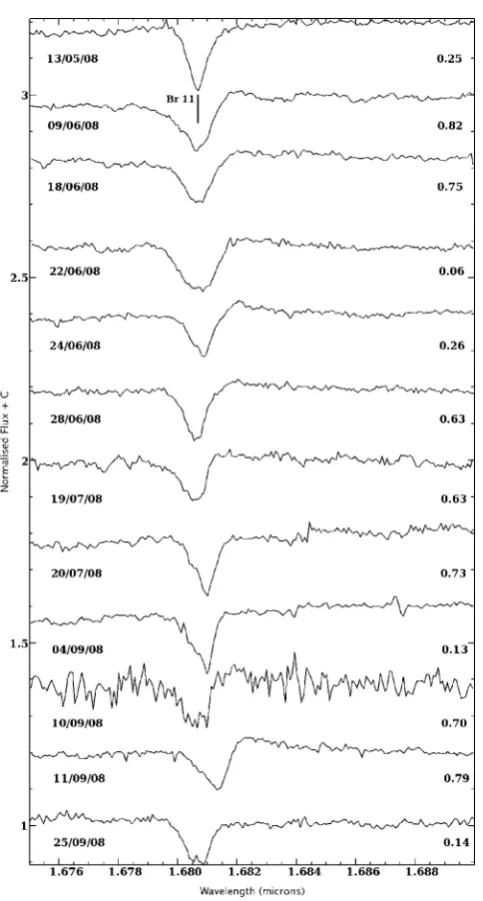
Cross-correlation was performed using the standardIRAF1routine fxcor. Unfortunately due to time constraints and the end of the VLT observing semester we were unable to obtain the full data set of the 20 target spectra we requested. However, 12 high quality spectra that covered a wide range of orbital phase were obtained, sufficient to determine a dynamical mass solution for OAO 1657−415 (Fig. 1).
3 DATA A N A LY S I S
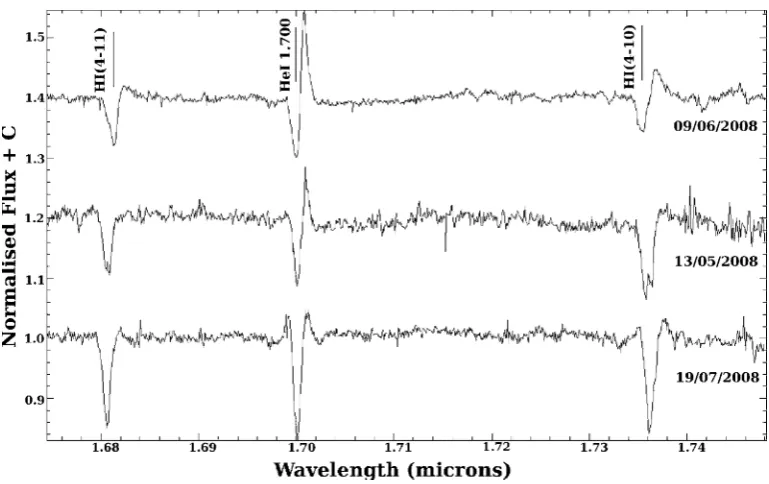
After telluric correction the target spectra can be seen to exhibit three well-defined spectral lines: 1.681μm Brackett 11 HI (4– 11), 1.700μm HeIand 1.736μm Brackett 10 HI(4–10) (Fig. 2). As noted earlier, OAO 1657−415 has been spectrally classified as an Ofpe/WNL star. These transitional stars are characterized by exceptionally intense stellar winds with low terminal velocities and high mass loss rates (Martins et al. 2007). This is demonstrated in the morphology of the three spectra from the data set obtained at differing orbital phases (Fig. 2), in which P-Cygni profiles can be seen in each of the spectral lines, the intensity of which clearly varies throughout an orbital cycle.
Stellar wind contamination leading to varying line-profiles make the process of cross-correlation to determine radial velocities prob-lematic. After close examination of each spectrum within the data set it was decided to cross-correlate around the region surrounding the Brackett 11 1.681μm line. We determined that the measured ra-dial velocities of this line would be less affected by the stellar wind, originating closer to the photosphere and exhibiting less P-Cygni profile variation. Unfortunately for two of the science spectra (#1 and #12 in Table 1) RV template observations were not completed. Additionally, two science spectra (#3 and #9 in Table 1) exhibited significantly broadened line-profiles in comparison to other spectra
1
IRAFis distributed by the National Optical Astronomy Observatory, which is operated by the Association of Universities for Research in Astronomy, Inc., under cooperative agreement with the National Science Foundation.
C
Figure 1.Continuum normalizedH-band spectra of OAO 1657−415 (high-lighting the Brackett 11 line) in date order. The orbital phase corresponding to each spectrum is indicated on the right-hand side of the figure. in the data set. To achieve as accurate an RV measurement as pos-sible it was decided to use the science spectrum #2 as a template reference spectrum in these four cases. We determined this spec-trum possessed the most accurate telluric division and the narrowest line profile. The resulting radial velocities were then corrected to the Solar system barycentre and are shown in Table 1.
4 OAO 1 6 5 7−4 1 5 RV C U RV E F I T T I N G
From X-ray data it has been deduced that OAO 1657−415 has an elliptical orbit withe=0.107±0.001 (Jenke et al. 2011) and the linear ephemeris of Barnstedt et al. (2008) gives the epoch at which the mean longitude is 90◦as
T90/MJD=52663.893(10)+10.44812(13)N, (1)
where the uncertainties refer to the last decimal place quoted and Nis the cycle number. The more recent quadratic ephemeris
de-rived by Jenke et al. (2011) concludes that the orbital period is currently decreasing with ˙Porb/Porb=(−3.34±0.14)×10−6yr−1, but otherwise is very little different from this. Given the relatively low precision of our RV measurements, the linear ephemeris is per-fectly adequate for our purposes. During the period in which our observations were conducted the accumulated uncertainty in phase was calculated as∼0.003.
As OAO 1657−415 has an appreciable eccentricity and thus will significantly deviate from sinusoidal motion, we cannot fit the radial velocities of the donor in this system with a sinusoidal RV curve. For an eccentric system we can construct a sinusoidal RV curve by fitting the true anomalyν(the angle between the major axis and a line from the star to the focus of the ellipse) to the calculated radial velocities of the donor. In order to do this we must first deduce the mean anomalyM (the time since the last periapsis multiplied by the orbital phase). This in turn is related to the eccentric anomaly E (the angle between the major axis of the ellipse and the line joining the position of the object and the centre of the ellipse) by the equation
E−esinE=M= 2π
P (t−T0). (2) The right-hand side of the above equation is the orbital phase, with T0the time of periastron passage. In an eccentric orbit,T0andT90 are related by
T0=T90+
P(ω−π/2)
2π . (3)
In the case of OAO 1657−415, the longitude of periastron,ω= 91◦.7±0◦.5 (Jenke et al. 2011), so the offset between the two is only about 0.005 in orbital phase.
This eccentric anomaly equation cannot be solved analytically, but solving it numerically we obtained the eccentric anomaly for each observation. These eccentric anomaly values can then be finally related to the true anomaly by the equation
tan ν
2
=
1+e 1−e
1/2 tan
E
2
. (4)
The calculated true anomaly values are shown in Table 1 and the measured radial velocities plotted as a function of the calculated true anomaly are shown in Fig. 3. Overplotted on these data are two sinusoidal fits. The first has just two free parameters (RV amplitude and systemic velocity) with a period and zero phase fixed by the ephemeris of Barnstedt et al. (2008). The second fit allows the zero phase as a third free parameter to allow for any possible accumulated uncertainty. However, this is only a marginally better fit and the reduction in chi-squared does not justify the inclusion of an extra free parameter. We therefore use the first fit which yields a RV amplitude of 22.1±3.5 km s−1and a systemic velocity of 57.2± 3.0 km s−1. Error bars on each RV value shown in Fig. 3 are such that the reduced chi-squared of the fit is equal to unity.
5 C A L C U L AT I O N O F S Y S T E M PA R A M E T E R S
Jenke et al. (2011) measured the projected semi-major axis of the neutron star’s orbit from X-ray pulse timing delays asaxsini= 106.16±0.08 light seconds. From this, the semi-amplitude of the neutron star’s RV may be calculated using
aXsini=
P 2π
KX(1−e2)1/2 (5)
Figure 2. OAO 1657−415 spectral features illustrating the varying wind structure which is particularly noticeable in the P-Cygni line profile of the HeI1.700
[image:4.595.89.505.346.492.2]µm line.
Table 1. The radial velocities of OAO 1657−415 determined from the Brackett 11 absorption line.
Spectrum number Mid-point of observations (UT) MJD Phase True anomaly RV (km s−1) RV Std.
1 2008 May 13.340 54 599.41 0.249 0.283 −45.77±10.3 Reference
2 2008 June 09.022 54 626.22 0.815 0.783 −99.05±10.3 HD 154313
3 2008 June 18.928 54 636.00 0.751 0.718 −79.26±10.3 Reference
4 2008 June 22.238 54 639.24 0.061 0.075 −39.93±10.3 HD 154313
5 2008 June 24.319 54 641.32 0.260 0.293 −26.02±10.3 HD 154313
6 2008 June 28.149 54 645.15 0.627 0.605 −65.87±10.3 HD 154313
7 2008 July 19.115 54 666.06 0.628 0.606 −66.72±10.3 HD 154313
8 2008 July 20.076 54 667.08 0.725 0.694 −61.13±10.3 HD 154313
9 2008 September 04.066 54 713.07 0.127 0.153 −38.67±10.3 Reference 10 2008 September 10.054 54 719.05 0.700 0.670 −79.50±10.3 HD 154313 11 2008 September 11.013 54 720.01 0.792 0.759 −81.77±10.3 HD 154313 12 2008 September 25.110 54 734.11 0.141 0.169 −45.52±10.3 Reference
To determine the masses of the system components we must first consider the mass ratio of the systemqwhich is equal to the ratio of the semi-amplitudes of the radial velocities for each star
q= MX MO
= KO KX
, (6)
where MO and MX are the masses of the supergiant star and neutron star, respectively, with KO and KX the corresponding semi-amplitudes of their radial velocities. Specifically for elliptical orbits,
MO=
KX3P(1−e)3/2 2πGsin3i (1+q)
2
(7)
and similarly
MX=
KO3P(1−e)3/2 2πGsin3i
1+ 1
q 2
, (8)
whereiis the angle between the normal to the plane of the orbit and the line of sight andPis the orbital period.
The geometry of the eclipse yields the following relation between the angle of inclination of the system,i, the eclipse half-angle,θ,
and various length scales in the system
sini≈
1−β2RL
r
2 1/2
cosθe
. (9)
HereRLis the Roche lobe radius of the supergiant,ris the separa-tion between the centres of the two stars andβis the ratio of the supergiant’s radius to that of its Roche lobe, referred to as the filling factor. For stars in a circular orbit,RLandβare constant, and the separation between the centres of the two stars is just the radius of the orbit. An approximation of the Roche lobe radius is given by Joss & Rappaport (1984) as
RL
r ≈A+Blogq+Clog 2q,
(10)
where they determine the constants as
A≈0.398−0.0262+0.0043
(11)
B≈ −0.264+0.0522−0.0153 (12)
C≈ −0.023−0.0052, (13)
C
Figure 3. Radial velocity solution for the mass donor in OAO 1657−415. The dashed line represents a fixed zero phase coincident with the published ephemeris (Barnstedt et al. 2008). The solid line is the best-fitting sinusoid with three free parameters, allowing for a shift in phase.
whereis the ratio of the spin period of the supergiant to its orbital period. Since the system has not circularized,is unlikely to be unity. If tides are efficient, then we might suppose that the rotation of the donor is synchronized at periastron, where the tides are most effective. In this case, the star’s angular velocity will be larger than the orbital velocity at mid-eclipse, and at this point∼1.2. To account for this uncertainty in our calculations we therefore adopt =1.2±0.2 as a conservative estimate.
For systems with a significantly eccentric orbit such as OAO 1657−415, the Roche lobe radius, the separation between the cen-tres of mass of the two stars, and the Roche lobe filling factor will all vary with orbital phase, althoughRL/r can be assumed to be constant. Using the above, we therefore calculateRL/r=0.553± 0.025.
The remaining system parameters were then calculated under two assumptions. If the donor star fills its Roche lobe at periastron, then the filling factor at mid-eclipse will beβ∼0.9. This allows us to calculate a lower limit to the system inclination,i, and upper limits are arrived at for the stellar masses. Conversely, if the system is viewed edge-on (i=90◦), we calculate a lower limit for the Roche lobe filling factor,βat mid-eclipse, and lower limits are derived for the stellar masses. The limits on the semi-major axis of the orbit,a, are simply determined from Kepler’s third law using the calculated ranges for the masses of the two stars. In practice, it turns out that the uncertainties on the system parameters overlap significantly for these two limits, so in Table 2 we list a single set of values.
Now, the separation between the centres of the two stars at mid-eclipse is given by
r= a(1−e2)
1+ecosω, (14)
whereωis the argument of periastron, measured by Jenke et al. (2011) to beω=91◦.7±0◦.5 in this case. This yields a value ofr= 49.9±1.0 R. Then the Roche lobe radius,RL, is this separation multiplied by the factor 0.553± 0.025 calculated earlier, which gives the value listed in Table 2. Finally, the radius of the donor star, ROis justβRL, and this value is also shown in Table 2.
Uncertainties on each of the inferred system parameters shown in Table 2 were determined by a Monte Carlo calculation which prop-agated the uncertainties in each observed parameter through one million trials, assuming a Gaussian distribution in each individual uncertainty.
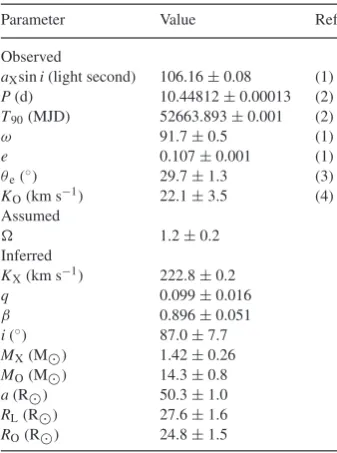
Table 2. System parameters for OAO 1657−415.
Parameter Value Ref.
Observed
aXsini(light second) 106.16±0.08 (1)
P(d) 10.44812±0.00013 (2)
T90(MJD) 52663.893±0.001 (2)
ω 91.7±0.5 (1)
e 0.107±0.001 (1)
θe(◦) 29.7±1.3 (3)
KO(km s−1) 22.1±3.5 (4)
Assumed
1.2±0.2
Inferred
KX(km s−1) 222.8±0.2
q 0.099±0.016
β 0.896±0.051
i(◦) 87.0±7.7 MX(M) 1.42±0.26 MO(M) 14.3±0.8 a(R) 50.3±1.0 RL(R) 27.6±1.6 RO(R) 24.8±1.5
References: (1) Jenke et al. (2011); (2) Barnstedt et al. (2008); (3) Chakrabarty et al. (1993); (4) this paper.
6 D I S C U S S I O N
6.1 System properties
The H band spectra for the period 2008 May–July (Fig. 2) demon-strate a high degree of line profile variability (LPV) in the HI transi-tions, with the HI(4–10) line observed to transition from absorption to a P Cygni profile. HeI1.70μm is also present and displays a vari-able P Cygni profile, although HeII1.69μm is absent. Conversely, the K-band spectrum of this object previously published (fig. 2, Mason et al. 2009), presents the HeII2.189μm line in emission. TheH-band spectrum is more reminiscent of P Cygni early B hy-pergiants than the Ofpe/WNL classification that had been inferred from theK-band data alone. Indeed, theHandKspectra can only be reconciled if it is assumed that the HeII2.189μm transition is driven into emission by the presence of the neutron star.
Precedents for excess HeIIemission in high mass X-ray binaries (HMXBs) in both the optical and NIR are provided by LMC X-3 and X-4 (Negueruela & Coe 2002) and CI Cam (Clark et al. 1999), respectively. RV shifts in this line in LMC X-4 confirm its asso-ciation with the compact accretor, with the observed line strength variability possibly resulting from changes in accretion rate; similar observations for OAO 1657−415 would test the hypothesis that the line is likewise associated with the accretor rather than the primary. The significant rapid, non-secular LPV in the remaining HIand HeIlines is most easily understood by a departure from spheri-cal symmetry by the presence of the neutron star. The WNLh star Wd1-44 provides a precedent for this conclusion, also demonstrat-ing dramatic LPV in wind dominated HIand HeIP Cygni profiles, although in this case it is expected that the companion is a normal H/He-burning object (Clark, Ritchie & Negueruela 2010).
[image:5.595.343.512.71.298.2]namely a lack of contemporaneous data for a star showing LPV – possibly as a consequence of an aspherical wind – and the pres-ence of an additional source of ionizing radiation within the system yielding discrepant HeII2.189μm emission.
While we were unable to obtain a formal fit to the model, we were able to determine order of magnitude estimates for the bulk prop-erties of the star that we regard as indicative of its true propprop-erties: T ∼20 kK,L∼105.1L
,R∼30 R, ˙M =2×10⁻⁶Myr−1, v∞ ∼250 km s−1. Using our spectra from theHandKbands the model also provided us with estimates of the mass fraction of hy-drogenXH=5 per cent (H/He=0.21 by number) in which our primary diagnostics were the Brackett series lines (1.680, 1.736 and 2.166μm), heliumXHe= 94 per cent by mass from HeIlines (1.700, 2.058, 2.112, 2.161μm) and other metalsXZ= 1 per cent.
Comparing the stellar parameters of OAO 1657−415 with the Ofpe/WNL star AF (Martins et al. 2007), we find a correspon-dence between temperature and radius, whilst the luminosity of OAO 1657−415 (L∼105.1L
) is consistent within the uncertain-ties to that of AF. However, the lower than expected luminosity of OAO 1657−415 implies that it could be a B supergiant rather than a Ofpe/WNL star. Noting that there is a large degree of overlap be-tween model derived luminosities of Ofpe/WNL and B supergiants, we turn to other stellar properties to address this possibility. We find the low terminal velocity of OAO 1657−415 combined with its mass loss rate and temperature are incompatible with those found for field Blue Supergiants (Crowther, Lennon & Walborn 2006). B supergiants with a luminosity ofL∼105.1L
would be expected to have a radius greatly in excess of that found from both modelling and dynamical calculations of ∼30 M(Searle et al. 2008). B supergiants also have a significantly greater hydrogen abundance of H/He= 5 by number (Crowther et al. 2006) than that found during our modelling of OAO 1657−415. With the degree to which hydrogen is depleted within OAO 1657−415 its radius may seem excessively large. However, several examples of WNL stars with atmospheres with a similar or greater degree of hydrogen depletion and comparable radii to that of OAO 1657−415 have been detailed in the literature. In particular, the emission line star HD 326823 (Marcolino et al. 2007) is reported as entering the WR phase as a WN8 star with a radiusR= 30 Rand a hydrogen mass fraction of XH∼3 per cent. Similarly the WN8 star WR123 (Crowther, Hillier & Smith 1995) may have a hydrogen mass faction as low as 0.5 per cent yet is reported as having a radiusR∼15 R.
6.2 OAO 1657−415 in an evolutionary context
When these properties are combined with the finding that OAO 1657−415 possesses a severely H-depleted atmosphere, it is apparent that it is a rather evolved object and is clearly more advanced than the typical OB SG mass donors in HMXBs. A com-parable mass donor in this regard is Wray 977, the blue hypergiant companion within GX301-2. Before OAO 1657−415, Wray 977 was the most evolved non-WR donor known within a HMXB sys-tem. Wray 977 has a significantly higher hydrogen mass fraction of 45 per cent, (table 8 in Kaper, van der Meer & Najarro 2006) than that of OAO 1657−415.
Thus, while a definitive spectral classification for the mass donor in OAO 1657−415 is difficult, even if it has yet to formally become a WR star, it is apparent that it will do so shortly. As such it will become only the fourth known HMXB with such an evolved mass donor. The only other example in our Galaxy is Cyg X-3, which has a WNE mass donor orbiting a NS or BH companion in a 4.8-h orbit (van Kerkwijk et al. 1996). van den Heuvel & De Loore (1973)
describe an evolutionary scenario for this system, whereby the mass donor in the OB SG+accretor progenitor system expands towards a RSG phase, triggering common envelope (CE) evolution which leads to the formation of the WNE star and a dramatic contraction in orbital separation.
In contrast, while the two known extragalactic examples – IC10 X-1 (Clark & Crowther 2004) and NGC300 X-1 (Crowther et al. 2007) – also host WN stars, they both have significantly longer or-bital periods (∼30 h), and appear to host more luminous mass donors and more massive accretors.2These properties preclude these bi-naries from evolving via the scheme inferred for Cyg X-3. Instead, it is thought that they must have evolved from very compact initial O+O star binaries via the case M pathway described by de Mink et al. (2009). In this, the rapid rotation of both (tidally locked) com-ponents leads to efficient mixing and hence homogeneous chemical evolution, which results in the stars remaining within their Roche lobes while evolving to WR stars. This evolution prevents binary driven mass loss, resulting in a longer final orbital period and cru-cially a heavier relativistic companion.
However, the properties of OAO 1657−415 do not fit either of these schemes. The non-zero eccentricity appears to preclude post-SN CE evolution (as a result of circularization processes during spiral-in) and hence OAO 1657−415 being the endpoint of the van den Heuvel & De Loore (1973) pathway. To address this in a more quantitative manner we adopt the formalism of Dewi & Tauris (2000), whereby the evolution of a putative RSG+NS sys-tem through a CE phase may be followed by the parametrization of the binding energy of the envelope of the donor star (λ) and the efficiency parameterηfor the removal of the envelope during spiral-in. In the following discussion we assumed an initial donor mass of∼40 Mresulting in a∼24.5 Menvelope and∼15.5 M core, representative of the current mass of the Ofpe/WNL star. The binding energy of the envelope of the mass donor is given by
Ebind=
−GMdonorMenv λRdonor
, (15)
where Mdonor, Menv and Rdonor are the masses of the donor and envelope of the donor and the donor radius, respectively. In order to facilitate a successful ejection of the donor star envelope we consider a wide orbit before the CE for two reasons: A wide orbit requires an evolved donor star to fill its Roche lobe and giant stars have relatively small binding energies of their envelope. Furthermore, a wide pre-CE orbit has the potential to release more orbital energy during spiral-in. Even for a rather evolved donor (Rdonor1500 R) we find|Ebind| ∼1050erg given that for such a starλ≤0.02 (cf. Dewi & Tauris 2001). However, simply determining the available orbital energy
Eorb=
GMcoreMNS 2a −
GMdonorMNS 2a0 =
8.2×1047erg, (16)
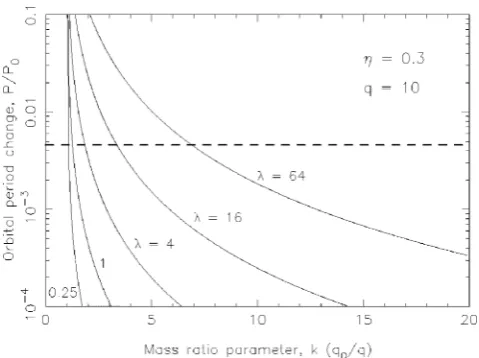
where the mass of the neutron star,MNS =1.5 M and a0and aare the initial and final orbital separations. Thus even assuming the smallest possible envelope binding energy and a 100 per cent ejection efficiency (η=1.0) for conversion of orbital energy we find that there is insufficient energy available for ejection of the donor envelope (by 2 orders of magnitude). This is indicated graphically in Fig. 4 which demonstrates that for a successful ejection of the envelope yielding the current orbital parameters one would require
2>15 M
for NGC300 X-1 (Crowther et al. 2010) and>23 Mfor IC10 X-1 (Silverman & Filippenko 2008) versus<10 Mfor Cyg X-3 (Hanson, Still & Fender 1999).
C
Figure 4. Plot of the initial/final mass ratio (in this caseqis defined as Mcore/MNS),k(=q0/q), versus the change in the orbital period –P/P0. The dashed line represents the value of the latter assuming a maximum orbital separation of∼2500 R(P0 =2250 d), while the shaded region corresponds to the range valid fork. The curved lines represent different binding energies of the envelope of the donor star (λ), assumingq=10 and an ejection efficiencyη=0.3. See Section 6.2.
λ >1 (solutions are only possible above the dashed line), while stellar structure calculations for a 40 Mstar yieldλ=0.006–0.02 (Dewi & Tauris 2001).
If the CE evolutionary pathway of van den Heuvel & De Loore (1973) cannot produce OAO 1657−415 what might? The large de-gree of H-depletion in the mass donor implies a post-rather than pre-RSG state; hence it is difficult to interpret the system as evolving towardssuch a CE phase. Moreover, case M chemically homoge-neous evolution (e.g. de Mink et al. 2009) also seems inappropriate since it would result in a much more massive relativistic companion than we find.
In the absence of any tailored numerical model for the evolution of OAO 1657−415 (cf. Wellstein & Langer 1999a for GX301-2) any scenario is inevitably somewhat speculative. It might be sup-posed that the progenitor system consisted of two O stars in a comparatively short orbit. Mass is transferred from the primary to the secondary, which after rapidly gaining mass evolves more quickly than the donor and hence undergoes SNe first, leaving the primary in a H-depleted phase. Despite such mass transfer lead-ing to a rather wide pre-SN binary configuration, a fortuitous SN kick may reduce the separation, with subsequent interaction acting to circularize the orbit. While this would leave the primary in the requisite H-depleted state, simulations of conservative mass trans-fer (e.g. Wellstein, Langer & Braun 2001) leading to reverse SNe yield very low masses for the mass donor in comparison to our dynamical mass estimate. Alternatively, from our earlier paper on OAO 1657−415, (Mason et al. 2009) luminosity calculations and comparison to evolutionary tracks for massive stars from Meynet & Maeder (2000) indicate a progenitor mass for the OAO 1657−415 donor of∼40 M. This implies OAO 1657−415 is massive enough to have undergone an LBV phase (Langer et al. 1994). If the evolu-tion of the progenitor system had proceeded such that a LBV+NS was produced with an orbital period in which both components would interact during the LBV phase, in this case the binding energy of the donors envelope would be reduced whilst the cor-responding efficiency parameterηfor the removal of the envelope would increase. The changes to these parameters might be sufficient
to enable the removal of the donors envelope by CE evolution. This scenario has been suggested qualitatively by De Donder, Vanbev-eren & van Bever (1997). The hydrogen depleted HMXB system GX301-2 which hosts a blue hypergiant donor of 43 M ±10 M with a 1.85±08 MNS companion in an eccentric 41d orbit may provide an analogue to the progenitor system to OAO 1657−415. Modelling of this system by Wellstein & Langer (1999b) as a 25+ 26 Mbinary which undergoes conservative case A mass transfer with an initial 3.5-day period was able to reproduce the current observed mass of the donor successfully, demonstrating that it is possible for a massive hypergiant to have a NS companion.
We are thus currently unable to determine a definitive qualitative evolutionary pathway for OAO 1657−415, but conclude that it can-not have formed via either of the scenarios proposed for the other three known WR X-ray binaries – consequently this class of object appear to be rather heterogeneous in nature in comparison to other subsets of HMXB such as the OB SG and Be star X-ray binaries.
However we do note that the future evolution of the mass donor in OAO 1657−415 will result in an increase in wind velocity, while wind driven mass loss will cause the separation to increase. The combination of both effects will result in a reduction in accretion efficiency and hence X-ray luminosity. Hence one might suppose that even if the evolutionary pathway that formed OAO 1657−415 is traversed by large numbers of stars, comparatively few will be detectable as X-ray sources due to the likely rapidity of passage through the Ofpe/WNL phase.
6.3 Future evolution of OAO 1657-415
The final mass of the WR star before its core-collapse is probably somewhere between 5 and 10 M(Meynet & Maeder 2005). If the star loses its mass in the form of a direct fast wind, (assuming the vast majority of the mass is lost from the binary) the system will have an orbital period of more than 65 days when the companion is reduced to 5 Mbefore the collapse in less than 1 Myr. If the outcome of the core collapse is a neutron star then the ejection of the envelope surrounding the iron core is likely to disrupt the binary; a binary will be disrupted if it loses more than half of its total mass in an instantaneous event like a SN (Colgate 1970). On the other hand, the momentum kick expected to be imparted to the newborn neutron star (Lyne & Lorimer 1994) can also, depending on its direction, have the effect of tightening the binary so it survives and remains bound despite losing more than half of its total mass (Hills 1983). In this case a double neutron star system is formed and would most likely be wider than the widest of the currently nine double neutron star systems known in our Galaxy, PSR J1811−1736, which has an orbital period of 18.8 days.
7 C O N C L U S I O N S
An attempt was made to model the stellar atmosphere of the donor; this was found to be problematic due to the presence of HeII emission that made a formal fit to the spectrum difficult. Modelling of the stellar atmosphere did however provide order of magnitude estimates of stellar parameters, indicating that the Ofpe/WN9 star in this system, although significantly hydrogen depleted, has retained a small fraction of its envelope. This combined with the non-zero eccentricity and∼10 d orbital period of the system is indicative of a different evolutionary pathway than in the three other WR– CC systems known. Calculating the binding energy of the envelope we found there is insufficient energy to eject the envelope. This combined with the orbital period of the system effectively rules out CE evolution as a viable evolutionary scenario. We have postulated other evolutionary pathways for OAO 1657−415 in which mass transfer occurs in a short binary orbit in which the secondary is the first to experience a SNe, or the system experiences a ‘mild’ form of CE evolution during an LBV phase. Whilst we are unsure of the exact evolutionary process responsible for the current configuration of OAO 1657−415, we are convinced that the evolution of this system forms an entirely new evolutionary scenario than the two proposed to explain the development of the other three known WR X-binary systems.
AC K N OW L E D G M E N T S
ABM acknowledges support from an STFC studentship. JSC ac-knowledges support from an RCUK fellowship. This research is par-tially supported by grants AYA2008-06166-C03-03 and Consolider-GTC CSD-2006-00070 from the Spanish Ministerio de Ciencia e Innovaci´on (MICINN). Based on observations carried out at the Eu-ropean Southern Observatory, Chile through programme ID 081.D-0073(B). We thank the anonymous referee for their constructive comments which have helped to improve this paper.
R E F E R E N C E S
Barnstedt J. et al., 2008, A&A, 486, 293 Chakrabarty D. et al., 1993, ApJ, 403, L33
Chakrabarty D., Wang Z., Juett A. M., Lee J. C., Roche P., 2002, ApJ, 573, 789
Clark J. S., Crowther P. A., 2004, A&A, 414, L45
Clark J. S., Steele I. A., Fender R. P., Coe M. J., 1999, A&A, 348, 888 Clark J. S., Ritchie B. W., Negueruela I., 2010, A&A, 514, A87 Colgate S. A., 1970, Nat, 225, 247
Crowther P. A., Evans C. J., 2009, A&A, 503, 985
Crowther P. A., Hillier D. J., Smith L. J., 1995, A&A, 293, 403 Crowther P. A., Lennon D. J., Walborn N. R., 2006, A&A, 446, 279 Crowther P. A., Carpano S., Hadfield L. J., Pollock A. M. T., 2007, A&A,
469, L31
Crowther P. A., Barnard R., Carpano S., Clark J. S., Dhillon V. S., Pollock A. M. T., 2010, MNRAS, 403, L41
De Donder E., Vanbeveren D., van Bever J., 1997, A&A, 318, 812
de Mink S. E., Cantiello M., Langer N., Pols O. R., Brott I., Yoon S., 2009, A&A, 497, 243
Demorest P. B., Pennucci T., Ransom S. M., Roberts M. S. E., Hessels J. W. T., 2010, Nat, 467, 1081
Dewi J. D. M., Tauris T. M., 2000, A&A, 360, 1043
Dewi J. D. M., Tauris T. M., 2001, in Podsiadlowski P., Rappaport S., King A. R., D’Antona F., Burderi L., eds, ASP Conf. Ser. Vol. 229, Evolution of Binary and Multiple Star Systems. Astron. Soc. Pac., San Francisco, p. 255
Hanson M. M., Still M. D., Fender R. P., 1999, BAAS, 31, 1426
Hanson M. M., Kudritzki R.-P., Kenworthy M. A., Puls J., Tokunaga A. T., 2005, ApJS, 161, 154
Hillier D. J., Miller D. L., 1998, ApJ, 496, 407 Hills J. G., 1983, ApJ, 267, 322
Jenke P. A., Finger M. H., Wilson-Hodge C. A., Camero-Arranz A., 2011, in G¨o˘g¨us¸ E., Belloni T., Ertan U., eds, AIP Conf. Ser. Vol. 1379, New Timing Results of the X-ray Binary Pulsar OAO 1657-415. Am. Inst. Phys., New York, p. 212
Joss P. C., Rappaport S. A., 1984, ARA&A, 22, 537
Kaper L., van der Meer A., van Kerkwijk M., van den Heuvel E., 2006, The Messenger, 126, 27
Kaper L., van der Meer A., Najarro F., 2006, A&A, 457, 595
Langer N., Hamann W., Lennon M., Najarro F., Pauldrach A. W. A., Puls J., 1994, ApJ, 290, 819
Lyne A. G., Lorimer D. R., 1994, Nat, 369, 127
Marcolino W. L. F., de Ara´ujo F. X., Lorenz-Martins S., Fernandes M. B., 2007, AJ, 133, 489
Martins F., Genzel R., Hillier D. J., Eisenhauer F., Paumard T., Gillessen S., Ott T., Trippe S., 2007, A&A, 468, 233
Mason A. B., Clark J. S., Norton A. J., Negueruela I., Roche P., 2009, A&A, 505, 281
Mason A. B., Norton A. J., Clark J. S., Negueruela I., Roche P., 2010, A&A, 509, A79
Meynet G., Maeder A., 2000, A&A, 361, 101 Meynet G., Maeder A., 2005, A&A, 429, 581 Negueruela I., Coe M. J., 2002, A&A, 385, 517
Polidan R. S., Pollard G. S. G., Sanford P. W., Locke M. C., 1978, Nat, 275, 296
Quaintrell H., Norton A. J., Ash T. D. C., Roche P., Willems B., Bedding T. R., Baldry I. K., Fender R. P., 2003, A&A, 401, 313
Searle S. C., Prinja R. K., Massa D., Ryans R., 2008, A&A, 481, 777 Silverman J. M., Filippenko A. V., 2008, ApJ, 678, L17
Timmes F. X., Woosley S. E., Weaver T. A., 1996, ApJ, 457, 834 Val Baker A. K. F., Norton A. J., Quaintrell H., 2005, A&A, 441, 685 van den Heuvel E. P. J., De Loore C., 1973, A&A, 25, 387
van Kerkwijk M. H., Geballe T. R., King D. L., van der Klis M., van Paradijs J., 1996, A&A, 314, 521
Wellstein S., Langer N., 1999a, A&A, 350, 148 Wellstein S., Langer N., 1999b, A&A, 350, 148 Wellstein S., Langer N., Braun H., 2001, A&A, 369, 939 White N. E., Pravdo S. H., 1979, ApJ, 233, L121 Zhang C. M. et al., 2011, A&A, 527, A83
This paper has been typeset from a TEX/LATEX file prepared by the author.
C