OF THE EUROPEAN COMMUNITIES
MONETARY DISORDER
OPINION
Committee, chaired by Mr Basil de FERRANTI, approved this opinion at its 160th Plenary Session, which was held on 20 and 21 June 1978.
The preliminary work was done by the Section for Economic and Financial Questions and the Rapporteur was Mr Yvan
OF THE EUROPEAN COMMUNITIES
0 P I N I 0 N
MONETARY DISORDER
frPnch, German and Itallan.
A bibliographical slip can be found at the end of this
volume.
Copyright 1978 Economic and Social Committee
Brussels
T A B L E 0 F C 0 N T E N T S
A. REPORT OF MR CHARPENTIE
Introduction . . . • . . • . . . • • '1.
l. SURVEY OF THE MAIN MONETARY EVENTS SINCE BHE'J'TON WOODS AND ANALYSIS OF '!'liE PRESENT Sl TUATION • • • • . . • . . . . . • • • . . . . . • . • • • . • . . . . . 3
1. Survey of the Main Monetary Events
since Bretton Woods •...•.. ...•••••.•.. 3
General Observations on the International Monetary System
Bretton Woods
Implementation of the Bretton Woods
3 5
Agreement • . • • . . . • . • . . • . . . 6
The Dollar Crisis and the End of
the Bretton Woods System •.•.. . . • . • 8
The Smithsonian Agreement •....•••••• 10
From the Smithsonian Agreement to
Moves to Organize a Community
Monetary System . .•.. .. ... . . .•... 20
-The Provisionn of the Treaty . . . 20
-The Institutions ... .. . .. .. .. . . 23
- The Machinery . . . 24
- The Narrowing of Exchange-Rate Fluctuation Margins or the "snake" . . . • . . . • . . . 28
- Management of the Community Foreign Exchange System . . . . .. . 30
- Balance Sheet of the Moves to Organize a Community Monetary System . . . • . . . , . . . • . • . . • . . . 36
;.>, Th0 Present 11oneLary Si l.ual.ion .. .. .. . 38
Main fcaturen of World Currency llelationshlpn .. .. .. .. .. .. . .. .. .. .. . 38
The Consequences and Risks of the Present Monetary Situation .. . . ... 45
II. THE REQUIREMENTS FOR RETURNING THE INTERNATIONAL MONETARY SYSTEM TO NORMAL 51 .·The Aims of a Policy for a Return to Normal • . • . . . • . . . 51
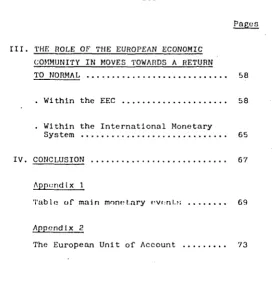
I I I. THE ROLE OF THE EUROPEAN ECONOMIC COHMUNITY IN MOVES 'J'OWArlDS A RETURN
TO NORMAL 58
• Within the EEC ••••••••••••••••••••• 58
Within the International Monetary
System • • • • • • • • • • • • • • • • • • • • • • • • • • • • • 65
IV. CONCLUSION • • • • • • • • • • • • • • • • • • • • • • • • • • • 67
flpp"ndix
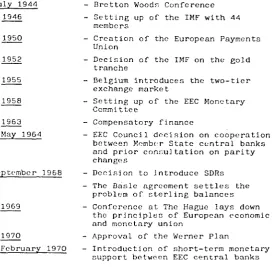
Table of main monet.ary PV<:nl.~; • • • • • • • • 69
Appendix 2
[image:7.401.49.322.76.374.2]B. OPINION OF THE COMMITTEE ON THE
COMMUNITY APPROACH TO THE PRESENT
INTERNATIONAL MONETARY DISORDER
1. General Considerations • • . . . . • • • . • . . . . 82
2. The Present Monetary Situation 82
3. The Effects and the Dangers of the
Present Monetary Situation . . . . .. ..•.. 86
'1. 'T'hn Rcqulrcme>nt~• for Returning the lnLernational Monetary Sy:;\.('m to
Normal . • . . . • • . • . . . • . . . 89
~. The Role of the European Economic Community in Moves towards a Return
to Norinal . . . . • . . . • . . • • . . • • • • • 93
6. Conclusion .. .. • .. .. .. • .. .. .. • .. . .. .. . 98
*
Introduction
The international monetary situation became
even more unstable towards the end of 1977 and in the
early part of 1978. Exchange rates fluctuated widely
and the US dollar went into a rapid slide. Were this
state of affairs to continue it could, in the longer
term, have an adverse effect on the economic situation
and on employment in the Community.
It could also spark off new increases in oil
prices.
Monetary Instability is harmful to good
International relations, undermines efforts being made
in Europe and elsewhere to conquer the problems of
inflation and unemployment, and encourages protectionist
tendencies which are already affecting world trade and
are threatening to spread to intra-Community relations.
Confronted with this situation, the Economic
and Social Committee decided to consider the issue on
its own initiative and to attempt to define the
con-ditions for a "Community Approach to the Present
Such is the aim of the present Report and
Opinion, which look into existing ways and means of
tackling the problems at both international and
Community level.
The Economic and Social Committee docs not
;;et out to propose technical or political solutions.
Experts and political leaders have already been studying
and discussing these for several years now. Its aim is
a more modest one : to suggest certain lines of approach
and determine the conditions for a return to normality. The Committee is well aware, however, that the ultimate
aim must be to eliminate international monetary disorder
and intolerable balance-of-payments disequilibria, and
that to this end it is necessary above all to seek a
better balance between growth and stability at world
l . SURVEY OF TilE MAIN MONETARY EVENTS SINCE BRETTON WOODS AND ANALYSIS OF THE PRESENT SITUATION
a) Survey of the main monetary events since Bretton Woods
Before passing judgement on the current
international monetary disorder i t would be useful to
briefly recall the major milestones of recent monetary
history and describe as simply as possible the complex problem of world currency relationships and the rules
governing these relationships in 1978.
General observations on the international monetary system
The rip~t to print money is a regalian right,
i.e. a right connected with the exercise of sovereignty.
This explains why the privilege of being able to create
money has gradually become a State monopoly, even if
the State itself puts the actual job in the hands of a bank of issue constituted under private bar.
There are no problems of principle regarding
a currency circulating within the territory under the
jurisdiction of the issuing State, since the public
authorities of that State can always decree a compulsory rate for the currency issued there.
But i t is quite a different matter when it
comes to a State wanting to get its currency accepted
for example when it wants to pay for imports in its own
national currency.
Hence all the difficulties and complexity of
international currency relationships.
A currency will in point of fact only be
accepted if people have confidence in it and in the
issuing authority. In other words it must have credit
worthiness.
For centuries and indeed until quite recently
(15 August 1971 to be exact) it was believed that this
could be achieved by using as national or international
currency precious metals (gold and silver) with an
intrinsic value or currencies that were convertible into
gold (gold standard or gold exchange standard).
The obvious strength of such a system was that
all par value or exchange rate problems could be solved,
since the gold standard was immutable - at least in
theory. The only snag was that gold production and stocks
lagged way behind the needs nf national economies and the
expanding volume of world trade. To get round this
dif-ficulty a whole host of systems were conjured up, all of
which led to the creation of "monetary symbols" on the
with gold was preserved. In fact, what was really
happening was that pyramids were being built upside down
and they were tottering precariously on their apexes.
Bretton Woods
Although the war had brought about a wholesale
redistribution of bullion reserves between countries,
Bretton Woods was in no way an exception to the rule
described above but merely reaffirmed the pivotal role
of gold in the international monetary system, since IMF members had to declare the par values of their currencies
in terms of gold or the dollar (35 dollars equalled one
ounce of fine gold) and were required to buy or sell
their own currency as appropriate in order to ensure that
the market rate kept within a margin of 1% on either side
of the declared par value.
Par values could be adjusted only with the
prior approval of the IMF'nnd only if there was a
"fundamental disequilibrium", a notion that was never
precisely defined. The two basjc aims of the Bretton
Woods Agreement were to
- fix exchange rates between the currencies of IMF
members numbering 44 in 1946 and 127 today) since
- institute a system for settling payments, as well as
a system for extending credit to deficit countries,
through the use of drawing rights based on quotas equivalent to members' subscriptions in gold or in
their own currency.
Finally, Article 8 of the Articles of Agreement
of the IMF made i t compulsory for each member, after the
transitional period, to remove all exchange controls in
respect of current transactions and to guarantee, vis-a-vis
other countries, the convertibility of its own currency
for the settlement of such transactions.
Implementation of the Bretton Woo~s Agre~~ent
The proposed objectives were only partially attained and the di~equilibria set in motion by the
Agreement finally brought about the downfall of the
~ystem,
The goal of fixed exchange rates was not fully
attained due to failure to apply the relevant measures
rigorously. Some countries never declared par values,
others declared several par values (multiple exchange
rates) and yet others floated their currencies without
Mast devaluations were decided on without the
agreement of, or even prior consultation with, the IMF,
so that during the thirty years the Agreement was in
operation there were_ con.siderable exchange rate
adjust-ments between currencies, even though these adjustadjust-ments had the advantage aver floating of being officially
registered in devaluations or revaluations in terms of the key currency, the dollar.
One thing in the IMF's favour that must be
recognized, however, is that the Fund has made i t much
easier for central banks to settle payments with one
another, and this in turn has furthered the development
of world trade. The IMF has achieved this by regularly
increasing drawing rights and expanding credit
facili-ties through :
- the introduction in 1952 of the gold tranche (for
which the agreement of the IMF is automatic) and
stand-by credit (where authoritization is given for
a specific period of time and the credit can be used
any time during that period);
- the introduction in 1953 of compensatory finance
facilities, particularly for the benefit of developing
- the introduction in 19GB of Special Drawing Rights in
addition to the ordinary drawing rights based on quotas
and subscriptions to the Fund.
The IMF has frequently come to the aid of
countries threatened by serious balance-of-payments
disequilibria.
Finally, the Bretton Woods system can also take
credit for the fact that a good many countries have got
rid of exchange control and made their currencies
con-vertible once more.
It is fair to say then that, if the Bretton
Woods Agreement had been applied more rigorously, i t
might have lasted and even survived the crisis resulting
from the four-fold increase in ojl prices. Unfortunately,
however, it carried within itself the seeds of
disequili-bria and tensions.
The dollar crisis and the end of the Bretton Woods System
Though officially pegged to gold, the par values
df national currencies were also pegged to the dollar.
In fact the Bretton Woods Agreement explicitly provided for this by putting the dollar-gold link on an official
footing, even though there was no question of currencies
being tied officially to the dollar. This thinking was
bulk of Lhe world'8 gold reserveR and it was inconceivable
that the dollar could be devalued in terms of gold.
In these circumstances, central banks and
economic operators preferred to hold dollars or dollar
claims (Eurodollars) which, whilst providing the same
security as eold, were superior in that they brought in
interest: "the dollar is gold that earns interest", as
the saying went.
The United States thus found i t hard to resist
the temptation to export substantial amounts of capital
to industrialized countries and this led to a
disequili-brium in its balance of payments.
So, whilst the United States accumulated
long-term .claims against foreign countries, the latter
accumu-lated current claims against the United States; these
claims increasingly outbal'anced American eold stocks.
In the early 1960s, this situation brought on
a first loss of confidence in the dollar and measures
The proper remedy would have been to bring the
United States' balance of payments permanently into
equilibrium. Unfortunately, however, the appearance of
inflationary tendencie_s i!] the United States, a trade deficit at the end of the 1960s, and the need to finance
the Vietnam war and foreign aid all conspired to steadily
worsen the US payments deficit.
To protect its currency and honour its
commit-ments, the United States was forced to dip into its gold
reserves. In fact, its stock of gold fell to the
equiva-lent of about 10,000 million dollars in the spring of
1971, when there was a new burst of speculation in gold,
the German mark, other European currencies and the yen,
whilst gold rose to 45 dollars an ounce on the free market.
On lC, August 1971, th" President of the United
States suspended convertibility of the dollar into gold
and into other foreign currencies. This effectively
marked the end of the Bretton Woods system.
The Smithsonian Agreement
The Smithsonian Agreement concluded by the Group
of Ten in December 1971 was designed to put an end to the world monetary .chaos that had existed since the decision
Under the Smithsonian Agreement
- a new set of par values in relation to the dollar were
fixed for the main currencies;
- the dollar was devalued by 8% in terms of gold (from
35 dollars per ounce to 38 dollars per ounce); this
was the first devaluation of the dollar since 1934
and the third since 1792;
- the bands within which exchange rate fluctuations were allowed were widened from 1% to 2.25% either side of
parity.
Although the United States maintained
non-convertibility of the dollar into gold - which made the
parity of 38 dollars to the ounce wholly academic - the
dollar nevertheless retained its dominant position,
since i t was in terms of that currency that the exchange
rates of other currencies continued to be expressed.
Under the Smithsonian Agreement then, the
United States was released from all obligations and
constraints (i.e. convertibility of the dollar into
gold), though at the same time it retained all the
privileges reserved for the dollar. It should be
rec6g-nized, however, that such privileges were, to a large
extent, a reflection of the confidence which central banks and economic operators continued - perhaps faute
From the Smithsonian Acreement to the Jamaica Agreement
The Smithsonian Agreement in fact solved nothing
and the world entered_a p~riod of monetary anarchy that
was by no means a short-lived phenomenon.
The United States' payments deficit continued
to grow : liquid funds expanded dangerously and the
dollar steadily depreciated, whilst harder currencies
(particularly the German mark) rose in value on a large scale (50% increase in terms of the dollar and 20% increase
in terms of all the other main currencies between 1970 and
1975). Speculation against the dollar returned with
renewed vigour and at the beginning of 1972 one ounce of
fine gold was worth 50 dollars.
Faced with this increasingly anarchistic
situa-tion, individual countries as well as international
institutions began to look for solutions - or at the very
least palliative measures.
In April 1972, the Member States of the EEC
conceived the idea of the European "snake" and undertook
to ensure that the exchange rates of their currencies did
not fluctuate by more than 2.25% (giving a maximum
remuinin2 within u broader band in relation to the
dollar (the tunnel).
·-The IMF decidPd to set up the Committee of
Twenty to prepare a reform
or
the international monetarysystem. Several dc~veloping r.ountries were members of
this Committee.
In June 1972, however. the United Kingdom decided to float the pound and her example was soon
followed by Italy (January 1973).
Early in 1973 there was a new upsurge in world
speculation against the dollar, which was devalued from
38 to 4?.22 dollars per ounce ot· gold.
Japan and Swit.zerl:1nd dc·eid('d to float thelr
curr~ncies and in ~larch 1973 l.hc cuunt.ries of the "snake"
agrer:d to do likewise in rPlatinn to the dollar. The
"snake" left the tunnel. The tunnel in fact no longer existed.
In spite of cvcrythinp,, the EEC tried during this period to make further progress towards economic
and monetary union, and in April 1973 set up the European Monetary Cooperation Fund (EMCF), to be administered by
the nank for International SPttlcments (1).
Finally, at a meeting held in Nairobi in September 1973, the Committee of Twenty laid the
founda-tions for new monetary rules.
The main elements of the new system included
-stable but adjustable par values (i.e. something midway between fixed parities and floating exchange rates);
- the protection of exchange rates between any given pair
of currencies, as in the European "snake" and no longer
between an individual currency on the one hand and the
dollar on the other;
privileged position;
the dollar thus lo~t Its previously
- arrangements whereby the responsibility for restoring balance would no longer lie solely with debtor countries
but would also be shouldered, where appropriate, by
creditor countries.
A few weeks after the Nairobi Conference came
the oil crisis and, concurrently, a general rise in raw
material and foodstuff prices. This threw the whole
question open again, affected the balance of power and
resulted in a geographical redintribution of foreign
'l'o help oil and raw maLerial importing countries,
the EEC (at ZeisL in April 1974) and the IMF ~in June)
decided to mobilize eold assets at the free market rate.
Some countries in fact.rey{llorized their gold reserves.
These measures, however, were but palliatives
and in 1974 the IMF took two decisions one after the other,
in order to continue, despite everything along the chosen
path and attend to the most ureent needs
- the value of the SDR would be fixed in relation to a "basket" of currencies instead of gold or the dollar;
- there would be a general increase in quotas.
Links with the eold standard and the dollar were
thus abandoned and replaced by a unit of account as the
pivot of the monetary system.
The SDR was related to a basket of 16 currencies
which included :
- 0.40 US dollar
- 0.38 German mark - 0.04~> pound :,;t.erl ing
The composition of the basket was calculated in
such a way that on the first day of operations, i.e.
28 June 1974, each of the 16 currencies was weighted more
or less in line with its share in world trade. The dollar
no longer enjoyed absolute pre-eminence, since the
curren-cies of the EEC countries taken together in the basket carried more weight than the US dollar.
The SDR is not a genuine standard, since in
reality it is but a convenient way of evaluating a currency
in relation to all the other currencies in the basket. In
the present monetary system a sLandard no longer exists.
The value of a currency can be recorded; it
cannot be determined.
The SDR nevertheless has the immense advantage
of enjoying a certain stability, since it represents the
weighted average of the values of the currencies, some of
which appreciate when others depreciate.
To meet the ever-growing payments needs of different countries, paricularly the developing countries
and the oil-importing countries, the IMF has regularly
reviewed quotas and hence drawing rights in the years
monetary system has become more and more unstable and is
characterized by the widespread, unmanaged floating of
currencies (except for the small nucleus of countries
still left in the European "snake" following the with-drawal of France in July" l975).
Experts have not lost hope, however, of re-introducing working rules acceptable to the majority of
countries. A step in this direction was the Jamaica Agreement adopted by the Committee of Twenty on 7 and
8 January 1976 on the basis of studies carried out by the Interim Committee. A number of observers even saw
another Bretton Woods in the overall agreement worked
out in Jamaica.
Under this agreement, an attempt was made to
base the international monetary system on a reserve asset that is not the currency of any given IMF member. This
principal reserve asset is· the SDR. At the same time
gold lost its privileged position and its role as a standard.
The Jamaica Agreement provides for
- abolition of the official price of gold and authoriza-tion for central banks to carry out transacauthoriza-tions in
- removal of the reference to gold from the Articles of
Agreement of the IMF. Par values may no longer be
expressed in terms of gold but must be expressed in
SDRs or any other denominator decided on by the Fund;
- the gold held by the IMF (154 million ounces in all) to be either returned to members or to be sold for the
benefit of the developing countries, over a period of
four years.
To encourage the return to a system of stable
but adjustable parities, the Jamaica Agreement stipulates,
by means of an amendment to Article IV of the IMF Articles
of Agreement, that every member must initially notify the
IMF of the exchange measures it intends to take.
These measures may comprise
-either maintaining the value of a currency in terms of
the SDR or in terms of another denominator other than
gold;
- or maintaining the value of a currency in relation to
another member currency or currencies, in order to
form joint float areas (along the lines of the European "snake");
At a later date - and depending on international
economic conditions - the IMF may decide by a majority of
85% (which implies US agreement) to institute a system of
stable but adjustable parities.
These parities will be fixed in terms of the snn or any other common denominator chosen by the Fund (though it will be neither gold nor any individual
currency) and the maximum fluctuation permitted will be
4.5%.
The IMF would have the task of supervizing this
arrangement and would be able to veto any parity adjustment
that did not appear to be justified.
The Jamaican Agreement., which officially came
Into force on 1 April 1978, thus initiates a cooperation
strategy that involves flexibility at the present time
and firmer discipline in t~e future. All this will only
be successful, however, if the IMF is able to effectively
exercise the powers vested in it and if the members are
Moves to organize a Community monetary system (1)
The provisions of the Treaty
The Treaty of Rbme lays down the following
two general principles in Article 3 :
- the abolition, as between Member States, of obstacles
to freedom of movement for persons, services and
capital;
- the application of procedures by which the economic policies of Member States can be coordinated and
disequilibria in their balances of payments remedied.
(1) As regards the period before 1973, reference can be made to the ESC Report and Opinion of 11 December 1973 on the Communication from the Commission to the Council on the progress achieved in the first stage of economic and monetary union, on the allo-cation of powers and responsibilities among the Community institutions and the Member States essen-tial to proper functioning of economic and monetary union and on the measures to be taken in the second stage of economic and monetary union
On the latter point, the Treaty provides for
coordination of the economic policies of the Member
States through cooperation between their appropriate
administrative dep~rt~~nts and between their central banks (Article 105);
- libP.ralization of payments connected with the movement of goods, cervices or capital, as well as transfers
of capital and earnings (Article lOG);
- policy with regard to rates of exchange to be treated
by each Member State as a matter of common concern
(Article 107);
- authorization for the Member States to take, for a
'itrictly limited period, the necessary measures to
counter the consequences of exchange rate alterations
which seriously distort conditions of competition
(Article 107);
-mutual assistance (which may take the form of limited
credits) decided by the Council by a qualified majority,
where a Member State is in difficulti~s or is seriously
threatened with difficulties as regards its balance of
- the possibility for a Member State to take, as a
precaution, the necessary protective measures in the
event of a sudden crisis in its balance of payments
(Article 109).
As regards the free movement of capital, the Treaty provides for
- liberalization of movements of capital connected with
current payments between Member States (Articles 67
and 68);
- progre:-;slve coordination or the exchange policies of
Member States in respect of the movement of capital
between those States and third countries (Article 70);
- the Commission to be kept informed by the Member States
of any movements of capital to and from third countries
which come to their knowledge (Article 72);
- authorization by the Commission for a Member State to
take protective measures should movements of capital
The in~titutions
As far as monetary institutions are concerned,
the Treaty provides onlY .. for the setting-up of a Monetary
Committee (composed of experts) with advisory status. It
has the following tasks
- to keep under review the monetary and financial situa-tion of the Member States and of the Community and the
general payments system of the Member States and to
report rccularly th~rcon to the Council and to the
Commission;
- to deliver opinionn at the request of the Council or
of the Commission or on its own initiative, for
sub-mission to these institutions.
Two other institutions were subsequently found
to be necessary
- the Committee of Governors of Central Dank, which was
set up in 1964 and whose functions were re-defined and
expanded by the Council Decision of 22 March 1971;
-the European Monetary Cooperation Fund (EMCF), .which
was decided on at the Paris Summit Meeting in October
The EMCF's board is composed of the governors
of the EEC central bankH, a representative of Luxembourg
und a representative of the Commission. The Bank for
International Settlements in Basle acts as the EMCF's
agent for the multilateralization of claims and debts
nnd intra-Community settlements, which the EMCF has the task of promoting.
The machinery
As the weaknesses of the international monetary system became apparent, so the idea of a genuine economic
and monetary union supplementing and reinforcing customs
union grew.
As early as 1962, the Common Agricultural Policy
had led to the introduction of an agricultural unit of
account for intra-Community transactions concerning farm
produce.
In 1968 Mr BARRE, acting on behalf of the
Commission, submitted (without success) a plan providing
for :
- a commitment on the part of the Member States not to
elimination of the marglns of fluctuation of exchange
rates between EEC currencies;
- organization of mutual financial assistance between
EEC countries (it had been practically impossible to apply Article 108 of the Treaty, since the provisions
were not sufficiently precise).
The following year the Commission issued a
memorandum on the coordination of economic policies and
monetary cooperation within the Community (BARRE
Memorandum), calling for :
- greater alignment of medium-term economic policies through better synchronization of national ?rogrammes;
- closer coordination of short-term policies through
more intensive inter-governmental consultations,
com-parison of budgets, improvement of statistics and
application of a warning indicator system;
- the introduction of Community monetary cooperation
machinery providing short and medium-term support.
The broad lines of this plan were approved by
·the Council in January 1969 and the various clements
In the monetary sphere, the short-term monetary support system created on 9 February 1970 involved the
setting-up of a 1,000 million dollar support fund for the
granting of financial assistance for a period of three
months, .renewable at the market rate. But, use of this
fund was subject to such conditions -particularly as
regards interest rates - that i t offered hardly any
advantage over the swap network set up on the initiative
of the United States (in which the Federal Reserve Bank formed the pivot).
In order to move ahead with economic and
monetary union, the Heads of State, meeting at The Hague
on 1 and 2 December 1969, decided to work out a plan
(the WERNER Plan) for achievtng by 1980 a genuine
Community monetary system based on
- total and irreversible mutual convertibility free from
fluctuations in rates and with immutable parities or
preferably their replacement by a single Community
currency;
- the creation of liquidity throughout the area and the
- transfer to the Community authorities of competence
for monetary policy towards the outside world;
- unification of Member State capital market policies.
The disorder in the international monetary system, however, forced the Commission and the Council
to take more urgent steps, and the Council decided on
the following on 22 March 1971
- the introduction of medium-term monetary assistance machinery in accordance with the BARRE Memorandum;
- intensification of the coordination of Member States'
short-term economic policies;
- intensification of the cooperation between Member State central banks, particularly in the Committee of Central
Bank Governors;
the introduction as from 1 June 1971 of machinery for
narrowing the margins of fluctuation between the
The narrowing of exchange-rate fluctuation margins or the
usnake11
Under the European Monetary Agreemcr.t of 1955
between the European CEEC member countries (which came into
operation in 1958 and is now defunct), the margin of fluctuation between a European currency and the dollar
had been fixed at 1.5% (giving a maximum divergence of 3% between two European currencies).
Under the decision of 22 March· 1971 the maximum divergence between EEC currencies was to be reduced
initially to 1.2%, with further reductions to follow.
Intervention was to be exclusively in dollars, and so the
aim of reaching agreement on intervention in Community
currencies was deferred to a later stage.
7he decision of 22 March 1971 had not yet come into force, however, when a wave of speculation in
European currencies led in May to complete disruption of
for European monetary alignment, and on 15 June 1971
the margin of fluctuation between the German mark and
the French franc, instead of being reduced to 1.2%,
increased to 6 - 7%.
The Smithsonian Agreement of December 1971
introduced new parities and widened the fluctuation
margins : the divergence between two European currencies
could now reach 4.5% (or 9% over a period).
On 21 March 1972 there was a new Community decision, which found expression in the agreement of
24 April 1972, under which :
- the United Kingdom and Denmark (which were to accede
to the EEC on 1 January 1973) and Norway joined the
six Community States in adhering to the agreement on
the narrowing of fluctuation margins;
- the intra-Community fluctuation margin was reduced
- intervention lo keep Lhe ":;nakt:" in the "tunnel" was
to be in dollars, but any intervention to keep each
of the European currencies in the "snake" was to be
in Community curre~cies, which meant the setting-up
of an intra-European settlement system.
Management of the Community foreign exchange system
The European summit meeting in October 1972
confirmed these decisions and redefined the functions
of the European Monetary Cooperation Fund, which were
initially to be as follows :
- concc rtcd ac lion among th" cc·r. L ral banks for the
purpose of narrowing currency fluctuation margins;
- the multilateralization of positions resulting from
interventions in Community currencies and the
multi-lateralization of intra-Community settlements;
- the use for this purpose of a European monetary unit of account;
- the adm1nistration of short-Lcrm monetary support
The EMCF's machinery is as follows
- An accounting system for claims and liabilities resul-ting from interventions by central banks in Community
currencies for the purpose of ensuring observance of
the limits of fluctuation indicated above.
- A system for offsetting claims and liabilities resulting
from one and the same accounting period and which, for
this purpose, are expressed in a common denominator
(the European monetary unit of account). This EMUA is still defined in terms of gold, which is inevitably a
theoretical definition since gold has lost its former
functions as an international means of payment, etc.
However, the anachronism of the gold-based de:finition
docs not cause any difficulty and the necessary
trans-actions are conducted by using EMUA-national currency conversion rates.
-A system of very short-term credit of unlimited scope
for an "end of month - 30 days" period (corresponding on average to a 45-day period) automatically renewable
for three months within a limit equal to the debit
monc• t.ary ::uppn r I.. 'J'h is rcnc·wa 1 rae 111 Ly can be used only to the extent that it does not lead to continuous
indebtedness for more than six consecutive months.
- A system for settlements, operating according to the
composition of the reserves (dollars, SDRs, reserve
positions in the IMF) held by the debtors.
Operation
The main ideas behind the creation of the EMCF stem directly from the traditional practices of the
central banks, which, of cour~:l', had left a very clear
mark on the agreement 0f 10 April 1972. They arc evident in particular ln
a) The institutional features and the practical operation
of the EMCF, the central banks tending to avoid as
much as possible the Board's supervision, which some central banks (in particular the Bundesbank) consider
to constitute an encroachment on their legal
preroga-tives as bodies which enjoy relative autonomy vis-a-vis
b) The Jack of nuLomntlc nffseLling over time in relations
between banks of issue; thus, although operations
con-ducted within one accounting period (one month) are
multilateralized with a view to being offset, there is
no automatic offsetting between positions taken from
two different accounting periods. One and the same
central bank may, in principle, be a creditor and a debtor simultaneously in the EMCF's books. However,
offsetting "by arrangement" docs take place in practice.
,-) flilateralism still occurs
ln theca:;<· of renr,wal by mutual agrcem~:nt; this js
POI:I:ib]<,
where a debt has already been renewed automatically
for three months; and
where a debt exceeds the debit share of the central bank concerned in the short-term monetary support.
- in connection with credit extended as short-term
monetary support : in this way each central bank can,
extends a given credit; in the case of the credit
granted to Italy, all the central banks chose the
US dollar at an exchange rate frozen at the level
prevailing at the time the credit was made available;
in view of the slenderness of the resources available
under this credit system and the risks which any bank
using it would run, the banks of the countries in the
"snake" have never used it; in most cases they have
even made only limited use of the system of very
short-term credit preferring to re-establish their
position by re-purchasing their currencies on the
market.
d) The changes which have come about in the application
of the initial rules concerning interventions; these r,eem to be very much influenced by the desire to have
an automatic mechanism. This aim has not been fully
achieved owing to the complex situations which occur.
In practice, consultation procedures have been intro-duced. In theory the consultation takes place in
advance, but frequently it is on an a posteriori basis,
that is to say, action is announced which has already
been taken or which is being prepared. In the latter
case, the action is postponed should the relevant
c) l.aHtly, t.he t"ndcncy to 1 imi t the powers of the EMCF
for the reasons given in (a) and (c) above has been
accentuated by the fact that the central banks .make
only limited and occasional use of Community currencies
in their interventions. The dollar is most frequently
used, but in this case the interventions are not
registered in the books of the EMCF and therefore do not give rise to offsetting. This trend can be put
down to several factors, including the following :
From a purely technical point of view, the fact that positions are settled in the EMCF mostly in dollars
(now that gold is no longer used) and the fact that
the limited size and duration of the very short-term
credits do not encourage countries in the "snake" to
take advantage of EMCF machinery.
From a wider point of view, the fact that the dollar
continues to a great extent to hold the key position in international currency relationships and that the
monetary authorities consistently baulk at remedying
this situation for fear that reform, within a European
framework, will lead to changes looked on as curtailing
13alanr.e shr~r't of Lhr~ movc~s to organize a Community
monetary system
After the conclusion of the agreement of
24 Apri 1 1972, thf' international monetary system
experienced many upheavals which shook the foundations
laid at Washington in 1971. It was the Jamaica
Agreement (which has just come into force) that enabled
new rules to be drawn up.
The oil crisis, inflation, and the resulting
balance-of-payments disequilibrium in many countries
further aggravated the currency situation throughout
the world.
In the Community, only five of the nine countries participate in thr. ",;nakc". The United
Kingdom, Italy and France have lr.ft in succession,
while Ireland was unable to join. The exchange rate
fluctuations between the "snake" currencies and the
currencies that are no longer in the "snake" have been
considerable (over 8 years, from September 1969 to
October 1977, the German mark has appreciated by 60.4%
in relation to the French franc and by 139.3% in
rela-tion to the pound sterling.
While the Community's aggregate balance of
payments on current account is now in surplus, there
Despite the introduction of monetary
compen-satory amounts in 1969, exchange-rate rluctuations are
complicating the operation of the Common Agricultural
Policy.
While the mutual assistance provided for in the
Treaty of Rome has helped certain Member States, i t has not led to genuine solidarity owing to the lack of an
effective mechanism for intervening on the exchange
markets.
The economic and monetary union project haS
been stagnating. As the Commission noted in its
Communication of 17 November 19// :
"the intermediate objectives originally set
The Commission also makes the following
observation :
"The division of the Community into
ill-coordinaLed monetary zones has been perpetuated; divergences in the value of currencies have jeopardized the unity of agricultural prices and freedom of movement for agricultural pro-ducts. The customs union itself, though pre-served intact in its essentials, continues to be threatened by the temptation of a return towards national markets".
2. The present monetary situation
The main monetary events since the Bretton
Woods Agreement having been outlined, it is possible to
dcflnc the basic features of present currency
rclation-Hhlps in the world as a whole and within the EEC in
particular.
Main features of world currency relationships
The situation in which the Jamaica Agreement
is being applied is very different from that at the end
of the Second World War in which the Bretton Woods
The United States no longer officially holds
the pre-eminent position it had immediately after the War
- the USA then held 80% of world gold stocks, whereas
it now has only about 25%;
the dollar is no longer convertible into gold at a
fixed rate and can no longer play the role of a
monetary standard;
- the United States• permanent deficit on its balance
of payments gives grounds for a growing lack of
con-fidence in the dollar. Since 1971, the dollar has
considerably depreciated in relation to the German
mark, the yen and the Swiss franc, which are
consi-dered to be strong currencies.
On the other hand, the dollar is still widely
used as a reserve currency by the central banks and as a
money of account or settlement for the bulk of
inter-national commercial transactions. International claims
are frequently denominated in dollars. For the United States this has the great advantage of enabling i t to
pay for its imports - and, in particular, its oil
imports - in its own currency without having to worry
There are many countries whose currencies are
still tied de facto or de jure to the dollar (Canada, Japan, certain countries in the Far East and Latin
America, South Africa, Israel, etc.), forming what can
be regarded as a real dollar area. The extent and
cohesion of this area are at present seriously
jeopar-dized by the instability of the dollar rate of exchange owing to structural factors. This instability is liable
to increase rather than diminish in the coming.years
(considerable and growing deficit on the US balance of
payments, difficulties hampering intervention by the
US monetary authorities to support the dollar, due in
t.hn main Lo the fact that thu bulk of US reserves arc
Jn gold - 12,000 million dol La~s out of 19,000 million
dollars at the ufi"ieial rat:c•
or
43 dollars per ounce of gold, or 110,000 million dollar~ out of 47,000 million dollars at the market rate of 180 dollars per ounce ofgold).
The pattern of central bank holdings of foreign
exchange reserves is now very different from that just
after the Second World War and at the time of the dollar
anount to 2S9,900 million SDRs (1 SDR ~ 1.28 dollars) ns
at the end of January 1978, and breakdown as follows :
-
United States...
36,720 million SDRs-
Federal Republic o-f ·Ge-rmany 34,140 million SDRs Japan...
20,050 million SDRs-
Switzerland...
11,070 million SDRs-
OPEC countries '...
60,840 million SDRs-
L."ltin America(excluding Venezuela)
...
15,51!0 million SDRs-
Other indufltrializedcountries
...
1'10,110 million SDRsIt can be seen that three countries are
clearly in the lead- the United States, the Federal
Republic of Germany and Japan (whose foreign exchange
reserves rose by 25% in the first three months of 1978).
This inevitably means that these countries carry special
responsibilities in stabtlizing the international
mo:-~etary system.
It should .be stressed that these exchange reserves include (besides gold and foreign currencies,
in many cases the dollar) a new element - the SDR, whonc stability in relation to certain currencies is a great
ba::nd on the weighted exchange rates of a basket of
currencles, some of which rise when others fall. Some
countries arc heavily in debt and their indebtedness
is constantly increasing. This is particularly the
case with the non-oil-producing developing countries,
which have not derived any real benefit from the increase in the price of energy and industrial raw materials but
rather have suffered from this increase. This Third
World indebtedness towards the industrialized countries,
which is at present estimated to amount to 250,000
million dollars, exceeds the debtor countries' ability
to pay and calls for urgent, coordinated international
solutions.
The volume of international liquidity has
grown considerably in recent years, rising from 85,000
million dollars in 19'l0 to 300,000 million dollars in
19'l'l. Euro-currencies (Euro-dollars and petro-dollars
in particular) stemming in large measure from the
ever-growing deficit on the US balance of payments and to a
lesser degree from the deficits of other countries,
from a mass of liquidity and short-term capital that
The Bretton Wood!; Agreement made possible the
de f'a<:to cl imination of exchaneo control and the
intro-duction of extensive convertibility which has facilitated
the development of international trade over the past decades.
But, gold and the dollar lost their status of
monetary standard owing in particular to the laxity of
the United States in the conduct of its economic and
monetary policies and the rapid inflation which was a
feature of many economics, particularly since the
quad-rupling of oil prices. The system of fixed exchange rates introduced at Bretton Wood~ gave way to general
floating of currencies until the Jamaica Agreement,
which provided for a return to ~table but adjustable
par values, inaugurated a new monetary system.
Of the arrangements introduced under the Bretton Woods Agreement, certain credit and settlement
machinery still exists. This is supervised and adminis-tered by the IMF, which is still the essential instrument
of international monetary coordination. In recent years the IMF has constantly increased its resources,
particu-larly since the introduction of SDRs in 1968. After the sixth increase in quotas on 1 April 1978, the credits
at the disposal of the IMF amounted to 39,000 million
-United States • . . . • . . . • . • . . . • • • . 21.5%
- EEC ...•.••••••.••••..••.••....•••••• 27 %
-OPEC countries ••..•....•...•..••.••• 10 %
- Developing countries . . . 20.9 %
-Other industrialized countries ...•.• 16.8%
The new majority required for IMF Board decisions is 3/5ths of the members (with 15% of the
quotas constituting a blocking minority).
At the meeting of the Interim Committee of
the IMF Board of Governors in Mexico on 29 and 30 April
1978, the possibility of a seventh increase in quotas
and general use of SDRs was discussed.
There is a move towards a rule under which the
old 25% gold tranche would be paid in SDRs. This raises
the problem of the return on net holdings in SDRs, the right to hold SDRs and the creation of a real SDR market.
In order to prevent the growth of international liquidity
that would result from the quota increases, the
bene-ficiaries of new SDR allocations (particularly the
equivalent into a consolidation account in dollars or
a reserve currency. This matter is at present being
studied by the IMF.
·The consequences and risks of the present monetary
situation
The criticisms which the operation of the IMF
at present gives rise to relate mainly to the fact that
the IMF acts pragmatically rather than following any
clear-cut policy.
Thus, quotas are often increased for political
reasons, and the unsystematic creation of SDRs can lead to a permanent temptation for some countries to remedy,
or defer remedying, structural imbalances in this way.
As the role of SDRs and their position in
international liquidity and foreign exchange reserves
become more important, the IMF Board will have to pursue a rigorous policy on quotas, baslng itself on objective
'l'hll gun<•r·a l floating of Cl,.lrrcnci es without any reference at all has more serious consequences.
Some members of the Section consider that floating makes possible automatic adjustment of exchange
rates in line with the depreciation or appreciation of
the currencies resulting from the economic policies
pursued. In their view floating is therefore a liberal
mechanism that through a series of balancing effects,
give rise to adjustments compensating for the domestic
depreciation or an appreciation of currencies, it
produces the normal consequence of inflationary
situa-tions. A country which has more severe inflation than
.Its trading partncrs.will sec its currency depreciate
on the foreign exchange market, which will lead to
automatic compensation enabling i t to maintain its
exports and reduce its imports.
According to the supporters of this theory,
the only way to control exchange-rate fluctuations is
to take economic policy measures that will combat
inflation and balance of payments disequilibria and hence the domestic depreciation of the currency. A
suitable economic policy is therefore the necessary
Against this theory it may, however, be
argued that disorderly rloating has numerous drawbacks.
First or all, it creates uncertainty in
commercial contracts and is liable ultimately to arrect
these transactions and hence the development of
inter-national trade. This is all the more serious since
international contracts for major items or equipment
such as ships, aircrart, industrial plant, conventional
and nuclear power stations, port installations, and
even certain contracts for the supply of energy or raw materials, extend over a number of years.
On top of the risks that firms or States normally take when they conclude such contracts, there
are exchange risks against which i t is difficult or
expensive to secure protectton.
Disor_:,derly floating alfw leads to excessive
appreciation or depreciation of certain currencies,
resulting in export or import difficulties and abnormal
Furthermore, certain countries may be tempted
to use the depreciation of thnir currency as a way of
strengthening their competitive position or stimulating
economic activity.
Floating may form an easy way out, at least
temporarily, for certain States. These States believe
that floating relieves them of the need to act early to
defend their currency and restore their balance of
payments equilibrium.
before exchange-rate adjustments have even
been able to have any balancing effect, inflation will
have been fuelled by the rise in import prices and by
currency speculation by economic operators seeking to
hedge against exchange risks or to anticipate future
exchange rates. This speculation may take the form of
delaying the repatriation of foreign exchange resulting from co~mercial transactions or of capital transfers
ThesP operations are facilitated by the
existence of large volumes of liquidity which further
aggravate the anarchy and the risks by encouraging
large-scale operations that may lead to certain
currencies being hit for more or less subjective economic or political reasons (acceleration of price
increases, social trends, political uncertainty, etc.).
The countries in question have no effective defence
against these operations, since corrective action takes
time to work through.
The harmful effects of the current
inter-national monetary anarchy arc further aggravated within the EEC.
Exchange-rate fluctuations and the lack of any
monetary standard reflect the absence of economic
soli-darity in the Community and form barriers to the freedom of movement established by the Treaty of Rome.
Coopera-tinn between the Member States is also hampered.
The Common Agriculture Policy is a case in
unit of account, in which farm prices were fixed. In 1969 exchange rate distortions led to the decision to
introduce monetary compensatory amounts to offset
currency fluctuations, This mechanism is liable to be
ineffective in the case of rapid and large fluctuations,
such as occurred at the beginning of 1978, thus jeopar-dizing the Common Agricultural Policy and the free
move-ment of farm produce that forms one of the pillars of
the Community.
The Treaty provides for a common commercial
policy towards third countries. It is with this in mind
that the Community has engaged in the GATT negotiations
in Tokyo and Geneva (to be completed shortly). One may
ask whether there is any poinL in negotiations on average
protective rates of 8%, when i t I~ known that exchange rate variations may far exceed that percentage in several
and that no common commHrclal pollcy is possible,
although it in now more than ever necessary for the EEC
to formulate such a policy towards its trading partners.
II. THE REQUIREMENTS FOR.RETURNING THE INTERNATIONAL MONETARY SYSTEM TO NORMAL
The aims of a policy for a return to normal
The monetary system cannot be expected to
solve economic problems by itself and remedy the
imbalan-ces which have often been at the root of monetary
dis-parities.
The valut, of a count.ry'n currency is not
un-related to that country's economic situation without,
however, being an exact reflection thereof. This is why
it is possible and necessary to formulate a monetary
policy (like a policy on prices, incomes and credit),
lt is therefore vital Lo conduct a suitable
economic policy in parallel with monetary policy; so
that the latter can produce a certain measure of
cer-tainty in international commercial transactions and does not contribute to any aggravation of economic
disequilibria (inflation, balance-of-payments deficits
or surpluses).
There are two requirements : a progressive return to parities which are stable but adjustable in
the light of countries' economic situations, and a
normalization of capital movements.
This incidentally was the aim of the Jamaica
Agreement of January 1976, which provided for the
sub-sequent. introduclion, by a qualified majority of 85%,
of a system of stable but adjustable par values defined
in SDRs or any other common denominator chosen by the
IMF (but not gold or a currency) and with a fluctuation
margin of 4.5%.
J!l!~ means of achieving a return to normal
This is a medium or long-term aim. The return '"more stable par values, which will at all events be
- th" lack of any international monetary authority
capable of unforcing the regulations laid down and,
where necessary, of applying sanctions for
undiscip-lined behaviour. Will the IMf be capable of playing
this role, after it has shown itself to be unable to act in the past? At any rate the Jamaica Agreement
laid down the principle that the IMF Is to supervise
par values and is to be able to veto any par value
change it considers to be unjustified;
- the lack of any monetary reference standard. Here
the role previously played by gold and the dollar
could be taken over in theory by either a unit of account defined by a basket of currencies (the Jamaica
Agreement suggests the SDR) or another national
cur-rency (this solution was ruled out by the Jamaica
Agreement, and in any case which currency would this
bt•'!) <>r any other rl!fercnr"! u~i t (one based on commo-di 1. ief; has be<>n :;uggesled).
These are political rather than technical
problems, although the technical aspects are important.
It is unlikely that early international agreement can be reached on these problems, mainly because of the
Acr.ord I ngly, it would be more realistic to aim at concerted international action to minimize
t'xcesclvc fluctuations in exchanee rates and control
to some extent the floatine of currencies or groups
of currencies, as has been done under the "snake"
agreement. The possibility has been mooted of forming
a dollar-German mark-Yen "snake" (which should be ex-tended to embrace a Community currency). In this way
areas of relative currency stability could be created
and gradually expanded.
But the joint floating of currencies is in
fact only possible between those countries which have
similar economic policies.
It. also presuppo:><·~; a common will to defend
par values by all appropriaLe technical means, such as
intervention by central banks, variation of interest
rates, swap agreements, etc., although i t must be
recognized that these means are not very effective in
the face of the heavy speculation in certain currencies, in which growing international liquidity has been an
to point to the fact that over the past few months the
defence of the dollar has necessitated the doubling of
the dollar -German mark- swap agreements from 2,000
million to 4,000 million dollars and the sale by the
United States to the Bundesbank of SDhs for 740 million
dollars, with the known outcome. From September 1977
to Vebruary 1978 the Bundesbank acquired more than
6,000 million dollars, while the Federal Reserve Bank
devoted only 1,500 million dollars to the defence of the US currency.
Th<' sec<,nd rcquirc:m<•nL J'or rc-e~;tablishing
inlernaLional monetary order is a return to normal in
capital movements. This means first of all limiting the inordinate increase in currency (and Euro-currency)
liquidity and if possible gradually reabsorbing this
liquidity.
As a result of the deficit on the US balance
of trade, 60,000 million dollars are added annually to
this liquidity (in February 1978 alone, this deficit