http://eprints.whiterose.ac.uk/72850/ Version: Submitted Version
Monograph:
Bramley, G, Pawson, H, White, M et al. (2 more authors) (2010) Estimating Housing Need. Research Report. Communities and Local Government , London.
[email protected] https://eprints.whiterose.ac.uk/ Reuse
Items deposited in White Rose Research Online are protected by copyright, with all rights reserved unless indicated otherwise. They may be downloaded and/or printed for private study, or other acts as permitted by national copyright laws. The publisher or other rights holders may allow further reproduction and re-use of the full text version. This is indicated by the licence information on the White Rose Research Online record for the item.
Takedown
If you consider content in White Rose Research Online to be in breach of UK law, please notify us by
www.communities.gov.uk
Glen Bramley, Hal Pawson, Michael White and David Watkins (School of the Built Environment, Heriot-Watt University) Nicholas Pleace (Centre for Housing Policy, University of York)
November 2010
previous government policies.
Department for Communities and Local Government Eland House
Bressenden Place London
SW1E 5DU
Telephone: 030 3444 0000 Website: www.communities.gov.uk © Crown Copyright 2010
Copyright in the typographical arrangement rests with the Crown.
This publication, excluding logos, may be reproduced free of charge in any format or medium for research, private study or for internal circulation within an organisation. This is subject to it being reproduced accurately and not used in a misleading context. The material must be acknowledged as Crown copyright and the title of the publication specified. Any other use of the contents of this publication would require a copyright licence. Please apply for a Click-Use Licence for core material at www.opsi.gov.uk/click-use/system/online/pLogin.asp, or by writing to the Office of Public Sector Information, Information Policy Team, Kew, Richmond, Surrey TW9 4DU
e-mail: [email protected]
If you require this publication in an alternative format please email: [email protected] DCLG Publications
Tel: 030 0123 1124 Fax: 030 0123 1125
Email: [email protected] www.communities.gov.uk
November 2010
Contents
Page
Executive summary 3
Chapter 1 14
Introduction 14
Purpose 14
Background 14
Type of model required 16
Nature of the research 20
Chapter 2 23
Housing need: Concept, theory and past research 23
Definition and concept of need 23
Types and levels of need 26
Need drivers and the housing market 31
Previous housing need models 34
Chapter 3 42
Incidence and drivers of different needs 42
Chapter scope 42
Concealed households 42
Sharing 46
Existing affordability problems 48
Overcrowding 51
Unsuitable accommodation 53
Homelessness 55
House condition 60
The overall picture 62
Chapter 4 64
Housing related support 64
Housing support service activity 67
Conclusions 77
Chapter 5 79
Household formation, mobility and tenure choice 79
Chapter scope 79
Household formation 80
Other household changes 89
Mobility and tenure choice 91
Conclusions 104
Chapter 6 106
Constructing an overall simulation model 106
Introduction 106
Model architecture 107
Model operation 118
Forecasting needs 124
Controlling and running simulations 127
Conclusions 131
Chapter 7 133
Modelling housing need scenarios 133
Introduction 133
Baseline scenario 133
Impacts of different policy scenarios 144
Conclusions 158
Chapter 8 161
Overall conclusions 161
Annex 1 164
List of technical appendices (available separately) 164
List of figures and tables 165
Executive summary
Background
This report, together with the model which it describes, is the main output of a study commissioned by the Department for Communities and Local Government in August 2008. The key goal for the research was to develop a statistical model for estimating housing need at both the national and regional level, both for the current period and well into the future. The model was required to build on and enhance existing ‘state of the art’ modelling techniques and to possess the flexibility to address a wide range of possible future scenarios and ‘what if?’ questions. This report seeks to provide a concise account of the research as a whole, including an explanation of the selected variables measured and modelled, a summary of key outputs generated by the model and a commentary about the significance and implications of these.
Key findings
Behavioural models and baseline evidence are brought together in a medium sized spreadsheet-based simulation model to produce medium term conditional forecasts of housing outcomes, subject to a wide range of user-controlled assumptions or policy inputs.
Unmet housing need has increased and is forecast to increase sharply around 2009 due to demographic and economic pressures, inadequate supply and recent credit rationing. Needs are forecast to remain at higher levels than a few years ago, with the prospect of only gradual improvement over time.
Increasing social housing supply has a larger and earlier impact on need than private supply, although there is a good case for a balance of provision including intermediate tenures. Social housing allocation policies appear to have quite a significant impact on need trajectories, but this finding must be weighed with other considerations.
Housing need: concept, theory and past research
Like other forms of social need, housing need is intrinsically a normative concept. Judgements about the conditions in which someone can be considered as ‘in need’ are inherently based on assumed ‘acceptable standards’. All revolves around decisions about which people with what problems have priority in what circumstances.
Critical concepts embedded within traditional approaches to the measurement of housing need include the distinction between ‘backlog’ and ‘newly arising’ need. Recognition of this duality has important implications for needs estimation
methodology. It is also important to differentiate between ‘need’ and ‘demand’ and to recognise that valid policy responses to need include some which do not entail new provision of affordable housing.
spending review discussions about the scale of state-funded housing investment and will also inform government about the desirable composition of the investment
programme, e.g. in relation to the size or tenure mix of homes newly constructed with public subsidy.
Forms of housing need and underlying influences on needs
incidence
The multi-dimensional quality of housing need can be classified under four general headings: lacking own secure tenure, mismatch/unsuitability, house condition and social needs. These are largely embodied in the legal framework as set out in the Housing Act 1996. However, enumeration of those experiencing each form of need, as required in the construction of a statistical model, necessitates use of some proxy indicators as well as statistics which are direct measures of the relevant phenomena.
Housing need drivers include demographic trends such as migration rates, population age structures and household headship rates. However, economic factors are also relevant – both directly and indirectly in terms of their influence over demographic outcomes such as household formation. Hence, any comprehensive housing needs model must include both demographic and economic variables.
Existing approaches to modelling housing needs
Four main approaches can be discerned within previous work on modelling housing needs. First, there is the Holmans model, a primarily demographic framework sometimes termed a ‘net stock’ methodology. Second, there is the approach developed by Cambridge University’s Department of Applied Economics (DAE); this more ambitious framework included modelling of both house prices and household formation. However, it incorporated a rather specific and economistic definition of the need for social housing which allowed little scope for flexibility or policy choices.
The third general approach may be termed an affordability-based needs model. Although particularly associated with the present author this approach has been adopted by other researchers and consultants, particularly in the context of sub-national needs studies. The model focuses mainly on the need for additional subsidised provision and does not cover needs relating to house condition or unsuitability within the social sector.
The fourth approach, as exemplified here by the Greater London Housing Needs study (2002-04), involves a survey-based model incorporating many of the concepts and features included in the other three approaches (e.g. distinction between backlog and newly arising need, explicit focus on affordability). However, like the Holmans
approach, this model is limited in that it contains no behavioural dimension in relation to factors such as migration, household formation, house prices and rents.
Why a new approach?
system, for example household numbers and types, are likely to evolve in the medium term, and how they will be affected by changing economic, market and other
conditions, including government policies. To understand and model the processes producing these outcomes entails looking at the current active market as well as background conditions (flows as well as stocks), while recognising crucial differences in the way tenures are rationed, regional and sub-regional differences, and cumulative processes. At the same time, the end product should be a model which is relatively easy to use to test a wide range of scenarios.
Incidence and drivers of different needs
In the research a number of distinct needs categories were identified and defined. Each of these need types was examined with respect to its national and regional incidence, and also in terms of trends over time as well as demographic and tenure patterns. Drivers of and relationships between different forms of need were also explored.
Concealed households are family units or single adults living within ‘host’ households. Depending on the chosen definition, concealed households are present in up to 4.1 per cent of all households in England. Concealed family households are much more
prevalent in London. At a national level their numbers have recently been increasing. Particularly given that formerly concealed households account for almost 30 per cent of new lettings in social rented housing, they are an important component in housing needs, overall.
Sharing households include lodgers and others who share use of facilities within a dwelling but do not cater collectively or share a living room. About 1 per cent of households are sharers and although their numbers have been subject to long-term decline, they may recently have plateaued. Like concealed single person households they are overrepresented in private renting and in London.
Unaffordability as a form of housing need is defined in this study as follows. For private renters, it affects those paying more than 50 per cent of their net income in rent, and/or those whose residual (post-rent) income is below the ‘applicable amount’ for housing benefit purposes. Mortgaged owners in circumstances of unaffordability are those with more than six months arrears or who are otherwise finding it ‘very difficult’ to meet payments, or ‘falling further behind’ with these. Applying these rather different definitions, unaffordability appears far more common among private renters (13 per cent) than owners (0.7 per cent). Further investigation confirms that on comparable ratio-based measures of risk private renters are still two-three times more likely to face such problems as mortgaged owners.
Overcrowding, a fourth identified form of housing need, affected an average of 2.7 per cent of households over the period 1997-2007. Compared with owner occupiers, rates of overcrowding have been three times higher in the private rented sector and four times higher among social renters. Across all tenures, overcrowding has been 3-4 times higher in London than elsewhere. Nationally, the incidence of the problem appeared to increase somewhat in the 2003-07 period and is forecast to increase further.
dwellings. At least 2 per cent (and possibly up to 5 per cent) of all households are affected on this basis and although incidence is higher in London the margin is smaller than in relation to most other forms of housing need.
Homelessness is another well-recognised form of housing need particularly prevalent in London. Both in the capital and elsewhere – almost certainly thanks to vigorous prevention activity on the part of local authorities – recorded numbers of households owed a main homelessness duty (homelessness acceptances) fell dramatically between 2003 and 2007. Modelling suggests the most effective measures have involved
universal home visits, floating support referral, formal referral to family mediation and ‘sanctuary schemes’. Adjusting homelessness acceptance rates for reported prevention activity suggests that the underlying rate of homelessness did, in fact, increase steadily from 1997 to 2007. Partly because homelessness substantially overlaps with other measures of housing need in the model, it is treated as a kind of ‘overlay’ on the main need estimates.
In calibrating housing need in relation to unsatisfactory house condition, compliance with the Decent Homes Standard has been taken as the main benchmark. A
distinction has, however, been made in relation to those whose home is ‘non-decent’ solely in relation to inadequate thermal comfort (both because this category is
widespread and because such problems are usually fairly inexpensive to remedy). Almost a quarter of households living in non-decent dwellings are subject to at least one other form of housing need.
Taking the core need indicators together London stands out from all other regions with 15 per cent of all households experiencing at least one form of need, compared with a national average of 7 per cent (excluding condition problems, which would roughly double these figures if included).
Housing related support
Alongside the development of the general needs model, the study explored how housing support services impact on overall housing need. These ‘low intensity’ housing related support services are targeted on three broad groups: older people, (other) adults with support needs, and socially excluded people. Individuals may be supported on a short or long-term basis, with provision models including both ‘floating support’ and ‘accommodation-based’. In recent years such activities have often been funded under the Supporting People (SP) programme.
Short term housing related support services are dominated by provision for socially excluded groups. Since around 70 per cent of those exiting such services move to a rented tenancy, they may represent a significant proportion of these housing sectors’ annual flow of lettings, particularly for the social sector.
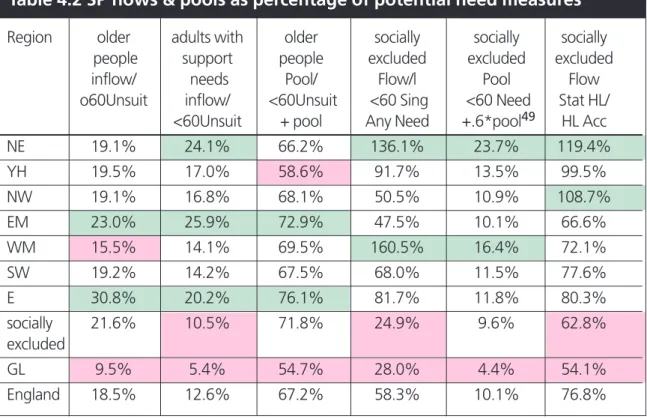
Although our investigation of housing related support services was partly a parallel track, setting housing related support service provision estimates alongside numbers derived from the main housing needs model also reveals some further insights. For example, the inflow into older people services represents about a fifth of over-60 households with ‘unsuitability problems’ – a not unreasonable ratio of flow supply to stock/backlog need. Our analysis also suggests that about two thirds of such older people needs are met by ongoing services. In a regional context, it appears that housing related support provision/takeup is low relative to need in London (for all clients), in the South East (for adults with support needs and socially excluded), and to some extent in the West Midlands and Yorkshire and Humberside (for older people). Conversely, provision/takeup looks high in the East Midlands and the East of England (for older people) and in the North East and West Midlands (for socially excluded clients).
By accommodating former social renters, housing related support services for older people play an important role in facilitating the generation of vacancies in social rented housing. Nationally, nearly one-in-ten general needs social rented sector lets arise in this way, with higher figures in the East, the South East and the South West, but much lower figures in London.
Also among the key findings of the above work that warrant further attention is that relating to the use of the social rented sector and (and a subsector of the private rented sector) by socially excluded groups coming through shorter term housing related support services. The rate at which these households consume available re-lets in these sectors, especially a social sector in particularly short supply, may be quite significant in some regions. It feeds into the longstanding concerns about
residualisation of the social sector.
Household formation, mobility and tenure choice
Household formation, household composition changes, mobility and tenure choice are centrally important for our understanding of how economic, social and demographic forces act through the housing system to generate housing need outcomes. Through a review of previous research on these issues we have developed a set of behavioural models forming the foundation of the simulation model constructed to estimate housing needs now and in the future.
Modelling household formation
In considering household formation, there has been an evolution from traditional demographic projection methods which, although sophisticated, remain extrapolative in character, towards modelling approaches which take more account of economic and social influences, including affordability conditions in housing markets. Recent data show that, although some long established trends to more separate household formation continue, there have been reductions in separate household formation by younger adults in some regions which probably reflect recently worsening affordability and supply constraints.
The model developed for household formation in the current study builds on earlier work in using longitudinal micro data on household transitions, linked to contextual data on housing and labour market conditions at a relatively local geographical scale. This model captures a range of effects as expected on theoretical grounds or as found in earlier empirical research. While demographic factors like age structure, marriage and children remain important, we also reveal evidence that income,
employment/unemployment, house prices and the supply of social lettings impact significantly on household formation. Our analysis here also addresses other elements of household change, including ‘in situ’ changes in household composition, the scale and incidence of household dissolutions, and the effect of migration.
Modelling tenure choice
In approaching tenure choice we emphasise the need to go beyond traditional approaches by including a genuine behavioural perspective, by focussing on flows of households actually moving in the market, and by recognising that the social rented sector is ‘different’ in the sense that supply is rationed and allocated administratively. The literature review emphasises the importance of factors like credit constraints as well as affordability and, in particular, the crucial role of expected mobility or length of stay in influencing the choice to buy a home. The growing importance of private renting is also apparent. Reviewing past research underlines that although economic factors are important in tenure choice, demographic factors continue to play a part.
The preferred form of model developed adopts a sequential approach; first predicting mobility itself, then the choice to buy, followed by the choice/opportunity to move into social renting, with private renting the residual option. This scheme is applied
separately to four groups: new households, existing owners, social and private renters. The mobility models draw out the importance of age, tenure and income. Younger people, private renters, and higher income households display greater mobility. These factors are more important than any differences between regions.
Constructing an overall simulation model
The culmination of the work described above was the development of a spreadsheet-based simulation model integrating the research outputs within a framework which projects forward the evolution of the English housing system at regional level given specified economic, demographic and policy scenarios. The principal outputs of this simulation model are (for each region):
• The size and household composition of the main tenure groups at future dates
• The incidence of a range of specific need categories at future dates. The model can be represented at a high level in terms of a structure with five main modules covering household change, the housing market, tenure flows, specific needs and overall simulation. Each of these can in turn be represented schematically in greater detail.
Base period data for the model are derived primarily from the Survey of English Housing (SEH) pooled over 11 years to 2007/8, supplemented by data from Labour Force Survey (LFS, 1992-2008), British Household Panel Survey (BHPS) and the
Continuous Recording System (CORE) for social lettings. Processes and outcomes are modelled at the level of 12 household age-type groups by three main tenures and 9 regions, and conditional forecasts are made annually for 2009-2021. Via the model we demonstrate significant differences in the household profile of both tenures and regions and, in particular, highlight the substantial differences in needs incidence between household groups.
The basic model operation is described in Chapter 6, highlighting the interaction of household composition changes with the effects of changes in regional
socio-economic and market drivers, using the results of the earlier econometric modelling to quantify these effects. Tenure flows are generated using the sequential approach to modelling developed in Chapter 5, while needs are forecast using the models described in Chapter 3. Endogenous variables within the model are generally accommodated through a recursive structure and/or the use of lagged values.
The estimating housing need model operates in tandem with the DCLG Affordability model and takes forecasts for a number of variables from this source. Both models contain adjustments for the current episode of credit rationing although some limitations on the ability to model labour market changes are recognised.
Semi-automatic mechanisms are incorporated within the model to ration social housing inflows to available supply, and to reconcile total household and stock numbers in the private sector. These have various feedback effects on household formation, tenure numbers and on needs, and reveal particular pressures on the housing system in the recent period. A method of forecasting private rents has been incorporated within the model to allow for the effects of rents on certain tenure flows and needs.
evidence on the needs of new social housing tenants. An additional feature included in the final model is an ability to simulate the impact of low cost home ownership provision on needs and tenure flows.
Modelling housing needs scenarios
Having constructed a simulation model as described above, this has been put to work in producing conditional forecasts of households, tenure and housing need outcomes. The model has proved capable of demonstrating the way in which recent market changes have generated a higher level of unmet need. More importantly, it enables us to forecast future levels of need, given certain levels of supply and economic
conditions. Needs are expected to peak in 2009-10 and remain at a higher level than in the recent past for some years. In the medium term (up to 2021) some reduction in backlog need may be anticipated, although this is unlikely to bring need down to below the levels of the early 2000s.
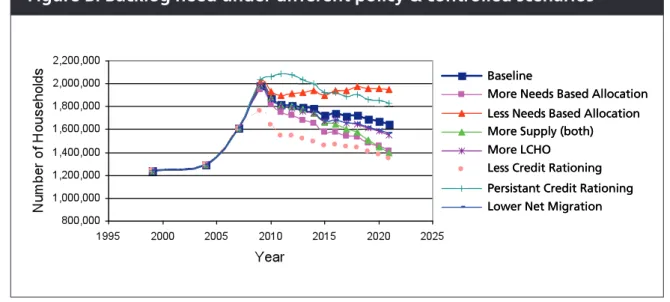
The baseline housing needs forecast generated by the model is summarised in Figure A. The total stood at 1.24m in 1999 and 1.29m in 2004 (6.1% of households), rising to 1.61m (7.3%) in 2007. The forecast is based on continuation of relevant existing policies and on judgements about the likely path of the wider economy going forward. It illustrates backlog need peaking in 2009 at around 1.99 million households –
equivalent to 8.8 per cent of all households, before falling back gradually until 2021.
Modelling expanded housing supply
Increasing social housing supply would, according to the model, have a sizeable impact on backlog needs in the short-medium run. Increasing social rented supply by 269,000 dwellings over the planning period would, assuming the continuation of existing tenancy allocation policies, reduce backlog need by 168,000 by 2021. The difference between the two figures arises for a range of reasons including the formation of extra households.
Figure A: Types of need profile over projection period
Rental Affordability Sharing
Mortgage Difficulties Concealed
Unsuitable
Overcrowded Overcrowded
Unsuitable Sharing
Rental A
Concealed
Mortgage Dif g
fordability
The model suggests that increasing private housing supply by 435,000 over the planning period would have a smaller impact on needs than the expanded social rented output scenario outlined above. This magnitude of extra private supply would reduce backlog need by 91,000 by 2021. The impacts would be modest in the early period owing to time lags in building up supply and in the affordability impacts
working through. A scenario where output is more modestly increased in both private and social sectors would deliver more appreciable reductions in need in the early years.
As well as reducing backlog need, expanding social rented supply as in the above scenario would also substantially increase household growth, from its current very suppressed level. The expanded private sector output scenario would also have a substantial impact on household growth, and would not increase owner occupation as much as private renting, while also increasing vacancies slightly.
Both higher and lower supply scenarios have bigger impacts on need in the regions where need is expected to be higher, namely London and the southern regions of England, especially the South West and South East. The types of need most sensitive to modelled changes in supply are concealed and sharing households, although there are also significant impacts on overcrowding, affordability and other problems.
This analysis also highlights the situation whereby, on current trends, younger households are getting less access to social housing and experiencing a growing incidence of need. An indirect effect of this is to further lower the turnover supply of social lettings.
A scenario involving expanded low cost home ownership shows that tripling the current programme (a total of 238,000 extra low cost home ownership units) would increase owner-occupation vs. private renting, increase household growth slightly, and reduce backlog need by 93,000 in 2021.
Modelling other policy, demographic and economic scenarios
The model can be used to test the consequences of certain types of change in social housing allocation priorities, in terms of household types and/or need groups.
Scenarios involving more or less needs-based allocation priorities have major impacts on the level of backlog need. Increasing the share of our key need groups by 30 per cent (close to the maximum possible) would reduce backlog needs by 228,000 (14 per cent) in 2021; reducing their share by the same proportion would leave backlog need 304,000 (19 per cent) higher in 2021. This suggests that there are substantial
tradeoffs between policies for widening choice and social balance, on the one hand, and meeting need on the other.
The model can also be used to explore changes in the regional allocation of social housing investment (or indeed private new build distribution). While, traditionally, housing needs have been much higher in London and less variable between other regions, a range of indications in the projections suggest that the regions where greatest increases in need may be expected are SE and SW. Our initial test here
suggests that the overall national reduction in need from a regional re-distribution of a fixed amount of social housing investment is minimal; this is essentially about
There are difficulties in modelling the economic recession including its labour market effects using the DCLG Affordability model, although we can make a partial test of the expected spike in unemployment within the EHN model. This suggests that the
immediate effect in terms of pushing up backlog needs (and certain other need factors like the proportion of renters on housing benefit) is quickly offset as needs appear to fall back to a lower level – partly because household formation is reduced and partly because of lower prices. There would also be a persistent fall in owner occupation as a result of such a labour market recession.
Migration is another topical issue, and the model can be used to assess the impact on housing need of certain migration scenarios – albeit with considerable caveats
regarding the different characteristics of international migrant groups. Under a ‘low migration’ scenario we would forecast a substantial reduction in backlog need (particularly sharing and concealed households), with rather less certain effects on tenure. Further work on this issue, distinguishing international migrants and taking account of price effects, may be appropriate.
Figure B provides a fitting way of summing up the impact of different scenarios tested on the trajectory of backlog need in England. It shows that the biggest reduction would be associated with less severe and less persistent credit rationing, whilst higher and more persistent credit rationing would lead to the worst need outcomes in the next five years. A sizeable reduction could be achieved by making social housing allocation as strongly needs-based as possible, while much less needs-based allocation would leave needs at a high level later in the period. However, any such policy shifts would have to be assessed against wider considerations. While the effects of greater supply, particularly involving social housing and low cost home ownership, are positive, the magnitude of their effects are less initially than the scenarios just mentioned, although comparable by the end of the period.
Figure B: Backlog need under different policy & controlled scenarios
Baseline
More Needs Based Allocation Less Needs Based Allocation More Supply (both) More LCHO
Less Credit Rationing Persistant Credit Rationing Lower Net Migration Les
Mo Mo Les Mo Bas
s Credit Rationing ore LCHO ore Supply (both)
s Needs Based Allocation ore Needs Based Allocation
seline
Low Per
Conclusions
Chapter 1
Introduction
Purpose
1.1 This report is the main output of the ‘Estimating Housing Need’ research project commissioned by DCLG in August 2008. Its main purpose (see Box 1.1, below) is to provide a concise account of the study as a whole, including an explanation of the selected variables measured and modelled, a summary of key outputs generated by the model and a commentary about the
significance and implications of these.
Background
1.2 Housing has attracted increasing policy attention in recent years. One
important stimulus to this was the Barker (2004) Review of Housing Supply. The Government outlined many of its ambitions for housing policy in the July 2007 Housing green paper (Homes for the future: more affordable, more
sustainable). This set out the Government’s vision that “everyone [should] have access to a decent home at a price they can afford, in a place where they want to live and work.”1 In the same period a wide-ranging review of the role and
functioning of social housing was carried out by Professor John Hills2 which
examined the current role and profile of social rented housing, as well as
discussing some options for how this might develop in the future. This included possible modifications in the social rented sector, including tenancy terms and • The Department for Communities and Local Government (DCLG) wished to
commission the development of a model that would allow the Department to produce estimates of ‘housing need’.
• The housing need model would be a medium-sized model.
• The model may also produce outputs in the area of the need for housing related support.
• Once developed, the housing need model would form an important
component of DCLG’s housing evidence base and will be used to inform policy development.
• The model would also add to DCLG’s suite of models in the area of housing policy – and specifically it will interact with the extant DCLG Affordability Model.
[from Project Specification, s.1]
Box 1.1: Purpose
1 P6 in: CLG (July 2007), Homes for the future: more affordable, more sustainable London: CLG
conditions, rents, opportunities for mobility and patterns of new development. In addition substantial progress was made against the major commitments entered into in 2001 to achieve Decent Homes for all social tenants and vulnerable households in the private sector (see Chapter 3, para 3.56).
1.3 DCLG’s Departmental Strategic Objective (DSO) 23, “To improve the supply, environmental performance and quality of housing that is more responsive to the needs of individuals, communities and the economy”, reflects the high priority of supplying not only housing but the right type of housing. This DSO has a number of indicators which relate to various aspects of housing need (including children living in poor housing). These indicators will aid the
Department in the measurement of success in tackling housing need over time.
1.4 DCLG’s Planning Policy Statement 34defines housing need as “the quantity of housing required for households who are unable to access suitable housing without financial assistance". One of the challenges facing the modelling team in this research was to develop and apply clear definitions of housing need (see point 1 in Table 1). It was anticipated that the definition of housing need given in PPS3 would serve as a foundation for this work.
1.5 The research was preceded by a Scoping Study5, which reviewed the main
existing approaches to housing needs estimation in the UK, highlighting their strengths and limitations, and suggested requirements for a new model. This provided a key jumping-off point for the research.
1.6 The Scoping Study underlined that need is inevitably in part a normative phenomenon, as well as a matter of (social) scientific measurement. In other words the definition of need entails value judgements about standards and who should have what. Having established such definitions and agreed standards, it is possible to set about measuring needs. The second key point about needs is that they are multi-dimensional, with qualitatively different kinds of need which often affect different groups of people and different geographical areas to differing degrees. Some of the key types of housing need of concern to government include:
• homeless people and those living in temporary accommodation
• overcrowded households
• people forced to share or live with others when they would rather form separate households
• people with housing-related support needs
• ‘non-decent’ homes
1.7 The different types and gradations of need are discussed further in Chapter 2, while Chapter 3 presents evidence on the incidence of different needs and the factors which may cause needs to vary.
3http://www.communities.gov.uk/corporate/about/howwework/publicserviceagreements/departmentalstrategicobjectives/
4http://www.communities.gov.uk/publications/planningandbuilding/pps3housing
1.8 The social rented sector of housing clearly plays a major role in meeting need and is the direct object of much of government’s housing policies and public investment. Therefore, a part of any study of housing need must involve considering the size of the sector: how big will it be in future, and how big should it be? The answers to these questions depend in part on views taken about the future roles and functions of the sector, issues examined in the Hills (2007) review.
1.9 When considering the need for social housing people frequently refer to housing ‘waiting lists’ as evidence of unmet need or demand. Recent national data show an apparent large rise in waiting lists. While accepting that this is clearly one symptom of a system under pressure, we have a somewhat sceptical view of the value of waiting lists per se as consistent measures of need, as explained in Chapter 2.
1.10 Government housing and planning policy has increasingly emphasised ‘affordability’ as a key goal, particularly following the Barker (2004) Review and the subsequent policy commitments reflected in the 2007 green paper and Public Service Agreement Targets. The affordability concept and its relationship with needs is discussed in Chapter 2. DCLG already has an operational model known as the ‘Affordability Model’6, which essentially
predicts the ratio of house prices to incomes under different economic and housing supply scenarios. This model operates at regional level, like the housing need model developed in this project, and an important requirement of this project was that the two models should be linked.
1.11 Affordability, the relationship between housing prices or costs and incomes, is an important factor, not just in its own right but also for its impact on
housing needs. Recognition of this is an important step forward from traditional approaches to housing need based on demographic projection. However, this is not to argue that housing need is solely driven by these economic variables. It remains important to consider a range of other influences, including demographic, social and environmental factors, and vital to remember that need is always in part a normative concept.
1.12 Significant demographic trends are impacting on housing need and demand, notably the growth in population resulting from both international migration and natural change. Trends towards smaller households continue to mean higher levels of growth in household numbers. People are living longer and the population structure is ageing. However, this may or may not mean greater needs for housing-related support or specialised housing, as longer lives may be healthier lives.
6 The CLG Affordability Model, often referred to as the ‘Reading model’, was developed by a multi-university team
led by Professor Geoff Meen; the basic model was described in the report of December 2005
http://www.communities.gov.uk/publications/housing/affordabilitytargetsimplications; significant updates and enhancements are reflected in reports published by the Department in June 2008
Type of model required
1.13 Recognition of different dimensions or types of need is valuable in providing more evidence for policymakers. However, some caution is needed when we quantify numbers and look at the overall picture. Firstly, needs may ‘overlap’ in the sense that one household might have more than one type of problem. This can give rise to an issue of double counting ‘households in need’ unless we make a specific adjustment for this. Secondly, different needs may warrant different solutions; these solutions may not all take the form of providing the household affected with a unit of social rented accommodation. Some
problems may be better solved ‘in situ’; for example, through improvements or adaptations, perhaps supported by a financial subsidy or regulation. Many people may be best able to resolve their problem by moving to other housing within the market, whether unassisted or with limited help from the state. Thirdly, different groups with different types of need are likely to be viewed by government (nationally and locally) as having different degrees of priority.
1.14 These observations have implications for the approach to developing a model, and particularly for the reporting of its results. They suggest that the output of the model will be an array of numbers rather than a single number. There is a need to make adjustments to numbers built up from specific needs to allow for overlaps, and further adjustments to allow for in situ or self-driven/ market solutions.
1.15 Box 1.2 summarises key desirable features for the model to fulfil, as derived from the Scoping Study and the Project Specification.7
7 The wording of some of the points in Box 1.2 has been edited, partly for brevity and partly to reflect slight
1.16 The Department also required that the model should have the capacity to explore the housing need consequences of different interventions in the housing market. For example, what happens to need under different allocations policies? And which demographic groups would win and lose from such changes in policy? However, the model is primarily an analytical tool, and as such it has not been designed to offer conclusions on what is the ‘optimal’ or ‘right’ policy.
1.17 Traditional housing needs models and estimates have tended to focus on a single number housing need figure8. This is typically either the total number
of dwellings, or the total number of social rented dwellings, which should be provided over a certain time period. The model developed in this research is slightly different in its philosophy and orientation. We are interested in
housing needs as a range of ‘outcomes’ from the housing system. The model aims to make a conditional forecast of the trajectory of those outcomes over the medium term, where the conditions are specified as regards assumed demographic and economic conditions and also policy inputs (e.g. private and social housing supply, allocation priorities based approach. The
policymaker is thus presented with a quantified picture of future prospects for key outcomes, in a series of ‘what if…?’ scenarios.
1. The methodology should apply clear definition(s) of housing need in consultation with DCLG.
2. Recognition should be given to the multi-dimensional nature of housing need, including possible districntion between ‘core’ and ‘additional’ need.
3. The approach should allow for and inform policy choices by showing the link between numbers and policies.
4. The method should be capable of yielding a single number bottom line answer, for given definition(s) and assumptions, as well as more disaggregated outputs.
5. The method should entail an explicit link between assumed/forecast economic conditions, demographic factors and housing need numbers.
6. The method should be able to forecast normatively relevant outcomes based on realistic models of behaviour.
7. The method should be capable of expression in terms of stocks and flows, with these different numbers being consistent and reconciled.
8. The model should operate at national and regional levels.
9. The model should be capable of using outputs from the DCLG Affordability Model.
10. The model should be based, so far as possible, on large scale secondary datasets available to government.
11. In-house analysts should be able quickly and easily to update the model.
Box 1.2: DCLG criteria for a housing need model
8 The best known estimates of this kind are those associated with Alan Holmans, particularly through a series of
1.18 This ‘outcome-based’ approach is a little different from traditional housing need assessments. However, it can be used to come back to the same kind of central quantified number, if desired. The point is that need number is then the answer to a question of the form: ‘if you want to bring backlog housing needs down to a level of (say) 20 per cent below 2007 levels by 2016, then what is the number of extra affordable or private homes which would need to be provided?’ The different approaches represented by this model and various previous models and research literature on housing needs are reviewed further in Chapter 2.
Limitations of traditional approaches
1.19 The motivation and justification for this research is partly based on a
recognition of the limitations of traditional approaches. These are discussed more fully in Chapter 2, but may be briefly summarised here.
• waiting lists reflect a mixture of need, demand, supply, expectations, rules and administrative procedures which vary greatly over time and space (see para 2.29 below)
• household surveys provide a static description of the ‘backlog’ of people with current needs, but do not directly provide a forecast of need in the future, particularly the emergence of new need and a recognition of the fluid, changing nature of individual situations (see para. 2.64 below)
• demographic projections represent a mechanistic extrapolation of household numbers and types but with no explicit link to economic, market or other drivers of change (see para. 2.49 below)
• macro and regional economic models can provide scenarios for future housing construction, prices and relationships with income, but they do not reflect the local variability of market conditions or the links between housing needs and other social, demographic and environmental factors at this level
• particular needs estimates are typically tied to particular normative standards and may be inflexible to changing policy priorities
• needs studies often produce a large number for the housing provision which is needed, when often resources and priorities will not support such a level; while not providing much indication of what may be expected to happen in the absence of such provision (or with a lower level)
Vision of preferred approach
1.20 We highlight here the key features of the approach which we have sought to adopt, responding to and overcoming many of the above limitations
• the approach views housing needs as problematic ‘outcomes’ which, while varying in nature and type, are expected to be of concern to governments
• housing outcomes are affected both by background conditions and by the operation of the current active market, implying an analysis in terms of flows as well as stocks
• flows involved in household formation and movement between tenures are integral to the generation, maintenance and alleviation of need as well as being of policy interest in their own right
• access to different tenures is governed by different factors, with needs-based rationing central to the social sector while affordability is critical for homeownership
• housing need displays in part a cumulative character and the model should be capable of representing this, and the associated characteristic of ‘path dependence’ of outcomes
• the model should link to robust national and regional economic models while taking account where appropriate of variations in market conditions at sub-regional level
• the model should be easy to use and give the ability to manipulate and test sensitivities to a wide range of policy inputs and other assumptions
1.21 These elements of the ‘vision’ were developed to some extent in the ‘Scoping study’ (Bramley 2007) and embodied in the brief for the research.
Nature of the research
1.22 The starting point for this study has been to review previous research literature on housing needs. This builds on the review embodied in the Scoping Study (Bramley, 2007) and addresses issues about the concept and definition of need, measurement of need and forward projection and forecasting. This provides the main focus for Chapter 2. The literature review also addresses issues about how the housing system is understood to operate and, in particular, about the housing market and how key outcomes there (house prices and affordability) impact on the numbers of households formed and moving between tenures. These issues are reviewed further in Chapter 5, which also goes on to examine empirical evidence and models for these processes.
1.23 A second main stage involved working with key secondary data sources to compile estimates of the extent and incidence of the various types of need identified as relevant and potentially key outcome measures. Although we are primarily interested in numbers at regional level, this analysis drills down within the various survey sources to examine patterns of incidence over time, by tenure and by household type and age groups. We try to operationalise the concept of broader and more narrow (filtered) definitions of need and to
quantify these differences as well as look at recent trends. More ambitiously, we have also aimed to develop predictive models to generate quantified forecasts for future need numbers, depending on assumptions about the future
1.24 Chapter 4 reports on the specific area of housing related support. This work sits alongside the mainstream need modelling, and draws on a range of specific data sources, some of which are relatively new. Some links and implications for the main model, in relation to issues of supply and demand flows augmented or pre-empted by housing related support clients, suitability needs of older households, and homelessness, turnover and benefit issues associated with socially excluded clients, are discussed in Chapter 4.
1.25 A third stage involved developing predictive models of behaviour relating to key processes and decision points in the operation of the housing
market/system. These relate particularly to processes of household formation, household mobility and household tenure choices or flows. Following the brief (Box 1.2, point 7 above) and the ‘vision’ sketched above (para 1.20), the aim has been to produce a ‘gross flows’ model of the housing system,
thereby arguably going somewhat beyond previous models9. The issues
involved are mainly reviewed in Chapter 5. Typically, the models developed have used statistical techniques to predict particular behavioural transitions at the level of individual households, based on large scale household surveys aggregated over a run of years, but taking account of the economic, labour and housing market conditions in the local/subregional area where those households are located in the year in question.
1.26 The fourth stage of the research entailed designing, setting up and testing an overall simulation model of the housing system. This model produces a baseline scenario at national and regional level including forecasts of housing stocks and flows by tenure and type of household, as well as housing need outcomes. It is designed to test the impact of a wide range of ‘what if..?’ scenarios on these outcomes, and looks forward over a dozen years (to 2021). Set up on a spreadsheet, the model is intended to be usable by
analysts within government. Chapter 6 describes the design and rationale for this model, including some further analysis of key relationships and
calibration of key parameters undertaken to ensure the model exhibits reasonable behavioural properties.
1.27 Figure 1.1 (which is the same as Figure 6.1 in chapter 6) presents a schematic overall picture of the model. It shows at the top some of the key data
sources, official demographic statistics and large scale government surveys. Four main elements of the model deal with household change, the housing market, tenure flows and specific needs, and there are many interconnections between these. The overall system simulation brings these together in testing medium-term scenarios which entail different combinations of economic conditions and policy options. The main outcomes which the model forecasts are household numbers and composition, housing tenures, and a range of specific housing needs (e.g. overcrowding, concealed households).
1.28 This model thus provides the basis for generating a detailed picture of future prospects for the housing system and key housing need outcomes under different scenarios. We offer a baseline scenario, described in detail in
Chapter 7, along with tests of the impact of a range of alternative scenarios. These mainly reflect different policy-related inputs; for example, the levels and mixes of new housing supply or social housing allocation priorities. However, they can also encompass some differences in the assumed wider economic and housing market conditions.
1.29 The final stage is to take stock of what has been achieved within the
research, while recognising some limitations and compromises adopted along the way. Chapter 8 provides this overall conclusion, highlighting the most significant findings, but also pointing to some areas of uncertainty and areas where more research, or refinement of the model, may be warranted.
1.30 The research underlying this report has been quite a substantial exercise. However, this report is intended to be relatively manageable in scale and readable/accessible in style. In order to provide a fuller ‘evidence trail’ from the overall model through its constituent sub-models to the original data sources, a number of Appendices have also been produced, providing more technical details of the research. In some instances this includes some
discussion and reporting of different estimates or models tested on the same or different data sets, for comparison with those finally selected for use. The Appendices are available at:
www.sbe.hw.ac.uk/ResearchandBusiness/Housing%20and%20urban %20society/downloads.htm?pane=6
Figure 1.1: Schematic picture of overall simulation model
Chapter 2
Housing need: Concept, theory and past research
Definition and concept of need
2.1 The Scoping Study (Bramley 2007) and the project specification suggested there should be an initial ground-clearing exercise, reviewing existing literature and policy documents to establish a clear picture of the meaning and interpretation of ‘housing need’. It was anticipated that this would be likely to yield some areas of general agreement and some greyer areas, where definition and scope depends upon policy judgements.
Normative basis
2.2 There is not actually a great deal of recent academic literature on housing need, and certainly relatively little addressing the fundamental concepts. One may situate housing need in a wider social need concept, and draw on a broader social/public policy perspective, although there are some distinct features in the housing case. Perhaps the central conclusion emerging from this perspective is that need is an intrinsically normative concept; other approaches, such as Bradshaw’s (1972), ‘felt’, ‘expressed’ and ‘comparative’ need are more problematic.
2.3 Bramley (1990), drawing on an extensive literature from the preceding decades10, concluded that “all need statements contain a normative
judgement somewhere about the desirability of the end states (e.g. survival, health, autonomy) which some set of means ….are argued empirically to further” (p.59). Beyond this it was argued there that ‘needs’ only carry special weight in policy discourse if these normative judgements are subject to wide consensus and hence stable political support (ibid. p.60). One of the more problematic areas for achieving consensus may be where people’s need-creating situation has arisen as a result of individual choice (Le Grand, 1991). Housing presents a number of such examples, as in the homelessness field or where people could afford to improve their home but choose not to do so.
2.4 Some work in allied fields such as homelessness may be regarded as relevant, although this also illustrates the point that definitions are very dependent on the local/national legal/institutional context; Britain has a very distinct
framework compared with other countries (Fitzpatrick & Stephens 2008).
2.5 The Scoping Study underlined the point that housing need is multi-dimensional; that is, it comprises a mixture of qualitatively different conditions which affect different groups in different ways and which may require different kinds of solutions. It was argued that any general housing needs model for government should recognise this multi-dimensionality and
allow some flexibility in terms of relative priority assigned to different
categories. Needs ultimately rest on value and policy judgements, as argued above, and will in practice have to be weighed against available resources. This may lead to varying judgements being made, at the margins, about the definitions and coverage. An obvious example of such marginal judgements concerns the ‘rights’ of younger single people to expect self-contained accommodation to be provided through public subsidy. It would be desirable for the model to make the relationship between these marginal judgements and resulting numbers explicit.
Backlog vs. new need
2.6 Holmans’ various studies (particularly Holmans (2001)) have generally included a discussion of this issue of definition, pointing to the historical evolution of housing need concepts in the UK and the areas where
legislation, custom and practice have implicitly applied certain definitions. These discussions have generally identified a broad distinction between the ‘backlog’ of households/individuals currently experiencing particular needs and ‘newly arising need’ expected to occur over a planning timescale. Whereas the backlog is a ‘stock’ concept, newly arising need is a ‘flow’. The homely analogy of a bathtub is often used here: the backlog is the water in the bath, the newly arising need is the flow from the taps, while new lettings of affordable housing (or other equivalent ‘solutions’) is the flow out through the plughole. We carry these concepts forward into our model design, and indeed argue that the ‘backlog’ of need is arguably the key outcome which should be our focus of attention.
2.7 The ‘backlog’ versus ‘newly arising’ distinction is particularly important in housing, because housing is a highly durable asset and interventions to meet housing need often entail new investment. The backlog may, in a broad conceptual sense, be weighed against the existing stock and prospective investment in a kind of capital balance sheet. However, rarely will it be
possible to meet all of these needs in a single year – indeed, it may take many years to fully eliminate backlog needs in a more pressured region. Also, the balance sheet analogy suggests that backlog need may be set off against vacant or underoccupied housing on the other side; but this is very
problematic if there is no mechanism to enable the households in need to access the vacant homes or free up the underoccupied ones, which may in any case be of the wrong type or in the wrong place. This is one reason why we favour a flows based approach over a solely stock-based approach.
Need vs. demand
2.9 These discussions also generally distinguish ‘need’ – shortfalls from certain normative standards of adequate accommodation – from ‘demand’ – the quantity and quality of housing which households will choose to occupy given their preferences and ability to pay (at given prices). The term ‘housing requirements’ is sometimes used in this context, to refer to the combination of need and demand, particularly where market as well as affordable housing provision is being considered (as in the planning system).
2.10 Social and affordable housing is generally a good in scarce supply which is subject to rationing. One kind of output from the model may therefore be a measure of the extent to which rationing has to be applied. At a more detailed level this might take the form of waiting times for different
categories of household in need, although this is not something we are easily able to calculate in our model. We do however provide a measure of the relative extent of rationing.
Shortfall vs. provision
2.11 It is also important to recognise the difference between statements about ‘need’ which refer to existing or expected shortfalls (the backlog) and
statements about the amount of affordable or general housing which ‘needs’ to be provided over some time frame. Statements of the former kind refer to problems, whereas statements of the latter kind deal with proposed
solutions. The latter assume some underlying aims and priorities, and also entail implicit judgements about more or less cost-effective solutions. Thus, such statements go beyond the strict scope of the needs model.
2.12 It is clear that some policy responses to need (e.g. homelessness prevention, facilitating underoccupier trading-down moves) do not entail new provision of affordable housing, which itself can take different forms (including
intermediate tenures or low cost home ownership). This also touches on the future role and functions of social housing, as addressed by Hills (2007) and others. However, the role of the needs model is to provide evidence to support assessment of policy options, rather than to determine the best options.
Purpose of needs assesment
2.13 Governments may require estimates of housing need for a variety of
purposes. If regularly refreshed they should provide a way of monitoring the state of the housing system, analagous to government’s monitoring of poverty or the state of the labour market. They may form an input to public spending review discussions about the scale of housing investment
programmes by the public sector.
2.14 They will also inform government about the desirable composition of the programme, e.g. the role of intermediate sector provision. Given
background evidence when assessing the adequacy of regional spatial strategies, particularly given the growing importance of s.106 arrangements for the delivery of affordable housing. They would similarly provide a
benchmark for looking at the aggregation of subregional housing strategies
2.15 The previous paragraphs still tend to assume that the needs estimates are mainly relevant to new housing provision, but as previously emphasised the policy basket may contain a much wider range of options. Thus, for example, outputs of the model may also be used to inform policies relating to
allocation of social housing, rents and housing benefit, or the regulation of the private rented sector.
Types and levels of need
Dimensions of need
2.16 One of the basic starting points for this research has been the recognition of different dimensions, or types, of housing need. Qualitatively different types of problem may tend to affect different kinds of household, with a different pattern of incidence across tenures and regions. These different problems may be caused or influenced by different factors and the appropriate solutions may vary. Policymakers may wish to assign different priorities different needs.
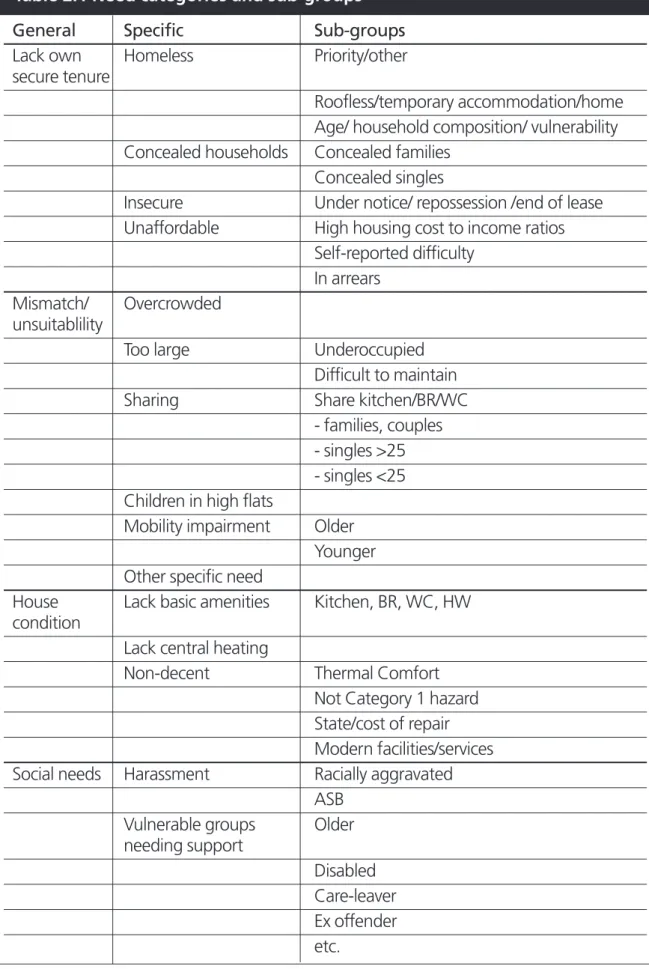
2.17 The CLG (2007) guidance on strategic housing market assessments and predecessor guidance on local housing needs assessment (DETR 2000) contain listings of categories of need which should be considered. Strategic housing market assessment (Table 5.1 in the 2007 guidance) identified four main categories (Lack own secure tenure; mismatch/unsuitability; house condition and social needs) as shown in the first column of Table 2.1. It further identified specific groups, as shown in the next column11. We have
suggested in the third column a further set of sub-groups; some of these classifications are overlapping or cross-cutting.
11 It is beyond the scope of this research to investigate the actual use of these categories and estimated numbers
General Specific Sub-groups
Lack own Homeless Priority/other
secure tenure
Roofless/temporary accommodation/home Age/ household composition/ vulnerability Concealed households Concealed families
Concealed singles
Insecure Under notice/ repossession /end of lease Unaffordable High housing cost to income ratios
Self-reported difficulty In arrears
Mismatch/ Overcrowded unsuitablility
Too large Underoccupied
Difficult to maintain
Sharing Share kitchen/BR/WC
- families, couples - singles >25 - singles <25 Children in high flats
Mobility impairment Older Younger Other specific need
House Lack basic amenities Kitchen, BR, WC, HW condition
Lack central heating
Non-decent Thermal Comfort
Not Category 1 hazard State/cost of repair Modern facilities/services
Social needs Harassment Racially aggravated
ASB Vulnerable groups Older needing support
Disabled Care-leaver Ex offender etc.
2.18 The most relevant recent legislation is probably the Housing Act 1996 which includes (in s.167(2)) a set of categories of case which local authorities should give ‘Reasonable Preference’ to in allocation of social housing. These include:
(a) homeless, including non-priority and intentionally
(b) others owed a duty under various specific legislation (c) insanitary, poor condition or overcrowded accommodation
(d) medical or welfare grounds, including disability
(e) hardship grounds for needing to move to a particular location.
2.19 While the above list provides underpinning for many but not all of the categories identified in Table 2.1, it can be argued, on the basis of evidence from actual allocations practice, that the reasonable preference categories are not a wholly adequate and inclusive definition of housing need. In their report on allocations practice Pawsonet al (2009, para 4.17), which was based on a survey of LAs in two regions, find that 58% of local authorities give some priority to locally-defined groups outside the reasonable preference categories, including for example family members in social rented sector without
succession rights, key workers, people ‘moving on’ from short term supported housing, young disadvantaged singles, relationship breakdown, split families. Not all social lettings go to RP cases, although this proportion varies over time and region.
2.20 Groups included in Table 2.1 but not within reasonable preference categories include decants, private tenants at the end of an assured shorthold tenancy, and people wishing to move to independent accommodation (i.e. concealed households). It is also worth noting that some allocations to reasonable preference groups would not necessarily be to people who were previously in one of the core backlog need groups used in this study, as described in more detail in Chapter 3. For example, some homeless people would not previously have been counted in one of these groups, prior to their episode of homelessness.
2.22 The point of the classification in Box 2.1 is that distinguishes (a) cases where there is a clear need for an additional affordable dwelling unit, (b) cases where the household needs access to an affordable unit but may release a unit which could be suitable for another household, and (c) cases which may be resolved by households moving within the social rented sector. However, cases in types (b) and (c) do not necessarily require no investment in
additional affordable/ social housing, because there may be a net shortfall of, say, larger or family-suitable housing.
2.23 Because our approach aims to separate issues of the solution to the need from the existence of the need or problem (paras 2.11-12 above), we do not attempt to make such a strong distinction between these types of case. Box 2.1 also highlights some subtle differences; for example, the category ‘couples forced to live apart’, which does not explicitly appear in Table 2.1.
2.24 It is one thing to create a refined definition of need which focuses on
particular groups which are or should be seen as priorities for assistance. It is another, however, to find measures within standard secondary statistical data sources which can measure the size of these groups, consistently across the whole country and over time. Thus, in building an operational model, we work with categories and indicators which are less than perfect compromises (see Chapter 3).
Standards and levels of need
2.25 Needs ultimately rest on value and policy judgements, and will in practice have to be weighed against available resources. This may lead to varying
judgements being made, at the margins, about the definitions and coverage. These judgements may be likened to ‘service standards’; they might also be thought of as ‘rationing filters’. An obvious example of such marginal judgements concerns the ‘rights’ of younger single people to expect self-contained accommodation to be provided through public subsidy. Concealed single persons living with parents or other households may not be in the reasonable preference category, but if the parental/other household asks them to leave they become homeless and thereby qualify as reasonable preference. a) Actual and potential households without self-contained accommodation,
including (i) homeless households in temporary accommodation, (ii) concealed couple and lone parent families living with others, (iii) involuntarily sharing households; (iv) would-be couples forced to live apart; (v) single homeless and hostel residents;
b) Private sector households needing social sector homes because current homes are unsuitable, for example due to (vi)/(viii) medical or age reasons, (vii) inability to meet housing costs, (ix) expiry of lease, or (x) overcrowding.
c) Social tenants in unsuitable housing, including due to disrepair, crowding, or children in high flats.
(based on Holmans (2001) Ch.3).