This is a repository copy of Theoretical Considerations of Potential-Based Reward
Shaping for Multi-Agent Systems.
White Rose Research Online URL for this paper:
http://eprints.whiterose.ac.uk/75111/
Version: Published Version
Proceedings Paper:
Devlin, Sam orcid.org/0000-0002-7769-3090 and Kudenko, Daniel
orcid.org/0000-0003-3359-3255 (2011) Theoretical Considerations of Potential-Based
Reward Shaping for Multi-Agent Systems. In: The 10th International Conference on
Autonomous Agents and Multiagent Systems. Tenth International Conference on
Autonomous Agents and Multi-Agent Systems, 02 May 2011 ACM , TWN , pp. 225-232.
[email protected]
https://eprints.whiterose.ac.uk/
Reuse
Items deposited in White Rose Research Online are protected by copyright, with all rights reserved unless
indicated otherwise. They may be downloaded and/or printed for private study, or other acts as permitted by
national copyright laws. The publisher or other rights holders may allow further reproduction and re-use of
the full text version. This is indicated by the licence information on the White Rose Research Online record
for the item.
Takedown
If you consider content in White Rose Research Online to be in breach of UK law, please notify us by
Theoretical Considerations of Potential-Based Reward
Shaping for Multi-Agent Systems
Sam Devlin
University of York, UKDaniel Kudenko
University of York, UKABSTRACT
Potential-based reward shaping has previously been proven to both be equivalent to Q-table initialisation and guaran-tee policy invariance in single-agent reinforcement learning. The method has since been used in multi-agent reinforce-ment learning without consideration of whether the theoret-ical equivalence and guarantees hold. This paper extends the existing proofs to similar results in multi-agent systems, providing the theoretical background to explain the suc-cess of previous empirical studies. Specifically, it is proven that the equivalence to Q-table initialisation remains and the Nash Equilibria of the underlying stochastic game are not modified. Furthermore, we demonstrate empirically that potential-based reward shaping affects exploration and, con-sequentially, can alter the joint policy converged upon.
Categories and Subject Descriptors
I.2.6 [Artificial Intelligence]: Learning; I.2.11 [Artificial Intelligence]: Distributed Artificial Intelligence— Multia-gent Systems
General Terms
Theory, Experimentation
Keywords
Reinforcement Learning, Reward Shaping,
Multiagent Learning, Reward Structures for Learning.
1.
INTRODUCTION
Current trends are showing a rise in interest in Multi-Agent Systems (MAS). With multiple, distributed agents a larger set of problem domains can be practically modelled [35]. To control each agent, a reinforcement learning solu-tion can provide adaptive, autonomous, and self-improving agents.
However, whilst reinforcement learning can handle prob-lems with combinatorial state spaces in single-agent problem domains [21, 26], adding more agents to the same environ-ment is a significant challenge [5]. Specifically, as the other
Cite as: Theoretical Considerations of Potential-Based Reward Shap-ing for Multi-Agent Systems, Sam Devlin and Daniel Kudenko,Proc. of 10th Int. Conf. on Autonomous Agents and Multiagent
Sys-tems (AAMAS 2011), Tumer, Yolum, Sonenberg and Stone (eds.),
May, 2–6, 2011, Taipei, Taiwan, pp.225-232.
Copyrightc 2011, International Foundation for Autonomous Agents and Multiagent Systems (www.ifaamas.org). All rights reserved.
agents execute their own actions they subsequently influ-ence the state of the world. This makes the environment appear non-stationary to an individual agent because other agents may concurrently learn and change their behaviour. Unknown to the agent, the same local state-action pair will have a different transition function even though the global state-joint action pair has not changed.
It has been shown in single-agent reinforcement learning that the quicker a learning agent can reach convergence in its policy the more it will benefit from instability in the envi-ronment, as it is better suited to adapt to changes [30]. But in MAS the state-action space grows exponentially with the number of agents, which may considerably slow down con-vergence reducing agents’ ability to adapt quickly. There-fore, methods of reducing the time to convergence are of sig-nificant importance when implementing reinforcement learn-ing solutions to MAS.
One such method, empirically demonstrated to decrease the time for each individual learning in a common environ-ment to converge on a stable policy, is incorporating heuris-tic knowledge [17, 25]. However, most existing reinforce-ment learning algorithms were proposed under the assump-tion that there is no knowledge available about the problem. This is often not the case; in many practical applications heuristic knowledge can be easily identified by the designer of the system [23], or acquired using reasoning or learning [10].
In single-agent reinforcement learning, potential-based re-ward shaping has been proven to be a principled and theoret-ically correct method of incorporating heuristic knowledge into an agent. Provided domain knowledge dependent on states alone, receiving an additional potential-based reward of the correct form does not alter the optimal policy of an agent [20].
To date, applications of potential-based reward shaping to MAS [2, 16] have been studied without published consid-eration of whether the proofs, originally intended for single-agent problem domains, hold for multi-single-agent reinforcement learning.
The bulk of our findings, discussed in Section 4, consider the theoretical implications for reward shaping of changing from single-agent problem domains to MAS. This work fo-cuses on the analysis of two fundamental results in single-agent, potential-based reward shaping; the equivalence to Q-table initialisation [33] and the invariance of policies be-tween shaped and non-shaped agents provided [20].
number of agents learning in the environment. The lat-ter, however, takes new meanings in a MAS. The goal of single-agent reinforcement learning is to compute the policy of maximum reward but with multiple agents, potentially competing, the goal becomes Nash Equilibrium [19]. There-fore, the multi-agent equivalent to policy invariance [20], successfully proven in this paper, is that potential-based re-ward shaping does not alter the Nash Equilibria of the MAS. However, potential-based reward shaping can have im-plications for the joint policy a multi-agent reinforcement learning solution will converge to. As we will show, the final joint policy will still be a Nash Equilibrium of the original system (i.e., before any agents received reward shaping) but may not be the same as the additional reward alters the individual agent’s exploration which affects the experiences all agents will have.
We close, in Section 5 by empirically demonstrating our findings but first, to begin, the following section will review existing work and the required background knowledge.
2.
EXISTING WORK
2.1
Reinforcement Learning
Reinforcement learning is a paradigm which allows agents to learn by reward and punishment from interactions with the environment [28]. The numeric feedback received from the environment is used to improve the agent’s actions. The majority of work in the area of reinforcement learning ap-plies a Markov Decision Process (MDP) as a mathematical model [22].
An MDP is a tuplehS, A, T, Ri, whereSis the state space,
A is the action space, T(s, a, s′
) = P r(s′
|s, a) is the prob-ability that action a in state s will lead to state s′
, and
R(s, a, s′
) is the immediate reward r received when action
a taken in state s results in a transition to state s′
. The problem of solving an MDP is to find a policy (i.e., mapping from states to actions) which maximises the accumulated reward. When the environment dynamics (transition prob-abilities and a reward function) are available, this task can be solved using iterative approaches like policy and value iteration [3].
When the environment dynamics are not available, as with most true environments, value iteration cannot be used. However, the concept of an iterative approach remains the backbone of the majority of reinforcement learning algo-rithms. These algorithms apply so called temporal-difference updates to propagate information about values of states,
V(s), or state-action,Q(s, a), pairs [27]. These updates are based on the difference of the two temporally different es-timates of a particular state or state-action value. The Q-learning algorithm is such a method [28]. After each tran-sition, (s, a)→(s′
, r), in the environment, it updates state-action values by the formula:
Q(s, a)←Q(s, a) +α[r+γmax
a′ Q(s ′
, a′
)−Q(s, a)] (1)
whereαis the rate of learning andγis the discount factor. It modifies the value of taking action a in state s, when after executing this action the environment returned reward
r, and moved to a new states′
.
2.2
Multi-Agent Reinforcement Learning
Applications of reinforcement learning to MAS typically take one of two approaches; multiple individual learners or joint action learners [6]. The former is the deployment of multiple agents each using a single-agent reinforcement learning algorithm. The latter is a group of multi-agent spe-cific algorithms designed to consider the existence of other agents.
Multiple individual learners assume any other agents to be a part of the environment and so, as the others simul-taneously learn, the environment appears to be dynamic as the probability of transition when taking action a in state
s changes over time. To overcome the appearance of a dynamic environment, joint action learners were developed that extend their value function to consider for each state the value of each possible combination of actions by all agents.
Learning by joint action, however, breaks a common fun-damental concept of MAS in which each agent is self moti-vated and so may not consent to the broadcasting of their action choices. Furthermore, the consideration of the joint action causes an exponential increase in the number of values that must be calculated with each additional agent added to the system. Typically, joint action learning algorithms have only been demonstrated in trivial problem domains [31, 11, 6] whilst applications in complex systems most often im-plement multiple individual learners [18, 29, 30]. For these reasons, this work will focus on multiple individual learners and not joint action learners. However, these proofs can be extended to cover joint action learners, those we have specif-ically considered include MiniMax Q-learning [14], Friend-or-Foe Q-learning [15] and Nash-Q [11].
Unlike single-agent reinforcement learning where the goal is to maximise the individual’s reward, when multiple self motivated agents are deployed not all agents can always receive their maximum reward. Instead some compromise must be made, typically the system is designed aiming to converge to a Nash Equilibrium [24]. Multiple individual learners will, given sufficient learning time, converge to a point of equilibrium, however, no guarantees can be made that this will be the optimum Nash Equilibrium [6].
To model a MAS, the single-agent MDP becomes inade-quate and instead the more general Stochastic Game (SG) is required [5]. A SG ofnagents is a tuple
hS, A1, ..., An, T, R1, ..., Rni, whereS is the state space,Ai
is the action space of agenti,T(s, A, s′
) =P r(s′
|s, A) is the probability that joint actionAin stateswill lead to states′
, andRi(s, a, s
′
) is the immediate rewardrreceived by agent
i when action a taken in state s results in a transition to states′
[9].
3.
REWARD SHAPING
The immediate rewardr, which is in the update rule given by Equation 1, represents the feedback from the environ-ment. The idea ofreward shapingis to provide an additional reward which will improve the convergence of the learning agent with regard to the learning speed [20, 23]. This con-cept can be represented by the following formula for the Q-learning algorithm:
Q(s, a)←Q(s, a) +α[r+F(s, s′
) +γmax
a′ Q(s ′
, a′
)−Q(s, a)] (2) whereF(s, s′
experiments it quickly became apparent that, when used improperly, it can change the optimal policy [23]. To deal with such problems, potential-based reward shaping was proposed [20] as the difference of some potential function Φ defined over a sourcesand a destination states′
:
F(s, s′
) =γΦ(s′
)−Φ(s) (3)
where γ must be the same discount factor as used in the agent’s update rule (see Equation 1).
Ng et al. [20] proved that potential-based reward shap-ing, defined according to Equation 3, guarantees learning a policy which is equivalent to the one learnt without reward shaping in both infinite and finite horizon MDPs.
Wiewiora [33] later proved that an agent learning with potential-based reward shaping and no knowledge-based Q-table initialisation will behave identically to an agent with-out reward shaping when the latter agent’s value function is initialised with the same heuristic knowledge represented by Φ(s). This is an important fact, because when function approximation is used in big environments, where the struc-tural properties of the state space are not clear, it is not easy to initialise the value function. Potential-based reward shap-ing represents a flexible and theoretically correct method to incorporate background knowledge regarding states into re-inforcement learning algorithms.
3.1
Reward Shaping In Multi-Agent Systems
Incorporating heuristic knowledge has been shown to be beneficial in multi-agent reinforcement learning [2, 16, 17, 25]. However, some of the previous examples did not use potential-based functions to shape the reward [17, 25] and could potentially, therefore, suffer from introducing benefi-cial cyclic policies that cause convergence to an unintended behaviour as demonstrated previously in a single-agent prob-lem domain [23].
The remaining applications that were potential-based [2, 16], demonstrated an increased probability of convergence to a higher value Nash Equilibrium. As it has long been established that multiple individual learners are not guar-anteed to converge to the optimal Nash Equilibrium [6], a number of methods to increase the probability of this occur-ring have already been devised. Amongst them are COIN [34] and myopic heuristics [6]. However, these methods re-quire knowledge of the reward function or the joint action. Potential-based reward shaping can similarly increase the probability of convergence to the optimal Nash Equilibrium provided a good heuristic, but does so without requiring either of these specific pieces of knowledge which are com-monly unavailable in MAS applications.
Both applications of potential-based reward shaping were published with no consideration of whether the proofs of guaranteed policy invariance hold in multi-agent reinforce-ment learning or how they affect the joint policy at time of convergence. Starting in the following section, our contribu-tion fills this gap in knowledge and provides the theoretical results to explain these previous empirical studies.
4.
THEORY
To discuss the implications of using potential-based re-ward shaping in MAS we must consider the differences be-tween single-agent and multi-agent reinforcement learning. SGs, unlike MDPs, share amongst all agents a common tran-sition function and common states but neither of these are
affected by shaping the reward function of one or more of the agents. Although the agents may change their own pol-icy and alter their exploration path due to the additional potential-based reward, this does not change the dynamics (transition function or states) of the environment, nor the set of actions the agent can take.
In fact the only elements of a SG to change when one or more agent implements potential-based reward shaping are the individual reward functions of those agents. If, as we will later show to be true in Section 4.2, these alterations to the individual reward functions do not change the best response policy of a shaped agent given a fixed set of policies followed by all other agents, the Nash Equilibria of the underlying SG remain constant regardless of how many agents are using potential-based reward shaping.
Formally, this argument will be completed by showing, in the following sub-section, that potential-based reward shap-ing in MAS is equivalent to Q-table initialisation and then, in Section 4.2, that it does not alter the Nash Equilibria of the MAS. Both of these findings, as we will discuss in Sec-tion 4.3, has implicaSec-tions for the eventual policy that will be converged upon.
4.1
Potential-Based Reward Shaping And
Q-Value Initialisation Are Equivalent
The proof of Wiewiora [33] of the equivalence of potential-based reward shaping and Q-value initialisation was pub-lished in the context of single agent problem domains but also holds for problem domains with multiple individual learners.
From [33] we quote:
Theorem 1 Given the same sequence of
expe-riences during learning, ∆Q(s, a) always equals ∆Q′
(s, a).
whereQ(s, a) is the modelled value function of an agent learning with potential-based reward shaping and Q′
(s, a) is the modelled value function of an agent learning with Q-value initialisation.
The original proof uses a fixed sequence of experiences for both agents. The theory can be extended to multi-ple individual learners simply by extending the definition of the sequence experienced from the 4-tuple hs, a, r, s′
i to the 2n+ 2-tuplehs, a1, a2, ..., an, r1, r2, ..., rn, s
′
i. Using the extended sequence and the inductive proof from [33] the following proves that Theorem 1 holds also for multi-agent reinforcement learning.
Proof By Induction
Consider any arbitrary agentifrom the set of all agents. As before,Q(s, a) is the modelled value function when the agent is learning with potential-based reward shaping andQ′
(s, a) is the modelled value function had the same agent learnt without reward shaping but with Q-value initialisation. The former agent will later be referred to asLand the latter as
L′
.
AgentLwill update its Q-values by the rule:
Qi(s, a) ← Qi(s, a) + α(ri+F(s, s
′
) +γmax
a′ Qi(s ′
, a′
)−Qi(s, a))
| {z }
δQi(s,a)
whereF(s, s′
) is the potential-based reward shaping func-tion and δQi(s, a) is the amount (scaled by α) that the Q
value will be updated by. The current Q-values of Agent
L can be represented formally as the initial value plus the change since:
Qi(s, a) =Q0i(s, a) + ∆Qi(s, a) (5)
where Q0i(s, a) is agent i’s initial Q-value of state-action
pair (s, a). Similarly agent L′
updates its Q-values by the rule:
Q′
i(s, a)←Q
′
i(s, a) +α(ri+γmax a′ Q
′
i(s
′ , a′
)−Q′
i(s, a))
| {z }
δQ′ i(s,a)
(6) And its current Q-values can be represented formally as:
Q′
i(s, a) =Q0i(s, a) + Φ(s) + ∆Q
′
i(s, a) (7)
where Φ(s) is the potential for states.
Base Case
Before either agent experiences anything, the Q-tables ofL
andL′
are both their respective initial values, and therefore both ∆Qiand ∆Q
′
i are uniformly zero.
Inductive Case
Assuming ∆Qi = ∆Q
′
i, both Land L
′
will be updated by the same amount in response to experience
hs, a1, a2, ..., an, r1, r2, ..., rn, s
′
i. First consider the update performed byL:
δQi(s, a) = ri+F(s, s
′
) +γmax
a′ Qi(s ′
, a′
)−Qi(s, a)
= ri+γΦ(s
′
)−Φ(s) +γmax
a′ (Q
0 i(s
′ , a′
) + ∆Qi(s
′ , a′
))
−Q0i(s, a)−∆Qi(s, a) (8)
Now consider the update performed byL′
:
δQ′
i(s, a) = ri+γmax a′ Q
′
i(s
′ , a′
)−Q′
i(s, a)
= ri+γmax a′ (Q
0 i(s
′ , a′
) + Φ(s′
) + ∆Q′
(s′ a′
))
−Q0i(s, a)−Φ(s)−∆Q
′
(s, a) = ri+γmax
a′ (Q
0 i(s
′ , a′
) + Φ(s′
) + ∆Q(s′ a′
))
−Q0i(s, a)−Φ(s)−∆Q(s, a)
= ri+γΦ(s
′
)−Φ(s) +γmax
a′ (Q
0 i(s
′ , a′
) + ∆Qi(s
′ , a′
))
−Q0i(s, a)−∆Qi(s, a)
= δQi(s, a) (9)
Therefore, the Q-tables of bothLandL′
are both updated by the same value and so ∆Qiand ∆Q
′
iremain equal.
Given that Theorem 1 of [33] holds for the multi-agent context then so too does Theorem 2, again quoted from [33]:
Theorem 2 IfL andL′
have learnt on the same sequence of experiences and use an advantage-based policy, they will have an identical proba-bility distribution for their next action.
where an advantage-based policy is one that chooses ac-tions based not on the absolute magnitude of the Q-values but on their relative differences within the current state. Ex-amples of advantage-based policies include greedy,ǫ-greedy and Boltzmann soft-max.
This is immediately apparent when considering both ∆Qi = ∆Q
′
i from Theorem 1 and Equations 5 and 7. As
the difference between the Q-values of agent L and agent
L′
are the potential of the state, the difference is consis-tent across all actions in any given state. Therefore, the actions maintain the same relative differences allowing an advantage-based policy to make the same action decisions.
Effectively, at any time in learningLandL′
will behave the same way (make the same decisions with the same prob-abilities). To conclude, whether an agent is shaped or ini-tialised it will have the same effect on all other agents in the environment, the learning dynamics are not changed by using one method or the other and the agents as a collec-tive whole will converge or not upon the same joint policy regardless of whether the agent was shaped or initialised.
Finally, although the proof here was written specifically for Q-learning, this was simply in keeping with the original work of [33]. In single-agent problem domains the equiv-alence of Q-table initialisation and potential-based reward shaping can be proven also in SARSA and other temporal difference algorithms [33]. Similar extensions to multi-agent, as above, are possible also for these extensions.
4.2
Potential-Based Reward Shaping Does
Not Alter The Nash Equilibria Of A
Stochastic Game
As already established the common goal of MARL is a Nash Equilibrium. The typical concern of modifying a re-ward function is that the original goals of the agent will be altered. Ng showed previously that in the single-agent con-text, the optimum policy was unchanged by the introduction of reward shaping provided the function was potential-based [20]. To extend this to MARL we must now consider whether implementing the same reward shaping in one or more agents in a SG will alter its points of equilibrium.
Formally a Nash Equilibrium in a SG is:
∀i∈1. . . n, πi∈Πi|Ri(πN Ei ∪π N E
−i )≥Ri(πi∪π−N Ei ) (10)
wherenis the number of agents, Πiis the set of all possible
policies of agenti,Riis the reward function for agenti,πiN E
is a specific policy of agentiandπN E
−i is the joint policy of
all agents except agent i following their own fixed specific policy. If the inequality holds for all agents, the joint policy of each agent following its policyπiN Eis a Nash Equilibrium.
Now consider any arbitrary agent i from the set of all agents. For the inequality above to hold for agenti, we must consider the set ΠN E
i of all joint policies consisting of each
possible policy of agent i combined with πN E
−i . Formally,
this set contains:
Each fixed joint policy in the set ΠN E
i will generate a fixed
infinite sequence of experiences when followed consistently from the current states0 of the form:
¯
s = s0, a0,0, a0,1, . . . , a0,n, r0,0, r0,1, . . . , r0,n, . . . , s∞, a∞,0, a∞,1, . . . , a∞,n, r∞,0, r∞,1, . . . , r∞,n, . . .
(12)
wheresj is the state at timej,aj,iis the action taken by
agentiat timejand rj,i is the reward received by agenti
at timej.
Then using the proof of [1], we can show the difference of the return received by agenti when following any arbi-trary fixed sequence with or without potential-based reward shaping is the potential of the states0.
Proof
The return for agent i when experiencing sequence ¯s in a discounted framework without shaping is:
Ui(¯s) =
∞ X
j=0
γjrj,i (13)
Now consider the same agent but with a reward function modified by adding a potential-based reward function. The return of the shaped agent experiencing the same sequence ¯
sis:
Ui,Φ(¯s) =
∞ X
j=0
γj(rj,i+F(sj, sj+1))
=
∞ X
j=0
γj(rj,i+γΦ(sj+1)−Φ(sj))
=
∞ X
j=0 γjrj,i+
∞ X
j=0
γj+1Φ(sj+1)−
∞ X
j=0 γjΦ(sj)
= Ui(¯s) +
∞ X
j=1
γjΦ(sj)−Φ(s0)−
∞ X
j=1 γjΦ(sj)
= Ui(¯s)−Φ(s0) (14)
Therefore, any policy that previously maintained the in-equality of Equation 10 will still maintain the inin-equality. Formally, and more strictly we can conclude:
∀πi∈Πi| (Ri(πN Ei ∪πN E−i )≥Ri(πi∪π−N Ei ))↔
(Ri,Φ(πN Ei ∪π−N Ei )≥Ri,Φ(πi∪π−N Ei )) (15)
whereRi,Φis the reward function of agentiwhen
receiv-ing both the environmental reward and the potential-based reward shaping.
As implementing reward shaping only affects the reward function of that agent, the remaining agents will also still maintain the same policies as part of the Nash Equilibria. Whether the group will converge to this point depends on the learning algorithm used and is outside of this proof. However, it suffices to say that regardless of how many agents in the MAS are or are not implementing potential-based reward shaping the points of equilibrium will remain constant.
4.3
Potential-Based Reward Shaping Alters
Exploration
In Section 4.1 we showed that an agent in a MAS receiving potential-based reward shaping is equivalent to one whose Q-table was initialised with each state s set to the poten-tial Φ(s) of that state. However, the implications of this proof in a MAS extend past showing that two methods of introducing domain knowledge are equivalent. Instead, it is worth considering the results of [32], in which Wellman and Hu showed that the joint policy converged upon in a learn-ing MAS was highly sensitive to initial belief. This clearly applies directly to Q-table initialisation, where the initial values directly represent some initial belief, and therefore, given that we have shown the equivalence between initial-isation and shaping, also applies to potential-based reward shaping. This can be reasoned intuitively by considering the following.
The MDP of an agent deployed in a common environ-ment with other learning agents does not hold the Markov property as the transition probabilities are subject to change with the unseen but changing policies of the other agents. Therefore, the convergence to optimal policy guarantees of Q-learning do not hold. This has been demonstrated empiri-cally in multi-agent reinforcement applications with multiple Q-learners converging to sub-optimal joint policies [2].
Shaping alters the path of exploration an agent takes. In single-agent reinforcement learning, as convergence to the optimal policy is guaranteed, this only affects the time taken to reach convergence. If a good heuristic, is used the time will be reduced as the number of sub-optimal actions taken will be reduced, but similarly if a bad heuristic is used the agent will take longer to converge to the optimal policy.
The concept of an optimal policy in MAS is not as clear. We have identified Nash Equilibrium as the typical goal of multi-agent reinforcement learning, but this does not nec-essarily identify a single goal. Most applications, with the exception of the very trivial, will have multiple points of equilibrium. Multiple individual learners will converge to one of these equilibrium, but whether it will be the opti-mum cannot be guaranteed [6]
With multiple agents in the same environment, altering the exploration of one will change the experiences of all agents [12, 13]. The change in actions chosen by even just one agent now receiving potential-based reward shaping will result in different state transitions. The agents will then explore different areas of the joint policy space and, with multiple points of equilibrium possible, may converge to a different equilibrium then had the agent not received the reward shaping and subsequently not have altered its indi-vidual exploration path.
s1
start
s2
s3
s4 +10
s5 −10
s6 +9
a,*
b,*
a,a;b,b
a,b;b,a
*,* *,*
*,*
[image:7.612.338.545.58.204.2]*,*
Figure 1: Boutilier’s Coordination Game
agents away from frequently, or possibly ever, experiencing the equilibrium reached by non-shaped agents and instead trapping them in a sub-optimal point of equilibrium.
To support and illustrate these claims the following sec-tion will present an empirical study that is typically charac-teristic of implementing potential-based reward shaping in a MAS.
5.
EMPIRICAL DEMONSTRATION
To demonstrate the theorised effects of potential-based reward shaping, an empirical study of a game based on Boutilier’s coordination game [4] will be presented here.
The game, illustrated in Figure 1, has six stages and two agents, each capable of two actions (aorb). The first agent’s first action choice in each episode decides if the agents will move to a state guaranteed to reward them minimally (s3) or
to a state where they must co-ordinate to receive the highest reward (s2). However, in states2 the agents are at risk of
receiving a large negative reward if they do not choose the same action.
In Figure 1, each transition is labelled with one or more action pairs such that the pair a,∗ means this transition occurs if agent 1 chooses actiona and agent 2 chooses ei-ther action. When multiple action pairs result in the same transition the pairs are separated by a semicolon(;).
The game has three joint policy Nash Equilibria; the joint policy of opting for the safety states3 or the two joint
poli-cies of moving to states2and coordinating on both choosing aorb. Any joint policy receiving the negative reward is not a Nash Equilibrium, as the first agent can choose to change its first action choice and so receive a higher reward by in-stead reaching states3.
Three sets of agents will be the focus of these experiments. All agents, in all sets, will learn by Q-learning with an ǫ -greedy policy and discount factor (γ) of 1. One set will receive no reward shaping, to illustrate the average perfor-mance without heuristic knowledge, another set will receive potential-based reward shaping from a good heuristic whilst the final set receives shaping from a poor heuristic.
The good heuristic, designed to encourage co-operation, gives statess1,s2ands4 the potentials 5, 10 and 15
respec-tively. All other states receive a potential of 0. Therefore, any transition from statess1tos2ors2 tos4 will receive an
additional reward of +5 but transitioning instead from state
0 20 40 60 80 100
5000 10000 15000 20000 25000 30000
Percentage Behaviour Achieved
Episode
Good Shaped Not Shaped Bad Shaped
Figure 2: Optimal Nash Equilibrium
s2 tos5 will receive an additional reward of−10.
Alterna-tively, the bad heuristic is designed to encourage miscoordi-nation and so potentials of 5, 10 and 15 are given instead to states s1,s2 and s5 respectively. Again all other states
receive a potential of 0.
Our experimental results are intended to show, provided a good heuristic, the increased probability of converging to the joint policies of higher global utility (those achieving coordi-nation in states2). Alternatively, provided a bad heuristic,
the agents will demonstrate that the Nash Equilibria have not changed and so converge still to one of the three original joint policy Nash Equilibria.
5.1
Results
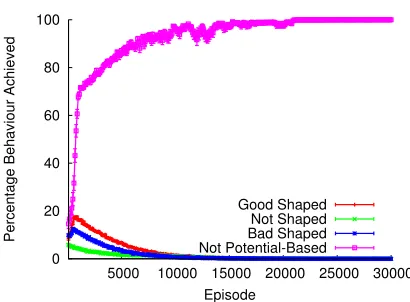
All experiments were run for 100,000 episodes (300,000 action choices) and repeated 100 times. The results, illus-trated in Figures 2, 3 and 4, plot the mean percentage of the last 100 episodes performing the optimal, safety and sub-optimal joint policies respectively. All figures include error bars illustrating the standard error from the mean. For clar-ity, graphs are plotted only up to 30,000 episodes as by this time all experiments had converged to a stable joint policy. Figure 2 shows that, for this relatively simple game, mul-tiple individual learners alone can only converge to the op-timal behaviour 72% of the time. Whereas, provided a good heuristic, potential-based reward shaping can increase the probability of convergence to this Nash Equilibrium to 100%. As theorised, provided a bad heuristic, the effect on the global utility can be detrimental. The probability of achiev-ing optimal behaviour, with a potential function encouragachiev-ing miscoordination, rapidly drops and converges on 0%.
Instead, as illustrated by Figure 3, the poorly shaped agents converge to the safety Nash Equilibrium. Despite the miscoordination state (s5) receiving the largest potential,
the agents do not converge to the sub-optimal behaviour, as illustrated by Figure 4.
Figure 4, highlights that agents with no shaping or potential-based reward shaping never converge to consis-tently perform the sub-optimal joint policy. This is because miscoordination in this game is not a Nash Equilibrium, both with and without potential-based reward shaping. Re-gardless of which joint policy is encouraged, if the additional reward is potential based, the Nash Equilibria remain con-stant.
[image:7.612.77.269.62.206.2]0 20 40 60 80 100
5000 10000 15000 20000 25000 30000
Percentage Behaviour Achieved
Episode
[image:8.612.77.280.57.202.2]Good Shaped Not Shaped Bad Shaped
Figure 3: Safety Nash Equilibrium
0 20 40 60 80 100
5000 10000 15000 20000 25000 30000
Percentage Behaviour Achieved
Episode
Good Shaped Not Shaped Bad Shaped Not Potential-Based
Figure 4: Sub-Optimal Behaviour
tional set of agents. These agents receive an additional re-ward on state transitions that is not potential based. Specif-ically they are rewarded 5, 10 and 30 upon entering states
s1,s2 ands5 respectively. These agents converge to a joint
policy representative of the sub-optimal behaviour. This has occurred because if additional rewards are not potential-based they can change the Nash Equilibria of a SG.
Finally, the learning performance of both sets of shaped agents favourably supports the use of potential-based reward shaping in MAS. The poorly shaped agents converge to the safety Nash Equilibrium after just 10,000 episodes whilst without shaping it takes agents 29,000 episodes to converge. More significantly, after only 2000 episodes agents receiv-ing reward shapreceiv-ing from a good heuristic are more likely to achieve the optimal Nash Equilibrium than non-shaped agents ever will.
6.
CONCLUSION
In conclusion, this paper shows how two fundamental pa-pers in single-agent reward shaping [20, 33] can be extended to provide similar guarantees in multi-agent reinforcement learning.
Specifically, we have proven that a potential-based shaped agent is still equivalent to an agent with initial Q-values set to the potential of each state regardless of how many exist within the same environment.
Furthermore, we have also proven that rewarding any
number of agents within a MAS with additional potential-based rewards has no subsequent effect on the Nash Equi-libria of the underlying SG.
Potential-based reward shaping affects the exploration of the shaped agent. Therefore, it can change the joint policy converged upon as even just one agent’s modified exploration can sufficiently redirect the search of joint policy space to converge to a different point of equilibrium.
Although the agents may now converge to a different joint policy, the latter of the two proofs guarantees that the new joint policy was also a goal of the unshaped agents.
Whether the goal achieved is the Nash Equilibrium of highest global utility, is dependent on the agents’ learning algorithms. With multiple individual learners, no guaran-tee of convergence to the highest utility Nash Equilibrium is provided. However, potential-based reward shaping can, dependent on the heuristic, either increase or decrease the probability of converging to equilibria of higher global utility as demonstrated in our empirical study.
Given a joint action learner guaranteed under fixed condi-tions to converge, such as NashQ [11], it is possible to con-struct similar proofs as those shown here. Agents learning by joint action and receiving potential-based reward shap-ing benefit from consistent Nash Equilibria, modified explo-ration to decrease the number of sub-optimal action deci-sions and guaranteed convergence.
It is also the authors’ expectation that potential-based ad-vice [8], an extension of potential-based reward shaping to include heuristics based on actions as well as states, could similarly be extended to guarantee consistent Nash Equi-libria when applied to multi-agent reinforcement learning. Recent empirical work supports these expectations [7].
The work here has been based entirely in fully observable problem domains, which some may consider uncharacteris-tic of MAS. However, by shaping agents based on the po-tential of observations (as opposed to fully observed states) the same arguments and proofs can be used to show simi-lar theoretical expectations in partially observable problem domains. Namely, the Nash Equilibria of a partially observ-able problem domain would remain the same but the agents exploration will alter and so convergence may be to a dif-ferent point of equilibrium or, given an unsuitable heuristic, may not converge at all.
In closing, adding potential-based reward shaping to mul-tiple individual learners does not alter the Nash Equilibria but can, provided suitable heuristics, increase the probabil-ity of convergence to a higher global utilprobabil-ity and decrease the time to convergence.
7.
ACKNOWLEDGEMENTS
We would like to thank M.Babes, M.Littman and M.Grze´s for their input during the development of these ideas and C.Poskitt for his time spent proof reading.
8.
REFERENCES
[1] J. Asmuth, M. Littman, and R. Zinkov.
Potential-based shaping in model-based reinforcement learning. InProceedings of the Twenty-Third AAAI
Conference on Artificial Intelligence, pages 604–609,
2008.
[image:8.612.75.280.237.388.2]the 7th International Joint Conference on
Autonomous Agents and Multiagent Systems,
volume 3, pages 1389–1392, 2008.
[3] D. P. Bertsekas.Dynamic Programming and Optimal
Control (2 Vol Set). Athena Scientific, 3rd edition,
2007.
[4] C. Boutilier. Sequential optimality and coordination in multiagent systems. InInternational Joint Conference
on Artificial Intelligence, volume 16, pages 478–485.
Citeseer, 1999.
[5] L. Busoniu, R. Babuska, and B. De Schutter. A Comprehensive Survey of MultiAgent Reinforcement Learning.IEEE Transactions on Systems Man &
Cybernetics Part C Applications and Reviews,
38(2):156, 2008.
[6] C. Claus and C. Boutilier. The dynamics of reinforcement learning in cooperative multiagent systems. InProceedings of the National Conference on
Artificial Intelligence, pages 746–752, 1998.
[7] S. Devlin, M. Grze´s, and D. Kudenko. Multi-agent, potential-based reward shaping for RoboCup KeepAway. InProceedings of The Tenth Annual International Conference on Autonomous Agents and
Multiagent Systems (AAMAS), 2011.
[8] G. C. Eric Wiewiora and C. Elkan. Principled
methods for advising reinforcement learning agents. In Proceedings of the Twentieth International Conference
on Machine Learning, 2003.
[9] J. Filar and K. Vrieze.Competitive Markov decision
processes. Springer Verlag, 1997.
[10] M. Grze´s and D. Kudenko. Plan-based reward shaping for reinforcement learning. InProceedings of the 4th IEEE International Conference on Intelligent Systems
(IS’08), pages 22–29. IEEE, 2008.
[11] J. Hu and M. Wellman. Nash Q-learning for general-sum stochastic games.The Journal of
Machine Learning Research, 4:1039–1069, 2003.
[12] S. Kapetanakis and D. Kudenko. Reinforcement learning of coordination in cooperative multi-agent systems. InProceedings of the National Conference on
Artificial Intelligence, pages 326–331. Menlo Park,
CA; Cambridge, MA; London; AAAI Press; MIT Press; 1999, 2002.
[13] S. Kapetanakis and D. Kudenko. Reinforcement learning of coordination in heterogeneous cooperative multi-agent systems. pages 119–131, 2004.
[14] M. Littman. Markov games as a framework for multi-agent reinforcement learning. InProceedings of the eleventh international conference on machine
learning, volume 157, page 163. Citeseer, 1994.
[15] M. Littman. Friend-or-foe Q-learning in general-sum games. InMachine Learning - International Workshop
then Conference, pages 322–328, 2001.
[16] B. Marthi. Automatic shaping and decomposition of reward functions. InProceedings of the 24th
International Conference on Machine learning, page
608. ACM, 2007.
[17] M. Matari´c. Reinforcement learning in the multi-robot domain.Autonomous Robots, 4(1):73–83, 1997. [18] M. Mihaylov, K. Tuyls, and A. Now´e. Decentralized
Learning in Wireless Sensor Networks.Adaptive and
Learning Agents, pages 60–73, 2009.
[19] J. Nash. Non-cooperative games.Annals of
mathematics, 54(2):286–295, 1951.
[20] A. Y. Ng, D. Harada, and S. J. Russell. Policy invariance under reward transformations: Theory and application to reward shaping. InProceedings of the
16th International Conference on Machine Learning,
pages 278–287, 1999.
[21] J. Peters, S. Vijayakumar, and S. Schaal. Reinforcement learning for humanoid robotics. In Proceedings of Humanoids2003, Third IEEE-RAS
International Conference on Humanoid Robots, 2003.
[22] M. L. Puterman.Markov Decision Processes: Discrete
Stochastic Dynamic Programming. John Wiley &
Sons, Inc., New York, NY, USA, 1994.
[23] J. Randløv and P. Alstrom. Learning to drive a bicycle using reinforcement learning and shaping. In Proceedings of the 15th International Conference on
Machine Learning, pages 463–471, 1998.
[24] Y. Shoham, R. Powers, and T. Grenager. If multi-agent learning is the answer, what is the question? Artificial Intelligence, 171(7):365–377, 2007. [25] P. Stone and M. Veloso. Team-partitioned,
opaque-transition reinforcement learning. In Proceedings of the third annual conference on
Autonomous Agents, pages 206–212. ACM, 1999.
[26] R. Sutton. Generalization in Reinforcement Learning: Successful Examples Using Sparse Coarse Coding.
Advances in Neural Information Processing Systems,
pages 1038–1044, 1996.
[27] R. S. Sutton.Temporal credit assignment in
reinforcement learning. PhD thesis, Department of
Computer Science, University of Massachusetts, Amherst, 1984.
[28] R. S. Sutton and A. G. Barto.Reinforcement
Learning: An Introduction. MIT Press, 1998.
[29] M. Tan. Multi-Agent Reinforcement Learning:
Independent vs. Cooperative Agents. InProceedings of the Tenth International Conference on Machine
Learning, volume 337, 1993.
[30] K. Tumer and N. Khani. Learning from actions not taken in multiagent systems.Advances in Complex
Systems (ACS), 12(04):455–473, 2009.
[31] X. Wang and T. Sandholm. Reinforcement learning to play an optimal Nash equilibrium in team Markov games.Advances in neural information processing
systems, pages 1603–1610, 2003.
[32] M. Wellman and J. Hu. Conjectural equilibrium in multiagent learning.Machine Learning, 33(2):179–200, 1998.
[33] E. Wiewiora. Potential-based shaping and Q-value initialization are equivalent.Journal of Artificial
Intelligence Research, 19(1):205–208, 2003.
[34] D. Wolpert and K. Tumer. An introduction to collective intelligence. Technical Report
cs.LG/9908014, NASA Ames Research Center, 1999. [35] M. Wooldridge.An Introduction to MultiAgent