ISSN 0378-3693
Bulletin
OF THE EUROPEAN
COMMUNITIES
Commission
No
1
1980
Reproduction is .authorized provided the source is acknowledged.
The following reference system is used: the first digit indicates the part number, the second digit the chapter number and the subsequent digit or digits the point number. Citations should therefore read .as follows: Bull. EC 1-1979, point 1.1.3 or 2.2.36.
Supplements to the Bulletin are published in a separate series at irregular intervals. They contain official Commission material (e.g. communications to the Council, programmes, reports and proposals). The Supplements do not appear in Spanish.
BULLETIN
OF THE
EUROPEAN
COMMUNITIES
European Coal and Steel Community European Economic Community European Atomic Energy Community
Commission of the European Communities Secretariat-General
Brussels
No 1
PART ONE
SPECIAL FEATURES1. The Community's reactions to the invasion of Afghanistan
2. North-South relations: towards 'global negotiations' . .
3. Technical barriers to trade: new Commission approach
PART TWO
1. Building the Community . . . . .
- Economic and monetary policy
ACTIVITIES IN JANUARY 1980
- Internal market and industrial affairs
- Customs union
- Competition
- Financial institutions and taxation
- Employment and social policy
- Regional policy . . . .
- Environment and consumers
- Agriculture
-Fisheries
-Transport -Energy
- Research and development, science and education
7
10
12
18
18
20
22
23
23
25
27
28
29
35
38 38
2. Enlargement and external relations . . . 42
- Enlargement and bilateral relations with applicant countries 42
- Commercial policy . . . 42
- Development . . . 45
- International organizations and conferences 48
- Industrialized countries 50
- Developing countries 52
- Diplomatic relations 54
- Political cooperation . 54
3. Institutional and political matters
- Institutional developments and European policy - Institutions and organs of the Communities
• Parliament • Council . . . . • Commission . . • Court of Justice
• Economic and Social Committee • European Investment Bank
- Financing Community activities
PART THREE
DOCUMENTATION 5454 57 57
63
66 67
71
73
75
1. Units of account . . . 78
2. Additional references in the Official Journal
3. Infringement procedures
4. Convergence and budgetary questions
Publications of the European Communities
81 81
Human Rights - Commission memorandum
3!79 Forestry policy in the European Community
4!79 Second Community programme for consumers
5!79 Air Transport: A Community approach - Memorandum of the Commission
6!79 Employee participation in asset formation - Memorandum of the Commission
7!79 Shipbuilding - State of the industry and crisis measures
8!79 A transport network for Europe - Outline of a policy
[f)t'Q\~U ©~~
FF Franc fra~is
DM Deutsche Mark LIT Lira italians
HFL Nedertandse gulden (Hollandse florijn) UKL Pound sterling
1 . The Community's
reactions to the
invasion of
Afghanistan
1.1.1. The events in Afghanistan have pro-voked reactions of various kinds on the part of Community and political cooperation bodies.
1.1.2. On 11 January the Italian representa-tive at the United Nations made a statement on behalf of the nine Community countries at an emergency session of the General Assembly.
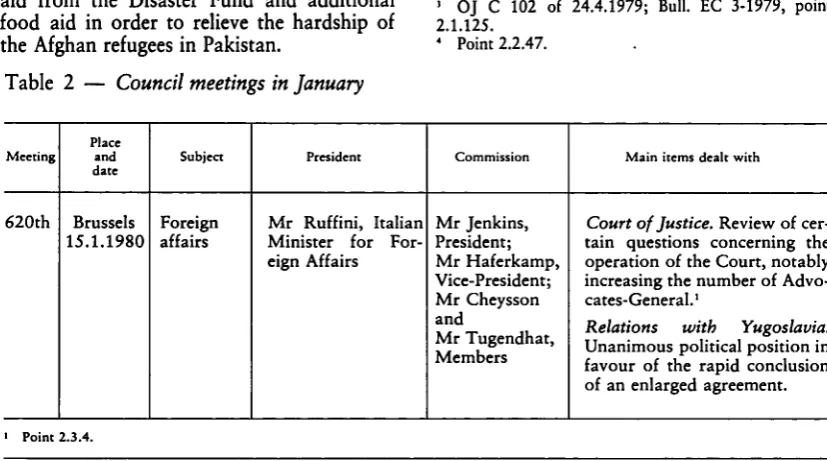
Meeting in Brussels in the political coopera-tion context on 15 January, the Foreign Ministers of the Nine adopted a declaration condemning the Soviet intervention, while on the same day the Council took a number of economic decisions concerning the USSR and humanitarian measures to help the Afghan refugees.
These were presented to Parliament the fol-lowing day by Mr Ruffini, the President of the Council, and were the subject of a debate followed by a resolution.
Throughout January the Community
authorities took steps in different areas (agricultural exports, development aid, etc.); on 31 January Mr Jenkins gave Parliament's Political Affairs Committee an account of what had been done.
Statement by the Member States of the Community at the UN
1.1.3. On 11 January Mr La Rocca, Italy's Permanent Representative to the United Nations, made a statement on behalf of the Community countries at an emergency ses-sion of the United Nations General Assembly on the following lines. The Nine were con-vinced of the need for the immediate with-drawal of the Soviet troops and reaffirmed the Afghan people's right to have their coun-try's sovereignty, independence and territorial
Afghanistan
integrity respected and to decide on their own form of government, without any foreign interference whatsoever. The Nine therefore urged the Soviet Union to observe the aims and principles of the United Nations Charter and to bring its military intervention in Afghanistan to an end forthwith. On 14 January the Nine voted in favour of the Assembly Resolution condemning the Soviet action and requesting the immediate, total and unconditional withdrawal of foreign troops from Afghanistan.
Declaration by the Nine (political cooperation)
1.1.4. The Foreign Ministers of the Nine adopted the following declaration at their political cooperation meeting on 15 January:
',The Foreign Ministers of the nine countries of the European Community have focused their attention on the Afghan crisis, in the light of its dramatic developments, the debate in the Security Council and the Resolution adopted by the General Assem-bly of the United Nations.
The nine Ministers have reaffirmed their grave concern with regard to the crisis created by the military intervention of the Soviet Union in Afghanistan, which represents a serious violation of the principles of international relations enshrined in the Charter of the United Nations.
They have emphasized that the explanations given by the Soviet Union to justify its intervention in Afghanistan are unacceptable. They take the view that the Soviet intervention constitutes a flagrant interference in the internal affairs of a non-aligned country belonging to the Islamic world and consti-tutes furthermore a threat to peace, security and stability in the region, including the Indian sub-continent, the Middle East and the Arab world.
It is with great concern that the Foreign Ministers of the nine countries of the European Community have noted that despite the almost universal pro-tests against the Soviet military intervention, the
Soviet Union has vetoed a Resolution on the Afghan crisis sponsored by non-aligned countries and supported by a considerable majority of mem-bers of the Security Council.
They urge the Soviet Union to act in conformity with the Resolution on the Afghan crisis adopted by the General Assembly of the United Nations with an overwhelming majority, which calls for the immediate and unconditional withdrawal of all foreign troops from Afghanistan.
The nine countries of the European Community have devoted continuous efforts to the cause of detente and they remain convinced that this pro-cess is in the interest of all members of the interna-tional community. They are, however, convinced that detente is indivisible and has a global dimen-sion. They therefore urge the Soviet Union, in con-formity with the standards and principles of the United Nations Charter, to allow the Afghan peo-ple to determine their own future without foreign interference.
In formulating their position on this important question, the Foreign Ministers of the member countries of the European Community have also been keenly aware of the sufferings borne by the Afghan people as a whole as a result of the crisis, including those Afghans who are being forced to leave their country.'
Conclusions of the Council
1.1.5. The press release published after the Council met-also on 15 January-included the following conclusions:
'The Council decided to cancel the 1979 Com-munity food aid programme for Afghanistan.
The Council also agreed to take a decision at the earliest opportunity on the proposals which the Commission would submit to it very shortly on · emergency aid to be provided via the Office of the High Commissioner for Refugees for Afghan refugees. This aid would be combined with such national aid as Member States might grant for this purpose.
Following the measures decided on by the United States concerning deliveries of agricultural pro-ducts to the Soviet Union, the Council laid down the principle that Community deliveries must not replace, directly or indirectly, United States deli-veries on the USSR market. With this in mind, the Council requested the Commission to take the necessary measures as regards cereals and products derived there from and to propose other possible measures for other agricultural products while respecting traditional patterns of trade. A consul-tation procedure was being instituted with the other main cereal-exporting countries in order to avoid disturbances on the world market.'
Parliament debate
1.1.6. Opening the debate in Parliament on 16 January, Mr Ruffini, the President of the Council, commented on the line that was being taken by the Nine in the light of the discussions in Brussels the previous days.
Stating that there was nothing about the situ-ation in Afghanistan which justified foreign intervention and that such intervention was a threat to
detente,
Mr Ruffini went on to say:Afghanistan
USSR's military intervention, which constitutes a serious violation of the principles of international relations enshrined in the United Nations Charter. They emphasized that the explanation given by the Soviet Union to justify its intervention in Afghanis-tan was unacceptable. The Soviet intervention con-stitutes blatant interference in the internal affairs of a non-aligned Islamic country and a threat to peace, security and stability in that region, includ-ing the Indian sub-continent, the Middle East and the Arab world.'
Following the debate, in which a large number of speakers took part, 1 Parliament
adopted a Resolution condemning the Soviet intervention and requesting the Commission to reconsider immediately all economic, trade financial and credit relations between the USSR and the European Community.
Measures taken by the Community
1.1. 7. The events in Afghanistan provoked immediate, concrete measures by the Com-munity affecting agriculture, food aid and humanitarian aid, and commercial policy.
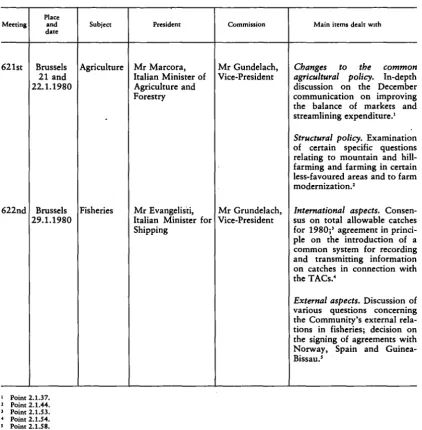
1.1.8. The Council and the Commission took steps to ensure that US agricultural exports to the USSR would not be replaced, directly or indirectly, by supplies from the
Community.2
1.1.9. The Council cancelled implementa-tion of the 1979 food aid programme since it was impossible for the Commission to monitor allocation of the aid.3
A decision was taken, on the other hand, to grant exceptional emergency aid, comprising financial assistance and emergency food aid, to the Afghan refugees. 3
Afghanistan
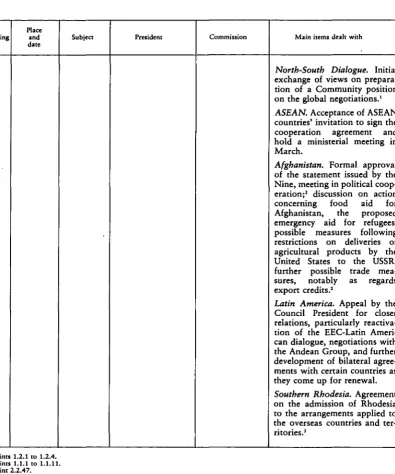
1.1.10. Lastly, the Council decided that other possible measures should be examined concerning trade, with particular reference to export credits.
Mr
Jenkins' address to Parliament's Political Affairs Committee1.1.11. The whole range of Community measures was described by Mr Jenkins at a public meeting organized by Parliament's Political Affairs Committee on 31 January, more particulary, Mr Jenkins rehearsed the measures taken in agriculture, stressing the coordination of the positions of the Com-munity and the United States on exports of foodstuffs. Mr Jenkins referred in this con-text to his visit to Washington and the posi-tive reaction in the United States to the steps taken by the Community.
Mr Jenkins pointed out that the Communi-ty's action should not be confined to negative measures: these should preferably be accom-panied by positive steps such as the strength-ening of links with the countries in the reg-ion, notably Turkey, Pakistan, India and other Asian countries; action should also be taken with regard to the European continent (Yugoslavia). He ended his statement by stressing the fact that the current political situation called for increased cohesion and solidarity on the part of the Community. Everything possible should be done to pre-vent a rift between the United States and the Community; the USSR, for its part, should realize that the events in Afghanistan consti-tuted a profound change in world politics.
1 Points 2.3.10 to 2.3.12. ' Point 2.1.36.
negotiations'
The Commission's guidelines
1.2.1. The adoption by the United Nations Assembly last December of a Resolution in favour op opening North-South economic negotiations within the United Nations sys-tem is felt by the Commission to mark the beginning of a process of major political importance. The Communication transmitted to the Council on 25 January to help prepare the Community position at the negotiations therefore welcomes this initiative.
In its Communication, the Commission refers to the changes that have occurred on the international scene since the Conference on International Economic Cooperation (the 'North-South Dialogue') was held in Paris from 1975 to 1977. It describes the changed international context in which the new negotiations will take place. It tries in par-ticular to make the subject it suggests for priority examination revolve around a central
theme: the development of the least
developed countries and the removal of bar-riers to world economic growth.
The major innovation of the 'global negotiations'
1.2.2. The Commission Communication emphasizes the profound changes which have come about on the international scene since the CIEC, which was to some extent a fail-ure. The energy problem is now seen as struc-tural and no longer tied to shifts in the world economic situation. Moreover, the individual groups of countries' interests now differ much more markedly, but at the same time interdependence has increased.
In its analysis of the General Assembly's Resolution the Communication points out in particular that:
(i) the new international economic order is looked upon as the ultimate aim, the
direc-North-South relations
tion in which the global negotiations should be conducted in order to contribute towards the establishment of a new system of interna-tional economic relations by means of bold initiatives and new, global solutions;
(ii) it is agreed that the negotiations should not only 'contribute to the solution of inter-national problems ... and to steady global economic development' but also 'reflect the mutual benefit, common interest and the responsibilities of the parties concerned, tak-ing into account the general economic capa-bility of each country'.
The Commission stresses in particular two points which sum up the major innovation embodied in the negotiations: first, the sub-ject of energy as such is raised once again, at the instigation of the developing countries themselves; second, the concept of economic interdependence seems to have matured: it is no longer seen in terms of the developing countries obtaining concessions from the industrialized countries whose boundless wealth was supposed to secure prosperity in all corners of the world, but far more as a joint effort to work out solutions to common problems.
The aims and subjects suggested by the Commission
1.2.3. The Commission's Communication goes on to examine what the Community's aims should be and the major subjects to be discussed.
The suggested
aims
would be to ensure a dynamic balance between energy supply and demand (security of supply, development of energy resources in the developing countries,North-South relations
etc.); to avoid the collapse of Third World markets; and to help the poorest countries (by developing food production, reinforcing world food security arrangements and impro-ving the exploitation of mineral resources in the developing countries).
As regards the subjects for discussion, the Commission feels that the negotiations should concentrate on certain major clusters of problems, which are interrelated and con-cern the international community as a whole. As a guideline in the general context already referred to, namely 'the removal of the main obstacles to world growth and development problems', the Commission wants to focus on a small number of subjects which tie in with most, if not all, of the major problems of international economic relations, while at the same time dealing in a coherent way with the five fields mentioned in the General Assem-bly's Resolution (trade, development, raw materials, energy, and monetary and financial matters).
Nature and mechanics of 'the negotiations
1.2.4. The Commission stresses the need to
establish appropriate machinery of these specific economic negotiations within the United Nations system-in other words, arrangements different from standard techni-ques in international discussions.
The Commission feels that it would be desir-able for politicians to be involved in these negotiations by making provision for one or more general or specialized ministerial ses-sions. Also, a central negotiating body should be set up to steer all areas of the negotiations, which would partly be conducted by
ad hoc
working parties or even in other specialized international agencies.
North-South relations
approach
1.3.1. In a Communication sent to Parlia-ment in January, and also to the Council, the Commission proposes a new approach to Community policy on technical barriers to trade. This emphasizes the positive, preven-tive aspects to be borne in mind in this con-nection, whereas the preoccupation to date has been the removal of barriers already in place. The Commission, then, is proposing a new 'philosophy' in this area with the funda-mental aim of contributing to the attainment of a genuine internal market here too.
Objective
1.3.2. The Commission summarizes its aims as follows:
'The Commission's intention ... is to follow up and intensify its efforts to ensure that free trade within the Community is implemented in full. A good deal of work has already been done, and the task of the future is not merely to safeguard the
Com-munity patrimony and continue the current activi-ties on the same lines as in the past, but also and above all to supplement them by taking account of other aspects that up to now have not been given the same priority. Clearly, the aim to be achieved is to establish an internal market and to enable the consumer and the enterprises to take advantage of it ... The removal of barriers cannot be regarded as a separate issue from the various policies that the Commission must follow-it is obvious that that policy is a crucial factor, and it must therefore be effective and realistic. The choice of priorities will be guided by those areas of industry in which action is more necessary than elsewhere, and the means must be selected according to their effec-tiveness. For the Commission to sponsor a flood of directives that it would have the utmost difficulty in managing would be pointless: the aim is the free movement of goods within the Community, and in order to achieve that aim the Commission intends to broaden its present activities by placing as much emphasis on the prevention of barriers as on the removal of those already created.
Technical barriers: new approach
Lastly, the Commission will keep the European Parliament informed of the progress of the work in an oral report. Any suggestions put forward by Members of the Parliament during the discussion would be given very careful attention by the Com-mission, and would be taken into account wher-ever possible in its subsequent activities.'
Action to date
1.3.3. The Communication details the Community's efforts to date in this area:
' ... The removal of technical barriers to trade is one of the requirements for the establishment of the Community's internal market. Goods must be able to move freely so that the consumer can reap the benefits of competition between manufacturers and of a wider choice of products, and in order that the manufacturers in turn can take advantage of the economies of scale offered by a market of 260 million inhabitants (soon to rise to over 300 million) and find in the internal market adequate scope for the development of new products before setting out to penetrate markets outside the Com-munity.
This is why the Commission has always laboured to break down these insidious non-tariff barriers to Community trade, especially those of a techni-cal nature. Up to now, practitechni-cally all its efforts in this field have been directed to the removal of bar-riers resulting from differences between the provi-sions of law, regulation or administrative action.
... Though this record shows that the procedures envisaged in the General Programme for the Removal of Technical Barriers to Trade, which was adopted in 1969 and revised in 1973, have been put into effect by the Commission with the necessary energy and drive, it does not mean that the situation is satisfactory.
The aim is not to accumulate directives, but to remove hindrances to trade. This is an objective
that is still a long way from realization and will not be achieved by merely following up the work
Technical barriers: new approach
already under way, for the barriers that can be dealt with by directives issued in accordance with Article 100 of the EEC Treaty are only a part of the actual barriers.
All the national standards being drawn up by the national standardization authorities at the rate of dozens every week are not in fact provisions of law, regulation or administrative action. These national standards are not designed deliberately in order to create obstacles but are generally meant to serve worthy aims: rationalization of produc-tion, improvement of product quality, protection of workers, users, consumers or the environment, more economic use of energy and the like.
Be that as it may, the way they are drawn up and the fact that only the national industry is actively involved in their preparation gives the national manufacturers a twofold advantage over their competitors: they can be sure that in the prepara-tion of these standards due consideraprepara-tion will have been given to their views and their manufacturing processes; they are aware of the intended pattern of development and modification in advance of their competitors, and therefore have time to pre-pare for it. The effect of these national standards in some of the member countries is enhanced by the importance attached to them by the inspection authorities and by the publicity given to certifi-cates of conformity with the national standards.'
Working methods
1.3.4. As regards the barriers set up as a result of differences in the laws, regulations
and administrative provisions, serious
thought should also be given to the working methods adopted by the Commission. The Communication makes the following points in particular:
' ... On a number of occasions the European Parlia-ment has openly complained at having to examine very technical proposals without understanding the place they occupy within the programme as a whole. The Commission, of course, transmits its proposals as and when they are drawn up in order not to delay the work of the Council, and this
Bull. EC 1-1980
Technical barriers: new approach
method results in a fragmentary presentation which makes it still more difficult to understand very complex and specialized documents ...
But the method adopted hitherto for the removal of technical barriers to trade poses yet another fundamental problem: it results in a growing bur-den of responsibility for the Commission and a constantly increasing workload for its staff. Whereas a few years ago the task of Commission officials in this field was to draw up new proposals and justify them to the other Community institu-tions, today much of their work is taken up with the management of directives already adopted, i.e. controlling their implementation in the Member States (nearly 250 actions for infringement are pending) and adapting them to technical progress.
These last-mentioned tasks are bound to grow with the Community patrimony, i.e. with the number of directives adopted by the Council, and will entail a steady expansion of the Commission's staff. Even if this increase of work at Community level and the wider responsibilities undertaken by the Commission brought about a corresponding reduction in the workload and responsibilities of the national administrations, an indefinite rein-forcement of the Commission staff dealing with these matters would be unacceptable.'
Review of activities:
forestalling the creation of barriers
1.3.5. These reflections have prompted the Commission to state:
' ... The Commission must therefore review the whole of its activities in connection with the removal. of barriers to trade in the light of the policies it intends to pursue.
From the point of view of the industrial policy, it would be a mistake to think that the removal of barriers is an operation without effect on the evolution of industrial structures. The establish-ment of a single internal market wiii primarily benefit those industries-whether of the Commun-ity or outside-that are able to take advantage of the economies of scale that can be expected to ensue from the development of this internal mar-ket. Those economies can be achieved only by
stepping up series production, and, since the development of the market is generally not likely
to enable every company to multiply its produc-tion, keener competition will bring about changes of structure either in the form of mergers or, for instance, by more intensive specialization on the part of the undertakings concerned.
... The Commission will have to tackle the problem from several angles: it should seek not only to
remove the barriers, as it has done hitherto (by directives based on Article 100), but also try to prevent such barriers from arising. Whether the obstacles are created by provisions of law, regula-tion or administrative acregula-tion or in some other way, this twofold approach must be such that no time is lost in identifying problems, not merely from the legal standpoint but according to their economic importance and the time limits within which they have to be resolved.
The Commission will also continue its work in implementation of Article 100, though it will con-centrate more of its attention on those areas in which it is most anxious to succeed in order to avoid dissipation of effort. It has never been the Commission's policy to harmonize for the sake of harmonizing, and up to now it has not only kept within the bounds of the programmes approved by the Council, but it has always tackled new areas in close consultation with the parties concerned, namely those most affected by the walling-off of the market and most conscious of the need to do away with national barriers.
Since, however, the number of officials who can be assigned to a task of this kind is limited, it will become more and more necessary to make a strict selection from among the requests received from industry in order to give maximum efficiency to the Commission's activities.'
Coordination
of standardization policies
1.3.6. ' ... In parallel the Commission proposes to hold meetings-as often as needed, and not less than twice a year-of the national officials responsible for standardization policy in order to coordinate their activities. At these meetings, the delegation from each Member State will give a
detailed account of its current programmes and its intentions with respect to technical specifications that it intends to make mandatory; it will also indicate any difficulties that might be arising in its exports to other Member States as a result of this type of barrier.
It will be essential to find joint solutions to these difficulties, which may be due either to the specifi-cations themselves or to the inspection formalities.
... The Commission feels sure that many of the problems can be solved, at any rate in part, by procedures less formal, and thus more flexible, than the issue of directives.
... Coordination between the national standardiza-tion bodies, which the Commission has always encouraged, must be developed and strengthened. A major factor in that coordination will be the transformation of the CEN' and CENELEC2 into
effective organizations. For that purpose, there must first be a firm commitment to these bodies on the part of the Governments of the Member States and the Commission.
At the political and technical level, this must take the form of more active participation in their work (notably with regard to their organization and control) and in the decisions taken. The meetings of the CEN and CENELEC should cease to be a confrontation of national interests, and become a forum for the pooling of information by the national experts. Where the problems encountered are outside the sole competence of the standardiza-tion experts, the Commission, in associastandardiza-tion with national officials, will study the various options, point out the main guidelines, and define priorities.
If European standardization is to fulfil any useful purpose, European standards will have to be pre-pared, without "deviations", at the rate of several hundred a year. This will not excessively compli-cate the work of the standardization institutes in the Member States, since the European standards will have to be included in the national standardi-zation systems and the work done at European
1 European Committee for Standardization.
2 European Commission for Electrotechnical
Technical barriers: new approach
level will not need to be repeated nationally. One need only think of the work being done over and over again by the eight standardization authorities in the Member States--each jealous of its preroga-tives and independently drawing up its own national standards-to realize the absurdity of the situation and the amount of work and money that could be saved by European organizations with a suitable mode of operation ...
The Commission also intends to promote the rep-resentation of consumers on standardization bodies as it announced in its second programme for a policy for consumer protection and informa-tion ... •
Moreover, the draft national standards will be communicated to the standardization bodies in other Member States early enough to enable them to make observations that can be effectively taken into consideration. Lastly, observers appointed by the standardization institutes of other Member States will be able, upon request, to be present at the standardization work carried out by a national institute on a given subject. These decisions, which have been taken in the last few months by the responsible officials of the Member States acting on a proposal from the Commission, should quickly produce positive results. The Commission will follow their implementation closely.
The Commission's work would be incomplete if it did not also endeavour to remove barriers engen-dered by the national requirements with respect to certification and inspection. In this field there is a wide variety of procedures, which are either laid down by provisions of law or regulation or which, although not legally binding, do in fact offer real advantage to those for whom they are most easily accessible ...
These problems are difficult to pin down. Many of them can be resolved by harmonization of the national standards and the creation of an adequate body of European standards. Pending the outcome of this laborious work, however, the Commission has undertaken, in agreement with the officials responsible for standardization in the various Member States, to draw up an inventory of
national certification procedures and the obstacles to trade they entail.'
1 OJ C 218 of 30.8.1979; Supplement 4/79 - Bull.
EC.
~b\~U
UW©
ACTIVITIES
Economic and monetary policy
Economic and monetary union
New Community borrowing and lending instrument
Second tranche of 500 million EUA proposed by the Commission
2.1.1. On 29 January, the Commission laid before the Council a proposal for a Decision empowering the Commission to contract a second tranche of borrowings amounting to 500 million EUA under the new Community borrowing and lending instrument (NCI-the 'Ortoli facility'), the purpose of which is to promote investment in the Community.
As in the case of the first tranche, the funds raised will be on-lent to finance investment projects on Community territory which are consistent with priority Community objec-tives in the infrastructure and energy sectors. Broadening its interpretation of 'infrastruc-ture', the Commission proposes that the sec-ond tranche should include certain very important projects for housing and advance factories, to be carried out in' priority regions or in areas hard-hit by the crisis.
The basic Decision1 empowering the
Com-mission to contract loans for the purpose of promoting investment within the Community (the amount of such loans not to exceed 1 000 million EUA) was adopted by the Council on 16 October 1978. Pursuant to
that Decision, the Commission was
authorized by the Council on 14 May 19792 to make a first tranche of borrowings amounting to 500 million EUA. By the end of 1979 nearly 300 million EUA had been
com-Economic and monetary policy
mitted as NCI loans; as the balance will be used up during the first few months of 1980, the Commission has made this approach to the Council to initiate the authorization pro-cedure so as to ensure continuity of action.
The new instrument has already demons-trated its usefulness: the first series of pro-jects alone represents a total investment cost of 3 372 million EUA, of which 60% is in the priority sector of energy.
Economic situation
Economic trends
2.1.2. A somewhat firmer trend of demand and production in 1979; resumption of growth in industrial production; unemploy-ment stable overall but with varying compo-nent trends; renewed pressure on prices; increased trade deficit; moderate monetary growth and rising interest rates: these, says the Commission, were the main economic trends in the Community in 1979, as iden-tified at the beginning of this year. The Com-mission staff report now published includes
the following points: ·
'The most recent Commission staff estimates sug-gest that real gross domestic product in the Com-munity as a whole grew by 3.3% in 1979, as against 3.1% in 1978. Although aggregate con-sumption rose at a slightly less rapid rate, the brisker expansion in the volume of fixed invest-ment and stockbuilding led to more vigorous growth in internal demand (4.3% in real terms, compared with 3.3% in 1978). Fixed investment growth at constant prices (3.9%) was the highest
1
OJ L 298 of 25.10.1978; Bull. EC 10-1978, point 2.1.10.
Economic and monetary policy
recorded for the Community since 1973. How-ever, with imports rising faster than exports, there were stronger restraining effects on activity than in 1978 ...
Although the leading indicators seemed to suggest the opposite, industrial production, seasonally adjusted, grew by as much as 1.2% in November. As a result, the trend over succeeding three-month periods, which had remained sluggish berween July and October, turned up again. This recovery was due primarily to the faster rate of growth experienced in Italy in the early autumn and, to a lesser extend, to the steadier growth of output in Germany. There was also evidence of a distinct recovery in industrial output in Denmark. In the United Kingdom, by contrast, despite efforts ill some industries to make up output lost through industrial disputes in the autumn, production was still below the peak level recorded mid-year. In France, too, there was a dip in the trend following the buoyant growth recorded in the third quarter ...
In December, the unemployment rate for the Com-munity, after showing only minor fluctuation dur-ing the course of the year, was unchanged from the previous month, at 5.5%. Among the Member States, unemployment rates declined berween November and December in Germany and Ireland, countries in which unemployment fell steadily dur-ing 1979. In France and Belgium, on the other hand, the unemployment rate continued to tend upwards. In the United Kingdom, where unem-ployment had been easing slightly in the first three quarters, the deterioration first discernible in October became more marked. Unemployment also rose in Italy, although there had been a recent tendency, admittedly fairly irregular, for its level to come down. The deterioration noted in Denmark follows a fall in unemployment that was particularly sharp in the first half of the year and continued for most of the second. In the Nether-lands and in Luxembourg, unemployment remained relatively stable throughout the year. As regards unemployment by sex, male unemploy-ment fell in December to its lowest level since the first half of 1977 ...
In December, the Community consumer price index rose 0.8%. For the year as a whole, con-sumer price inflation thus probably amounted to
9.9%, as against 7.5% in 1978. The six-month
Economic and monetary policy
increase, seasonaly adjusted and expressed at an annual rate, remained close to the 14.8% max-imum recorded in mid-1974 following the first oil crisis. In several Member States, the movement of consumer prices clearly reflected the impact of the rise in petroleum product prices. The December increase was highest in Italy, amounting to 1.6%, but remained well below 1% in the other Com-munity countries. During recent months, rates of increase in wholesale prices have tended to come more into line with those for consumer prices; for the year as a whole, the rise in wholesale prices was probably 10.3%, as against 4.4% in 1978 ...
The basic tendency for the Community's trade deficit to increase, which first started in the autumn of 1978, seems to have continued at the end of last year. While, in November, an improve-ment was noted in most Member States, the Italian deficit widened sharply owing in particular to the building up of stocks of crude oil. In December, the Community deficit worsened because of a further reduction in the German surplus due largely to a fall in exports, and because of increased deficits in France and Denmark ...
The only exception was the United Kingdom deficit, which has been narrowing since October. Primarily as a result of the considerable increase in the price of imported crude oil-on a year-on-year comparison, the rise in the fob price expressed in dollars was about 88% in the fourth quarter of 1979-the Community's terms of trade deterior-ated by 1.3% in 1979. The deterioration in the Community's trade balance berween 1978 and 1979 is estimated at almost USD 20 000 million, equivalent to some 0.9% of Community gross domestic product at current prices and exchange rates.''
Monetary Committee
2.1.3. The Monetary Committee held its 257th meeting in Brussels on 23 January. It
elected its officers for 1980-81: Mr Haberer as Chairman and Sir Kenneth Couzens, Mr
- 1 Commission, European Economy, Supplement A:
Recent economic trends-No 2, February 1980.
Dini and Mr Horgan as Vice-Chairmen. It then continued its discussions on the future
European Monetary Fund. ·
Economic Polley Committee
2.1.4. The 88th meeting of the Economic Policy Committee was held in Brussels on 23 January, in its reduced 'medium-term' com-position, with Mr Leonard in the Chair. The Committee completed its review of medium-term questions of common interest by examining medium-term economic policy problems in the Benelux countries, and adopted a consolidated report covering all its national reviews. It also prepared, for the next meeting of the full Committee, a draft opinion on the general problems in~erent in the medium-term economic outlook.
Internal market
and industrial affairs
Free movement of goods
Removal of technical barriers to trade
2.1.5. On 23 January the Commission adopted a communication to Parliament on the removal of technical barriers to trade.1 Its
efforts to stem the ever-increasing flow of national measures which set up barriers to trade by introducing harmonization directives based on Article 100 of the EEC Treaty date back to 1969. The Commission feels that its activities on this front could usefully be extended in two directions:
(a) first, by attempting to curb the barriers resulting from national standards, which may not be mandatory but create obstacles none the less;
(b) second, by preventing the creation of such barriers at source.
Directives adopted
2.1.6. On 15 January the Council adopted a Directive on the ranges of nominal quan-tities and capacities permitted for certain
pre-packaged products;2 the Commission
prop-osaP was presented in July 1976.
The Directive is designed to provide free access to all Community countries for certain products (including foodstuffs, cosmetics, aerosols, tins and glass containers) sold by weight or volume in the quantities or capacities specified in this new Community instrument. Provision is made for other pro-ducts to be added to the list later, but the process of harmonization is now well under way. The resulting standardization will per-mit substantial economies of scale which will be profitable to manufacturers and at the same time beneficial to consumers.
Commission proposals
2.1.7. On 17 January the Commission sent the Council two proposals for Directives on the approximation of the laws of the Member States relating to roll-over protective struc-tures (ROPS) and falling-object protective structures (FOPS) for certain construction plant.
' Points 1.3.1 to 1.3.6. ' OJ L 51 of 25.2.1980.
Internal market and industrial affairs
The technical provlSlons were worked out with the assistance of government experts and representatives of the Committee for European Construction Equipment and the Commission of European Inspecting Bodies, and based on international standards. The Commission proposals were prompted by a number of considerations:
(a) protection structures significantly reduce both the number and the seriousness of acci-dents;
(b) the sector involved is a very important one accounting for 10% of the mechanical engineering market and 25% of world pro-duction;
(c) the fact that several Member States had already taken action placed an onus on the Commission to do something about harmoni-zation.
2.1.8. On 17 January the Commission sent the Council two proposals for Directives on the approximation of the laws of the Member States relating to the fuel consumption and the engine power of motor vehicles. The introduction of a Community method for measuring fuel consumption is important both as a means of monitoring reduction targets and as a means of providing purchas-ers and consumpurchas-ers with objective informa-tion. The proposals are part of the Commis-sion's wide programme for the rational utili-zation of energy' and of its consumer action programme.
2.1.9. On 28 January the Commission adopted a proposal for a Council Directive on the approximation of the laws of the Member States concerning electrical equip-ment for use in protentially explosive atmos-pheres in mines susceptible to fire-damp.2
2.1.10. On 23 January the Commission sent the Council a proposaP to amend the
Bull. EC 1-1980
Internal market and industrial affairs
Directive of 27 July 1976 relating to restric-tions on the marketing and use of certain
dangerous substances and preparations.4
Since it is not yet possible to do without polychlorinated terphenyls (PCT) for certain purposes, notably in aircraft engines and
high-precision lenses, they must be
authorized for specific uses in certain pre-mises until a suitable substitute has been found.
2.1.11. On 28 January the Commission sent the Council a proposal for a Directive on the approximation of the laws of the Member States relating to textile names.5
*
2.1.12. On 18 January Parliament gave its opinion6 on two Commission proposals,
con-cerning the trade arrangements applicable to certain goods resulting from the processing of agricultural products7 and cocoa and
choco-late products intended for human consump-tion.•
At its 30 and 31 January session the
Economic and Social Committee gave its opinion' on the Commission proposals con-cerning colouring matters which may be used in foodstuffs intended for human consump-tion10 and colouring matters in medicinal pro-ducts.11
1 OJ C 208 of 18.8.1979; Bull. EC 6-1979, point
2.1.111.
2 Point 2.1.27.
' OJ C 31 of 8.2.1980. • OJ L 262 of 27.9.1976. • Point 2.1.34.
' OJC34of11.2.1980. 7 Bull. EC 7/8-1979, point 2.1.11.
1 OJ C 121 of 15.5.1979; Bull. EC 4-1979, point 2.1.8.
' Point 2.3.29.
•• OJ C 201 of 10.8.1979; Bull. EC 7/8-1979, point 2.1.12.
" OJ C 262 of 17.10.1979; Bull. EC 9-1979, point 2.1.15.
Business law
Product liability
and intellectual property
· Protection of industrial property
2.1.13. On 29 January the Council took a decision on the revision of the Paris Conven-tion for the ProtecConven-tion of Industrial Property! in line with the proposaP put to it by the Commission last December.
Free movement of persons and freedom to provide services
Mutual recognition of diplomas and access to economic activities
Midwives
2.1.14. On 21 January3 the Council
for-mally ·adopted two Directives on the mutual recognition of diplomas, certificates and other evidence of qualifications for midwives and on coordination of provisions laid down by law, regulation or administrative action relating to their activities, approved in princi-ple on 18 December.'
Industry
Textiles
2.1.15. The group of distinguished academics responsible for looking into pro-ductions held a further meeting on 11 Janu-ary. The all-important role of local factors in
the different textile-producing areas of the Community was stressed and the group agreed to carry out a survey of all the textile-producing areas and to assess regional impact in an attempt to build up a clearer com-prehensive picture of the textiles and clothing industry as a whole.
Customs union
Economic tariff matters
Suspensions
2.1.16. On 29 January the Council adopted a Regulation6 temporarily suspending
auton-omous CCT duties on certain agricultural products originating in Turkey. These duties are being suspended totally or partially until 31 December in order to ensure that Turkey is not treated less favourably than the developing countries and territories.
*
2.1.17. On 18 January Parliament delivered its Opinion7
on the Commission proposal8 of 24 July 1979 for a Council Directive on the
1 Point 2.2.32.
2 -Bull. EC 12-1979, point 2.2.48. ' OJ L 33 of I 1.2.1980. ' Bull. EC 12-1979, point 2.1.12.
5 Bull. EC 11-1979, point 2.1.20.
• OJ L 27 of 2.2. 1980. 7 OJ C 34 of 11.2.1980.
Competition
harmonization of procedures for the exporta-tion of goods.
Competition
Restrictive practices, mergers and dominant positions: specific case
Distribution
Removal of restrictions on advertising
2.1.18. Access to the market of a Member State may be seriously impeded for a manu-facturer in another Member State if he is dep-rived of the proper facilities for advertising his products. This was the thinking behind the Commission's action on a complaint filed by a British supplier of boating equipment when, in March last year, the only two Bel-gian specialist journals in this field, the jointly owned
Sur l'eau
andIk vaar,
stated that they would no longer carry. advertise-ments for his products. The journals had been approached by Belgian manufacturers who alleged that they were competing under serious cost and tax disadvantages. In sup-port of his case the complainant argued that his sales in Belgium had suffered seriously as a result and that boating equipment purchas-ers in Belgium had also been deprived of access to a cheaper and wider source of sup-ply in another Member State.In response to Commission representations the journals have now agreed to accept advertisements from suppliers in other Member States on the same basis as from their Belgian competitors.
Bull. EC 1-1980
Financial institutions and taxation
Financial institutions
and taxation
Taxation
Indirect taxes
Tax exemptions
Procedure applicable to the stores
of vessels, aircraft
and international trains
2.1.19. On 23 January the Commission transmitted to the Council a proposal for a Directive' on the Community tax procedure applicable to the stores of vessels, aircraft and international trains, i.e. goods such as catering supplies, fuels and sundry stores to be used exclusively on board.
National legislation traditionally provides, subject to certain conditions, for exemptions on the importation and exportation of such products. This is incorporated in Community legislation in the Sixth VAT Directive of 17 May 1977/ which at the same time stipulates that Community rules defining the scope of the exemption and implementing provisions are to be adopted at a later date. This is the purpose of the Directive now proposed: it would determine the Community tax proce-dure to apply in this field, both within the Community and in traffic with non-member countries.
The procedure covers both VAT and excise duties. A single procedure is necessary, both
1 OJ C 31 of 8.2.1980.
' OJ L 145 of 13.6.1977.
because the two types of tax give rise to simi-lar problems and because the tax rules applic-able to one and the same transaction should be simplified. For the same reasons, the tax procedure has been modelled as closely as possibl~ .on that already suggested by the Comm1ss1on for customs purposes in its proposal for a Regulation sent to the Council on 8 March 1978.1 The principles of this
lat-ter proposal are also largely derived from the Sixth VAT Directive.
If true harmonization is to be achieved excise dut!es must .be
inclu~ed
in thepr~posal,
owmg to the1r great Importance in the tax field, given the high level of rates applied in the Member States.Denmark derogation
2.1.20. On 31 January the Commission adopted a report to the Council on the dero-gation accorded to Denmark, under a Direc-tive adopted on 1~ December 1977/ relating to the rules govermng turnover tax and excise duty applicable in international travel. This Directive authorized Denmark to derogate from the Community system of allowances up to 31 December 1982, and the Commis-sion undertook to report annually to the Council on the prices of tobacco products and alcoholic beverages in Denmark and the Feder~l Republic of Germany, on passenger fares m Denmark and on the Danish Govern-ment's tax policy. The Commission's report (the second on this matter) concludes that in ~eneral no significant progress was achieved
m 1979-as in 19783-in reducing the
differences between the prices of the products con -cerned. On the contrary, so far as cigarettes are concerned, the price gap increased consid-erably as a direct result of Danish tax increases.
24
Excise duties
French overseas departments
2.1.21. On 28 January the Commission transmitted to the Council a proposal for a Directive authorizing France not to apply in the French overseas departments the Direc-tives, adopted by the Council on 19
December 19724 and on 18 December 1978
s
on taxes other than turnover taxes (i.e. exci;e duties) on consumption of manufactured tobacco. The first of these Directive lays dow? t~e principles for a stage-by-stage har-momzatlOn of the structures of excise duties on manufactured tobacco (and, in its am~nded version, the criteria to be applied durmg the second stage); the second defines the different types of manufactured tobacco.
In adopting these Directives, the Commission a!ld the Council had, in the absence of provi-siOns to the contrary, interpreted Article 227(2) of the EEC Treaty as excluding the French ?ver~eas del?artments from the scope of the D1rect1ves. A judgment delivered by the Court of Justice on 10 October 19786 set
aside th_is interpretation, holding that, with the ~xp1ry. of the two-year period provided for m Art1cle 227(2), the provisions of the Treaty and secondary legislation applied automatically to the overseas departments.
The purpose of the proposal sent to the Council in January is to enable France, as
ini-1 OJ C 77 of 23.3.1978.
2 OJ L 336 of 27.12.1977; Bull. EC 12-1977 point
2.1.68. '
' Bull. EC 1-1979, point 2.1.43. • OJ L 303 of 31.12.1972.
s OJ L 10 of 16.1.1979; Bull. EC 12-1978, point 2.1.53.
' Case 148/77 Hansen & Balle 11 Hauptzollamt
Flens-burg [1978] ECR 1787: OJ C 263 of 7.11.1978; Bull. EC 10-1978, point 2.3.57.
Employment and social policy
tially intended, to exclude the overseas departments from the scope of the two Direc-tives in question.
*
2.1.22. At its plenary session on 30 and 31 January the Economic and Social Committee delivered its Opinion1 on the proposal for a Fifth Directive on the rules governing turn-over tax and excise duty applicable in inter-national travel, which the Commission had sent to the Council on 30 November 1979.2
Employment and social policy
Employment
Employment policy response to the new micro-electronic technology
2.1.23. On 30 January the Commission adopted a Communication on the employ-ment policy response to the new micro-electronic technology, to be discussed at the meeting of the Standing Committee on Employment scheduled for 26 February.
In a Communication on new information technologies sent to the Council on 29
November 19793 the Commission has
stres-sed the need for Community action and prop-osed a number of measures: the paper has also been discussed at the European Council in Dublin.4
The new Commission paper goes further into the social aspects referred to in the November Communication. It is intended to assist the governments of the Member States, the two sides of industry and the Community to iden-tify their respective tasks and sets out various
Employment and social policy
proposals for action in response to the Euro-pean Council's requests. In it the Commission examines possible ways of palliating the quantitative and qualitative effects of the spread of data technology on living and working conditions, and puts forward the following three principles on which it consid-ers that appropriate measures should be based:
(i) intensifying the dialogue between the two sides of industry at company level; (ii) closer cooperation between the two sides of industry and governments;
(iii) developing comprehensive and flexible policies in response to the new needs.
Lastly, the Commission sets out a series of suggestions to promote discussion and action in the Community in connection with mea-sures to be set in motion in this sphere. These suggestions mainly involve stimulating and directing economic policy in such a way that it can maintain demand, support structural changes and guide the development of emerg-ing needs, especially in the services sector. They concern: the reorganization of working time; working conditions and improvements to the quality of life (by applying the new technology to the problems of the least-favoured groups in society, especially the
handicapped); vocational training; the
development of other labour market support measures (guidance, placement, mobility of
labour); reinforcing social protection
arrangements; setting up employment fore-casting machinery; and active participation by the two sides of industry.
*
' Point 2.3.30.
2 OJ C 318 of 19.12.1979; Bull. EC 11-1979, point
2.1.38.
2.1.24. On 16 January Parliament adopted two Resolutions on the employment situation in the Community .1
Social protection
The fight against poverty
2.1.25. At its 30 and 31 January session2 the Economic and Social Committee adopted an Opinion on the Commission proposaP of 27 November 1979 for a Council Decision concerning an interim programme to combat poverty.
Health and safety
Health protection
2.1.26. On 31 January the Commission adopted, for transmission to t~e Council, the first report on progress made in implement-ing the Council Resolution of 29 June 19784
on an action programme of the European Communities on safety and health at work. This report deals mainly with activities already brought to fruition or about to lead to concrete proposals. Several major initia-tives have thus been taken, including a prop-osal for a Directive on the protection of workers from harmful exposure to chemical, physical and biological agents at work5 and a
proposal for a Directive on the protection of workers from harmful exposure to metallic lead.6
Safety and hygiene
2.1.27. On 28 January the Commission adopted a proposal for a Council Directive
on the approximation of the laws. of the Member States concerning electrical equip-ment for use in potentially explosive atmos-pheres in mines susceptible to fire damp; this instrument is therefore outside the scope of the Council Directive of 18 December 1975,' from which underground work in mines sus-ceptible to fire damp was specifically excluded. The new proposal is also in line with the Directive of 6 February 19791 intro-ducing certain forms of protection in applica-tion of the 1976 Directive.
Paul Finet Foundation
2.1.28. Meeting in Luxembourg on 18 January, the Executive Committee of the Paul Finet Foundation examined 496 cases and granted financial aid (totalling about BFR 3 728 000) to 348 young persons whose fathers had died as a result of an industrial accident or occupational disease, after being employed in an ECSC colliery, iron mine or steelworks.
' Point 2.3.9; 0 J C 34 of 11.2.1980.
2 Point 2.3.31.
3 OJ C 307 of 7.12.1979; Bull. EC 11-1979, point
2.1.49.
• OJ C 165 of 11.7.1978; Bull. EC 6-1978, point 2.1.39.
' OJ C 89 of 5.4.1979; Bull. EC 3-1979, point 2.1.52. • OJ C 324 of 28.12.1979; Bull. EC 12-1979, point 2.1.70.
7 OJ L 24 of 30.1.1976.
Regional policy
Regional policy
Financial Instruments
European Regional Development Fund
ERDF aid: first allocation for 1980
2.1.29. On 24 January the Commission
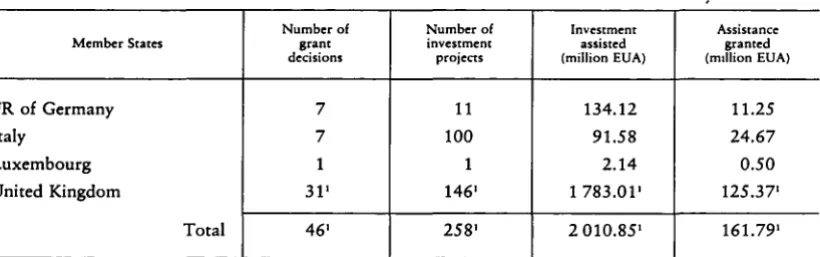
approved the first allocation of grants for 1980 from the European Regional Develop-ment Fund, totalling 161.79 million EUA. These grants will go to 258 projects costing a total of 2 010.85 million EUA.
Regional policy
Under the Regulation of 18 March 1975 establishing the ERDF,1 as amended by the
Regulation of 6 February 1979/ the Fund Committee had unamimously endorsed these projects on 28 and 29 November 1979, except for two on which a consensus was not reached. The Regional Policy Committee had been consulted on 22 and 23 November, on projects relating to infrastructure investments costing more than 10 million EUA. It was only because the ERDF had exhausted its funds for 1979 that the Commission had to defer its decisions until 1980.
The aid granted under this allocation was dis-tributed as shown in Table 1.
1 OJ L 73 of 21.3.1975.
2 OJ L 35 of 9.2.1979.
Table 1 - Grants from the ERDF (first 1980 allocation)
Number of Number of Investment Assistance
Member States grant investment assisted granted
decisions projects (million EUA) (m11lion EUA)
FR of Germany 7 11 134.12 11.25
Italy 7 100 91.58 24.67
Luxembourg 1 1 2.14 0.50
United Kingdom 31' 146' 1 783.011 125.371
Total 461 2581 2 010.851 161.791
[image:29.460.30.440.509.637.2]The 161.79 million EUA breaks down as follows:
(a) 71.61 million EUA to help finance 207 industrial and tourism infrastructure projects, comprising:
(i) 6.82 million EUA to finance 2 projects costing over 10 million EUA each;
(ii) 64.79 million EUA to finance 205 pro-jects costing less than 10 million EUA each.
The total cost of infrastructure investment projects receiving assistance from the Fund amounts to 346.07 million EUA.
(b) 90.18 million EUA to finance 51 pro-jects in industrial (including small business) or service activities, comprising:
(i) 82.04 million EUA to finance 9 projects costing more than 10 million EUA each; (ii) 8.14 million EUA to finance 42 projects costing less than 10 million EUA each.
The total cost of industrial and services investment projects receiving assistance from the Fund amounts to 1 664 78 million.
Conversion loans
2.1.30. Under Article 56(2)(a) of the ECSC Treaty, the Commission signed a conversion loan contract for UKL 5 million (about 7.4 million EUA) with the British firm of ERF Ltd, which manufactures heavy commercial vehicles. This five-year loan will go towards the building of a new plant for the assembly of heavy vehicles at Wrexham, in North Wales, and the transfer to Middlewich, Che-shire, of the company's engineering research and development unit. The Council gave its assent at its 10 and 11 December 1979 meeting.1
Environment and consumers
Environment
Prevention and reduction of pollution and nuisances
Chemicals
2.1.31. The ecological problems facing the chemical industry were discussed at a meeting between representatives of the Commission and of the European Council of Chemical Manufacturers' Federations held in The Hague on 24 and 25 January.
Discussions centred on how the Community's environment policy relates to the long-term development of the chemical industry, having regard in particular to essential economic and energy requirements. The meeting considered the following topics in turn: Community objectives in this field and the means of attaining them; strategies to bring down the cost of environmental protection; the benefits of pollution control to the economy; and the attitude which the industry should adopt to environmental problems, chiefly by introduc-ing 'clean' technologies into manufacturintroduc-ing processes.
2.1.32. The Scientific Advisory Committee set up by the Commission on 28 June 1978 to examine the toxicity and ecotoxicity of chemical compounds2 held its second full
meeting at Luxembourg on 15 and 16 Janu-ary. It examined the problems raised by
cer-1 OJ C 14 of 18.1.1980.
2 OJ L 198 of 22.7.1978; Bull. EC 6-1978, point