City, University of London Institutional Repository
Citation
: Henning, V., Hennig-Thurau, T. & Feiereisen, S. (2012). Giving the
Expectancy-Value Model a Heart. Psychology and Marketing, 29(10), pp. 765-781. doi:10.1002/mar.20562
This is the accepted version of the paper.
This version of the publication may differ from the final published
version.
Permanent repository link:
http://openaccess.city.ac.uk/14453/Link to published version
: http://dx.doi.org/10.1002/mar.20562
Copyright and reuse:
City Research Online aims to make research
outputs of City, University of London available to a wider audience.
Copyright and Moral Rights remain with the author(s) and/or copyright
holders. URLs from City Research Online may be freely distributed and
linked to.
City Research Online: http://openaccess.city.ac.uk/ [email protected]
Giving the Expectancy-Value Model a Heart
Victor Henning Mendeley 144a Clerkenwell Road
London EC1R 5DF Phone +44 (0) 7515 963 435
Email: [email protected]
Thorsten Hennig-Thurau
Department of Marketing and Media Research Am Stadtgraben 13-15
48143 Münster Germany
Phone:+49 (0) 251 83 29954 And
Department of Marketing Cass Business School, City University
106 Bunhill Row, London EC1Y 8TZ United Kingdom
Email: [email protected]
Stephanie Feiereisen* Department of Marketing Cass Business School, City University
106 Bunhill Row, London EC1Y 8TZ Phone: +44 (0)20 7040 0913
Fax: +44 (0)20 7040 8328
Email: [email protected]
*corresponding author
Psychology & Marketing
1
Giving the Expectancy-Value Model a Heart
1ABSTRACT
Over the past decade, research in consumer behavior has debated the role of emotion in
consumer decision making intensively but has offered few attempts to integrate emotion-related
findings with established theoretical frameworks. This manuscript augments the classical
expectancy-value model of attitude with a dimensional model of emotion. An experiment
involving 308 college students who face actual purchase decisions shows that predictions of
attitudes, behavioral intentions and actual behavior can be improved through the use of the
augmented model for both hedonic and utilitarian products. The augmented model has
theoretical implications for marketing scholars as well as practical uses for marketers.
1 The authors thank an anonymous reviewer for suggesting this title. The authors would
2
Giving the Expectancy-Value Model a Heart
INTRODUCTION
Ever since its inception, the “information processing view” has been the predominant paradigm
of consumer behavior research (Bagozzi, Gürhan-Canli, & Priester, 2002). This paradigm mainly
regards consumers as logical problem solvers and “thinking machines” (Shiv & Fedorikhin, 1999, p.
290). Prominent researchers now increasingly contend that the information processing paradigm
paints an incomplete picture of consumer decision making. Although it can explain and predict
the consumption of functional, utilitarian goods, its adequacy for hedonic consumption
decisions, in which “less experience is available, where the problem is not well-structured, and
where emotional reactions are important” (Phillips, Olsen, & Baumgartner, 1995, p. 284), appears
questionable.
In turn, the role of affect2 has become a central research topic in consumer research in the
past decade (Cohen, Pham, & Andrade, 2008). However, the proliferation of research on
seemingly contextual affective influences on behavior and the limited integration of new
findings into established information processing frameworks have led to growing concerns
among decision-making researchers. Such concerns have prompted questions such as the one
cited by Schwarz (2006, p. 20): “Whatever happened to Fishbein and Ajzen’s theory of rational
behavior and other such models? All we hear about from psychologists these days is how funny
little things make people feel one way or another, influencing what they like and do.”
2 Regarding the terms affect, emotion, and mood, which are often used interchangeably, the authors follow the
definitions offered by Ekman and Davidson (1994), according to which affect is an umbrella concept that
3 This research attempts to address such concern by assessing the compatibility of the
flourishing emotion research stream with cognitively dominated attitude-theory decision making
models. The manuscript begins with a theoretical discussion of whether Fishbein and Ajzen’s (1975)
expectancy-value model (EVM) of attitude is sufficient to capture the influence of emotion on
decision making. Then, the EVM is augmented with anticipatory emotions and emotional
expectation constructs (Bagozzi, Baumgartner, Pieters, & Zeelenberg, 2000), drawing on Larsen and
Diener’s (1992) circumplex model of emotion. With a controlled experiment involving 308 college
students faced with actual purchase decisions, the authors test whether the augmented EVM
performs better than the traditional EVM in predicting overall evaluations and attitudes, purchase
intentions, and actual behavior, using a series of multistage linear and logistic regressions. To test
Philips and colleagues’ (1995) proposition that the traditional model is sufficient for utilitarian but
not hedonic consumption contexts, the analysis is performed for both consumption categories.
Finally, the results are discussed and implications for researchers and marketing practitioners are
offered.
THE LINK BETWEEN THE EXPECTANCY-VALUE MODEL AND EMOTION IN EXTANT RESEACH
The Influence of the Expectancy-Value Model
Using economic theories of rationality and utility as a foundation, Edwards (1954) introduced
expectancy-value models to psychological literature. According to his theory of subjective expected
utility, the likelihood of an event’s occurrence when an action is taken is the subjective probability
SP of an outcome, and the desirability of this outcome is its subjective utility U. The product of
subjective probability and desirability equals the subjective expected utility SEU from the action:
(1) n
i i i 1
SEU SP U
4 In the realm of social psychology, Fishbein (1967) adapted this expectancy-value model to
form the backbone of his theory of reasoned action. In Fishbein’s variant - today considered “the
most widely applied representation of attitude across many disciplines” (Bagozzi et al., 2002, p. 7) -
beliefs bi about the probability of the presence of attributes in an object get multiplied with
evaluations ei of these attributes. This formulation of attitude forms the theoretical basis for more
than 150 studies relying on the theory of reasoned action or the theory of planned behavior
published in EBSCOhost Business/Economics database, and more than 830 in the PsycINFO and
Medline databases (Francis et al., 2004). In studies of consumer behavior, bi often is replaced with
wi, or the importance weight of the attribute (the so-called adequacy-importance formulation of the
EVM), because a consumer often knows with certainty whether an attribute is present or absent in a
decision object (Mazis, Ahtola, & Klippel, 1975). The product of belief bi (or importance wi) and
evaluation ei then can be summed over n attributes to determine global attitude toward the object
Aobj. In turn, Aobj determines the intention to act, which, according to EVM, should trigger the
corresponding behavior (Fishbein & Ajzen, 1975):
(2) n
Obj i i i 1
A b e
EVM and Measures of Emotion
One of the main criticisms directed at the EVM by emotion researchers is its conceptualization of
evaluation ei. Fishbein and Ajzen (1975, p. 11) use the terms “evaluation” and “affect”
synonymously, arguing that no reliable empirical distinction can be made between a person’s
judgment that an object makes him or her feel good and the evaluation that the object is good. Their
assessment derives from earlier observations that failed to establish discriminant validity among the
cognitive, affective, and conative components of the classic tripartite model of attitude (Ajzen &
5 evaluative measures […] and antecedent or subsequent processes, which might be feeling-based”
(Cohen et al., 2008, p. 297).
In response, the “experiential view” of consumer behavior was put forward in two seminal
papers (Hirschman & Holbrook, 1982; Holbrook & Hirschman, 1982). The experiential view
contrasted attribute beliefs/knowledge with fantasies/daydreams, tangible/objective benefits with
symbolic/subjective ones, attitudes with emotions, and utility with aesthetic value. Like the
information processing view, the experiential view was not developed as a testable, mathematical
model, but rather as an encompassing perspective of consumer behavior. It suggested that the
information processing view was adequate for studying utilitarian consumption contexts, but that
affective responses had to be accounted for when studying hedonic consumption contexts. Likewise,
in the realm of testable models, Phillips and colleagues (1995) stressed that multi-attribute
expectancy-value models had been successful in capturing utilitarian consumer decisions, but could
not account for hedonic consumer decision making. Nonetheless, Holbrook and Hirschman (1982, p.
138) cautioned that “abandoning the information processing approach is undesirable, but
supplementing and enriching it with an admixture of the experiential perspective could be extremely
fruitful.”
Hence, as theories of emotion have become more fine-grained and measurement methods
advanced, several studies have empirically demonstrated the discriminant validity between
evaluations and affect (Breckler & Wiggins, 1989; Richard, van der Pligt, & de Vries, 1996; Bodur,
Brinberg & Coupey, 2000), and several theoretical arguments distinguish affect and evaluation.
These arguments broadly can be grouped into four main categories: conceptual breadth, possibility
versus probability, dynamic appraisals versus static predispositions, and temporal focus. These
categories represent underlying features of evaluations versus affect and highlight where these
6 Conceptual breadth. Affect encompasses the entire spectrum of human moods and emotions,
whereas evaluative liking or disliking is widely considered just a tiny subset of this broad
spectrum (Allen, Machleit, & Kleine, 1992).
Possibility versus probability. Whereas affect is sensitive to mere possibility and can
influence intentions, even when the probability of an outcome is nearly zero, attitudes
usually are conceptualized as a direct function of probability and thus are very weak when
the probability is close to zero (Loewenstein, Weber, Hsee, & Welch, 2001; MacInnis & de
Mello, 2005).
Dynamic appraisals versus static predispositions. Attitudinal evaluations are defined as a
consumer’s learned static predispositions that are activated when the consumer is confronted
with the stimulus object. Emotional reactions depend instead on context-sensitive dynamic
appraisals (Bagozzi et al., 2003).
Temporal focus. Whereas attribute evaluations are traditionally measured as pre-consumption
judgments, affective reactions include the consumer’s actual and expected emotions before,
during, and after consumption (Bagozzi, Dholakia, & Basuroy, 2000; Richard et al., 1996).
The Role of Emotions for Attitude and Behavior
While emotions and evaluation can be theoretically (and empirically) distinguished, as shown
above, there is considerable debate about how emotions affect consumers’ decision making—
by functioning as an antecedent of attitude, by influencing behavior in addition to attitudes, or
by both.
Regarding emotions as attitude antecedents, Cohen and colleagues (2008, p. 309) perceive
an emerging consensus that emotions are “one of several potential antecedents or determinants of
overall evaluation or attitude.” Early evidence for this position was provided by Breckler and
7 measured by Izard’s (1972) differential emotion scale (DES), are distinguishable components of
overall attitude. Kempf (1999) studied the effects of two emotion dimensions (pleasure and arousal)
and expectancy-value (measured as the product of attribute evaluations, attribute beliefs, and belief
confidence) on product trial evaluations for a computer game and grammar checker software. Her
results suggest that pleasure and arousal are antecedents of Aobj for hedonic products, whereas
expectancy-value is not. Conversely, pleasure and expectancy-value are antecedents of Aobj for
utilitarian products, whereas arousal is not. Bodur et al. (2000) showed that affect, as measured by
arousal, elation, pleasantness and distress constructs, has a direct effect on attitudes towards risky
behaviors. More recently, Kulviwat et al. (2007) tested whether the Technology Acceptance Model
– an adaptation of the theory of reasoned action – could be improved by augmenting it with a
dimensional model of emotion, namely Mehrabian and Russell’s (1974)
Pleasure-Arousal-Dominance paradigm. The authors found that the prediction of technology adoption attitudes and
intentions could be significantly improved by accounting for affect.
A related stream of research on persuasion and the elaboration likelihood model has
emphasized the role of affect as a significant antecedent of attitude, moderated by message
elaboration and involvement (e.g. Batra & Stayman, 1990; Petty, Schumann, Richman, &
Strathman, 1993; Petty & Caccioppo, 1986). In particular, Mano (1997) found evidence for indirect
effects of the pleasure and arousal emotion dimensions on Aobj (mediated by elaboration and thought
positivity) as well as direct effects of pleasure on Aobj in one experimental condition.
Regarding the effect of emotions on behavior, human emotions appear to have evolved
as drivers of behavior because of their approach/avoidance function (for a review, see Ekman &
Davidson, 1994)—positive emotions impel the person experiencing them to approach the emotions’
referent object, whereas negative emotions elicit avoidant behavior. However, it is unclear whether
8 and employing the DES as a measure of emotion, Allen and colleagues (1992) demonstrated that
emotions can have a direct effect on behavior, not explained by attitudes. They limit their study to
behaviors for which previous experiences were not freely chosen. Richard and colleagues (1996)
empirically showed that attitudes and emotional expectations have parallel effects on behavioral
intentions for four different behaviors (i.e., eating junk food, using soft drugs, drinking alcohol, and
studying), but measure both attitudes and emotions with the same three semantic differential
measures. Most recently, Perugini and Bagozzi (2001) have augmented the theory of planned
behavior with desires, frequency, and recency of past behavior, as well as a selection (not explained
theoretically) of positive and negative anticipated emotions added as independent variables for two
utilitarian behaviors (bodyweight regulation and studying). They find that the variance explanation
of intentions and behavior increases significantly when they include emotion constructs.
This research builds on these findings and extends them. It is the first study which
comprehensively tests the influence of emotion on attitude formation, intention formation, and
behavior, and systematically analyzes potential differences between hedonic and utilitarian
behaviors, extending knowledge of how emotions affect consumers’ decision making. This
research aims to overcome limitations inherent with the studies listed above, such as the
conceptualization of attitude as a global “good/bad”-type evaluation instead of attribute-level
measurements3. Foregoing attribute-level measurements makes it nearly impossible to differentiate
between the effects of cognitive evaluation versus emotion on the formation of attitudes, intentions,
and actual behavior. The authors also account for the recently suggested distinction between
“anticipatory emotions” and “emotional expectations” (also termed “anticipated emotions”; Cohen
et al., 2008) in the decision-making process.
9 AUGMENTING THE EXPECTANCY-VALUE MODEL: HYPOTHESES DEVELOPMENT To augment the EVM with measures of affect, this research draws on Larsen and Diener’s (1992)
circumplex model of emotion. The circumplex model groups emotions into two bipolar dimensions
based on empirical associations: pleasant versus unpleasant affect and high activation versus low
activation. Dimensional models of emotions such as this one have been criticized because they do
not provide any insights into the conditions that give rise to the different emotion states, in contrast
with appraisal theory models that conceptualize emotions as discrete entities and explain their
genesis (for an overview, see Bagozzi et al., 2000). However, this research is concerned not with the
antecedents of emotions but rather their consequences in the decision making process, so
dimensional models are adequate due to their parsimony and intuitiveness (Bagozzi, Gopinath, &
Nyer, 1999). Kulviwat et al. (2007) also cite parsimony as their main reason for choosing a
dimensional model of emotion for augmenting the Technology Acceptance Model.
Traditionally, dimensional models of emotion such as Larsen and Diener’s (1992), the
PA/NA model by Watson & Tellegen (1985; “PA/NA”), or the PAD paradigm employed by
Kulviwat et al. (2007) rely on just two or three bipolar dimensions anchored in phenomenologically
opposing emotions, e.g. “elated/euphoric” on one end of the scale and “dull/drowsy” on the other
end. This implies that these emotions are conceptualized as perfectly mutually exclusive. However,
recent research has shown that consumers can experience different emotions at the same time, a
phenomenon referred to as “mixed emotions” (e.g., Aaker, Drolet, & Griffin, 2008). To account for
such non-exclusiveness of pleasant and unpleasant affect, four unipolar emotion constructs listed in
Table 1 are conceptualized, instead of using two bipolar dimensions.
---
Insert Table 1 approx. here
10 Bagozzi and colleagues (2000) also stress that currently experienced and future emotions
should be differentiated in consumer decision making. Consumers’ a priori experience of emotions
felt during or after a future event, brought about by their mental simulation of these events, has been
termed anticipated emotions, affective expectations, affective forecasts, or how-do-I-feel-about-it
heuristics (e.g., Mellers, Schwartz, & Ritov, 1999; Pham, 1988; Wilson & Gilbert, 2005). Yet
Bagozzi and colleagues (2000, p. 50) assert that “little is known [especially] about positive
anticipated emotions, even though it is likely that many consumer behaviors are the result of, say,
the anticipation of future joy.”
Scholars also have debated whether anticipated emotions are genuinely experienced in the
present, when the expectation about the future is formed, or whether they are mere cognitive
predictions about future emotional states. Mellers and colleagues (1999) find for the former,
whereas Bagozzi and colleagues (2000) declare the point an open research question. Cohen and
colleagues (2008) consider both possibilities equally valid and make a theoretical distinction
between “anticipatory emotions” (i.e., currently experienced emotions that result from mental
simulations of future events) and “anticipated emotions” (i.e., mere cognitive beliefs about future
emotional states). The latter have also been termed “emotional expectations” (Neelamegham & Jain,
1999).
If anticipatory emotions and emotional expectations can indeed be distinguished
empirically, they may also exhibit differential effects on the different stages of decision
-making. For example, both anticipatory emotions and Aobj are conceptually anchored in the
present: Anticipatory emotions are what the consumer is currently experiencing, and Aobj
measures his current evaluation of an object. Emotional expectations and behavioral intentions,
on the other hand, are expectations of future emotions and behavior. In terms of the
11
Aobj than emotional expectations do, while emotional expectations may have a stronger
influence on behavioral intentions than anticipatory emotions do. Following this logic,
conceptual differences between the evaluation component of attitudes and emotions, and the effect
of emotions on consumer decision making, as demonstrated in the emotions literature, it is argued
that adding emotions to the expectancy-value model may increase the variance explanation
associated with the model’s established outcomes, namely, attitudes, purchase intentions, and
actual purchases. Kulvivat et al.’s (2007) findings when adding emotions to the Technology
Acceptance Model further strengthen this hypothesis. Formally:
H1: The variance explanation (a) attitude toward the object, (b) purchase intentions, and (c)
actual purchases will increase significantly when the EVM includes anticipatory emotion and
emotional expectation dimensions.
Moreover, it is argued that emotions may become more important in decision making when
the product is perceived as hedonic as opposed to utilitarian. By definition, hedonic consumption is
the facet of consumer behavior which relates to “multisensory, fantasy and emotive aspects” of the
product usage experience (Hirschman & Holbrook, 1982, p. 92). When consuming hedonic
products, consumers pay more attention to the emotional outcome of the consumption episode. In
certain instances, such as the consumption of movies, the emotional outcome may itself be the goal
of consumption (Neelamegham & Jain, 1999). Contemplating the consumption of hedonic products
thus can trigger mood management and mood protection strategies (Caruso & Shafir, 2006).
A stream of literature on “affect-as-information” has shown that consumers rely on their
current affective states when making decisions, and that this reliance is moderated by the extent to
which these affective reactions are believed to have been caused by the target object (Schwarz &
12 about it” or “representativeness” heuristic. Pham (1998) has argued that a second type of
consideration will determine whether emotional responses are used as information, namely the
perceived relevance toward the target. In his study, he demonstrates that emotional responses are
perceived to be more relevant to hedonic consumption motives than to utilitarian consumption
motives, and are therefore more relied upon in decision making.
In summary, even when emotional responses are present to a similar extent in both hedonic
and utilitarian consumption episodes, consumers are more likely to infer that their emotional
responses have been elicited by the stimulus object itself (rather than by external circumstances) in
hedonic consumption episodes, and they will perceive these emotions to be more relevant to their
decision. Thus, it is expected that the impact of emotions on the outcomes of the expectancy-value
model is greater for products perceived as hedonic than for products perceived as utilitarian:
H2: The influence of anticipatory emotions and emotional expectations on (a) attitude toward
the object, (b) purchase intentions, and (c) actual purchases is significantly greater when the
product is perceived as hedonic rather than utilitarian.
EMPIRICAL TEST OF THE AUGMENTED EVM MODEL
To test the EVM model, augmented with emotions, a controlled experiment with motion picture
DVDs and pocket calculators as experimental stimuli for the hedonic versus utilitarian
consumption context manipulation was performed. The choice of these stimuli reflects several
reasons. Both products are multi-attribute offerings, are in the same price range, and are
common, such that the majority of the population likely has had personal experiences with
them.
Many studies which probe the role of emotion in judgment and decision-making
13 introspection about emotional episodes (e.g. Tice, Bratslavsky, & Baumeister, 2001), or bogus
feedback about personal performance (e.g. Forgas & Bower, 2000). The goal of this research,
however, is not to manipulate emotion directly in such a fashion , but to recreate an actual
purchasing decision in hedonic and utilitarian consumption contexts. Therefore,
product-generated emotions and evaluations were measured to test whether accounting for emotions
will improve behavioral prediction within the EVM framework.
Pretest
A pretest with 98 students at a German university was conducted with the goal of determining
the modal salient attributes for the chosen stimuli, that is, the attributes considered by the
majority of the target population when they form an attitude toward the object. The authors also
controlled for differences of DVDs versus calculators on the HED/UT scale (Voss,
Spangenberg, & Grohmann, 2003). The participants completed the online questionnaire, which
was based on a modified rank-order elicitation technique (Breivik & Supphellen, 2003). The
questionnaire contained the product images and descriptions of 10 motion picture DVDs, taken
from online retailer Amazon.de, which appeared in five sets of randomized pairs. Therefore,
the pretest consisted of 45 different DVD combinations. For each pair of D VDs, participants
chose which they would rather buy and described the attributes they evaluated for each decision
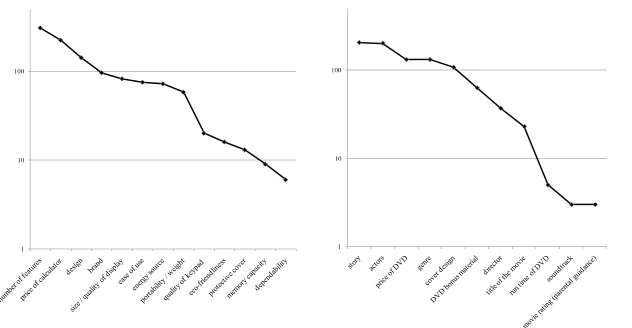
in a free response format. The procedure was then repeated for five pairs of pocket calculators.4
On average and per participant, 9.33 discrete attributes were elicited across the five
choice sets in the DVD pre-test, and 11.41 discrete attributes were elicited across the five
choice sets in the calculator pre-test. The attributes listed by the respondents were grouped and
tabulated on the basis of the total frequency with which they were mentioned, then the
frequency distribution was plotted on a log-scale chart (similar to the scree plot approach in
14 cluster analysis). This plot, listing all elicited attributes, is shown in Figure 1. For both the
DVDs and the pocket calculators, the frequency distribution curve dropped sharply after the
eighth attribute. This suggests that, when asked to introspect on their decision, the majority of
participants considered these eight attributes to have influenced their choice, whereas the
remaining attributes appear to have been salient only for a minority of participants and choices.
Thus, the eight most frequently listed attributes per product were retained as the salient
attributes for the experiment.
---
Insert Figure 1 approx. here
---
Experimental Procedure
Three-hundred thirty-four students were recruited on the campus of a German university as
potential participants for the main experiment. After eliminating incomplete responses and
participants who had already seen the movie that was used as the stimulus in the hedonic
condition, the final data set contains 308 complete cases (55.3% female).
The participants were randomly assigned to two experimental conditions. The stimulus
in the hedonic condition was the motion picture DVD Stay (USA 2006, directed by Marc
Foster, starring Ewan McGregor, Ryan Gosling, and Naomi Watts), and the stimulus in the
utilitarian condition was a pocket calculator, the Sharp EL-W531H. Both stimuli could be
purchased at the time of the experiment from online retailers for approximately €10. The
participants entered separate rooms that contained each condition’s respective stimulus and a
paper-based survey for measuring the hypothesized constructs. After completing the
questionnaire, they were directed into a second room, where an interviewer (the same person
15 calculator, for a price of €4.99. The physical separation of the survey-based intention measures
and measures of actual behavior makes it possible to reduce potential self-generated validity
and interviewer compliance effects (Chandon, Morwitz, & Reinartz, 2005). The purchases were
recorded as a binary measure of actual behavior. 29 of 146 (19.9%) participants in the hedonic
condition and 14 of 163 (8.6%) participants in the utilitarian condition purchased the respective
product.
Manipulation Checks and Scale Validation
To check the effectiveness of the experimental manipulation of hedonic value, the HED/UT
scale developed by Voss and colleagues (2003) was used. As expected, the movie DVD scores
significantly higher on the five-item HED subscale (4.69) than the calculator (3.07; F (1, 308)
= 139.25, p < .001; Cronbach .880). Likewise, the calculator scored significantly higher on
the five-item UT subscale (5.13) than for the movie DVD (2.32; F (1, 308) = 417.34, p < .001;
Cronbach .927). Subsequently, only the HED subscale was used to evaluate the hedonic
value of the stimuli. The attribute importance wi and evaluations ei were gathered for the eight
attributes per stimulus, using the adequacy-importance formulation (Mazis et al., 1975). The
attitude toward the object Aobj measure contains two items ( = .882), and purchase intention is
a single item. All the items appear in the Appendix.
In both temporal dimensions (anticipatory emotions and emotional expectations), the
four emotion constructs (Positive Low Activation, Positive High Activation, Negative Low
Activation, Negative High Activation5) were measured as reflective constructs with three to six
items each, based on the emotions listed for each dimension in Larsen and Diener’s (1992)
5 For the sake of brevity, the authors will refer to Positive Low Activation as “PosLoAct”, Positive High Activation
16 circumplex model. Cronbach alphas for the constructs range from .835 to .930. The
discriminant validity between the emotion constructs was assessed with a confirmatory factor
analysis (employing LISREL) of the eight emotion constructs (four emotion constructs in both
anticipatory emotion and emotional expectation dimensions). Then, the χ² of a model in which
constructs are allowed to correlate freely (χ² = 5772.96) was compared with several constrained
models. Specifically, when constraining the correlation between any pair of anticipatory
emotion constructs to 1, the chi-square increases significantly (all χ² differences > 528.89, df
change = 1, p < .001). Similarly, when constraining any pair of emotional expectation
constructs to unity, it was found that the chi-square also increases significantly (all χ²
differences > 111.80, df change = 1, p < .001). It was thus concluded that within their temporal
dimensions, anticipatory emotions and emotional expectations exhibit discriminant validity
(Bagozzi, Yi, & Phillips, 1991). The same conclusion emerges when pairs of anticipatory
emotions and emotional expectations were constrained to unity, with the exception of two pairs
that fail to exhibit discriminant validity as a result of their high correlation: anticipatory
NegLoAct–anticipated NegLoAct and anticipatory NegHiAct–anticipated NegHiAct. This
result may be explained by the finding that consumers are likely to infer their future (expected)
emotions from their current (anticipatory) emotional experience (Wilson & Gilbert, 2003). In
the calculations, this was remedied by removing the effect of anticipatory emotions on
emotional expectations through adjusted regressions, as described subsequently. The
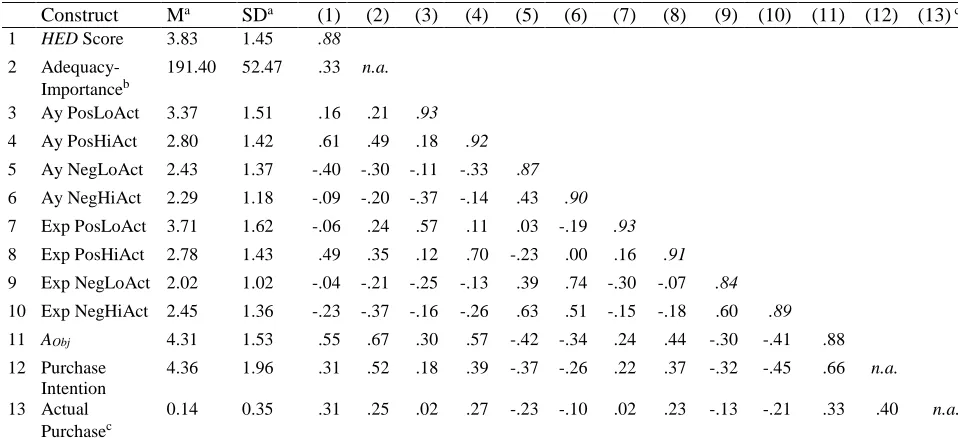
descriptive statistics and correlations appear in Table 2.
---
Insert Table 2 approx. here
---
17 latter conceptualization would have required that emotions are mutually exclusive, so that the
unipolar scales of PosHiAct versus NegLoAct (and PosLoAct versus NegHiAct) would have to
correlate with close to -1. However, the actual correlations were r (anticipatory PosHiAct,
anticipatory NegLoAct) =-.33, r (anticipatory PosLoAct, anticipatory NegHiAct) =-.37, r (expected
PosHiAct, expected NegLoAct) =-.15 and r (expected PosLoAct, expected NegHiAct) =-.07,
pointing to the existence of mixed emotions. This suggests that the emotion dimensions anchoring
the bipolar scales are far from mutually exclusive. While having two emotion dimensions per time
frame would be more parsimonious than having four, the four emotion constructs were employed
due to the observed correlations and discriminant validity.
Results for Hypothesis 1
The hypotheses were tested with a series of adjusted multistage regression models that use the
standardized residuals of the initial regression steps as independent variables in subsequent
regression steps. This procedure decomposes effects in path analysis and makes it possible to
estimate models that contain both linear and logistic relations among the variables, as is the
case for the EVM outcomes of attitude, intentions, and actual purchase (Lance, 1988). In short,
the purpose of calculating the residuals through multi-stage regressions is to test (1) the effect
of emotions on attitude, (2) the effect of emotions on intentions that is not already contained in
attitude, and (3) the effect of emotions on actual purchase behavior that is not already
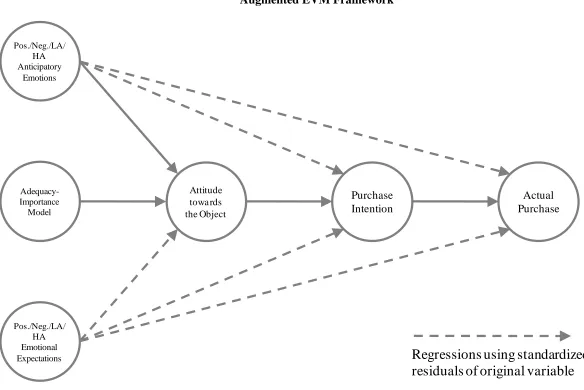
contained in either attitude or intention. Figure 2 shows the general augmented EVM
framework, outlining which variables are exogenous and which are included as standardized
residuals for each of the three regressands Aobj, PI, and AP.
---
Insert Figure 2 approx. here
18 In the augmented EVM models, linear regressions of each expected PosLoAct,
PosHiAct, NegLoAct, and NegHiAct emotion on its anticipatory counterpart were first run and
the standardized residuals were saved. This approach removes any effect of anticipatory
emotions on emotional expectations from subsequent regressions that involve both temporal
emotion dimensions. To test H1a, Aobj was regressed on the adequacy-importance score,
anticipatory emotion, and the emotional expectation residuals, and then compared with the
“traditional” EVM model in which Aobj is regressed only on the adequacy-importance model.
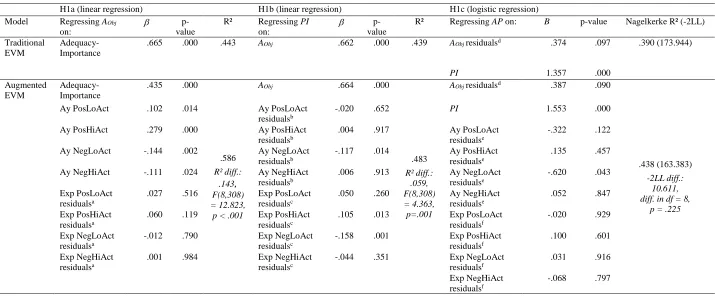
For support, H1a would require a significant increase in R2. The traditional EVM model attains
an R² of .443, and the model that includes the emotion constructs produces an R² of .586 for
Aobj (see Table 3).
---
Insert Table 3 approx. here
---
As the augmented model uses more information, it must be determined whether this
increase in variance explanation is trivial. However, because the R² difference of .143
(F(8,308) = 12.823, p < .001) between the two models which balances variance explanation
against the amount of used information is significant, it can be claimed that the inclusion of
anticipatory emotions and emotional expectations significantly improves the prediction of Aobj,
in support of H1a. However, though the adequacy-importance model and all four anticipatory
emotion constructs directly influence Aobj as expected, none of the emotional expectation
dimension residuals has a significant effect. When separate regressions for the hedonic
condition and utilitarian condition subsamples were conducted, H1a holds true in both the
hedonic condition (traditional EVM R² = .529, augmented EVM R² = .663, R² difference =
19 augmented EVM R² = .566, R² difference = .155, F (8,162) = 6.78, p < .001). In the hedonic
condition, anticipatory PosHiAct and anticipatory NegLoAct are significant at p < .01, and
expected PosHiAct is significant at p < .05. In the utilitarian condition, on the other hand,
anticipatory PosLoAct and anticipatory NegHiAct are significant at p < .01, and anticipatory
PosHiAct is significant at p < .05. The adequacy-importance score is significant at p < .001 in
both subsamples. That is, counter to the prediction, including emotion measures significantly
improves the prediction of Aobj for not only hedonic products but also utilitarian objects.
To test H1b, each anticipatory emotion dimension and the residuals of each emotional
expectation dimension was linearly regressed on Aobj and the standardized residuals were saved.
Consistent with the objectives of this research, this was done to obtain the incremental effect of
anticipatory emotions and emotional expectations on the subsequent outcome variables
purchase intentions (PI) and actual purchase (AP), i.e. the effect not already included in Aobj6.
Then, the augmented EVM model was calculated as the regression of PI on Aobj and the
residuals of anticipatory emotions and emotional expectations. Table 3 lists the results; for the
augmented EVM model, R² reaches .488, compared with an R² of .439 for the traditional EVM
model in which PI are regressed on Aobj only. The R² difference of .049 (F(8,308) = 3.55, p <
.01) is again significant, in line with H1b. Similar to when attitudes are the dependent variable,
regarding influencers of purchase intention, anticipatory NegLoAct, expected PosHiAct, and
expected NegLoAct are significant, whereas the other emotions are not. H1b receives support
for both hedonic (traditional EVM R² = .560, augmented EVM R² = .629, R² difference = .069,
F (8,146) = 3.16, p < .01) and utilitarian (traditional EVM R² = .356, augmented EVM R² =
6 Please note that the direction of this regression, from A
20 .429, R² difference = .073, F (8,162) = 2.45, p < .05) conditions. In the former, anticipatory
PosLoAct is significant, in addition to the emotions that are significant in the full sample
analysis, whereas in the latter condition, only expected PosHiAct and expected NegLoAct are
significant at p < .10.
To test H1c, each expected emotion was regressed on its anticipatory emotion
counterpart and the residuals were saved. Next, each anticipatory emotion and each expected
emotion residual were regressed on Aobj and PI and the residuals were saved to obtain the
effects of anticipatory emotions and expected emotions on actual purchase (AP) that are not
already contained in Aobj and PI. Then, Aobj was regressed on PI and the residuals were saved to
capture the direct effect of Aobj on AP thatis not already contained in PI. As a fourth and final
step, a logistic regression of AP on PI, the Aobj residuals, and the residuals of anticipatory and
expected emotion was run. For the traditional EVM model, a logistic regression of AP on PI
and the Aobj residuals (saved from the regression of Aobjon PI) was calculated.
The results are also included in Table 3. For the augmented EVM model, a Nagelkerke
R² of .438 (-2LL = 163.383) was obtained; only anticipatory NegLoAct directly influences AP.
In the case of the traditional EVM model, the Nagelkerke R² is only .390 (-2LL = 173.994), but
the likelihood ratio test (Hosmer & Lemeshow, 2004) indicates that the -2LL difference is not
significant (χ² = 10.61, df = 8, p = .225). Therefore, predictions of actual purchase do not
improve significantly when anticipatory and expected emotion constructs were included, and
H1c must be rejected. The same result occurs for both the hedonic and utilitarian condition
subsamples.
Results for Hypothesis 2
To test H2, it was calculated whether the effects of the anticipatory and expected emotion
21 hedonic versus utilitarian conditions. To do so, the residual-centering procedure introduced by
Lance (1988) was employed. For H2a, an interaction term was created first for each
anticipatory emotion and each residual of the expected-on-anticipatory emotion regressions by
multiplying the respective values with the binary condition (i.e., hedonic = 1, utilitarian = 0).
Then, each interaction term was regressed on its two main effects, that is, the anticipatory
emotion (expected emotion residual) and the hedonic (utilitarian) condition. The resulting
residuals were used alongside the other independent variables and the main effects from the
augmented EVM regression model, with Aobj as the outcome variable.
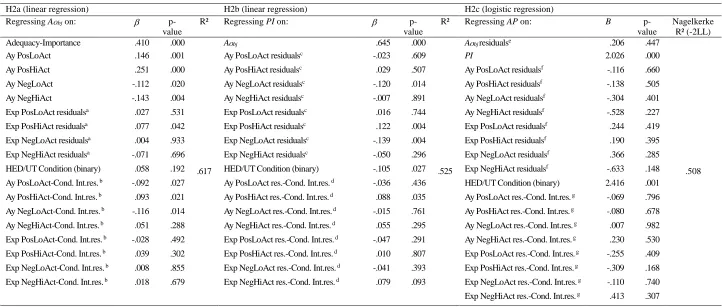
The results, reported in Table 4, uncover three significant interaction residual terms:
anticipatory PosHiAct × condition ( = .093, p < .05), anticipatory NegLoAct × condition ( =
-.116, p < .05), and anticipatory PosLoAct × condition ( = -.092, p < .05). Because interaction
effects represent the estimated change in the slope of Y on X1, given a one -unit change in X2
(Jaccard, Wan, & Turrisi, 1980), this means that anticipatory PosHiAct emotion (i.e.
enthusiasm, elation, excitement) has a stronger positive effect, and its opposing dimension of
anticipatory NegLoAct emotion (i.e. boredom, sluggishness, dullness) has a stronger negative
effect on Aobj when the product is hedonic, in partial support of H2a. However, the positive
effect of anticipatory PosLoAct emotions (i.e. relaxation, contentedness, serenity) on Aobj
becomes weaker when the product is hedonic though, which partially contradicts H2a.
---
Insert Table 4 approx. here
---
For the tests of H2b and H2c, interaction terms were analogously created by multiplying
the residuals of each anticipatory and expected emotion contained in the augmented EVM
22 on the main effects to obtain the interaction residuals. Next, they were added to the respective
augmented EVM model. In the linear regression with PI as the dependent variable, a significant
anticipatory PosHiAct × condition interaction ( = .088, p < .05) was found, which indicates that
the direct effect of enthusiasm, elation, and excitement on PI (which is not mediated through
Aobj) becomes stronger when the product is hedonic, in support of H2b (see Table 4). However,
none of the other anticipatory emotion residual (expected emotion residual) × condition
interactions is significant. In the augmented EVM logistic regression with actual purchase as
the outcome variable, no significant interaction residual term was found, which fails to provide
support for H2c. Overall, support for H2 is limited, in that H2c must be fully rejected and,
regarding H2a and H2b, that some but not all anticipatory emotions become more important to
the decision-making process when the product is hedonic.
DISCUSSION AND IMPLICATIONS
This is the first study that attempts to broaden the EVM by integrating it with a dimensional theory
of emotion and tests the effects of emotions on three stages of decision-making: attitude formation,
intention formation, and behavior. This research also accounts empirically for the distinction
between anticipatory emotions and emotional expectations, an issue rarely addressed by extant
research, and it joins various strands of emotion research by testing the moderating effects of
hedonic value in this setting.
Our findings have implications both for marketing scholars and practitioners. In general,
the results show that augmented EVM models explain significantly more variance of Aobj than
does the traditional EVM, because several anticipatory emotion and emotional expectation
constructs have strong direct effects on Aobj that are not captured by assessing product attribute
23 Similarly, the prediction of purchase intentions can be improved significantly by the inclusion
of the direct effects of anticipatory emotions and emotional expectations that are not already
contained in Aobj, as was demonstrated through the adjusted regressions approach. This is
consistent with earlier findings (Kulviwat et al., 2007) which demonstrate that variance
explanation attitudes and intentions in the Technology Acceptance Model, which has the same
roots as the EVM, can be improved by augmenting it with a dimensional model of emotion. It
is interesting to note that this study’s findings hold for both hedonic and utilitarian conditions,
which indicates that predictions of both global attitudes and purchase intentions for extremely
utilitarian products, such as pocket calculators, can be enhanced by accounting for emotions.
This appears to run counter to Pham’s (1998) findings which show that emotions play a more
important role for hedonic (“consummatory”) than for utilitarian (“instrumental”) consumption
episodes. The disparity may be explained by an important difference between Pham’s and the
present study. While the present research experiment used a product genuinely perceived as
utilitarian (i.e. a pocket calculator), Pham merely gave participants a utilitarian motive for
consuming a hedonic product (i.e. watching a movie in order to be able to write a better t erm
paper essay and win prize money). Thus, in Pham’s study, the relevance of emotional responses
to the prospect of watching a movie was diminished by introducing the utilitarian (and
extrinsic) motive, thus reducing the reliance on emotions in the consumption decision. In the
present research study, participants appear to have viewed emotions elicited by the pocket
calculator as both representative and relevant to their decision – for example, they may have
wished to avoid feeling anxious and annoyed about it when having to rely on it during an
important exam. Thus, just because a product is utilitarian, one should not assume that the
24 An analysis of the subsamples also reveals that anticipatory emotions (vs. emotional
expectations) play a relatively bigger role in the hedonic condition (vs. the utilitarian
condition). This finding may be explained by the theoretical difference between anticipatory
emotions and emotional expectations: The latter are phenomenologically closer in nature to
cognitive expectations, whereas the former are truly experienced emotions. When evaluating
emotion-related hedonic products, the aforementioned representativeness heuristic (Pham ,
1998) may therefore explain why anticipatory emotions are weighted more heavily in hedonic
consumption decisions than emotional expectations.
The prediction of actual purchases, however, cannot be improved significantly by
adding anticipatory emotions and emotional expectations as predictors. Evidently, the further
one moves along the decision-making stages, the weaker are the direct effects of emotion
because an increasing amount of variance is captured by the traditional EVM variables due to
the adjusted regressions. Yet emotions indirectly influence PI through mediation by Aobj and
AP through mediation by Aobj and PI. It was also found that anticipatory emotions and
emotional expectations can be empirically distinguished, and that they influence consumer
decision making at different stages. As conjectured, currently experienced (anticipatory)
emotions have a stronger effect on Aobj, whereas expected future (expected) emotions have a
stronger effect on PI, quite possibly due to their shared temporal anchor.
It may be argued that the relationship between anticipatory emotions and emotional
expectations is the inverse of what is assumed in this research, i.e. emotional expectations
guiding the formation of anticipatory emotion. For example, anticipating the negative emotions
associated with visiting the dentist in the future may make one feel dreadful at the moment. Or
anticipating the positive emotions, e.g. elation/excitement, from the upcoming vacation may lead
25 detail in the manuscript) was run incorporating this inverse relationship.7 As would be expected
due to the adjusted regression methodology, reversing the causal relationship between
anticipatoryemotions and emotional expectations does not influence the R² or Nagelkerke R² of
the Augmented EVM models, and therefore has no effect on the confirmation or
disconfirmation of hypotheses. What happens, however, is that the effects of emotional
expectations generally increase, whereas the effects of anticipatory emotions generally decrease
(this shift is most pronounced when AObj is the dependent variable, and less so when PI and AP
are the dependent variables). Again, this is a result of the methodology, which reassigns
variance explanation to emotional expectations that was previously attributed to anticipatory
emotions. This also means that the interpretation of the relative effects strengths of anticipatory
emotions versus emotional expectations is influenced by the theoretical perspective taken. If
one assumes that anticipatory emotion guides emotional expectation (as originally argued in
this research), and thus removes from emotional expectation all variance explanation already
contained in anticipatory emotion, then the effects of anticipatory emotions will grow stronger
relative to emotional expectations, and vice versa.
In terms of the emotion circumplex model, this research shows that the emotional axis of
boredom/dullness versus excitement/elation is weighted more heavily during the formation of
Aobj when the product is hedonic rather than utilitarian. This effect decreases when PI
represents the dependent variable, and it disappears when AP is the dependent variable. It is
also conceivable that the choice of hedonic stimulus, a motion picture DVD, may have
contributed to the higher weighting of the PosHiAct/NegLoAct dimension. For different types
of hedonic consumption experiences, e.g. a massage, the PosLoAct dimension (relaxation,
contentment, serenity) may be a better predictor.
26 For marketing practitioners, this study’s results highlight the need to take emotional
responses into account when using expectancy-value models to predict consumers’ brand
attitudes and purchasing intentions. Examples abound of manufacturers, marketers, and
marketing scholars having relied on expectancy-value models to inform product design
decisions (Watkins, 2008) and predict attitudes and purchasing intentions towards utilitarian
and hedonic products (online banking - Yousafzai, Foxall, & Pallister, 2010; tourism, local
cuisine - Ryu & Han, 2010; games versus grammar checking software – Kempf, 1999). As
Kempf (1999) argues, in all of these settings, practitioners can benefit from being able to
predict which category of responses – attribute evaluations versus emotions – will be most
important to attitudes, purchasing intentions, and choice. A more precise understanding of
brand attitude determinants, as provided by the augmented expectancy-value model, can be
used by marketers to tweak product feature sets prior to manufacturing, improve their
understanding of the competitive landscape, and optimize product positioning for both
functional and emotional qualities. This study’s results demonstrate that these benefits are not
only available to marketers of hedonic products, but also to marketers of utilitarian products
where emotional responses have traditionally been viewed as irrelevant to consumer decis ion
making. They show that just because a product or service fulfils a mainly utilitarian purpose,
emotional responses cannot be safely ignored when studying attitude formation and purchase
intentions. Instead, researchers and practitioners should consider whether emotional responses
can conceivably be viewed as both representative and relevant to the target object; the answer
may be “yes” even for many products heretofore considered purely utilitarian.
27 This study contains several limitations. First, by focusing on the expectancy-value model of
attitude, the authors do not control for another component of Fishbein and Ajzen’s (1975)
theory of reasoned action, namely, subjective norms. This construct accounts for the normative
beliefs of a person’s significant others, as well as the person’s motivation to comply with these
beliefs. In the theory of reasoned action, it is modeled to have a direct effect on intentions,
parallel to (and independent of) Aobj. There is little doubt about the power of subjective norms
in most settings studied by social psychologists, yet their role in purchasing decisions for every
day consumer goods appears more equivocal. At least five recent empirical studies based on the
theory of reasoned action find no effect of subjective norms on purchase intentions or purchase
behavior (Bosnjak, Obermeier, & Tuten, 2006; Helmig, Huber, & Leeflang, 2007; Hsu, Wang,
& Wen, 2006; Njite & Parsa, 2005; Wang, Chen, Chang, & Yang, 2007). Similarly, the
purchase of the pocket calculator or DVD in this study is not likely to engender strong approval
or disapproval by participants’ significant others, so subjective norms should not have biased
the results. Nevertheless, accounting for subjective norms in further studies might prove
instructive; it would be particularly interesting to examine the interplay between emotions and
subjective norms in determining Aobj and intentions.
Second, Ajzen’s (1991) extension of the theory of reasoned action, the theory of planned
behavior, is ignored, which adds perceived behavioral control as an antecedent of intentions,
alongside Aobj and subjective norms. Perceived behavioral control captures the perceived ease
or difficulty associated with performing the behavior in question. In the context of this
28 difficulty with the act of purchasing a simple consumer good for €4.99 and that the behavior
was within their locus of control.8
Third, as with any study that relies on survey-based (self-reported) measures of emotion,
the measurement method might have introduced distortions by prompting respondents to
introspect on, cognitively process, and report on their emotional states. Thus , latent and
unconscious processes that otherwise would not have been salient or active during “normal”
decision making might have become salient or activated. Conversely, respondents might not
have been able to cognitively access their latent and unconscious emotional states, which would
prevent their accurate reports. Therefore, though the survey-based emotion measures exhibit
both internal and external validity, it could prove instructive to combine them with alternative,
non–self-reported measures in additional studies. For example, physiological measures such as
skin conduction resistance, blood pressure, pupil dilation, or heart rate could capture the
activation dimension of emotion. However, there is great difficulty in using such autonomic
nervous system measures to distinguish responses along the pleasantness dimension (Levenson,
1992). Modern brain imaging techniques, such as functional magnetic resonance imaging
(fMRI), may be used to observe the activation of brain areas generally associated with ple asure
and arousal, but these techniques, too, highly depend on subjective interpretations by the
researcher. Moreover, physiological and neurological measures are physically intrusive (i.e.,
electrodes applied to the respondents’ skin or head, eye monitoring devices) or require
extremely noisy machinery and claustrophobic environments. They therefore introduce their
own set of problems and distortions. For decision-making studies such as this one, the most
practical and unobtrusive external measure of emotion may be facial action coding. To apply
8 If participant had no cash but stated an interest in purchasing the product, the researchers allowed him or her to return
29 the faction action coding system (FACS; Ekman & Friesen, 1978), participants would have to
be filmed during the choice experiment, and specifically trained judges would then
independently analyze and code the participants’ facial expressions into the emotional states
they believed the participants had experienced during the experiment.
The above limitations notwithstanding and without taking anything away from all
research subsequent to the emergence of the expectancy-value model, it appears that for many
practical situations the EVM with its simplicity may suffice. In this sense, a resurrection of the
utility of the EVM in the literature seems in order. However, whether a researcher or
practitioner should augment the expectancy-value model with anticipatory emotion and
emotional expectation constructs depends on the trade-offs he or she is willing to make, as well
as the stage of decision making under investigation. For some practical purposes, especially
when the antecedents of overall attitude formation are not of interest, traditional EVM is more
parsimonious and easier to handle. On the other hand, the additional variance explanation
offered by anticipatory emotions and emotional expectations is huge for Aobj, considerable and
significant for PI, but only marginal for AP. Thus, for researchers and marketing practitioners
30 REFERENCES
Aaker, J., Drolet, A., & Griffin, D. (2008). Recalling mixed emotions. Journal of Consumer
Research, 35, 268-278.
Ajzen, I. (1991). The theory of planned behavior. Organizational Behavior and Human Decision
Processes, 50, 179-211.
Ajzen, I., & Fishbein, M. (2005). The influence of attitudes on behavior. In D. Albarracín, B. T.
Johnson, & M. P. Zanna (Ed.), The handbook of attitudes (pp. 173-221). Mahwah, NJ:
Erlbaum.
Allen, C. T., Machleit, K. A., & Kleine, S. S. (1992). A comparison of attitudes and emotions as
predictors of behavior at diverse levels of behavioral experience. Journal of Consumer
Research, 18, 493-504.
Bagozzi, R. P., Baumgartner, H., Pieters, R., & Zeelenberg, M. (2000). The role of emotions in
goal-directed behavior. In S. Ratneshwar, D. G. Mick & C. Huffman (Ed.), The why of
consumption: Contemporary perspectives on consumer motives, goals and desires (pp. 36-58).
New York, NY: Routledge.
Bagozzi, R. P., Dholakia, U., & Basuroy, S. (2003). How effortful decisions get enacted: The
motivating role of decision processes, desires, and anticipated emotions. Journal of Behavioral
Decision Making, 16, 273-295.
Bagozzi, R. P., Gopinath, M., & Nyer, P. U. (1999). The role of emotions in marketing. Journal of
the Academy of Marketing Science, 27, 184-206.
Bagozzi, R. P., Gürhan-Canli, Z., & Priester, J. R. (2002). The social psychology of consumer
31 Bagozzi, R. P., Yi, Y., & Phillips, L. W. (1991). Assessing construct validity in organizational
research. Administrative Science Quarterly, 36, 421-458.
Batra, R., & Stayman, D. M. (1990). The role of mood in advertising effectiveness. Journal of
Consumer Research, 17, 203-214.
Bodur, H. O., Brinberg, D., & Coupey, E. (2000). Belief, affect, and attitude: Alternative models of
the determinants of attitude. Journal of Consumer Psychology, 9, 17-28.
Bosnjak, M., Obermeier, D., & Tuten, T. L. (2006). Predicting and explaining the propensity to bid
in online auctions: A comparison of two action-theoretical models. Journal of Consumer
Behaviour, 5, 102-116.
Breckler, S. J., & Wiggins, E. C. (1989). Affect versus evaluation in the structure of attitudes.
Journal of Experimental Social Psychology, 25, 253-271.
Breivik, E., & Supphellen, M. (2003). Elicitation of product attributes in an evaluation context: A
comparison of three elicitation techniques. Journal of Economic Psychology, 24, 77-98.
Caruso, E. M., & Shafir, E. (2006). Now that I think about it, I'm in the mood for laughs: Decisions
focused on mood. Journal of Behavioral Decision Making, 19, 155-169.
Chandon, P., Morwitz, V. G., & Reinartz, W. J. (2005). Do intentions really predict behavior?
Self-generated validity effects in survey research. Journal of Marketing, 69, 1-14.
Cohen, J. B., Pham, M. T., & Andrade, E. B. (2008). The nature and role of affect in consumer
behavior. In C. P. Haugtvedt, P. M. Herr, & F. R. Kardes (Ed.), Handbook of consumer
psychology (pp. 297-348 ). Boca Raton, FL: CRC Press.
Damasio, A. R. (1994). Descartes' error: Emotion, reason, and the human brain. New York:
Putnam.
32 Ekman, P., & Davidson, R. J. (1994). The nature of emotion: Fundamental questions. New York:
Oxford University Press.
Ekman, P., & Friesen, W. V. (1978). Facial action coding system. Palo Alto, CA: Consulting
Psychologists Press.
Fishbein, M. (1967). Attitude and the prediction of behavior. In M. Fishbein (Ed.), Readings in
attitude theory and measurement (pp. 477-492). New York: Wiley.
Fishbein, M., & Ajzen, I. (1975). Belief, attitude, intention and behavior: An introduction to theory
and research. Reading, MA: Addison-Wesley.
Forgas, J. P., & Bower, G. H. (2000). Mood effects on person-perception judgments. In G. Gerrod
Parrott (Ed.), Emotions in social psychology: Essential readings (pp. 204-215). New York,
NY: Psychology Press.
Francis, J., Eccles, M., Johnston, M., Walker, A., Grimshaw, J., Foy, R., et al. (2004). Constructing
questionnaires based on the theory of planned behavior. Research-Based Education and
Quality Improvement. University of Newcastle upon Tyne, UK.
Helmig, B., Huber, J., & Leeflang, P. (2007). Explaining behavioural intentions toward co-branded
products. Journal of Marketing Management, 23, 285-304.
Hirschman, E. C., & Holbrook, M. B. (1982). Hedonic consumption: Emerging concepts, methods
and propositions. Journal of Marketing, 46, 92-101.
Holbrook, M., & Hirschman, E. (1982). The experiential aspects of consumption: Consumer
fantasies, feelings, and fun. Journal of Consumer Research, 9, 132-140.
Hosmer, D. W., & Lemeshow, S. (2004). Applied logistic regression (2nd ed.). New York: John
33 Hsu, T., Wang, Y., & Wen, S. (2006). Using the decomposed theory of planned behaviour to
analyse consumer behavioural intention towards mobile text message coupons. Journal of
Targeting, Measurement & Analysis for Marketing, 14, 309-324.
Izard, C. E. (1977). Human emotions. New York: Plenum.
Jaccard, J., Wan, C. K., & Turrisi, R. (1980). The detection and interpretation of interaction effects
between continuous variables in multiple regression. Multivariate Behavioral Research, 25,
467-478.
Kempf, D. S. (1999). Attitude formation from product trial: Distinct roles of cognition and affect for
hedonic and functional products. Psychology & Marketing, 16, 35-50.
Kulviwat, S., Bruner II, G., Kumar, A., Nasco, S., & Clark, T. (2007). Toward a unified theory of
consumer acceptance technology. Psychology & Marketing, 24, 1059-1084.
Lance, C. E. (1988). Residual centering, exploratory and confirmatory moderator analysis, and
decomposition of effects in path models containing interactions. Applied Psychological
Measurement, 12, 163.
Larsen, R. J., & Diener, E. (1992). Promises and problems with the circumplex model of emotion.
Review of Personality and Social Psychology, 13, 25-59.
Lerner, J. S., Small, D. A., & Loewenstein, G. F. (2004). Heart strings and purse strings: Carryover
effects of emotions on economic decisions. Psychological Science, 15, 337-341.
Levenson, R. W. (1992). Autonomic nervous system differences among emotions. Psychological
Science, 3, 23-27.
Loewenstein, G. F., Weber, E. U., Hsee, C. K., & Welch, N. (2001). Risk as feelings. Psychological
Bulletin, 127, 267-286.
MacInnis, D. J., & de Mello, G. E. (2005). The concept of hope and its relevance to product