Volume: 04, Issue: 03
(
May-
June, 2018)
162
Improved Data Hiding Based on Digital Image Encrypted Using Block
Histogram Technique and PHCT
Abhishek Mishra
1M. Tech. Scholar Department of CSE ASCE, RGPV, Bhopal M.P., India, [email protected];
Prof. B.P.S. Senger
2Asst. Professor, Department of CSE, ASCE, RGPV, Bhopal, M.P., India, bpssenger @gmail.com;
ABSTRACT- Improved information hiding supported digital image encrypted using block histogram technique and particle histogram changing technique (PHCT). Image data security and image data integrity are the two difficult areas for analysis in image processing. Such a lot of researches are progressing on the field like internet security supported image information or data. The need of secure transmission of image data is vital issue in IP. The transmission ought to be more secure once channel and network is simply too noisy and fraudulent. Image information transmission is one among the applications that must be securely transmitted over the duplicity network. Secure transmission of image is needed in numerous fields like drugs, military etc. once it's desired to send the confidential vital secure information over an insecure and online internet. It’s customary to write in code as well as compress the cover information then introduce the secure information into that cover information Proposed particle histogram changing technique based on strong histogram encrypted data image. Proposed technique a particle histogram changing in image pixel component values. It is the general behavior for strong histogram encrypted data image and image data hiding strong and recover toughness of encrypted particle histogram image data or information hiding. It is high-quality security, privacy and image data recovery with original. Information transfer secures one and to another end with security of encrypted particle histogram image data also as maintaining the standard of original encrypted particle histogram image data all over transfer.
KEYWORDS: Digital Image Watermarking, Histogram, Image Data Hiding, Block Histogram Shifting, Image encryption, PSNR, MSE, Image Security, PHCT.
I. INTRODUCTION
Nowadays the information is transmitted by embedding it in pictures. This way improves the safety of the information. This kind of information activity during which the changeability are often achieved is named as Reversible information activity. This system is especially employed in case of encrypted pictures. Therefore the protection of the duvet image is often ensured. They’ll use this system wherever situation during which each the transmitted information and therefore the cover image is confidential, web could be a common manner for information transmission. A lot of and a lot of information is out there on the net because of growth in info technology. With growth in digital information there have some security issues. To unleash the burden of information Management user most popular outsourcing of information to the cloud. For information privacy and security several user utilized cryptography techniques for encryption before uploading it on cloud. So as to confidentially convey secret messages stenography is that the efficient manner utilized by user for transmission information activity. In stenography, carriers are often pictures, audio or video. Original image is treated
as cover image and therefore the alternative image during which information is embedded called stego image. However the matter is occurred throughout embedding some distortion in stego image. It’s called “embedding distortion”. To recover the first image there's standard technique is out there called, “RDH”, its reversible information activity technique which may extracts embedded message from image while not losing original image. It will establish on security and stenography techniques. Several applications like, law forensics, military representational process, medical representational process etc needed original cowl with none distortion. RDH contains 2 forms of information activity techniques specifically, Reversible and Non-reversible. The reversible information activity in encrypted pictures relies on the technique RIT i.e. reversible image transformation. each ways represent the linguistics lossless compression by that some house are going to be preserved for extracting information embedded in image.
Fig1 draws of lossless data hiding scheme
Process encrypted information is often quite helpful for several applications, like activity info within an encrypted image. a typical application could be a buyer-seller watermarking protocol during which the vendor of the transmission product encrypts the first information employing a public secret writing key then embeds a novel fingerprint to spot the client within the encrypted information. A lot of general case might be a thing during which the content owner has encrypted a picture however needs to imbed over one extra information stream. Reversible information activity (RDH) in pictures could be a technique for embedding extra information into pictures such the first cover image are often lossless recovered when the embedded information [1, 2].
Volume: 04, Issue: 03
(
May-
June, 2018)
163
computing there are several applications for information hiding. Information activity is that the follow of concealing info or files among non secret information. The file containing the key information is named the carrier. The changed carrier seems like original carrier. Best’s carriers are images; audio, video files since everyone will send receive transfer them. The info is hidden not encrypted. Information hiding techniques will be typically classified as, 1) Spatial Domain Technique: In spatial domain steganography bits within the pixels values are modified so as to cover the info. abstraction domain techniques will be classified into Least important Bit (LSB), component price Differencing (PVD), Random component Embedding technique, bar chart Shifting technique, Texture based mostly technique etc. LSB is that the widely used simplest technique wherever there's less probability for degradation of original image.
2) Transform Domain Technique: transform domain embeds info in transform house. During this domain, the image is transformed from spatial domain to frequency domain by victimization any transforms and once a metamorphosis method; the embedding process are going to be worn out correct transform coefficients. The method of embedding information within the frequency of an indication is way stronger than embedding principles that operate within the time domain. Transform domain techniques include DFT, DCT, DWT and that they are less exposed to compression, cropping etc.
3) Distortion Technique: this method store message by distorting the quilt slightly and police work the modification from the first. The decoder perform uses the first cover image throughout cryptography method to search out the difference between original and distorted cover image so as to revive secret message .
i) Masking and filtering: this system is sometimes restricted to grayscale and 24-bit pictures. It doesn’t hide the information in noise level however embeds it in important areas. Masking adds redundancy to the hidden data. This technique is additional strong than LSB modification with reference to compression and completely different forms of image process since the data is hidden within the visible components of the image [3-6].
II. LITERATURE SURVEY
Wien Hong et al. [7]. Proposed an improved version of Zhang’s reversible information hiding technique in encrypted pictures. The first work partitions an encrypted image into blocks, and every block carries one bit by flipping 3 LSBs of a group of pre-defined pixels. The info extraction and image recovery may be achieved by examining the block smoothness. Zhang’s work didn't totally exploit the picture elements in calculative the smoothness of every block and didn't consider the pixel correlations within the border of neighboring blocks. These two problems may reduce the correctness of information extraction. This letter adopts a far better scheme for activity the smoothness of blocks, and uses the facet match theme to any decrease the error rate of extracted bits.
Wei Liu et al. [8]. Suggested a lossless compression methodology for encrypted gray image victimization progressive decomposition and rate-compatible punctured turbo codes. During this methodology they developed resolution progressive compression that has been shown to possess far better secret writing efficiency and less computational quality than existing approaches. Determined that lossless compression of encrypted sources is achieved through Slepian-Wolf secret writing. For encrypted real-world sources like pictures, they're attempting to enhance the compression efficiency. During this paper, he projected a resolution progressive compression scheme that compresses an encrypted image more and more in resolution, such the decoder will observe a low-resolution version of the image, study native statistics supported it, and use the statistics to decrypt the next resolution level. He centered on the look and analysis of a sensible lossless image codec, wherever the image information undergoes stream-cipher based mostly cryptography before compression. Resolution progressive compression is used for this drawback that has far better secret writing efficiency and less computational quality than existing approaches.
X Zhang et al. [9]. Presented a scheme within which, a content owner encrypts the first image victimization an encoding key, and an information-hider embeds extra data into the encrypted image using a data-hiding key however he doesn't understand the first content. With an encrypted image containing extra information, a receiver could 1st rewrite it according to the coding key, so extract the embedded information and recover the first image according to the data-hiding key. within the scheme, the activity of information extraction isn't divisible from the activity of information should be extracted from the decrypted image, so the principal content of original image is opened before knowledge extraction, and, if somebody has the data-hiding key however not the coding key, he's not capable to extract any data from the encrypted image containing extra information.
Xianfeng Zhao et al. [10]. Have projected the system that maintains the changeability. This paper defines the reversible data-hiding in encrypted image by victimization spare area as reserving space before coding. Here additional attention on RDH technique that maintains the changeability meaning original cover recovered when embedding extra information. It provides the protection and confidentiality to user. It’s new topic for cloud information management because of privacy protective needs. the prevailing System enforced by the utilization of the construct of RDH in encrypted pictures by vacant space before coding, however projected system was opposite of it during this we tend to use the reserving construct before coding. The benefits of this projected system are to keep up the additional house for embedding information in information hider module. This technique achieves excellent performance with none loss of information.
Volume: 04, Issue: 03
(
May-
June, 2018)
164
predictive Error expansion (PEE) and element selection. Predictive Error expansion is vital for embedding the info and used for reversible watermarking. It provides authentication and integrity to the user. It additionally improves the payload with low distortion. Wherever distortion free information needed we use the construct of watermarking. PEE is an improvement of the distinction expansion (DE). The planned system represented the threshold price for element of image and it divides the image pixels into 2 elements. Subsequently choose the element on the idea of capability parameter and threshold. Adaptive embedding and picture element choice performed at the same time. This technique reduces the embedding impact with the utilization of decreasing the modification and improves the visual quality.
J. Tian et al. [12]. Has projected a system that uses difference expansion methodology for embedding information in reversible manner for digital pictures. Reversible information embedding means that lossless embedding. Here quality degradation was terribly low when embedding the information. This paper describes a way to live the performance of the system by victimization the conception of reversible information embedding. This may be measured through varied factors like the payload capability limit, visual quality and complexness. This method uses the variations between two neighboring pixels. The LSB’s of the variations are all zero and this embedded to the message. The advantages of the system aren't any loss of knowledge whereas playing compression and decompression. This method is helpful for audio and video information. The drawbacks of the system area unit achieving error due to division by two and attributable to bit replacement visual quality degrade.
Lee et al. [13] .improve technique by transforming the key image to an at random chosen target image with none use of info. In. method, every block of the key image is transformed to a block of the target image with a reversible color transformation, so the specified data for restoring secret image, like parameters, indexes of block, is more into the transformed blocks, it provides Encrypted image. Technique will transform a secret image to an at random chosen target image, and increase quality of the encrypted image. However, in method, the transformation isn't reversible. In order that secret image cannot be lossless reconstructed.
H. Deng et al. [14]. Represented two tailored reversible watermarking schemes for the clinical atlas by exploiting its inherent characteristics. From each of the schemes initial scheme is meant for atlases with homochromous structures. It achieves the changeability. Whereas the second scheme is used to any atlas in palette format, and inquires zero misuse to the watermarked atlas by simply modifying the palette. During this paper, author discussed regarding security problems to digital medical information that classified into 3 aspects like, confidentiality, handiness and authentication.
During this paper author primarily explores the aspect of authentication of medical pictures.
H.J. Kim et al. [15]. Proposed reversible and lossless watermarking algorithmic program while not victimization location data. For comparison of projected reversible watermarking scheme totally different pictures are used and compared with the opposite four strategies. By reducing the dimensions of location map key goals are achieved. Location maps contain the flags having worth either zero or one. Primarily location maps are large in size; if they're compressed they will occupy a part of payload. The projected approach moderately will increase the capability and it additionally needed further data. It exploits the prediction errors with less variance so higher enhancements can do. For low distortion information hiding sorted prediction is used with efficiency. During this paper the projected bar graph shift methodology moderately decreases the dimensions of location map typically.
III Simulation and Result Analysis
(a)The proposed technique are initial perform transformation for color image (RGB format) separately and convert into gray scale images. Proposed technique is recover original content can be perfectly restored after extraction into the cover image is also called reversible image data hiding technique. General digital image processing typically takes place before encryption and after decryption original image data. Proposed technique an image data encryption using particle histogram changing technique (PHCT) and improved PSNR values as compare existing method. Generally the content owner doesn't believe the supplier of the service, in such cases ability to supply manipulating the initial image information content secret is undesirable. Thus manipulation on encrypted information once keeping the initial image information content is appropriate. Any data of the cryptanalytic key might reduce the encrypted information, once the key information to be transmitted. So as to confirm the privacy the content owner should write the info once it shares a secret image with different person. Some data’s like the origin information, image information or authentication information and is wish to be additional among the encrypted original image content. At receiver side it's going to be additionally expected that the initial content is recovered.
Volume: 04, Issue: 03
(
May-
June, 2018)
165
Workspace, which displays information about all output variables defined in current session. The Figure explains the basic MATLAB working environment. It is the high level language and interactive background used by millions of engineers and scientists universal. It lets the explore and visualize ideas and work together across different disciplines with signal and image processing, message and calculation of results. MATLAB provides implements to obtain, analyze, and picture data, allow you to get insight into your data in a division of the time it would take using spreadsheets or traditional programming languages.
(c) Result analysis:
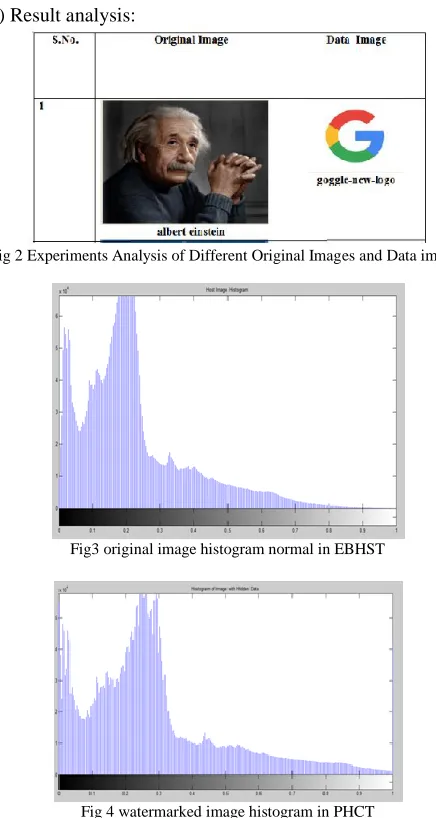
Fig 2 Experiments Analysis of Different Original Images and Data images
Fig3 original image histogram normal in EBHST
Fig 4 watermarked image histogram in PHCT
Albert-einstein as an original image and Google-new-logo image as data image both are embedding and generate watermarked image .In this image also used using particle histogram shifting technique and show watermarked image histogram. proposed work techniques and pervious work is obtained. The corresponding results for this albert-einstein as an original image and Google-new-logo image as data image are shown in above The PSNR and MSE value obtained for albert-einstein as an original image and Google-new-logo image as data image. The proposed system uses
PHCT technique which shows the maximum PSNR and less MSE obtained compared with the existing system are shown above.
IV.CONCLUSION
Proposed technique a particle histogram changing in image pixel component values. It is the general behavior for strong histogram encrypted data image and image data hiding strong and recover toughness of encrypted particle histogram image data or information hiding. It is high-quality security, privacy and image data recovery with original. Information transfer secures one and to another end with security of encrypted particle histogram image data also as maintaining the standard of original encrypted particle histogram image data all over transfer. Reversible information hiding in encrypted pictures may be a new topic drawing attention as a result of the privacy protective needs from cloud information management. Previous ways implement block histogram technique (BHDH) in encrypted pictures by vacating area once encoding, as against that is planned by reserving space before encoding. Therefore the information hider will have the benefit of the additional area empty get in previous stage to create data hiding method effort- less. This methodology will benefit of all traditional BHDH techniques for plain pictures and reach excellent performance while not loss of excellent secrecy. It’s conjointly analyzed a low computation quality. The first pictures are encrypted by an encoding strategy using encoding key. Therefore a study regarding an encoding strategy is performed. Therefore this ways for information embedding are noticed. Lastly, additionally think about a replacement method for secret writing of image. Hence, encoding and secret writing method of a picture by this algorithmic rule protect the image from an unauthorized access to provide a lot of security to a picture and occupies minimum memory area. Compared to the other existing BHDH technique and particle histogram changing technique (PHCT) improves PSNR of the image, is also good. The above work is simulated using MATLAB-2013a simulation tool. Find out results best enhanced of image data hiding and good security. The future work on proposed histogram shifting technique is to implement this to audio and video sequences by dividing the sequences into frames and performing the similar process to each of these frames and to obtain better performances analysis in future.
REFERENCES
[1]. Jun Tian, “Reversible data embedding using a difference expansion,” Circuits and Systems for Video Technology, IEEE Transactions on, vol. 13, no. 8, pp. 890–896, Aug 2003.
[2]. Krishna Priya S, Minu Lalitha Madhavu, “A Survey on Data Hiding Techniques in Encrypted Images”, International Journal of Scientific Engineering and Applied Science (IJSEAS) – Volume-2, Issue-1, ISSN: 2395-3470, January 2016.
Volume: 04, Issue: 03
(
May-
June, 2018)
166
Journal of Advanced Science and Technology Vol. 54, May, 2013.
[4]. V. K. Bhat, I. Sengupta, and A. Das, “Audio Watermarking Based on mean Quantization in Cepstrum Domain,”978-1-4244-2963-9/08 IEEE 2008. [5]. Tribhuwan Kumar Tewari, VikasSaxena, Prof. J P
Gupta “Audio Watermarking: Current State of Art and Future Objectives” IJCTA, Volume 5, Number 7, July 2011.
[6]. M. Arnold, M. Schmucker, and S. D. Wolthusen, Techniques and Applications of Digital Watermarking and Content Protection. Boston, London: Artech House, INC, 2003.
[7]. W. Hong, T. Chen, and H.Wu, “An improved reversible data hiding in encrypted images using side match,” IEEE Signal process. Lett. vol. 19, no. 4, pp. 199–202, Apr. 2012.
[8]. Wei Liu, Wenjun Zeng, Lina Dong, and Qiuming Yao “Efficient Compression of Encrypted Grayscale Images”, Image Processing, IEEE Transactions Vol: 19, April 2010, pp. 1097 –1102.
[9]. X. Zhang, "Reversible data hiding in encrypted images," IEEE Signal Process. Lett., vol. 18, no. 4, pp. 255258, Apr. 2011
[10]. Kede Ma, Wei. Zhang, Xianfeng Zhao, “Reversible data Hiding in Encrypted Images by reserving Room before encryption”, IEEE trans. On information forensics and security, vol, 8 No.3, march 2013.
[11]. Xinpeng Zhang, Jing Long, Zichi Wang, and Hang Cheng, “Lossless and Reversible Data Hiding in Encrypted Images with Public Key Cryptography,” IEEE Trans. on Circuits and Systems for Video Technology, 2015.
[12]. J. Tian, “Reversible data embedding using a difference expansion” Trans. Circuits Syst. Video Technol., vol. 13, no. 8, pp. 890 2003
[13]. Y.-L. Lee and W.-H. Tsai, “A new secure image transmission technique via secret-fragment-visible mosaic images by nearly reversible color transformations,” IEEE Trans. Circuits Syst. & Video Technol., vol. 24, no. 4, pp. 695–703, 2014.
[14]. F. Bao, R. H. Deng, B. C. Ooi, et al., “Tailored reversible watermarking schemes for authentication of electronic clinical atlas,” IEEE Trans. on Information Technology in Biomedicine, vol. 9, no. 4, pp. 554-563, Dec. 2005.
[15]. V. Sachnev, H. J. Kim, J. Nam, S. Suresh, and Y. Q. Shi, “Reversible watermarking algorithm using sorting and prediction,” IEEE Trans. on Circuits and Systems for Video Technology, vol.19, no.7, pp. 989-999, Jul. 2009.
[16]. Qingzhong Li, Chen Yu and Dongsheng Chu,” A robust Image Hiding Method Based on Sign Embedding and Fuzzy classification”, Proceedings of the 6th world congress on Intelligent control and Automation, IEEE, pp: 10050-10053,2006.
[17]. Vinay pandey and Manish Srivastava, “Medical Image Protection Using Steganography by Crypto-image as
cover image”, International Journal of Advanced Computer Research, vol.2, issue 5, pp: 45-48, 2012. [18].Jun Kong, Hongru Jia, Xiaolu Li and Zhi Qi,” A Novel
Content- Based Information Hiding Scheme”, International Conference on Computer Engineering and Technology, IEEE, pp: 436-4401, 2009.
[19].T.V. Nguyen, J.C. Patra, “A simple ICA-based watermarking scheme”, Digit. Signal Process. 18 762– 776, 2008.
[20].L. Luo et al., “Reversible image watermarking using interpolation technique,” IEEE Trans. Inf. Forensics Security, vol. 5, no. 1, pp. 187–193, Mar. 2010.
[21].M. Hassan Najafi and David J. Lilja, “A High-Capacity Separable Reversible Method For Hiding Multiple Messages In Encrypted Images”, 1612.04339v1, 13 Dec 2016.