City, University of London Institutional Repository
Citation:
Kato, K., Galvao Jr, A. F. and Montes-Rojas, G. (2012). Asymptotics for panel quantile regression models with individual effects. Journal of Econometrics, 170(1), pp. 76-91. doi: 10.1016/j.jeconom.2012.02.007This is the accepted version of the paper.
This version of the publication may differ from the final published
version.
Permanent repository link:
http://openaccess.city.ac.uk/id/eprint/12022/Link to published version:
http://dx.doi.org/10.1016/j.jeconom.2012.02.007Copyright and reuse: City Research Online aims to make research
outputs of City, University of London available to a wider audience.
Copyright and Moral Rights remain with the author(s) and/or copyright
holders. URLs from City Research Online may be freely distributed and
linked to.
City Research Online: http://openaccess.city.ac.uk/ [email protected]
Asymptotics for panel quantile regression models
with individual effects
∗
Kengo Kato
†Antonio F. Galvao, Jr.
‡Gabriel V. Montes-Rojas
§February 6, 2012
Abstract
This paper studies panel quantile regression models with individual fixed
ef-fects. We formally establish sufficient conditions for consistency and asymptotic
normality of the quantile regression estimator when the number of individuals,
n, and the number of time periods, T, jointly go to infinity. The estimator is
shown to be consistent under similar conditions to those found in the nonlinear
panel data literature. Nevertheless, due to the non-smoothness of the objective
function, we had to impose a more restrictive condition on T to prove
asymp-totic normality than that usually found in the literature. The finite sample
performance of the estimator is evaluated by Monte Carlo simulations.
Key words: asymptotics, fixed effects, panel data, quantile regression.
JEL Classification: C13, C21, C23.
∗The authors would like to express their appreciation to Roger Koenker, Hidehiko Ichimura,
Kazuhiko Hayakawa, Ryo Okui, Stephane Bonhomme, Ivan Fernandez-Val, participants in the 16th
Panel Data Conference, Amsterdam, and the 10th World Congress of the Econometric Society,
Shang-hai, for useful discussion and advice regarding this paper. We also would like to thank the editor, the
associate editor, and three anonymous referees for their careful reading and comments to improve the
manuscript. All the remaining errors are ours. Kato’s research was supported by the Grant-in-Aid
for Young Scientists (B) (22730179) from the JSPS.
†Department of Mathematics, Graduate School of Science, Hiroshima University, 1-3-1
Kagamiyama, Higashi-Hiroshima, Hiroshima 739-8526, Japan. E:mail: [email protected]
‡Department of Economics, University of Iowa, W210 Pappajohn Business Building, 21 E. Market
Street, Iowa City, IA 52242. E-mail: [email protected]
§Department of Economics, City University London, D306 Social Sciences Bldg, Northampton
1
Introduction
Quantile regression (QR) for panel data has attracted considerable interest in both
the theoretical and applied literatures. It allows us to explore a range of conditional
quantiles, thereby exposing a variety of forms of conditional heterogeneity, and to
control for unobserved individual effects. Controlling for individual heterogeneity via
fixed effects, while exploring heterogeneous covariate effects within the QR framework,
offers a more flexible approach to the analysis of panel data than that afforded by the
classical Gaussian fixed and random effects estimation.
This paper focuses on the estimation of the common parameters in a QR model
with individual effects. We refer to the resulting estimator as the fixed effects quantile
regression (FE-QR) estimator. Unfortunately, the FE-QR estimator is subject to the
incidental parameters problem (Neyman and Scott, 1948; Lancaster, 2000, for a review)
and will be inconsistent if the number of individualsngoes to infinity while the number
of time periods T is fixed. It is important to note that, in contrast to mean regression,
to our knowledge, there is no general transformation that can suitably eliminate the
individual effects in the QR model. Therefore, given these difficulties, in the QR panel
data literature, it is usual to allow T to increase to infinity to achieve asymptotically
unbiased estimators. We follow this approach employing a large n, T asymptotics. In
the nonlinear and quantile regression literatures, the large panel data asymptotics is
used in an attempt to cope with the incidental parameters problem.
The incidental parameters problem has been extensively studied in the recent
non-linear panel data literature. Among them, Hahn and Newey (2004) studied the
max-imum likelihood estimation of a general nonlinear panel data model with individual
effects. They showed that the maximum likelihood estimator (MLE) has a limiting
normal distribution with a bias in the mean whenn andT grow at the same rate, and
proposed several bias correction methods to the MLE. Note that since they assumed
that likelihood functions are smooth, while the objective function of QR is not, their
results are not directly applicable to the QR case.
Koenker (2004) introduced a novel approach for estimation of a QR model for
panel data. He argued that shrinking the individual parameters towards a common
value improves the performance of the common parameters’ estimates, and proposed
a penalized estimation method where the individual parameters are subject to the
ℓ1 penalty. He also studied the asymptotic properties of the (unpenalized) FE-QR
estimator, claiming its asymptotically normality when na/T → 0 for some a > 0.
We provide an alternative formal approach that offers a clearer understanding of the
establish these properties.
The goal of this paper is to study the asymptotic properties of the FE-QR
esti-mator when n and T jointly go to infinity and formally establish sufficient conditions
for consistency and asymptotic normality of the estimator. We show that the FE-QR
estimator is consistent under similar conditions to those found in the nonlinear panel
data literature. We are required to impose a more restrictive condition on T (i.e.,
n2(logn)3/T →0) to prove asymptotic normality of the estimator than that found in
the literature. This reflects the fact that the rate of remainder term of the Bahadur
representation of the FE-QR estimator is of order (T /logn)−3/4. The slower
conver-gence rate of the remainder term is due to the non-smoothness of the scores. It is
important to note that the growth condition on T for establishing √nT-consistency of the FE-QR estimator (or other fixed effects estimators in general) is determined so
that it “kills” the remainder term. Thus, the rate of the remainder term is essential
in the asymptotic analysis of the fixed effects estimation when n and T jointly go to
infinity. The theoretical contribution of this paper is the rigorous study of the rate of
the remainder term in the Bahadur representation of the FE-QR estimator, which we
believe is far from trivial.
From a technical point of view, the proof of asymptotic normality of the FE-QR
estimator is of independent interest. Because of the non-differentiability of the
objec-tive function, the stochastic expansion technique of Li, Lindsay, and Waterman (2003)
is no longer applicable to the asymptotic analysis of the FE-QR estimator. Instead,
we adapt the Pakes and Pollard (1989) approach for proving asymptotic normality
of the estimator. In addition, we make use of some inequalities from the empirical
process literature (such as Talagrand’s inequality) to establish the convergence rate
of the remainder term in the Bahadur representation of the FE-QR estimator. These
inequalities significantly simplify the proof. Our results are also extended to the case
where temporal dependence is allowed.
From an applied perspective, however, the required rate condition for asymptotic
normality might be seen as a negative result. The restrictive condition on T is not
found in most of the panel data applications of interest. However, the paper highlights
that special attention needs to be taken with respect to formal asymptotic study in
the QR panel data (see the discussion in Section 3.2). In addition, it shows that small
sample simulations are an important tool to study the estimator’s performance.
We carried out Monte Carlo simulations to study the finite sample performance of
the FE-QR estimator. The simulation study highlights some cases where the FE-QR
estimator has large bias in panels with large n/T. In addition, the results show that,
as the sample size increases, but on the other hand, the coverage probability of the
asymptotic Gaussian confidence interval may be inaccurate whenn/T is large. This is
probably due to the fact that the variance of the FE-QR estimator decreases whennT
increases while the bias decreases when T increases but is independent of n, so that
the centering of the confidence interval will be severely distorted whenn/T is large.
We now review the literature related to this paper. Lamarche (2010) studied
Koenker’s (2004) penalization method and discussed an optimal choice of the tuning
parameter. Canay (2008) proposes a two-step estimator of the common parameters.
The difference is that in his model, each individual effect is not allowed to change
across quantiles. Graham, Hahn, and Powell (2009) showed that when T = 2 and the
explanatory variables are independent of the error term, the FE-QR estimator does
not suffer from the incidental parameters problem. However, their argument does not
apply to the general case. Rosen (2009) addressed a set identification problem of the
common parameters whenT is fixed. Chernozhukov, Fernandez-Val, and Newey (2009)
considered identification and estimation of the quantile structural function defined in
Imbens and Newey (2009) of a nonseparable panel model with discrete explanatory
variables. They studied bounds of the quantile structural function whenT is fixed and
the asymptotic behavior of the bounds whenT goes to infinity.
This paper is organized as follows. In Section 2, we introduce a QR model with
individual fixed effects and the FE-QR estimator we consider. In Section 3, we discuss
the asymptotic properties of the FE-QR estimator. Proofs of the theorems in Section
3 are given in Appendix. In Section 4, we report a simulation study for assessing
the finite sample performance of the FE-QR estimator. In Section 5 we extend the
asymptotic results of Section 3 to the dynamic case where we allow for dependence
across time. Finally, in Section 6 we present some discussion on the paper.
2
Quantile regression with individual effects
In this paper, we consider a QR model with individual effects
Qτ(yit|xit, αi0(τ)) =αi0(τ) +x′itβ0(τ) (2.1)
where τ ∈ (0,1) is a quantile index, yit is a dependent variable, xit is a p dimensional
vector of explanatory variables,αi0(τ) is thei-th individual effect, andQτ(yit|xit, αi0(τ))
is the conditionalτ-quantile ofyitgiven (xit, αi0(τ)). In general, eachαi0(τ) andβ0(τ)
can depend onτ, but we assumeτ to be fixed throughout the paper and suppress such
a dependence for notational simplicity, such that αi0(τ) = αi0 and β0(τ) = β0.1 We
1In our model, the individual effects include the intercept term and the intercept term depends
make no parametric assumption on the relationship betweenαi0 and xit. Throughout
the paper, the number of individuals is denoted by n and the number of time periods
is denoted by T =Tn that depends on n. In what follows, we omit the subscript n of
Tn.
We consider the fixed effects estimation of β0, which is implemented by treating
each individual effect also as a parameter to be estimated. Throughout the paper,
as in Hahn and Newey (2004) and Fernandez-Val (2005), we treat αi0 as fixed by
conditioning on them.2 We consider the estimator ( ˆα,βˆ) defined by
( ˆα,βˆ) := arg min ¸,˛
1 nT
n
∑
i=1 T
∑
t=1
ρτ(yit−αi−x′itβ), (2.2)
whereα:= (α1, . . . , αn)′ and ρτ(u) := {τ−I(u≤0)}uis the check function (Koenker
and Bassett, 1978). Note that α implicitly depends on n. We call ˆβ the fixed effects
quantile regression (FE-QR) estimator of β0. The optimization for solving (2.2) can
be very large depending on n and T. However, as Koenker (2004) observed, in typical
applications, the design matrix is very sparse. Standard sparse matrix storage schemes
only require the space for the non-zero elements and their indexing locations. This
considerably reduces the computational effort and memory requirements.
It is important to note that in the QR model, there is no general transformation
that can suitably eliminate the individual effects. This intrinsic difficulty has been
recognized by Abrevaya and Dahl (2008), among others, and was clarified by Koenker
and Hallock (2000). They remarked that “Quantiles of convolutions of random
vari-ables are rather intractable objects, and preliminary differencing strategies familiar
from Gaussian models have sometimes unanticipated effects. (p.19)”
3
Asymptotic theory: static case
3.1
Main results
In this section, we investigate the asymptotic properties of the FE-QR estimator.
We first consider the consistency of ( ˆα,βˆ). We say that ˆαis weakly consistent if ˆαi
converges in probability toαi0 uniformly over 1≤i≤n, that is, max1≤i≤n|αˆi−αi0| p
→
0. We introduce some regularity conditions that ensure the consistency of ( ˆα,βˆ).
approach, where the individual specific intercepts are restricted to be the same across the quantiles.
This procedure can be implemented using weighted QR, as proposed initially by Koenker (1984). It is
important to note that both models are identical for our purposes of estimating a single fixed quantile.
(A1) {(yit,xit), t≥1}is independent and identically distributed (i.i.d.) for each fixed
i and independent acrossi.
(A2) supi≥1E[∥xi1∥2s]<∞ for some real s≥1.
The distribution of (yit,xit) is allowed to depend oni. Put uit :=yit−αi0−x′itβ0.
Condition (A1) implies that{(uit,xit), t≥1}is i.i.d. for each fixed iand independent
across i. LetFi(u|x) denote the conditional distribution function ofuit given xit=x.
We assume thatFi(u|x) has density fi(u|x). Letfi(u) denote the marginal density of
uit.
(A3) For each δ >0,
ϵδ := inf
i≥1|α|+inf∥˛∥1=δ
E
[∫ α+x′i1˛
0
{Fi(s|xi1)−τ}ds
]
>0, (3.1)
where ∥ · ∥1 stands for the ℓ1 norm.3
Condition (A1) is the same as Condition 1 (i) of Fernandez-Val (2005). Hahn
and Newey (2004) also assume temporal and cross sectional independence. In
condi-tion (A1) we exclude temporal dependence to focus on the simplest case first and to
highlight the difficulties arising from the FE-QR estimator. The present results are
ex-tended below (Section 5) to the dependent case under suitable mixing conditions as in
Hahn and Kuersteiner (2004).4 Condition (A2) corresponds to the moment condition
of Fernandez-Val (2005, p.12). Condition (A3) is an identification condition of (α0,β0)
and corresponds to Condition 3 of Hahn and Newey (2004). In fact, it is sufficient for
consistency of ( ˆα,βˆ) that (3.1) is satisfied for any sufficiently smallδ > 0. Recall that
Fi(0|xi1) =τ. Under suitable integrability conditions, the expectation in (3.1) can be
expanded as (α,β′)Ωi(α,β′)′+o(δ2) for|α|+∥β∥1 =δ uniformly overi≥1 asδ →0,
where Ωi := E[fi(0|xi1)(1,x′i1)(1,x′i1)′]. If the minimum eigenvalue of Ωi is bounded
away from zero uniformly over i ≥1, there exists a positive constant δ0 such that for
0 < δ ≤ δ0, (3.1) is satisfied. The following result states consistency. The proof is
given in the Appendix.
3There is no significant role in the ℓ
1 norm, as any norm on a fixed dimensional Euclidean space
is equivalent. Theℓ1norm is used just to avoid the notation like ∥(αi−αi0,β′−β′0)′∥.
4The independence assumption is used mainly to apply some standard stochastic inequalities; our
results are extended below to the dependent case by replacing these stochastic inequalities by those
that hold under suitable dependence conditions. We shall mention that the condition onT for the
mean-zero asymptotic normality, which is given in Theorem 3.2 below, is not weakened when the
Theorem 3.1. Assume that n/Ts →0 as n→ ∞, where s is given in condition (A2).
Then, under conditions (A1)-(A3), ( ˆα,βˆ) is weakly consistent.
Theorem 3.1 is not covered by Hahn and Newey (2004) and Fernandez-Val (2005)
because they assumed that the parameter spaces of αi0 and β0 are compact. In our
problem, due to the convexity of the objective function, we can remove the compactness
assumption of the parameter spaces. The condition on T in Theorem 3.1 is the same
as that in Theorems 1-2 of Fernandez-Val (2005). If supi≥1∥xi1∥ ≤M (a.s.) for some
positive constant M, then the conclusion of the theorem holds when logn/T → 0 as n→ ∞. See Remark A.1 after the proof of Theorem 3.1 for details.
Next, we derive the limiting distribution of ˆβ. To this end, we consider another set
of conditions.
(B1) There exists a constant M such that supi≥1∥xi1∥ ≤M (a.s.).
(B2) (a) For eachi, fi(u|x) is continuously differentiable with respect toufor each x
and let fi(1)(u|x) :=∂fi(u|x)/∂u; (b) there exist constants Cf and Lf such that
fi(u|x) ≤ Cf and |f (1)
i (u|x)| ≤ Lf uniformly over (u,x) and i ≥ 1; (c) fi(0) is
bounded from below by some positive constant independent ofi.
(B3) Put γi := E[fi(0|xi1)xi1]/fi(0) and Γn := n−1
∑n
i=1E[fi(0|xi1)xi1(x′i1 −γi′)].
(a) Γn is nonsingular for each n, and the limit Γ := limn→∞Γn exists and is
nonsingular; (b) the limit V := limn→∞n−1
∑n
i=1E[(xi1 −γi)(xi1 −γi)′] exists
and is nonsingular.
Condition (B1) is assumed in Koenker (2004). This condition is used to ensure
the “asymptotic” first order condition displayed in equation (A.7) in the proof of
Theorem 3.2. Condition (B2) imposes some restrictions on the conditional densities
and is standard in the QR literature (cf. Condition (ii) of Angrist, Chernozhukov, and
Fernandez-Val, 2006, Theorem 3). Condition (B3) is concerned with the asymptotic
covariance matrix of ˆβ. Condition (B3) (a) implies that the minimum eigenvalue of
Γn is bounded away from zero uniformly over n≥1.
The term γi is the projection of xi1 onto the constant term 1 with respect to the
norm∥V∥2 = E[f
i(0|xi1)V2] as E[fi(0|xi1)(xi1−γi)] =0, and has the same role as the
mean E[xi1] in the mean regression case.5 More formally, the termγi comes from the
fact that the lowerp×(n+p) part of the inverse Hessian matrix of the expectation of the QR objective function in (2.2) evaluated at the truth is given by Γ−n1[−γ1 · · · −γn Ip].
We now state the main theorem of the paper. The proof is given in the Appendix.
5The norm ∥V∥2 = E[f
i(0|xi1)V2] is a Fisher-like norm to the QR objective function, as
Theorem 3.2. Assume conditions (A1), (A3) and (B1)-(B3). If logn/T → 0 as
n→ ∞ but T grows at most polynomially in n, then βˆ admits the expansion
ˆ
β−β0+op(∥βˆ−β0∥) = Γ−n1
[
1 nT
n
∑
i=1 T
∑
t=1
{τ −I(uit≤0)}(xit−γi)
]
+Op{(T /logn)−3/4}. (3.2)
If moreover n2(logn)3/T →0, then we have
√
nT( ˆβ−β0) d
→N{0, τ(1−τ)Γ−1VΓ−1}.
The restriction thatT grows at most polynomially innis only to simplify the
expo-sition, as it ensures logT =O(logn). We shall stress that the Bahadur representation
(3.2) is valid without the condition thatn2(logn)3/T →0. This condition is used only
to “kill” the remainder term (the second term on the right side of (3.2)). Some other
specific comments are listed in the next subsection.
We now turn to estimate the asymptotic covariance matrix. The estimation of
Γ and V depends on the conditional densities, and therefore, they are not directly
estimated by their sample analogues because the conditional densities are unknown.
We consider the kernel estimation of the matrices Γ and V. Let K :R →R denote a kernel function (probability density function). Let {hn} denote a sequence of positive
numbers (bandwidths) such that hn → 0 as n → ∞. We use the notation Khn(u) =
h−1
n K(u/hn). Let ˆuit =yit−αˆi−x′itβˆ, which can be viewed as an “estimator” of uit.
It is seen that Γ and V can be estimated by
ˆ Γ := 1
nT
n
∑
i=1 T
∑
t=1
Khn(ˆuit)xit(xit−γˆi)
′, Vˆ := 1
nT
n
∑
i=1 T
∑
t=1
(xit−γˆi)(xit−γˆi)′,
where
ˆ fi :=
1 T
T
∑
t=1
Khn(ˆuit), γˆi :=
1 ˆ fiT
T
∑
t=1
Khn(ˆuit)xit.
To guarantee the consistency of ˆΓ and ˆV, we assume:
(C1) The kernel K is continuous, bounded and of bounded variation on R.
(C2) hn →0 and logn/(T hn)→0 as n → ∞.
Condition (C1) is an assumption we only make on the kernel. Most standard
kernels such as Gaussian and Epanechnikov kernels satisfy condition (C1). Although
the uniform kernel does not satisfy condition (C1) as it is not continuous, the continuity
x′β)/hn) : (α,β) ∈Rp+1} is pointwise measurable, and it is verified that the uniform
kernel also ensures this property.6 Condition (C2) is a restriction on the bandwidth
hn. The bandwidthhn needs to be slightly slower than T−1.
Proposition 3.1. Assume conditions (A1), (A3), (B1)-(B3) and (C1)-(C2). If T
grows at most polynomially in n, we have Γˆ→p Γ and Vˆ →p V.
We shall mention that the consistency of ˆΓ and ˆV only requires the consistency
of ( ˆα,βˆ), which is guaranteed by conditions (A1), (A3), (B1) and (C2) (observe that
condition (C2) implies that logn/T → 0). It is now straightforward to see that the asymptotic covariance matrix of ˆβ, τ(1 −τ)Γ−1VΓ−1, is consistently estimated by
τ(1−τ)ˆΓ−1VˆΓˆ−1.
3.2
Discussion on Theorem 3.2
In this subsection, we give some discussion on Theorem 3.2.
1. Relation to Hahn and Newey (2004): Equations (10) and (17) in Hahn and Newey (2004) show that the MLE of the common parameters for smooth likelihood
functions admits the representation
ˆ
θ−θ0 =
(
1 n
n
∑
i=1
Ii
)−1(
1 nT
n
∑
i=1 T
∑
t=1
Uit
)
+ 1 2Tθ
ϵϵ(0) + 1
6T3/2θ
ϵϵϵ(˜ϵ), (3.3)
where ˆθ, θ0,Ii, Uit, θϵϵ(·) and θϵϵϵ(·) are defined in Hahn and Newey (2004) and ˜ϵ is
in [0, T−1/2]. Under suitable regularity conditions, θϵϵ(0) is Op(1) and θϵϵϵ(ϵ) is Op(1)
uniformly over ϵ ∈ [0, T−1/2], which implies that the last two terms on the right side
of equation (3.3) are Op(T−1) and Op(T−3/2), respectively.7
The difference from their result is that the rate of the remainder term of the
FE-QR estimator (the second term on the right side of (3.2)) is roughly T−3/4, which is
significantly slower than T−1. Hahn and Newey (2004) assumed that the scores are
sufficiently smooth with respect to the parameters. On the other hand, the scores for
problem (2.2), which are formally defined in Appendix, are not differentiable (in fact
they consist of indicator functions). This means that, in contrast to estimators with
smooth objective functions that have been studied in the literature such as Li, Lindsay,
and Waterman (2003), Hahn and Newey (2004) and Fernandez-Val (2005), the
Taylor-series methods of asymptotic distribution theory do not apply to the FE-QR estimator,
6See Appendix B for the definition of the pointwise measurability.
7In fact, Hahn and Newey (2004) showed that θϵϵ(0) converges in probability to some constant
vector, which will contribute to the bias in the asymptotic distribution when n and T grow at the
which greatly complicates the analysis of its asymptotic distributional properties. The
difficulty is partly explained by the fact that, as Hahn and Newey (2004) observed, the
first order asymptotic behavior of the (smooth) MLE of the common parameters can
be affected by the second order behavior of the estimators of the individual
param-eters, while the second order behavior of QR estimators is non-standard and rather
complicated (Arcones, 1998; Knight, 1998). In particular, for cross-sectional models,
the second order of the QR estimator is n−3/4 and not n−1 when the sample size is
n. We shall mention that our proof strategy leads to the standard condition (i.e.,
n/T →0) up to the log term for the mean-zero asymptotic normality when the scores are smooth (see the remark after the proof of Theorem 3.2 for the technical reason
why the slower rate appears).
However, it should be pointed out that although the above rate of the remainder
term is the best one (up to the log term) that we could achieve, there might be a
room for improvement on the rate, which means that our condition for the
asymp-totic normality is only a sufficient one. It is an open question whether the mean-zero
asymptotic normality holds under the standard assumption thatn/T →0.
2. Relation to Koenker (2004): Koenker (2004) claimed asymptotic normality of the FE-QR estimator under similar conditions to ours except that he assumed that
na/T →0 for somea >0. We believe that our proof of asymptotic normality offers a
clearer understanding of the asymptotic properties of the FE-QR estimator than that
in his Theorem 1. Actually, in his proof, a formal proof for √nT-consistency of ˆβ is not offered, and a justification for the second expression ofRmn in p.82 when nand m
(in his notation) jointly go to infinity is not presented.
3. Relation to He and Shao (2000): He and Shao (2000) studied a general M -estimation with diverging number of parameters that allows for non-smooth objective
functions. It is interesting to note that their Corollary 3.2 shows that the smoothness
of scores is crucial for the growth condition of the number of parameters in asymptotic
distribution theory ofM-estimators. However, it should be pointed out that our
Theo-rem 3.2 is not derived from their result because of the specific nature of the panel data
problem. The formal problem to apply their result is that the convergence rate of ˆαi
is different from that of ˆβ. To avoid this, make a reparametrizationθ = (n−1/2α′,β′)′
and put zit := (n1/2e′i,xit′ )′, where ei is the i-th unit vector in Rn. Then, the
cur-rent problem is under the framework of He and Shao (2000) with xi = (yit,zit), m =
(n+p), p = (n+p), n =nT, θ = θ and ψ(xi, θ) = {τ −I(yit ≤ zit′ θ)}zit.8 Although
conditions (C0)-(C3) may be achieved in this case, it is difficult to obtain a tight bound
8The left sides correspond to the notation of He and Shao (2000) and the right sides correspond
ofA(n, m) in conditions (C4) and (C5) of their paper. If we use the same reasoning as
in Lemma 2.1 of He and Shao (2000),A(n, m) is bounded by a constant timesn3/2T1/2
(in our notation), but if we use this bound, the condition on T implied by Theorem
2.2 of He and Shao (2000) will be such thatn3(logn)2/T →0.
4. On the proof of Theorem 3.2: The proof of Theorem 3.2 is of independent in-terest. The proof proceeds as follows. It is based on the method of Pakes and Pollard
(1989), but requires some extra efforts. The first step is to obtain certain
representa-tions of ˆαi−αi0 by expanding the firstnelements of the scores. Plugging them into the
expansion of the lastpelements of the scores, we obtain a representation of ˆβ−β0 (see
(A.5)). The remaining task is to evaluate the remainder terms in the representation
of ˆβ−β0, which corresponds to establishing the stochastic equicontinuity condition in
Pakes and Pollard (1989). However, since the number of parameters goes to infinity
asn → ∞, the “standard” empirical process argument such as that displayed in their paper will not suffice to show this. In order to establish the convergence rate of the
remainder terms, we make use of some empirical process techniques such as celebrated
Talagrand’s (1996) inequality, which significantly simplify the proof.
4
Monte Carlo
We investigate the finite sample performance of the FE-QR estimator. Two simple
versions of model (2.1) are considered in the simulation study:
1. Location shift model: yit =ηi+xit+ϵit;
2. Location-scale shift model: yit =ηi+xit+ (1 +γxit)ϵit,
where xit = 0.3ηi +zit, zit ∼ i.i.d. χ23, ηi ∼ i.i.d. U[0,1] and ϵit ∼ i.i.d. F with
F = N(0,1), χ2
3 or Cauchy. In the location shift model, αi0 = αi0(τ) = ηi+F−1(τ)
and β0(τ) = 1, while in the location-scale shift model, αi0 = αi0(τ) = ηi +F−1(τ)
and β0 = β0(τ) = 1 +γF−1(τ). We consider cases where n ∈ {25,50,100,200},
T ∈ {5,10,50,100} and τ ∈ {0.25,0.50,0.75}. For the location-scale shift model we use γ ∈ {0.5,1}.
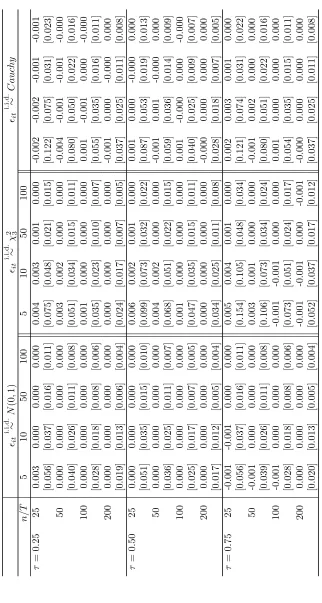
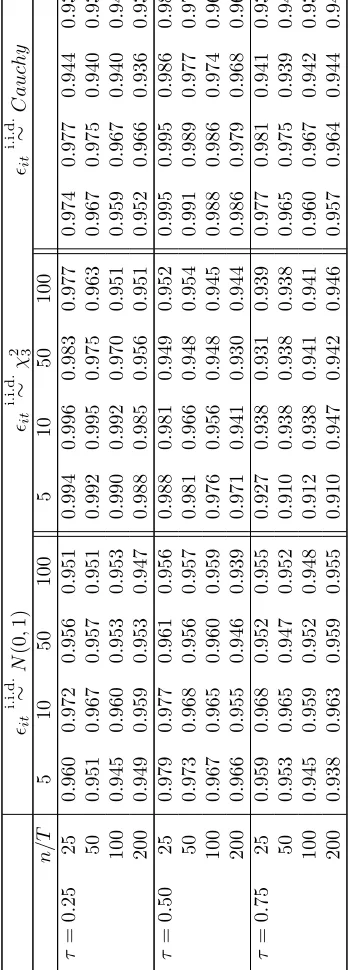
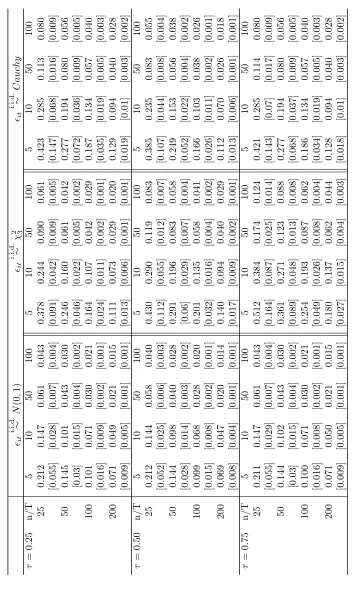
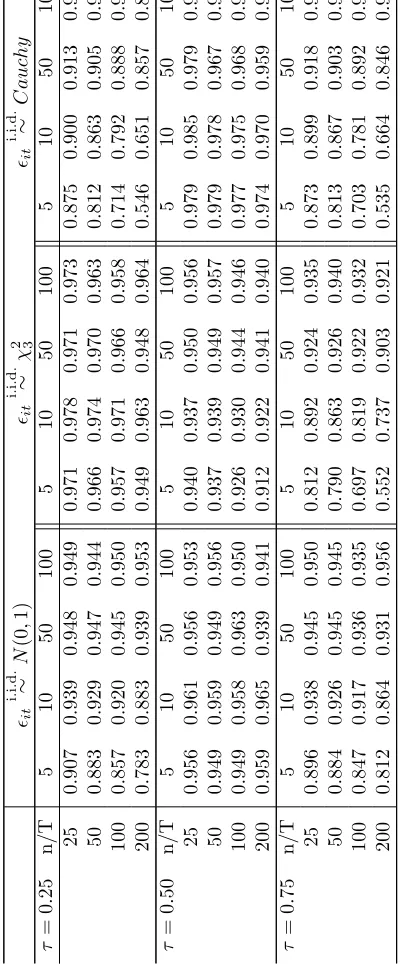
Tables 1, 4 and 7 report the bias and the standard deviation of the FE-QR
estima-tor. Tables 2, 5 and 8 report the average of the estimated standard error (together with
its standard deviation) described in Proposition 3.1. Finally, the empirical coverage
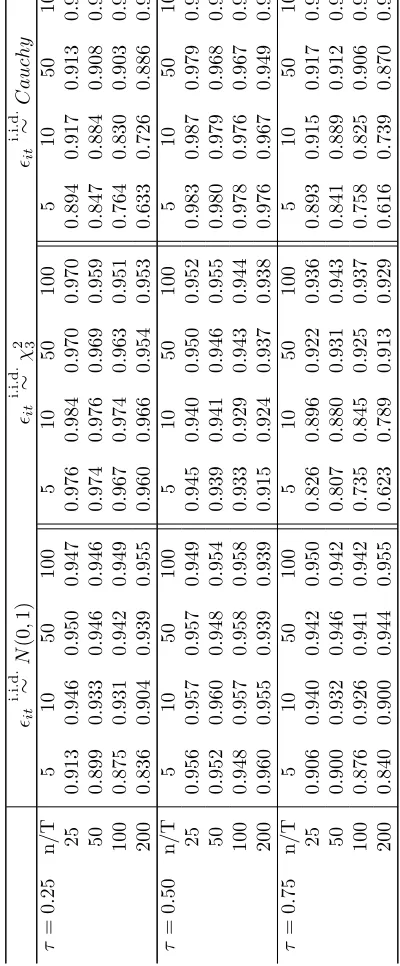
probability of the asymptotic Gaussian confidence interval at the 95% nominal level
is constructed using this estimated standard error (tables 3, 6 and 9). The empirical
coverage probability is also computed. The number of Monte Carlo repetitions is 5000
4.1
Bias
The performance of the FE-QR estimator is evaluated first by its bias. Tables 1, 4 and
7 report the results for the location shift and location-scale shift (γ = 0.5,1) models,
respectively. For the median, the results are in line with those of Koenker (2004), where
in both models the FE-QR estimator has small bias and standard deviation in small
samples. However, there are noticeable differences for the first and third quartiles.
In the location shift model, the bias is small in every case and the standard errors
decrease monotonically as either n or T increases. In the location-scale shift model,
however, both bias and standard errors are large for small T. In particular, the bias
is considerable in the Cauchy and χ2
3 case (in the latter for the third quartile) and
T = 5,10. Moreover, the bias is much larger for the γ = 1 case than for γ = 0.5.9
These results suggest that the FE-QR estimator performs well in small samples for
the location shift model but may have a large bias for the location-scale shift model
where the quantile of interest is evaluated at an associated low density (i.e., F = χ2 3
and τ = 0.75 case) when T is small. Overall, these simulations confirm that the bias
exists for small T and does not depend on n.
4.2
Inference
To study the inference procedure based on the FE-QR estimator, we first compute
the estimated standard error.10 The results are reported in tables 2, 5 and 8 for the
location shift and location-scale shift (γ = 0.5,1) cases, respectively. We also report
the sample standard deviation of the estimator based on the Monte Carlo repetitions
By comparing table 2 with 1, 5 with 4 and 8 with 7, we may see that the estimated
standard error approximates very closely the truth. Second, we calculate the empirical
coverage probability of the asymptotic Gaussian confidence interval at the 95% nominal
level. In this case, the greater distortions appear in the location-scale shift case for
largen/T, and in particular for theχ2
3 case andτ = 0.75. The distortion is very severe
for T = 5,10 and n = 200 for all distributions, despite the fact that the estimated
standard error approximate well the truth. This possibly reflects that the variance of
the FE-QR estimator decreases when nT increases while the bias decreases when T
increases but is independent of n, so that the centering of the confidence interval will
be severely distorted when n/T is large.
9Although not reported, we have also performed the same experiments forγ = 0.2. In this case
the bias is smaller than forγ= 0.5.
10For estimation of the asymptotic covariance matrix, we use the Gaussian kernel and the default
5
Extension: dynamic case
We now extend the asymptotic results in Section 3 to the dynamic case where we
allow for dependence across time while maintaining independence across individuals.
We make the following assumptions in this case.
(D1) {(yit,xit), t ≥ 1} is stationary and β-mixing for each fixed i, and independent
across i. Let βi(j) denote the β-mixing coefficients of {(yit,xit), t ≥ 1}. Then,
there exist constants a ∈ (0,1) and B > 0 such that supi≥1βi(j) ≤ Baj for all
j ≥1.
(D2) Let fi,j(u1, u1+j|x1,x1+j) denote the conditional density of (ui1, ui,1+j) given
(xi1,xi,1+j) = (x1,x1+j). There exists a constantCf′ >0 such thatfi,j(u1, u1+j|x1,x1+j)≤
Cf′ uniformly over (u1, u1+j,x1,x1+j) for all i≥1 andj ≥1.
(D3) Let ˜Vnidenote the covariance matrix of the termT−1/2
∑T
t=1{τ−I(uit ≤0)}(xit−
γit). Then, the limit ˜V :=n−1
∑n
i=1V˜ni exists and is nonsingular.
Condition (D1) is similar to Condition 1 of Hahn and Kuersteiner (2004). Condition
(D2) imposes new restrictions on the conditional densities. Note that in Condition (D3)
now ˜Vni is now a long run covariance matrix.
The next theorem shows that similar asymptotic results to those in Section 3 are
obtained for the dependent case. The proof is given in the Appendix.
Theorem 5.1. Assume conditions (D1)-(D3), (A3) and (B1)-(B3). Then, ( ˆα,βˆ) is
weakly consistent provided that (logn)2/T →0. If (logn)2/T →0 but T grows at most polynomially in n, then βˆ admits the expansion (3.2). If moreover n2(logn)3/T →0,
then we have √nT( ˆβ−β0) d
→N(0,Γ−1V˜Γ−1).
In proving Theorem 5.1, we need some extensions of empirical process inequalities to
β-mixing sequences, which we believe is a nontrivial task. We develop those extensions
in Appendix C, which are useful in other contexts such as asymptotic analysis of sieve
estimation for β-mixing sequences.
6
Discussion
In this paper, we have studied the asymptotic properties of the FE-QR estimator. The
results found in this paper show that the asymptotic theory for panel models with
non-differentiable objective functions, as in the QR case, should be analyzed carefully.
the sequential asymptotics as long as n/T goes to zero, as is well recognized in the
literature. However, this paper draws a caution that such a result may not directly
apply to the QR case.
There remain several issues to be investigated.
It is an open question whether the convergence rate of the remainder term in (3.2)
can be improved to Op(T−1). It should be pointed out that although the rate of the
remainder term derived in this paper is the best one that we could achieve at this point,
there might be a room for improvement on the rate, which means that our condition
for the asymptotic normality is only a sufficient one. However, although we could not
formally show in this paper, we conjecture that n/T → 0 is a sufficient condition to asymptotic normality of QR panel data. Kato and Galvao (2010) used a smoothed
version of the FE-QR estimator to derive the asymptotic bias of the estimator when
n/T → ρ > 0. Thus, the smoothed estimator is unbiased for n/T → 0. However, it is important to note that the derivation makes use of the smoothness of the objective
and the score functions, which is not applicable to this paper. The challenge in the
present context is that higher order expansions for the standard QR is a very difficult
subject.
Since there is a large literature on analytical bias correction for large panel data,
one could wonder about deriving the asymptotic bias in the present context of FE-QR
estimation. There are at least two important reasons to explain the degree of difficulty
in the FE-QR case. First, the rate Op{(T /logn)−3/4} in the Bahadur representation
in Theorem 3.2 comes from the rate of the score terms, as defined in the proof of
Theorem 3.2. Unfortunately, a direct expansion of these terms with respect to ( ˆα,βˆ)
and the simple evaluation of the mean and variance is not feasible.11 It is important
to note that for each i, the convergence rate of ( ˆαi,βˆ) is dominated by ˆαi, and thus is
at most T−1/2. However, because of the non-smoothness of the indicator function, the
evaluation of these terms based on some moment inequalities for empirical processes
(such as Proposition B.1) leads to the rate Op{max1≤i≤n|αˆi −αi0|3/2}, which turns
out to beOp(T−3/4) (logn term is ignored for simplicity). Thus, a more refined result
(such as a bias result) could be obtained if one could establish the probability limits of
these terms (scaled by a suitable term), which is thought to be a quite challenging task
and is not solved in this paper.12 Secondly, there is another difficulty to obtain a bias
result to the FE-QR estimator. This is related to indeterminateness of the higher order
11A way to deal with such terms is to consider them as empirical processes indexed by (α,β), and
establish the rates by using the preliminary rates of ( ˆα,βˆ). This is what the present proof does.
12To obtain a bias result, establishing the exact probability limits of these terms would be essential,
because the corresponding terms in the standard smooth case contribute to the bias of the resulting
behavior of quantile regression estimators. Consider, for illustrative purposes, a sample
τ-quantile of uniform random variablesu1, . . . , unon [0,1] whereτ ∈(0,1) is fixed and
nτ is integer. Let u(1) <· · ·< u(n) denote the order statistics of u1, . . . , un. Then, the
sampleτ-quantile is usually given byu(nτ). However, if we view of the sample quantile
as a solution to the QR minimization problem, it can be any value in [u(nτ), u(nτ+1)], of
which the mean length is of order n−1. This means that the higher order behavior of
the sampleτ-quantile atn−1 rate is not fully determined if we take the sample quantile
as a solution to the QR minimization problem. Since the asymptotic bias of the general
fixed effect estimator depends on the higher order behavior of the estimators of the
individual parameters atT−1 rate, this indeterminateness would be another challenge
to obtain a bias result to the FE-QR estimator.
A
Proofs
A.1
Proof of Theorem 3.1
PutMni(αi,β) := T−1
∑T
t=1ρτ(yit−αi−x′itβ) and ∆ni(αi,β) :=Mni(αi,β)−Mni(αi0,β0).
For each δ > 0, define Bi(δ) := {(α,β) : |α−αi0|+∥β−β0∥1 ≤ δ} and ∂Bi(δ) :=
{(α,β) :|α−αi0|+∥β−β0∥1 =δ}.
Proof of Theorem 3.1. We divide the proof into two steps.
Step 1. We first prove ˆβ →p β0. Fix any δ > 0. For each (αi,β) ∈/ Bi(δ), define
˜
αi =riαi+ (1−ri)αi0, β˜i =riβ+ (1−ri)β0, where ri =δ/(|αi −αi0|+∥β−β0∥1).
Note that ri ∈ (0,1) and ( ˜αi,β˜i) ∈ ∂Bi(δ). Because of the convexity of the objective
function, we have
ri{Mni(αi,β)−Mni(αi0,β0)} ≥Mni( ˜αi,β˜)−Mni(αi0,β0)
={E[∆ni( ˜αi,β˜i)]}+{∆ni( ˜αi,β˜i)−E[∆ni( ˜αi,β˜i)]}. (A.1)
Use the identity of Knight (1998) to obtain
E[∆ni(αi,β)] = E
[∫ (αi−αi0)+x′i1(˛−˛0)
0
{Fi(s|xi1)−τ}ds
]
.
From condition (A3), the first term on the right side of equation (A.1) is greater than
or equal to ϵδ for all 1≤i≤n. Thus, by (A.1), we obtain the inclusion relation
{
∥βˆ−β
0∥1 > δ
}
⊂ {Mni(αi,β)≤Mni(αi0,β0), 1≤ ∃i≤n, ∃(αi,β)∈/ Bi(δ)}
⊂ {
max
1≤i≤n(α sup
i,˛)∈Bi(δ)
|∆ni(αi,β)−E[∆ni(αi,β)]| ≥ϵδ
}
The first inclusion follows from the following argument. Suppose that ∥βˆ−β0∥1 > δ.
Then, ( ˆαi,βˆ)∈/ Bi(δ) for all 1≤i≤n. IfMni( ˆαi,βˆ)>Mni(αi0,β0) for all 1≤i≤n,
then∑ni=1Mni( ˆαi,βˆ)>
∑n
i=1Mni(αi0,β0), which however contradicts the definition of
( ˆα,βˆ). Thus, Mni( ˆαi,βˆ) ≤ Mni(αi0,β0) for some 1 ≤ i ≤ n, which leads to the first
inclusion.
Therefore, it suffices to show that for every ϵ >0,
lim
n→∞P
{
max
1≤i≤n(α sup
i,˛)∈Bi(δ)
|∆ni(αi,β)−E[∆ni(αi,β)]|> ϵ
}
= 0. (A.2)
[Recall thatT =Tn is indexed by n, andn → ∞automatically means thatT =Tn →
∞.]
Because of the union bound, it suffices to prove that for every ϵ >0,
max
1≤i≤nP
{
sup
(α,˛)∈Bi(δ)
|∆ni(α,β)−E[∆ni(α,β)]|> ϵ
}
=o(n−1). (A.3)
We follow the proof of Fernandez-Val (2005, Lemma 7) to show (A.3). Without loss
of generality, we may assume that αi0 = 0 and β0 = 0. Then, Bi(δ) is independent
of i and write Bi(δ) =B(δ) for simplicity. Putgα,˛(u,x) :=ρτ(u−α−x′β)−ρτ(u).
Observe that |gα,˛(u,x)−gα,¯˛¯(u,x)| ≤ C(1 +∥x∥1)(|α−α¯|+∥β −β¯∥1) for some
universal constant C > 0. Put L(x) := C(1 + ∥x∥1) and κ := supi≥1E[L(xi1)].
SinceB(δ) is a compact subset ofRp+1, there existK ℓ
1-balls with centers (α(j),β(j)),
j = 1, . . . , K and radius ϵ/(7κ) such that the collection of these balls covers B(δ).
Note that K is independent of i and can be chosen such that K = K(ϵ) = O(ϵ−p−1)
as ϵ → 0. Now, for each (α,β) ∈ B(δ), there is a j ∈ {1, . . . , K} such that
|gα,˛(u,x)−gα(j),˛(j)(u,x)| ≤L(x)ϵ/(7κ), which leads to |∆ni(α,β)−E[∆ni(α,β)]| ≤
|∆ni(α(j),β(j))−E[∆ni(α(j),β(j))]|+{ϵ/(7κ)} · |T−1
∑T
t=1{L(xit)−E[L(xi1)]}|+ 2ϵ/7.
Therefore, we have
P
{
sup
(α,˛)∈B(δ)
|∆ni(α,β)−E[∆ni(α,β)]|> ϵ
}
≤
K
∑
j=1
P
{
|∆ni(α(j),β(j))−E[∆ni(α(j),β(j))]|>
ϵ 3
}
+ P
{
1 T
¯¯ ¯¯ ¯
T
∑
t=1
{L(xit)−E[L(xi1)]}
¯¯ ¯¯ ¯>
7κ 3
}
. (A.4)
Since supi≥1E[L2s(xi1)] < ∞, application of the Marcinkiewicz-Zygmund inequality
(see Corollary 2 in Chow and Teicher, 1997, p. 387) implies that both terms on the
T, they areo(n−1), leading to (A.3).
Step 2. Next, we shall show that max1≤i≤n|αˆi − αi0|
p
→ 0. Recall that ˆαi =
arg minαMni(α,βˆ). Fix any δ > 0. For each αi ∈ R such that |αi −αi0| > δ,
de-fine ˜αi = riαi + (1−ri)αi0, where ri = δ/|αi −αi0|. Because of the convexity of the
objective function, we have
ri{Mni(αi,βˆ)−Mni(αi0,βˆ)} ≥Mni( ˜αi,βˆ)−Mni(αi0,βˆ)
=Mni( ˜αi,βˆ)−Mni(αi0,β0)− {Mni(αi0,βˆ)−Mni(αi0,β0)}
={∆ni( ˜αi,βˆ)−E[∆ni( ˜αi,β)]|˛= ˆ˛} − {∆ni(α0i,βˆ)−E[∆ni(α0i,β)]|˛= ˆ˛}
+ E[∆ni( ˜αi,β0)] +{E[∆ni( ˜αi,β)]|˛= ˆ˛−E[∆ni( ˜αi,β0)]}+ E[∆ni(α0i,β)]|˛= ˆ˛. It is seen from condition (A3) that the third term on the right side is greater than or
equal to ϵδ. Thus, we obtain the inclusion relation
{|αˆi−αi0|> δ, 1≤ ∃i≤n}
⊂ {Mni(αi,βˆ)≤Mni(αi0,βˆ), 1≤ ∃i≤n, ∃αi ∈Rs.t. |αi−αi0|> δ}
⊂ {
max
1≤i≤n|α−supα
i0|≤δ
|∆ni(α,βˆ)−E[∆ni(α,β)]|˛= ˆ˛| ≥ ϵδ
4
}
∪ {
max
1≤i≤n|α−supα
i0|≤δ
||E[∆ni(α,β)]|˛= ˆ˛ −E[∆ni(α,β0)]| ≥
ϵδ
4
}
=:A1n∪A2n.
Since ˆβ is consistent by Step 1, and especially ˆβ = Op(1), by (A.2), it is shown that
P(A1n)→0. Finally, since
|E[∆ni(α,β)]−E[∆ni(α,β0)]| ≤2E[∥xi1∥]∥β−β0∥,
and supi≥1E[∥xi1∥]≤1+supi≥1E[∥xi1∥2s]<∞, consistency of ˆβimplies that P(A2n)→
0. Therefore, we complete the proof.
Remark A.1. If supi≥1∥xi1∥ ≤ M (a.s.) for some constant M, we may take L(x)≡
C(1 +M) and the second term on the right side of (A.4) will vanish. In this case,
we can apply Hoeffding’s inequality to the first term on the right side of (A.4) and
the probability in (A.3) is bounded byDexp(−DT) for some positive constantDthat depends on ϵ but not on i. Therefore, the conclusion of Theorem 3.1 holds when
A.2
Proof of Theorem 3.2
Define
H(1)
ni(αi,β) :=
1 T
T
∑
t=1
{τ −I(yit ≤αi+x′itβ)},
Hni(1)(αi,β) := E[Hni(1)(αi,β)] = E[{τ −Fi(αi−αi0+x′i1(β−β0)|xi1)}],
H(2)
n (α,β) :=
1 nT
n
∑
i=1 T
∑
t=1
{τ−I(yit ≤αi+x′itβ)}xit,
Hn(2)(α,β) := E[H(2)n (α,β)] = 1 n
n
∑
i=1
E[{τ−Fi(αi−αi0+xi1′ (β−β0)|xi1)}xi1].
Note that H(1)ni(αi,β) depends on n since T does. The (n+p) dimensional vector of
functions [H(1)n1(α1,β), . . . ,H (1)
nn(αn,β),H (2)′
n (α,β)]′ are called the scores for problem
(2.2).
Before starting the proof, we introduce some notation used in empirical process
theory. LetF be a class of measurable functions on a measurable space (S,S). For a processZ(f) defined onF,∥Z(f)∥F := supf∈F|Z(f)|. For a probability measureQon (S,S) andϵ >0, letN(F, L2(Q), ϵ) denote theϵ-covering number ofF with respect to
the L2(Q) norm ∥ · ∥L2(Q). For the definition of a Vapnik- ˇCervonenkis (VC) subgraph
class, we refer to van der Vaart and Wellner (1996), Section 2.6. For a, b∈R, we use the notationa∨b:= max{a, b}.
Proof of Theorem 3.2. Recall first that by Theorem 3.1, under the present conditions, ( ˆα,βˆ)) is weakly consistent. We divide the proof into several steps.
Step 1 (Asymptotic representation). We shall show that
ˆ
β−β0+op(∥βˆ−β0∥) = Γ−n1{−n− 1∑n
i=1H (1)
ni(αi0,β0)γi+H(2)n (α0,β0)}
−Γ−n1[n−1∑ni=1γi{H (1)
ni( ˆαi,βˆ)−H (1)
ni ( ˆαi,βˆ)−H (1)
ni(αi0,β0)}]
+ Γ−n1{H(2)n ( ˆα,βˆ)−Hn(2)( ˆα,βˆ)−Hn(2)(α0,β0)}
+Op{T−1 ∨ max
1≤i≤n|αˆi−αi0| 2}
. (A.5)
Because of the computational property of the QR estimator (see equation (3.10) of
Gutenbrunner and Jureckova, 1992), it is shown that max1≤i≤n|H (1)
ni( ˆαi,βˆ)|=Op(T−1).
Thus, uniformly over 1≤i≤n, we have Op(T−1) = H
(1)
ni(αi0,β0) +H (1)
ni ( ˆαi,βˆ) +{H (1)
ni( ˆαi,βˆ)−H (1)
ni ( ˆαi,βˆ)−H (1)
ni(αi0,β0)}.
ExpandingHni(1)( ˆαi,βˆ) around (αi0,β0), we have
ˆ
αi−αi0 ={fi(0)}−1H (1)
ni(αi0,β0)−γi′( ˆβ−β0)
+{fi(0)}−1{H (1)
ni( ˆαi,βˆ)−H (1)
ni ( ˆαi,βˆ)−H (1)
where max1≤i≤n|rˆni|=Op{T−1∨max1≤i≤n|αˆi−αi0|2∨ ∥βˆ−β0∥2}.
Similarly, the computational property of the QR estimator implies that∥H(2)n ( ˆα,βˆ)∥=
Op{T−1max1≤i≤n,1≤t≤T ∥xit∥}=Op(T−1), from which we have
Op(T−1) =H(2)n (α0,β0)+Hn(2)( ˆα,βˆ)+{H (2)
n ( ˆα,βˆ)−H (2)
n ( ˆα,βˆ)−H (2)
n (α0,β0)}. (A.7)
Use Taylor’s theorem to obtain
Hn(2)( ˆα,βˆ) =−1 n
n
∑
i=1
E[fi(0|xi1)xi1]( ˆαi−αi0)−
{
1 n
n
∑
i=1
E[fi(0|xi1)xi1x′i1]
}
( ˆβ−β0)
+op(∥βˆ−β0∥) +Op
{
max
1≤i≤n|αˆi−αi0| 2
}
. (A.8)
Plugging (A.6) into (A.8) leads to
Hn(2)( ˆα,βˆ) =−1 n
n
∑
i=1
H(1)
ni(αi0,β0)γi−Γn( ˆβ−β0)
− 1
n
n
∑
i=1
γi{H(1)ni( ˆαi,βˆ)−Hni(1)( ˆαi,βˆ)−H(1)ni(αi0,β0)}
+op(∥βˆ−β0∥) +Op
{
T−1∨ max
1≤i≤n|αˆi−αi0| 2
}
. (A.9)
Combining (A.7) and (A.9) yields the desired representation. The remaining steps are
devoted to determining the order of the remainder terms in (A.5).
Step 2 (Rates of the remainder terms). Takeδn →0 such that max1≤i≤n|αˆi−αi0| ∨
∥βˆ−β0∥=Op(δn). We shall show that
∥n−1∑ni=1γi{H (1)
ni( ˆαi,βˆ)−H (1)
ni ( ˆαi,βˆ)−H (1)
ni(αi0,β0)}∥=Op(dn), (A.10)
∥H(2)
n ( ˆα,βˆ)−H (2)
n ( ˆα,βˆ)−H (2)
n (α0,β0)∥=Op(dn). (A.11)
where dn:=T−1|logδn| ∨T−1/2δ 1/2
n |logδn|1/2.
We only prove (A.10) since the proof of (A.11) is analogous.13 Without loss of
generality, we may assume that αi0 = 0 and β0 = 0. Put gα,˛(u,x) := I(u ≤ α+
x′β)− I(u ≤ 0), Gδ := {gα,˛ : |α| ≤ δ,∥β∥ ≤ δ} and ξit := (uit,xit). Since γi is
bounded over i, it suffices to show that
max
1≤i≤nE
°°°°
°
T
∑
t=1
{g(ξit)−E[g(ξi1)]}
°° °° °
Gδn
=O(dnT). (A.12)
13Although the present proof requires x
i1 to be bounded, it is possible to use Theorem 2.14.1 of
van der Vaart and Wellner (1996) to show (A.11), which only requires that supi≥1E[∥xi1∥2] <∞.
To this end, we apply Proposition B.1 to the class of functions ˜Gi,δn :={g−E[g(ξi1)] :
g ∈ Gδn}. Observe that ˜Gi,δn is pointwise measurable and each element of ˜Gi,δn is
bounded by 2. Because of Lemmas 2.6.15 and 2.6.18 of van der Vaart and Wellner
(1996), the class G∞ := {gα,˛ : α ∈ R,β ∈ Rp} is a VC subgraph class. Thus, by Theorem 2.6.7 of van der Vaart and Wellner (1996), the fact that ˜Gi,δn ⊂ {g −
E[g(ξi1)] : g ∈ G∞}, and a simple estimate of covering numbers, there exist constants
A≥3√e and v ≥1 independent of i and n such thatN( ˜Gi,δn, L2(Q),2ϵ)≤(A/ϵ)
v for
every 0 < ϵ < 1 and every probability measure Q on Rp+1. Combining the fact that
E[gα,˛(ξi1)2] = E[|Fi(α+x′i1β|xi1)−Fi(0|xi1)|] ≤ Cf(|α|+M∥β∥), one can see that
˜
Gi,δn satisfies all the conditions of Proposition B.1 withU = 2 and σ
2 =C
f(1 +M)δn,
and the constants A and v are independent of iand n. This implies that the left side
of (A.12) is O(dnT).
Step 3 (Preliminary convergence rates). We shall show that
max
1≤i≤n|αˆi−αi0|=Op{(T /logn)
−1/2}, ∥βˆ−β
0∥=op{(T /logn)−1/2}.
We first show that max1≤i≤n|αˆi−αi0|=Op{(T /logn)−1/2}. Because of consistency
of ( ˆα,βˆ) and the result given in Step 2, the second and third terms on the right side
of (A.5) is op(T−1/2), which implies that
∥βˆ−β
0∥=Op{max
1≤i≤n|αˆi−αi0| 2}+o
p(T−1/2). (A.13)
Thus, by (A.6), max1≤i≤n|αˆi−αi0| is bounded by
const.×
{
max
1≤i≤n|H (1)
ni(αi0,β0)|+ max 1≤i≤n|H
(1)
ni( ˆαi,βˆ)−H (1)
ni ( ˆαi,βˆ)−H (1)
ni(αi0,β0)|
}
+op(T−1/2),
with probability approaching one.
First, observe that for any K >0,
P
{
max
1≤i≤n|H (1)
ni(αi0,β0)|>(T /logn)−1/2K
} ≤
n
∑
i=1
P
{ |H(1)
ni(αi0,β0)|>(T /logn)−1/2K
}
,
and the right side is bounded by 2n1−K2/2 by Hoeffding’s inequality. This implies that
max1≤i≤n|H (1)
ni(αi0,β0)|=Op{(T /logn)−1/2}.
We next show that
max
1≤i≤n|H (1)
ni( ˆαi,βˆ)−H (1)
ni ( ˆαi,βˆ)−H (1)
ni(αi0,β0)|=op{(T /logn)−1/2},
which leads to the first result. Without loss of generality, as before, we may assume