City, University of London Institutional Repository
Citation
:
Defever, F. & Toubal, F. (2013). Productivity, relationship-specific inputs and the sourcing modes of multinationals. Journal of Economic Behavior and Organization, 94, pp. 345-357. doi: 10.1016/j.jebo.2012.11.006This is the accepted version of the paper.
This version of the publication may differ from the final published
version.
Permanent repository link:
http://openaccess.city.ac.uk/16011/Link to published version
:
http://dx.doi.org/10.1016/j.jebo.2012.11.006Copyright and reuse:
City Research Online aims to make research
outputs of City, University of London available to a wider audience.
Copyright and Moral Rights remain with the author(s) and/or copyright
holders. URLs from City Research Online may be freely distributed and
linked to.
Productivity, Relationship-Specific Inputs and
the Sourcing Modes of Multinationals
?
Fabrice Defever
aand Farid Toubal
bJournal of Economic Behavior & Organization, forthcoming
Abstract
We investigate the roles of productivity and the specificity of inputs for the international sourcing strategy of firms which are part of a multinational net-work. We present a framework in which firms decide to import from a foreign independent supplier or from their related party abroad according to these two dimensions. We use a detailed survey that provides a detailed geograph-ical breakdown of French firms’ imports at the product level as well as the sourcing mode used for each transaction. The dataset also provides information to estimate the firms’ productivity and their intensity in relationship-specific inputs. After controlling for countries of origin, products and sectors specific effects, the empirical results provide evidence that for the most productive multinationals the likelihood of trading through an independent supplier is higher especially if they use relationship-specific inputs intensively.
Keywords: Productivity, Incomplete Contracts, Intra-group Trade,
Outsourc-ing.
JEL classification: F23, F14, L22, L23
?A previous version of this paper was circulated under the title “Productivity and
the Sourcing Modes of Multinational Firms: Evidence from French Firm-Level Data”. We are really grateful to Pol Antr`as, Andrew Bernard, Elhanan Helpman, Beata Javorcik, Philippe Martin, Thierry Mayer, Fergal McCann, Gianmarco Otta-viano, Peter Neary, Steve Redding, Fr´ed´eric Robert-Nicoud and Jean-Marc Siroen for helpful comments. Thanks to seminar participants at the universities of Aix-Marseille, ESSEC Business School, Strathclyde-Glasgow, Hohenheim University, London School of Economics, UCL-Louvain la Neuve, Oxford, Paris School of Economics, the annual meeting of the Royal Economic Society 2008 (Warwick), ESEM 2008 (Milan), ETSG 2008 (Warsaw) and Econometric Society 2009 (San Francisco).
aUniversity of Nottingham, School of Economics and Centre for Economic
Performance at the London School of Economic. Sir Clive Granger Build-ing, University Park, NG7 2RD, Nottingham. United Kingdom. Email: [email protected].
bUniversity of Angers, Paris School of Economics and CEPII. Centre d’ ´Economie
1 Introduction
According to the WTO (1996), one-third of world trade is intra-group, whereas
another third involves the participation of multinationals in one of the two
sides of the exchange. In this paper, we use a unique dataset on the trade
ac-tivities of French Multinational companies (MNCs) which are part of a
multi-national network to understand how they organize their sourcing strategies
from abroad. These firms may import their intermediate inputs from their
network-based related-parties (intra-group trade) or from independent
sup-pliers (outsourcing). As an illustration, consider the French “motor vehicle”
industry which is largely globalized. In 1999, year of our observation, the
median firm in this sector realizes 19 import transactions from 7 countries.
All firms in this sector are part of an international network such as those of
Renault, Peugeot-Citro¨en (PSA) or Deere & co. However, we observe large
variations in their sourcing modes. About 8% of these firms import
interme-diate inputs exclusively from their foreign related parties, while 47% of them
import exclusively from outside foreign suppliers. While firms like Iveco (Fiat
trucks division) and Mercedes-Benz Molsheim (Mercedes-Benz trucks) import
exclusively from related parties, Heuliez Bus (Renault Trucks) and Smart Car
(Mercedes-Benz Cars division) exclusively rely on unrelated suppliers. In this
paper, we empirically analyze the firm-level choice of multinationals between
outsourcing and intra-group trade.1
While a vast theoretical literature has been established to examine the
de-terminants of the boundaries of the firm2, the majority of empirical studies
have focused on sector and host country attributes. 3 The role of firm-specific
characteristics in explaining the sourcing decision has been underemphasized.
We explore how the total factor productivity of a MNC and the intensity of
its production process in relationship-specific inputs (henceforth, RSI) affect
its choice of organization.
We first develop a model that analyzes the input sourcing choice of MNCs. It
builds on the incomplete contracts approach to the theory of the firm. This
approach helps in predicting the prevalence of alternative sourcing strategies
as a function of productivity variation across MNCs and their intensity in RSI.
Our theoretical framework is borrowed from Antr`as and Helpman (2004, 2008)
from which we derive two empirical propositions. First, the firm’s intensity in
RSI increases the likelihood of importing an input from an independent
sup-plier rather than from an affiliate. Second, we show that the decision depends
on the combination of variation of productivity and variation in RSI across
MNCs. Our model predicts that only the most productive MNCs would be
able to outsource their intermediate inputs abroad while the least-productive
MNCs will necessarily import from a foreign related party. In addition, the
likelihood of importing through an independent supplier increases with the
firm’s productivity, especially if it uses relationship-specific inputs intensively.
We use a firm-level survey that provides a detailed geographical breakdown
of French firms’ imports at product level and their sourcing modes – through
outside suppliers and/or related parties. In our empirical analysis, we
pro-pose to investigate the links between the productivity and the RSI with the
sourcing decision.
2Theoretical contributions include McLaren (2000), Antr`as (2003, 2005), Antr`as and Helpman (2004, 2008) and Grossman and Helpman (2002, 2003, 2005). See Spencer (2005), and Helpman (2006) for detailed surveys of the literature.
3See for instance, Yeaple (2006), Nunn and Trefler (2008), Bernard et al. (2010),
The intensity in RSI has been found to positively affect the decision to import
intermediate inputs from outside suppliers by Nunn and Trefler (2008) and
Bernard et al. (2010) who use aggregate sector or product-level data for the
U.S. Nunn (2007) and Nunn and Trefler (2008) identify inputs that require
relationship-specific investments as those inputs that are neither bought and
sold on an exchange nor reference priced. Bernard et al. (2010) approximate
the products’ contractibility based on the degree of intermediation. Our
pa-per is taking one step forward by providing an alternative measure to the
RSI intensity, which has the advantage to be firm specific and to be directly
observable from the firm’s balance sheet. We follow the French statistical
insti-tute (INSEE) and we define as relationship specific inputs the value of “work
based on plans”. It corresponds to inputs for which the MNC provides to
the supplier all the technical specifications required for the production of the
intermediate inputs he has ordered.4 For instance, in the “motor vehicle”
in-dustry, it would includes inputs which required forging, cutting, stamping and
foundry work based on plans provided by the car producers. In the “textile
and clothing” industry, it would include the cutting of sheet of cloth based
on plans and most of the textiles ennobling subsectors, whose main activity
is to provide textile material with the suitable characteristics for their use as
an intermediate product. The amounts reported in the balance sheet include
the value of intermediate inputs bought from both independent suppliers and
affiliates, purchased nationally and internationally. Hence, we can compute a
direct measure of the share of relationship-specific inputs on the total value of
total inputs. Our novel variable is different from that used in previous studies
because it does not rely on external information to classify the different type
of inputs. We find a positive correlation between the intensity in RSI and the
likelihood to outsource.
There is information in the data that allows to construct firm’s total
fac-tor productivity (TFP). We analyze whether the variation of firm-level TFP
across MNCs influences the choice of organization. We find that the
preva-lence of outsourcing is higher for firms that have higher productivity levels.
For firms that are part of a multinational network, importing inputs from a
related party seems less costly in terms of organization. As a consequence,
importing from a foreign related party is more appropriate for low productive
firms, which cannot incur the fixed organizational costs of outsourcing.5 As
we evaluate the productivity variation across MNCs, our empirical strategy is
different from recent studies using samples that contain information on both
independent firms and multinational firms (See Corcos et al., 2009, Kohler
and Smolka, 2009 and Stefano, 2009).6 By definition, intra-group trade can
only occur among the group of multinational firms, which are known as being
more productive than independent firms. Hence, the findings of these papers
confirm that firms that are part of a multinational network, which are more
5The survey from which we base our empirical analysis shows that French MNCs perceive outsourcing to be related to higher fixed costs than intra-group trade (Ser-vice des ´etudes et des statistiques industrielles, SESSI, 1999). In his seminal book, Williamson (1985) considers that the fixed cost of organization under vertical inte-gration is lower than the one associated with outsourcing because it amalgamates the coordination costs of two firms.
productive than independent firms, can import within the group. However,
the idea that most productive multinationals would always prefer to
internal-ize their import transactions is at odd with the empirical evidence that many
large firms import mostly from outside suppliers. Take the firms Renault and
Peugeot-Citro¨en in 1999, more than 90% of the total number of their import
transactions are bought from independent suppliers.7 In this paper, we
com-pare the TFP across firms that are part of a multinational network and argue
that given the existence of a foreign related-party, the firm might still face the
choice of organization. This choice is still guided by its productivity level. In
line with the theoretical prediction of our model, we find that the firm’ TFP
increases the likelihood to outsource. For firms that are part of a multinational
network, the choice between the different sourcing modes should imply a
com-parison between an already existing related-party and an outside supplier. For
any given country, there may or may not be a foreign related party from which
the firms can import the input. Once we control for the presence of a related
party, we still find that the most productive firms outsource.
Despite the small number of MNCs, their international sourcing strategy is
likely to alter the structure of international trade since they account for a
large share of the world trade. Considering the French manufacturing sectors,
firms which are part of a multinational network represent 83% of total French
imports of industrial products. To further examine the role on MNCs on the
volume of intra-group trade, we aggregate our data at the
sector-product-country level. We compute the outsourcing share as the ratio of the value
of imports from independent suppliers to the value of total imports. Using
product and country specific effects, our empirical results support the idea
that outsourcing is a prevalent mode of organization in RSI intensive sectors,
especially those which are composed by highly productive firms.
The remainder of this paper is structured as follows. Section 2 provides the
theoretical background and the empirical implications of the model. Section 3
provides a thorough discussion of the data and discusses the empirical strategy.
Section 4 proposes some stylized facts that can be constructed from the data.
Section 5 contains our core empirical results and provides some robustness
checks. Section 6 concludes.
2 Theoretical Background
In this section, we propose a theoretical framework which is borrowed from
Antr`as and Helpman (2004, 2008) but differs in two dimensions. First, we
fol-low Williamson (1985) assuming that the fixed cost of organization of trading
with a related party is lower than the one associated with outsourcing because
it amalgamates the coordination costs of two firms. As a consequence, only the
most productive MNCs would be able to outsource abroad their intermediate
inputs while the least-productive MNCs will necessarily import from a foreign
related party. Second, we assume that the RSI intensity is firm-specific and we
analyze how the variation in RSI intensity influence a firm’s sourcing choice.
As a consequence, we show that the decision depends on the combination of
firm’s productivity and firm’s RSI across MNCs.
We denote byv a firm that imports intermediate inputs from a foreign related
party. We use the subscript o for a firm that imports these inputs from a
2.1 Set-up
Each sector produces a differentiated good under monopolistic-competition.8
The production of the final good requires the use of two specialized
interme-diate inputs, xh and xm. xh is produced locally by headquarters, HQ, with
a wage that is normalized to one. xm is sourced from supplier, M, located in
foreign country, l, where the wage is wl<1.9 In addition, only a fractionµh
andµm of the activities produced respectively byHQandM are contractible.
As in Antr`as and Helpman (2004, 2008), we assume the output of varietyito
be Cobb-Douglas:
Qi =θ
xh c µh xh n
1−µh
η η " (xm c ) µm (xm n)
1−µm
1−η
#1−η
0< η <1 (1)
whereηis the intensity in headquarter services andxcand xnare respectively
the contractible and non-contractible activities involved in the production of
each input.η andµh are assumed to be sector specific and would be captured
by sector fixed effects in our empirical estimations. θ is the firm-specific
pro-ductivity parameter. ω ≡ (1−η)(1 −µm) measures the importance of the
non-contractible relationship-specific input (RSI) used in the production of
the final good. We depart from Antr`as and Helpman (2004, 2008) and assume
firm-level heterogeneity in both θ and ω. After observing θ and ω, the
head-quarter, HQ, faces a choice when sourcing its inputs. It can decide to import
inputs from an independent supplier or import them from a foreign related
party.
8Consumers are assumed to share Dixit-Stiglitz preferences for differentiated
prod-ucts which generate the inverse demand function p(i) =D.x(i)α−1 for varietyiin this sector.p(i) is the price of this variety,x(i) is the quantity demanded,Dis an index of total demand for the output of this sector, and the elasticity of demand is equal to 1/(1−α) and is larger than one. All final goods are freely traded with zero transport costs, so that Dmeasures the world demand for the output of the sector.
Since our study focuses on firms that are part of a multinational network and
have related parties abroad, an intra-group transaction does not imply to
set-up an affiliate abroad. Hence, the model could be simplified by considering that
the fixed costs associated with the set-up of a foreign network of related parties
isg = 0. Nevertheless, different Ultimate Beneficial Owner (henceforth, UBO)
may have different capacity to set-up affiliates in different countries. Assuming
that each firm have a related party in each country is not binding in the data
as we shall see in the empirical section. For any given country, the UBO may
or may not have a foreign related party from which the firms of the group
can import inputs intra-group. In the empirical section 5.2, we will consider
a two step strategy where we first evaluate the likelihood of a UBO to have
an affiliate in a given foreign country. We will be using the number of French
firms owned by the UBO as an instrument, as it is likely to be correlated with
the number of foreign related parties, but is exogenous to the international
sourcing choice of a French firm own by the group. Given the existence of
a foreign related party, the second step informs on the firm specific choice
between importing from an already existing related-party or a foreign outside
supplier.
However, the firm has to pay an additional fixed cost of organization Fo if it
decides to import inputs from an outside supplier or Fv when it decides to
import from its related party. We follow Williamson (1985) and assume that
transactions with an outside supplier generate higher organization costs than
transactions with an affiliate, i.e. Fo > Fv. In fact, intra-group trade may
create economies of scope in the management of diverse activities, reducing
the organization costs. In addition, the fixed costs of finding a suitable foreign
partner, writing an international contract and managing cross-boarder
Cr´emer et al. (2007) identify communication codification as an important
de-terminant of firms’ organization. Intra-group trade relies on internal
codifica-tions, which may translate in economize in communication cost and a lower
fixed cost of communication for intra-group transactions. This assumption is
widely used in the empirical literature on vertical integration (see Lafontaine
and Slade, 2007). In line with this assumption, the survey from which we base
our empirical analysis shows that French MNCs perceive outsourcing to be
related to higher fixed costs than trade with affiliates (Service des etudes et
des statistiques industrielles,SESSI, 1999).
The headquarter, HQ, writes a contract with the supplier, M, stipulating
the required investment in the contractible activities xhc and xmc . However,
the transaction between HQ and M involves incomplete contracts because,
ex-ante the headquarter and the supplier cannot sign enforceable contracts
specifying the required investment in the non-contractible relationship-specific
activitiesxh
n and xmn.10 Sincexh and xm are entirely customized and have no
value outside the relationship, both firms face a hold-up problem. After the
specific investment has been made, there is a renegotiation over the ex-post
quasi-rents. Letβ be the share of ex-post gain from trade obtained by the HQ.
Following the property-rights approach, the ex-post bargaining takes place
both under outsourcing and under intra-group trade (Grossman and Hart
(1986) and Hart and Moore (1990)). Once the HQ selects the organization
formk ∈ {o, v}, the quantity of intermediate inputs is chosen byM to
maxi-mize (1−βk)R(i)−wlxm, while the quantity chosen by theHQ to maximize
βkR(i)−wNxh. However, the distribution of surplus is sensitive to the
sourc-ing mode. Followsourc-ing Antr`as and Helpman (2004), we assume βv > βo. Under
this assumption, final good producers have a higher bargaining power when
importing from a related party - directly affiliated or not. Even if the firm is
not the UBO of the group, a final good producers is a major and influential
actor of the group compared to a simple input supplier. Hence, final-good
producers would hold some residual right of control over the supplier’s
pro-duction especially for inputs which propro-duction is based on plans owned by
the final good producers. Hence, on the one hand, intra-group trade yields the
headquarter with a higher share of the surplus than under outsourcing. On
the other hand, the supplier’s share of surplus is lower, and this decreases its
incentive to invest. When choosing their sourcing mode, the headquarter faces
a trade-off between having more control and inducing more investment from
its supplier.
Ex-ante, the supplier pays a transfer T to the headquarter. It ensures its
participation in the relationship and is equal to its profit.11 The choice of
ownership is chosen ex-ante by the headquarters to maximize its profit, which
includes the transfer. Then, the headquarters’ profit equals:
πk(ω, θ) =πk(ω)θα/(1−α)−Fk (2)
where πk represents the variable profit for a final good producer with θ = 1
that uses organizational formk∈ {o, v}andα is a parameter that determines
the elasticity of demand. We obtain the empirical model by appending an
unobserved zero-mean random variable, k, to the profits under each mode of
organization. Given its productivity levelθ and its intensity in specific inputs
ω, outsourcing will be chosen by the final-good producer if
πo(ω, θ) +o > πv(ω, θ) +v (3)
⇔∆ =πo(ω, θ)−πv(ω, θ)> o−v
Finally, if o−v has a cdf, F(.), the probability of outsourcing is defined as
follow:
P ROB[Outsourcing] =F(∆)
As shown by Antr`as and Helpman (2008), the optimal share of the revenue
ex-tracted by the Headquarter during the ex-post bargaining,β∗, is an decreasing
function of ω. As a consequence, it exist a unique value ω, for which πo > πv
for any valueω > ω while πo < πv for any valueω < ω. We now translate this
result in an testable proposition:
Proposition 1.The likelihood of sourcing inputs through an independent
sup-plier increases with the relationship-specific input intensity of the production.
The supplier’s RSI intensity affects the incentive the final good producer wants
to give to the supplier. The more intensive the production is in RSI that are
produced by the supplier, the larger is the share of revenue that the producer
wants to give the supplier. This is possible under outsourcing where βo < βv.
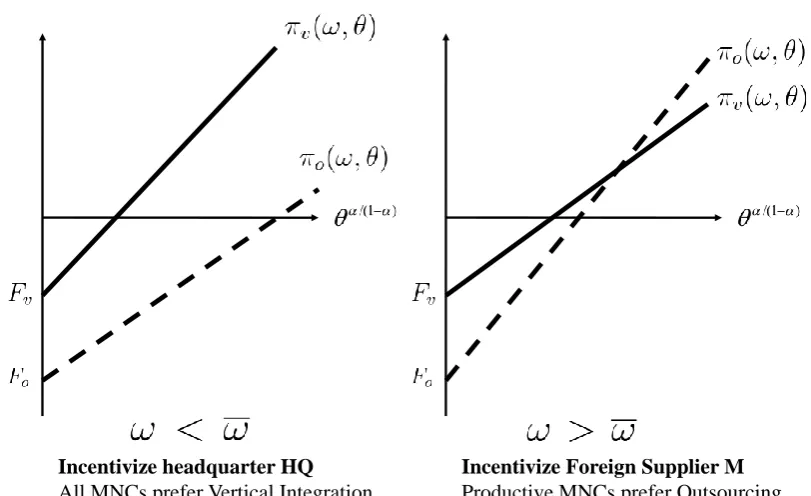
Figure 1 illustrates the implication of the introduction of firms’
heterogene-ity and different fixed costs of organization. Below a threshold value ω, the
likelihood of outsourcing would be equal to zero. Past this threshold value,
for ω > ω, the likelihood of outsourcing will become positive. GivenFo> Fv,
firms that are above the threshold value θ outsource. The most productive
firms that rely intensively on specific inputs from the supplier, choose
out-sourcing. In addition, the prevalence of outsourcing will increase with ω as
πo(θ) becomes steeper and πv(θ) becomes narrower.
Proposition 2.The likelihood of sourcing inputs through an independent
sup-plier increases with the productivity of the firm. This effect is magnified by the
intensity in relationship specific inputs.
As explained by Nunn and Trefler (2008, 2013), the mode of sourcing
Figure 1. Firm-level productivity, Relashionship-Specific Input intensity and
sourc-ing modes
Incentivize headquarter HQ All MNCs prefer Vertical Integration to Outsourcing
Incentivize Foreign Supplier M Productive MNCs prefer Outsourcing to Vertical Integration
implication implies that outsourcing is chosen solely by firms that are
simulta-neously intensive in relationship-specific inputs and very productive.12 Indeed,
the willingness to pay the fixed organization cost associated with outsourcing
increases withω. Notice that this result depends on the ranking of fixed costs.
Considering Fv > Fo, the most productive firms with a low RSI intensity
would have preferred to import from a foreign related-party, as illustrated in
Nunn and Trefler (2013).
In the following section, we present the data and our estimation strategy. We
then provide the empirical results showing a positive correlation between the
TFP, the RSI and the probability for the firm to source its input through an
independent supplier.
3 Data and Estimation Strategy
3.1 Data
This paper uses data on intra-group trade from a 1999 INSEE confidential
firm-level survey on the foreign activities of French multinationals. 13 Looking
at industrial sectors, the survey covers 83% of the French total imports of
industrial products.14 The survey was addressed to all French firms with trade
worth more than 1 million Euro. The firm is part of, or is itself a group that
controls at least 50% of the voting rights of a foreign firm. Hence, all the firms
have at least one related party abroad and can be considered as multinational
firms. A French intra-group transaction is thus defined as trade with a related
party – directly affiliated or not – controlled by the group.15
The survey provides a detailed geographical breakdown of French firms’ import
at product level (HS4) and their sourcing modes – through outside suppliers
and/or related parties. However, it has little information that is specific to
the characteristics of the firm. We have obtained this information from the
EAE database which contains the non-consolidated balance sheet and income
statement of all firms located in France with more than 20 employees from
13Echanges internationaux intra-groupe.´
14www.insee.fr/fr/ffc/docs_ffc/IP936.pdf, INSEE WP 936, Table 1.
1996 to 1999. TheEAE provides firm-level information on sales, capital, labor
and intermediates use, as well as the 4-digit NAF700 sector classification of
the firm.16
3.2 Endogenous Variable: Sourcing Modes
Our dependent variable, yisjl, is the share of input j that is imported by a
multinational i active in sector s from an independent supplier located in
country l: M
o isjl
(Mo
isjl+Misjlv )
.17 We take into account the country dimension
be-cause HS4 goods produced in low-income countries are very different from
similar goods produced in high income countries (Schott (2004)). We restrict
our analysis to manufacturing sectors. However, we do not consider the
man-ufacture of food products, beverages and tobacco because there is no detailed
firm-level information for these sectors from theEAE. We exclude firms which
are active in the manufacture of coke, refined petroleum products and nuclear
fuel since the sourcing modes in this industry are likely to be determined by
factors such as national sovereignty (Antr`as (2003)). This leaves us with 2394
firms in our baseline specification realizing 68590 transactions.
3.3 Main Explanatory Variables
3.3.1 Relationship-Specific Inputs
Nunn (2007) has identified the share of Relationship-Specific Inputs (RSI) at
industrial level while our measure is at firm level.18 To approximate the RSI
16Nomenclature d’Activit´e Fran¸caise: nomenclature of French activities.
17Our dependent variable takes the valuezeroorone in 87% of the cases. Consid-ering the strong binary nature of our dependent variable, we use a fractional logit model as in Papke and Wooldridge (2006) and interpret our results in terms of likelihood.
of firms, we rely on the value of inputs that are classified as “work based
on plans”, i.e., where the firm provides the supplier with all the technical
specifications required for the production of the input. As the production
re-alized by the supplier must exactly comply with the instructions or technical
specifications fixed by the firm, these invoices are necessarily specific to the
production process of the firm. Therefore, we consider them as
”relationship-specific inputs” (RSI). Let us provide an example of how the French accounting
regulation classifies inputs. When a firm buy metals, iron, steel of light metal
and other non-ferrous metal, it enters into the firm accounting as purchased
intermediate inputs but not as produced inputs based-on-plans. In fact, for
these inputs, the firm does not need to provide any technical and exclusive
specifications for the supplier to follow. However, casting production, which
in-volves pouring a liquid metal into a mold, is likely to enter the firm accounting
as purchases of based-on-plans inputs. In fact, the mold used by the supplier
should comply with the instructions of the firm. Nevertheless, the use of a
mold and of the casting technology is not a sufficient condition. For instance,
most of the cast iron tubes are excluded from the based-on-plans category.
In fact, this production is relatively standard and the technical and exclusive
specifications fixed by the firm are rather limited. With limited changes, the
same mold can be used to produce inputs which can enter the production
process of various firms. In other words, the production of cast iron tubes is
not relationship-specific.
The French accounting regulation states how inputs should be classified. In
addition to comply with the instructions or technical specifications fixed by
the firm, the products also need to directly integrate the firm’s final product.
However, in most of cases, the product classification (HS4) does not depend
depending on the level of requirement of the firm. Out of 215 different 4-digit
manufacturing products, 206 have an additional digit to classify the produced
inputs based-on-plans. Unfortunately, this additional information is not made
public. Therefore, we rely on the balance sheet information which provides
the value of inputs bought that are based on the firm’ plans. The information
is reported in the EAE and the firms’ income statement and balance sheets
are not consolidated. The model requires an approximation of ωi, the share
of relationship-specific inputs (RSI) provided by suppliers. We compute this
share as follow:
ωi =
Relashionship−Specif ic Inputs T otal inputs used
The EAE provides information on the total value of manufacturing inputs used
as well as the value of manufacturing inputs that we consider as
relationship-specific (RSI), i.e “work based on plans”. In both case, the value reported
is an accounting entry, which includes inputs purchased from the affiliates of
the firms, the other affiliates of the group or any other independent suppliers.
In fact, as mentioned previously, the income statement and balance sheet are
consolidated at the firm level and not at the group level and do not include
the firm’s affiliates or related parties, which have separate accounting. Each
firm reports the values of all the invoices from any other firm regardless of
their location (in France or abroad), and independently of their financial ties
with the multinational (being a related party or not).
3.3.2 Total Factor Productivity
We also use the EAE database to estimate the total factor productivity of
each firm. The estimations have been realized for each of the 52 (3-digit)
Cobb-Douglas production function:
Qit =λ0 +λKKit+λLLit+λMMit+θit+it
with labor (Lit), deflated values of capital (Kit), and material inputs (Mit)
as production factors. θit denotes the productivity variable and it stands
for measurement error in output. Labor is the firm specific number of
em-ployees. The deflators are obtained from the national accounts system of the
French statistical office (INSEE).19 We use the Olley and Pakes (1996) (OP)
semiparametric method to control the simultaneity bias that arises from the
endogeneity of a firm’s inputs selection. The bias exists if a firm responds to
unobservable productivity shocks by adjusting its input choices. This response
yields correlation between the stochastic error term and an explanatory
vari-able in the estimation of the production function. The OP estimator corrects
for this possible bias by using the firm’s investment decision as a proxy for
unobserved productivity shocks. The main assumption of the OP technique is
the existence of a monotonic relationship between investment and firm-level
unobserved heterogeneity.20
3.4 Other Control Variables
In order to account for possible within-sector heterogeneity in terms of
head-quarter services intensity, we include firms’ specific factor intensities. We use
the firm-level capital-labor ratio, (k/l), to proxy the firm’s capital intensity
and its spending per-employee on information technology, (s/l), to roughly
control for the firm’s skill intensity. The data on firm factor intensity are
19Nominal values of output are deflated using two-digit sectoral price indexes. Ma-terial inputs are deflated using two-digit sectoral price indexes for intermediate inputs published by the INSEE.
taken from the EAE for the year 1999.
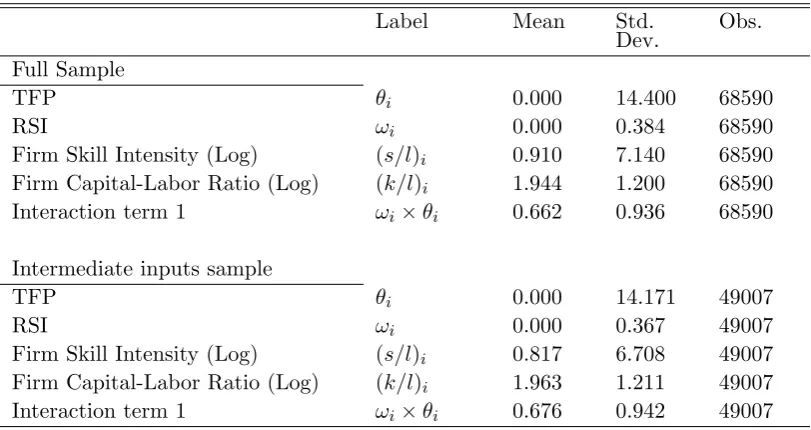
Table A.1 in Appendix 1 reports the descriptive statistics.
4 Descriptive Statistics
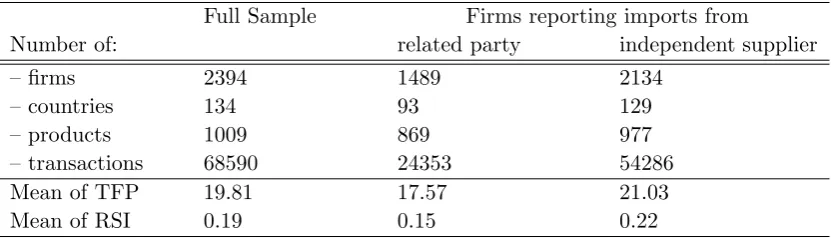
Table 1 reports the number of firms, transactions and countries for firms
re-porting intra-group trade and firms rere-porting outsourcing. The sample is
com-posed of 2394 firms that import 1009 different types of SH4 products from 134
countries. The total number of observations is 68590. The number of firms
that report outsourcing is about 1.5 times larger than the number of firms
that report intra-group trade. The number of transactions reported by firms
that outsource is larger than that reported by firms that import through their
[image:20.595.93.509.436.555.2]affiliates.
Table 1
Descriptive statistics on the full sample
Full Sample Firms reporting imports from
Number of: related party independent supplier
– firms 2394 1489 2134
– countries 134 93 129
– products 1009 869 977
– transactions 68590 24353 54286
Mean of TFP 19.81 17.57 21.03
Mean of RSI 0.19 0.15 0.22
A crude look at the means of the TFP and RSI variables show that firms that
report outsourcing are more productive and use more relationship specific
in-puts. We implement a two-sided Kolmogorov-Smirnov test on firms’ TFP and
RSI distribution in order to further investigate these results.21 Table 2 show
Table 2
Kolmogorov-Smirnov test for equality of productivity and RSI distributions
Difference P-value Corrected
Total Factor Productivity (Olley and Pakes, 1996)
T F Po > T F Pv 0.0406 0.229
T F Po < T F Pv -0.0841 0.002
Combined K-S 0.0841 0.004 0.003
Labor Productivity
LPo> LPv 0.0038 0.987
LPo< LPv -0.1704 0.000
Combined K-S 0.1704 0.000 0.000
Relationship Specific Inputs
RSIo> RSIv 0.0054 0.974
RSIo< RSIv -0.0985 0.000
Combined K-S 0.0985 0.000 0.000
are both statistically different at 1% level of significance.22 Importantly, the
two-sided test rejects the null hypothesis of higher productivities for firms
importing from affiliates. However, it accepts the hypothesis that firms that
outsource have higher productivities than those that import from their related
parties. The KS-test on the RSI distribution shows a similar pattern. Firms
that outsource are more intensive in relationship specific inputs than firms
that import from their affiliates. The KS-test also rejects the null hypothesis
of higher RSI intensity firms importing from foreign affiliates.
4.1 Estimation Strategy
Since our dependent variable is bounded between zero and one, the OLS linear
regression is unsuitable because it cannot guarantee that the predicted values
21The KS-test has the advantage of making no assumption about the sample dis-tribution. It determines whether two distributions differ significantly. Therefore, it calculates the largest difference between the observed and expected cumulative frequencies, which is called D-statistics. This statistic is compared against the critical D-statistic for that sample size. We run the tests at the firm level by ag-gregating the imports under both modes. A firm is classified under “outsourcing” if more than half of its imports are under this sourcing mode.
lie in the unit interval, like for binary data models. We use the fractional logit
estimation method developed by Papke and Wooldridge (2006) to deal with
fractional response variables bounded between zero and one. Since the unit
of observation is a transaction, but none of our variables are measured at the
transaction level–the finest being the firm level– we correct the standard errors
by clustering by firm (Wooldridge, 1996).
We also correct for non-response in our sample survey by using specific weights
that have been constructed by the SESSI. The weight coefficients correspond
to the inverse probability that a multinational firm answers the survey. It is
based on several characteristics. The SESSI methodology gives more weight
to the answer of small firms in the survey. This correction for non-response is
commonly used in all official releases.23
From our theoretical framework, the organizational choice is a function of
firm’s productivityθi and the RSI intensity ωi. To estimate the predictions of
the model, we also need to estimate how the relationship between the intensity
in suppliers’ inputs changes with the productivity. We add additional controls
such as the capital-labor intensity (k/l)i and the skill intensity (s/l)i.
All estimations include a set of specific effects at the French sector level,N AFs,
the imported product level,HSj, and the country level,Cl. The baseline
equa-tion is reported below.
yisjl=λ0+λ1θi+λ2ωi+λ3(ωi×θi) (4)
+λ4(k/l)i+λ5(s/l)i
+N AFs+HSj +Cl+νisjl
The interpretation of interaction effects in non-linear models is complex. Ai
and Norton (2003) argue that odds ratios have no meaningful interpretation
for the interaction terms. We apply the Ai and Norton (2003) correction to
our fractional logit estimations.
5 Estimation Results
The findings reported in this section do not represent, strictly speaking, a test
of the theoretical hypothesis but show the correlation between the level of
productivity and RSI and the sourcing choice. The theoretical model provides
testable predictions on the effects a cross-variation in productivity and RSI on
the incentives to outsource. Since our estimation is based on a cross-section
of firms, we control for time invariant country, product and sector specific
unobserved characteristics. We have moreover centered all variables around
their respective means in order to interpret the coefficient of the interaction
term.24
5.1 Baseline Specification
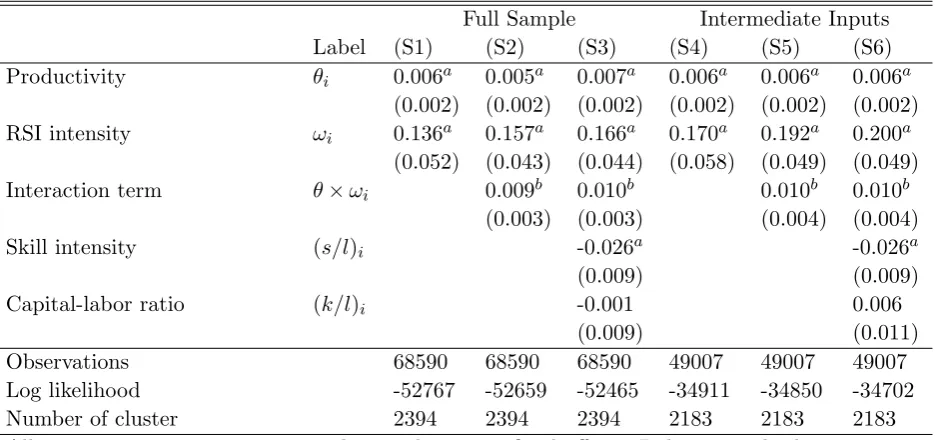
In the following Tables, we estimate a fractional logit model and present the
marginal effects that are evaluated at sample means. We include a full set
of country, product and sector specific effects to control for unobserved
char-acteristics. The first three columns (S1-S3) of Table 3, present the results
using the full sample of available transactions. Results from the application
of the fractional logit estimations show the expected pattern of signs, and all
estimated coefficients are statistically significant at the five percent level or
better.25 In specifications (S4) to (S6), we refine our estimation by using a
sample composed of intermediate inputs. We follow the methodology
devel-24This explains the difference between the TFP and RSI averages in Tables 1 and A.
oped by Feenstra and Hanson (1996), which identifies imported intermediate
inputs as purchased inputs registered in another HS3-digit sector than that in
[image:24.595.95.563.188.408.2]which the French multinational reports its main activity.
Table 3
Baseline Results. Dependent variable: Y= share of outsourcing (marginal effects presented.)
Full Sample Intermediate Inputs
Label (S1) (S2) (S3) (S4) (S5) (S6)
Productivity θi 0.006a 0.005a 0.007a 0.006a 0.006a 0.006a (0.002) (0.002) (0.002) (0.002) (0.002) (0.002) RSI intensity ωi 0.136a 0.157a 0.166a 0.170a 0.192a 0.200a
(0.052) (0.043) (0.044) (0.058) (0.049) (0.049)
Interaction term θ×ωi 0.009b 0.010b 0.010b 0.010b
(0.003) (0.003) (0.004) (0.004)
Skill intensity (s/l)i -0.026a -0.026a
(0.009) (0.009)
Capital-labor ratio (k/l)i -0.001 0.006
(0.009) (0.011)
Observations 68590 68590 68590 49007 49007 49007
Log likelihood -52767 -52659 -52465 -34911 -34850 -34702
Number of cluster 2394 2394 2394 2183 2183 2183
All regressions contain sector, product and country fixed effects. Robust standard error clustered at the firm level into brackets. a, b , c significantly different from 0 at 1%, 5% and 10% level, respectively.
The results of Table 3 provide support for our theoretical prediction. In
partic-ular, the most productive firms that intensively rely on specific inputs import
from foreign independent suppliers. In both samples, a positive and significant
marginal effect on TFP variable can be found. The size of the marginal effects
is similar across columns. Their magnitudes are economically meaningful. The
marginal effect associated with the productivity is 0.006. A standard
devia-tion in the TFP variable is associated with an increase in the probability to
outsource by about 8.6 percentage points.
There is also evidence that the share of relationship specific inputs affects the
multinational sourcing mode. The marginal effect of theRSI intensity variable
level of precision. For a given productivity, we find that going from the lowest
to the highest intensity in suppliers’ input increases the share of outsourced
inputs by 17 percentage points.26
The marginal effect of the interaction term on the other hand bears a positive
sign and appears to be significant. The estimates are robust across
specifi-cations and confirm the second theoretical prediction of the model. Greater
intensity in the RSI increases the marginal effect of the TFP variable on the
likelihood to import from a foreign outside supplier.
As for the other control variables, The spending on information technology is
negatively correlated with the outsourcing decision. Furthermore, we do not
find any significant effect of the firm specific capital intensity on the sourcing
mode.
5.2 Sourcing strategy, conditional on having a foreign related party
For any given country in the sample, there may or may not be an affiliate
located there that imports a specific input. The choice between the different
sourcing modes should imply a comparison between an already existing foreign
related party and a foreign outside supplier. We need to correct this potential
selection bias (Bernard et al. 2010).
To examine this issue, we identify the location of the firm’s foreign related
parties that supply the inputs. We use information from the LIFI data set
which provides a survey on the financial links between firms. We construct
a dummy variable, gl, that takes the value of one if the Ultimate Beneficial
Owner (UBO) of the firm reports a related party in a given foreign country.
Otherwise, it takes the value of zero.
26The calculation is based on the subsample of intermediate inputs (Specification
We address the selection issue by using the two following methodologies. First,
we drop all transactions between a firm and any countries where the UBO of
the firm has no related party. In other words, we drop all transactions for
which our dummy variable takes the value of zero. The firm choice to import
inputs is thus guided by the comparison between an existing related party
and an independent supplier. This first procedure eliminates about one fifth
of the total number of transactions in both the full and the intermediate inputs
samples. The results shown in Table 4 still support our theoretical predictions
(columns S1-S3 and S6-S8). A significant and positive correlation is found
between the level of productivity and the outsourcing likelihood. Moreover, the
positive effect of outsourcing is reinforced by the firm’s intensity in RSI. The
results are still economically significant. These findings are broadly consistent
with our baseline results, but the estimated marginal effects are larger.
Second, we apply a two-step estimation procedure (columns S4-S5 and
S9-S10 of Table 4). The equation to be estimated in the first stage is a probit
equation using the related parties dummy variable as the dependent variable.
The selection equation is identified by two variables: the number of related
parties located in France owned by its UBO (from which we exclude the firm
itself) and a dummy variable that identifies firms that are owned by a foreign
group.
Instrumental variables are expected to have a positive impact on the likelihood
of having a related party abroad. However, they should be exogenous to the
firm’s sourcing choice. As argued by Egger et al. (2011), multinational groups
establish a network of affiliates in their home country, in parallel of a network
of foreign affiliates abroad. We expect the size of the domestic network to
predict the presence of a related party abroad. Our prior is that, the number
itself, is positively correlated with the number of affiliates abroad. A similar
argument applies to the foreign ownership dummy. The foreign ownership
status is likely to have a positive impact on the likelihood for the UBO to
have affiliates in other foreign countries. From the point of view of the French
affiliate which is part of the UBO network, the number of affiliate owned by the
same UBO in France or the nationality of the UBO is exogenously determined
and is independent on its own decision to outsource or not when importing
inputs.
The equation to be estimated in the second stage is the one related to the
sourcing choice. We estimate the fractional probit equation augmented by the
inverse Mills’ ratio.27 The results are qualitatively similar. The inverse mills
ratio is significant and negative indicating that the correction for selection
bias reduces the outsourcing share. In Section D of the online appendix with
Supplementary Materials, we show that our main findings are qualitatively
similar when we take into account the product dimension in the construction
of the related party dummy variable.28
5.3 Results from aggregate level data
We follow Yeaple (2006) and Bernard et al. (2010) and aggregate our data at
4-digit sector, 3-digit product and country level. We compute the outsourcing
share as the ratio of the value of imports from independent suppliers to the
value of total imports. Total imports have been computed as the sum of
im-ports from affiliates plus imim-ports from independent suppliers from the SESSI
survey. Using the EAE database on all firms located in France with more than
27See Wooldridge (2007) for an example of a two step selection model with a frac-tional probit in the second stage.
28In this case, we use a more restrictive definition. We construct a dummy variable,
20 employees, we measure the extent of dispersion within an industry using
the standard deviation of firms’ TFP in that industry. We also compute the
RSI intensity at the sectoral level, as the ratio of the value of
relationship-specific inputs to the total inputs used in the sector. We also calculate the
[image:29.595.91.531.229.449.2]skill intensity and capital intensity for each sector.
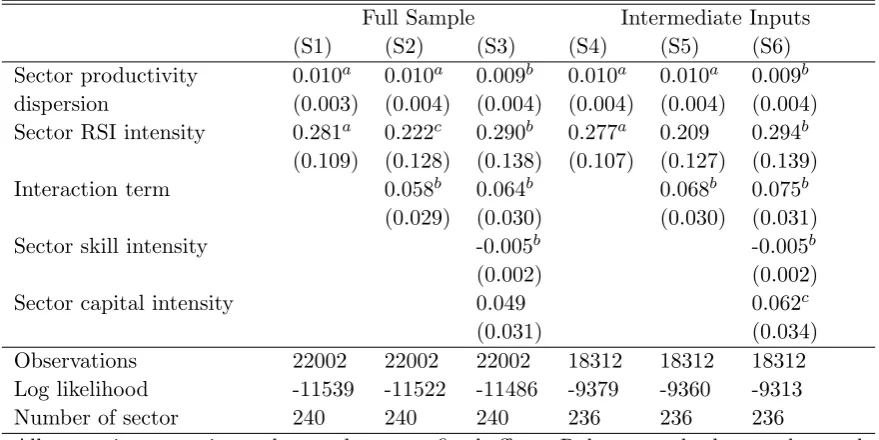
Table 5
Results from the aggregated sample
Full Sample Intermediate Inputs
(S1) (S2) (S3) (S4) (S5) (S6)
Sector productivity 0.010a 0.010a 0.009b 0.010a 0.010a 0.009b dispersion (0.003) (0.004) (0.004) (0.004) (0.004) (0.004) Sector RSI intensity 0.281a 0.222c 0.290b 0.277a 0.209 0.294b
(0.109) (0.128) (0.138) (0.107) (0.127) (0.139)
Interaction term 0.058b 0.064b 0.068b 0.075b
(0.029) (0.030) (0.030) (0.031)
Sector skill intensity -0.005b -0.005b
(0.002) (0.002)
Sector capital intensity 0.049 0.062c
(0.031) (0.034)
Observations 22002 22002 22002 18312 18312 18312
Log likelihood -11539 -11522 -11486 -9379 -9360 -9313
Number of sector 240 240 240 236 236 236
All regressions contain product and country fixed effects. Robust standard error clustered at the sector level into brackets. a,b ,c significantly different from 0 at 1%, 5% and 10% level, respectively.
Table 5 reports the estimated marginal effects of fractional logit models. We
control for product and country specific heterogeneity by using a set of
prod-ucts and country fixed effects. Robust standard-errors are clustered at the
4-digit sector level.
The results are in line with the predictions of our theoretical framework. The
findings are qualitatively similar to those of the firm-level regressions of Table
3. We find a larger outsourcing share in industries that are intensive in
rela-tionship specific inputs. The share of intra-firm imports is lower in industry
orga-nization cost under outsourcing than under intra-firm trade. Moreover, the
productivity dispersion variable magnifies the effect of the RSI variable.
6 Conclusion
Since multinational firms account for a large share of the world trade, their
international sourcing strategy is likely to change the structure of
interna-tional trade. Understanding the choice of organization of multinainterna-tional firms
is important as it may have several implications on welfare. For instance, the
structure of wages paid by firms in integrated or non-integrated units may be
different, e.g. Egger and Kreickemeier (2011). In addition, in models featuring
Nash-bargaining, such as the one considered in this paper, the choice of
organ-isation is likely to affect firms’ mark-up, and ultimately consumers’ welfare.
See Defever (2011) and Conconi et al. (2012).
In this paper, we use detailed French data on firms that are part of a
multi-national network to analyze how they organize their intermulti-national production.
There are multiple ways to organize its imports. Even being part of a
multi-national network, these firms might still face a choice between importing
in-termediate inputs from their related party abroad and/or from foreign outside
suppliers. We analyze the determinants of the sourcing modes by focusing on
the firm characteristics.
We build on the incomplete contracts approach to the theory of the firm
and we identify two important determinant of this choice. We show that the
decision to outsource depends on a combination between firms’ total factor
productivity and their intensity in RSI. Our model predicts that the most
productive MNCs outsource abroad their intermediate inputs while the
least-productive MNCs import from a foreign related party. In addition, the
productivity, especially if it uses relationship-specific inputs intensively.
The data are sufficiently detailed to construct the share of relationship specific
inputs that is used by firms. This is an important trait of the French firm-level
database. It is compulsory for French firms to report in their balance sheet the
value of inputs bought that are based-on plans and so, relationship specific.
In combination to the firm-level productivity, we show empirically that the
prediction of the model are borne out in the data. These results are robust to
References
Ai, C. and E. C. Norton (2003). Interaction terms in logit and probit models.
Economics Letters 80, 123–129.
Antr`as, P. (2003). Firms, contracts, and trade structure. Quarterly Journal
of Economics 118(4), 1375–1418.
Antr`as, P. (2005). Incomplete contracts and the product cycle. American
Economic Review 95(4), 1054–1073.
Antr`as, P. and E. Helpman (2004). Global sourcing. Journal of Political
Economy 112(3), 552–580.
Antr`as, P. and E. Helpman (2008). Contractual friction and global sourcing.
In E. Helpman, D. Marin, and T. Verdier (Eds.),The Organization of Firms
in a Global Economy. Harvard University Press.
Bernard, A. B., J. B. Jensen, S. J. Redding, and P. K. Schott (2010). Intrafirm
trade and product contractibility. American Economic Review 100(2), 444–
48.
Conconi, P., P. Legros, and A. F. Newman (2012). Trade liberalization and
organizational change. Journal of International Economics 86(2), 197–208.
Corcos, G., D. Irac, G. Mion, and T. Verdier (2009). The determinants of
intra-firm trade. CEPR Discussion Papers 7530.
Costinot, A., L. Oldenski, and J. Rauch (2011). Adaptation and the boundary
of multinational firms. The Review of Economics and Statistics 93(1), 298–
308.
Cr´emer, J., L. Garicano, and A. Prat (2007). Language and the theory of the
firm. The Quarterly Journal of Economics 122(1), 373–407.
Defever, F. (2011). Incomplete contracts and the impact of globalization on
consumer welfare. CEP Discussion Papers dp1057.
for you. Technical report.
Egger, P., M. Fahn, V. Merlo, and G. Wasmer (2011). On the genesis of
multinational foreign affiliate networks. Technical report.
Feenstra, R. C. and G. H. Hanson (1996). Globalization, outsourcing, and
wage inequality. American Economic Review 86(2), 240–45.
Grossman, G. and E. Helpman (2002). Integration versus outsourcing in
in-dustry equilibrium. Quarterly Journal of Economics 117, 85–120.
Grossman, G. and E. Helpman (2003). Outsourcing versus fdi in industry
equilibrium. Journal of the European Economic Association 1, 317–327.
Grossman, G. and E. Helpman (2005). Outsourcing in the global economy.
Review of Economic Studies 72(1), 135–159.
Grossman, S. J. and O. D. Hart (1986). The costs and benefits of
owner-ship: A theory of vertical and lateral integration. Jouranl of Political
Econ-omy 94(4), 691–719.
Hart, O. and J. Moore (1990). Property rights and the nature of the firm.
Journal of Political Economy 98(6), 1119–1158.
Helpman, E. (2006). Trade, fdi, and the organization of firms. Journal of
Economic Literature 44(3), 589–630.
Kohler, W. and M. Smolka (2009). Global sourcing decisions and firm
pro-ductivity: Evidence from spain. CESifo Working Paper Series (2903).
Lafontaine, F. and M. Slade (2007). Vertical integration and firm boundaries:
The evidence. Journal of Economic Literature 45(3), 629–685.
McLaren, J. (2000). ’globalization’ and vertical structure.American Economic
Review 90, 1239–1254.
Nunn, N. (2007). Relationship-specificity, incomplete contracts, and the
pat-tern of trade. Quarterly Journal of Economics 122:2, 569–600.
Nunn, N. and D. Trefler (2008). The boundaries of the multinational firm: An
Organization of Firms in a Global Economy. Harvard University Press.
Nunn, N. and D. Trefler (2013). Incomplete contracts and the boundaries of
the multinational firm. Journal of Economic Behavior & Organization, this
issue.
Olley, S. and A. Pakes (1996). The dynamics of productivity in the
telecom-munications equipment industry. Econometrica 64(6), 1263–1298.
Papke, L. E. and J. M. Wooldridge (2006). Econometric methods for fractional
response variables with an application to 401(k) pan participation rates.
Journal of Applied Econometrics 11, 619–632.
Schott, P. K. (2004). Across-product versus within-product specialization in
international trade. The Quarterly Journal of Economics 119(2), 646–677.
Spencer, B. (2005). International outsourcing and incomplete contracts.
Cana-dian Journal of Economics 38(4), 1107–1135.
Stefano (2009). Outsourcing versus integration at home or abroad and firm
heterogeneity. Empirica 37(1), 47–63.
Tomiura, E. (2007). Foreign outsourcing, exporting, and fdi: a productivity
comparaison at the firm level. Journal of International Economics 72, 113–
127.
Williamson, O. E. (1985). The Economic Institutions of Capitalism. Free
Press.
Wooldridge, J. (1996). Cluster-sample methods in applied econometrics: An
extended analysis. Working paper.
Wooldridge, J. (2007). What s new in econometrics? lecture 6: Control
func-tions and related methods. NBER Summer Institute.
World Trade Organization (1996). World Trade Organization, 1996 Annual
Report. Geneva.
Yeaple, S. (2006). Offshoring, foreign direct investment, and the structure of
Appendices
[image:35.595.92.498.173.388.2]A Descriptive Statistics
Table A.1
Summary statistics of variables
Label Mean Std.
Dev. Obs.
Full Sample
TFP θi 0.000 14.400 68590
RSI ωi 0.000 0.384 68590
Firm Skill Intensity (Log) (s/l)i 0.910 7.140 68590 Firm Capital-Labor Ratio (Log) (k/l)i 1.944 1.200 68590
Interaction term 1 ωi×θi 0.662 0.936 68590
Intermediate inputs sample
TFP θi 0.000 14.171 49007
RSI ωi 0.000 0.367 49007
Firm Skill Intensity (Log) (s/l)i 0.817 6.708 49007 Firm Capital-Labor Ratio (Log) (k/l)i 1.963 1.211 49007