
C
e
C bond-forming reactions of ground-state aryl halides under
reductive activation
Katie J. Emery, Tell Tuttle
*, Alan R. Kennedy, John A. Murphy
*WestCHEM, Department of Pure and Applied Chemistry, 295 Cathedral Street, Glasgow G1 1XL, United Kingdom
a r t i c l e i n f o
Article history:
Received 6 February 2016
Received in revised form 22 May 2016 Accepted 31 May 2016
Available online xxx
Keywords: Radical Coupling Electron transfer BHAS
SRN1
a b s t r a c t
Under basic conditions aryl halides can undergo SRN1 reactions, BHAS reactions and benzyne formations.
Appropriate complex substrates afford an opportunity to study inherent selectivities. SRN1 reactions are
usually favoured under photoactivated conditions, but this paper reports their success using ground-state and transition metal-free conditions. In benzene, the enolate salt12, derived by deprotonation of diketopiperazine 11, behaves as an electron donor, and assists the initiation of the reactions, but in DMSO, it is not required. The outcomes are compared and contrasted with a recent photochemical study on similar substrates. A particular difference is the prevalence of hydride shuttle reactions under rela-tively mild thermal conditions.
Ó2016 The Authors. Published by Elsevier Ltd. This is an open access article under the CC BY license (http://creativecommons.org/licenses/by/4.0/).
1. Introduction
AreC and Areheteroatom bond formations have long been key reactions in organic synthesis. Pd salts and related complexes have played an important role in thisfield, but other metals, notably copper, are central to some of these coupling processes. The 2010 Nobel Prize in Chemistry1 was awarded to Heck,2 Negishi3 and Suzuki4for their pioneering studies on the former; whereas the Sonogashira reaction5is one of a host of other AreC coupling re-actions that are now indispensable to organic chemistry. Further-more, Buchwald’s and Hartwig’s studies of the synthesis of Areheteroatom bonds6have become extremely important, adding significantly to the much earlier discovery of the Ullmann synthesis.7
Alongside these pioneering reactions, transition metal-free couplings have emerged and are now witnessing spectacular growth.8e10With the increasing cost of transition metal catalysts,
and the requirement for costly separation and recovery of heavy metals from waste-streams, the attractions of the transition metal-free couplings are clear. We consider below three types of reactions (Scheme 1) that can take place with aryl halides, all of which occur under basic conditions (other types of reaction that occur for
restricted classes of aryl iodides, such as SNAr, are not considered here): (i) the SRN1 reactions developed by Bunnett and co-workers.11In this case, electron transfer to aryl halide1affords an aryl radical3, which couples with an anionic nucleophile to form radical anion4. This species transfers an electron to another mol-ecule of aryl halide to form another aryl radical 3 and thereby propagates the chain reaction. In doing so, 4 is converted into product5. This family of reactions has shown expanded scope in recent years, mirroring the greater mechanistic understanding of the processes.12e15 It includes both carbon
ecarbon and carbon-eheteroatom bond formations. Rossi has been a pioneer of much of the recent development of the SRN1 reaction.13,14His studies gen-erally focus on reactions that are conducted under photoactivation conditions.14
(ii) benzyne coupling reactions, an area of rapid recent de-velopments.10,16Base-induced elimination of hydrogen halide from a halobenzene1forms the benzyne6, which is attacked by a nu-cleophile to form aryl anion 7. On protonation, this affords the product5.
(iii) the BHAS (base-promoted homolytic aromatic substitution) reaction.8,9Here, an aryl radical3adds to an arene; the new radical
8is deprotonated to form an electron-rich radical anion9. Transfer of an electron from this species leads to the biaryl product10; the electron is transferred to another molecule of aryl halide1to form a new aryl radical3, continuing the chain.
For transition metal-free coupling chemistry to advance, com-plex substrates need to be studied, including those where different *Corresponding authors. E-mail addresses: [email protected] (T. Tuttle),
[email protected](J.A. Murphy).
Contents lists available atScienceDirect
Tetrahedron
j o u r n a l h o m e p a g e :w w w . e l s e v i e r . c o m / l o c a t e / t e t
http://dx.doi.org/10.1016/j.tet.2016.05.083
types of coupling reactions are in competition. Rossi and co-workers have conducted a recent study where aryl radicals have more than one option from the classes of reactions listed above.13 The studies were conducted (i) under transition metal-free pho-toactivation conditions, or (ii) without phopho-toactivation but in the presence of iron (II) salts and pinacolone. Our interest in coupling reactions that are conducted in the ground-state and under tran-sition metal-free conditions attracted us to this area. We recently studied BHAS coupling reactions of arenes with aryl halides under more routine thermal conditions and using organic electron donors to initiate the reaction of the aryl halides.9i,9m,9s,17In this paper, we now report on a series of competing reactions for a selection of substrates that are carried out under thermal reaction conditions.
2. Results and discussion
Recent reports of BHAS coupling reactions use KOtBu together with one of a wide variety of organic additives, to facilitate coupling of haloarenes with arenes under transition metal-free conditions.8,9 We have previously shown that one of the most successful addi-tives at initiating the BHAS pathway was N,N0 -dipropyldiketopi-perazine (DKP) 11.9m,9s The enolate anion, 12, derived by deprotonation of DKP11(Scheme 2), acts as an electron donor to the aryl halides in the initiation step. Most reactions reported in the literature that proceed via the BHAS mechanism are performed using benzene as the solvent, since benzene is the coupling partner in these reactions. In the few examples where aryl radicals couple to enolate anions via the SRN1 pathway, the solvents used are DMSO or liquid ammonia or DMF.14a,15Given that the polarity of the me-dium is expected to play an important role in facilitating electron transfer reactions, the reaction outcomes in both benzene and DMSO were investigated and the results are compared throughout our studies.
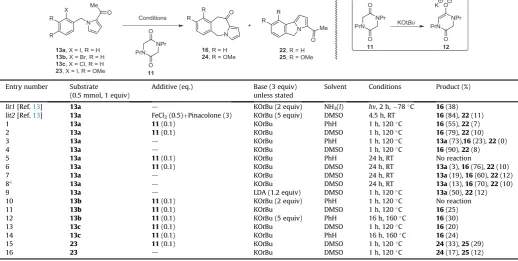
Our initial studies exposed substrates13aecto these transition metal-free reaction conditions (Table 1). When13awas stirred at 120C for 1 h in the presence of KOtBu and DKP11, and in either anhydrous benzene or anhydrous DMSO, two products were iso-lated. The major product in both benzene and DMSO was 5H-benzo [e]-pyrrolo[1,2-a]azepin-11(10H)-one16, which was isolated in 55% and 79% yields, respectively, and the minor product isolated was 3-acetyl-5H-pyrrolo[2,1-a]isoindole22 in yields of 7% and 10%, re-spectively [Table 1: entries 1 and 2]. These products were isolated in yields that compared favourably to previous experiments under light irradiation or when iron salts were used as a catalyst [Table 1: entrieslit 1andlit 2], and with the same preference for the for-mation of16as major product.13Blank reactions were performed without the DKP additive11, to observe how the enolate anion of DKP,12, influences the yields of the reaction. We note that the choice of solvent has a dramatic effect on the yields. A blank re-action in benzene, without the DKP additive11, afforded much lower yields of16compared to when DKP was present [Table 1: entry 3]. However, a blank reaction in DMSO showed the opposite trend, and16was achieved with higher yields of 90% when the DKP additive was omitted [Table 1: entry 4]. The difference in DMSO
Scheme 1.Transition metal-free routes to formation of AreC and AreHeteroatom bond.
may not be due purely to polarity effects, as evidence mounts of the dimsyl anion as an electron donor.18
When using DMSO as a solvent (but not benzenedseeTable 1: entry 5) the reactions could be achieved at lower temperatures. When the reaction was performed at room temperature (RT) in DMSO moderate to high yields of cyclized products were isolated both with and without the DKP11additive, respectively [Table 1: entries 6 and 7]. A reaction that was conducted in the dark provided confirmation that these reactions proceed via a ground-state SET pathway, with yields matching those carried out in the presence of ambient light [Table 1: entry 8]. So, even at RT, photochemical as-sistance is not needed for these SRN1 reactions. When LDA was used as the base in the reaction, only the product22was isolated in low yields; the yield of22was comparable with the yield of22obtained in the presence of KOtBu [Table 1: entry 9]. To test the effect of the halogen substituent, the substrates13b,cwere also treated under transition metal-free reaction conditions. When13bwas stirred at 120C for 1 h in the presence of KOtBu and DKP11, in anhydrous benzene,13bdid not react [Table 1: entry 10]. However under the same conditions in DMSO solvent, both13band13cafforded16in low yields [Table 1: entries 11 and 13]. When either13bor13cwas reacted under harsher reaction conditions, stirred at 160C for 16 h in the presence of KOtBu and DKP11, in anhydrous benzene, the product16was achieved in low yield [Table 1: entries 12 and 14]. Finally the substrate23was treated with KOtBu and DMSO, and stirred at 120C for 1 h, in the presence of DKP11, and afforded the products24and25in moderate yields [Table 1: entry 15]. In the absence of DKP under the same conditions,23yielded lower yields of24and25[Table 1: entry 16].
The proposed mechanism involves initial deprotonation of the substrates and additives by KOtBu (Scheme 2). Under the basic conditions,13aecwill exist in part as enolate14aec, and similarly the DKP additive11will be partly converted to its enolate anion12. The enolate anion 12 acts as an electron donor, and will in-termolecularly donate a single electron to14aecto afford the aryl
radical17. The aryl radical formed could undergo intramolecular cyclisation onto the enolate anion to form the seven-membered cyclic radical anion18. This radical anion18is electron-rich and can propagate the radical chain mechanism by donating an elec-tron, to either14aecor13aec, and thus yield the seven-membered cyclic product16. The formation of the minor by-product22likely arises when an electron is donated intermolecularly to the sub-strate13aec. SET (single electron transfer) to13aecforms the aryl radical 19 which cyclises onto the pyrrole ring to form the in-termediate radical20. Deprotonation of20affords the radical anion
21and, after the transfer of an electron, the product22is formed (Scheme 2).
[image:3.595.43.562.90.351.2]It was demonstrated that in DMSO, and to a slight extent in benzene, the substrate13acyclises in the absence of the DKP ad-ditive11(Table 1: entries 3 and 4). The enolate anion of DKP is proposed to act as the electron donor, but the substrate also forms an electron-rich enolate species,14a, in the presence of KOtBu. The relative effectiveness of the two potential electron donors, in this case the enolate anion of DKP 12 or the enolate anion present within 14a, is often an important aspect in SRN1 chemistry. Al-though two enolates are present, they are not necessarily of equal strength as electron donors. SRN1 reactions are frequently de-pendent on traces of a more active electron donor (here 12) to initiate the radical chaindthis is known as‘entrainment’.11,13,14,19In non-polar solvents like benzene, where electron transfer from neutral species to form charged species is not facilitated, a stronger donor like12can play a powerful role in assisting the initiation of the chains. Polar solvents, like DMSO, favour SET reactions in which charged species are formed from neutral starting materials, and so, donors like 12 are not needed to initiate the reaction.18 If the enolate anion within14aecdonated an electron intramolecularly to the LUMO in the haloaryl moiety, the diradical15would form upon the loss of an iodide anion. The diradical15would undergo radical coupling in the cyclisation to form product16. This route does not involve a radical chain.
Table 1
Thermally activated Electron Transfer Reactions of 1-(2-halobenzyl)-2- acetylpyrrole13aecand 1-(2-Iodo-3,4-dimethoxybenzyl)-2-acetylpyrrole23
Entry number Substrate (0.5 mmol, 1 equiv)
Additive (eq.) Base (3 equiv) unless stated
Solvent Conditions Product (%)
lit1[Ref.13] 13a d KOtBu (2 equiv) NH3(l) hv, 2 h,78C 16(38)
lit2[Ref.13] 13a FeCl2(0.5)þPinacolone (3) KOtBu (5 equiv) DMSO 4.5 h, RT 16(84),22(11)
1 13a 11(0.1) KOtBu PhH 1 h, 120C 16(55),22(7)
2 13a 11(0.1) KOtBu DMSO 1 h, 120C 16(79),22(10)
3 13a d KOtBu PhH 1 h, 120C 13a(73),16(23),22(0)
4 13a d KOtBu DMSO 1 h, 120C 16(90),22(8)
5 13a 11(0.1) KOtBu PhH 24 h, RT No reaction
6 13a 11(0.1) KOtBu DMSO 24 h, RT 13a(3),16(76),22(10)
7 13a d KOtBu DMSO 24 h, RT 13a(19),16(60),22(12)
8a 13a
d KOtBu DMSO 24 h, RT 13a(13),16(70),22(10)
9 13a d LDA (1.2 equiv) DMSO 1 h, 120C 13a(50),22(12)
10 13b 11(0.1) KOtBu (2 equiv) PhH 1 h, 120C No reaction
11 13b 11(0.1) KOtBu DMSO 1 h, 120C 16(25)
12 13b 11(0.1) KOtBu (5 equiv) PhH 16 h, 160C 16(30)
13 13c 11(0.1) KOtBu DMSO 1 h, 120C 16(20)
14 13c 11(0.1) KOtBu PhH 16 h, 160C 16(24)
15 23 11(0.1) KOtBu DMSO 1 h, 120C 24(33),25(29)
16 23 d KOtBu DMSO 1 h, 120C 24(17),25(12)
When substrate13awas treated with LDA, the lithium enolate salt analogous to14aformed. Based on the experiments above with KOtBu as base, the expected product was16. However only22and unreacted13awere observed. In this case, we expect full depro-tonation of the substrate and hence a different rationalization than above for formation of22. Its formation may suggest that the tightly bound lithium enolate anions are less effective electron donors than the corresponding potassium enolates (differences between potassium salts and salts of lower alkali metals are pronounced in BHAS and other coupling reactions.15,9v) Intramolecular electron transfer from the lithium analogue of14awould have produced the (metal-free) diradical 15 that should behave as described above. Intermolecular electron transfer would create the lithium analogue of radical17; here, coupling of the aryl radical to the lithium enolate must again be harder than for the potassium enolate, whether for conformational or electronic reasons, so that coupling to the pyr-role occurs,finally on workup forming22.
The substrate23should follow the same type of mechanism as
[image:4.595.346.511.312.369.2]13aec(Scheme 2) in the formation of products24 and25. This substrate was important for mechanistic reasons. Our previous studies had shown that coupling of haloarenes to arenes can be initiated through formation of benzynes.9i,9mSince this substrate cannot form a benzyne, it confirms that the current trans-formations are not dependent on a benzyne route. Compared to the cyclisation of13a, lower yields of products were achieved in the cyclisation of23. The low yields may reflect the increased steric hindrance around the aryl radical that would arise from the methoxy substituents on the benzene ring.9m Alternatively, electron-rich substrate23should also have a higher LUMO, hence the initiation by electron transfer to the haloarene would be harder, and require more energy.
Table 2 illustrates the powerful effects that solvent and tem-perature can have on the reaction pathways that are followed. Substrates 26a,b were synthesized and reacted under various conditions in the presence of KOtBu and with either DMSO or benzene as the solvent.
Under the thermal activation conditions in benzene solvent,26a
afforded three products in low yields: the 6-membered cyclised product, 4-acetylphenanthridine,27, its dihydro derivative,28and the deiodinated but uncyclised product29[Table 2: entry 1].
This differed markedly from the photoactivated conditions,13 which afforded solely27in moderate yields [Table 2: entrylit3].
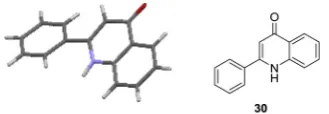
Surprisingly, when 26a was exposed to the thermal electron transfer conditions in DMSO, a completely different product,30, was isolated in moderate yield [Table 2: entry 2]. The product structure was confirmed by X-ray crystallography (Fig. 1). The for-mation of30also occurs in similar yields in the absence of the additive11[Table 2: entry 3]. When26bwas subjected to similar reaction conditions, product 30 was isolated in lower yields, showing that changing the halogen to Br adversely affects the yield [Table 2: entry 4]. The reaction of26ain DMSO [Table 2: entry 5] at RT generated a mixture of products,27,29and30in low yields and a new product identified as42was obtained in moderate yields. Product42was only seen at RT, but its desaturation product,30, was seen at higher temperature [Table 2: entry 2]. When substrate
29, which is the non-halogenated analogue of26a,bwas subjected to the reaction conditions in DMSO, the starting material was re-covered [Table 2: compare entries 7 and 5]. This substrate was used to provide added information about the mechanism of formation of products from26a(Scheme 3). Particularly interesting is the fact that by isolating pure29and subjecting it to these reaction con-ditions, this does not lead to isolation or detection of30 or42, implying a role for the halogen of26a,bin the reactions of these substrates.
In these reactions, we recognize that either deprotonation of
26a,bof the N-H or of the C-H of the ketone can occur to form the enolate; in addition, an equilibrium is likely to exist between the
neutral and deprotonated forms.Scheme 3A proposes a possible route for the formation of27, starting with an electron transfer from the DKP enolate12to26a,b. The resulting aryl radical,32, cyclises onto the neighbouring aryl ring via the BHAS mechanism and generates the intermediate33. The rate of cyclisation of radical
[image:4.595.67.552.476.673.2]32must be competitive with hydrogen atom transfer (H.A.T.); the
Table 2
Thermally activated electron transfer reactions of26a,band the non-halogenated analogue29
Entry number Substrate (0.5 mmol, 1 equiv) Additive (0.1 equiv) Base (3 equiv) unless stated Solvent Conditions Product (%)
lit3[Ref.13] 26a KOtBu NH3(l) hv, 2 h,78C 27(51)
1 26a 11 KOtBu PhH 1.5 h, 120C 27(10),28(21),29(8)
2 26a 11 KOtBu DMSO 1 h, 120C 28(trace),30(52)
3 26a d KOtBu DMSO 1 h, 120C 30(49)
4 26b 11 KOtBu DMSO 16 h, 120C 30(31)
5 26a 11 KOtBu DMSO 24 h, RT 27(14),29(16),30(23),42(42)
6 29 d KOtBu PhH 1 h, 120C No reaction
7 29 11 KOtBu DMSO 24 h, RT No reaction
hydrogen abstraction will quench 32 to generate the observed product29. Deprotonation of33yields the radical anion34, which will form35, by donating an electron to the starting substrate26a, which goes on to propagate the radical chain. Deprotonation of the NeH proton of35, followed by hydride loss forms the product27, which was the only product reported under photoactivation.13 Hydride loss has been observed from alkoxides under the condi-tions of the coupling reaccondi-tions;9min this case, the aromaticity of the nitrogen-containing ring in the product 27 provides additional driving force. The proposal that a hydride is eliminated from36to form27is supported by the isolation of 28; this compound can form when27behaves as the hydride acceptor for another mole-cule of36.
When the reaction is performed in DMSO, the major product is either30or42, depending on the temperature of the reaction. It is proposed that in DMSO the substrate26awill be present to some extent in its enolate anionic form,31(Scheme 3B). Since the iso-lated yields of30 were similar both with and without the DKP additive11, we proposed that this enolate anion31is capable of undergoing intramolecular SET, whereby an electron is donated from the enolate anion moiety to its haloaryl moiety. This would yield the diradical species37. An 8-membered ring could form by the combination of the radicals, however it appears that this pro-cess must be slower than an alternative propro-cess. One possibility is that a [1,4]-hydrogen atom transfer by the aryl radical would form intermediate38.20Instead of radical combination between the two electrophilic species in38, hydrogen atom transfer occurs to form a conjugated imine39. In the presence of KOtBu the enolate anion formation will occur to give40, 6-endo-cyclisation would afford salt
41, which would yield 42 by proton transfer either during the
reaction or on work up. On the other hand, exposure of41to heat could lead to loss of hydride, consistent with the conversion of36to
27discussed earlier, and leads to43. Tautomerism would then af-ford 30. In addition, trace amounts of28 were also observed in DMSO, which proceeds via the same mechanism as proposed above (Scheme 3A). Recently, Long et al. published an alternative syn-thesis of analogues of30using TEMPO and KOtBu in DMSO, but our route must occur by a different mechanism.21
Thefinal substrate tested was substrate44(Scheme 4), which is analogous to26aexcept that the nitrogen of the tether is methyl-ated to favour selective deprotonation to form the enolate anion. Under UV irradiation conditions, this substrate led, in Rossi’s hands, to the formation of the 8-membered ring47(78%), in preference to a 6-membered cyclisation, that would have been analogous to that seen in the formation of27from26a. We wanted to probe the effect of this methylation under our ground-state conditions.
When44was treated with KOtBu and11in benzene at 120C, tetracycle45was isolated as a novel compound, the structure of which was confirmed using X-ray single crystal structure de-termination (Fig. 2), and additionally46was isolated in low yield [Scheme 4: reaction A]. However when the reaction was performed in DMSO at RT, this tetracycle 45 was not observed [Scheme 4: reaction B]. The products isolated were 46, similar to when the reaction was performed in benzene, 47 (which was the only product observed when the reaction was performed using photo-irradiation13) and48.
[image:5.595.45.294.63.394.2]Possible mechanisms for forming the products are shown in Scheme 5. Electron transfer within enolate49affords the diradical
Fig. 2.The X-ray crystal structure of the (4bR,9bS)-5-methyl-4b,10-dihydro-indeno [1,2-b]indol-9b(5H)-ol45.
Scheme 3.The proposed reaction pathways of substrate26.
50. This diradical could directly close to form the 8-membered ring in47. Alternatively, hydrogen atom transfer through a favoured 6-centred transition state would give diradical51, that cyclises rap-idly to form ketone 46. Of course, more than one mechanistic pathway may have relevance. Intermolecular electron transfer to enolate49would yield radical anion52. Coupling of the radical to the anion would give53, which could transfer an electron (to an-other molecule of44) to give product47.
Two possible routes are shown (and one of them is discussed below) for the formation of tetracycle45. We took purified47and converted this to45in the presence of KOtBu. The 5-membered ring product45was not observed in DMSO at room temperature, which suggests that the application of heat is required to convert the 8-membered product47to the cyclic product45(Scheme 5).
Formation of48was not observed in the photochemical study. This compound can arise by cleavage of the bond between the benzylic N and the benzylic C atoms. This cleavage can be trig-gered from the radical anions 56and/or57, which can form by
electron transfer to either of the arene rings of44. (The radical anions56and57are shown, where substituent X]I or H; in our experience, deiodination of arenes is an easier reaction than cleavage of benzylic CeN bonds, and so we suspect that deiodi-nation to X]H occurs first). Such reactions have recently been observed using powerful organic electron donors,22but this is the
first observation of such reactions under KOtBu-facilitated cou-pling conditions.
3. Conclusion
In conclusion, the present work reports the results of our studies on thermally initiated reactions of various substrates using the additive DKP11and KOtBu, in DMSO or benzene. Entrainment with enolate12is of benefit in the less polar benzene solvent, but gen-erally not so in the more polar DMSO. Although SRN1 reactions are normally conducted under photochemical activation, the sub-strates represented here show that activation also occurs efficiently when ground-state conditions are used.15
4. Experimental section
The electron transfer reactions were carried out within a glove box (Innovative Technology Inc., U.S.A.) under nitrogen atmo-sphere, and performed in oven-dried orflame-dried apparatus. All the reagents were obtained from commercial suppliers and used without further purification unless stated otherwise. A B€uchi rotary evaporator was used to concentrate the reaction mixtures. Column chromatography was performed using Prolabo 35e70
m
m particle size silica gel 60 (200e400 mesh). Thin Layer Chromatography (TLC) was performed using Merck silica gel 60 F254pre-coated al-uminium plates. Visualisation was achieved under UVP mineralight UVG-11 lamp and by using methanolic vanillin or phosphomolyb-dic acid to develop them. Melting points were determined using a GallenKamp‘Griffen Melting Point Apparatus’.1H NMR spectra were obtained at 400 MHz (Bruker AV400) or 500 MHz (Bruker AV500) and13C NMR spectra were obtained at 100 MHz (Bruker AV400) or 125 MHz (Bruker AV500) using broadband decoupled mode. Spectra were recorded in either deuterated chloroform (CDCl3) or deuterated dimethyl sulfoxide (DMSO-d6), depending on the solubility of the compounds. Chemical shifts are reported in parts per million (ppm) calibrated on the residual non-deuterated solvent signal, and the coupling constants,J, are reported in Hertz (Hz). The peak multiplicities are denoted using the following ab-breviations: s, singlet; d, doublet; t, triplet; q, quartet; sx, sextet; m, multiplet; br s, broad singlet; dd, doublet of doublets; td, triplet of doublets. GCeMS data were recorded using an Agilent Technologies 7890A GC system coupled to a 5975C inert XL EI/CI MSD detector. Separation was performed using the DB5MS-UI column (30 m0.25 mm0.25m
m) at a temperature of 320C, using he-lium as the carrier gas. Positive Chemical Ionisation (PCIþ) was used with methane as the ionization gas and a voltage of 952.941 V. High-resolution mass spectrometry (HRMS) was performed at the University of Wales, Swansea, in the EPSRC National Mass Spec-trometry Centre. Accurate mass was obtained using nanospray ionization (NSI) or atmospheric pressure chemical ionisation (APCI) with a LTQ Orbitrap XL mass spectrometer. Infra-Red spectra were recorded using Shimadzu FTIR Spectrophotometer (Model IRAffinity-1) with a MIRacle Single Reflection Horizontal ATR Accessory.4.1. Experimental procedures and characterisation of substrates
4.1.1. 1,4-Dipropylpiperazine-2,5-dione 11.9m In a round-bottomed
flask with anhydrous dichloromethane (30 mL) under argon at
0 C, chloroacetyl chloride (4 mL, 50 mmol) and propylamine (8.64 mL, 105 mmol, 2.1 equiv) were simultaneously added drop-wise, and the reaction mixture was stirred at 0C for 15 min. The reaction mixture was diluted with diethyl ether (200 mL) and a solid precipitated out of solution. The reaction mixture wasfiltered and the solid was washed with diethyl ether. Thefiltered solution was concentrated in vacuo and again diluted with diethyl ether (200 mL) andfiltered. Thefiltered solution was concentrated in vacuo to yield the crude product 2-chloro-N-propylacetamide (6.72 g, 99%) as a pale yellow oil which was used without further purification. In a round-bottomed flask, 2-chloro-N-propylacetamide (6.604 g, 48.7 mmol) was diluted with anhydrous tetrahydrofuran (30 mL). At 0C, a suspension of sodium hydride in mineral oil (60%, 1.95 g, 48.7 mmol, 1 equiv) in anhydrous tetrahydrofuran (20 mL) was added dropwise to the reaction mixture via cannula. The reaction mixture was stirred at 0C for 10 min, then at RT for 3.5 h. The re-action mixture was quenched by dropwise addition of water and diluted with diethyl ether (150 mL). The reaction mixture was dried over anhydrous sodium sulfate. Thefiltered solution was concen-trated in vacuo and purified by column chromatography (30%e100% ethyl acetate in petroleum ether) to yield 1,4-dipropylpiperazine-2,5-dione11(0.696 g, 14%) as pale yellow crystals, and recovered 2-chloro-N-propylacetamide (3.26 g, 49%).
Compound 11: mp 54e59 C; [Found: (ESIþ) 199.1438. C10H19N2O2þ (MþH)þ requires 199.1438];
n
max(film)/cm1 2964, 2932, 2872, 1647, 1483, 1335, 1308, 1277, 1204, 1055; 1H NMR (500 MHz, CDCl3)d
0.92e0.95 (6H, m, 2CH3), 1.56e1.62 (4H, m, 2CH2), 3.37 (4H, t,J¼7.5 Hz, 2CH2), 3.96 (4H, s, CH2);13C NMR (125 MHz, CDCl3)d
11.3 (CH3), 20.0 (CH2), 47.7 (CH2), 50.0 (CH2), 163.7 (C);m/z(ESIþ) 199.1438 (MHþ, 100%).4.1.2. 1-(1-(2-Iodobenzyl)-1H-pyrrol-2-yl)ethan-1-one 13a. In an oven-dried round-bottomedflask, (2-iodophenyl)methanol (8.2 g, 35 mmol) was dissolved in anhydrous dichloromethane (60 mL). At 0C, PBr3(1.32 mL, 14 mmol, 0.4 equiv) was added slowly into the reaction flask, and the reaction mixture was stirred at 0 C for 30 min, then at RT overnight. The reaction mixture was quenched with water (20 mL) and extracted with dichloromethane (320 mL). The combined organic phases were washed with water (250 mL), brine (50 mL) and dried over anhydrous sodium sulfate. Thefiltered solution was concentrated in vacuo to yield the crude product 1-(bromomethyl)-2-iodobenzene (9.37 g, 90%) as white crystals, which was used without further purification. In an oven-dried three-necked flask equipped with condenser, sodium hy-dride in mineral oil (60%, 0.720 g, 18 mmol, 1.2 equiv) was sus-pended in anhydrous DMF (5 mL). At 0C, a solution of 1-(1H-pyrrol-2-yl)ethan-1-one (1.64 g, 15 mmol) in anhydrous DMF (10 mL) was added slowly into the reaction mixture, which was stirred at 0C for 5 min, then at RT for 1 h. A solution of 1-(bro-momethyl)-2-iodobenzene (5.12 g, 17.25 mmol, 1.15 equiv) in an-hydrous DMF (10 mL) was added dropwise to the reaction mixture, which was stirred at 60C overnight. The reaction mixture was cooled to RT, quenched dropwise with water (80 mL) and extracted with ethyl acetate (350 mL). The combined organic phases were washed with water (2100 mL), brine (50 mL) and dried over an-hydrous sodium sulfate. Thefiltered solution was concentrated in vacuo and purified by column chromatography (0%e10% diethyl ether in petroleum ether) to yield 1-(1-(2-iodobenzyl)-1H-pyrrol-2-yl)ethan-1-one 13a (3.90 g, 80%) as off-white crystals; mp 99e100C (lit.13: 100.3e101.5C); [Found: (HRMS-ESIþ) 326.0034. C13H13INOþ (MþH)þ requires 326.0042];
n
max(film)/cm1 3109, 2359, 2342, 1634, 1533, 1468, 1433, 1397, 1331, 1252, 1094, 1011, 947, 752, 743, 720;1H NMR (400 MHz, CDCl3)d
2.43 (3H, s, CH3), 5.57 (2H, s, CH2), 6.22e6.24 (1H, m, ArH), 6.47 (1H, dt,J¼8, 0.8 Hz, ArH), 6.84e6.85 (1H, m, ArH), 6.92e6.96 (1H, m, ArH), 7.05 (1H, dd,J¼4.0, 1.6 Hz, ArH), 7.21 (1H, t,J¼7.6, 1.2 Hz, ArH), 7.84 (1H, d,J¼8.0, 1.2 Hz,ArH);13C NMR (100 MHz, CDCl3)
d
27.3 (CH3), 57.9 (CH2), 97.6 (C), 109.0 (CH), 120.4 (CH), 127.3 (CH), 128.7 (CH), 129.1 (CH), 130.5 (CH), 130.7 (C), 139.5 (CH), 140.9 (C), 188.5 (C). The spectral data of13awere consistent with the literature data.13
4.1.3. 1-(1-(2-Bromobenzyl)-1H-pyrrol-2-yl)ethan-1-one 13b. In an oven-dried three-neckedflask equipped with condenser, sodium hydride in mineral oil (60%, 0.240 g, 6 mmol, 1.2 equiv) was sus-pended in anhydrous DMF (5 mL). At 0 C, a solution of 1-(1H-pyrrol-2-yl)ethan-1-one (0.546 g, 5 mmol) in anhydrous DMF (5 mL) was added slowly into the reactionflask, which was stirred at 0C for 5 min, then at RT for 1 h. A solution of 1-(bromomethyl)-2-bromobenzene (1.44 g, 5.75 mmol, 1.15 equiv) in anhydrous DMF (5 mL) was added dropwise to the reaction mixture, which was stirred at 60C overnight. The reaction mixture was cooled to RT, quenched dropwise with water (60 mL) and extracted with ethyl acetate (340 mL). The combined organic phases were washed with water (20 mL), brine (20 mL) and dried over anhydrous so-dium sulfate. Thefiltered solution was concentrated in vacuo and purified by column chromatography (0%e5% diethyl ether in pe-troleum ether) to yield 1-(1-(2-bromobenzyl)-1H-pyrrol-2-yl) ethan-1-one13b(1.20 g, 86%) as pale-yellow crystals; mp 90e91C (lit.13: 80e81 C); [Found: (HRMS-ESIþ) 278.0176. C13H1379BrNOþ (MþH)þrequires 278.0175];
n
max(film)/cm11651, 1528, 1470, 1439, 1422, 1398, 1356, 1325, 1244, 1086, 1024, 943, 758, 741, 677;1H NMR (400 MHz, CDCl3)d
2.43 (3H, s, CH3), 5.65 (2H, s, CH2), 6.22e6.24 (1H, m, ArH), 6.52e6.54 (1H, m, ArH), 6.88e6.89 (1H, m, ArH), 7.04e7.06 (1H, m, ArH), 7.09e7.13 (1H, m, ArH), 7.15e7.19 (1H, m, ArH), 7.56 (1H, dd,J¼7.6, 1.2 Hz, ArH);13C NMR (125 MHz, CDCl3)d
27.4 (CH3), 53.0 (CH2), 108.9 (CH), 120.4 (CH), 122.5 (C), 127.9 (2CH), 128.9 (CH), 130.6 (CH), 130.7 (C), 132.8 (CH), 138.0 (C), 188.5 (C);m/z(ESIþ) 280.0153 (MHþ, Br81, 100%), 278.0176 (MHþ, Br79, 100). The spectral data of13bwere consistent with the literature data.134.1.4. 1-(1-(2-Chlorobenzyl)-1H-pyrrol-2-yl)ethan-1-one 13c. In an oven-dried three-neckedflask equipped with condenser, sodium hydride in mineral oil (60%, 0.240 g, 6 mmol, 1.2 equiv) was sus-pended in anhydrous DMF (5 mL). At 0 C, a solution of 1-(1H-pyrrol-2-yl)ethan-1-one (0.546 g, 5 mmol) in anhydrous DMF (5 mL) was added slowly into the reactionflask, which was stirred at 0C for 10 min, then at RT for 1 h. A solution of 1-(bromomethyl)-2-chorobenzene (0.75 mL, 5.75 mmol, 1.15 equiv) in anhydrous DMF (5 mL) was added dropwise to the reaction mixture, which was stirred at 60C overnight. The reaction mixture was cooled to RT, quenched dropwise with water (40 mL) and extracted with ethyl acetate (330 mL). The combined organic phases were washed with water (30 mL), brine (30 mL) and dried over anhy-drous sodium sulfate. The filtered solution was concentrated in vacuo and purified by column chromatography (0%e2% ethyl ace-tate in petroleum ether) to yield 1-(1-(2-chlorobenzyl)-1H-pyrrol-2-yl)ethan-1-one 13c (0.717 g, 61%) as pale yellow crystals; mp 77e80C (lit.13: 69e70 C); [Found: (GC-CI) 234.1. C13H13ClNOþ (MþH)þ requires 234.0680];
n
max(film)/cm1 2980, 1647, 1468, 1397, 1331, 1244, 1086, 1038, 945, 745, 694, 633, 615; 1H NMR (400 MHz, CDCl3)d
2.43 (3H, s, CH3), 5.68 (2H, s, CH2), 6.22 (1H, dd, J¼4, 2.8 Hz, ArH), 6.61 (1H, d,J¼7.6 Hz, ArH), 6.89e6.90 (1H, m, ArH), 7.04e7.05 (1H, m, ArH), 7.11e7.21 (2H, m, ArH), 7.37 (1H, dd, J¼8, 1.2 Hz, ArH);13C NMR (125 MHz, CDCl3)d
27.4 (CH3), 50.5 (CH2), 108.9 (CH), 120.5 (CH), 127.2 (CH), 127.8 (CH), 128.7 (CH), 129.5 (CH), 130.6 (C), 130.7 (CH), 132.6 (C), 136.4 (C), 188.5 (C);m/z (ESIþ) 236.1 (MHþ, Cl37, 32%), 234.1 (MHþ, Cl35, 100). The spectral data of13cwere consistent with the literature data.13(2-iodo-3,4-dimethoxyphenyl)methanol (2.94 g, 10 mmol) was dissolved in anhydrous dichloromethane (20 mL). At 0 C, PBr3 (0.38 mL, 4 mmol, 0.4 equiv) was added slowly into the reactionflask, and the reaction mixture was stirred at 0C for 30 min, then at RT over-night. The reaction mixture was quenched with water (20 mL) and extracted with dichloromethane (315 mL). The combined organic phases were washed with water (25 mL), brine (25 mL) and dried over anhydrous sodium sulfate. Thefiltered solution was concen-trated in vacuo to yield the crude product 1-(bromomethyl)-2-iodo-3,4-dimethoxybenzene (3.57 g, 90%) as off-white crystals which was used without further purification. In an oven-dried round-bottomed flask equipped with condenser, sodium hydride in mineral oil (60%, 0.352 g, 8.81 mmol, 1.2 equiv) was suspended in anhydrous DMF (5 mL). At 0C, a solution of 1-(1H-pyrrol-2-yl) ethan-1-one (0.800 g, 7.34 mmol) in anhydrous DMF (5 mL) was added slowly into the reaction mixture, which was stirred at 0C for 5 min, then at RT for 1 h. A solution of 1-(bromomethyl)-2-iodo-3,4-dimethoxybenzene (3.01 g, 8.44 mmol, 1.15 equiv) in anhydrous DMF (10 mL) was added dropwise to the reaction mixture, which was stirred at 60C overnight. The reaction mixture was cooled to RT, quenched dropwise with water (40 mL) and extracted with ethyl acetate (330 mL). The combined organic phases were washed with water (50 mL), brine (50 mL) and dried over anhy-drous sodium sulfate. The filtered solution was concentrated in vacuo and purified by column chromatography (0%e20% ethyl acetate in petroleum ether) to yield 1-(1-(2-iodo-3,4-dimethoxybenzyl)-1H-pyrrol-2-yl)ethan-1-one 23 (1.75 g, 62%) as off-white crystals; mp 89e90C; [Found: (HRMS-ESIþ) 386.0250. C15H17INO3þ (MþH)þ requires 386.0248];
n
max(film)/cm1 1641, 1479, 1460, 1397, 1290, 1265, 1225, 1144, 1086, 1022, 947, 743, 631; 1H NMR (400 MHz, CDCl3)
d
2.44 (3H, s, CH3), 3.82 (3H, s, CH3), 3.85 (3H, s, CH3), 5.54 (2H, s, CH2), 6.20e6.21 (1H, m, ArH), 6.28 (1H, d, J¼8.4 Hz, ArH), 6.76 (1H, d,J¼8.4 Hz, ArH), 6.82e6.83 (1H, m, ArH), 7.04e7.05 (1H, m, ArH);13C NMR (100 MHz, CDCl3)d
27.4 (CH3), 56.2 (CH3), 57.6 (CH3), 60.4 (CH2), 96.8 (C), 108.8 (CH), 112.7 (CH), 120.4 (CH), 123.2 (CH), 130.3 (C), 130.7 (C), 133.7 (CH), 149.0 (C), 151.8 (C), 188.5 (C).4.1.6. 1-(2-((2-Iodobenzyl)amino)phenyl)ethan-1-one 26a. To an oven-dried high-pressure sealed tube was added 1-(bromo-methyl)-2-iodobenzene (1.48 g, 5 mmol), 1-(2-aminophenyl)ethan-1-one (1.22 mL, 10 mmol, 2 equiv), K2CO3(2.07 g, 15 mmol, 3 equiv) and acetonitrile (5 mL). The reaction mixture was stirred at 85C for 3 days. The reaction mixture was cooled to RT, diluted with H2O (20 mL) and extracted with dichloromethane (320 mL). The combined organic phases were washed with brine (60 mL) and dried over anhydrous sodium sulfate. The filtered solution was concentrated in vacuo and purified by column chromatography (5% ethyl acetate in petroleum ether) to yield 1-(2-((2-iodobenzyl) amino)phenyl)-ethan-1-one26a(1.18 g, 67%) as a yellow solid; mp: 137e138C (lit.13: 128.3e129.3C); [Found: (HRSM-ESIþ) 352.0188. C15H15INOþ (MþH)þ requires 352.0193];
n
max(film)/cm1 3296, 2359, 2342, 1626, 1570, 1516, 1435, 1418, 1356, 1331, 1248, 1229, 1173, 1150, 1013, 955, 743, 667;1H NMR (400 MHz, CDCl3)d
2.62 (3H, s, CH3), 4.43 (2H, d,J¼6 Hz, CH2), 6.53 (1H, d,J¼8 Hz, ArH), 6.61e6.65 (1H, m, ArH), 6.94e6.98 (1H, m, ArH), 7.27e7.32 (3H, m, ArH), 7.79 (1H, dd,J¼8.0, 1.2 Hz, ArH), 7.86 (1H, d,J¼7.6 Hz, ArH), 9.39 (1H, br s, NH);13C NMR (100 MHz, CDCl3)d
28.1 (CH3), 52.1 (CH2), 98.4 (C), 112.4 (CH), 114.9 (CH), 118.2 (C), 128.2 (CH), 128.6 (CH), 129.1 (CH), 132.9 (CH), 135.2 (CH), 139.6 (CH), 140.3 (C), 150.8 (C), 201.3 (C). The spectral data of26awere consistent with the literature data.134.1.7. 1-(2-((2-Bromobenzyl)amino)phenyl)ethan-1-one 26b. To an oven-dried 3-necked flask was added 1-(bromomethyl)-2-bromobenzene (1.25 g, 5 mmol), 1-(2-aminophenyl)ethan-1-one
(1.22 mL, 10 mmol, 2 equiv), K2CO3(2.07 g, 15 mmol, 3 equiv) and acetonitrile (10 mL). The reaction mixture was stirred at 85C for 22 h. The reaction mixture was cooled to RT, diluted with water (30 mL) and extracted with ethyl acetate (330 mL). The combined organic phases were washed with water (30 mL) and brine (30 mL) and dried over anhydrous sodium sulfate. Thefiltered solution was concentrated in vacuo and purified by column chromatography (2%e4% diethyl ether in petroleum ether) to yield 1-(2-((2-bromobenzyl)amino)phenyl)ethan-1-one 26b (1.14 g, 75%) as yel-low crystals; mp 141e143 C; [Found: (HRMS-ESIþ) 304.0328. C15H1579BrNOþ (MþH)þ requires 304.0332];
n
max(film)/cm13291, 2924, 2359, 1634, 1572, 1516, 1437, 1418, 1356, 1250, 1229, 1152, 1024, 955, 745, 677;1H NMR (400 MHz, CDCl3)d
2.63 (3H, s, CH3), 4.53 (2H, s, CH2), 6.56e6.58 (1H, m, ArH), 6.61e6.66 (1H, m, ArH), 7.10e7.15 (1H, m, ArH), 7.23 (1H, td,J¼7.6, 1.2 Hz, ArH), 7.28e7.33 (2H, m, ArH), 7.57 (1H, dd,J¼8.0, 1.2 Hz, ArH), 7.79 (1H, dd,J¼8.0, 1.6 Hz, ArH), 9.40 (1H, br s, NH);13C NMR (100 MHz, CDCl3)d
28.1 (CH3), 47.1 (CH2), 112.4 (CH), 114.9 (CH), 118.2 (C), 123.2 (C), 127.7 (CH), 128.6 (CH), 128.8 (CH), 132.9 (CH), 132.9 (CH), 135.2 (CH), 137.5 (C), 150.8 (C), 201.3 (C); m/z (ESIþ) 306.0304 (MHþ, Br81, 96%), 304.0328 (MHþ, Br79, 100).4.1.8. 1-(2-((2-Iodobenzyl) (methyl)amino)phenyl)-ethan-1-one 44. To an oven-dried round-bottomed flask containing K2CO3 (3.46 g, 25 mmol, 1 equiv) suspended in anhydrous DMF (15 mL), was added 1-(2-aminophenyl)ethan-1-one (3.04 mL, 25 mmol) under argon atmosphere and reaction mixture was stirred at RT for 15 min. A solution of MeI (1.56 mL, 25 mmol, 1 equiv) in anhydrous DMF was added dropwise to the reaction mixture. The reaction mixture was stirred at RT for 3 days. The reaction mixture was di-luted with H2O (60 mL) and extracted with ethyl acetate (340 mL). The combined organic phases were washed with water (50 mL) and brine (50 mL) and dried over anhydrous sodium sulfate. Thefiltered solution was concentrated in vacuo and purified by column chro-matography (3%e5% ethyl acetate in petroleum ether) to yield 1-(2-(methylamino)phenyl)ethan-1-one (1.98 g, 53%) as yellow crystals. To an oven-dried high-pressure sealed tube was added 1-(bromo-methyl)-2-iodobenzene (1.48 g, 5 mmol), 1-(2-(methylamino) phenyl)ethan-1-one (895 mg, 6 mmol, 1.1 equiv), K2CO3 (1.38 g, 10 mmol, 2 equiv) and acetonitrile (5 mL). The reaction mixture was stirred at 85C for 4 days. The reaction mixture was cooled to RT, diluted with H2O (20 mL) and extracted with dichloromethane (315 mL). The combined organic phases were washed with brine (40 mL) and dried over anhydrous sodium sulfate. Thefiltered so-lution was concentrated in vacuo and purified by column chro-matography (5% ethyl acetate in petroleum ether) to yield 1-(2-((2-iodobenzyl) (methyl)amino)phenyl)ethan-1-one44(1.45 g, 79%) as orange crystals; mp 66e68 C; [Found: (ESIþ) 366.1];
n
max(film)/ cm1 1668, 1503, 1221, 1211, 1119, 1015, 953, 750; 1H NMR (400 MHz, CDCl3)d
2.63 (3H, s, CH3), 2.78 (3H, s, CH3), 4.31 (2H, s, CH2), 6.95e7.00 (2H, m, ArH), 7.02 (1H, d,J¼8.0 Hz, ArH), 7.25e7.38 (3H, m, ArH), 7.46 (1H, dd,J¼7.6, 1.6 Hz, ArH), 7.85 (1H, dd,J¼8, 0.8 Hz, ArH);13C NMR (100 MHz, CDCl3)d
29.7 (CH3), 42.8 (CH3), 64.4 (CH2), 99.6 (C), 118.9 (CH), 120.8 (CH), 128.4 (CH), 129.1 (CH), 129.4 (CH), 129.6 (CH), 132.0 (CH), 132.9 (C), 139.5 (C), 139.8 (CH), 151.0 (C), 203.3 (C). The spectral data of44were consistent with the literature data.13dried over anhydrous sodium sulfate. The filtered solution was concentrated in vacuo and purified by column chromatography (20%e40% toluene in hexane) to yield 1-(2-(benzylamino)phenyl) ethan-1-one29(0.482 g, 43%) as yellow crystals; mp 83e85 C (lit.23: 79e81 C); [Found: (HRMS-ESIþ) 226.1227. C15H16NOþ (MþH)þ requires 226.1226];
n
max(film)/cm1 3323, 1638, 1566, 1514, 1493, 1418, 1362, 1244, 1225, 1165, 1024, 953, 747, 729, 706, 692, 667;1H NMR (400 MHz, CDCl3)d
2.61 (3H, s, CH3), 4.47 (2H, d, J¼5.6 Hz, CH2), 6.59e6.63 (1H, m, ArH), 6.65 (1H, d,J¼8.8 Hz, ArH), 7.24e7.34 (5H, m, ArH), 7.77 (1H, dd,J¼8, 1.6 Hz, ArH), 9.31 (1H, br s, NH);13C NMR (100 MHz, CDCl3)d
28.1 (CH3), 46.8 (CH2), 112.3 (CH), 114.5 (CH), 118.0 (C), 127.1 (2CH), 127.3 (CH), 128.8 (2CH), 132.8 (CH), 135.2 (CH), 138.8 (C), 151.0 (C), 201.1 (C). The spectral data of29were consistent with the literature data.23
4.2. General procedure for electron transfer reactions
Substrate (0.5 mmol) and11 (0 or 0.1 equiv) were added to a pressure tube. Base and anhydrous solvent were added into the tube in the glove box. The tube was then sealed properly and then removed from the glove box. The reaction was carried out at the given temperature for the given reaction time. The reaction was stopped and the pressure tube was cooled to RT. The reaction mixture was quenched with either water or saturated aqueous ammonium chloride (20 mL) and extracted with diethyl ether or dichloromethane or ethyl acetate (320 mL). The combined or-ganic layers were then washed with water (15 mL) and brine (15 mL) and dried over anhydrous sodium sulfate. Thefiltered so-lution was concentrated in vacuo and purified by column chro-matography to yield products.
4.2.1. Table 1; entry 1. 13a(0.163 g, 0.5 mmol) was treated with11
(10 mg, 0.05 mmol, 0.1 equiv), KOtBu (0.168 g, 1.5 mmol, 3 equiv) and anhydrous benzene (5 mL) under the general reaction pro-cedure at 120C for 1 h. The reaction mixture was quenched with water and extracted with diethyl ether. Purification (10%e20% ethyl acetate in petroleum ether) yielded 5,10-dihydro-11H-benzo[e] pyrrolo[1,2-a]azepin-11-one16(54 mg, 55%) as a pale green solid and 1-(5H-pyrrolo[2,1-a]isoindol-3-yl)ethan-1-one22(7.2 mg, 7%) as a yellow solid.
For 5,10-dihydro-11H-benzo[e]pyrrolo[1,2-a]azepin-11-one16: mp 176e177C (lit.:24174e176C); [Found: (HRMS-ESIþ) (MþH)þ 198.0911. C13H12NO (MþH) requires 198.0913];
n
max(film)/cm1 2963, 2359, 2342, 1636, 1520, 1489, 1466, 1398, 1337, 739, 72, 677; 1H NMR (400 MHz, CDCl3)d
4.09 (2H, s, CH2), 5.26 (2H, s, CH2), 6.15e6.17 (1H, m, ArH), 6.94e6.95 (1H, m, ArH), 7.10e7.12 (1H, m, ArH), 7.25e7.35 (4H, m, ArH);13C NMR (125 MHz, CDCl3)d
49.1 (CH2), 53.7 (CH2), 109.2 (CH), 118.6 (CH), 127.5 (CH), 127.9 (CH), 128.3 (CH), 129.3 (CH), 129.9 (CH), 132.4 (C), 134.3 (C), 135.2 (C), 184.4 (C). The spectral data of16were consistent with the literature data.13,24For 1-(5H-pyrrolo[2,1-a]isoindol-3-yl)ethan-1-one 22: mp 128e129 C; [Found: (HRMS-ESIþ) (MþH)þ 198.0913. C13H12NO (MþH) requires 198.0913];
n
max(film)/cm12922, 2359, 2342, 1626, 1614, 1476, 1439, 1395, 1306, 1262, 1192, 1138, 1098, 1067, 1026, 1017, 963, 924, 747, 718, 696, 655;1H NMR (400 MHz, CDCl3)
d
2.48 (3H, s, CH3), 5.22 (2H, s, CH2), 6.41 (1H, d, J¼4 Hz, ArH), 7.07 (1H, d, J¼4.4 Hz, ArH), 7.30e7.34 (1H, m, ArH), 7.38e7.42 (1H, m, ArH), 7.49e7.51 (1H, m, ArH), 7.63 (1H, d, J¼7.6 Hz, ArH); 13C NMR (100 MHz, CDCl3)d
26.0 (CH3), 53.2 (CH2), 100.2 (CH), 120.2 (CH), 121.7 (CH), 123.5 (CH), 127.1 (CH), 128.1 (CH), 129.2 (C), 131.9 (C), 142.1 (C), 144.8 (C), 187.4 (C). The spectral data of22were consis-tent with the literature data.134.2.2. Table 1; entry 2.13a(0.163 g, 0.5 mmol) was treated with11
(10 mg, 0.05 mmol, 0.1 equiv), KOtBu (0.168 g, 1.5 mmol, 3 equiv)
and anhydrous DMSO (2 mL) under the general reaction procedure at 120C for 1 h. Reaction contents mixture was with saturated ammonium chloride and extracted with dichloromethane. Purifi -cation (5%e25% ethyl acetate in hexane) yielded 5,10-dihydro-11H-benzo[e]pyrrolo[1,2-a]azepin-11-one16 (77.8 mg, 79%) as a pale-brown solid and 1-(5H-pyrrolo[2,1-a]isoindol-3-yl)ethan-1-one
22(9.6 mg, 10%) as pale brown crystals.
4.2.3. Table 1; entry 3.13a(0.163 g, 0.5 mmol) was treated with KOtBu (0.168 g, 1.5 mmol, 3 equiv) and anhydrous benzene (5 mL) under the general reaction procedure at 120C for 1 h. Reaction mixture was quenched with saturated ammonium chloride and extracted with dichloromethane. Purification (5%e20% ethyl ace-tate in hexane) yielded 5,10-dihydro-11H-benzo[e]pyrrolo[1,2-a] azepin-11-one 16 (22.9 mg, 23%) as pale yellow crystals and re-covered starting material,13a, (118.9 mg, 73%) as yellow crystals.
4.2.4. Table 1; entry 4.13a(0.163 g, 0.5 mmol) was treated with KOtBu (0.168 g, 1.5 mmol, 3 equiv) and anhydrous DMSO (2 mL) under the general reaction procedure at 120C for 1 h. Reaction mixture was quenched with water and extracted with ethyl acetate. Purification (5%e20% ethyl acetate in hexane) yielded 5,10-dihydro-11H-benzo[e]pyrrolo[1,2-a]azepin-11-one 16 (88.6 mg, 90%) as pale brown crystals and 1-(5H-pyrrolo[2,1-a]isoindol-3-yl) ethan-1-one22(7.6 mg, 8%) as brown crystals.
4.2.5. Table 1; entry 5.13a(0.163 g, 0.5 mmol) was treated with11
(10 mg, 0.05 mmol, 0.1 equiv), KOtBu (0.168 g, 1.5 mmol, 3 equiv) and anhydrous benzene (5 mL) under the general reaction pro-cedure at RT for 24 h. Reaction mixture was quenched with satu-rated aqueous ammonium chloride and extracted with dichloromethane. Thefiltered solution was concentrated in vacuo and an NMR and TLC of the crude mixture showed only starting material,13a, was present, with trace amounts (<5%) of possible cyclized product.
4.2.6. Table 1; entry 6.13a(0.163 g, 0.5 mmol) was treated with11
(10 mg, 0.05 mmol, 0.1 equiv), KOtBu (0.168 g, 1.5 mmol, 3 equiv) and anhydrous DMSO (2 mL) under the general reaction procedure at RT for 24 h. Reaction mixture was quenched with saturated aqueous ammonium chloride and extracted with dichloromethane. Purification (5%e25% ethyl acetate in hexane) yielded 5,10-dihydro-11H-benzo[e]pyrrolo[1,2-a]azepin-11-one 16 (74.9 mg, 76%) as off-white crystals and 1-(5H-pyrrolo[2,1-a]isoindol-3-yl) ethan-1-one22(9.5 mg, 10%) as off-white crystals, and recovered starting material13a(4.7 mg, 3%) as pale brown solid.
4.2.7. Table 1; entry 7.13a(0.163 g, 0.5 mmol) was treated with KOtBu (0.168 g, 1.5 mmol, 3 equiv) and anhydrous DMSO (2 mL) under the general reaction procedure at RT for 24 h. Reaction mixture was quenched with saturated aqueous ammonium chlo-ride and extracted with dichloromethane. Purification (5%e25% ethyl acetate in hexane) yielded 5,10-dihydro-11H-benzo[e]-pyr-rolo[1,2-a]azepin-11-one 16 (58.8 mg, 60%) as off-white crystals and 1-(5H-pyrrolo[2,1-a]isoindol-3-yl)ethan-1-one 22 (12.1 mg, 12%) as off-white crystals, and recovered starting material 13a
(30.9 mg, 19%) as pale brown crystals.
pyrrolo[1,2-a]azepin-11-one 16 (70%) and 1-(5H-pyrrolo[2,1-a] isoindol-3-yl)ethan-1-one 22 (10%), and starting material 13a
(13%).
4.2.9. Table 1; entry 9. To aflame-dried round-bottomedflask was added freshly distilled diisopropylamine (0.1 mL, 0.7 mmol, 1.4 equiv) and anhydrous THF (1 mL) which was put under argon atmosphere and cooled to78C. A solution of n-butyllithium in hexane (2.38 N, 0.25 mL, 0.6 mmol, 1.2 equiv) was added to gen-erate lithium diisopropylamine in situ. This LDA solution was added via cannula to aflame-dried 3-neckflask, containing a solution of
13a(0.163 g, 0.5 mmol) in anhydrous THF (2 mL), under argon at-mosphere at78C. The reaction mixture was stirred at78C for 1 h, then at RT for 1 h. The THF was removed from the reaction mixture by vacuum, leaving a residue. In the glovebox the residue was dissolved in anhydrous DMSO (2 mL) and transferred to a sealed tube. The reaction mixture was heated to 120C and stirred for 1 h. The reaction mixture was quenched with saturated aqueous ammonium chloride (10 mL) and extracted with dichloromethane (410 mL). The combined organic phases were dried over anhy-drous sodium sulfate. To the crude reaction mixture was added 1,3,5-trimethoxybenzene (42 mg; 0.25 mmol) as an internal stan-dard. The yields were deduced from NMR analysis to be 1-(5H-pyrrolo[2,1-a]isoindol-3-yl)ethan-1-one 22 (12%), and starting material13a(50%).
4.2.10. Table 1; entry 10. 13b(0.139 g, 0.5 mmol) was treated with
11(10 mg, 0.05 mmol, 0.1 equiv), KOtBu (0.168 g, 1.5 mmol, 3 equiv) and anhydrous benzene (5 mL) under the general reaction pro-cedure at 120C for 1 h. Reaction mixture was quenched with water and extracted with diethyl ether. NMR and TLC of the crude mixture showed only starting material13bwas present.
4.2.11. Table 1; entry 11.13b(0.139 g, 0.5 mmol) was treated with
11(10 mg, 0.05 mmol, 0.1 equiv), KOtBu (0.168 g, 1.5 mmol, 3 equiv) and anhydrous DMSO (2 mL) under the general reaction procedure at 120C for 1 h. Reaction mixture was quenched with saturated aqueous ammonium chloride and extracted with dichloromethane. Purification (2%e25% ethyl acetate in hexane) yielded 5,10-dihydro-11H-benzo[e]pyrrolo[1,2-a]azepin-11-one 16 (24.2 mg, 25%) as dark green crystals.
4.2.12. Table 1; entry 12.13b(0.139 g, 0.5 mmol) was treated with
11 (10 mg, 0.05 mmol, 0.1 equiv), KOtBu (0.281 g, 2.5 mmol, 5 equiv) and anhydrous benzene (5 mL) under the general re-action procedure at 160 C for 16 h. Reaction mixture was quenched with water and extracted with diethyl ether. Purifi ca-tion (10e20% ethyl acetate in petroleum ether) yielded 5,10-dihydro-11H-benzo[e]pyrrolo[1,2-a]azepin-11-one 16 (29.3 mg, 30%) as a brown solid.
4.2.13. Table 1; entry 13. 13c(0.117 g, 0.5 mmol) was treated with
11(10 mg, 0.05 mmol, 0.1 equiv), KOtBu (0.168 g, 1.5 mmol, 3 equiv) and anhydrous DMSO (2 mL) under the general reaction procedure at 120C for 1 h. Reaction contents were quenched with saturated aqueous ammonium chloride and extracted with dichloromethane. Purification (2%e40% ethyl acetate in hexane) yielded 5,10-dihydro-11H-benzo[e]pyrrolo[1,2-a]azepin-11-one 16 (19.8 mg, 20%) as a brown solid.
4.2.14. Table 1; entry 14. 13c(0.117 g, 0.5 mmol) was treated with
11 (10 mg, 0.05 mmol, 0.1 equiv), KOtBu (0.168 g, 1.5 mmol, 3 equiv) and anhydrous benzene (2 mL) under the general re-action procedure at 160 C for 16 h. Reaction mixture was quenched with water and extracted with diethyl ether. Purifi ca-tion (5%e100% ethyl acetate in petroleum ether) yielded
5,10-dihydro-11H-benzo[e]pyrrolo[1,2-a]azepin-11-one 16 (23.5 mg, 24%) as a brown solid.
4.2.15. Table 1; entry 15. 23(0.193 g, 0.5 mmol) was treated with11
(10 mg, 0.05 mmol, 0.1 equiv), KOtBu (0.168 g, 1.5 mmol, 3 equiv) and anhydrous DMSO (2 mL) under the general reaction procedure at 120C for 1 h. Reaction mixture was quenched with water and extracted with diethyl ether. Purification (10%e30% ethyl acetate in petroleum ether) yielded8,9-dimethoxy-5,10-dihydro-11H-benzo[e] pyrrolo[1,2-a]azepin-11-one24(42.9 mg, 33%) as yellow crystals, 1-(8,9-dimethoxy-5H- pyrrolo[2,1-a]isoindol-3-yl)ethan-1-one 25
(37.3 mg, 29%) as green crystals.
For 8,9-Dimethoxy-5,10-dihydro-11H-benzo[e]pyrrolo[1,2-a]aze-pin-11-one, 24; mp 184e187 C; [Found: (HRMS-ESIþ) 258.1124. C15H16NO3(MþH)þrequires 258.1125];
n
max(film)/cm12924, 1638, 1491, 1398, 1341, 1279, 1267, 1076, 976, 812, 747, 689; 1H NMR (400 MHz, CDCl3)d
3.81 (3H, s, CH3), 3.85 (3H, s, CH3), 4.15 (2H, s, CH2), 5.19 (2H, s, CH2), 6.14e6.16 (1H, m, ArH), 6.75 (1H, d,J¼8.4 Hz, ArH), 6.92e6.93 (1H, m, ArH), 7.05 (1H, d,J¼8.4 Hz, ArH), 7.09e7.11 (1H, m, ArH);13C NMR (100 MHz, CDCl3)d
41.1 (CH2), 53.5 (CH2), 56.0 (CH3), 61.8 (CH3), 109.1 (CH), 110.5 (CH), 118.4 (CH), 123.8 (CH), 127.6 (CH), 128.5 (C), 128.7 (C), 132.7 (C), 147.5 (C), 153.5 (C), 184.5 (C).For 8,9-Dimethoxy-5,10-dihydro-11H-benzo[e]pyrrolo-[1,2-a]aze-pin-11-one, 25; mp 136e144C; [Found: (HRMS-ESIþ) 258.1126. C15H16NO3þ (MþH)þ requires 258.1125];
n
max(film)/cm1 2938, 1636, 1495, 1397, 1252, 1223, 1921, 1105, 1057, 1042, 1022, 934, 806, 774, 750, 694, 625;1H NMR (400 MHz, CDCl3)
d
2.47 (3H, s, CH3), 3.91 (3H, s, OCH3), 3.99 (3H, s, OCH3), 5.16 (2H, s, CH2), 6.50e6.51 (1H, m, ArH), 6.88 (1H, d,J¼8.0 Hz, ArH), 7.07e7.08 (1H, m, ArH), 7.15 (1H, d,J¼8.0 Hz, ArH);13C NMR (100 MHz, CDCl3)d
26.0 (CH3), 52.8 (CH2), 56.5 (CH3), 60.9 (CH3), 102.6 (CH), 112.0 (CH), 118.8 (CH), 121.7 (CH), 126.2 (C), 129.2 (C), 135.3 (C), 142.6 (C), 143.2 (C), 152.6 (C), 187.4 (C).4.2.16. Table 1; Entry 16. 23(0.193 g, 0.5 mmol) was treated with KOtBu (0.168 g, 1.5 mmol, 3 equiv) and anhydrous DMSO (2 mL) under the general reaction procedure at 120C for 1 h. Reaction mixture was quenched with water and extracted with ethyl acetate. Purification (20%e40% ethyl acetate in petroleum ether) yielded 8,9-dimethoxy-5,10-dihydro-11H-benzo[e]pyrrolo[1,2-a]azepin-11-one24(21.2 mg, 17%) as pale brown crystals, 1-(8,9-dimethoxy-5H-pyrrolo[2,1-a]isoindol-3-yl)ethan-1-one 25 (15.8 mg, 12%) as dark brown crystals.
4.2.17. Table 2; entry 1. 26a(0.176 g, 0.5 mmol) was treated with11
(10 mg, 0.05 mmol, 0.1 equiv), KOtBu (0.168 g, 1.5 mmol, 3 equiv) and anhydrous benzene (5 mL) under the general reaction pro-cedure at 120C for 1.5 h. Reaction mixture was quenched with saturated aqueous ammonium chloride and extracted with dichloromethane. Purification (5%e100% ethyl acetate in petroleum ether, to 2% methanol in ethyl acetate) yielded 1-(phenanthridin-4-yl)ethanol28(22.9 mg, 21%) as an orange oil, 1-(2-(benzylamino) phenyl)ethan-1-one29(9.4 mg, 8%) as a yellow solid, and an im-pure sample of 1-(phenanthridin-4-yl)ethan-1-one27(37.6 mg). This impure mixture was purified by column chromatography (10%e100% dichloromethane in hexane) to yield 1-(phenanthridin-4-yl)ethan-1-one27(10.4 mg, 10%) as yellow crystals.
For 1-(Phenanthridin-4-yl)ethan-1-one,27; mp 91e94C (lit.13: 93.7e95.5C); [Found: (GC-CI) 222.2. C15H12NOþ(MþH)þrequires 222.0913];
n
max(film)/cm1 2922, 2359, 2342, 1684, 1580, 1346, 1275, 1184, 1165, 1111, 889, 768, 747, 731, 720, 637; 1H NMR (400 MHz, CDCl3)d
2.95 (3H, s, CH3), 7.69e7.78 (2H, m, ArH), 7.87e7.92 (2H, m, ArH), 8.07e8.09 (1H, m ArH), 8.62 (1H, d, J¼8.0 Hz, ArH), 8.69 (1H, dd,J¼8.4, 1.2 Hz, ArH), 9.32 (1H, s, ArH); 13C NMR (100 MHz, CDCl3)(CH), 132.4 (C), 141.1 (C), 141.9 (C), 153.6 (CH), 205.2 (C). The spectral data of27were consistent with the literature data.13
For 1-(Phenanthridin-4-yl)ethanol, 28; [Found: (HRMS-ESIþ) 246.0888. C15H13NONaþ(MþNa)þrequires 246.0889];
n
max(film)/ cm13320, 2967, 2922, 1614, 1587, 1516, 1445, 12612, 1231, 1159, 1098, 1069, 1053, 1007, 889, 752;1H NMR (400 MHz, CDCl3)d
1.77 (3H, d,J¼6.8 Hz, CH3), 5.47e5.52 (2H, m, ArH), 7.62e7.67 (2H, m, ArH), 7.73e7.76 (1H, m, ArH), 7.87e7.92 (1H, m, ArH), 8.09 (1H, d, J¼8 Hz, ArH), 8.52 (1H, dd,J¼7.6, 2 Hz, ArH), 8.64 (1H, d,J¼8.4 Hz, ArH), 9.25 (1H, s, ArH);13C NMR (100 MHz, CDCl3)d
24.8 (CH3), 70.7 (CH), 121.5 (CH), 122.3 (CH), 124.7 (C), 126.1 (C), 126.1 (CH), 127.1 (CH), 127.8 (CH), 129.1 (CH), 131.4 (CH), 133.1 (C), 142.5 (C), 142.8 (C), 151.7 (CH).For 1-(2-(Benzylamino)phenyl)ethan-1-one29; mp 83e85 C (lit.23: 79e81 C); [Found: (HRMS-ESIþ) 226.1227. C15H16NOþ (MþH)þ requires 226.1226];
n
max(film)/cm1 3323, 1638, 1566, 1514, 1493, 1418, 1362, 1244, 1225, 1165, 1024, 953, 747, 729, 706, 692, 667;1H NMR (400 MHz, CDCl3)d
2.61 (3H, s, CH3), 4.47 (2H, d, J¼5.6 Hz, CH2), 6.59e6.63 (1H, m, ArH), 6.65 (1H, d,J¼8.8 Hz, ArH), 7.24e7.34 (5H, m, ArH), 7.77 (1H, dd,J¼8, 1.6 Hz, ArH), 9.31 (1H, br s, NH);13C NMR (100 MHz, CDCl3)d
28.1 (CH3), 46.8 (CH2), 112.3 (CH), 114.5 (CH), 118.0 (C), 127.1 (2CH), 127.3 (CH), 128.8 (2CH), 132.8 (CH), 135.2 (CH), 138.8 (C), 151.0 (C), 201.1 (C). The spectral data of29were consistent with the literature data.23
4.2.18. Table 2; entry 2. 26a(0.176 g, 0.5 mmol) was treated with11
(10 mg, 0.05 mmol, 0.1 equiv), KOtBu (0.168 g, 1.5 mmol, 3 equiv) and anhydrous DMSO (2 mL) under the general reaction procedure at 120C for 1 h. Reaction mixture was quenched with saturated aqueous ammonium chloride and extracted with dichloromethane. Purification (1%e100% ethyl acetate in hexane to 2% methanol in ethyl acetate) yielded 1-(phenanthridin-4-yl)ethanol28(trace) as an orange oil and 2-phenylquinolin-4(1H)-one30(57.1 mg, 52%) as pale-yellow solid.
For 2-Phenylquinolin-4(1H)-one, 30; mp 252e255 C (lit.:25 251e253 C); [Found: (HRMS-ESIþ) 222.0915. C15H12NO (MþH)þ requires 222.0913];
n
max(film)/cm12955, 2922, 2853, 1738, 1632, 1580, 1543, 1497, 1470, 1449, 1431, 1356, 1254, 1138, 839, 790, 754, 689, 662;1H NMR (400 MHz, DMSO-d6)d
6.33 (1H, s, CH), 7.32e7.36 (1H, m, ArH), 7.58e7.60 (3H, m, ArH), 7.65e7.69 (1H, m, ArH), 7.76 (1H, d,J¼8.0 Hz, ArH), 7.83e7.84 (2H, m, ArH), 8.10 (1H, dd,J¼8.0, 1.2 Hz, ArH), 11.68 (1H, br s, NH);13C NMR (100 MHz, DMSO-d6)d
107.3 (CH), 118.7 (CH), 123.2 (CH), 124.7 (CH), 124.9 (C), 127.4 (2CH), 129.0 (2CH), 130.4 (CH), 131.8 (CH), 134.2 (C), 140.5 (C), 150.0 (C), 176.9 (C);1He13C HSQC 6.33/107.3, 7.33/123.2, 7.57/130.4, 7.57/128.9, 7.66/131.7, 7.76/118.7, 7.7.82/127.4, 8.11/124.7. X-ray crystallographic data is in the Supplementary data. The spectral data of30were consistent with the literature data.254.2.19. Table 2; entry 3. 26a(0.176 g, 0.5 mmol) was treated with KOtBu (0.168 g, 1.5 mmol, 3 equiv) and anhydrous DMSO (2 mL) under the general reaction procedure at 120C for 1 h. Reaction mixture was quenched with water and extracted with ethyl acetate. Purification (5%e100% ethyl acetate in petroleum ether) yielded 2-phenylquinolin-4(1H)-one30(54.7 mg, 49%) as off-white crystals.
4.2.20. Table 2; entry 4. 26b(0.152 g, 0.5 mmol) was treated with
11(10 mg, 0.05 mmol, 0.1 equiv), KOtBu (0.168 g, 1.5 mmol, 3 equiv) and anhydrous DMSO (2 mL) under the general reaction procedure at 120C for 16 h. Reaction mixture was quenched with water and extracted with ethyl acetate. Purification (5%e100% ethyl acetate in petroleum ether) yielded 2-phenylquinolin-4(1H)-one30(33.8 mg, 31%) as a pale brown solid.
4.2.21. Table 2; entry 5. 26a(0.176 g, 0.5 mmol) was treated with11
(10 mg, 0.05 mmol, 0.1 equiv), KOtBu (0.168 g, 1.5 mmol, 3 equiv)
and anhydrous DMSO (2 mL) under the general reaction procedure at RT overnight. Reaction mixture was quenched with saturated aqueous ammonium chloride and extracted with dichloromethane. Purification (2%e100% dichloromethane in hexane, to 2% methanol in ethyl acetate) yielded 1-(phenanthridin-4-yl)ethan-1-one 27
(15 mg, 14%) as yellow crystals, 1-(2-(benzylamino)phenyl)ethan-1-one 29 (17.5 mg, 16%) as yellow crystals, 2-phenyl-2,3-dihydroquinolin-4(1H)-one 42 (46.4 mg, 42%) as yellow crystals and 2-phenylquinolin-4(1H)-one30(25.6 mg, 23%) as a pale yellow solid.
For 2-Phenyl-2,3-dihydroquinolin-4(1H)-one, 42; mp 144e146C (lit.26: 148e149C); [Found: (GC-CIþ) 223.9];
n
max(-film)/cm13331, 1653, 1603, 1479, 1330, 1302, 1153, 764, 698;1H NMR (400 MHz, CDCl3)
d
2.77e2.95 (2H, m, COCH2), 4.49 (1H, br s, NH), 4.76 (1H, dd,J¼13.6, 4.0 Hz, CHPh), 6.71 (1H, d,J¼8.4 Hz, ArH), 6.78e6.82 (1H, m, ArH), 7.32e7.48 (6H, m, ArH), 7.81e7.90 (1H, m, ArH);13C NMR (100 MHz, CDCl3)d
46.6 (CH2or CH), 58.7 (CH2or CH), 116.1 (CH), 118.6 (CH), 119.2 (C), 126.8 (2CH), 127.8 (CH), 128.6 (CH), 129.2 (2CH), 135.6 (CH), 141.2 (C), 151.7 (C), 193.4 (C). The spectral data of42were consistent with the literature data.264.2.22. Table 2; entry 6. 29(0.100 g, 0.5 mmol) was treated with KOtBu (0.168 g, 1.5 mmol, 3 equiv) and anhydrous benzene (5 mL) under the general reaction procedure at 120C for 1 h. Reaction mixture was quenched with saturated aqueous ammonium chlo-ride and extracted with dichloromethane. NMR and TLC of the crude mixture showed only starting material29was present.
4.2.23. Table 2; entry 7. 29(0.100 g, 0.5 mmol) was treated with11
(10 mg, 0.05 mmol, 0.1 equiv), KOtBu (0.168 g, 1.5 mmol, 3 equiv) and anhydrous DMSO (2 mL) under the general reaction procedure at RT for 24 h. Reaction mixture was quenched with saturated aqueous ammonium chloride and extracted with dichloromethane. NMR and TLC of the crude mixture showed only starting material
29was present.
4.2.24. Scheme 4; reaction A. 44(0.183 g, 0.5 mmol) was treated with11(10 mg, 0.05 mmol, 0.1 equiv), KOtBu (0.168 g, 1.5 mmol, 3 equiv) and anhydrous benzene (5 mL) under the general reaction procedure at 120C for 1 h. Reaction mixture was quenched with saturated aqueous ammonium chloride and extracted with dichloromethane. Purification (25%e100% dichloromethane in hexane) yielded ((4bR,9bS)-5-methyl-4b,10-dihydroindeno[1,2-b] indol-9b(5H)-yl)oxonium 45 (61.6 mg, 52%) and 1-benzyl-2,3-dihydroquinolin-4(1H)-one46(isolated but not pure) (<11.3 mg, <9%).
For 5-Methyl-4,10-dihydroindeno[1,2]indol-9(5H)-ol, 45; mp 102e106C; [Found: (HRMSþ) 238.1222. C16H16NOþ(MþH)þ re-quires 238.1226];
n
max(film)/cm13304, 1668, 1609, 1489, 1373, 1314, 1263, 1219, 1123, 1057, 1040, 982, 745, 727, 654, 631;1H NMR (400 MHz, CDCl3)d
2.14 (1H, br s, OH), 3.07 (3H, s, CH3), 3.44e3.53 (2H, m, CH2), 4.73 (1H, s, CH), 6.46 (1H, d,J¼8.0 Hz, ArH), 6.71e6.75 (1H, m, ArH), 7.16e7.25 (4H, m, ArH), 7.36 (1H, dd,J¼7.2, 0.8 Hz, ArH), 7.43e7.45 (1H, m, ArH);13C NMR (100 MHz, CDCl3)d
33.8 (CH3), 46.1 (CH2), 82.7 (CH), 88.3 (C), 107.4 (CH), 117.8 (CH), 123.4 (CH), 125.4 (CH), 125.5 (CH), 127.1 (CH), 128.6 (CH), 130.1 (CH), 132.6 (C), 140.6 (C), 142.8 (C), 151.2 (C). X-ray crystallographic data are provided in theSupplementary data.119.9 (C), 126.9 (2CH), 127.6 (CH), 128.4 (CH), 129.0 (2CH), 135.6 (CH), 137.4 (C), 151.9 (C), 193.7 (C). The spectral data of46were consistent with the literature data.27
4.2.25. Scheme 4; reaction B. 44(0.183 g, 0.5 mmol) was treated with11(10 mg, 0.05 mmol, 0.1 equiv), KOtBu (0.168 g, 1.5 mmol, 3 equiv) and anhydrous DMSO (2 mL) under the general reaction procedure at RT overnight. Reaction mixture was quenched with saturated aqueous ammonium chloride and extracted with dichloromethane. Purification (2%e25% ethyl acetate in hexane) to yield 2-phenylquinolin-4(1H)-one47(32.4 mg, 27%) as a yellow solid, 1-benzyl-2,3-dihydroquinolin-4(1H)-one46 (25.2 mg, 21%) as a yellow oil and 1-(2-(methylamino)phenyl)ethan-1-one 48
(9.5 mg, 13%) as a yellow oil.
For 5-methyl-6,11-dihydrodibenzo[b,f]azocin-12(5H)-one, 47; mp 102e106 C (lit.13: 108e109 C); [Found: (GC-CIþ) 238.1];
n
max(film)/cm11661, 1591, 1487, 1350, 1285, 1163, 1088, 1009, 756, 735, 623;1H NMR (400 MHz, CDCl3)d
3.01 (3H, s, CH3), 4.08 (2H, s, CH2), 4.22 (2H, s, CH2), 6.90e6.94 (1H, m, ArH), 7.05 (1H, d, J¼8.4 Hz, ArH), 7.11 (1H, d,J¼7.6 Hz, ArH), 7.21e7.29 (3H, m, ArH), 7.40e7.45 (1H, m, ArH), 7.61 (1H, dd,J¼7.6, 1.6 Hz, ArH);13C NMR (100 MHz, CDCl3)d
38.0 (CH3), 48.3 (CH2), 64.6 (CH2), 115.2 (CH), 119.0 (CH), 127.2 (CH), 128.4 (CH), 128.8 (CH), 129.5 (CH), 130.9 (CH), 131.2 (C), 132.7 (CH), 135.3 (C), 135.8 (C) 153.0 (C), 210.9 (C). The spectral data of47were consistent with the literature data.13For 1-(2-(methylamino)phenyl)ethan-1-one 48; mp 45e47C (lit.28: 37
e39 C); [Found: (HRMS-ESIþ) 150.0910. C9H12NOþ (MþH)þrequires 150.0913];
n
max(film)/cm13321, 1632, 1562, 1516, 1410, 1234, 1165, 951, 743, 652, 613; 1H NMR (400 MHz, CDCl3)d
2.57 (3H, s, CH3), 2.91 (3H, d,J¼4.8 Hz, CH3), 6.57e6.61 (1H, m, ArH), 6.68e6.70 (1H, m, ArH), 7.36e7.40 (1H, m, ArH), 7.73e7.75 (1H, d,J¼8, 1.6 Hz, ArH), 8.78 (1H, br s, NH);13C NMR (100 MHz, CDCl3)d
27.9 (CH3), 29.3 (CH3), 111.3 (CH), 113.9 (CH), 117.6 (C), 132.7 (CH), 135.1 (CH), 152.0 (C), 200.8 (C). The spectral data of48were consistent with the literature data.284.2.26. Reaction of 47with KOtBu. 47(0.010 g, 0.042 mmol) was treated with KOtBu (0.014 g, 0.126 mmol, 3 equiv) and anhydrous benzene (1 mL) under the general reaction procedure at 120C for 1 h. Reaction mixture was quenched with water and extracted with ethyl acetate. To the crude reaction mixture was added 1,3,5-trimethoxybenzene (0.025 mmol) as an internal standard. The yields were deduced from NMR analysis to be yield ((4bR,9bS)-5-methyl-4b,10-dihydroindeno[1,2-b]indol-9b(5H)-yl)oxonium 45
(31%) and starting material47(29%).
Acknowledgements
We thank the EPSRC (grant number EP/L505080/1) and Univer-sity of Strathclyde for the funding and the National Crystallography Service, University of Southampton, for data collection on com-pound45. High Resolution mass spectrometry data were acquired at the EPSRC National Mass Spectrometry Service Centre, Swansea.
Supplementary data
Supplementary data associated with this article can be found in the online version, athttp://dx.doi.org/10.1016/j.tet.2016.05.083.
References and notes
1. Johansson Seechurn, C. C. C.; Kitching, M. O.; Colacot, T. J.; Snieckus, V.Angew. Chem., Int. Ed.2012,51, 5062e5085.
2. Heck, R. F. InOrganic Reactions; John Wiley & Sons: 2004. 3. Negishi, E.-i.Angew. Chem., Int. Ed.2011,50, 6738e6764.
4. Suzuki, A.Angew. Chem., Int. Ed.2011,50, 6722e6737.
5. Sonogashira, K.J. Organomet. Chem.2002,653, 46e49.
6. (a) Muci, A.; Buchwald, S. In Cross-coupling Reactions; Miyaura, N., Ed.; Springer: Berlin Heidelberg, 2002; Vol. 219, pp 131e209;(b) Hartwig, J. F.Pure
Appl. Chem.1999,71, 1417e1423.
7. Ullmann, F.; Bielecki, J.Ber. Dtsch. Chem. Ges.1901,34, 2174e2185.
8. (a) Yanagisawa, S.; Ueda, K.; Taniguchi, T.; Itami, K. Org. Lett. 2008, 10, 4673e4676;(b) Deng, G.; Ueda, K.; Yanagisawa, S.; Itami, K.; Li, C.-J.Chem.dEur.
J.2009,15, 333e337;(c) Sun, C.-L.; Shi, Z.-J.Chem. Rev.2014,114, 9219e9280; (d) Sun, C.-L.; Li, H.; Yu, D.-G.; Yu, M.; Zhou, X.; Lu, X.-Y.; Huang, K.; Zheng, S.-F.; Li, B.-J.; Shi, Z.-J.Nat. Chem.2010,2, 1044e1049;(e) Shirakawa, E.; Itoh, K.-i.; Higashino, T.; Hayashi, T.J. Am. Chem. Soc.2010,132, 15537e15539;(f) Studer, A.; Curran, D. P.Angew. Chem., Int. Ed.2011,50, 5018e5022;(g) Sun, C.-L.; Gu, Y.-F.; Wang, B.; Shi, Z.-J.Chem.dEur. J.2011,17, 10844e10847;(h) Sun, C.-L.; Gu, Y.-F.; Huang, W.-P.; Shi, Z.-J.Chem. Commun.2011, 9813e9815;(i) Shirakawa, E.; Zhang, X.; Hayashi, T.Angew. Chem., Int. Ed.2011,50, 4671e4674;(j) Yong, G.-P.; She, W.-L.; Zhang, Y.-M.; Li, Y.-Z.Chem. Commun. 2011, 11766e11768; (k) Rueping, M.; Leiendecker, M.; Das, A.; Poisson, T.; Bui, L.Chem. Commun.2011, 10629e10631;(l) Qiu, Y.; Liu, Y.; Yang, K.; Hong, W.; Li, Z.; Wang, Z.; Yao, Z.; Jiang, S.Org. Lett.2011,13, 3556e3559;(m) Roman, D. S.; Takahashi, Y.; Char-ette, A. B.Org. Lett.2011,13, 3242e3245;(n) Shirakawa, E.; Hayashi, T.Chem.
Lett.2012, 41, 130e134;(o) Liu, H.; Yin, B.; Gao, Z.; Li, Y.; Jiang, H. Chem.
Commun.2012, 2033e2035;(p) Chen, W.-C.; Hsu, Y.-C.; Shih, W.-C.; Lee, C.-Y.; Chuang, W.-H.; Tsai, Y.-F.; Chen, P. P.-Y.; Ong, T.-G.Chem. Commun. 2012, 6702e6704;(q) Pieber, B.; Cantillo, D.; Kappe, C. O.Chem.dEur. J.2012,18, 5047e5055;(r) Bhakuni, B. S.; Kumar, A.; Balkrishna, S. J.; Sheikh, J. A.; Konar, S.; Kumar, S.Org. Lett.2012,14, 2838e2841;(s) Ng, Y. S.; Chan, C. S.; Chan, K. S.
Tetrahedron Lett.2012,53, 3911e3914;(t) De, S.; Ghosh, S.; Bhunia, S.; Sheikh, J. A.; Bisai, A.Org. Lett.2012,14, 4466e4469;(u) Tanimoro, K.; Ueno, M.; Takeda, K.; Kirihata, M.; Tanimori, S.J. Org. Chem.2012,77, 7844e7849;(v) Wu, Y.; Wong, S. M.; Mao, F.; Chan, T. L.; Kwong, F. Y.Org. Lett.2012,14, 5306e5309.
9. (a) Zhao, H.; Shen, J.; Guo, J.; Ye, R.; Zeng, H.Chem. Commun.2013, 2323e2325; (b) Buden, M. E.; Guastavino, J. F.; Rossi, R. A.Org. Lett.2013,15, 1174e1177;(c) Liu, W.; Tian, F.; Wang, X.; Yu, H.; Bi, Y.Chem. Commun.2013, 2983e2985;(d) Kumar, A.; Bhakuni, B. S.; Prasad, C. D.; Kumar, S.; Kumar, S.Tetrahedron2013,
69, 5383e5392;(e) De, S.; Mishra, S.; Kakde, B. N.; Dey, D.; Bisai, A.J. Org. Chem.
2013,78, 7823e7844;(f) Sharma, S.; Kumar, M.; Kumar, V.; Kumar, N.
Tetra-hedron Lett.2013,54, 4868e4871;(g) Dewanji, A.; Murarka, S.; Curran, D. P.; Studer, A.Org. Lett.2013,15, 6102e6105;(h) Wu, Y.; Choy, P. Y.; Kwong, F. Y.Org.
Biomol. Chem.2014,12, 6820e6823;(i) Zhou, S.; Anderson, G. M.; Mondal, B.; Doni, E.; Ironmonger, V.; Kranz, M.; Tuttle, T.; Murphy, J. A.Chem. Sci.2014,5, 476e482;(j) Guastavino, J. F.; Buden, M. E.; Rossi, R. A. J. Org. Chem.2014,79, 9104e9111;(k) Bhakuni, B. S.; Yadav, A.; Kumar, S.; Patel, S.; Sharma, S.; Kumar, S.J. Org. Chem.2014,79, 2944e2954;(l) Cuthbertson, J.; Gray, V. J.; Wilden, J. D.
Chem. Commun.2014, 2575e2578;(m) Zhou, S.; Doni, E.; Anderson, G. M.; Kane, R. G.; MacDougall, S. W.; Ironmonger, V. M.; Tuttle, T.; Murphy, J. A.J. Am. Chem. Soc.2014,136, 17818e17826;(n) Ghosh, D.; Lee, J.-Y.; Liu, C.-Y.; Chiang, Y.-H.; Lee, H. M.Adv. Synth. Catal.2014,356, 406e410;(o) Zheng, X.; Yang, L.; Du, W.; Ding, A.; Guo, H.Chem.dAsian J.2014,9, 439e442;(p) Bhakuni, B. S.; Yadav, A.; Kumar, S.; Kumar, S.New J. Chem.2014,38, 827e836;(q) Liu, W.; Xu, L.Tetrahedron2015,71, 4974e4981;(r) Liu, W.; Liu, R.; Bi, Y.Tetrahedron2015,
71, 2622e2628;(s) Doni, E. Z. ,S.; Murphy, J. A.Molecules2015,20, 1755e1774; (t) Masters, K.-S.RSC Adv.2015,5, 29975e29986;(u) Yi, H.; Jutand, A.; Lei, A.
Chem. Commun.2015, 545e548;(v) Patil, M.J. Org. Chem.2016,81, 632e639.
10. (a) García-Lopez, J.-A.; C¸etin, M.; Greaney, M. F.Angew. Chem., Int. Ed.2015,54, 2156e2159;(b) Goetz, A. E.; Silberstein, A. L.; Corsello, M. A.; Garg, N. K.J. Am.
Chem. Soc.2014,136, 3036e3039.
11. (a) Rossi, R. A.; Bunnett, J. F.J. Org. Chem.1973,38, 1407e1410;(b) Bunnett, J. F.; Scamehorn, R. G.; Traber, R. P.J. Org. Chem.1976,41, 3677e3682;(c) Bunnett, J. F.; Kim, J. K.J. Am. Chem. Soc.1970,92, 7463e7464;(d) Scamehorn, R. G.; Bunnett, J. F.J. Org. Chem.1977,42, 1449e1457;(e) Scamehorn, R. G.; Hardacre, J. M.; Lukanich, J. M.; Sharpe, L. R.J. Org. Chem.1984,49, 4881e4883.
12. Haines, B. E.; Wiest, O.J. Org. Chem.2014,79, 2771e2774.
13. Guastavino, J. F.; Rossi, R. A.J. Org. Chem.2012,77, 460e472.
14. (a) Rossi, R. A.; Pierini, A. B.; Pen~e~nory, A. B.Chem. Rev.2003,103, 71e168;(b) Alonso, R. A.; Rossi, R. A.J. Org. Chem.1980,45, 4760e4763.
15. For a recent ground-state example, see: Pichette Drapeau, M.; Fabre, I.; Gri-maud, L.; Ciofini, I.; Ollevier, T.; Taillefer, M.Angew. Chem., Int. Ed.2015,54, 10587e10591.
16. Bajracharya, G. B.; Daugulis, O.Org. Lett.2008,10, 4625e4628.
17. Barham, J. P.; Coulthard, G.; Kane, R. G.; Delgado, N.; John, M. P.; Murphy, J. A.
Angew. Chem., Int. Ed.2016,55, 4492e4496.
18. For papers addressing dimsyl anions as electron donors, see(a) Rajan, S.; Muralimohan, K.Tetrahedron Lett.1978,19, 483e486;(b) Alonso, R. A.; Rossi, R. A.Tetrahedron Lett.1985,26, 5763e5764;(c) Øpstad, C. L.; Melø, T.-B.; Sliwka, H.-R.; Partali, V.Tetrahedron2009,65, 7616e7619;(d) Shishlov, N. M.; Khursan, S. L.Russ. J. Phys. Chem. B2011,5, 737e747;(e) Zhang, M.-X.; Hu, X.-H.; Xu, Y.-H.; Loh, T.-P.Asian J. Org. Chem.2015,4, 1047e1049.
19. Our recent research shows how12is a more powerful donor than a ketone enolate. In simple terms, enolate12is more rich, with three electron-donating heteroatom substituents, compared to the ketone enolate present in
14a
20.Nechab, M.; Mondal, S.; Bertrand, M. P.Chem.dEur. J.2014,20, 16034e16059.
21. Hu, W.; Lin, J.-P.; Song, L.-R.; Long, Y.-Q.Org. Lett.2015, 1268e1271.
23.Wei, W.-t.; Dong, X.-j.; Nie, S.-z.; Chen, Y.-y.; Zhang, X.-j.; Yan, M.Org. Lett.2013,
15, 6018e6021.
24.Stefancich, G.; Artico, M.; Massa, S.; Vomero, S.J. Heterocycl. Chem.1979,16, 1443e1447.
25.Romek, A.; Opatz, T.Eur. J. Org. Chem.2010,2010, 5841e5849.
26. Castaing, M.; Wason, S. L.; Estepa, B.; Hooper, J. F.; Willis, M. C.Angew. Chem., Int. Ed.2013,52, 13280e13283.
27. Bunce, R. A.; Nago, T.J. Heterocycl. Chem.2009,46, 623e628.
![Fig. 2. The X-ray crystal structure of the (4b[1,2-b]indol-9b(5H)-olR,9bS)-5-methyl-4b,10-dihydro-indeno 45.](https://thumb-us.123doks.com/thumbv2/123dok_us/1522306.104820/5.595.45.294.63.394/fig-ray-crystal-structure-indol-methyl-dihydro-indeno.webp)
