Open Access
Research article
Evaluating an educational intervention to improve the accuracy of
death certification among trainees from various specialties
Jesús Villar*
1,2and Lina Pérez-Méndez
2,3Address: 1Multidisciplinary Organ Dysfunction Evaluation Research Network (MODERN), Research Unit, Hospital Universitario Dr. Negrin, Las
Palmas de Gran Canaria, Spain, 2CIBER de Enfermedades Respiratorias, Spain and 3Clinical and Genetic Epidemiology, Research Unit, Hospital
Universitario NS de Candelaria, Tenerife, Spain
Email: Jesús Villar* - [email protected]; Lina Pérez-Méndez - [email protected] * Corresponding author
Abstract
Background: The inaccuracy of death certification can lead to the misallocation of resources in health care programs and research. We evaluated the rate of errors in the completion of death certificates among medical residents from various specialties, before and after an educational intervention which was designed to improve the accuracy in the certification of the cause of death.
Methods: A 90-min seminar was delivered to seven mixed groups of medical trainees (n = 166) from several health care institutions in Spain. Physicians were asked to read and anonymously complete a same case-scenario of death certification before and after the seminar. We compared the rates of errors and the impact of the educational intervention before and after the seminar.
Results: A total of 332 death certificates (166 completed before and 166 completed after the intervention) were audited. Death certificates were completed with errors by 71.1% of the physicians before the educational intervention. Following the seminar, the proportion of death certificates with errors decreased to 9% (p < 0.0001). The most common error in the completion of death certificates was the listing of the mechanism of death instead of the cause of death. Before the seminar, 56.8% listed respiratory or cardiac arrest as the immediate cause of death. None of the participants listed any mechanism of death after the educational intervention (p < 0.0001).
Conclusion: Major errors in the completion of the correct cause of death on death certificates are common among medical residents. A simple educational intervention can dramatically improve the accuracy in the completion of death certificates by physicians.
Background
Every day in Spain, 2 deaths per 100.000 inhabitants occur [1]. While data on the number of deaths in a com-munity or a country is something precise and accurate, the identification of the causes of death is often incorrect [2,3]. Although death certification is mainly a profes-sional activity oriented to medico-legal purposes, the information from death certificates is used for
epidemio-logical purposes to monitor the health status of a popula-tion and direct the allocapopula-tion of health care resources for health care programs and research [4-6]. The standard death certificate in Europe follows the recommendations of the World Health Organization which recommends that the underlying cause of death should be used for sta-tistical analysis of mortality [3]. Although most physicians routinely complete death certificates as part of their pro-Published: 15 November 2007
BMC Health Services Research 2007, 7:183 doi:10.1186/1472-6963-7-183
Received: 18 May 2007 Accepted: 15 November 2007
This article is available from: http://www.biomedcentral.com/1472-6963/7/183
© 2007 Villar and Pérez-Méndez; licensee BioMed Central Ltd.
fessional activity and the process is well standardized, a critical review of the information contained in death tificates shows that they are full of errors [7]. Correct cer-tification of the cause of death requires: 1) awareness of the distinction between "cause" and "mechanism" of death, and 2) understanding the meaning of the concepts "immediate cause of death" and "underlying cause of death", both of them included in the standard format of the medical section of a death certificate.
On the other hand, most published papers report a rate of 25 to 50% of discrepancies between pre-mortem and
post-mortem diagnosis in hospitalised patients [8]. Considering
that less than 40% of deaths occur in a hospital environ-ment and that in less than 10% of them an autopsy is per-formed, current statistics could not represent the true incidence of death-causing diseases in the community. Despite its importance, there are few studies comparing the inaccuracies and errors incurred during the comple-tion of death certificates. In this paper, we describe the impact of an educational intervention delivered to several groups of medical residents designed to improve the accu-racy of death certification.
Methods
Educational intervention and Subjects
This study was performed over an 18-month period at var-ious Spanish teaching hospitals. Medical trainees from various medical specialties (family medicine, internal medicine, anaesthesiology, general surgery, critical care medicine) were invited to attend a 90-min seminar on the proper completion of death certificates. There was no fee for registration. The seminars were held in a classroom in each hospital under the approval of the Continuing Med-ical Education Office in each institution. The seminars were delivered as interactive workshops by one the authors (JV) and were based on a previous publication with the same title written by the same author [3]. In each seminar, the following aspects were reviewed and ana-lysed: (i) current legislation on death certification, (ii) dis-tinction between causes and mechanisms of death, (iii) review of most common errors in the certification of the cause of death, and (iv) some recommendations to improve the quality and completion in death certificates.
Case-scenario of death certificate
Immediately before the seminar, all the attendants were invited to read carefully a case-scenario and anonymously complete a death certificate for that case (Figure 1). This case was retrieved from a similar study performed with internal medicine residents in Canada [9]. For the pur-pose of this study, the example of the death certificate was a simplification of the standard medical certificate of death issued by the Royal College of Physicians and Sur-geons, Madrid, Spain. Once completed, the death
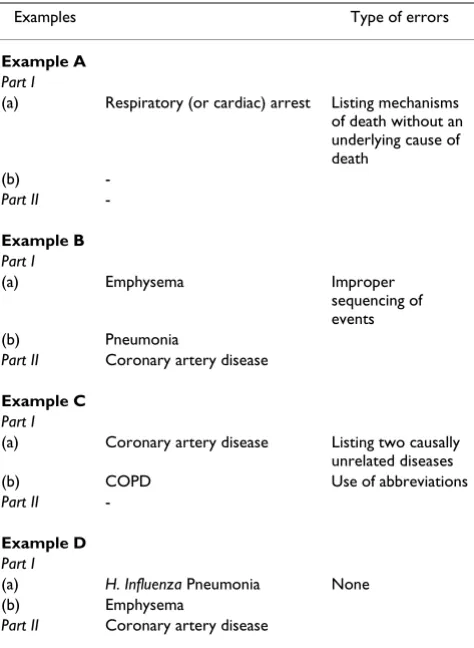
certifi-cates were retrieved from each participant just before the seminar took place. At the end of the seminar, and unex-pected by the medical residents, the same case-scenario was asked to be completed. From all the four major possi-bilities of death certification (Table 1), only one of them was considered to be accurate.
Data Analysis
Death certificates were classified categorically by the pres-ence and types of errors. Six types of errors were identified: (i) listing the mechanism of death without an underlying disease as the cause of death; (ii) improper temporal sequencing of events; (iii) listing two causally unrelated, etiologically specific diseases as the cause of death; (iv) use of abbreviations as a mean of identifying diseases, (v) listing the mechanism of death followed by the proper underlying cause of death, and (vi) listing the cause of death as one of other significant conditions contributing to the death but not causally related to the immediate cause of death. Fisher's exact test was used to compare dif-ferences in the proportion of correct or incorrect comple-tion of death certificates before and after the educacomple-tional intervention. The strength of the association between the proportions of change in the overall accuracy of the com-pletion of death certificates (an improvement attributable to the seminar) before and after the educational interven-tion was expressed by the relative risks of the estimates (RR) with confidence intervals (CI). Analyses were per-formed by means of EPIDAT 3.0 [10]. A significance level of 5% was used.
Summary of a case scenario used in a seminar to illustrate common errors in the certification of death
Figure 1
Summary of a case scenario used in a seminar to illustrate common errors in the certification of death.
A 75-year old male, smoker with a 5-year medical history of emphysema, is admitted into a hospital
for exacerbation of his lung disease caused by Haemophilus influenza pneumonia. His only other medical problem is coronary artery disease of 10 years´ duration. His clinical condition deteriorates
but he decided against further extraordinary therapeutic measures, such as endotracheal intubation and
mechanical ventilation. A week after admission he is found on his bed with vital signs absent. You are
called to pronounce and certify his death.
Medical certification of death
Part I
(a) Immediate cause of death………..……….
(b) Underlying cause of death………..……….
Part II
Other significant conditions contributing to the death but not causally related to the immediate cause
Results
A total of seven seminars were held in seven different cit-ies across Spain (Table 2) with an overall attendance of 166 physicians. A total of 332 death certificates were ana-lysed (166 before and 166 after the seminar). Before the seminar, 71.1% of the completed certificates had at least one error; less than a third of participants (28.9%) com-pleted the death certificate correctly. Of the 118 physi-cians that incorrectly completed the certification of death, 67 of them (56.8%) listed respiratory arrest, cardiac arrest
or cardiopulmonary arrest as the immediate or the under-lying cause of death. Types and frequency of errors in the death certification before and after the educational inter-vention are listed in Table 3.
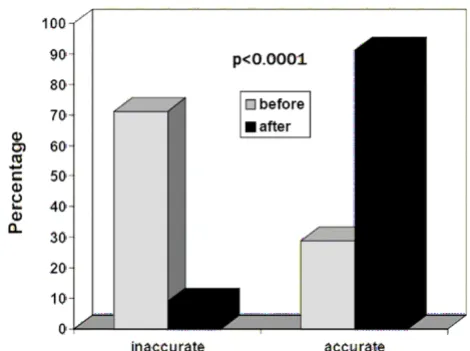
After the seminar, most physicians (91%) correctly com-pleted both the causes of death and the temporal sequence of causes. Only 9% of the death certificates con-tained at least one error. None of the physicians listed res-piratory arrest, cardiac arrest or cardio-resres-piratory arrest as a cause of death. The probability of accurately completing the death certificate after the seminar was more than three times higher than before the seminar (RR 3.67, 95%CI: 2.84–4.73) and the overall rate of improvement attribut-able to the educational intervention was 62.1% (p < 0.0001) (Figure 2).
Discussion
[image:3.612.58.295.119.443.2]In this study, the 71.1% proportion of death certificate with at least one error filled by medical residents is higher than the reported in previous studies. However, our study shows that a simple educational intervention can increase the accuracy rate by more than three-fold. To our knowl-edge, only four previous groups [9,11-13] have imple-mented an educational intervention to improve the accuracy of death certification and measured the changes after the intervention. In those studies, the rate of inaccu-racies was lower but their study design was very different from ours. Weeramanthri et al [11] from Australia attempted to change physician behaviour on death certifi-cation by means of written guidelines. They sent written educational material as part of the questionnaire and compared rates of errors 1 month before and 1 month after the intervention. Less than 20% of physicians responded the questionnaire and although the propor-tion of error dropped from 22.4% to 15.1%, this change was not statistically significant. Pain et al [12] from Eng-land evaluated in a randomised controlled fashion the effectiveness of a training video on proper death certifica-tion among 185 medical students. The video was shown as an addition to the usual lecture on death certification. Although students assigned to see the video scored
Table 1: Four examples of possible ways of completion of death certificate for the same case scenario described in Figure 1. Only the example D is accurate.
Examples Type of errors
Example A
Part I
(a) Respiratory (or cardiac) arrest Listing mechanisms of death without an underlying cause of death
(b)
-Part II
-Example B
Part I
(a) Emphysema Improper
sequencing of events (b) Pneumonia
Part II Coronary artery disease
Example C
Part I
(a) Coronary artery disease Listing two causally unrelated diseases (b) COPD Use of abbreviations
Part II
-Example D
Part I
(a) H. Influenza Pneumonia None (b) Emphysema
Part II Coronary artery disease
Table 2: List of hospitals and cities where a 90-min seminar on "How to improve the accuracy of death certification" was held. Number of medical residents participating in each session is listed as well. A total of 332 death certificates were audited.
Hospital City No. participants
Hospital Universitario Río Hortega Valladolid 42
Hospital Clínico Universitario Salamanca 40
Hospital Universitario Dr. Josep Trueta Gerona 29
Hospital Universitario Reina Sofía Córdoba 20
Complejo Hospitalario Xeral-Calde Lugo 20
Hospital Marítimo de Oza La Coruña 9
[image:3.612.54.553.615.728.2]slightly better overall, adding this teaching method to the usual lecture had a limited effect on the overall knowledge and skills. Myers et al [9] from Canada implemented an interactive 75-min seminar on proper completion of death certificates delivered to medical residents rotating in a teaching hospital. The seminar included the discussion of 10 case scenarios accompanied by the correctly com-pleted death certificate reviewed with the help of a coro-ner. In addition to the seminar, a memorandum was attached reminding residents to avoid the use of mecha-nisms of death in the Cause of Death section of the death certificate. The audit of 146 death certificates before the seminar for the same case-scenario showed that 32.9% of them contained at least one major error and 84.2% of them had at least one minor error. Although only 83 cer-tificates were completed after the seminar, frequency of
major errors dropped to 15.7% but the frequency of minor errors did not change significantly (90.4%). In a randomized fashion, Lakkireddy et al [13] from USA have recently evaluated in 200 internal medicine residents the impact of two educational interventions: a 45-min inter-active workshop or printed instruction material. They used two case simulations that were prepared based on real-life cases, as we did, and found that before the educa-tional intervention, only 15.5% of residents correctly identified the cause of death and 60% incorrectly identi-fied a cardiac cause of death. Although both interventions significantly improved the appropriate completion of death certification, Lakkireddy et al demonstrated that interactive workshops are a better mode of teaching than printed handouts.
The concepts of the "underlying cause of death", the "immediate cause of death" and the "mechanism of death" are often a source of confusion for certifying phy-sicians [14-16]. The mechanism of death is a physiologic derangement or biochemical disturbance by which a cause of death exerts its lethal effect. One of the most com-mon errors is attributing the cause of death to respiratory arrest, cardiac arrest, cardiorrespiratory arrest, or asystole in all deaths. Except in heart donors, cardiac arrest is a meaningless term; it is simply a condition to be dead and it must not be used as an underlying cause of death. The underlying cause of death is the disease that triggered the chain of events leading to death, without which death would not have occurred. It should be as etiologically spe-cific as possible. Non spespe-cific conditions (e.g. sepsis, haemorrhage, respiratory failure, renal failure) have more than one possible cause and are not acceptable as an underlying cause of death [17]. The immediate cause of death is the final complication resulting from the under-lying cause of death which is occurring closest to the time of death and directly causing death. The certifying physi-cian does not always have enough information to be cer-tain of the immediate cause of death. Therefore, in many cases, an immediate cause of death may not be identifia-ble and an underlying cause of death can stand alone in part I of the medical section of the death certificate.
"Nat-Rate of accuracy in the completion of a death certificate based on the case scenario of Figure 1, before and after a 90-min educational intervention entitled "How to improve the accuracy of certification of death"
Figure 2
[image:4.612.61.296.443.619.2]Rate of accuracy in the completion of a death certificate based on the case scenario of Figure 1, before and after a 90-min educational intervention entitled "How to improve the accuracy of certification of death". Before the seminar, 71.1% of death certificates contained at least one error and this proportion decreased to 9% after the educational interven-tion (p < 0.0001).
Table 3: Types and frequency of errors in the death certification before and after the educational intervention.
Type of Error Pre-interventionn (%) Post-interventionn (%) p-value
Listing the mechanism of death without an underlying disease as the cause of death
71 (42.6) 4 (2.4) <0.0001
Improper temporal sequencing of events 31 (18.7) 1 (0.6) <0.0001 Listing two causally unrelated, etiologically specific diseases as the cause of death 10 (6.0) 5 (3.0) 0.290 Use of abbreviations as a mean of identifying diseases 9 (5.4) 5 (3.0) 0.413 Listing the mechanism of death followed by the proper underlying cause of death 22 (13.3) 0 (0) <0.0001 Listing the cause of death in Part II (as one of other conditions contributing to
the death but not causally related to the immediate cause of death)
ural causes" may be entered if the manner of death is nat-ural and the physician does not know exactly how the patient died [18]. Using the phrase "natural causes" is preferable to making a possibly inaccurate guess as to the cause of death.
Experience does not appear to improve death certification practice. Methods to improve standards of practice and performance include early and continuing post-graduate education, and practical accessible guidance on death cer-tification completion. Several authors [7,13-15] have found that most physicians consider accurate death certi-fication important but they feel insufficiently instructed to correctly complete the death certificate. In a recent study, Cirera et al [19] examined the training need priorities in Spain for proper death certification and found out that the highest priorities were how to accurately declare a death and improve medical training. We think that, for example, an immediate audit of completed death certificate by skilled attending physicians is a valid method. In fact, most physicians have reported that, given that possibility, they would modify the cause of death statement in some circumstances [7]. On the other hand, pathologists could serve as a better resource for teaching clinicians given their familiarity with the death certification process.
There are some limitations to our study. First, we have used only one method to improve the accuracy of death certification, but as it has been shown by Lakkireddy et al [13], this type of interactive workshop is perhaps the most effective educational intervention. Second, the informa-tion given in the case scenario was simple and clear to exclude the possibility of incorrect clinical diagnoses that very frequently physicians face in their current medical practice. Lastly, the post-educational assessment was done immediately after the seminar and we do not know for how long the residents can keep their abilities over time. We feel that educational interventions to improve accu-racy of death certificate should be mandatory not only during the residence programs but as part of the continu-ing medical education package for attendcontinu-ing physicians in community health care centers and teaching hospitals. In the absence of accurate information on death causing dis-eases, we cannot guarantee that hospital, community or population-based mortalities can be used as a source of information to allocate health care resources and foster research where is needed to improve the health of our cit-izens.
Conclusion
In summary, major errors in the completion of the correct cause of death on death certificates are very common among medical residents. We have demonstrated that a simple, 90-min seminar can dramatically improve the accuracy in the completion of death certificates by
physi-cians. We believe that educational interventions to improve accuracy of death certificate should be manda-tory not only during the residence programs but as part of the continuing medical education package for physicians.
Competing interests
The author(s) declare that they have no competing inter-ests.
Authors' contributions
JV conceived the study, obtained permission for the study, delivered all the interactive workshops, collected the data, and drafted the manuscript. LPM helped in the design of the study, participated in the data storage, performed the statistical analysis, and helped to draft the manuscript. Both authors read and approved the final manuscript.
Acknowledgements
Supported, in part, by Asociación Científica Pulmón y Ventilación Mecánica. The authors want to thank Dr. Julio Pérez-Naranjo from MEDIFORUM (Madrid, Spain) for his support in contacting and obtaining the approval of the Continuing Medical Education Office in each participating center.
References
1. Llácer A, Fernández-Cuenca R, Martínez de Aragón MV: Mortalidad en España en 1998. Evolución en la década 1989–1998. Bol Epi-demiol (Madrid) 2001, 9:241-248.
2. Schadé B: Reliability and validity of the classification of death in general practice. Scand J Prim Health Care 1987, 5:109-112. 3. Villar J: Causa de muerte: errores en la certificación de
defun-ción. Med Clin 1989, 93:463-466.
4. Rasmussen SA, Wong LY, Yang Q, May KM, Friedman JM: Popula-tion-based analyses of mortality in trisomy 13 and trisomy 18. Pediatrics 2003, 111:777-84.
5. Arias E, Smith BL: Deaths: preliminary data for 2001. Natl Vital Stat Rep 2003, 51(5):1-44.
6. Goldacre MJ, Roberts SE, Griffith M: Multiple-cause coding of death from myocardial infarction: population-based study of trends in death certificate data. J Public Health Med 2003,
25:69-71.
7. Maudsley G, William EM: Death certification by house officers and general practitioners-practice and performance. J Public Health Med 1993, 15:192-201.
8. Tai DYH, El-Bilbeisi H, Tewari S, Mascha EJ, Wiedemann HP, Arroliga AC: A study of consecutive autopsies in a medical ICU. A comparison of clinical cause of death and autopsy diagnosis.
Chest 2001, 119:530-536.
9. Myers KA, Farquhar DRE: Improving the accuracy of death cer-tification. CMAJ 1998, 158:1317-1327.
10. Website title [http://dxsp.sergas.es]
11. Weeramanthri T, Beresford W, Sathianathan V: An evaluation of an educational intervention to improve death certification practice. Aust Clin Rev 1993, 13:185-9.
12. Pain CH, Aylin P, Taub NA, Botha JL: Death certification: produc-tion and evaluaproduc-tion of a training video. Med Educ 1996,
30:434-9.
13. Lakkireddy DR, Basarakodu KR, Vacek JL, Kondur AK, Ramachan-druni SK, Esterbrooks DJ, Market RJ, Gowda MS: Improving death certificate completion: a trial of two training interventions.
J Gen Intern Med 2007, 22:544-548.
14. Lu TH, Shih TP, Lee MC, Chou MC, Lin CK: Diversity in death cer-tification: a case vignette approach. J Clin Epidemiol 2001,
54:1086-93.
15. Messite J, Stellman SD: Accuracy of death certificate comple-tion: the need for formalized physician training. JAMA 1996,
275:794-796.
16. Lakkireddy DR, Gowda MS, Murray CW, Basarakodu KR, Vacek JL:
Publish with BioMed Central and every scientist can read your work free of charge "BioMed Central will be the most significant development for disseminating the results of biomedical researc h in our lifetime."
Sir Paul Nurse, Cancer Research UK
Your research papers will be:
available free of charge to the entire biomedical community
peer reviewed and published immediately upon acceptance
cited in PubMed and archived on PubMed Central
yours — you keep the copyright
Submit your manuscript here:
http://www.biomedcentral.com/info/publishing_adv.asp
BioMedcentral
trained and are cardiovascular causes overstated? Am J Med 2004, 117:492-498.
17. Hanzlick R, ed, the Autopsy Committee of the College of American Pathologists: Cause of death statements and certification of natural and unnatural deaths (Manual). College of American Pathologists, Northfield, Illinois, USA; 1997.
18. Hanzlick R: Protocol for writing cause-of-death statements for deaths due to natural causes. Arch Intern Med 1996, 156:25-6. 19. Cirera-Suarez L, Navarro-Sanchez C, Barber-Valles X, Contreras-Gil
J, Martinez-Lopez C, García-Rodriguez J: Principal requirements in medical training for certification of deaths in Spain (article in Spanish). Aten Primaria 2002, 29:348-355.
Pre-publication history
The pre-publication history for this paper can be accessed here: