ACTION LEARNING
Action learning is a rich philosophy of learning and practice that offers a significant contribution
to the fields of management and professional education and development, organisation
problem-solving and performance improvement, organisation change and development as well as to
action research.
Overview of Entry
This entry provides an outline of action learning’s origins, traditions and key ideas.
Contemporary ideas and applications are illustrated before considering the particular relevance
of action learning to action research.
Origins, traditions and key ideas
Action learning, as a coherent and named body of practice, was created and developed by
English man Reg Revans (1907-2003) in the mid twentieth century, where he evolved his notion
of action learning through his work in the coalmines and in the health services of Britain and
Belgium. Influenced by his early training as a physicist at Cambridge University in the late
1920s, where he encountered Nobel-prize winning scientists meeting weekly, not to display their
achievements, but to learn from one another through voicing the challenges and unknowns they
were tackling, when coal pit managers had problems, Revans encouraged them to meet together
Later, in Belgium, he introduced a process where senior managers learned through spending time
investigating problems in areas unfamiliar to them.
Revans eschewed definition of action learning, saying that to define it was too simplistic.
However, he also argued that, in that action learning can be characterized by specific
assumptions, objectives and an educational method, neither was it merely common sense, nor
simply action that may or may not result in learning.
Assumptions, Objectives and Educational Method
Core assumptions that underpin action learning are that learning derives from taking action and
asking insightful questions about urgent problems or enticing opportunities. Formal instruction
and theory is not sufficient. External training, instruction or expertise is not relied upon, because
existing codified knowledge, whilst it may be drawn from, may not suit the specific context of a
particular problem. Processes such as action and feedback, asking fresh questions, learning from
and with peers and creating a multiplier effect between individual and organizational learning are
central to action learning.
Revans saw the objectives of action learning as follows:
1) To make useful progress on the treatment of some real problems or opportunities 2) To give participants sufficient scope to learn for themselves with others, and 3) To encourage teachers and others engaged in management development to help
Based on a philosophy of action (praxeology), action learning is a challenging educational
method that is much more than simply learning by doing, in that it engages participants in
risk-taking experimentation and a degree of self-challenge, on the basis that a person cannot expect to
change others or an organisation if they cannot change themselves.
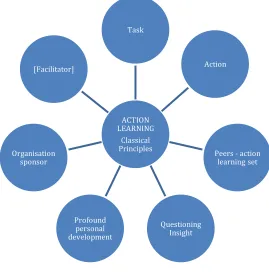
Revans’ Classical Principles
Though Revans resisted simplistic definition of action learning, there were consistent principles
in the practice he wrote about, which have become widely known as Revans Classical Principles
[image:3.612.144.413.399.671.2](RCP) (See Figure 1).
Figure 1. Core Elements of Action Learning (Revans’ Classical Principles)
ACTION LEARNING
Classical Principles
Task
Action
Peers - action learning set
Questioning Insight Profound
personal development Organisation
1. A task- a problem, concern or opportunity that needs action taken and is owned by group members.
Central to action learning is a distinction between puzzles and problems. Puzzles are
those difficulties for which a correct solution exists and which are amenable to specialist
and expert advice, for example, how to stop a roof leaking or what medicines might cure
a particular disease. These neither need nor benefit from action learning. Problems, on
the other hand, are difficulties where no single solution exists, where the context may be
familiar or unfamiliar and where neither agreement amongst stakeholders nor certainty
are strong. For example, how to reduce hospital waiting lists or how to speed up product
development cycles. Problems are amenable to action learning because of its
exploratory, collaborative approach that can incorporate diverse inputs, values and
intended outcomes.
2. Action: based on the premise that action is the basis for learning and that no real learning takes place unless and until action is taken. Problems are ones on which the learners can
take action, not merely offer diagnosis or recommendations to others.
3. Peers - a set of action learners: a group of people (typically 4-8, though this may be more or less) who care about the issue, have the power to do something about it and work
Such a group, originally referred to by Revans as a set, takes responsibility for organizing
themselves and develops their own capacity to solve problems. These peers are usually
others with comparable issues and in similar organizational hierarchy positions.
4. Questioning insight is more valuable than formal instruction
Learning is understood to result primarily from inquiry, investigation, experimentation
and reflection, rather than through formal teaching, instruction or access to expert
knowledge. The search for fresh questions and questioning insight is seen as more
helpful to assist set members to clarify the nature of their task/problem, to reflect on their
assumptions about how they frame the issue, and to illuminate what is unknown as well
as what is known.
5. Profound personal development resulting from reflection on action.
With the support, questions and challenge of peers within the action learning set, action
learners review their experimental attempts to address the task, reflect on their actions,
recognize and reframe their assumptions as well as receive feedback. Action learning
aims at going beyond merely solving immediate problems. An increase in the knowledge
and capacity to better adapt to change is the ultimate outcome. Action learning helps
managers develop meta-skills such as self-insight, wider organization-political
understanding and influencing abilities.
learning can benefit both individuals and organization. Sponsorship by a senior manager
is important to enable more junior staff to take action and influence change.
7. Facilitators have become a norm in much action learning practice, though they were not strongly advocated by Revans and are not employed in all variations of the approach (see
below).
What action learning is not
Action learning is a term that is used with a wide range of meanings. Some simply equate it with
experiential learning, such that any process that includes experiential activity is considered to be
action learning. Revans was clear that action learning was not job rotation, project work, case
studies, business games or other simulations, group dynamics, operations research, industrial
engineering, work study or consultancy.
The Action Learning Formula
Revans formulated action learning around the formula, L=P+Q where L stands for learning, P for
programmed knowledge (i.e. existing theory) and Q for questioning insight.
Programmed Knowledge
The concept of programmed knowledge (P) relates to technical expertise, functional specialism,
formal instruction, published theory and the syllabi of teaching institutions. Action learning’s
thought, conscious selection by those who generate or disseminate programmed knowledge. As
time and context change, so also does the usefulness and usability of P for the specific situation
of new action learners. Yet, managers faced with change may incline towards a favoured tool,
technique or well-remembered article or book to help to start their process of change. Whilst
action learning incorporates a diagnostic phase (System alpha - see below), in which P may help
frame the issue, to follow the guidance of such a source of P in an unquestioning way may
prematurely narrow conceptualization, lead to mis- or partial diagnosis and would be unlikely to
result in the amelioration of the problem.
Questioning Insight
Faced with a complex challenge to explore or a problem to ameliorate, for Revans learning
always begins with Q – questioning insight.
Insight is an act of understanding that grasps the intelligible connections between things that
previously have appeared disparate. As we attempt to make sense of new experience we do not
yet understand, we ask the question, ‘what does this mean?’. Answers to such questions come in
the form of insights, which are creative acts of understanding, of grasping and formulating
patterns, unities, relationships and explanations in response to questions posed to our experience.
Insight must be followed by evaluation and judgment in order to assess and verify the evidence.
If we ask fresh questions, unfreeze underlying assumptions, and create new connections and
conceptual models, this is questioning insight. Q challenges both the usefulness of programmed
both admits to lack of knowledge and increases the scope of the search for solutions. It also
carries the potential for new insight into the current state.
Philosophical Basis - Praxis and Praxeology
Action learning, as developed by Revans, grew from a mid 20th century disenchantment with
positivism and prevailing cultural beliefs in the dominance of expertise, which fostered the
conviction that, unless problems can be solved by a purely technical solution, there is more
learning to be had through action being taken by those involved with an issue. Revans’ key idea
was a synergy between learning and action. In other words, praxis is fundamental to action
learning in the sense that activity or work is essential to learning.
Systems Alpha, Beta and Gamma
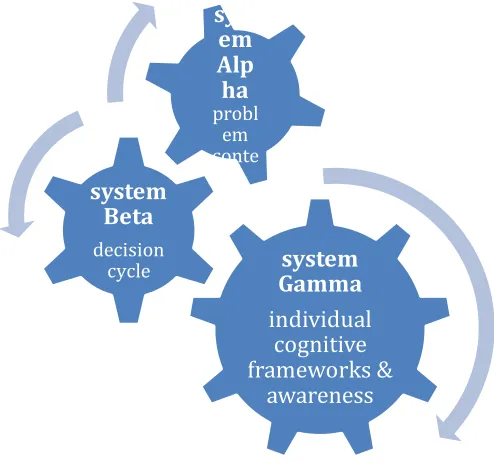
Revans proposed a theory of action in terms of a science of praxeology, comprising what he
called systems alpha, beta and gamma. In essence, system alpha focuses on the investigation of
the problem, based on the managerial value system, the external environment and available
internal resources. System beta focuses on the problem resolution, through decision cycles of
negotiation and trial and error. System gamma focuses on the learning as experienced uniquely
by each of the participants through their self-awareness and questioning. System gamma
Figure 2. Praxeology in Action Learning:
Diagrammatic representation of Revans’ Systems Alpha, Beta and Gamma
The scientific method associated with system beta comprises the steps:
Observation/survey involves collecting data for diagnosis and classifying what seems to
go on.
Theory/hypothesis generation involves suggesting causal relationships between those
happenings; formulate courses of feasible action.
Test/experiment involves taking action on the basis of those causal relationships.
Audit/review involves asking if that action has gone as expected.
Review/control involves rejecting, changing or accepting the emergent causal
relationships; comparisons between expectation and experience; draw conclusions and
system Gamma
individual cognitive frameworks &
awareness
system Beta decision
cycle
syst em Alp
ha probl
em conte
Enactment of this five step cycle or scientific method (endlessly repeated) is a detailed
description of the questioning and reflection that goes on within system beta.
The three systems, alpha, beta and gamma are not linear or sequential, nor are they entirely
discrete (as illustrated in Figure 2). Rather, they overlap on important issues of learning, power
and politics. They emphasize how action learning involves engagement with real issues, rather
than with fabrications. The engagement is both scientifically rigorous in confronting the issues
and critically subjective through managers learning in action. Systems alpha and beta focus on
the investigation of the problem while system gamma focuses on the learning. The three systems
are perhaps best understood as a whole, with interlocking yet overlapping parts.
More recent evolutions of action learning cycles include explicit attention to decision-selection
of solutions, involvement of other organization stakeholders and questioning what assumptions
underpin how the issue/problem is framed.
Examples
In relation to organization change and development, action learning has a long tradition of
application to management and leadership development, both as the sole method and in
combination with other interventions including one-to-one coaching and large group instruction.
For example, a leadership development programme might incorporate individual action learning
enquiries into the question ‘how do I improve my leadership capability?’ Other applications have
focused on whole organization change or even, at a higher level of complexity, enhanced
clients within a geographical space. Examples include such problems sponsored by senior
management as:
reduce wastage
improve the quality of problem-solving
learning to work collaboratively across professional and geographical boundaries
improve rates of innovation
promote collaborative learning across the value chain.
Contemporary Developments
Facilitation
Though classical action learning is ambivalent about the use of facilitators, in practice their use,
also termed coach or set advisor has become widespread. The facilitator can play a variety of
roles for the group, coordinator, catalyst, observer, climate setter, communication enabler,
learning coach among many. Their role is to model the peer challenge / critical friend behaviors,
to help the group establish ground rules and develop questioning, reflective and inclusive team
practices. Good facilitation attends to the process of the group, rather than becoming drawn into
the content of discussions or being the expert problem-solver. Facilitators have to be able to
tolerate and interpret silence, ambiguity and conflict, as well as be active listeners who can
summarize back to set members. However, action learning facilitation is not the same as group
facilitation or team building because of the primary focus on learning. The action learning ideal
is that a group grows to be self-directing and the role of the facilitator is deemed to be
Extending Ideas on Insight – Organizing Insight (O) and Inter-Organizing Insight
(IO)
Advances in thinking about the role of insight, questioning and inquiry within action learning
have led to concepts of ‘Organizing Insight’ (O) and Inter-Organizing-Insight (IO). O derives
from the relationship between action learning and organizational learning and inquiry into the
power and emotion within the organization dynamics in which action learning takes place. The
action learning formula has been further extended to include the network or system-wide setting
of multi-partner action learning, as found in supplier networks or public service inter-agency
collaborative arrangements. This leads to a network action learning formula of
NAL=P+Q+O+IO, where network action learning includes both organizing insight (within
partner organizations) and inter-organizing insights (IO).
Action Learning as an Organizational Learning Mechanism
Action learning was originally formulated by Revans in order to sustain learning in
organizations. As such an approach designed to realise the commitments to action and learning
in relation to a specific problem it also holds the potential to act as a learning mechanism in the
sense of being an organizational configuration, formal or informal, intended to develop, improve
and assimilate learning. Correspondingly, the formal structures and processes associated with
action learning include the disciplined application of the RCP elements noted above and, in
particular, the group, the questioning and reflective process, and the facilitator. The informal
of individuals as a group around a common problem and the group commitments to action as
well as to learning in relation to the problem.
Action learning also meets the characteristics of ‘dialogic OD’ in that it works to enable dialogue
between people as to what organizational problems might mean and how they might be
addressed.
Varieties of Action Learning
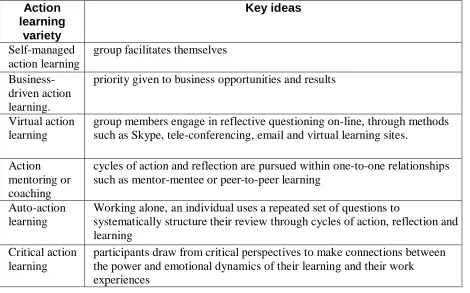
[image:13.612.72.542.363.656.2]A variety of interpretations of action learning have now developed internationally (see Table 1).
Table 1. Varieties of Action Learning
Action learning variety Key ideas Self-managed action learning
group facilitates themselves
Business-driven action learning.
priority given to business opportunities and results
Virtual action learning
group members engage in reflective questioning on-line, through methods such as Skype, tele-conferencing, email and virtual learning sites.
Action mentoring or coaching
cycles of action and reflection are pursued within one-to-one relationships such as mentor-mentee or peer-to-peer learning
Auto-action learning
Working alone, an individual uses a repeated set of questions to
systematically structure their review through cycles of action, reflection and learning
Critical action learning
Different varieties share most of the RCP outlined above, but key aspects differ. Firstly, the
balance of priority between business objectives and profound personal learning varies, for
example, with business-driven action learning, as its name implies, prioritizing business results
compared to critical action learning in which learning, perspective transformation and changed
practice are completely intertwined. Secondly, is the use of facilitators or coaches, which in the
Auto- and Self-Managed Action Learning, have least weight and are advocated only temporarily
or not at all. In contrast, in Critical Action Learning significant weight is placed on strong
facilitation to help surface and challenge assumptions. A third distinction is the emphasis placed
on group process as an experiential source of learning for participants, for example about team
dynamics and skills such as chairing, collaboration and decision-making. In Critical Action
Learning, group process is central as a source of potential learning about self, others and the
organization, because of the way dynamics within a group so often mirror the power relations of
the wider organization and society.
Application to Action Research
As a method that integrates individual and organisation learning, change and development,
action learning has many parallels with action research in its concern with praxis and
praxeology, and its philosophical grounding in theories of learning from experience, as practiced
collaboratively with others through some form of action-oriented inquiry. These theories are
influenced both by the assumption that we can shape our environment and also by a belief in the
value of scientific method in the pursuit of improvement. Participants take responsibility for and
guides the action learning approach is a pragmatic focus on learning for the sake of more
effective problem solving and organization improvement.
Action Learning Research
A recent development of action learning presents Action Learning Research as a new member of
the family of action-oriented approaches to inquiry, such as Mode 2 research, praxeological
inquiry, action research and collaborative management research. These new paradigms of
research are providing alternatives to traditional research paradigms and Action Learning
Research offers a contribution to practical, actionable knowledge.
See also
Mode 1 & Mode 2 Knowledge Production
Praxeology
Critical action learning
Further Reading
Coughlan, P. & Coghlan, D. (2011). Collaborative strategic improvement through network
action learning. Cheltenham: Edward Elgar.
Dilworth, R.L. & Willis, V.J. (2003). Action learning: Images and pathways, Malabar, FL:
Krieger.
O’Neil, J. & Marsick, V.J. (2007). Understanding action learning. New York, AMACOM
Raelin, J. (2009). Seeking conceptual clarity in the action modalities. Action Learning: Research
and Practice, 6 (1), 17-24.
Revans, R. (1982). The origins and growth of action learning. Bromley: Chartwell-Bratt.
Rigg, C. & Trehan, K. (2004). Reflections on working with critical action learning. Action
Learning: Research and Practice, 1 (2), 149-166.
Vince, R. & Reynolds, M. (2004). Organizing reflection. London: Gower.