promoting access to White Rose research papers
White Rose Research Online
Universities of Leeds, Sheffield and York
http://eprints.whiterose.ac.uk/
White Rose Research Online URL for this paper:
http://eprints.whiterose.ac.uk/8526/
Published paper
Aritua, B., Male, S. and Bower, D.A (2009)
Defining the intelligent public sector
construction procurement client.
Management, Procurement and Law, 162 (MP0).
pp. 75-82.
http://dx.doi.org/10.1680/mpal.2009.162.2.75
Bernard Aritua
Research assistant and doctoral scholar, School of Civil Engineering, University of Leeds, UK
Steve Male Professor of Property & Infrastructure Asset Management, School of Civil Engineering, University of Leeds, UK
Denise Bower Professor of Engineering Project Management, School of Civil Engineering, University of Leeds, UK
Proceedings of the Institution of Civil Engineers
Management, Procurement and Law 162
Month 2009 Issue MP0 Pages 1–8
doi:10.1680/mpal.2009.162.0.1 Paper 800040
Received 30
Q1 /07/2008
Accepted 14/01/2009 Keywords:
buildings, structure & design/ education & training/management
Defining the intelligent public sector construction
procurement client
B. Aritua
MSc,
GMICE,
MAPM, S. Male
MSc,
PhDand D. Bower
BEng,
PhD,
MASCE,
MILTRecent efforts and aspirations to transform the delivery of major capital programmes and projects in UK public sector construction by focusing on achievement of value for money, whole life asset management and sustainable procurement have led to the adoption of integrated procurement routes characterised by multiplicity of stakeholders with a diversity of differing and often competing requirements. A study of the challenges faced by the public sector to deliver present and future major capital programmes and projects gravitates to the role of the intelligent client, and concomitant skills and
capabilities. The results of the multiple case studies research show that the challenges of this role are especially evident at the interface between the internal organisation and the external suppliers and advisors from the private sector. The research concludes that the intelligent client role requires an individual champion with a unique set of skills working in an environment of a supporting team and capable organisation.
1. INTRODUCTION
For all the wealth of guidelines on how to be a successful consultant or contractor, there is very little information on how to be a successful client. This may be partially accounted for by the fact that the role of the construction client has hitherto been considered secondary in most construction-related schemes. In most cases the focus has been on the role of designers, contractors and other supply chain members. In the UK, however, initiatives such as the Confederation of Construction Clients (CCC) (now referred to as Construction Clients’ Group) and Movement for Innovation (M4I) which are the results of reforms that started in the 1990s have advocated for and supported clients in taking a leading role and focusing the construction procurement process on value for the client. This shift of emphasis is well captured by
authors such as Blismasset al.1,2who attempt to build a picture of
the construction clients’ organisational arrangements. Case study
research by Boyd and Chinyio3(in association with the
Construction Clients’ Group) has provided a detailed characterisation of construction clients and suggested a framework to understand clients’ actions and needs. This work
supplements earlier work by Winch,4which considers the problem
of managing construction schemes as investments and discusses how a well designed and constructed asset can deliver greater capital returns for the client in the form of business benefits.
Kamaraet al.5argue that it is vital for designers and contractors to
understand their clients’ businesses in order for them to provide what the client wants. Most of this previous work, however, contributes to how others can understand and meet the needs of clients. This article reinforces the focus on the construction client but from a client perspective. It presents recent findings on how the public sector client role has evolved in view of changes in procurement and end-user demands. The main aim is to explore the critical skills and capabilities needed to fulfil this dynamic client role.
2. CLARIFICATION OF TERMINOLOGY AND SEMANTICS
For the purposes of this article and the research on which it is
based,skillsrefer to the requirement and ability to do a particular
task and include the relationship with appropriate knowledge and
competency.Capabilityis considered to exist at an individual,
team and organisational level. The levels are inter-related and have practical as well as policy implications.
One of the biggest challenges in research and practice of project management is the lack of consistency and uniformity in understanding and use of terminology. Although there is general consensus on the common features, the use and understanding of terminology varies widely and there are no consistent
all-encompassing definitions.6More generally, there is a diversity of
both terms and concepts that extends through from single to multiple project management with terms such as multi-project, portfolio, programme, macro-project, mega-project, super-project, meta-project and combinations of these terms commonly used; often interchangeably and synonymously giving the impression they have similar meanings. Therefore the following definitions are adopted for the key terms.
In accordance with Office of Government commerce (OGC) best
practice guidelines:7
A project is a temporary organisation, usually existing for a short duration, which will deliver one or more outputs in accordance with a specific business case. A particular project may or may not be part of a programme.
Additionally the termMajor Projectsas defined by research
conducted by theMajor Projects Associationis also used in
recognition of the characteristics of current public sector procurement of capital infrastructure. According to Morris and
Hough,8a major project is one that may have singly or in
combination the following characteristics.
(a) High monetary value.
(b) Time and schedule urgency.
(c) Organisational and managerial complexity – the extent to
which there are a significant number of managerial interfaces to be managed; and/or a significant number of hierarchical layers either within the organisation or project structure to be managed, and/or significant number of stakeholders to be managed.
(d) Technological complexity of high level of innovation.
The terms programme and programme management are used by authors in different contexts and even to mean different things. However the review of literature showed that a common theme was the coordination of multiple projects to gain benefits that would not be possible to obtain if the projects were managed independently. In practice, however, the manner in which multiple projects are implemented, and the resulting benefits, are extremely variable. Furthermore programmes are also closely linked to organisational strategies and are seen to provide the link between individual projects and overall strategies.
The OGC 2007 guide,Managing Successful Programmes,9
definition is adopted as it succinctly draws the various programme management features obtained from a content analysis into an apt definition for research in the public sector:
A programme is a temporary, flexible, organisation created to co-ordinate, direct and oversee the implementation of a set of related projects and activities in order to deliver outcomes and benefits related to the organisation’s strategic objectives . . . . During a programme life cycle projects are initiated, executed, and closed. The programme provides an umbrella under which these projects can be co-ordinated. The programme integrates the projects so that it can deliver an outcome greater than the sum of its parts.
The above definitions make explicit the contrast between
achievingoutcomesin programme management as contrasted
with time–cost–qualityoutputsin project management.
In brief, the above terms adopted fulfil the need for research rigour while maintaining pragmatism. The next part of this paper provides an overview of the research upon which the paper is based. This is then followed by a description of a conceptual model of public sector procurement and an exploration of how changes in the procurement process have affected the public sector client role.
3. THE STUDY – UK PUBLIC SECTOR CONSTRUCTION PROCUREMENT
The findings in this paper are based on mixed methods multiple case study research in five major spending UK public sector organisations. An investigation of reports and documents in the public domain was undertaken. This was then complemented by 70 semi-structured interviews with key participants and study of business cases. The interviews were digitally recorded where permissible and then transcribed and analysed using N
Q2 Vivo
software. An on-line survey targeted at OGC gateway reviewers for high-risk projects/programmes was also carried out to broaden
the scope of the research and to validate the findings. The emerging themes and conclusions were tested through two stakeholder workshops which were each attended by 40 representatives from the case study departments, other public sector regular procuring bodies and smaller ad hoc procurers. The second workshop which was attended by senior representatives from the public and private sector was also meant to explore the policy implications of the research findings. The outcomes from the research have been presented to the Public Sector Construction Client’s Forum (PSCCF).
The detailed results of the research are commercially sensitive and subject to confidentiality agreements; and are therefore not included in this article. Nevertheless, the generic lessons and policy level insights are considered useful. The following section discusses a conceptual model of public sector procurement that was used in the research.
4. PUBLIC SECTOR PROCUREMENT – A CONCEPTUAL MODEL
Traditionally procurement of infrastructure assets was sequential, with a clear separation between design and construction phases. The client’s requirements were often articulated with the help of private sector advisors. These requirements were then translated into a project brief that formed the basis for the design team to develop designs. When different facets of design were required from specialist designers, these were also engaged serially. Construction phase participants and supply chain members/ organisations were also involved in the same manner. The shortcomings and potential negative impacts of this approach to
procurement of built infrastructure assets is well documented.10
The management forms of procurement evolved as an attempt to increase the level of integration between the design and construction processes and reconfigure involvement of project participants. The need for repetitive success in a multiplicity of projects led to the design and build procurement and its variants.
As a result of public sector construction reforms more
collaborative procurement systems such as prime contracting and private finance initiative (PFI) have been introduced. With involvement of the private sector in the procurement of public infrastructure through private finance models, the definitions of roles in the procurement process have changed significantly. For example in PFI procurement, the special purpose vehicle (SPV) in a sense acts as a surrogate client fulfilling the functions traditionally perceived as the public sector construction client domain. The use of sophisticated contract and payment
mechanisms has created a need for several specialist advisors for technical, legal and accounting issues through the PFI
procurement process. Many of these advisors in effect undertake functions or provide input which was traditionally the exclusive realm of the public sector client.
Other recent drivers for the change in the public sector
construction procurement have included the Gershon’sReview of
Civil Procurement in Central Government11whose key
aggregation and promotion of best practice. The Gershon Review came against a backdrop of three previous studies of government
procurement (Efficiency in Civil Government Procurement;12
Setting New Standards: A Strategy for Government Procurement;13Organisation of Procurement in Government Departments and their Agencies14). Common themes within these studies were proposals to adopt an approach to procurement that allows simultaneous management of multiple projects in bundles that fulfill specific objectives, better risk management and emphasis on value for money.
The National Audit Office reportTransforming Government
Procurement15noted that as a result of the OGC and the gateway review process, over £8.0 billion of annual efficiency savings have been realised in public sector procurement. The study reiterated the government’s commitment to use the three principal integrated procurement routes, namely prime contracting, design & build and PFI. These are referred to here as integrated procurement routes because of their underlying aspirations to integrate the various asset delivery phases.
Together with these studies and reforms in public sector procurement, a number of factors have had a specifically powerful influence on the role of the public sector client. First, the use of output-based specifications as the basis for the client and stakeholders to define the services required; rather than by defining outputs. Unlike other forms of procurement, the government-recommended integrated procurement routes advocate for increased leeway to suppliers, to enable them to provide innovative solutions to resolve the underlying problem that the procurement is designed to deal with, rather than deciding
what the precise solution should be.16–18Second, a series of
initiatives and policy reviews have progressively emphasised the
need to procure on the basis of whole life value.19–21The influence
of these initiatives has changed the approach of the public sector to procuring construction projects and has directly affected the attitudes of the private sector as partners and suppliers to the public sector. Under the current procurement regimes the delivery of infrastructure assets is now viewed as a value chain from concept through to decommissioning, over a relatively extended period. In fact the public sector is increasingly making the value for money case on this basis. For these major capital programme and project schemes to be attractive to the private sector, which takes on additional risks that have traditionally been considered the realm of the public sector, they are often incentivised through multi-project procurement. The third and more recent influence resulted from the recommendations of the
government-commissionedSustainable Development Strategy Group,22,23
which advised the public sector to ensure that it spends in a way that supports the achievement of its sustainable development goals in line with the ambition to deliver sustainable operations targets.
In order to take account of these drivers and increase the chances of successful programmes and projects, the OGC gateway review process was introduced. The process examines major high-risk capital infrastructure procurement at key decision points and offers an independent view of their state of health. Closely related to the gateway review process is the development of the business case, which essentially contains a written record of the client’s plans and decisions. The OGC best practice guide for public sector
procurement24,25also views the business case as a means of
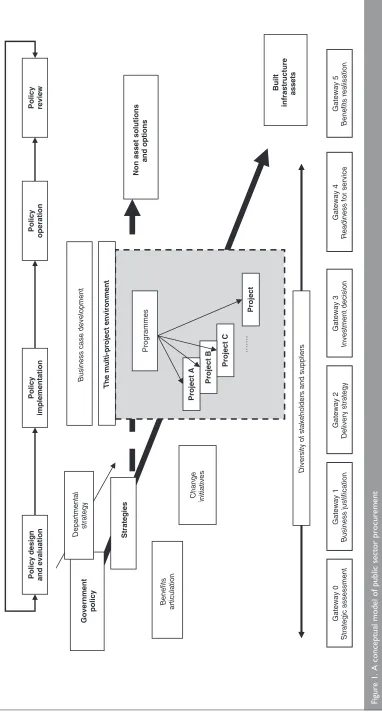
obtaining management commitment and approval for the investment. It is seen as a framework for risk management and informed decision-making in order to realise expected benefits. Figure 1 conceptualises the foregoing discussion and provides a basis for discussing how the changes in public sector procurement affect the client’s role.
Essentially, the main proposition in Figure 1 is that a link should exist between government policy and the desired public service benefit (whether this relates to education, transport, law enforcement, residential and office accommodation or health-care). The policy cycle and gateways review process best practice have been superimposed on the conceptual model to place it in context.
The current guidance from the OGC advises that the policy agenda should be kept in focus at the delivery end of benefits realisation. This is possible through a structured process that progresses from policy design, implementation through to operation and review. The policy should result in overall government strategies.
Best practice in whole life management suggests that the alignment between individual departmental strategies and the government strategies should result in change initiatives and a crucial decision point about how the strategies are to be delivered through various change initiatives.
Articulation of the anticipated benefits should assist in deciding the types of solutions needed and concomitant projects. Some of these solutions may be non-asset-based whereas others may necessitate construction of built infrastructure such as schools, hospitals, roads or prisons. Whatever the case a programme management approach should result in a multi-project environment with a combination of projects which may be construction projects, cultural change initiatives, organisational
reconfiguration, or the rationalisation of assets.26–29
From this perspective, programme management is seen as a means for considering both internal and external multi-project
environments.25,30,31Thus the conceptual model in Figure 1 shows
that programme management provides a strategic fit between policy and organisational strategy, and the benefits realisation. This conception aligns with recent arguments by Winter and
Szczepanek32that programme management is a value-creation
activity and arguments by Pellegrinelliet al.33that programme
management in this sense is a vehicle for strategic change. The entire process inevitably involves a diversity of stakeholders and suppliers who influence the process and provide input towards
achieving the benefits.34
Strategies
Built
infrastructure
assets
Benefits
articulation
Business case development
The multi-project environment
Government
policy
Programmes
Non asset solutions
and options
Change initiatives
Departmental
strategy
Project C
Project
Project B
Project A
…….
Diversity of stakeholders and suppliers
Policy design and evaluation
Policy
implementation
Policy
operation
Policy review
Gateway 0
Strategic assessment
Gateway 1
Business justification
Gateway 2
Delivery strategy
Gateway 3
Investment decision
Gateway 4
Readiness for service
Gateway 5
Benefits realisation
Figure
1.
A
conceptual
model
of
public
sector
[image:5.595.99.481.67.779.2]public sector. This intelligent client role keeps the client firmly at the centre and creates effective, productive, value-for-money relationships with stakeholders and suppliers.
5. THE INTELLIGENT CLIENT ROLE IN PUBLIC SECTOR PROCUREMENT
The research discovered that the various models of public sector procurement may be captured on a continuum ranging from centralised to devolved organisations. The ‘centralised’ organisations usually undertake procurement of major capital programmes and projects through some sort of central investment board which is responsible for investment decision-making and resource allocation across the entire organisation. All programmes and projects are accountable to the central body which generally supervises the entire process. At the other extreme of the continuum are organisations which operate a substantially devolved model. This approach has been influenced by the government’s policy of shifting responsibility for delivery of services to local authorities and units which are considered to be closer to the end-user/beneficiary. In many cases the reality is that a hybrid of models actually exists. In the centralising
organisations some of the decision-making is devolved to the local level whereas in the devolved organisations, decisions with major financial implications have to be sanctioned by a central body. Nevertheless, the tendency to be more centralising or devolved is evident.
In terms of procurement of major capital programmes and projects, the organisations with a tendency to be more centralising are more likely to adopt integrated procurement routes.
Reasonably, this is the case due to the availability of resources within a team which is likely to be under one roof and complement each other during the procurement process. The devolved organisations are more comfortable with traditional forms of procurement. This is partially because of the lack of a construction-specific expertise base and due to the sequential nature in which experts and supply chain members are engaged during the life cycle. The use of PFI routes in devolved
organisations is usually due to prescribed policy decisions made in central government. This is the case with local authorities and government departments with ad hoc construction-related expenditure. The multi-organisational and multi-disciplinary nature of PFI procurement has
proved to be a major challenge for devolved organisations attempting to procure construction infrastructure.
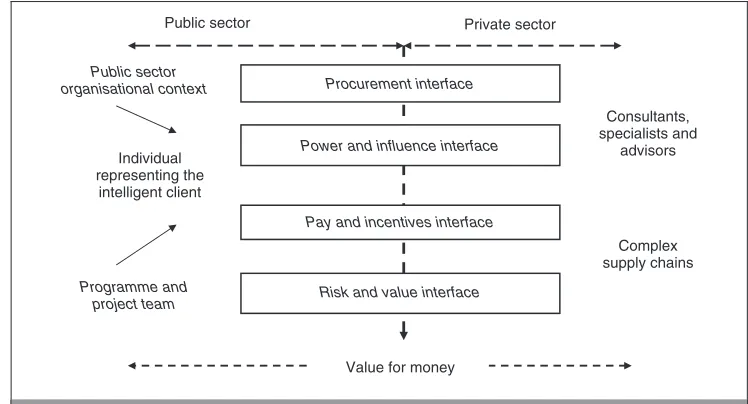
As earlier highlighted the procurement influences and changes in approach towards the delivery of major capital programmes and projects have meant that a new set of skills is needed to fulfil the intelligent client role. The issues specifically influencing this need for new skills are evident in Figure 2.
As shown in Figure 2, the value for money interface raises a
number of issues related to fulfilling the intelligent client role. The public–private sector differential may be highlighted in the skills and capability to handle procurement and the risk/value issues. The transformations in procurement discussed in previous sections have resulted in an emphasis on value (rather than product) based thinking, output-based specifications, whole-life asset management, sustainable procurement and innovation in design. To optimally accommodate these requirements client representatives must make decisions relatively much earlier than is the case in more traditional sequential types of procurement. Furthermore, in an environment characterised by increasing pressure to achieve efficiency while using relatively complicated contract and payment mechanisms, the need for various private sector advisors and suppliers (designers, contractors, sub-contractors or lenders) becomes inevitable. The adoption of the programme management approach with its emphasis on outcomes rather than outputs also requires early involvement of many
stakeholders with competing requirements.35,36The difficulties
associated with fulfilling the intelligent client role at the value for money interface and getting the right set of skills to support this role are also exacerbated by the pay and incentives disparity between the public and private sector. The combination of these issues affects the balance of power and influence at the public– private interface.
Some of the issues raised by Figure 2 are being considered as part of public sector policy. Nevertheless, the research showed that the individual representing the public sector intelligent client needs
the backing of the organisational and team capability.37,38In
fulfilling the role of representing the intelligent client a different set of skills and capability are required from the individual in his interaction with the private sector. The following section explores the skills and capabilities that define the intelligent client role in view of the discussion.
6. FULFILLING THE INTELLIGENT CLIENT ROLE
According to Czerniawska39the intelligent client should be in a
position to establish their needs and select the right private sector organisation and people to fill this need. The intelligent client should also be able to maximise value from the private sector by managing the relationships and increasing the value that is added by these private sector participants. The implications of these
Private sector
Individual representing the
intelligent client
Power and influence interface Procurement interface Public sector
organisational context
Programme and project team
Consultants, specialists and
advisors
Complex supply chains
Risk and value interface
Public sector
Pay and incentives interface
[image:6.595.179.553.557.759.2]Value for money
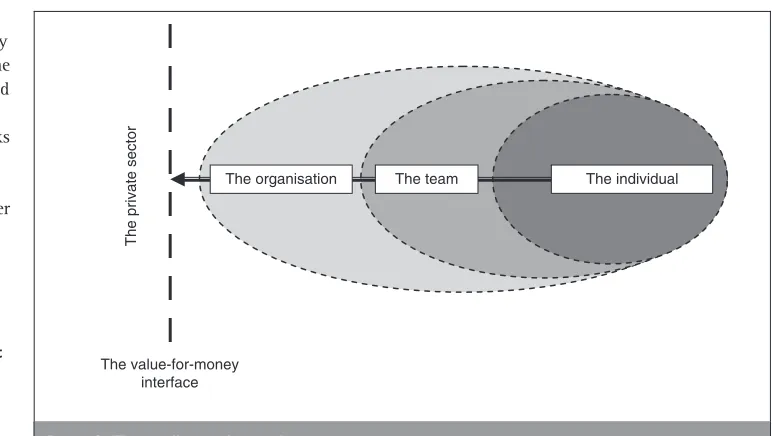
requirements in terms of the skills sets and capabilities may be addressed at three levels: the individual, the programme and project team and the
organisation. This section seeks to explore the skills and capabilities that enhance the intelligent client role in greater detail. Figure 3 provides a framework for the discussion.
6.1. The requisite skills set of the individual
representing the intelligent client
A combination of personal attributes and skills gained through formal education/ training are needed by the individual intelligent client
champion. This hybrid skills set model is in line with current research and best practice which reflects the reality of
management expectations. The research revealed that in addition to the functional knowledge-based skills (gained for example through project and programme management education); the individual representing the intelligent client would have to be achievement orientated and able to articulate the client’s needs in terms of public service outcomes. These qualities are especially useful at the early stages when public sector clients engage the services of advisors and consultants. The client champion also requires analytical and conceptual thinking skills tempered with flexibility to cope with change since the optimal solution will not be perfect but should be the one which best meets the policy and strategic aspirations. The need for team leadership qualities and the ability to influence multi-disciplinary teams is very important in view of the early involvement of individuals representing a diversity of organisations and differing motivations.
6.2. The client team supporting the intelligent client
Kellyet al.40argue that a team is characterised by a shared
commitment by all members to their collective performance and this will influence how they work together to accomplish team
goals. However, as shown by Male41construction schemes are
often comprised of both intra- and inter-organisational teams that are often temporary. Team norms dictate that depending on the perceived balance of expertise and power, leadership roles emerge and have a strong influence on who is ultimately recognised as the leader of the team; despite any formal leadership arrangements that might be in place. This is significant under the current procurement routes since teams composed of individuals internal to the department and private sector individuals are not unusual; even from the outset of the business case development process. The challenge for the intelligent client is to assemble the internal team of individuals who complement one another and maintain the balance of power while maximising the output from the private sector and enabling them to play a supporting role to fulfil the client’s aspirations.
6.3. The organisational context
The skills and capability issues within an organisational context may be conceived as a multi-dimensional set of inter-related
facets which the intelligent client must deal with and
accommodate. At the heart of the model in Figure 4 is the need to be thoroughly acquainted with cultural issues that are generic to the public sector and cultural characteristics that may be peculiar to the procuring organisation. The cultural issues are linked to strategy, people and process dynamics.
The strategy that results from central government and departmental policy will have a bearing on how the scheme is conceived and delivered. The people with associated political motivations and communication mechanisms need to be dealt with. Especially in the public sector, the need to follow a set of stipulated processes, protocols and procedures are an invariable and far-reaching requirement. The intelligent client role must be championed by an individual who is able to balance these dimensions, which are shown in Figure 4.
In conclusion, public sector clients involved in procurement of construction-related major programmes and projects are under increasing pressure from end-users and multiple stakeholders to fulfil a variety of expectations. Furthermore, the efforts to streamline the procurement process and achieve efficiency in public sector procurement are unlikely to change. The new approaches to procurement have greatly altered how the public
The organisation The team The individual
The value-for-money interface
[image:7.595.153.539.37.255.2]The private sector
Figure 3. The intelligent client role
Strategy
Process People
Culture
[image:7.595.299.539.593.744.2]and private sector engage in delivery of projects and programmes. Therefore, the challenge for the public sector is to act as an intelligent client. This article has shown that different skills and capabilities are required by the individual representing the intelligent client. The skills are needed to maintain the focus on the requirements of the client and benefits desired. However, as discussed, the individual must operate in a supporting team and organisational context. The individual should have the ability to harness the team and organisational features to obtain value for money. Conversely, the public sector client organisation must give serious consideration to the issues that impact on the value-for-money interface and use these to develop a framework to support the intelligent client champion. It may be possible through skills profiling to enlist complementary skills from a number of individuals to provide the composite skills requirements if these are not fulfilled by an individual. The nature of such an undertaking and the organisational implications are the subject of further research by the authors.
REFERENCES
1. BLISMASSN., SHERW. D., THORPEA. and BALDWINA. N. A typology for clients’ multi-project environments.
Construction Management and Economics, 20
Q3 04,22, 357–
371.
2. BLISMASSN., SHERW. D., THORPEA. and BALDWINA. N. Factors influencing delivery within construction clients’
multi-project environments.Engineering, Construction and
Architectural Management, 2004,11, No. 2, 113–125.
3. BOYDD and CHINYIOE.Understanding the Construction
Client.Blackwell, Oxford, 2006.
4. WINCHG.How Buildings Add Value For Clients. Thomas Telford, London, 2002.
5. KAMARAJ., ANUMBAC. and EVBUOMWANN.Capturing Client Requirements in Construction Projects. Thomas Telford Ltd, London, 2002.
6. PINTOJ. K.Project Management: Achieving Competitive
Advantage. Pearson Prentice Hall, Upper Saddle River, New Jersey, 2007.
7. OFFICE OFGOVERNMENTCOMMERCE(OGC).Project Management.
Available fromhttp://www.ogc.gov.uk/
delivery_lifecycle_project_management.aspAccessed: 21 July 2008.
8. MORRISP. W. G. and HOUGHG. H.The Anatomy of Major
Projects: A Study of the Reality of Project Management. Wiley, Chichester, 1987.
9. OFFICE OFGOVERNMENTCOMMERCE(OGC).Managing Successful
Programmes. HM Stationery Office, London, 2007.
10. BOWERD.Management of Procurement.Thomas Telford,
London, 2003.
11. GERSHONP.Review of Civil Procurement in Central
Government. 19
Q4 99.
12. HERMAJESTY’STREASURY.Efficiency in Civil Government
Procurement. 19
Q4 98, the PX Report.
13. HERMAJESTY’STREASURY.Setting New Standards: A Strategy
for Government Procurement. London, 19
Q5 95, White Paper –
CM 2840.
14. HERMAJESTY’STREASURY.Organisation of Procurement in
Government Departments and their Agencies. HM Stationery Office, 19
Q5 93.
15. HERMAJESTY’STREASURY.Transforming Government
Procurement.Available from: http://www.hm-treasury.gov. uk/media/E/6/government_procurement_pu147.pdf2007
Accessed October 2007.
16. NATIONALAUDITOFFICE(NAO).Getting Value for Money from
Construction Projects through Design – How Auditors Can
Help.National Audit Office, 2006. Q5
17. CONFEDERATION OFBRITISHINDUSTRY(CBI).Improving Delivery:
Realising Best Practice in Procurement and Contract Management. CBI, London, 2006.
18. CONFEDERATION OFBRITISHINDUSTRY(CBI).Innovation and
Public Procurement – A New Approach to Stimulating Innovation. CBI, London, 2006.
19. HERMAJESTY’STREASURY.Guidance Note 7: Whole Life Costs.
HM Stationery Office, 2000. Q5
20. GERSHONP.Independent Review of Public Sector Efficiency.
HM Stationery Office, 2004. Q5
21. NATIONALAUDITOFFICE(NAO).Improving Public Services
through Better Construction. NAO, London, 2005.
22. HERMAJESTY’SGOVERNMENT.Securing the Future – UK
Government Sustainable Development Strategy. HM
Stationery Office, 2005. Q5
23. GOVERNMENTCONSTRUCTIONCLIENTS’ PANEL(GCCP).Achieving
Sustainability in Construction Procurement: Sustainability Action Group of the Government Construction Clients’ Panel. GCCP, London, 2000.
24. OFFICE OFGOVERNMENTCOMMERCE(OGC).Business Case
Toolkit.HM Stationery Office, 2002. Q5
25. OFFICE OFGOVERNMENTCOMMERCE(OGC).Managing Successful
Programmes. The Stationery Office, 2003. Q5
26. ASSOCIATION OFLOCALGOVERNMENTENGINEERS OFNEWZEALAND.
International Infrastructure Management Manual, international edn. Association of Local Government Engineering NZ Inc. (INGENIUM), National Asset Management Steering (NAMS) Group, Thames, New Zealand, 2006.
27. LYONSM.Towards Better Management of Public Sector
Assets, A Report to the Chancellor of the Exchequer. HM Stationery Office, London, 2004.
28. INSTITUTE OFASSETMANAGEMENT.Asset Management
Specification for the Optimised Management of Physical Infrastructure Assets. Institute of Asset Management, London, 2003, PAS 55–1:2003.
29. DONALDSONG.Corporate Restructuring: Managing the
Change Process from Within. Harvard Business School Press, Boston, MA, 1994.
30. MORRISP. W. G. and JAMIESONA. Linking corporate strategy
to project strategy via portfolio and program management.
International Journal of Project Management, 2006,25, No. 1, 57–65.
31. PELLEGRINELLIS. Shaping context: the role and challenge for
programmes.International Journal of Project Management,
2002,20, No. 1, 229–233.
32. WINTERM. and SZCZEPANEKT. Projects and programmes as
value creation processes: a new perspective and some
practical implications.International Journal of Project
Management, 2008,26, No. 1, 95–103.
33. PELLEGRINELLIS., PARTINGTOND., HEMINGWAYC., MOHDZAINZ.
and SHAHM. The importance of context in programme
management: an empirical review of programme.
International Journal of Project Management, 2007,25, No. 1, 41–55.
34. LLEWELLYNS. and TAPPINE. Strategy in the public sector:
management in the wilderness.Journal of Management
35. OSBORNES. P. and BROWNK.Managing Change and
Innovation in Public Service Organizations.Routledge, London, 2005.
36. BECKHARDR. and HARRISR. T.Organizational Transitions:
Managing Complex Change, 2nd edn. Addison-Wesley Publishing Co., Reading, MA, 1987.
37. HUCZYNSKIA. and BUCHANAND. A.Organizational Behaviour:
An Introductory Text, 6th edn. Pearson Education, Harlow, UK and New York, 20
Q6 07.
38. JOHNSONG and SCHOLESK.Exploring Public Sector Strategy.
Prentice Hall, Harlow, UK and New York, 2000. Q6
39. CZERNIAWSKAF.The Intelligent Client: Managing your
Management Consultant.Hodder & Stoughton Education, The Management Consultancies Association, London, 2007.
40. KELLYJ., MALES. and GRAHAMD.Value Management of
Construction Projects.Blackwell Science, Oxford, 2004.
41. MALES. and STOCKSR.Competitive Advantage in
Construction. Butterworth-Heinemann, London, 1992.
What do you think?
To comment on this paper, please email up to 500 words to the editor at [email protected]