,1
i
:l
'i,,,
,
EUROPEAN
ATOMIC ENERGY COTflfiTNITY
-
EURATOU
.l i
i
j,.
'1 ,!
APACFIE
A
BREAKTT{ROUGH
IN
ANALOG
COMPUTING
by
i
,,,
'
rA.
DEBROUN'* H.,D'HOOP.:
C.
GREEN
t
n.
1o
20
LEGAL
NOTICEThis document was prepared under the spcn$orship of the Commission of the Erirop6an
Atomic Energy Community (EURATOM).
Neither the Euratom Comrnission, its contractors nor'any percon acting on their behalf :
-
completeness, Make any waranty or or usefi:Iness representation, of the information express contained of implied, in this with document, respect to or that the accuracy,the useof any information, apparatus, method, or process disclosed
in
this document may not infringe privately owned rights; or-
any information, Assume any liability apparatus, wittr respect method to the or use of, or Ior damages resulting from the use ofProoess disclosed
in
this document.This reprint intended
lor
restricted, d.istribulion only.It
reproduces,'
by hind pennissionol
thefublislwr, an wticle lrom ,,IRE TRANS-ACTIONS ON ELECTRONIC COMPaTERS", Vol,. EC-11, No. 5
'
1962, 699-706. For lurtlwr copies flease apply ta IRE
-
Prolessionelbouf
on El,utronic Compulers, T Easl 79lh Street-
Nas York 21.,N,Y,,
U.S.A.Diesar Sond.erdluck ist fdi.r eine beschriinkte Verteil'ung bestimml. Die Wiciteryabe des ooilieganden
in
,,IRE TRANSACTIONS ON ELEC'TRONIC COMPUTERS",
Vot.
EC-11,Nr.
5
-
1962, 699-706ercchienenen Aulsatzes erfol,gt
mit
frcunC)iclur Genehmigung d,esHerausgebers. Bestell,ungen wei,terer Exempl,are sinil au, IRE
'
Profes' sional Group on Electronic Computas,1
East 79th Stred-
NewYork 21,
N.Y.,
USA., zu ricktenCe tirl-d-part esl erclusioement destinC
d
une dillusion restreide.Il
reprend, aacc l,'aimable auailsation de l"dd'ilew, wn articlc publ,ii dans
IIRE
TRANSACTIONSON
ELECTRONIC COMPUTERSI,Vol. EC-11, No 5
-
1962,699-706. Tout autre cxenfl*irc do cet art'i.el.eiloil
8*e d.enund| A IRE-
Prolessicnal Grwp on EledranicConf*
tas,7
East 70lh
Street-
Neu York 27,N.Y.,
U.S.A.Qtusto estuatto e ilestinalo esclusiaanente ad. una dillwsione liruitata. Esso d stata riprodotto, por gentile wnussione ilpll'Eilftore, da <IRE TRANSACTION S ON ELECTRONIC COMPUTERS t, Vol,.
EC-ll,
No
5
'
1.962, 699-706. Ulteriori copie ilel,l'arficoh d.ebbono essereriihieslp
a
IRE - Prolasyional Grwp on Elactronic Camfuters, 1 East 79th Street-
Nas
York 27,N.y.,
U.S.l.
Dcze oteilruh is sl'echls aoot bcperW'e tasfreiding bestemd. Het artikcl
is met wel,uillend,e toestemming uon de
uitgarr
ot)ergenan enuil
,,IRETRANSACTIONS ON ELECTRON IC COMPUTERS", Vd,. 8C.1.1,
to.
5
-
1962, 699-706. Meer exen'flaren kunnen bestelil worden bi,iIRE - Prolessionel Group'on Elpclronic Cotnfuters,
1
East 79th StreetReprinted. lrom IRE TRANSACTIONS ON ELECTRONIC COMPUTERS Volume EC-l1, Number 5, October, 1962
PRINTED IN TEE U.S.A.
analog treatment have turned to digital simulation for
these economic reasons.
With
the steady improvementsin
digital
machinesand
programing techniques this trend could become very important.On the other hand, once
the
problemis
posed, thesolution becomes apparent.
The
questionat
issue iswhether the process followed
by
the analog programer can be treated as a problem in data reduction according to defined rules in order that the programing andcheck-ing process may be handled automatically; the APACHE
system gives an affirmative answer
to
this question.APACHE
(Analog ProgramingAnd
CHEcking) is the resultof a
combined studyby
digital and analog specialistsat
the
Calculation Centerof
EURATOM,Ispra, (Italy)r and consists of a digital computer program which accepts the essential problem data in a raw state and produces the analog program
in
such a form as to make maximum use of automation and logical feedback possibilities.Great emphasis has been placed on the languoge em-ployed,
in
the hopethat
if
a
language is foundto
belogical, clear and concise,
it
will
also beof
permanentand universal application.2
Thus, the rest of this article is devoted to a
descrip-tion of this language and program, including its
exploi-l The EURATOM Computation Center is equipped with a 250
amplifier, PACE 231R analog installation and a 7090 digital
com-puter. The APACHE code uses 8 tape units, is run by a FORTRAN monitor s)/stem;
it
makes use of indirect addressing and of the ttConvert" instructions.2 A detailed account of the language will be found in
communica-tion No. 107 presented at the 3rd Internatl. Conf. on Analogue Com-putation, Opatija, Yugoslavia ; September, 1961.
APACHE-A
Breakthrough
in
Analog
Computing.
C. GREENf,
H.
D'HOOPf,
ANDA.
DEBROIIXT
Summarg-l\is paper describes ttre working of the APACIIE (Aaalog Programing And Csncking) system for ttre production of analog computer programs using a digital computer, which has been
developed jointly by digital and analog programers at the
computa-tion center of EURATOM in Ispra, Italy. The language which has
been formulated for ttre writing of analog problems is discussed and its rules are set out in the Appendir, while tle processes involved in tle utilizatioa of the program are described and illustrated by an
erample of ttre listing of the digital computer input and output for a
range of equation types. Finally, ttre significaace of this new pr(F grarning system in terms of economic erploitation of the analog
machine, the use of kained personnel, a.nd ttre desiga of rrew com-puters, are considered briefly.
IurnooucrtoN
lf
F
ONE
CONSIDERSthe
advantages anddisad-ll
vantagesof
the analog methodfor
the solution of^
engineering and scientific problems, one finds on the debit side two items of outstanding importance. Thefirst
of these is the costof
preparinga
problemto
the pointat
which useful results are produced,in
terms of both engineering and machine time, not forgetting that for the analog machine the bulkof
this price must bepaid each time a given problem is set up. The second is
the great difficulty of ensuring that the given equations are being solved
at
all
times during the production of results.It
is worth remarkingthat
the cost of a minor error is proportional to the time which elapses beforeit
is discovered, and therefofe, the cost can be very high.There are cases
in
which engineers studying large systems of a type which one would suppose ideal for the* Received February 19, 1962; revised manuscript received,
March 10, 1962.
700
tation, and
it
concludeswith
an assessmentof
future development,in
the courseof
whichit
will
be shownthat
the APACHE system offers considerable savingsof money to owners of both large and small analog in-stallations and also provides the most powerful economic justification of remote controlled setting-up facilities for the analog computer.
WutlNc
INpur DereThe criteria adopted in the choice of form for input to program were:
1)
Economy in writing,2)
Correspondence with the best basic possible formof mathematical symbolism in general use,
3)
Uniquenessin
interpretationat
the stageof
an-alog set-up,4)
Flexibility
allowingthe
possibilityof
writing
aproblem to produce any desired computer set-up.
The
readeris
invited
to
examinethe
programing phaseof
an
analog problem using APACHE,at
the stage when the analyst is able to write a mathematical model according to the following form:1) a set of differential equations
October
VARIABLES
Xl:50.00,
100.00and in general:
alphanumerical expression
:
initial
value, maximum expected value.EQUATIONS
,4 * DER2
(X1):B
* DER1(Xt)*C
* X2F*
DER1
(X3):
Yl,,
Y2.(D+Zl/22).
The words such as: PARAMETERS, VARIABLES
or EQUATIONS are orders to the digital computer,
de-termining how the data following
will
be organized in tables.The familiar square-root arrangement using
a
high-gain amplifier
will
showhow
implicit
relations are introduced.The expression
y:
/r-
is convertedto
6:yz-x
andin
APACHE
notations:EQUATIONS
ZERO
(Y):Y
*
*2-X
where the expression ZERO
(Y)
indicatesthat
Y
isdesired as
the output
of
the
high-gain amplifier, the right-hand terms being the inputs, asin all
the otherAPACHE notations.
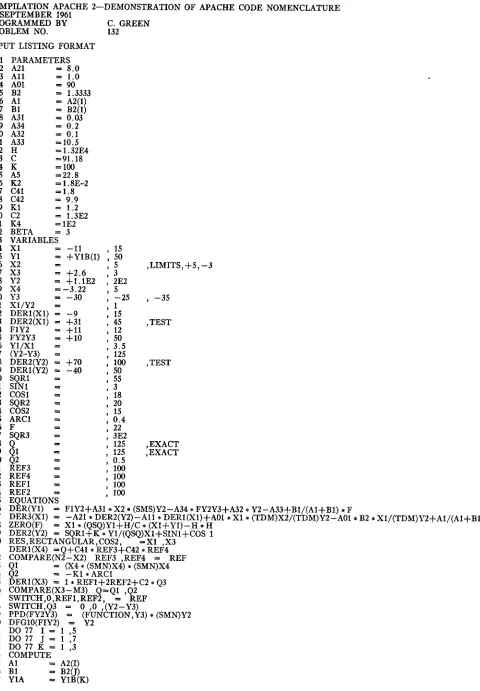
Another example (Fig. 1) shows the writing of a large number of equation types, and the rules for writing the input will be found in detail in the Appendix. The reader
is
invited,
however,to
judgethe
clarity of
the
lan-guage from the point of view of an engineer rather than
a
computation specialist. Althoughthe
whole processis
implicit
in
the Appendix, a few generalities may bepermitted here. The reader
will
observethat
although an effort was made to keep the languagestrictly
prob-lem-orientedthis
soon proved impossible; concessionswere made
to
analog technique,for
example,in
the treatment of resolutions of coordinates, as being carriedout in a "black box," which is logically equivalent to a resolver.
A
substantial advancewith
respectto
thefirst
twocriteria above has been obtained
by
includinga
largepart
of
the reductionof
differential equationsto
firstorder
in
the automatic section of the processing.This elimination
of a
manual transformationis
im-portant asit
eliminates errors which cannot be checkedat
the stage of problem checkout.In
a similar fashion, provision is made for the insertion of minimum as well as maximum values of variables, where appropriate, in which case the equationswill
automatically be trans-formedto
workwith
perturbations about the averageof
these two values.IRE
TRANSACTIONS ON ELECTRONTC COilTPATERSd"$n
r.tl
iln-\(r;)illl
" \
dr"-,d(*,\
:-:, Xr"'X;"'X^t
dt
Yr.
.
.
Y^,2.2^\
ifrom I
tom,/
2)
a set of explicit algebraic equationsyi
: fi(xr.
.
.x^,
Yr.
.. Yi.
YorZr"'Zr)
j
fromI
to p,3)
a set of implicit relations (geometrical constraints, etc.,. .
.)
g:f*(Z;...2*...2o)
ft from 1 to q,4)
a set of arbitrary functionsto
feed function gen-erators, coordinate transformationsand
logical conditions necessitating relays.Where differential equations require integrators, ex-plicit algebraic equations summers and the
implicit
re-lations are taken care ofby
means of high-gain ampli-fiers.At
this stage, a certain number of punched cardswill
be prepared, and the evident purposeof the
lan-guage is to have an easy correspondence between usual mathematical notations and the characters on the key-board of the card punch machine. So, the statements for programing a certain problem would have the following appearance:PARAMETERS
.4
:
1.0500and,
in
general:7962
G,reen,a.
a[.:"APACHF,-A
Brealethroighin
Analog
ComputingCOMPILATION APACHE 2_DEMONSTRATION OF APACHE CODE NOMENCLATURE
15 SEPTEMBER 1961
PROGRAMMED
BY
C. GREENPROBLEM
NO.
132INPUT LISTING FORMAT PARAMETERS
L2l
:
8,0All
-
1.0A01
:
9082 A1 B1 701 1 ) 3 4 5 6 8 9 10 11 t2 l3 l4 15 16 t7 18 19 20 2t 22 23 24 25 26 27 28 29 30 3t 32 33 34 35 36 JI 38 39 40 4t 42 43 M 45 46 47 48 49 50 51 52 53 54 55 56 57 58 59 60 61 62 63 64 65 66 67 68 69 70 7t 72 73 74 /5 76 77 :1.3333
_
A2(r):
B2(1)A31
=
0.03A34
:
0.2432
:
0.1A33
-
10. 5H
:1.32E4C
:91.18K
:100A5 K2 c41 c42 K1 C2 K4 :22.8 :1.8E-2 :1.8
:9.9
:
1.2:
1.3E2:lEZ
BETA :
3VARIABLES
Xl
:
-11Yl
:
*YlB(l)
x2
x3
_
+2.6y2
-
+1.1E2X4
-
-3.22Y3
:
-30xl/Y2
DERl(Xl)
:
-e
DER2(Xl):
+31FlY2
:
+11FY2Y3
-
+10Yt/xt
(Y2-Y3)
DER2(Y2)
-
+70 DER1(Y2)=
-40sQRl SINl COSl sQR2 CO52 ARCI
F-sQR3 a Q1 Q2 REF3 REF4 REFl REF2 EQUATIONS ,15 ,50,
5
,LIMTTS, +5,-3
,3
,
282,5
, -25
,
-35,l
,15
,
45
,TEST,72 ,50
,3.5
,
125,
1@
,TEST,50 ,55
,3
,18 ,20 ,15 ,0.4 ,22,
382, 125
,EXACT,
125
,EXACT,
0.5,10
,1@ ,1@
,
100pPBg-l_).
:
FIY?+431+X2 * (SMS)Y2-A34 xFY2Y3*A32 * Y2-A33*B1I(A1*B1) xFP_E_R!(41)
:
-
A2! 1_DE_!l(uf_)._A,\!_1DE-R1(41)tA01 * Xl * (TDM)X2I(TDM)Y2-Aol *82 *Xt/(TDM)y2+A1l(At*Bt) * FZERO(F)
-
Xl *(QSOYI+H/C*(X1*Y1)-H*H pEB2(Y2):
SQRI+K*Y1I(QSQ)X1+SIN1+COS IRES,RECTANGULAR,COS2,
- tXI
,X3DER1(X4) :Q+C41 * REF3*C42 * REF4
CoMPARE(N2-X2) REF3
,REF4
REFQ1
=
(X4x(SMN)X4)*(SMN)X4Q2
:
-KI*ARCIDER1(X3)
=
I *REF1*2REF2*C2*Q3 CoMPARE(X3-M3) Q=Ql,Q2swITCH,0,REF1,REF2, REF
swrTCH,Q3
0 ,0 ,(Y2-Y3)PPD(FY2Y3)
(FUNCTION,Y3)*(SMN)Y2DFG1o(FrY2)
Y2DO77
I:1,5
DO77J: t,7
DO77K:1,3
COMPUTE
Al
:
A2(l)Bl
-
B2(J)YIA
:
YIB(K) [image:5.554.33.513.48.739.2]702
IRE
TRAYSACTIONSON
ELECTRONTC COMPATDRSPARAMETERS
78
A2(l) =
1.57e
A2(2)
t.480
A2(3)
1.381
A2(4)
1.282
A2(s) :1.0
83
B2(l) =
0.03u B2(2)
0.0485 B2(3)
=
0.0586
B2(4)
0.0687
B2(s)
0.0788
82(6)
0.0889
B2(7)
0.190 YlB(l)
:
409l
YIB(2)-
5092
YlB(3):
60END
COMMENTS
OUTPUT LISTING FORMAT SAMPLE. DEVELOPMENT OF COMPLEMENTARY EQUATIONS
57.0 DER(DER2(XI))
:
-AZt * DER2(Y2)-A11 * DER1(X1)+A01 * (Xt*X2/Y2)-A01 * B2* (Xt/v2)tA1l(A1*B1) * Fs7.t
DER(DER1(X1)):
*DER2(xl)s7.2
DER(XI)
-
*DERl(Xl) 57.3(Xl*X2/Y2) :
+xl*X2/Y2
October
s7.4 (Xt/vz)
COMMENTS
OUTPUT LISTING
s6.01 DER(YI) s6.02 s.777e
:
+xt/Y2FORMAT SAMPLE. COMPLETE DEVELOPMENT OF AN EQUATION
56.03 DERTAU(2xYl)
(-l):
+
F1Y2
+A31 * (X2 * Y2)-434
*FY2Y3
+A32
*Y2+11.000
+(-3.se47)
-2.OO0O
+11.OOO-0.25/B
*(8xF1Y2)-0.6/B
*(0-1* (X2*Y2))*0.2/B
*(2xFY2Y3)-0.4/B *(0.5*Y2)-07.33
+02.40
+01.33
-07.33-1x
.0833 * (*88.00)-1*
.2000 * (-11.98)f
1* .0667 *(*20.00)
-1*
.1333 * (+55.00)56.04 +03.85
56.05 +03.85
56.06 rNT A31 (A42)
56.07 A34
(-t):
(- 1):
-l)= -1):
56.01
56 .02 56.03 56.04 56.05
56.06
56.11 (X2*Y2) 56.12 -119.81 56.13 (0.1(x2 x Y2))
56.14 -11.98 56.15 -11.98 56.16 SMIA
56.17
A66
(-t)=
DFG
F62fl*Q80
A66*81/(A1*Bl) x F
+(-0.1274)
{l *P24
424*Y2
* (-30)
*l *
P32
A32 *1 *P33
A33+0.21/B * REF
-00.098/8'
* (4 * F)+07.00
+00.08fl*.0700x(100)-1*.0033
*(-26.00){1*
Q30{1
*
A31 -433-
10. 500fl
*P33+x2
+3.9941
*(20 *x2)/100 * (0.5 * Y2)
-
11.98+79.88/100 * (-15.00)
+Atz
(+A21-A33)f
1x SM1AFig. |-Cont'd.
UsB op SusnourrNBs
By extension of a very common digital technique the notions of subroutine and indexes have been admitted, giving opportunities previously unknown to the analog programer.
It
will
now be possible to preserve programsections in a permanent form, including everything up to the block diagram, without numbering, for which appli-cation should not be hard to find, especially in an instal-Iation such as that of EURATOM, which specializes in nuclear problems. For the writing of problems involving the finite difference technique, where one has a number of similar cells, the use of indexed variables effects a
use-ful
economy;but
the main applicationof
indexes willbe
in
the
automatic permutationof
parameter andinitial
condition values resultingin
a
productionpo-tentiometer setting
list
or
tape. The latter use isillus-trated
at
the endof Fig.
1, and deserves notice as an example of.a
sequent'ial operation.Finally,
it
is to be noted that a sufficient set of orders has been provided to give the operator complete controlover
the
block
diagram producedand
its
allocation' among the equipment available, which gives theoppor-tunity to
profit
from machine checking of circuits de-signed and patched by hand, whereas the correction ofa
mistakein
the writing ofa
problem is,in
any case,immediate by virtue of the
facility
for the suppression and insertion of sections of program of any size.INrBnpnBrrNG
Ourpur
DATAAfter
reductionof all
introduceddata, the
digital computerwill
supplyan
output
undertwo
different forms:1)
A listing, written in a clear language, [image:6.554.20.525.65.529.2]1962
The
listing
will
bethe
equivalentof the
..problem sheets" which are familiarto
analog engineers.If
the analog computer hasonly
manual setting,this
listingwill be used to program the analog computer in the con-ventional way, since the following information
will
bedisplayed in successive rows:
1) The physical equation in its reduced form,
2)
The same equationwith
the values of parametersand
initial
valuesof
variables substituted, cor-responding to the traditional static checkcalcula-tion
in
physical units,3)
The scaled equation in its traditional form,4)
Gives the valuein
voltsof
each term, and cor-respondsto
the outputs of the potentiometers,5)
Contains the coefficients to be set on the potenti-ometers togetherwith
the
valuein
voltsof
thevariable,
the
productof
these terms being the valuein
line 4).
Thesetwo
lines, considered asequations, preserve their arithmetic sense.
6)
The address line, writtenin
correspondence with the scaled equation.It
is to be noted that the flowof
informationis
right to
left,
and the patching should proceed accordingly, as amplifierto
po_tentiometer to stated gain of the amplifier on the
left
of
the
equality
sign.This
arrangement isrepeated for each equation.
The reader will be able to verify that this layout makes clear the output in volts for every machine element for the checking stage, the terms having been carefully aligned for this purpose. The reason
for
the use of complementary equations also be_comes clear
at
this
point. The
flow diagram is implicitly contained in the preceding information,but may be redrawn for clarity.
The
output listing
for
the second-order differential equation givenin
the first example would have the fol-lowing appearance:703
values can be produced
if
required, and since nearly all analog machines have a wide variety of manual settings possible,for
example function switches, positions ofvarious types of multiplier and external switches govern-ing the function of nonlinear units, a list of these settings appropriate to the machine concerned is included in the
output listing.
It
is
to
be noted, however,that
everythingup
to address line is independent of the type of analog com-puter used, and in fact the circuit diagram exists in thedigital computer
in
a general form. Thus, to adapt the program for another computer type requireslittle
more than the rewriting of the allocation of addresses routine.If
the analog computer is equipped with digitalinput-output facilities and
if
pots are set by means of servos, (in our case we use an ADIOS coupledto
a 026IBM
card reader) the system includes all coefficient settings and the selection and perforation of
all
voltagesneces-sary
to
checkihe
functioningof
the analog computerand the problem itself. The perforations are then an-alyzed
by
the digital computer which puts out a com-pletelist of
faults. The automation also includes the preparationof
the patch panel, for which instructions are decoded and fed to an optical apparatus, which willaid patching in such
a
waythat
this operation may bedone
by
unskilled personnel.OppnerrNc pnocBounBs
'I'here is a distinction
to
be drawn between the pro-gram stage and the problem running,in
the sense thatthe first is available to all who have access to any digital facilities, while the second is
a
benefit reservedto
the centers which have both digital and analog machines.It
must
be
emphasizedthat the
program stage of APACHE is completely self-contained and is themech-anized, equivalent of the traditional form of analog pro-gram as produced
at
great costby
skilled engineers.Furthermore, the APACHE output is free from error.
In
any
case,the
economic aspectis
sufficient tojustify
the hiring of digital time, even at a distantloca-tion; for the preparation of program and checks and the procedure which is given here
will
not differ in principle whatever the degree of sophistication of the installationinvolved. For all users the existence of ApACHE makes
Green,
et.
al.:
aPACHE-a
Breakthroughin
anarog computing1)
DER
(DER1(x1))
2)
-2.
s0003)
-DER(2.0000 *DER(X1))
4)
+(os.oo)s)
+(0s.00)6)
A00rNT
:
-B/A
:
-5.0000
(-1):
-2.5000/B
(-1):
-(10.00)
(-1):-10
*.2500:_10.Q00
-
DERl(X1)
* (2.0000 .
DER1
(X1)) - (04.00)* A00
+c/A
+2 .5000 +4. ooo0/B
+ (0s .00)
+ 10 - .4000
+10
-
Q02*X2
. (o.5oo0 .
x2)
- (0. 125)* A13
It
is worth remarkingthat
experience suggests thatthe unifrcation of all data relative to a given equation is greatly superior
to
the
separatelisting
of
each pro_graming phase. However, tabulations of potentiometer
704
he can make
a
preliminary programing on the digital machine.All
the consequences of the programing deci-sions taken can then be clearly seen and fed back intothe
problem appreciation stage. Thereafter,the
com-plete program can be written out with care, the outputlisting
is
produced,the
patch panelis
prepared and placed on the machine, the function generators are set up and finally the nonlinear boxes and manual switches and the setting and checking programs are run'In
the case of a purely analog installation the process is then complete but the owner of a digital machine canstill
gain much from the system. His program is stored on magnetic tape for speedy access and when the out-put of the checking program is readyit
is fed back into the digital computer for analysis and the resulting listof
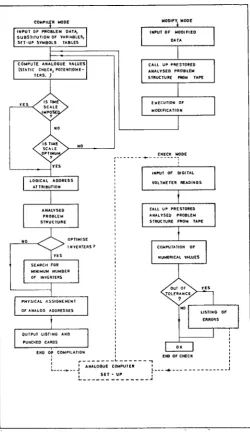
errors can be immediately corrected and checked' The general organization of the APACHE program will be foundin
Fig. 2.It
may be
necessaryto
emphasize whilethe
fullyautomatic compilation of perfect programs is admittedly
October
impossible, the APACHE system is so designed as to give maximum assistance to all analog programers, both experts and beginners.
The average operator
will
immediately produce pro-grams giving correct results, while the expertwill
6ndthat full
scopeis
allowedfor
more subtile useof
the machine, since any circuit which can be patched with standard elements can bewritten
in
APACHE code.On the other hand,
all
userswill
findthat
the tedious and mechanical elements of programing, namelycalcu-lation
of
coefficient settings and static check, and the onerousfault-finding
procedureshave
been entirely eliminated, leadingto
a
much more efficient use of trained personnel.It
is intended that the manner of working in thepro-duction stage shall be more systematic
than
hitherto andthat
asfar
as possible advantage be takenof
the possibility of producing production tapes automatically. Thus,it
is intended to increase the loading of the ana-log machines substantially because of1) The very large reduction
in
"debugging" time,2)
The greatly increased possibility of "timesharing'between several problems, due to the rapid check-ing procedure which gives much cheaper thinking
time and, thus, the chance
to
preparefor
faster and more systematic Production.It
is
to
be notedthat
during operation, changes in patching and coefficients may be made manually with perfect freedom, andit
is only necessary to keep acare-ful
noteof
themfor
perforationand
additionto
the program at any convenient time, whileit
is also possibleto
introduce modificationsinto the
stored program which are treatedin a
few secondsof
digital-machine time and which put out complete or partial listings and miniature setting and checking tapes.Srarus oF THE Pnocneu eNo
Furunr
PnosprctusA
limited
version calledAPACHE
t
has been in operation since March, 1961,at
Ispra, andit
is on the basisof
this
restricted versionthat
APACHE
2
hasbeen designed. The new version is scheduled
to
be in operation by the time this article is printed.s Although several references have already been found, and in many placesin
the United States andin
England work has been attempted which coversa part of
the automatic analog programing problem, nothing has so far come to hand of a similar scope and magnitude. Thus, diffusion is sought particularly for the language employed, in thehope that
it
may be found a suitable standard for futurework
in
this field.In
this connectionit
has been a constant aim of thestudy
to
createa
programingand
checking system, which while being completely self-contained is designedto
be partof a
fully
integrated systemof
analog ands APACHE
II
came into operation at Ispra in July, 1962, and copies have been distributed to several other computation centers.IRE
TRIIVSACTIONSON
ELECTRONIC COfrIPATERSIIPUT OF Pf,OlLEM OATA, Su gSlrtutoN 0t v^nr^BLE5,
5EI.UP SYXEOLS IABTES
CALL UP PiESTOiEO
f,AIY5ED PNOAIEI
stiucTuiE mx rAE (STAItC CHEC(,
POIEXITOME-rERs. )
ITPUI OF OIGITAL
YOtTtElEn iEADril9S
CALL UP PiE5IOiED ANAIYSED PIOBLEH
5TiUCIURE FiOM
'AP€
couPUrAloN oF xuMtirc^t v tuEs
/4.
)\
SI
;z___)
xolI rrsrtx
,1,*l
ooFRS o
EE OF CAECi
Fig. 2-APACHE program organization.
PHYSICAL ASSI6NEMEXI ol Af,^LoG A0DRESSES
[image:8.554.22.273.318.754.2]1962
Green, ea.al,:
APACHE-A Brukthrough
in
Analog Computingdigital computers, and
it
is claimedthat
APACHE is already prepared to accept the additions necessary forthe possibilities which follow. The
first of
these is the remote-controlled patching systemwhich
is
already under active study, and which would bring almost the whole problem set-up under the direct controlof
thedigital
machine.If
desired, the communication couldat
this stage bemade purely electrical, eliminating the use
of
punched cards.With
the addition of remote-controlled function and delay generatorsit
completes what is known as the static phase of the integration of the two types of com-putation which would necessitate a physicalreorganiza-tion of the next generation of analog machines, leading
to
much greaterflexibility
in
assembling suitable ma-chines to solve a given problem.A corollary to this must surely be the replacement of the present wide variety of multiplier types by a
stand-ard unit with
high accuracy and effectively unlimited frequency response,greatly simplifying
programing. Another highly important aspect is the automation of maintenance procedures whichwill
change completely the problem of machine realiability whenit
is realized. This is not to forget the dynamiclink,
using the an-alog-digital and digitanalog converters which are al-ready commercially available, enabling the two types of machine to work simultaneously on one large problem. There can be no doubt that this technique which has al-ready been proven powerfulfor
some classesof
prob-lems can be greatly developed oncethe
setupof
the analog machineis
broughtinto
linewith that of
thedigital
computer.AppBNolx
This
appendixis
intendedprimarily
to
summarizethe language above and the reader should consult the publication described2 for a definitive statement on the
input
andoutput
language. These notes should makethe above example quite clear however. Number: There are two forms permitted.
1)
Asin
normal use including decimal pointin
any position.2)
As abovewith
an exponentof
10 added after acapital
E-e.g.
12. 518-
2:12.51X
10-2:
0.1251. For the output format a more specific rule is used by the machine, the exponent being employedif,
and onlyif,
the number is greater than 9999 or less than 0.01.Name:
A
name consistsof
up
to
5
alphabetical or numerical characters, of which the first must be a letter, and can refer to either a parameter or a variable.Arithmetic Symbols: Keep their usual meanings with
certain machine conventions added as
in
FORTRAN.This applies also to brackets. The asterisk (x) is the sign
of multiplication and the slash
(/)
of division.Orders: These are given in capitals below, and
at
theinput may be taken in any order. They are cancelled by the next order given.
705 PARAMETERS is followed by a list of constants and
their
values.A
parameter can be composedof
morethan one constant and
its
value can be a combinationof
other parameters providedonly
that
the completelist
be self-consistent. Parameters introduced directly into the equations in numerical form need not be listed.VARIABLES precedes a list of names, to which are attached the following columns
of
information,all in
physiml units:
1)
Initial
value, where appropriate. Redundantval-ues will be ignored by the program, which replaces
them by calculated values,
2)
Maximum value, from which a scale factorwill
becalculated and rounded off for easy manipulation,
3)
Minimum value, ifit
is desired that the variable in question be expressed as a perturbation about itsmean,
4)
Comments such as:LIMITS
indicating the use of a feedback limiter,LIMITS
B for a bridge limiter,TEST causing the
initial
condition to be patched to the machine test reference,EXACT
inhibiting
the
round
off
of
the
scalefactor
soas
to
makethe
maximum value cor-respondto
precisely 100 volts.EQUATIONS
precedes the physical equations, the rulesof
writing
being conveniently explainedfor
the following classes:1)
Linear and nonlinear ordinary differential equa-tions of any order. The highest derivativeof
the variable for which the equation is solved is placed on theleft,
the operatord"fdt
being replaced bythe
operatorDER
z( ).
(z
beingany
number from 0to
9.)If
DER n(x) is included in the list of variables, the equation will be treated as algebraic and DERn(x) calculated explicitly. Otherwise, the right hand side
will
be integratedto
yield
DER
(z-1)(r).
Multiplications
and
divisions are admissible onthe right hand side at the input, these being
auto-matically
convertedinto
complementaryequa-tions
by
the
program,but
other typesof
non-linearity
must be replacedby
dummy variablesfor
which
equationsare given
elsewhere. Evi-dently, the typeof
multiplier and sometimes the number of quadrants must also be given formulti-plication and division,
if
more than one type is available.2)
Algebraic equations are covered by the same rules exceptthat
summation is impliedby
the absence of the operator. The variable on theleft
must bein
the variablelist
and noinitial
condition isre-quired for
it.
3)
Implicit
equations are resolvedby
the
operator ZERO, the variable for which the equation is toequa-7M
tion for a square root,
y2-v:0
is written ZERO(v):v'-x.
The operator ZERO corresponds to a high-gain amplifier
in
the analog circuit.4)
Arbitrary functions are written as equations using special operators which give all necessaryinforma-tion
about
the
analog set-up.Thus
y:/(r)
is written DFG 20(y):
FUNCTION
(r)
in the caseof a
diode function generatorof
20 segments orY:
zf(x)PPD
(r/):
(FUNCTION
(X)).
Zin the case of a servomultiplier with a padded pot.
A
fixed function generatoris
representedby
the operator FFG.5)
Switching operations usethe
operators COM-PARE for comparators and SWITCH for manual switches and the readerwill
have no difficulty in understanding the example, providedthat
here-members
that
the output
of
an
element follows the operator on theleft
while the input(s) comeon the right, separated by arithmetical symbols or
commas.
6)
Resolutions of coordinates are carriedout by
re-solvers and rate resolvers which are representedby
the operatorsRES, RECTANGULAR
RES,
POLARRRV,
RECTANGULARRRV, POLAR
which are self-explanatory.
Other orders are provided to enable the operator to
control
the
problem set up and need be used only in certain cases. These are:IMPOSE which allocates a given variable or param-eter to an address chosen by the programer.
OMIT
which prevents the allocation of the addresseswhich follow.
SUPPRESS effaces a given list of statements.
INSERT
z
adds the statements which follow after statement z.COMMENTS precedes
a
statement whichwill
bereproduced but
will
not affect the program.VARIPLOTTER and, RECORDER assign
to
these elements a given list of variables (for automaticpatch-i,g).
October
HEFERENCE is used for those machines which have a scale other
than
*
100 volts.CONSOLE SELECT allows the distribution
of
the program among several consoles.BETA
imposes the time scale.These last two
will
be automaticif
no specification is made. In the case of BETA a time scale is chosen whichkeeps the largest gain slightly below 10.
In addition to these orders, which allow the program-ing stage to be completed in the classical manner, some
others have been added, giving new possibilities.
MODIFY
recalls a program for the incorporation ofchanges.
SUBROUTINE
allowsthe
insertionof
a
prepro-gramed block corresponding to a "black box" at theset-up level, the arguments of the subroutine including the scale factors of input and output variables.
FUNCTION
hasa
similar
purpose exceptthat
afunction has one output and a subroutine several. RETURN terminates
a
functionor a
subroutine.E.l/D
signals the completionof
the problem'CHECK prepares the
entry
of a
readoutfrom
the analog machine for analysisby
thedigital
program.COl[PUTE
prepares the necessary data to carry out a program of production in whatever form the installa-tion can assimilateit.
AcxNowr-BocMENT
The authors wish
to
acknowledge the collaborationof
G. P.
Del Bigio who wrote mostof
the APACHEcode and contributed many important ideas to the pro-ject. We wish to thank also
MM.
P. Braffort, A. Gazzano and A. Riotte for their good advice and for the support they gave to this work.Brsr,rocnePHY
lll
L. Ohlineer, "ANATRAN-Fist step in breeding DIGNALOG"' '
Proc.th;1960 Western Joint Conputer ConJ.,pp.315-328.[2] T. Witzel and -J. L. Wilson, "Digital computer programs analog
' '
solution," Conirol Engrg., vol. 8, pp. 135-138; June,1961.-[3]
J.
Diebold, et al., "-The hybrid computer,' Automatic Datt-
Processing, vol. 3, pp. ZO'23; IulV, !?91.
t4l G. P. oeiBigio, 'TRAPPORT APACHE 1, EUR-C-lS/441/61t.
(tlnpublished.)
[5] C. Green, A.'Debroux, G. P. Del Bigio, and H.-d'Hoop,.nle
' '
code APACHE, destind 6la
programmation d'un probl€me analogique au moyen d'un caliulateur digital,." Proc' StilIn-turnat\. 'Conf. on' Analog Compuling, Opatija, Yugoslavia,
Presses Academiques Europ6ennes, Brussels, Belgium, Commun.
No. 107; September, 1961.
16l P. Camion.' "Nombre minimum d'inverseurs dans un sch0ma