White Rose Research Online [email protected]
Universities of Leeds, Sheffield and York
http://eprints.whiterose.ac.uk/
This is an author produced version of a paper published in Health Psychology. White Rose Research Online URL for this paper:
http://eprints.whiterose.ac.uk/76353/
Paper:
Michie, S and Prestwich, A (2010) Are interventions theory-based? Development of a Theory Coding Scheme. Health Psychology, 29 (1). 1 - 8 (8).
APA Copyright Notice: This article may not exactly replicate the final version
published in the APA journal. It is not the copy of record. This is a preprint of an article
whose final and definitive form has been published in Health Psychology © 2010 American
Psychological Association DOI: 10.1037/a0016939; Health Psychology is available online
at http://www.apa.org/pubs/journals/hea/index.aspx . The final and definitive form of the
article can be found at http://psycnet.apa.org/journals/hea/29/1/1/
Running Head: CODING THEORY
Are interventions theory-based? Development of a Theory Coding Scheme
Susan Michie
Centre for Outcomes Research and Effectiveness, University College London, UK
Andrew Prestwich
Institute of Psychological Sciences, University of Leeds, UK
Author Note
We would like to thank Falko Sniehotta, Kali Demes, Ben Gardner, John McAteer
and Lizzie Rogers for their helpful input in developing the coding scheme and Robert
West, Mark Conner, Rebecca Lawton, and David French for helpful comments on an
earlier draft. Correspondence should be addressed to Professor Susan Michie, Centre
for Outcomes Research and Effectiveness, University College London, 1-19
Torrington Place, London WC1E 7HB, United Kingdom, email: [email protected]
Abstract
Objective
Interventions are increasingly described as theory-based; however, the basis for this is
often not clear. Advancing behavioural science requires a good understanding of how
interventions are informed by, and test, theory. This study aims to develop a reliable
method for assessing the extent to which behavioural interventions are theory-based.
Design
The reliability, usability, and comprehensiveness of an initial coding scheme were
improved in 13 iterative stages on the basis of its application to 29 papers from a
systematic review of interventions to promote physical activity and healthy eating.
Results
The final Theory Coding Scheme contained 19 items, each with satisfactory
inter-rater reliabilities, coding whether a theory or model was mentioned, how theories
were used in intervention design, how intervention evaluations tested theory and the
implications of the results for future theory development.
Conclusion
The Theory Coding Scheme is an important methodological innovation, providing a research
tool to reliably describe the theoretical base of interventions, inform evidence syntheses
within literature reviews and meta-analyses, and stimulate the use of empirical data for theory
development.
Introduction
There is growing recognition in the discipline of psychology, and the broader
health services research and public health community (Campbell et al., 2000; Craig et
al., 2008), that the development and implementation of behaviour change
technologies are enhanced by applying theory. Theory provides a common
description of what is known within an organising system. Within the behavioural
and social sciences, the term “theory” has been defined variously, but definitions tend
to share a core set of common ideas, elegantly expressed in the following:
“A theory presents a systematic way of understanding events or situations.
It is a set of concepts, definitions, and propositions that explain or predict
these events or situations by illustrating the relationships between variables.”
Glanz and Rimer (2005, p.4).
Applying theory leads both to “a steadily richer and more potent picture of how things
work” (Clarke, 1987, p.35) and to the refinement of the theory from which they
derived. The problem of research that lacks explicit theory is characterised by Clarke
as “pieces of a jigsaw which accumulate in journals ….despite the fact that a real
jig-saw puzzle can only be made by taking a picture and cutting it up into pieces, not by
making pieces and hoping they will form a picture.” (p.35)
Explicit use of theory in designing and evaluating interventions has several
benefits. First, theory can be used to inform interventions by identifying constructs
(key concepts in the theory) that are hypothesised to be causally related to behaviour
and are therefore appropriate targets for the intervention. Changing constructs that
cause behaviour will, theoretically, lead to behaviour change (Hardeman et al., 2005).
Using theory in this way can confer a range of benefits including potentially stronger
Fisher, 2000; Gehrman & Hovell, 2003; Kim, Stanton, Li, Dickersin, & Galbraith,
1997). First, by identifying theoretical constructs to target, theory provides a means
for selecting component intervention techniques (Wingood & DiClemente, 1996;
Michie, Johnston, Francis, Hardeman, & Eccles, 2008) and for refining or tailoring
intervention techniques (Noar, Benac, & Harris, 2007). Second, collecting empirical
data within a theoretical framework facilitates the accumulation of evidence of
effectiveness across different contexts, populations and behaviours. Third, as well as
using theory to inform intervention development, theory-based interventions can aid
understanding of why interventions are effective or ineffective, thus facilitating an
understanding of mechanisms of change and providing a basis for refining and
developing better theory (Jemmott & Jemmott, 2000; Michie & Abraham, 2004). In
this way, there is a synergistic cycle of intervention development and evaluation.
Despite the apparent advantages of applying theory to interventions, a
substantial proportion of studies, identified in reviews, fails to make explicit reference
to theory, let alone explicitly apply or test it (see Albarracin et al, 2005; Trifiletti,
Gielen, Sleet, & Hopkins 2005; Noar & Zimmerman, 2005; Dombrowski, Sniehotta,
& Avenell, 2007). Studies are traditionally less likely to be developed within an
organising conceptual framework in the behavioural and social sciences than in the
biomedical and physical sciences (Clarke, 1987). Theory is too often used as a „loose
framework‟, to which passing reference is made, rather than as an integral part of a
rigorous scientific process. Where a theoretical base for an intervention is stated,
there is seldom reference to a method describing how the theory informed the design
of the intervention, or how the evaluation tests theory (Rothman, 2004). This may
reflect a lack of consideration as to how theory might be used to inform and evaluate
dissemination stage. Where theoretically informed interventions have been developed
and thoroughly tested, there has been limited consideration of the implications of the
findings for theory revision or development (Michie, Sheeran, & Rothman, 2007).
Current practice in systematic reviews of behavioural interventions is to deem
an intervention to be theory-based if authors cite theory-based literature in relation to
the intervention. Examples of such reviews in the area of prevention of sexually
transmitted infections are Albarracin et al. (2005), Downing et al. (2006), Fisher &
Fisher (2000), Jemmott & Jemmott (2000), Kim et al. (1997) and Wingood &
DiClemente (1996) and, in the area of smoking, Gehrman & Hovell (2003). Other
reviews that cross several behavioural domains are Baban & Craciun (2007) and
Webb & Sheeran (2006). Many of these reviews claim that interventions grounded in
theories of behaviour change were more effective. However, most of these claims are
not backed by strong evidence, and few authors who cite theory as the basis for their
interventions explain the method by which this is done.
Frameworks have been developed for designing and evaluating complex
interventions that give theory a central role within the process e.g. UK Medical
Research Council´s framework (Campbell et al., 2000; Craig et al., 2008) and
Intervention Mapping (Bartholomew, Parcel, Kok, & Gottlieb, 2006).However, they
do not give detailed guidance as to how to use theory to design interventions, nor how to use evaluations of behaviour change interventions to test and develop theory
(Michie, Sheeran, & Rothman, 2007). If we are to improve our understanding of how
interventions effect change, to develop more effective interventions and to use
empirical evaluation to develop theory, we need to develop a more precise and
scientific method for linking behaviour change theory to designing and evaluating
“theory-based” means and a rigorous method for assessing the theoretical base for
interventions.
This paper reports the development of a detailed, objective and reliable
method for assessing the extent to which behavioural interventions are theory-based,
specifically the degree to which intervention development and evaluation are
informed by, and therefore can inform, behaviour change theory.
Method
Conceptualisation
The starting point for the coding frame came from Ellis et al. (2003) who
posited that theory-based interventions require the following; named „modifying
factors‟, explanations as to how these factors will bring about change, methods to
demonstrate changes in the modifying factors, and demonstration of how those
changes contributed to behaviour change. We operationalised these concepts as three
categories: whether the relevant theoretical constructs („modifying factors‟) were
targeted by intervention techniques, whether these constructs were measured and
whether mediation effects were tested.
Initial development
An initial coding scheme of 10 items was generated, with two to six response options per
item: (1) theory specified in introduction to journal article (2) psychological constructs specified
in the introduction (3) intervention was generally theory informed (4) intervention focused on
either one or more than one specific theory (5) explicit description of how theory-based
interventions targeted psychological constructs (6) all theoretical constructs were measured (7) at
least one theoretical construct was measured (8) change in any/all theoretical constructs was
explained in relation to theory, or theories, on which the intervention was based. These 10 items
reflected the three categories outlined in the conceptualisation section above. Specifically, items
1-5 related to whether the relevant theoretical constructs were targeted by intervention
techniques, item 6-7 related to whether theoretical constructs were measured and items 8-10
referred to whether mediation effects were tested and how the intervention brought about
behaviour change.
The initial coding scheme1 was applied by one of the authors to 29 papers of a
systematic review of interventions to increase healthy eating in the general population
(Michie, Abraham, Whittington, & McAteer, 2007). A sub-set of papers was coded
by the other author. Following discussions between the coders, some items were
re-worded and the response options were simplified to either yes/no or all/some/none.
Definitions of theory (or model), theory-relevant construct, predictor and intervention
technique were then generated.
Refinement
The initial scheme was tested by four independent raters in a series of 13 iterative stages
coding papers from a systematic review of interventions to increase healthy eating in the general
population (Michie, Abraham, Whittington, & McAteer, 2007). Ten of these stages involved two
raters, one involved three and two involved one. The scheme was refined on the basis of
discussion between the authors concerning comprehensiveness, clarity and ease of use, feedback
from independent raters, and the inter-rater reliability of each item. The final modification was
made following the comments of an anonymous reviewer, revising items 12 and 15 and adding
items 13 and 19. Inter-rater reliability of two independent coders was assessed using Cohen‟s
kappa statistic. A Cohen‟s kappa value between .61 and .80 reflects substantial agreement
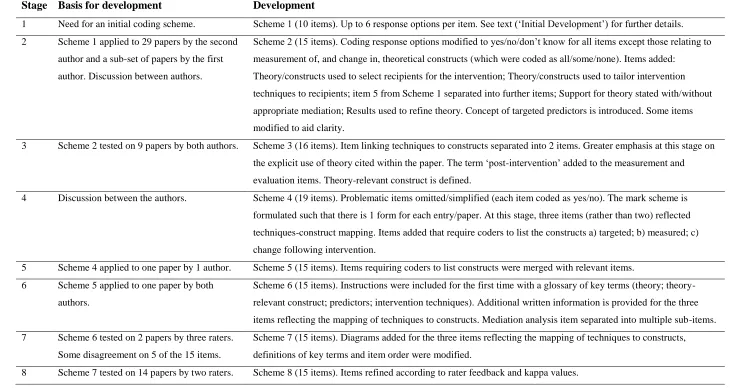
Insert Table 1 here
A glossary of key terms was first introduced at stage 6. The final definitions used as a guide for
coders were:
Theory (or Model): „a set of interrelated concepts, definitions and propositions that present a
systematic view of events or situations by specifying relations among variables, in order to
explain or predict the events or situations‟ (Glanz and Rimer, 2005, p.4). Examples provided in
the guidance include: Theory of Planned Behaviour, Theory of Reasoned Action, Health Belief
Model and Stages of Change/Trans-Theoretical Model.
Theory-relevant construct: A construct (a key concept, excluding behaviour) within a
theory/model upon which the intervention is based. A „Table of Theories‟ was
included in the coding guidance to assist coders in identifying whether a particular
construct belongs to the specified theory.
Predictor: A construct that is not explicitly linked to a theory by the authors, but is targeted for
intervention (as a means to change behaviour) because it predicts behaviour. Predictors were
only coded if the author had presented evidence that the construct predicts/correlates with/causes
behaviour. Predictors did not include actual behaviour, self-reported or otherwise (e.g. amount of
time spent exercising), or biological factors (e.g., age, gender), or demographic factors (e.g.
socio-economic status).
Intervention Technique: Strategy used to change behaviour, theory-relevant construct or
predictor (e.g., providing information on consequences; prompting specific goal setting;
Results
The final Theory Coding Scheme comprised 19 items with a clear description
of how to code each item2. Each item required a yes/no/don‟t know response and the
coder to identify the supporting evidence. All items showed substantial inter-rater
reliability (all κs ≥ .70) except one sub-item (19d, κ =.64) which had a lower, but
acceptable kappa and a high level of agreement between coders (18/19, 95%). The
scheme and kappa values are shown in Table 2. The items are presented within the
following six categories of coded items: reference to underpinning theory (items 1 to
3), targeting of relevant theoretical constructs (items 2, 5, 7-11), using theory to select
recipients or tailor interventions (items 4 and 6), measurement of constructs (items 12
and 13), testing of mediation effects (items 14-18) and refining theory (item 19).
Category 1: Is theory mentioned?
These items assessed stated or suggested, rather than demonstrated, theoretical
base. One item assessed whether theory was mentioned even if the intervention was
not explicitly based on it (item 1). A second item related to whether predictors of the
targeted behaviour (item 2) were mentioned (and also targeted) while a third (item 3)
assessed whether the intervention was based on a single or multiple theories. An
intervention based on a number of different theories or a combination of theory and
„predictors‟ makes the links between theory and the intervention more complex and,
usually, obscure. This makes theory testing more difficult. Often studies use a wide
variety of behaviour change techniques in the hope that it will change something but
this something is often unspecified and not linked to the theory upon which the
intervention is stated to have been based.
Whether evidence was provided that a targeted theoretical construct predicted
behaviour was assessed by item 2 and whether theory or predictors were explicitly
used for designing the intervention was assessed by item 5. Items 7-11 examine the
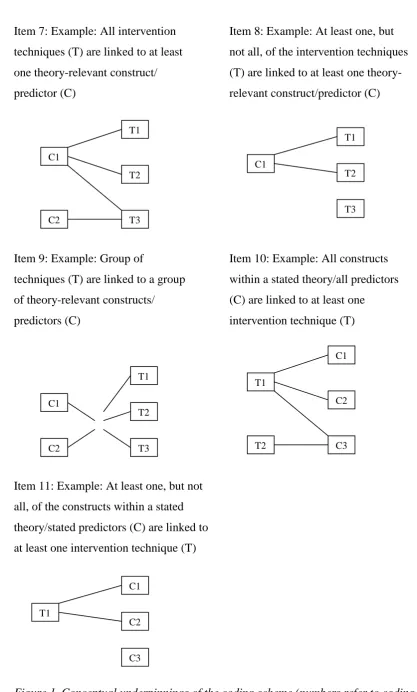
extent to which the intervention targets particular theory-relevant constructs. Items 7
and 10 reflect the optimal options as each intervention technique is associated with a
specific theoretical construct, clarifying the theoretical basis for each behaviour
change technique (item 7) or each theoretical construct is associated with a specific
technique, facilitating theory testing (item 10). Items 8, 9 and 11 refer to different,
less optimal, ways of mapping (i.e. not one-to-one) between intervention techniques
and theoretical constructs/predictors.
Category 3: Is theory to select recipients or tailor interventions
Theory may also be used to select participants likely to benefit from the
intervention (item 4) or to tailor the intervention to the needs of a particular individual
(item 6).
Category 4: Are the relevant theoretical constructs measured?
Item 12 assesses whether the relevant theory-based constructs/predictors have
been measured. Item 13 assesses the reliability and validity of measures of relevant
constructs/ predictors and of behaviour, as high measurement quality permits more
powerful application, testing and refinement of theory.
Category 5: Is theory tested?
While items 1-11 concern the extent to which interventions have been based
on theory, items 12-18 concern theory testing. Items 12-14 assess either whether
theoretical constructs are measured adequately pre- and post-intervention, or whether
post-intervention measures are accompanied by satisfactory randomisation
constructs and items 16-18 assess whether these changes explain the effect. Item 16
assesses whether constructs have been demonstrated to mediate the effect of the
intervention on behaviour and items 17 and 18 assess whether results are discussed in
relation to theory and whether support or refutation of the theory is appropriate, given
the results.
Category 6: Is theory refined?
Item 19 assesses whether the results of evaluating theory-based interventions
are used to refine theory.
Overview of Final Scheme
The conceptual underpinnings of Items 7-11 are shown in Figure 1, and a
diagrammatic representation of the coding scheme is shown in Figure 2. It assesses
whether theory is mentioned (1, 3), how theory can directly inform an intervention (2,
5, 7-11), how theory can influence an intervention indirectly via the selection of
participants (4) and via delivery to different groups of participants (6), how theory
explains the effects of the intervention on outcomes (12-16), the association between
outcomes and theory (17-18) and whether theory is refined on the basis of the study
outcomes (19)
Insert Figures 1 & 2 here
Discussion
We have developed a reliable method for assessing the extent to which theory
has been applied to developing and evaluating interventions to change behaviour.The
Theory Coding Scheme comprises 19 items covering a broad range of areas in which
phases to improve the comprehensiveness, usability, clarity and reliability of the
method.
The Theory Coding Scheme has a number of potential benefits and
applications. First, it can be used as a measure within reviews and meta-analyses.
Specifically, it can provide a means for a more rigorous and systematic examination
of the use of theory within intervention research than the approaches adopted in
evidence syntheses of intervention effectiveness (e.g., Albarracin et al., 2005; Baban
& Craciun, 2007; Trifiletti et al., 2005; Webb & Sheeran, 2006). Typically such
reviews ask the question of whether theory-based interventions are more effective
than those that are not based on theory. Unfortunately, they consistently fail to
consider exactly how theory has informed the intervention. This scheme will allow a
more fine-grained examination of whether the use of theory can enhance the effects of
interventions and how these benefits can be achieved.
Second, it provides a potentially valuable framework for describing
interventions, and the role that theory has played, to the scientific community. The
CONSORT (Consolidated Standards for Reporting Trials) guidelines have been used
to improve the way in which studies, particularly their methodologies, are conveyed
to readers. Consequently, the methodological quality of randomized controlled trials
(RCTs) can be more reliably considered, potentially helping to reduce heterogeneity
in effect sizes across similar studies. The Theory Coding Scheme might be used in a
similar way to encourage researchers to articulate their use of theory with greater
clarity and depth. Within intervention evaluations, theory can be tested and ultimately
refined only if the use of theory is explicit and well reported. A third use of the
scheme is as a framework to inform the design of theory-based interventions. By
the coding frame can encourage more careful consideration of what constitutes
theory-based interventions and how they can be most usefully developed and
evaluated.
The original CONSORT guidelines (Begg et al, 1996) were built upon earlier
guidelines (The Standards of Reporting Trials Group, 1994; Working Group on
Recommendations for Reporting of Clinical Trials in the Biomedical Literature,
1994). Similarly, this Theory Coding Scheme represents an initial scheme. Its
usefulness will be determined by its application. The items in categories 2 and 5
potentially lend themselves to forming a quantitative scale; the current coding scheme
is a starting point for further conceptual and methodological refinement.
The Theory Coding Scheme can also be applied to assessments of the
processes through which theory-informed interventions change behaviour. Mediation
analyses are often conducted to indirectly assess a proposed causal mechanism of
change. Whilst statistical methods of mediation analyses are becoming more
powerful and sophisticated e.g. using bootstrapping (Cerin, Taylor, Leslie, & Owen,
2006; Preacher & Hayes, 2004), it should be remembered that finding a statistically
significant indirect effect supportive of mediation does not prove causation. One
limitation of testing theory by examining mediation is that measuring constructs
might, in itself, bring about changes in behaviour (e.g., Morwitz & Fitzsimmons,
2004; Godin, Sheeran, Conner, & Germain, 2008) and thus interfere with the
interpretation of effects. In addition, demonstrating mediation statistically does not
demonstrate a causal relationship between the mediator and the dependent measure; a
better approach is to experimentally manipulate the proposed mediator, guided by the
without appropriate tests, and the possibility of alternative causal explanations should
be considered.
A further issue in theory development is what constitutes sufficient evidence
to refute a theory. In biological sciences, a rule of thumb is that support or refutation
requires independent replication in three independent laboratories. In the behavioural
sciences, this is more likely to be seen in laboratory than in applied settings. For
example, within the implementation intention (Gollwitzer, 1993) literature, tests of
mechanisms are almost exclusively laboratory-based (see Gollwitzer & Sheeran,
2006, for a review of mechanisms). It cannot be assumed that mechanisms
demonstrated in laboratories operate in more applied settings. Addressing these, and
other questions concerning the application of theory to interventions, will be helped
by a systematic method of assessing the way in which theory has been applied. This
coding scheme is one method; such methods are foundational for developing this area
References
Albarracin, D., Gillette, J. C., Earl, A. N., Glasman, L. R., Durantini, M. R., &
Ho, M. H. (2005). A test of major assumptions about behavior change: a
comprehensive look at the effects of passive and active HIV-prevention interventions
since the beginning of the epidemic. Psychological Bulletin, 131, 856- 897.
Baban, A., & Craciun, C. (2007). Changing health-risk behaviors: A review of
theory and evidence-based interventions in health psychology. Journal of Cognitive
and Behavioral Psychotherapies, 7, 45-67.
Bartholomew, L. K., Parcel, G. S., Kok, G., & Gottlieb, N. H. (2006).
Planning health promotion programs; an Intervention Mapping approach. San
Francisco, CA: Jossey-Bass.
Begg C., Cho, M., Eastwood, S., Horton, R., Moher, D., Olkin, I., Pitkin, R.,
Rennie, D., Schulz, K. F., Simel, D., & Stroup, D. F. (1996). Improving the quality of
reporting of randomized controlled trials. The CONSORT statement, Journal of the
American Medical Association, 276, 637-9.
Campbell, M., Fitzpatrick, R., Haines, A., Kinmonth, A.L., Sandercock, P.
Spiegelhalter, D., & Tyrer, P. (2000). Framework for design and evaluation of
complexinterventions to improve health. British Medical Journal, 321, 694-696.
randomized controlled trials need more powerful methods of meditational analyses
than the Baron-Kenny method. Journal of Clinical Epidemiology, 59, 457-464.
Clarke, D. D. (1987). Fundamental problems with fundamental research: A
meta--theory for social psychology. Philosophica, 40, 23-61.
Craig, P., Dieppe, P., Macintyre, S., Michie, S., Nazareth, I., & Petticrew, M.
(2008). Developing and evaluating complex interventions: the new Medical Research
council guidance. British Medical Journal, 337.
Dombrowski, S. U., Sniehotta, F. F., & Avenell, S. (2007). Towards a
cumulative science of behaviour change: Do current conduct and reporting of
behavioural interventions fall short of good practice? Psychology and Health, 22,
869-874.
Downing, J., Jones, L., Cook, P. A., & Bellis, M. A. (2006). Prevention of
sexuallytransmitted infections (STIs): a review of reviews into the effectiveness of non
clinical interventions. Evidence Briefing Update. London, UK: National Institute of
Clinical Excellence.
Ellis, S., Barnett-Page, E., Morgan, A., Taylor, L., Walters, R., & Goodrich, J.
(2003). HIV prevention: a review of reviews assessing the effectiveness of
interventions to reduce the risk of sexual transmission. London, UK: Health
Fisher, J. D., & Fisher, W. A. (2000). Theoretical approaches to individual
levelchange in HIV risk behaviour. In Handbook of HIV prevention, Perterson and
DiClemente. Kluwer Academic/Plenum Publishers, New York.
Gehrman, C. A., & Hovell, M. F. (2003). Protecting children from
environmental tobacco smoke (ETS) exposure: A critical review. Nicotine & Tobacco
Research, 5,289-301.
Glanz, K. & Rimer, B.K. (2005). Theory at a Glance: A Guide for Health
Promotion Practice (Second edition). National Cancer Institute, NIH, Public Health
Service. U.S. Government Printing Office.
Godin, G., Sheeran, P., Conner, M., Germain, M. (2008). Asking questions
changes behaviour: mere measurement effects on frequency of blood donation. Health
Psychology, 27, 179-84.
Gollwitzer, P. M. (1993). Goal achievement: The role of intentions. In W.
Stroebe and M. Hewstone (Eds.), European Review of Social Psychology, 4, 141-185.
Chichester, England: Wiley.
Gollwitzer, P. M., & Sheeran, P. (2006). Implementation intentions and goal
achievement: A meta-analysis of effects and processes. Advances in Experimental
Social Psychology, 38, 249-268.
Kinmonth, A. L. (2005). A causal modelling approach to the development of theory
based behavior change programmes for trial evaluation. Health Education Research,
20, 676-687.
Jemmott, J. B., & Jemmott, L. S. (2000). HIV risk reduction behavioral
Interventions with heterosexual adolescents. AIDS, 14 (suppl 2), S40-S52.
Kim, N., Stanton, B., Li, X., Dickersin, K., & Galbraith, J. (1997).
Effectiveness of the 40 adolescent AIDS-risk reduction interventions: A quantitative
review. Journalof Adolescent Health, 20, 204-215.
Landis, J. R., & Koch, G. G. (1977). The measurement of observer agreement
for categorical data. Biometrics, 33, 159-174.
Michie, S. & Abraham, C. (2004). Identifying techniques that promote health
behaviour change: Evidence based or evidence inspired? Psychology and Health.19,
29-49.
Michie, S., Abraham, C., Whittington, C., & McAteer, J. (2007). The impact
and mechanisms of self-regulation interventions to increase healthy eating and
physical activity. Psychology and Health, 22, Suppl 1, 258.
Michie, S., Johnston, M., Francis, J., Hardeman, W., & Eccles, M. (2008).
to behaviour change techniques. Applied Psychology: an International Review, 57,
660-680.
Michie, S., Sheeran, P. & Rothman, A. (2007). Advancing the Science of
Behaviour Change. Invited editorial, Psychology and Health, 22, 249-253.
Morwitz, V. G., & Fitzsimmons, G. J. (2004). The mere-measurement effect:
Why does measuring intentions change actual behavior. Journal of Consumer
Psychology, 14, 64-73.
Noar, S. M., & Zimmerman, R. S. (2005). Health Behavior Theory and
cumulative knowledge regarding health behaviors: are we moving in the right
direction? Health Education Research: Theory and Practice, 20, 275-290.
Noar, S. M., Benac, C. N., & Harris, M. S. (2007). Does tailoring matter?
Meta-analytic review of tailored print health behaviour change interventions.
Psychological Bulletin, 133, 673-693.
Preacher, K. J., & Hayes, A. F. (2004). SPSS and SAS procedures for
estimating indirect effects in simple mediation models. Behaviour Research Methods,
Instruments & Computers, 36, 717-731.
Rothman, A. J. (2004). “Is there nothing more practical than a good theory?”:
Why innovations and advances in health behavior change will arise if interventions
are used to test and refine theory. International Journal of Behavioral Nutrition and
Sigall, H., & Mills, J. (1998). Measures of independent variables and
mediators are useful in social psychology experiments: But are they necessary?
Review of Personality and Social Psychology, 2, 218-226.
The Standards of Reporting Trials Group (1994). A proposal for structured
reporting of randomized controlled trials. The Standards of Reporting Trials Group.
Journal of the American Medical Association, 272, 1926-31.
Trifiletti, L. B., Gielen, A. C., Sleet, D. A., & Hopkins, K. (2005). Behavioural
and social sciences theories and models: are they being used in unintentional injury
prevention research? Health Educational Research, 20, 298-307.
Webb, T. L., & Sheeran, P. (2006). Does changing behavioral intentions
engender behavior change? A meta-analysis of experimental evidence. Psychological
Bulletin, 132, 249-268.
Wingwood, G. M., & DiClemente, R. (1996). HIV sexual interventions for
women: A review. American Journal of Preventive Medicine, 12, 209-217.
Working Group on Recommendations for Reporting of Clinical Trials in the
Biomedical Literature (1994). Call for comments on a proposal to improve reporting
of clinical trials in the biomedical literature. Working Group on Recommendations for
Reporting of Clinical Trials in the Biomedical Literature. Annals of Internal
Table 1: Overview of Coding Scheme Development
Stage Basis for development Development
1 Need for an initial coding scheme. Scheme 1 (10 items). Up to 6 response options per item. See text („Initial Development‟) for further details.
2 Scheme 1 applied to 29 papers by the second
author and a sub-set of papers by the first
author. Discussion between authors.
Scheme 2 (15 items). Coding response options modified to yes/no/don‟t know for all items except those relating to
measurement of, and change in, theoretical constructs (which were coded as all/some/none). Items added:
Theory/constructs used to select recipients for the intervention; Theory/constructs used to tailor intervention
techniques to recipients; item 5 from Scheme 1 separated into further items; Support for theory stated with/without
appropriate mediation; Results used to refine theory. Concept of targeted predictors is introduced. Some items
modified to aid clarity.
3 Scheme 2 tested on 9 papers by both authors. Scheme 3 (16 items). Item linking techniques to constructs separated into 2 items. Greater emphasis at this stage on
the explicit use of theory cited within the paper. The term „post-intervention‟ added to the measurement and
evaluation items. Theory-relevant construct is defined.
4 Discussion between the authors. Scheme 4 (19 items). Problematic items omitted/simplified (each item coded as yes/no). The mark scheme is
formulated such that there is 1 form for each entry/paper. At this stage, three items (rather than two) reflected
techniques-construct mapping. Items added that require coders to list the constructs a) targeted; b) measured; c)
change following intervention.
5 Scheme 4 applied to one paper by 1 author. Scheme 5 (15 items). Items requiring coders to list constructs were merged with relevant items.
6 Scheme 5 applied to one paper by both
authors.
Scheme 6 (15 items). Instructions were included for the first time with a glossary of key terms (theory;
theory-relevant construct; predictors; intervention techniques). Additional written information is provided for the three
items reflecting the mapping of techniques to constructs. Mediation analysis item separated into multiple sub-items.
7 Scheme 6 tested on 2 papers by three raters.
Some disagreement on 5 of the 15 items.
Scheme 7 (15 items). Diagrams added for the three items reflecting the mapping of techniques to constructs,
definitions of key terms and item order were modified.
Six of the 15 items yielded kappa <.70.
9 Scheme 8 tested on 15 papers by two raters.
Two of the 15 items yielded kappa <.70.
Scheme 9 (15 items). Items refined according to rater feedback and kappa values.
10 Scheme 9 tested on 15 papers by two raters.
One of the 15 items yielded kappa <.70.
Scheme 10 (15 items). Item refined according to rater feedback and kappa values.
11 Scheme 10 tested on 22 papers by two raters.
All 15 items were reliable.
Scheme 11 (15 items). Although scheme 10 was reliable, three items were modified slightly to aid clarity.
12 Scheme 11 tested on 22 papers by new rater.
All 15 items were reliable. Two items
concerning construct-technique mapping
needed.
Scheme 11b (17 items). Two items (kappa >.80) added reflecting the degree to which constructs are targeted by
specific techniques.
13 Scheme 12 tested on 19 papers by two raters. Scheme 12 (19 items). Items 12 and 14d revised, and items 13 and 14 added following reviewer feedback. All
Table 2.Overview of Theory Coding Scheme
Item No. and kappa
Item Description Yes/
No/
Don’t know
List with location in paper (i.e. page number)
1 (1)
Theory/model of behaviour mentioned
Models/theories that specify relations among variables, in order to explain or predict behaviour (e.g., TPB, SCT, HBM) are mentioned, even if the intervention is not based on this theory
2 (.77)
Targeted construct mentioned as predictor of behaviour
(„Targeted‟ construct refers to a psychological construct that the study intervention is hypothesised to change).
Evidence that the psychological construct relates to (correlates/predicts/causes) behaviour should be presented within the introduction or method (rather than the
Discussion).
Location of evidence that construct relates to behaviour:
Location that this predictor is targeted by the intervention:
3 (.70)
Intervention based on single theory
The intervention is based on a single theory (rather than a combination of theories or theory + predictors)
4 (.83)
Theory/ predictors used to select recipients for the intervention
Participants were screened/selected based on achieving a particular score/level on a theory-relevant construct/predictor
Construct (Theory) Predictor
5 (.88)
Theory/ predictors used to select/develop intervention techniques
The intervention is explicitly based on a theory or predictor or combination of theories or predictors
Theory Predictor
6 (.86)
Theory/ predictors used to tailor intervention techniques to recipients
The intervention differs for different sub-groups that vary on a psychological construct (e.g., stage of change) or predictor at baseline
Construct Predictor
7 (1)
All intervention
techniques are explicitly
Each intervention technique is explicitly linked to at least one theory-relevant construct/predictor.
linked to at least one theory-relevant construct/ predictor
8 (.91)
At least one, but not all, of the intervention techniques are explicitly linked to at least one theory-relevant construct/ predictor
At least one, but not all, of the intervention techniques are explicitly linked to at least one theory-relevant construct/ predictor.
Construct (list links) Predictor (list links)
9 (.74)
Group of techniques are linked to a group of constructs/ predictors
A cluster of techniques is linked to a cluster of constructs/ predictors.
List clusters of techniques/constructs
List clusters of techniques/predictors
10 (.80)
All theory-relevant constructs/predictors are explicitly linked to at least one intervention technique
Every theoretical construct within a stated theory, or every stated predictor (see item 5), is linked to at least one intervention technique.
Construct (list links) Predictor (list links)
11 (.90)
At least one, but not all, of the theory relevant constructs/predictors are explicitly linked to at least one intervention technique
At least one, but not all, of the theoretical constructs within a stated theory or at least one, but not all, of the stated
predictors (see item 5) are linked to at least one intervention technique.
12 (1) Theory-relevant constructs/ predictors are measured
a) At least one construct of theory (or predictor) mentioned in relation to the intervention is measured POST-INTERVENTION.
b) At least one construct of theory (or predictor) mentioned in relation to the intervention is measured PRE AND POST-INTERVENTION.
Construct Predictor
13 (a=.77) (b=.77) (c=1) (d=.64) (e=.89) (f=.76)
Quality of Measures a) All of the measures of theory relevant
constructs/predictors had some evidence for their reliability
b) At least one, but not all, of the measures of theory relevant constructs/predictors had some evidence for their reliability
c) All of the measures of theory relevant
constructs/predictors have been previously validated d) At least one, but not all, of the measures of theory
relevant constructs/predictors have been previously validated
e) The behaviour measure had some evidence for its reliability
f) The behaviour measure has been previously validated
Construct Predictor
14 (all=1, except b=.73)
Randomization of participants to condition
a) Do the authors claim randomization?
b) Is a method of random allocation to condition described (e.g., random number generator; coin toss)
c) Was the success of randomization tested? d) Was the randomization successful (or baseline
differences between intervention and control group statistically controlled)?
15 (1)
Changes in measured theory-relevant
The intervention leads to sig. change in at least one theory-relevant construct/predictor (vs. control group) in favour of
constructs/ predictor the intervention.
16
(1 for each sub- item)
Mediational analysis of construct/s / predictors
In addition to 14, do the following effects emerge?:
a) Mediator predicts DV? (or change in mediator leads to change in DV)
b) Mediator predicts DV (when controlling for IV)?
c) Intervention does not predict DV (when controlling for mediator)?
d) Mediated effect statistically significant?
Construct Predictor
17 (.72)
Results discussed in relation to theory
Results are discussed in terms of the theoretical basis of the intervention
18 (.78)
Appropriate support for theory
Support for the theory is based on appropriate mediation OR refutation of the theory is based on obtaining appropriate null effects (i.e. changing behaviour without changing the theory-relevant constructs).
19 (1)
Results used to refine theory
The authors attempt to refine the theory upon which the intervention was based by either: a) adding or removing constructs to the theory, or b) specifying that the
interrelationships between the theoretical constructs should be changed and spelling out which relationships should be changed
a) Constructs added or removed from theory:
b) Interrelationships between the theoretical
C1 C2 T1 T2 T3 T1 C1 C2 C3 C1 C2 T1 T2 T3 C1 T1 T2 T3 T1 T2 C1 C2 C3
Item 7: Example: All intervention Item 8: Example: At least one, but
techniques (T) are linked to at least not all, of the intervention techniques
one theory-relevant construct/ (T) are linked to at least one theory-
predictor (C) relevant construct/predictor (C)
Item 9: Example: Group of Item 10: Example: All constructs
techniques (T) are linked to a group within a stated theory/all predictors
of theory-relevant constructs/ (C) are linked to at least one
predictors (C) intervention technique (T)
Item 11: Example: At least one, but not
all, of the constructs within a stated
theory/stated predictors (C) are linked to
[image:30.595.76.494.48.741.2]at least one intervention technique (T)
Figure 1. Conceptual underpinnings of the coding scheme (numbers refer to coding
Theory/ Constructs
1 Intervention
Participants
Behaviour
2, 3, 5, 7-11, 19 12-16
6
17-19 4
Footnotes
1
The references for these pre-coded papers, and their associated codes, are
available upon request. 2