This is a repository copy of
Automatic Speech Recognition Errors Detection Using
Supervised Learning Techniques
.
White Rose Research Online URL for this paper:
http://eprints.whiterose.ac.uk/121246/
Version: Accepted Version
Proceedings Paper:
Errattahi, R., El Hannani, A., Ouahmane, H. et al. (1 more author) (2016) Automatic
Speech Recognition Errors Detection Using Supervised Learning Techniques. In: 2016
IEEE/ACS 13th International Conference of Computer Systems and Applications
(AICCSA). 13th International Conference of Computer Systems and Applications
(AICCSA), Nov 29 – Dec 02, 2016, Agadir, Morocco. IEEE .
https://doi.org/10.1109/AICCSA.2016.7945669
[email protected] https://eprints.whiterose.ac.uk/ Reuse
Unless indicated otherwise, fulltext items are protected by copyright with all rights reserved. The copyright exception in section 29 of the Copyright, Designs and Patents Act 1988 allows the making of a single copy solely for the purpose of non-commercial research or private study within the limits of fair dealing. The publisher or other rights-holder may allow further reproduction and re-use of this version - refer to the White Rose Research Online record for this item. Where records identify the publisher as the copyright holder, users can verify any specific terms of use on the publisher’s website.
Takedown
If you consider content in White Rose Research Online to be in breach of UK law, please notify us by
Automatic Speech Recognition Errors Detection Using Supervised Learning
Techniques
Rahhal Errattahi∗, Asmaa El Hannani∗, Hassan Ouahmane∗, and Thomas Hain†
∗Laboratory of Information Technologies, National School of Applied Sciences University of Chouaib Doukkali, El Jadida - Morocco
Email:{errattahi.r, elhannani.a, ouahmane.h}@ucd.ac.ma †Speech and Hearing Group, Department of Computer Science
University of Sheffield, UK Email: [email protected]
Abstract—Over the last years, many advances have been made in the field of Automatic Speech Recognition (ASR). However, the persistent presence of ASR errors is limiting the widespread adoption of speech technology in real life applications. This motivates the attempts to find alternative techniques to auto-matically detect and correct ASR errors, which can be very effective and especially when the user does not have access to tune the features, the models or the decoder of the ASR system or when the transcription serves as input to downstream systems like machine translation, information retrieval, and question answering. In this paper, we present an ASR errors detection system targeted towards substitution and insertion errors. The proposed system is based on supervised learning techniques and uses input features deducted only from the ASR output words and hence should be usable with any ASR system. Applying this system on TV program transcription data leads to identify 40.30% of the recognition errors generated by the ASR system.
1. Introduction
Automatic Speech recognition (ASR) is the process by which a machine converts a speech signal into a sequence of words either for text-based communication purposes or for device control. The importance of such technology reach when using the traditional input devices (as keyboard, mouse, and touchscreen) is not possible such, for example, when our hands are busy or with limited mobility, when we are using the phone, we are in the dark, or we are moving around etc.
ASR has improved over the last decade to the point of commercial applications by providing transcription with an acceptable level of performance, especially with the introduction of deep learning technologies (as Deep Neural Networks DNN) for acoustic modeling, which allows inte-gration into many applications such as dictation, meeting and lectures transcription, speech translation, voice-search, phone-based services and others. Those systems are, in general, effective when the conditions are well controlled,
especially when the speech is recorded under clean condi-tion.
The Large Vocabulary Continuous Speech Recognition (LVCSR) task poses a particular challenge to ASR technol-ogy developers and still one of the most challenging tasks in the field, due to a number of factors, including poor articu-lation, speaking rate and high degree of acoustic variability caused by noise, side-speech, accents, sloppy pronunciation, hesitation, repetition, interruptions and channel mismatch, and/or distortions. Performances of LVCSR systems vary from domain to other. In some domains, as read continuous speech where generally the speech was recorded under clean conditions, results are satisfactory with an error rate under 5%. While in other domain that contain more speech vari-ations, as video speech, telephone conversations or distant conversational speech (meeting), results are not acceptable presenting an error rate near to 50% in certain conditions [1], [2].
Even though many algorithms and technologies have been proposed by the scientific community for all steps of LVCSR over the last decade, including pre-processing, fea-ture extraction, acoustic modeling, language modeling, de-coding and result post-processing. The problem of LVCSR is far from being solved, where more research efforts are still needed to reduce the height presence of errors in their outputs. To deal with this key problem and to enhance the performance of imperfect ASR systems, the automatic detection and correction of the transcription errors can, in some cases, be the only choice. Particularly, when tuning the ASR system itself is not possible (e.g. the system is purchased as a black-box) or when the manual correction is not convenient or even impossible as in the case where the transcription is not the final goal of the system (e.g. machine translation, information retrieval and question answering systems).
of this work was on substitution and insertion errors. The proposed system was evaluated on the transcription of a dataset from Multi-Genre Broadcast Media using Sheffield ASR system [3].
The remainder of the paper is organized as follows. In Section 2 we give a brief overview of previous works in the field. Section 3 describes our proposed errors detection system, including feature extraction. Section 4 describes experiments that were conducted on, including a detailed description of the data set used either for training and testing our system, and the ASR system used in transcription. In Section 5 we present a detailed discussion of the results in comparison with other existing results. Finally, in Section 6 we give some concluding remarks and future directions of this work.
2. Related works
There are two categories of research, that address the subject of errors detection in ASR systems, in the literature: The first one focused on features generated from the ASR decoder, such as confidence scores [4], linguistic informa-tion, confusion networks etc. The second one used additional features generated from hypothesized word sequence, such as n-grams, parts of speech, syntactic features, semantic features etc.
2.1. Decoder based features
For the decoder based features, Zhou et al. [5] ad-dressed the issue of errors detection in ASR, especially in Dictation Speech Recognition (DSR), by using data-mining techniques. Their study consists of using three different data-mining classifiers, including Nave Bayes (NB), Neural Networks (NN), and Support Vector Machines (SVM) for detecting errors in DSR. The three models were trained to identify errors using features extracted from DSR output, in-cluding confidence scores and linguistic information. Results of this study have shown that those systems could identify until 50% of ASR errors.
Another study [6] proposed the use of additional features extracted from the confusion networks and estimated a cor-rectness probability using logistic regression based on those features. The proposed system achieved a Classification Error Rate (CER) of 12.3% on a French broadcast news corpus.
Pellegrini et al. [7] investigated the use of a Markov Chains (MC) classifier with two states: error state and correct state, to model errors using a set of 15 features common in errors detection. The resulting system was tested on American English broadcast news speech NIST corpus and it has achieved 16.7% CER.
2.2. Non-decoder based features
In [8], a word correctness prediction system was con-structed for use in a dialog domain. In this work, the authors
investigated the use of 11 features: (i) 9 decoder based fea-tures in four categories: acoustic feafea-tures, language model features, word lattice features, and N-Best list features, and (ii) 2 non-decoder based features: a parsing-mode feature indicating if a word is parsed by the grammar and a slot-backoff-mode feature using a bigram language model for the slots. They have shown that both decoder based features and non-decoder based features independently contribute to the correctness prediction accuracy and that Support Vector Machines (SVM) appear to be an affective classifier for this task compared to the Decision Tree and Neural Nets clas-sifiers, with 18.2% CER in a travel-planning domain. This finding has been confirmed in [9], where simlar SVMs were constructed for phoneme correctness prediction in ASR.
In [10] Pellegrini et al. suggested using, in addition to the traditional decoder based features, non-decoder based tures extracted from other sources: a binary word match fea-ture that presents a binary comparison between two different ASR systems, a bigram hit feature measuring the number of hits found by querying a very popular Web search engine, and a topic feature to identify if a word is out of the global topic of the hypothesized sentence. The introduction of these non-decoder based features led to significant improvements, from 13.87% to 12.16% CER with a maximum entropy model, and from 14.01% to 12.39% CER with linear-chain conditional random fields, comparing to a baseline using only decoder-based features.
Chen et al. [11] proposed a system for errors detection in conversational spoken languages translation. In addition to traditional features obtained from ASR outputs, this system used additional features provided as the feedback of Statistical Machine Translation (SMT), including SMT confidence estimates and posteriors from named entity de-tection. Furthermore, this system used an automated word boundary detector based on acoustic-prosodic features to verify the existence of ASR-hypothesized word boundaries. This system provided 2.8% absolute improvement in errors detection over the error detector that used features tradition-ally employed in the field (e.g. ASR confidence score, LM perplexity, confusion network density and phonetic acoustic model score deviation).
3. Proposed Method
In this work, we propose supervised learning based techniques for ASR errors detection. As a first attempt we automate the detection process of the transcription errors with the intention of automating the correction process as well in the future. The work consists of training a classifier to differentiate between a correct word and an erroneous word in the transcript of an ASR system.
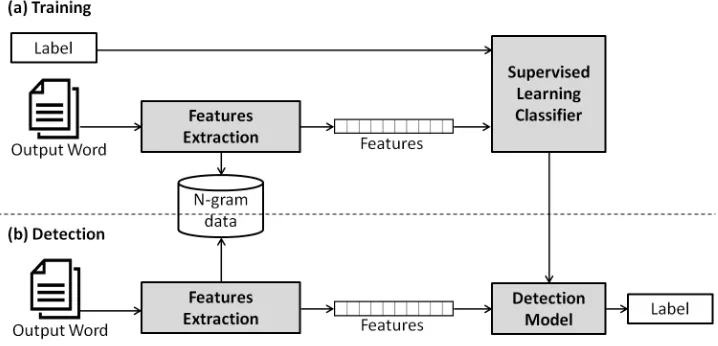
Figure 1. General process of the error detection system.
the substitution and insertion errors because in the case of deletion it is difficult to decide if a non-existent word is correct or not.
Figure 1 illustrates the general process of the proposed system. Our approach consists of two steps: a training phase and a prediction phase. During training, a feature extractor is used to convert each word from the ASR transcription to a feature set. This feature set, which capture the basic information about each word that should be used to classify it, will be discussed in the next section. Both, feature sets and labels (correct, substitution and insertion) are presented to the machine learning classifier to generate a classification model. During prediction, the same feature extractor is used to convert recognized words to feature sets. These feature sets are then fed into the model, which generates predicted labels: correct or error.
3.1. Features
In order to identify the errors in the ASR output, we extract a set of features that capture the basic information about each word. Those features should potentially indicate if a given word is correct or not. Given that the majority of recognition systems are used as a black-box and that the user does not have access to the internals of the system, we attempt to develop our system using a minimum of information from the ASR decoder.
The majority of ASR systems generate, in addition to the output words, a score (probabilistic value between 0 and 1) called confidence score to indicate the trustworthiness of any word recognition made by the ASR decoder. Otherwise, a confidence score can be computed for every word to indicate how likely it is correctly recognized or for an utterance to indicate how much we can trust the results for the utterance as a unit. Many researches have confirmed that the confidence score can be used to predict the correctness of a given word [12], such that, correct words tend to have higher confidence score than errors. Thus the confidence
score of a recognized word (wi) in its context could help
to make a decision if the given word is correct or not. The three selected features based on confidence score are:
CS: Confidence score of the recognized word; LCS: Confidence score of the preceding (Left) word (wi−1);
RCS: Confidence score of the following (Right) word (wi+1);
In addition to the confidence score based features, we can use the bigram language model to verify the context of an output word. For this we calculate the probability
P(wi|wi−1) that the recognized word wi comes with its
preceding word in the transcriptionwi−1, and the probability
P(wi+1|wi) that wi is followed by the next word in the
transcription wi+1:
LBG: Bigram language model of (wi
−1, wi); RBG: Bigram language model of (wi, wi+1);
Given that:
P(wi|wi−1) =
count(wi−1, wi)
count(wi−1)
(1)
According to Fong et al. [13], if a word is a substitution, then it is expected that it won’t fit well in the context of the sentence. And when we discard this word and it was not meaningful in the context, then the frequency of the bag-of-words with the word discarded should be greater than that of the original bag. This can be represented using a sentence oddity as follows:
SO= frequency of the bag-of-words with the word discarded frequency of the entire bag-of-words
of the sentence. In this paper, we adopt the definition of the sentence oddity [13] for the problem of ASR errors detection, starting from the similar proposition: ”If a word is a substitution or insertion, then it is expected that it won’t fit well in the context of the sentence”. Thus, instead of calculating the frequency of bag-of-words we propose to use the sentence probability using the maximum likelihood estimation. So, for a given sentence=w1, w2, ..., wn, we
redefine the Sentence Oddity (SO) as:
SO= P(sentence with the word discarded)
P(sentence) (3)
With:
P(sentence) =P(w1, w2, ..., wn) = n
Y
k=1
P(wk|wk
−1)
(4) We extract in total 6 features (CS, LCS, RCS, LBG, RBG, SO) for each word in the ASR output and then use them to train a classifier to predict whether a recognized word is correct or not.
3.2. Classifiers
We investigated the ASR errors detection using three supervised learning classifiers: Classification and Regression Tree (CART) [14], Neural Network (NN) [15] and Bayesian Network (BN) [16]. The CART classifier uses a standard information gain criterion. The NN classifier is a single backward propagation network with one hidden layer. The number of neurons in the hidden layer was chosen empir-ically in the range of 0.5 to 1 times the total size of the input and output layers. The BN classifier uses the simple estimator function to estimate the conditional probability and the k2 algorithm to heuristically search for the most probable beliefnetwork structure. All experiments were per-formed using the Weka Machine Learning Software [17].
4. Experimental setup
4.1. Data and ASR System
To train and evaluate the effectiveness of our proposed approach, we conducted experiments on a recent and very challenging dataset from the Multi-Genre Broadcast (MGB) Challenge [18]. The MGB data is a large broad and multi-genre, spanning the whole range of TV output. The Auto-matic transcriptions were produced by the Sheffield system described in [3]. This system was built using two different types of systems. The first ones are Hybrid DNN-HMM systems, where the DNNs consisted of 6 hidden layers of 2,048 neurons, and an output layer of 6,478 triphone state targets. The second are Bottleneck DNN-GMM-HMM systems, where (i) the DNNs consisted of 4 hidden layers of 1,745 neurons plus 26-neuron bottleneck layer, and an output layer of 8,000 triphone state targets, and (ii) the
GMM-HMM models were trained using 16 Gaussian com-ponents per state, and around 8k distinct triphone states. The Sheffield ASR system has a performance that varies significantly from news shows, with a 13.2% WER, to comedy shows, with a 40.9% WER and a 27.5% WER as the global result, which reflects the complexity of the chosen task.
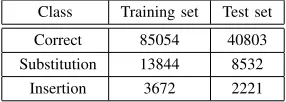
[image:5.612.365.508.449.500.2]We first performed a preprocessing on the MGB data to remove utterances with hesitations. Then using the align-ment provided by the scoring script we connected each hypothesis word with its equivalent reference word, and we added a label to the word; correct, substitution, insertion or deletion. Given that we decided to work only on sub-stitution and insertion errors, we performed an additional preprocessing step to eliminate deletion errors from the samples. The resulted dataset was divided into two parts. The first split is about 70%, which is considered as the training set. It contains 13912 utterances from 30 speakers, with a total of 102570 words. The remained data (30%), will be used to evaluate the system. The test set contains 7788 utterances from 16 speakers, with a total of 51562 words. The distribution of the words in the training and test sets is summarised in Table 1. If we analyse the training set distribution we can see that the correct words represent about 83% of the samples in this set, which means that we have unbalanced classes in our training set. In this case the predictive model will ignore the error class. Therefore we performed a sampling on our training data by duplicating instances from the under-represented class (over-sampling). For the n-gram based features, we used the google book n-gram data [19].
TABLE 1. WORDS DISTRIBUTION IN THE TRAINING AND TEST SETS.
Class Training set Test set
Correct 85054 40803
Substitution 13844 8532
Insertion 3672 2221
4.2. Evaluation Metrics
In order to measure the performance of our predictive model and to compare our results with the literature, we used four popular classification evaluation metrics: Accu-racy (ACC), Precision (PRE), Recall (REC) and F-measure (FM). Accuracy is the most intuitive performance measure for the classification tasks. It is simply the percent of correctly classified words by the predictive model and is calculated as follows:
ACC=# of correctly classified words
total # of words (5)
TABLE 3. CLASSIFICATION PERFORMANCE(% PRE, % RECAND% FM)BASED ON DIFFERENT FEATURES COMBINATIONS AND USING THREE SUPERVISED CLASSIFIERS,ON THETEST SET.
Classifier Features Correct Error
PRE PEC FM PRE REC FM
CS,LCS,RCS 84.00 87.80 85.86 44.00 36.50 39.90
NB CS,LCS,RCS,LBG,RBG 85.80 80.70 83.17 40.30 49.40 44.39
CS,LCS,RCS,LBG,RBG,SO 85.80 80.60 83.12 40.20 49.50 44.37
CS,LCS,RCS 79.10 100.00 88.33 0 0
-NN CS,LCS,RCS,LBG,RBG 80.10 99.10 88.59 64.90 6.60 11.98
CS,LCS,RCS,LBG,RBG,SO 80.80 97.80 88.49 58.80 11.70 19.52
CS,LCS,RCS 80.60 97.90 88.41 56.40 10.50 17.70
CART CS,LCS,RCS,LBG,RBG 81.50 97.10 88.62 59.70 16.20 25.48
CS,LCS,RCS,LBG,RBG,SO 81.50 97.00 88.58 59.50 16.60 25.96
as correct that are, indeed, correct words. And for the error class, it is the percentage of words detected as error that are, indeed, erroneous words.
The recall is defined as the total number of words correctly classified as belonging to a given class, divided by the total number of elements that actually belong this class. In our context, for the correct class, it is the proportion of actual correct words that are correctly classified as correct. And for the error class, is the proportion of actual ASR errors that are correctly classified as errors.
The last performance measure is the F-measure, which is a quality score for the classification results and is obtained by combining the indices of recall and precision. The for-mula for FM score is:
FM= 2∗ P RE∗REC
P RE+REC (6)
TABLE 2. DETECTIONACCURACY IN%,BASED ON DIFFERENT FEATURES COMBINATIONS ON THETEST SET.
Features Classifier
NB NN CART
CS,LCS,RCS 77.05 79.13 79.63
CS,LCS,RCS,LBG,RBG 74.18 79.77 80.23
CS,LCS,RCS,LBG,RBG,SO 74.08 79.86 80.24
5. Results & Discussion
Table 2 presents the performance of our ASR errors detector based on different features combinations and using three supervised classifiers on our test set. Firstly, it is shown that all the three models achieve encouraging results in term of classification accuracy. In particular, both NN and CART outperform NB, with accuracy around 80%. On the other hand, it can be seen by comparing the same results but using different features combinations that using only confidence score (CS, LCS, RCS) based features gives high accuracies across the three classifiers, which confirms the effectiveness
of confidence score for ASR errors detection. Adding N-gram based features (LBG, RBG) and Sentence Oddity (SO) enhanced slightly the classification performance.
In Table 3, we present extra details about the classifi-cation performances based on the different features com-binations and using the three classifiers by presenting the PRE, REC and FM of each class (correct versus error). The results show that adding both n-gram based features(LBG, RBG) and SO improves the detection performance overall the three measures. For example, the PRE and the REC of the NN classifier increased from 0% to 58.80% and from 0% to 11.70%, respectively, after combining the confidence score based features with n-gram based features and SO. In addition n-gram based features and SO are generally effective in detecting errors because they are susceptible to have low values when an error occurs. In contrast, they are less useful in detecting correct words. They increase PRE but their introduction decrease slightly both REC and FM measures.
The comparison of the three classifiers in Table 3, shows that the NN and CART classifiers present better results on correct words detection on all the three measures in comparison with the NB. For example, the FM of the CART classifier reached 88.62%, while the best value achieved by the NB was 85.86%. However, on the erroneous words detection, the NB presents the best results with an FM of 44.39% (40.30% PRE and 49.40% REC) compared to 19.52% for the NN and 25.96% for the CART.
speech is more spontaneous, whereas in [10], Pellegrini et al. performed their experiments on dictation tasks where speech is recorded in a quite lab environment using reading text. Also, they used a very large feature set with 37 features; most of them are depending on the ASR decoder, such as alternative hypothesis. In comparison, in our work we used only 6 features where solely confidence score is depending on the ASR decoder, bearing in mind that the majority of ASR systems provide the confidence score of the hypothesis word as output.
6. Conclusion
We have presented an automatic system for the ASR errors detection task. The system was tested using three supervised classifiers, with a set of 6 features obtained from the ASR output. Evaluating this system using TV programs transcriptions data from the MGB challenge gives encouraging results, with an FM of 83.17% for correct words detection and 44.39% for erroneous words detection. Our experimental results confirmed the utility of confidence score features in the task of ASR errors detection and also proved the positive influence of both n-gram and SO features on the system performance. The proposed system is based on features extracted exclusively from the ASR output and hence should be usable with any ASR system.
In future works, we will continue developing our system along several axes. Firstly, we will investigate the possibil-ity of adding supplementary features, such as lexical and semantic features, with further refinements of our training model, while providing additional training data from differ-ent tasks and using differdiffer-ent ASR decoders. We also intend to consider the deletion errors and investigate the usefulness of web based information in order to replace the n-gram dictionary. And finally, our ultimate aim is to develop a post-editing ASR errors correction system to correct the erroneous segments detected in the automatic transcription.
Acknowledgments
This work is supported by the CNRST Morocco under Contract No. 5UCD2015.
References
[1] P. Swietojanski, A. Ghoshal, and S. Renals, “Convolutional neural networks for distant speech recognition,” IEEE Signal Processing Letters, vol. 21, no. 9, pp. 1120–1124, 2014.
[2] N. Jaitly, P. Nguyen, A. Senior, and V. Vanhoucke, “Application of pretrained deep neural networks to large vocabulary speech recogni-tion,” inthe proceedings of interspeech, 2012.
[3] O. Saz, M. Doulaty, S. Deena, R. Milner, R. W. Ng, M. Hasan, Y. Liu, and T. Hain, “The 2015 sheffield system for transcription of multigenre broadcast media,” inIEEE Workshop on Automatic Speech Recognition and Understanding (ASRU), 2015.
[4] H. Jiang, “Confidence measures for speech recognition: A survey,”
Speech communication, vol. 45, no. 4, pp. 455–470, 2005.
[5] L. Zhou, Y. Shi, J. Feng, and A. Sears, “Data mining for detecting errors in dictation speech recognition,”IEEE Transactions on Speech and Audio Processing, vol. 13, no. 5, pp. 681–688, 2005.
[6] A. Allauzen, “Error detection in confusion network.” inthe proceed-ings of Interspeech, 2007, pp. 1749–1752.
[7] T. Pellegrini and I. Trancoso, “Error detection in broadcast news asr using markov chains,” inHuman Language Technology. Challenges for Computer Science and Linguistics. Springer, 2009, pp. 59–69.
[8] R. Zhang and A. I. Rudnicky, “Word level confidence annotation using combinations of features,” inthe proceedings of the European Conference on Speech Communication and Technology (Eurospeech), 2001, pp. 2105–2108.
[9] M. Gibson and T. Hain, “Application of svm-based correctness predictions to unsupervised discriminative speaker adaptation,” in
the proceedings of the IEEE International Conference on Acoustics, Speech, and Signal Processing (ICASSP), 2012, pp. 4341–4344.
[10] P. Thomas and T. Isabel, “Improving asr error detection with non-decoder based features,” inthe proceedings of interspeech, 2010, pp. 1950–1953.
[11] W. Chen, S. Ananthakrishnan, R. Kumar, R. Prasad, and P. Natarajan, “Asr error detection in a conversational spoken language translation system,” inthe proceedings of the IEEE International Conference on Acoustics, Speech, and Signal Processing (ICASSP). IEEE, 2013, pp. 7418–7422.
[12] L. Gillick, Y. Ito, and J. Young, “A probabilistic approach to con-fidence estimation and evaluation,” inthe proceedings of the IEEE International Conference on Acoustics, Speech, and Signal Processing (ICASSP), vol. 2. IEEE, 1997, pp. 879–882.
[13] S. Fong, D. Skillicorn, and D. Roussinov, “Detecting word substitu-tion in adversarial communicasubstitu-tion,” inin In the proceedings of 6th SIAM Conference on Data Mining. Bethesda, Maryland, 2006.
[14] L. Breiman, J. Friedman, C. J. Stone, and R. A. Olshen,Classification and regression trees. CRC press, 1984.
[15] D. E. Rumelhart, J. L. McClelland, P. R. Groupet al., “Parallel dis-tributed processing: Explorations in the microstructure of cognition, vol. 1-2,”Cambridge, MA, 1986.
[16] I. J. Good, I. Hacking, R. Jeffrey, and H. T¨ornebohm, “The estimation of probabilities: An essay on modern bayesian methods,” 1966.
[17] M. Hall, E. Frank, G. Holmes, B. Pfahringer, P. Reutemann, and I. H. Witten, “The weka data mining software: an update,”ACM SIGKDD explorations newsletter, vol. 11, no. 1, pp. 10–18, 2009.
[18] P. Bell, M. Gales, T. Hain, J. Kilgour, P. Lanchantin, X. Liu, A. McParland, S. Renals, O. Saz, M. Webster et al., “The mgb challenge: Evaluating multi–genre broadcast media transcription,” in
IEEE Workshop on Automatic Speech Recognition and Understanding (ASRU), 2015.