constraints into SAT
.
White Rose Research Online URL for this paper:
http://eprints.whiterose.ac.uk/141516/
Version: Accepted Version
Proceedings Paper:
Akgün, Özgür, Gent, Ian Philip, Jefferson, Christopher Anthony et al. (2 more authors)
(2016) Exploiting short supports for improved encoding of arbitrary constraints into SAT. In:
Rueher, Michael, (ed.) Principles and Practice of Constraint Programming:22nd
International Conference, CP 2016, Toulouse, France, September 5-9, 2016, Proceedings.
Lecture Notes in Computer Science . SPRINGER , Netherlands , pp. 3-12.
https://doi.org/10.1007/978-3-319-44953-1_1
[email protected] https://eprints.whiterose.ac.uk/
Reuse
Items deposited in White Rose Research Online are protected by copyright, with all rights reserved unless indicated otherwise. They may be downloaded and/or printed for private study, or other acts as permitted by national copyright laws. The publisher or other rights holders may allow further reproduction and re-use of the full text version. This is indicated by the licence information on the White Rose Research Online record for the item.
Takedown
If you consider content in White Rose Research Online to be in breach of UK law, please notify us by
Exploiting Short Supports for Improved Encoding of
Arbitrary Constraints into SAT
Özgür Akgün, Ian P. Gent, Christopher Jefferson, Ian Miguel, Peter Nightingale
School of Computer Science, University of St Andrews, St Andrews, UK {ozgur.akgun, ian.gent, caj21, ijm, pwn1}@st-andrews.ac.uk
Abstract. Encoding to SAT and applying a highly efficient modern SAT solver is an increasingly popular method of solving finite-domain constraint problems. In this paper we study encodings of arbitrary constraints where unit propagation on the encoding provides strong reasoning. Specifically, unit propagation on the encoding simulates generalised arc consistency on the original constraint. To cre-ate compact and efficient encodings we use the concept of short support. Short support has been successfully applied to create efficient propagation algorithms for arbitrary constraints. A short support of a constraint is similar to a satisfying tuple however a short support is not required to assign every variable in scope. Some variables are left free to take any value. In some cases a short support rep-resentation is smaller than the table of satisfying tuples by an exponential factor. We present two encodings based on short supports and evaluate them on a set of benchmark problems, demonstrating a substantial improvement over the state of the art.
1
Introduction
We address the problem of encoding constraint problems into SAT. This is an impor-tant step because it allows us to leverage the rich modelling languages available in constraints such as MiniZinc [26] and Essence Prime [20]. We have previously shown that the constraint modelling tool SAVILEROW[17] can be used to translate constraint
problems directly to SAT, exploiting automated modelling techniques such as com-mon subexpression elimination [21]. We add to the important and growing literature on modelling of constraints in SAT [6]. Most study has been devoted to constraints such as linear constraints including the special case of cardinality constraints [1,2,8,24].
faster propagation, while still obtaining GAC. We present two encodings for table con-straints with short supports into SAT. We get the advantages of modern SAT solvers automatically, such as generating explanations of failure and learning.
Short supports represent one method of compressing table constraints, and other methods have been proposed: MDDs [7], C-tuples [13] and their generalisation [22], and Smart Tables [14]. Uniquely, short supports allow us to directly improve the encod-ing of Bacchus without introducencod-ing any complications to it.
2
Preliminaries
The Propositional Satisfiability Problem (SAT) is to find an assignment to a set of Boolean variables so as to satisfy a given Boolean formula, typically expressed in con-junctive normal form [5]. SAT has many important applications, such as hardware de-sign and verification, planning, and combinatorial dede-sign [15]. Powerful, robust solvers have been developed for SAT employing techniques such as conflict-driven learning, watched literals, restarts and dynamic heuristics for backtracking solvers [16], and so-phisticated incomplete techniques such as stochastic local search [23].
Aconstraint satisfaction problem(CSP) is defined as a set of variablesX, a function that maps each variable to its domain,D :X →2Zwhere each domain is a finite set, and a set of constraintsC. A constraintc∈Cis a relation over a subset of the variables
X. Thescopeof a constraintc, named scope(c), is the set of variables thatcconstrains. During a systematic search for a solution to a CSP, values are progressively removed from the domainsD. Therefore, we distinguish between the initialdomains and the
current domains. The functionD refers to the current domains and Ds to the initial domains. Aliteralis a variable-value pair (writtenx7→v). A literalx7→visvalidif
v ∈ D(x). The size of the largest initial domain isd. For a constraintcwe userfor the size of scope(c). A constraintcis Generalised Arc Consistent (GAC) if and only if there exists a full-length support containing every valid literal of every variable in scope(c). GAC is established by identifying all literalsx7→vfor which no full-length support exists and removingvfrom the domain ofx. We consider only algorithms for establishing GAC in this paper. Afull-length supportof constraintcis a set of literals containing exactly one literal for each variable in scope(c), such thatc is satisfied by the assignment represented by these literals.
Ashort support is a support containing at most one literal for each variable in scope(c). As a motivating example for short supports, consider the lexicographic order-ing constraint≤lexon tuples. We can often know this is true just based on examining a small number of the variables in the constraint. Considerhx1, x2, x3i ≤lexhx4, x5, x6i where variablesx1, . . . x6each have initial domainDs ={1,2,3}. A full-length sup-port is necessarily size 6: e.g.{x1 7→ 2, x2 7→ 2, x2 7→ 2, x4 7→ 2, x5 7→ 2, x6 7→
2} is a correct full-length support since h2,2,2i ≤lex h2,2,2i. In contrast, the set
{x1 7→1, x4 7→ 2}is a correct short support even though it contains only two of the
Exploiting Short Supports for Encoding into SAT 3
literal can be removed from it without leaving at least one extension to a set of literals breaking the constraint. Following [19] we formally define short support as follows.
Definition 1 [Short support] Ashort supportSfor constraintcand domainsDsis a
set of literalsx 7→v such thatx ∈scope(c),x7→ vis valid w.r.tDs,xoccurs only
once inS, and every superset ofS that contains one valid (w.r.tDs) literal for each
variable inscope(c)is a full-length support.1
Note from the definition that any full-length support is also a short support. In the example the set{x1 7→ 2, x2 7→ 2, x2 7→ 2, x4 7→ 2, x5 7→ 2, x6 7→ 2} is a short
support and indeed no literal can be omitted to give another short support. In some cases even an empty set can be a short support. Suppose we change the motivating example so thatDs(x1) ={0}and other domains are unchanged. All valid assignments satisfy the lexicographic constraint since the only value ofx1is 0 andh0,∗,∗i ≤lex h∗,∗,∗i, so the empty set is a correct short support.
3
Encoding Table Constraints into SAT
Our encoding of constraint problems into SAT follows that which we have previously used and reported on [21]. When encoding a CSP variable, SAVILEROWprovides SAT
literals for facts about the variable:[x=a],[x6=a],[x≤a]and[x > a]for a CSP variablexand valuea. On all benchmarks used here, CSP variables are encoded in two ways. A variable with domain size 2 is represented with a single SAT variable. For variables with larger domains we have one SAT variable representing[x=a]for each valuea∈Ds(x), and one SAT variable for each[x≤a]except[x≤max(Ds(x))]that would always be true. Also,[x= max(Ds(x))]↔ ¬[x≤ max(Ds(x))−1]saving one more SAT variable. If we have a literal, e.g.[x≤a], wherea 6∈Ds(x), then the literal is mapped as appropriate to True, False or an equivalent literal, e.g.[x≤b]for
b = max({i ∈ Ds(x)|i < a}). The encoding has2|Ds(x)| −2 SAT variables and consistency among them is maintained by the following clause set (sometimes called the ladder encoding [10]).
∀a∈Ds(x). [x=a]↔([x≤a]∧ ¬[x≤a+ 1]) ∧ [x≤a−1]→[x≤a]
The only constraint we consider in this paper is the table constraint. This can be used to encode arbitrary constraints extensionally. The table constraint is very important in constraint programming, for constraints where no convenient expression in terms of simpler constraints is available. Suppose we have a constraintCon variablesx1. . . xr represented as a table of satisfying tuples, each of which is valid w.r.t. initial domains. Bacchus presented an encoding of table constraints [3]. Each satisfying tupleτi(where
i ∈ {1. . . m}) is represented with an auxiliary SAT variableti. The first clause set
1The set of short supports depends on the domains
ensures that eachtibecomesfalsewhen the tupleτibecomes invalid (i.e. a value inτi has been removed).
∀i∈ {1. . . m}. ∀j∈ {1. . . r}. ([xj=τi[j]]∨ ¬ti)
The second clause set states that each domain value of variablesx1. . . xrmust be supported by a valid tuple.
∀i∈ {1. . . r}. ∀a∈D(xi). ([xi6=a]∨ _
tj where τj[i] =a)
Unit propagation (UP) applied to these clauses firstly removes from consideration any invalid tupleτiby settingtitofalse, then removes any domain valueaof variable
xi (by setting[xi 6= a]) where no remaining tuples support the value. Thus UP (re-)establishes GAC. Bacchus observed that the encoding has sizeO(mr)which is linear in the size of the table representation of the constraint and applying UP has the same time complexity as a generic GAC propagator.
4
Short Support Encodings of Arbitrary Constraints
The idea of short support has already been successfully applied in constraint propaga-tors [18,19,12]. Short support is defined above (Definition 1). Our contribution here is to exploit short supports in a new encoding that is smaller and more efficient than the Bacchus encoding while keeping the property that unit propagation establishes GAC. We assume that we already have a short support set for the constraint we wish to encode. It is often straightforward to construct a short support set for a constraint. Otherwise, an automated approach may be used such as the Greedy-Compress algorithm [12] that takes the table of full-length supporting tuples and compresses them to a short support set. It is possible that no short supports are available: in this case our encoding will provide neither harm nor benefit as it is equivalent to the Bacchus encoding.
The encoding for constraintCon variablesx1. . . xris as follows. Each short sup-portσi(i∈ {1. . . m}) is represented with an auxiliary SAT variablesi. The first clause set ensures thatsiisfalsewhenσicontains a literal that is invalid.
∀i∈ {1. . . m}. ∀(xj7→a)∈σi. ([xj =a]∨ ¬si)
The second clause set states that each literal(xi 7→ a)of variablesx1. . . xrmust be supported by a valid short support, eitherexplicitly(where the short support simply
contains (xi 7→ a)) orimplicitly (where the short support contains no literal of the variablexi, meaningximay take any value).
∀i∈ {1. . . r}.∀a∈Ds(xi).
([xi6=a]∨Wsjwhere(xi7→a)∈σjor∀b.(xi7→b)∈/ σj)
Exploiting Short Supports for Encoding into SAT 5
This encoding has the property that the auxiliary variablessimay not be uniquely determined when all SAT variables representing CSP variables have been assigned. This occurs when more than one short support is valid w.r.t. the CSP assignment. In this case at least one of the correspondingsimust be true, but otherwise their values float freely. The free variables may cause additional search, and would cause a problem if we wished to count solutions. We obtain a second encoding without this issue by including the following additional clause set, which sets ansivariable to true when all literals in
σiare set true.
∀i∈ {1. . . m}. _[xj =6 a] where (xj 7→a)∈σi
∨si
Compared to the full-length table encoding, the short support encoding has fewer auxiliary variables, each representing a smaller conjunction of literals of the primary SAT variables. This is likely to be beneficial for conflict learning, facilitating more general and reusable explanations for conflicts.
We will refer to the short support encoding without the optional clause set as Short-TableSAT, and with the optional clause set as ShortTableSAT+.
5
Experimental Evaluation
To show the potential benefit of encoding using short supports, we evaluated our encod-ings of them on a number of problem classes. These are not intended to be an exhaustive or representative sample of possible problems, but a set of instances where short sup-ports are available and thus show the potential benefit of our encodings. The instances we study are drawn from three general categories.
5.1 Case Study 1: Rectangle Packing
The rectangle packing problem [25] (with parametersn,widthandheight) consists of
packing all squares from size1×1ton×ninto the rectangle of sizewidth×height. This is modelled as follows: we have variablesx1. . . xnandy1. . . yn, where(xi, yi) represents the Cartesian coordinates of the lower-left corner of thei×isquare. Domains ofxi variables are{0. . .width−i}, and foryivariables are{0. . .height−i}. The only type of constraint is non-overlap of squaresiandj:(xi+i ≤xj) ∨(xj+j ≤
xi)∨(yi+i≤yj)∨(yj+j≤yi). The domains ofxnandynare reduced to break flip symmetries [25]. The short supports of the non-overlap constraints are all of length two. Each short support satisfies one of the four disjuncts, thus satisfying the constraint. In a given instance, each constraint has a distinct short supports table because the constants
iandjdiffer.
those instances wherewidth <heightand also filtered out those which were trivially unsatisfiable due to area constraints.
5.2 Case Study 2: The Oscillating Life Problem and variants thereof
We consider the problem of maximum density oscillators (repeating patterns) in John Conway’s Game of Life. We consider this and three variants. Immigration has twoalive
states. When a cell becomes alive, it takes the state of the majority of the 3 neighbouring live cells that caused it to become alive. Otherwise the rules of Immigration are the same as those of Life. Quadlife has fouralivestates. When a cell becomes alive, it takes the state of the majority of the 3 neighbouring live cells which caused it to become alive, unless all 3 neighbours have different colours in which case it takes the colour which none of its neighbours have. Apart from this the rules are the same as Life. Finally Brian’s Brain has three states:dead,aliveanddying. If a cell isdeadand has exactly
twoalive(not dying) neighbours, it will becomealive, otherwise it remainsdead. If a
cell isalive, it becomesdyingafter one time step. If a cell is dying, it becomesdead
after one time step. We use ann×ngrid withttime steps, for all pairs of values(n, t)
wheren∈ {3. . .7}andt∈ {2. . .6}, giving 25 instances.
We use the problem and constraint model as described by Gent et al. [9]. For all four problems, we make one change: we minimise the occurrences of the value 0 (dead) in all layers. For Immigration, Quadlife and Brian’s Brain we also add extra domain values for each additional state. For each cell and each time step, a single constraint links the cell and its eight neighbours to the same cell in the next time step. Therefore the constraints have arity 10. Short supports arise from sums in the rules, e.g. a live cell with more than three live neighbours will die: if the current cell is alive, any four neighbours are alive, and the next cell is dead then the constraint is satisfied and we have a short support of length 6.
5.3 Case Study 3: The Antichain Problem
The antichain problem is to find a set of multisets under some conditions [11]. Rep-resenting a multiset as a vector of integers (giving the cardinality of each possible value), we find a set of size n of vectors of lengthl, containing integers from the set{0. . . d−1}. For each pair of vectorsv1, v2, there must exist an index iwhere v1[i]< v2[i]and a second indexjwherev1[j]> v2[j]. The problem is modelled with
a two-dimensional matrixAwith sizenbyl. Each pair of vectors is linked by a single constraint capturing both the<and>requirements, with scope size2l. The constraint linking any two vectors has short supports of length four. We compared the full length table encoding to both short table encodings on a set of 50 instances that includes all instances used by Jefferson et al [11].
5.4 Experimental Results
Exploiting Short Supports for Encoding into SAT 7
1 10 100 1000 10000
0 10 20 30 40 50 60 70 80 90 100
Solver Time
Instances
Long vs Short supports for the Rectangle Packing Problem
LongTableSAT ShortTableSAT ShortTableSAT+
1 10 100 1000 10000
0 5 10 15 20 25 30 35 40 45 50
Solver Time
Instances
Long vs Short supports for the Antichain Problem
LongTableSAT ShortTableSAT ShortTableSAT+
1 10 100 1000 10000
0 10 20 30 40 50 60 70
Solver Time
Instances
Long vs Short supports for the Life Problems
[image:8.595.152.464.107.624.2]LongTableSAT ShortTableSAT ShortTableSAT+
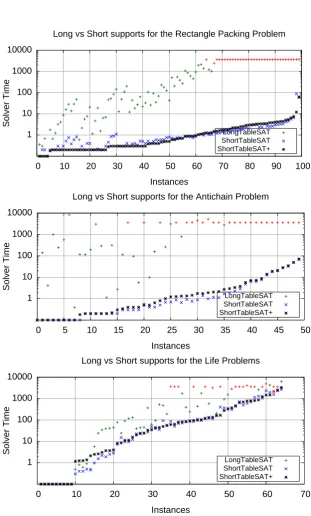
times, with random seeds changing from 1 to 5. We report the median of the five run-times reported by Lingeling. Experiments were performed with 32 processes in parallel on a 32-core AMD Opteron 6272 at 2.1 GHz with 256 GB RAM. We set a limit of 1 hour for each Lingeling process. Results are in Figure 1. Thexaxis shows instances, or-dered by increasing run time of ShortTableSAT+. Each position on thexaxis represents the same instance within a plot. Theyaxis shows run time in seconds of Lingeling. Run time of the SAVILEROWtranslation process is ignored, except that nothing is plotted if
SAVILEROWoverran its time or space limit. We do plot (in red) the points where
Lin-geling reported that it reached its time limit. In some cases LinLin-geling reported reaching the time limit but also reported a time substantially less or greater than 1 hour. We simply plotted the time Lingeling reported using a red point.
For the packing problem (Figure 1, top), we see that we benefit greatly from use of short supports. There are many instances where LongTableSAT is unable to solve the instance, but both short table encodings are. On most other instances both short sup-port methods are at least one and often several orders of magnitude faster. There is no clear preference between the two short encodings, with both methods faster on some instances, although ShortTableSAT+ is typically faster on the instances which can be solved fastest. We see in the antichain problem (Figure 1, middle) that again short sup-ports provide improved search performance compared to LongTableSAT, by orders of magnitude. In this case it seems that ShortTableSAT is the better of the two short ta-ble encodings. For the Life, Immigration, Brian’s Brain and Quadlife prota-blem classes (Figure 1, bottom), we see that short supports do improve search but to a much lesser degree than in the previous cases. There are a small number of cases where LongTable-SAT beats one of the short methods. However, using short tables is still much faster in most cases.
Our results show that the use of short supports in a SAT encoding can greatly im-prove solving performance over the use of full length table constraints.
6
Conclusions
Encoding to SAT and solving with a modern CDCL SAT solver is a very effective way to solve difficult finite-domain constraint problems. We have studied the encoding of table constraints, and proposed two new encodings based on the idea ofshort supports.
These improve upon an existing encoding in both size and solving efficiency. In our experiments, the new encoding is consistently faster, frequently by over 10 times and in some cases by over 1000 times.
Acknowledgements We would like to thank the EPSRC for funding this work through
grants EP/H004092/1, EP/K015745/1, and EP/M003728/1. In addition, Dr Jefferson is funded by a Royal Society University Research Fellowship.
References
Exploiting Short Supports for Encoding into SAT 9
2015, Proceedings, chap. Encoding Linear Constraints with Implication Chains to CNF, pp. 3–11. Springer International Publishing, Cham (2015),http://dx.doi.org/10. 1007/978-3-319-23219-5_1
2. Asín, R., Nieuwenhuis, R., Oliveras, A., Rodríguez-Carbonell, E.: Cardinality networks: a theoretical and empirical study. Constraints 16(2), 195–221 (2011), http://dx.doi. org/10.1007/s10601-010-9105-0
3. Bacchus, F.: GAC via unit propagation. In: Principles and Practice of Constraint Program-ming (CP 2007). pp. 133–147 (2007)
4. Biere, A.: Lingeling, plingeling and treengeling entering the sat competition 2013. Proceed-ings of SAT Competition pp. 51–52 (2013)
5. Biere, A., Heule, M., van Maaren, H.: Handbook of Satisfiability, vol. 185. IOS Press (2009) 6. Brain, M., Hadarean, L., Kroening, D., Martins, R.: Verification, Model Checking, and Abstract Interpretation: 17th International Conference, VMCAI 2016, St. Petersburg, FL, USA, January 17-19, 2016. Proceedings, chap. Automatic Generation of Propagation Com-plete SAT Encodings, pp. 536–556. Springer Berlin Heidelberg, Berlin, Heidelberg (2016),
http://dx.doi.org/10.1007/978-3-662-49122-5_26
7. Cheng, K.C.K., Yap, R.H.C.: An MDD-based generalized arc consistency algorithm for pos-itive and negative table constraints and some global constraints. Constraints 15(2), 265–304 (2010)
8. Eén, N., Sörensson, N.: Translating pseudo-boolean constraints into SAT. JSAT 2(1-4), 1–26 (2006), http://jsat.ewi.tudelft.nl/content/volume2/JSAT2_ 1_Een.pdf
9. Gent, I.P., Jefferson, C., Miguel, I., Nightingale, P.: Generating special-purpose stateless propagators for arbitrary constraints. In: Principles and Practice of Constraint Programming (CP 2010). pp. 206–220 (2010)
10. Gent, I.P., Nightingale, P.: A new encoding of alldifferent into sat. In: Proc. 3rd Interna-tional Workshop on Modelling and Reformulating Constraint Satisfaction Problems (Mod-Ref 2004). pp. 95–110 (2004)
11. Jefferson, C., Moore, N., Nightingale, P., Petrie, K.E.: Implementing logical connectives in constraint programming. Artificial Intelligence 174, 1407–1429 (2010)
12. Jefferson, C., Nightingale, P.: Extending simple tabular reduction with short supports. In: Proceedings of 23nd International Joint Conference on Artificial Intelligence (IJCAI). pp. 573–579 (2013)
13. Katsirelos, G., Walsh, T.: A compression algorithm for large arity extensional constraints. In: Proceedings CP 2007. pp. 379–393 (2007)
14. Mairy, J.B., Deville, Y., Lecoutre, C.: The smart table constraint. In: Proceedings of Inte-gration of AI and OR Techniques in Constraint Programming (CPAIOR 2015). pp. 271–287 (2015)
15. Marques-Silva, J.: Practical applications of boolean satisfiability. In: 9th International Work-shop on Discrete Event Systems (WODES 2008). pp. 74–80 (2008)
16. Moskewicz, M.W., Madigan, C.F., Zhao, Y., Zhang, L., Malik, S.: Chaff: Engineering an efficient SAT solver. In: Proceedings of the 38th annual Design Automation Conference. pp. 530–535. ACM (2001)
17. Nightingale, P., Akgün, Ö., Gent, I.P., Jefferson, C., Miguel, I.: Automatically improving constraint models in Savile Row through associative-commutative common subexpression elimination. In: 20th International Conference on Principles and Practice of Constraint Pro-gramming (CP 2014). pp. 590–605. Springer (2014)
18. Nightingale, P., Gent, I.P., Jefferson, C., Miguel, I.: Exploiting short supports for generalised arc consistency for arbitrary constraints. In: Proceedings IJCAI 2011. pp. 623–628 (2011) 19. Nightingale, P., Gent, I.P., Jefferson, C., Miguel, I.: Short and long supports for constraint
20. Nightingale, P., Rendl, A.: Essence’ description (2016), arXiv:1601.02865 [cs.AI]
21. Nightingale, P., Spracklen, P., Miguel, I.: Automatically improving SAT encoding of con-straint problems through common subexpression elimination in Savile Row. In: Proceedings of the 21st International Conference on Principles and Practice of Constraint Programming (CP 2015). pp. 330–340 (2015)
22. Régin, J.: Improving the expressiveness of table constraints. In: The 10th International Work-shop on Constraint Modelling and Reformulation (ModRef 2011) (2011)
23. Shang, Y., Wah, B.W.: A discrete lagrangian-based global-search method for solving satisfi-ability problems. Journal of global optimization 12(1), 61–99 (1998)
24. Silva, J.P.M., Lynce, I.: Towards robust CNF encodings of cardinality constraints. In: Bessiere, C. (ed.) Principles and Practice of Constraint Programming - CP 2007, 13th International Conference, CP 2007, Providence, RI, USA, September 23-27, 2007, Pro-ceedings. Lecture Notes in Computer Science, vol. 4741, pp. 483–497. Springer (2007),
http://dx.doi.org/10.1007/978-3-540-74970-7_35
25. Simonis, H., O’Sullivan, B.: Search strategies for rectangle packing. In: Proceedings CP 2008. pp. 52–66 (2008)