http://sgr.sagepub.com
Small Group Research
DOI: 10.1177/1046496407304923 2007; 38; 696
Small Group Research
Jane S. Prichard and Melanie J. Ashleigh
Performance
The Effects of Team-Skills Training on Transactive Memory and
http://sgr.sagepub.com/cgi/content/abstract/38/6/696 The online version of this article can be found at:
Published by:
http://www.sagepublications.com
can be found at: Small Group Research
Additional services and information for
http://sgr.sagepub.com/cgi/alerts
Email Alerts:
http://sgr.sagepub.com/subscriptions
Subscriptions:
http://www.sagepub.com/journalsReprints.nav
Reprints:
http://www.sagepub.com/journalsPermissions.nav
Permissions:
http://sgr.sagepub.com/cgi/content/refs/38/6/696 SAGE Journals Online and HighWire Press platforms):
696
The Effects of Team-Skills
Training on Transactive
Memory and Performance
Jane S. Prichard Melanie J. Ashleigh
University of Southampton
The existence of effective transactive memory systems in teams has been found to enhance task performance. Methods of developing transactive memory are therefore an important focus of research. This study aimed to explore one such method, the use of a generic team-skills training program to develop transactive memory and subsequent task performance. Sixteen three-member teams were all trained to complete a complex collaborative task, prior to which half the teams (n=8) completed a team-skills training program. Results confirmed that those teams that had been trained to develop a range of team skills such as problem-solving, interpersonal relationships, goal setting, and role allocation evidenced significantly higher team skill, transactive memory, and performance than those that were not trained in such skills. Results are discussed with reference to the wider transactive memory literature and the mechanisms through which team-skills training could facilitate the more rapid development of transactive memory.
Keywords: team-skills training; team skill; transactive memory; team development; trust
T
he concept of shared cognition has been considered as a valuable com-modity in team research for a number of years. Researchers have argued that it is one of the contributing factors that explain the difference between good and poor team performance, especially with respect to supe-rior team interaction and well-coordinated behavior (Cannon-Bowers, Salas, & Converse, 1993; Kerr & Tindale, 2004). In addition, the literature suggests that sharing knowledge among team members also promotesVolume 38 Number 6 December 2007 696-726 © 2007 Sage Publications 10.1177/1046496407304923 http://sgr.sagepub.com hosted at http://online.sagepub.com
enhanced turn taking, interpretation of cues, and decision making, all of which lead to more effective teamwork (Cooke, Salas, Cannon-Bowers, & Stout 2000; Klimoski & Mohammed, 1994; Mohammed & Dumville, 2001). In their conceptualization, Cannon-Bowers and Salas (2001) posited that team members’ knowledge of each other is one important aspect of shared cognition. They, and others (e.g., Mathieu, Heffner, Goodwin, Salas, & Cannon-Bowers, 2005; Moreland & Myaskovsky, 2000), have suggested that to work effectively together, team members need to develop an under-standing of each other in terms of their strengths and weaknesses and levels of expertise. One way in which this area has been theoretically considered is that of transactive memory.
Transactive memory has been defined as the combination of the knowl-edge held by each team member and the awareness of what information other members in the team hold (Hollingshead, 1998a, 1998b; Wegner, 1987, 1995; Wegner, Erber, & Raymond, 1991). The literature makes a fur-ther distinction between transactive memory, which is memory held at the individual level, and transactive memory systems, which describes how members actively use transactive memory to cooperatively encode, store, and retrieve information (K. Lewis, 2003). Transactive memory systems therefore enable a team to allocate information between members and, through knowing that an individual member has expertise about a particu-lar issue, facilitate the access of that information during task performance as and when it is required. Early work in transactive memory focused on relational couples, where partners developed a cooperative cognitive sys-tem through relying on each other as memory aids. Wegner further posited that this concept could be extended to groups, and based on this proposal, more recent research has focused on the role of transactive memory in ad hoc experimental and organizational teams (e.g., K. Lewis, 2003; Moreland, 1999; Moreland & Myaskovsky, 2000).
Transactive Memory and Training
decreased as transactive memory systems became more fully developed. Conversely, they found that the frequency of interactions evaluating shared knowledge increased over time. They proposed that this cycle of interaction established shared knowledge within the group that could then be drawn on during task performance.
Rulke and Rau’s (2000) findings are further supported by K. Lewis (2004) in her longitudinal study of the natural development of transactive memory systems in organizational teams. She found that the planning stage in team activity was critical to transactive memory systems development, arguing that the frequent interaction during this stage helped to develop accurate perceptions of knowledge distribution within the team. In addition, she proposed that this stage provided the opportunity for members to build up a common understanding of the task and how each member’s different expertise fitted together. More recently, K. Lewis, Lange, and Gillis (2005) proposed that transactive memory systems are learning systems incorporat-ing location information and transactive processes that operate in a cycle to facilitate the learning of and subsequent performance of a task. As with Rulke and Rau, they propose that transactive processes of interaction and communication function to facilitate the encoding, storing, and retrieving of knowledge relevant to the task. In their study, K. Lewis et al. propose that Learning Cycle 1 occurred during the task training of individual groups such that group members learned location information about task expertise distribution, improved the task expertise of individual members, and devel-oped new collective knowledge. Furthermore, groups used this learning to improve performance when subsequently undertaking the same task a week later. Therefore, a training environment has been shown to facilitate trans-active memory systems development by allowing time for engaging in a variety of transactive processes.
Moreland, 1999, Rulke & Rau, 2000). In addition, this exclusive focus on task skills is inconsistent with a number of team development models that have argued that both team skills and task skills are necessary to maximize successful team performance (e.g., Morgan, Glickman, Woodard, Blaiwes, & Salas, 1986; Tuckman, 1965). Morgan et al. (1986) defined task skillsas the technical skills required to perform a task, such as task demands and operating skills, and team skillsas the skills necessary for people to work effectively as a team, such as coordination and effective communication. Clearly, the performance of a complex task demands a level of task skill without which the team could not successfully complete the task. For example, one cannot drive a car without a certain amount of procedural knowledge. The centrality of task-skills training to performance clearly jus-tifies the prior interest in this type of training in the earlier work on trans-active memory. However, similarly, tasks that require high levels of team member interdependency will need the additional element of team skills for members to work efficiently together (Bass & Barrett, 1981; Glickman et al., 1987; Stanton, Ashleigh, Roberts, & Zu, 2001; Tuckman, 1965). For example, Stanton et al. (2001) found that effective teams were those that were more interdependent, as evidenced by more frequent and higher qual-ity interactions. Similarly, Tuckman (1965) proposed that good interper-sonal relationships between team members must be established if they are to focus effectively on the performance of their task. Furthermore, and importantly in relation to this study, Bass and Barrett (1981) found that effective team interaction modified the development of individual task skills by providing cues and reinforcing behaviors important for learning the task. Consistent with this, Glickman et al. (1987), in their research on the team development, argue that teamwork skills such as coordination and cooperation are more important than task skills early on in the team train-ing process because it is unreasonable to expect teams to produce optimal task performance without first understanding how they can work together as interdependent teams. During later stages of development, team and task skills become equally important, and a focus on both is needed for teams to be effective. Together, these findings suggest that superior team skills improve team interaction and support the development of effective task skills, perhaps in part through promoting the development of transactive memory processes.
effective team performance requires the development of both task-related and team-related SMM (Mathieu et al., 2005). Consequently, ensuring the development of both these types of SMM should be a critical element of any type of team training. In their article, Mathieu et al. (2005) also consider the importance of both the quality of the models held by team members and the sharedness of the models. For example, it may be that more than one effective mental model exists for how to best perform a task, but members may hold different effective models rather than the same model, leading to confusion and disrupted performance. In such situations, training that can ensure that task models are not only high in quality but also shared by all members will be important to performance, as disagreements resulting from different models are likely to damage team processes. Relating these ideas to transactive memory, we suggest that it could be that team members have a good understanding of who knows what but hold different cognitive models of how that expertise fits together. Team-skills training should lead to the development of team processes that are more likely to identify such differences in conceptualizations of the task, allowing members to recon-cile discrepancies. This type of training should be more effective in achiev-ing this aim compared to task-skills trainachiev-ing alone, as the latter does not directly focus on interpersonal interactions; rather, it assumes that these evolve naturally while learning about the task.
in others’ task knowledge, one could speculate that other constructs are also important in the development and use of transactive memory systems. For example, simply trusting another team member’s task knowledge may not be enough to actively use transactive memory systems because sharing knowledge within teams may be impeded if there is no trust in terms of members’ commitment to each other and in their confidence in each other or if they do not have the ability to interact effectively. Consistent with this, research has established that the concept of trust underlies the sharing and transference of vital knowledge (e.g., Dirks & Ferrin, 2001; Mayer et al., 1995). It has also been argued that in high-trust environments, individuals are more likely to evidence cooperative behavior in terms of open commu-nication and are more predisposed to sharing knowledge (Sharkie, 2005). Arguing from this perspective, it could be said that trust is an antecedent of knowledge sharing. Relating this idea to transactive memory, higher levels of trust established early on should facilitate the initial development of transactive memory systems when the team needs to encode, store, and evaluate shared knowledge.
to work together as a team will be enhanced. Thus, there may be a recical relationship between trust and performance. Team-skills training thus pro-vides more opportunities for the trust-performance link to be reinforced. Therefore, we hypothesize that team-skills training will increase trust not only in terms of its more narrow use, as currently defined with respect to transactive memory as task credibility, but also more widely in relation to the trust required for the initial sharing and evaluation of knowledge.
How Should Team Skills Be Developed? The Effectiveness of Training
Although the importance of team skills has been identified, questions have been raised as to how these skills develop. Some authors argue that team skills develop naturally through time spent together, implying that specific team process training is not required (Harrison, Mohammed, McGrath, Florey, & Vanderstoep, 2003; Moreland & Myaskovsky, 2000). In contrast, others propose that team skills need to be facilitated through training (Michaelson & Black, 1994; Porter, 1993; Prichard, Bizo, & Stratford, 2006; Prichard, Stratford, & Bizo, 2006; Prichard, Stratford, & Hardy, 2004) and that even if team skills do develop naturally, such unfa-cilitated development is likely to take place through trial and error and therefore take longer. Such a time delay is likely to be particularly prob-lematic for one-off task groups and newly formed groups that are often expected to achieve high levels of performance immediately. Therefore, at a minimum, benefits are likely to accrue from teams-skills training by accelerating and ensuring team skill development, at least in the short term. Given that the early planning stages are a critical time in the development of transactive memory systems, there should be an advantage to those teams with a high level of team skill that can optimize the use of this time.
interpersonal model focuses on the development of open communication, mutual trust, and cohesion. Role clarification models emphasize the differ-ent interacting roles that people play in a group situation and aim to increase each person’s knowledge about the roles played by others. Although other models have been proposed, these incorporate elements of the models already described. For example, Dyer’s (1987) general problem-solving model incorporates many of the elements of the goal-setting model. In practice, although these models may serve as a basis for interventions, training programs increasingly encompass all of these models in a generic team-skills training framework (Prichard et al., 2004). Relating these generic skills back to the literature on transactive memory discussed above, it is easy to see how they should support the development and use of trans-active memory systems if they could be developed through training.
A considerable literature from applied settings reports research relating to the effectiveness of team training (for reviews, see Kozlowski & Ilgen, 2006; Salas et al., 1999; Woodman & Sherwood, 1980). This literature gen-erally reports positive effects of team training interventions (e.g., Adair, 1986; Belbin, 1981, 1993; Dyer, 1987). However, reviewers have raised questions over many studies, claiming that findings are often ambiguous in their interpretations (e.g., Salas et al., 1999; Woodman & Sherwood, 1980). Primarily, reviewers have criticized much of the research on the basis of inadequate methods, such as the lack of a control group, or of linking train-ing to job behaviors that do not always equate to job effectiveness. As a consequence, these reviewers have voiced caution as to the effects of team building on group performance. For example, Salas et al. (1999) concluded in their review that there is no improvement in objective measures of per-formance as a result of team-building interventions and only a slight gain in subjective performance measures. However, Macy and Izumi (1993), in a meta-analysis of the effects of a number of human resource management techniques on performance, found that team development interventions were among the most effective.
training and found that trained teams showed higher levels of a range of team skills that were associated with better performance on collaborative learning tasks. Although Prichard et al.’s findings support the use of team-skills training for educational learning tasks, there is currently no compa-rable research to replicate this effect with other types of tasks. This is a concern, as there is considerable evidence that task type influences the relationship between team member behavior and performance (Steiner, 1972). Therefore, in addition to exploring the impact of these processes on the development of transactive memory systems, this study also extends the earlier work of Prichard et al. by exploring the effects of team-skills training on the development of team processes used in performing a com-plex collaborative task in which the desired outcome of performance is a group product rather than individual learning per se.
In summary, prior research on transactive memory, together with the research on team development and the wider literature on shared cogni-tion, all support the hypothesis that team-skills training should enhance the development of transactive memory systems in terms of all three of its components through the use of more efficient team skills such as planning, coordination, role allocation, performance monitoring, and trust develop-ment. Although the literature clearly shows that transactive memory is facilitated by task training, we argue that it may not be enough to know who knows what about the task if team members lack the necessary skills to distribute and communicate this knowledge effectively within the team. Therefore, this study investigates the added benefits of training specific team skills such as planning, problem solving, and delegating appropriate roles for members according to their natural strengths and weaknesses. It is considered that when such behaviors are optimized across team members performing a complex collaborative task, transactive memory will be enhanced, which in turn will improve task performance. Therefore, this study will address the following three hypotheses:
Hypothesis 1:Teams that receive team-skills training will display a higher level of team skill on a complex collaborative task than teams that do not receive training.
Hypothesis 2: Teams that receive team-skills training will display higher transactive memory across all three components (task coordination, memory differentiation, and task credibility) than teams that do not receive training.
Method
Design
This study used a hierarchically nested design in which 3 randomly assigned people were nested within 16 different teams, yielding a total of 48 individuals. Under experimental conditions, each team was required to assemble an AM radio having previously received training for this task. Teams assembled the radio under one of two conditions; team-skills train-ing (n=8 teams) or no team-skills training (n=8 teams). Teams in these two conditions were compared across two task performance variables (pro-cedural recall and the percentage of components correctly installed), team process measures, transactive memory, and trust. Earlier research has shown that where training is of a short duration (90 minutes), matching the time spent in training with an alternative activity for those in the no team-skills training condition does not improve the performance of those groups (Prichard, Stratford, et al., 2006). That is, performance benefits do not accrue simply as a consequence of a limited length of time spent together in the absence of training. In addition, Moreland, Argote, and Krishnan (1998) used a team-building exercise to explore the possibility of time-matching leading to superior transactive memory and found that time-matching had no effect. Therefore, for the purposes of this study, a time-matching condition was not included in the design.
Participants
Forty-eight undergraduate students (22 women and 26 men) participated in the study. They were recruited through flyers handed out in campus build-ings and subjected to a number of selection criteria to exclude people who had prior team-skills training experience and any electronics experience. Participants were paid £5 per hour for taking part in the study, and an addi-tional £100 prize was awarded to the best performing team. The mean age of participants was 19.2 years (range = 18-23 years). Participants were assigned to 3-person teams such that teams contained either 1 woman and 2 men or 2 women and 1 man. Exploratory analysis of all variables found no evidence of differences based on team gender composition.
Material and Equipment
could be completed in the 30-minute time frame available for task perfor-mance, only the AM section of the radio was built. In addition, some sec-tions of the kit were preassembled: Location numbers were copied onto the back of the circuit board and the amplifier, speaker, tuner, and battery and AM/FM and on/off switches were fitted into place but not wired. To assist in the radio assembly, participants were provided with a small screwdriver and a number of spare component parts in case of breakage.
Participants were required to complete a series of postexperimental questionnaires to measure their perceptions of team processes and trust in other team members. Team processes were measured using a self-report instrument developed in earlier work by Prichard (2002). This measured five team processes that related to the objectives of the training program— level of planning, time management, role allocation, task monitoring, and effectiveness of working together—rated on a 7-point scale (1= low, 7 =
high). This questionnaire was therefore a test of whether teams in the team-skills training condition reported higher team skill levels that could be correlated with observed team behaviors (see below).
Although the task credibility aspect of trust was measured through the direct observation of teams, consistent with the literature reviewed above, it was felt that other aspects of trust were also likely to be important in the development of transactive memory systems. Therefore, a multidimen-sional trust questionnaire, the Perceptual Model of Trust (Ashleigh, 2002; Ashleigh & Stanton, 2001), was used to explore this further. This 37-item questionnaire measured trust around three dimensions: emotive, cognitive, and behavioral. Example items for the emotive dimension include “I felt confident with other team members” and “I felt a sense of loyalty towards other members of my team.” Example items for the cognitive dimension include “I think there was a lack of understanding in the team” (reverse scored) and “I think that team members fulfilled each other’s expectations.” Example items for the behavioral dimension include “I relied on other members of the team to do what they said they would” and “I worked openly with other members of the team.” Self-ratings were measured on a 5-point scale (1 =low, 5 =high).
Teams-Skills Training
interpersonal relations, and role clarification, as discussed above, but it was modified slightly to further emphasize the development of role allocation, time management, and equality of participation. So, for example, in devel-oping problem-solving ability, teams were trained to develop specific strategies of identifying the aims of the team goal and gather information about the task in terms of variables such as resources, member expertise, and experience. They were then trained how to use this information to gen-erate and evaluate possible solutions and identify, plan, and perform a best approach of how this would be done. Finally, teams were trained to contin-ually monitor, give feedback, and review the team process throughout this problem-solving approach.
The environment for this type of team-skills training is experiential in nature and designed around the principles of Kolb’s (1984) learning cycle. Students work together in teams on a variety of tasks. Each task provides the focus for a subsequent facilitated review activity in which students have the opportunity to reflect on what happened during the task with the other team members. From this process, students are able to integrate their experience with other information and knowledge they have, develop greater under-standing of why things happened in the way that they did, and establish key learning points for future team tasks. During the training, students go through a number of iterations of this learning process; however, in the case of this study, only one iteration of the task review process was used. At the beginning of the training, the experimenter established objectives and agreed on a set of ground rules with participants to guide subsequent team activi-ties. Following this, participants were required to perform a team training task (to plan and build a tent blindfolded). On completion of this task, the experimenter facilitated a review of the team’s performance that was sup-plemented with direct instruction in relation to the key training objectives identified above. The training session ended with a review of the key learn-ing points to be applied to the next activity. The trainlearn-ing lasted 90 minutes.
Procedure
Participants were then given 30 minutes in which to practice building the radio in the expectation of having to build it unassisted the following week. At all stages of the training period, participants were allowed to ask ques-tions of the experimenter. At the end of the task-training session, partici-pants were reminded that they would be required to return the following week to complete the task unaided, when their performance would be assessed as a team. In addition, they were asked not to discuss the radio-building task prior to meeting at the next session.
Each team returned 1 week following training to perform the radio-building task. Consistent with Moreland (1999), this session began with each team being given a blank sheet of paper and asked to recall as much as they could about how to build the radio. Participants were given 10 minutes to complete this task as a team, during which time they were not allowed to ask the exper-imenter anything. Teams were then given 30 minutes to complete the radio-building task unaided after which they were required to individually complete trust, workload, and team processes questionnaires. Participants were video-taped during their performance of the task for subsequent analysis. Finally, all participants were debriefed, thanked, and paid for their participation. The procedure was identical for teams in the no team-skills training condition, with the exception of team-skills training, which was omitted.
Results
Justification for Group-Level Analysis
therefore concluded that nonindependence could not be assumed (rI =
.76,p< .05 and rI=.75,p< .05, for team skill and trust, respectively).
Consequently, both of these measures were analyzed at the group level. All other measures were collected at the group level.
Video Observational Analysis
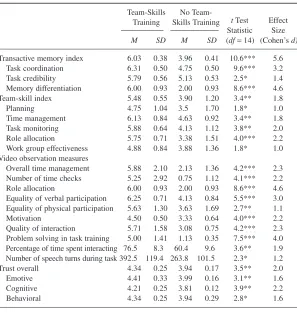
The performance of each team on both the task training and the task itself was videotaped for subsequent analysis. In addition, audio recordings of each team were taken so that verbal interactions could be transcribed to assist in the coding process. Using the videotapes and transcripts together, each team’s performance was coded for behaviors that were linked to the three variables examined in this study: transactive memory, team skills, and trust. For a full list of each of the variables rated, please refer to Table 1. All of the 16 videotapes were coded by three judges, one of whom was unaware of the study’s research hypotheses. The coding process began with a train-ing period in which all judges developed an agreed conceptualization of the behaviors associated with each of the variables. For example, each of the three subcomponents of transactive memory was rated in a manner consistent with Moreland’s research (Liang et al., 1995; Moreland, 1999; Moreland & Myaskovsky, 2000). Therefore, memory differentiation was assessed based on the distribution of expertise in the team, such as whether one person had expertise in relation to a specific area of the task.
Team Skills
[image:17.396.50.347.106.419.2]For each team process, the mean for each team was calculated from indi-vidual responses and then compared across conditions. Teams with a higher level of team skill should perceive greater planning, time management, task monitoring, role allocation, and work group effectiveness within their teams. Consistent with this expectation, results confirmed that the five team process scales were strongly correlated with one another, so we averaged them together to produce a team-skill index (Cronbach’s α =.93 at group
Table 1
Means and Standard Deviations of Transactive Memory, Team Skill, Video Observation, and Trust Ratings
Team-Skills No
Team-tTest Effect Training Skills Training
Statistic Size
M SD M SD (df =14) (Cohen’s d)
Transactive memory index 6.03 0.38 3.96 0.41 10.6*** 5.6 Task coordination 6.31 0.50 4.75 0.50 9.6*** 3.2 Task credibility 5.79 0.56 5.13 0.53 2.5* 1.4 Memory differentiation 6.00 0.93 2.00 0.93 8.6*** 4.6 Team-skill index 5.48 0.55 3.90 1.20 3.4** 1.8
Planning 4.75 1.04 3.5 1.70 1.8* 1.0
Time management 6.13 0.84 4.63 0.92 3.4** 1.8 Task monitoring 5.88 0.64 4.13 1.12 3.8** 2.0 Role allocation 5.75 0.71 3.38 1.51 4.0*** 2.2 Work group effectiveness 4.88 0.84 3.88 1.36 1.8* 1.0 Video observation measures
Overall time management 5.88 2.10 2.13 1.36 4.2*** 2.3 Number of time checks 5.25 2.92 0.75 1.12 4.1*** 2.2 Role allocation 6.00 0.93 2.00 0.93 8.6*** 4.6 Equality of verbal participation 6.25 0.71 4.13 0.84 5.5*** 3.0 Equality of physical participation 5.63 1.30 3.63 1.69 2.7** 1.1
Motivation 4.50 0.50 3.33 0.64 4.0*** 2.2
Quality of interaction 5.71 1.58 3.08 0.75 4.2*** 2.3 Problem solving in task training 5.00 1.41 1.13 0.35 7.5*** 4.0 Percentage of time spent interacting 76.5 8.3 60.4 9.6 3.6** 1.9 Number of speech turns during task 392.5 119.4 263.8 101.5 2.3* 1.2 Trust overall 4.34 0.25 3.94 0.17 3.5** 2.0
Emotive 4.41 0.33 3.99 0.16 3.1** 1.6
Cognitive 4.21 0.25 3.81 0.12 3.9** 2.2
Behavioral 4.34 0.25 3.94 0.29 2.8* 1.6
level and .88 at individual level). The means and standard deviations of the individual scales and the team-skill index are summarized in Table 1. Team-skill index scores differed significantly across training conditions,t(14) = 3.38,p<.01, Cohen’s d=1.84, with trained teams showing higher levels of team skill than untrained teams.
In addition to the self-report measures of team skill, video observational data from the performance of the task itself was analyzed for evidence of team skill. Three areas were considered that related to the training objec-tives: time management, role allocation, and equality of participation. Means and standard deviations for these observational data are presented in Table 1. There were two time management measures taken from the video data: overall time management and number of time checks. The mean over-all time management rating for the team-skills training condition was sig-nificantly higher than the no team-skills training condition,t(14) =4.24,
p<.001, Cohen’s d=2.27. In addition, the mean number of time checks for teams in the team-skills training condition was also significantly higher than for teams in the no team-skills training condition,t(14) =4.1,p<.001, Cohen’s d = 2.18. These findings were consistent with the self-reported time management measure. Correlation of the self-report and video data were found to be significant (r=.74,n=16,p<.001). Observational data for role allocation found that trained teams showed significantly higher lev-els of distributing roles than untrained teams,t(14) =8.6,p<.001, Cohen’s
d=4.6. This finding was consistent with the self-reported measure of dis-cussing roles. Correlation of this self-report and video data were found to be significant (r= .73,n=16,p<.01). Observations of both verbal and physical equality of participation were found to be significantly higher in trained teams than untrained teams,t(14) =5.5,p<.001, Cohen’s d=2.98;
t(14) =2.7,p<.05, Cohen’s d=1.41, for verbal and physical equality of participation, respectively. Finally, groups that had been trained in team skills spent significantly more time conversing about the task and had a sig-nificantly higher number of speech turns across members than those that did not receive training,t(14) =3.6,p<.01; t(14) =2.3,p<.05, for per-centage of time in conversation and number of speech turns, respectively.
skills training condition was significantly higher than the no team-skills training condition,t(14) =7.52,p<.001, Cohen’s d=4.03.
In summary, consistent with Hypothesis 1, teams that undertook team-skills training evidenced higher levels of team process team-skills than teams that did not receive the training.
Transactive Memory
Consistent with the work of Moreland (1999), a transactive memory index was calculated from the average observational ratings of task coordi-nation, task credibility, and memory differentiation for each team’s task performance (see Table 1 for means and standard deviations). The mean rat-ing for transactive memory was higher in the team-skills trainrat-ing condition than in the no team-skills training condition. A ttest revealed that this dif-ference was significant,t(14) =10.6,p<.001. Furthermore, when consid-ered at the level of individual dimensions, in each case ratings were significantly higher in the team-skills training condition than in the no team-skills training condition (see Table 1 for ttest results and effect sizes). Correlational analysis examined the relationship between team skill and transactive memory. A significant positive association was found such that those teams that reported a high level of team skill also evidenced high transactive memory (r=.78,n=16,p<.01). In addition, significant and positive correlations were also found between transactive memory and the five observation measures relating to the team-skills training (see Table 2). Therefore, in summary, consistent with Hypothesis 2, teams that received team-skills training evidenced enhanced transactive memory both overall and also across all three components.
outlier in the data set that deviated from the mean by more than 2 standard deviations. Therefore, this case was removed from all subsequent analysis of the trust variable. The mean score for the team-skills training condition was higher than the no team-skills training condition (see Table 1). A ttest revealed that this difference was significant,t(13) =3.53,p<.01, Cohen’s
d=1.98. The data were further analyzed for each of the three dimensions: emotive, cognitive, and behavioral. In each case, the mean score for the team-skills training condition was higher than the no team-skills training condition (see Table 1). A ttest revealed that differences between the two conditions were significant for each dimension (see Table 1 for ttest results and effect sizes).
[image:20.396.51.349.83.236.2]The video data were analyzed for evidence of behaviors that might sup-port the higher levels of trust in trained teams. These were necessarily lim-ited to the behavioral dimensions of trust, that is, variables that could actually be observed. Raters assessed each team on the level of motivation observed among team members and on the quality of their interactions, both of which would predictably be higher in teams reporting higher levels of trust. Motivation was rated based on levels of team effort, apathy, and overall motivation to succeed. It was found that trained teams displayed higher levels of motivation than untrained teams, t(14) = 4.04,p< .001, Cohen’s d = 2.23. Quality of interaction was rated on levels of positive feedback, information sharing, and overall team interaction. It was found that trained teams displayed a better quality of interaction than untrained teams,t(14) =4.2,p<.001, Cohen’s d=2.34. Each of these observational
Table 2
Correlations for Key Dependent Variables and Video Observation Measures
Variable 1 2 3 4 5 6 7 8 9
1. Transactive memory index 1.0 2. Team-skill index .78** 1.0 3. Trust overall .74* .69** 1.0 4. Performance .66** .53* .48 1.0 Video observation measures:
5. Problem solving in task training .84** .63** .60* .52* 1.0 6. Overall time management .74** .66** .44 .54* .73** 1.0 7. Role allocation .96** .70** .75** .59* .86** .69** 1.0 8. Equality of verbal participation .79** .59* .63* .77** .83** .64** .83** 1.0 9. Equality of physical participation .63** .32 .55* .34 .54* .33 .60* .48 1.0
measures was found to be significantly correlated with the behavioral dimension of the trust questionnaire (r=.57,n=15,p<.05; r=.65,n=
15,p<.01 for motivation and quality of interaction, respectively). Finally, correlational analyses were performed to explore the relation-ships between trust and transactive memory and between trust and team skill. A strong association was found between overall trust and transactive memory such that those teams reporting high levels of trust also evidenced high levels of transactive memory (r=.74,n=15,p<.01). In addition, a strong association was found between overall trust and the team-skill index, such that those teams reporting high levels of trust also reported high lev-els of team skill (r=.69,n=15,p<.01). Trust was also found to correlate with the observed measures of team skill, with the exception of time man-agement, which showed no association (see Table 2).
Task Performance
For each team, the total score of correctly installed components was cal-culated against a standardized assembly error scoring sheet adapted from Moreland (1999). The highest possible score achievable was 86, indicating zero errors. The mean score for the team-skills training condition (M =81.3,
SD=4.1) was higher than the no team-skills training condition (M =69.1,
SD=9.0). A ttest revealed that this difference was significant,t(14) =3.5,
p<.01, Cohen’s d=1.87. This means that teams that received team-skills training performed better at the task, making fewer assembly errors, than teams that did not receive team-skills training. Pearson’s chi squared revealed a relationship between type of training and whether the task was completed within the 30-minute deadline, χ2
(1,n =24) =4.27,p< .05). Within the team-skills training condition the majority of teams (7 teams of 8) completed the task within the time limit, whereas in the no team-skills training condition only a minority (3 teams out of 8) completed the task.
Finally, correlational analyses were performed to examine the relation-ships between performance and transactive memory and between perfor-mance and team skill. A strong association was found between perforperfor-mance and transactive memory such that high-performing teams also evidenced high levels of transactive memory (r=.66,n=16,p<.01). In addition, a moderate association was found between performance and the team-skill index, such that high-performing teams also reported higher levels of team skill (r=.53,n=16,p<.05). Performance was also found to correlate with the observed measures of team skill, with the exception of equality of phys-ical participation, which showed no association (see Table 2). In summary, consistent with Hypothesis 3, those teams that received team-skills training performed the task better than those that did not receive training.
Discussion
Team-Skills Training and the Effect on Team Process Development
The first hypothesis was supported by the results of this study. Analysis of both the team process questionnaire and the observational data demon-strated that in line with the training objectives, the team-skills training was successful in bringing about differences in team-skills behaviors. Team members in this condition reported higher levels of planning, time man-agement, task monitoring, role allocation, and overall work group effec-tiveness. These findings were highly correlated with the observational measures of time management, role allocation, and problem solving.
product rather than an individual’s learning, the findings presented in this article therefore extend Prichard et al’s work by evidencing the generaliz-ability of team-skills training into other types of tasks. A major strength in each of these studies is the methodological rigor adopted, where the use of control conditions was combined with the triangulation of objective and subjective measures of skill level, including self-report and video observa-tion. Thus, together, these findings provide strong empirical evidence that generic team-skills training, of the type used in these studies, is effective in developing higher levels of team skills used by groups.
Team-Skills Training and the Effect on Transactive Memory
Our results also supported the prediction that transactive memory would be more developed in teams that received team-skills training than those that did not. This effect was also found for each of the three dimensions that constitute the transactive memory index, showing that task coordination, memory differentiation, and task credibility are all promoted by team-skills training when compared to task-skills training alone. The observational measures of transactive memory were additionally confirmed by the find-ings of the two self-report questionnaires. The team process questionnaire offered support for both task coordination and memory differentiation through superior scores for planning, work group effectiveness, task moni-toring, and task role allocation, whereas support for the task credibility dimension was provided through the trust questionnaire, which evidenced higher levels of trust in the team-skills training condition. This higher level of transactive memory in the trained condition means that those teams that underwent the team-skills training program had a more accurate shared understanding of each other’s knowledge in specific areas of expertise and were better able to use that knowledge during performance of the task.
problem-solving skills during task training also evidenced high levels of transactive memory during subsequent task performance. Likewise, teams that showed low levels of problem-solving skills during task training showed low levels of transactive memory during the task. Establishing this finding means that it is possible to relate our work to K. Lewis’s (2004), that the early planning stage of team activity is vital to the development of transactive memory systems. She argued that high levels of team interaction during plan-ning enabled team members to more easily distribute knowledge among themselves. Closer inspection of the way in which Lewis explicates the plan-ning stage reveals how she uses this term in a very broad sense that encom-passes the wider issues of problem solving such as information identification and the development of a mutually shared conceptualization of the task. Assuming that the higher levels of interaction observed by Lewis can be accounted for by more engagement in these specific behaviors, her findings clearly relate to those we observed to be differentially displayed by teams in each of the two conditions in this study. Therefore, we speculate that team-skills training developed superior problem-solving team-skills in groups, which were then used during task training. This in turn helped to develop transac-tive memory systems beyond a level obtained in teams without team-skills training that had not developed their problem-solving skills to the same level. This is also in keeping with K. Lewis et al.’s (2005) more recent conceptual-ization of transactive memory systems as learning systems in which shared knowledge is developed through cycles of engagement in transactive processes that encode, store, and retrieve knowledge relevant to the group’s task.
transactive memory systems development, by both seeking out and evalu-ating information about expertise. In addition, in relation to the subsequent stage of retrieval, observational analysis of the task found that a number of the behaviors that may be predicted to facilitate accessing shared knowl-edge were present at higher levels in teams that received team-skills train-ing. For example, the allocation of roles, the equality of participation, and the quality of interaction were all significantly higher in these teams. Furthermore, these team skills were significantly correlated with transac-tive memory.
1973; Walter, 2000; Woodman & Sherwood, 1980). Indeed, the level of team skill from both self-reports and video observations were also found to correlate with the trust measure. However, this study does not enable us to address the question of how this effect occurs, and at this point, we can only speculate as to whether it is a consequence of the safe environment in which team members are trained. Therefore, further research is necessary to explore the mechanisms through which team-skills training increases trust. Turning to the relationship between trust and transactive memory, corre-lational analysis found that there was a significant association between these two variables, such that those teams reporting high levels of trust also evidenced higher transactive memory. Although causal analysis between higher trust in these teams and more developed transactive memory systems could not be performed, as discussed below, it could be argued that consis-tent with the work of Mayer et al. (1995) and Sharkie (2005), when people are feeling more committed toward each other, share similar expectations, and experience a higher quality of interaction, they are more likely to risk sharing knowledge and make themselves vulnerable to others in the antici-pation of expecting reciprocal behavior. We therefore consider that teams that have developed higher levels of trust through team-skills training are more inclined to share knowledge with others, facilitating the development of transactive memory. This is critical not only in the initial encoding stages of development but also during the task, when members need to access this shared knowledge in order to perform successfully.
Team Skill, Transactive Memory, and Performance
The final hypothesis of this study related to differences in team perfor-mance across conditions. Specifically, we hypothesized that teams that received team-skills training would perform better than teams without such training. Consistent with this hypothesis, it was found that teams in the team-skills training condition were significantly more likely to finish the task within the time and, crucially, made significantly fewer errors when assembling the radio.
1995; Moreland, 1999; Moreland & Myaskovsky, 2000). The findings of the study presented in this article reveal that both transactive memory and team skill correlate with performance. So, how can we conceptualize the rela-tionship between team-skills training, team skill, transactive memory, and performance? Referring back to the literature, it is possible to speculate a number of ways in which one or other of the variables—team skill and transactive memory—mediate the relationship between team-skills training and performance. For example, as considered above, it is possible that team-skills training develops higher levels of team skill, which in turn enables the team to develop superior transactive memory systems and subsequent enhanced performance compared to those teams that have not had this type of training. Unfortunately, the restricted sample available for use in this study was not sufficient to perform the necessary mediational analysis to explore these ideas (Tabachnick & Fidell, 1996), and future studies should aim to specifically examine the relationship between these variables by drawing on a bigger sample.
Limitations
negate the advantage to performance (Prichard, Stratford, et al., 2006). In other words, the performance advantage was due to the development of skills learned in training, not due to time spent together. Although this assumption seems plausible for the short study duration used here, questions remain over the potential for team skills to evolve naturally over time to the levels achieved by trained teams. It must also be acknowledged that prior research has not considered the effect of matching for time on transactive memory and trust measures. Therefore, it is recommended that future research explore the effects reported here over longer time frames to deter-mine how long it takes without training for each of the dependent mea-sures—team skill, transactive memory, and trust—to reach the levels found in the trained condition.
Conclusion
In summary, we believe that findings from this study go some way in contributing to the literature on team-skills development, transactive memory, and trust and provide a starting point from which to consider how team-skills training interacts with these variables to have an impact on team performance.
References
Adair, J. (1986). Effective teambuilding. Aldershot, UK: Gower.
Ashleigh, M. J. (2002). Trust in human supervisory control domains. Unpublished doctoral thesis, University of Southampton.
Ashleigh, M. J., & Nandakhumer, J. (2007). Trust and technologies: Implications for organi-zational work practices. Decision Support Systems, 43(2), 607-617.
Ashleigh, M. J., & Stanton, N. A. (2001). Trust: Key elements in human supervisory control domains. Cognition, Technology & Work , 3,92-100.
Austin, J. R. (2003). Transactive memory in organizational groups: The effects of content, con-sensus, specialization, and accuracy on group performance. Journal of Applied Psychology, 88,866-878.
Bass, B. M., & Barrett, B. V. (1981). People, work, and organizations. Boston: Allyn & Bacon. Beer, M. (1976). The technology of organization development. In M. D. Dunnette (Ed.),
Handbook of industrial and organizational psychology (pp. 937-993). Chicago: Rand McNally.
Belbin, R. M. (1981). Management teams: Why they succeed or fail. Oxford, UK: Butterworth Heinemann.
Belbin, R. M. (1993). Team roles at work. Oxford, UK: Butterworth Heinemann.
Blickensderfer, E. L., Cannon-Bowers, J. A., & Salas, E. (1997) Theoretical bases for team self-corrections: Fostering shared mental models. In M. M. Beyerlein, D. Johnson, & S. Beyerlein (Eds.),Advances in interdisciplinary studies of work teams (Vol. 4, pp. 249-279). Greenwich, CT: JAI.
Blois, K. J. (1999). Trust in business to business relationships: An evaluation of its status.
Journal of Management Studies, 36(2), 197-215.
Buller, P. F., & Bell, C. H. (1986). Effects of team building and goal setting on productivity: A field experiment. Academy of Management Journal, 29,305-328.
Cannon-Bowers, J. A., & Salas, E. (2001). Reflections on shared cognition. Journal of Organizational Behavior, 22, 195-202.
Cannon-Bowers, J. A., Salas, E., & Converse, S. (1993). Shared mental models in expert team decision making. In N. J. Castellan Jr. (Ed.),Individual and group decision making
(pp. 221-246).Hillsdale, NJ: Lawrence Erlbaum.
Cooke, N. J., Salas, E., Cannon-Bowers, J. A., & Stout, R. J. (2000) Measuring team knowl-edge. Human Factors, 42,151-173.
Cummings L. L., & Bromiley, P. (1996). The Organisational Trust Inventory (OTI): Development and validation. In R. M. Kramer & R. R. Tyler (Eds.),Trust in Organisations: Frontiers of theory and research(pp. 302-330). London: Sage.
Dyer, W. G. (1987). Team building: Issues and alternatives. Reading, MA: Addison-Wesley. Edmondson, A. (1999). Psychological safety and learning behaviour in work teams. Administrative
Science Quarterly, 44(2), 350-383.
Glickman, A. S., Zimmer, S., Montero, R. C., Guerette, P. J., Campbell, W. S., Morgan, B. B., et al. (1987).The evolution of teamwork skills: An empirical assessment with implications for training(Tech. Rep. 87-016). Orlando, FL: Naval Training Systems Center. Harrison, D. A., Mohammed, S., McGrath, J. E., Florey, A. T., & Vanderstoep, S. W. (2003).
Time matters in team performance: Effects of member familiarity, entrainment, and task discontinuity on speed and quality. Personnel Psychology, 56(3), 633-669.
Hollingshead, A. B. (1998a). Communication, learning, and retrieval in transactive memory systems. Journal of Experimental Social Psychology, 34,423-442.
Hollingshead, A. B. (1998b). Retrieval processes in transactive memory systems. Journal of Personality and Social Psychology, 74,659-671.
Kegan, D. L., & Rubenstein, A. H. (1973). Trust, effectiveness, and organizational devel-opment: A field study in R & D. Journal of Applied Behavioral Science, 9, 498-513. Kenny, D. A., & La Voie, L. (1985). Separating individual and group effects. Journal of
Personality and Social Psychology, 48,339-348.
Kerr, N. L., & Tindale, R. S. (2004). Group performance and decision making. Annual Review of Psychology, 55,623-655.
Klimoski, R., & Mohammed, S. (1994) Team mental model: Construct or metaphor? Journal of Management, 20,403-437.
Kolb, D. A. (1984). Experiential learning: Experience as the source of learning and develop-ment. Englewood Cliffs, NJ: Prentice Hall.
Kozlowski, S. W. J. & Ilgen, D. R. (2006). Enhancing the effectiveness of work groups and teams. Psychological Science in the Public Interest, 7(3), 77-124.
Lewis, J. D., & Weigert, A. (1985). Trust as a social reality. Social Forces, 63,967-985. Lewis, K. (2003). Measuring transactive memory systems in the field: Scale development and
validation. Journal of Applied Psychology, 88,587-604.
Lewis, K. (2004). Knowledge and performance in knowledge-worker teams: A longitudinal study of transactive memory systems. Management Science, 50,1519-1533.
Lewis, K., Lange, D., & Gillis, L. (2005). Transactive memory systems, learning, and learning transfer. Organization Science, 16,581-598.
Liang, D. W., Moreland, R., & Argote, L. (1995). Group versus individual training and group performance: The mediating role of transactive memory. Personality and Social Psychology Bulletin, 21,384-393.
Luhmann, N. (1988). Familiarity, confidence, trust: Problems and alternatives. In D. Gambetta (Ed.), Trust: Making and breaking cooperative relationships (pp. 94-107). New York: Blackwell.
Macy, B. A., & Izumi, H. (1993). Organizational change, design, and work innovations: A meta-analysis of 131 North American field studies 1961-1991. In W. Passmore & R. Woodman (Eds.),Research in organizational change and development (pp. 235-313). Greenwich, CT: JAI.
Mathieu, J. E., Heffner, T. S., Goodwin, G. F., Salas, E., & Cannon-Bowers, J. A. (2005). Scaling the quality of teammates’ mental models: Equifinality and normative comparisons.
Journal of Organizational Behavior, 26,37-56.
Michaelson, L. K., & Black, R. H. (1994). Building learning teams: The key to harnessing the power of small groups in higher education. In S. Kadel & J. Keehner (Eds.),Collaborative learning: A sourcebook for higher education (Vol. 2, pp. 65-81). University Park: Pennsylvania State University, National Center for Post Secondary Teaching, Learning, and Assessment.
Mohammed, S., & Dumville, B. C. (2001). Team mental models in a team knowledge frame-work: Expanding theory and measurement across disciplinary boundaries. Journal of Organizational Behavior, 22,89-106.
Moreland, R. L. (1999). Transactive memory: Learning who knows what in work groups and organizations. In L. L. Thompson, J. M. Levine, & D. M. Messick (Eds.),Shared cogni-tion in organizacogni-tions: The management of knowledge (pp. 3-31).Mahwah, NJ: Lawrence Erlbaum.
Moreland, R. L., Argote, L., & Krishnan, R. (1998). Training people to work in groups. In R. S. Tindale, L. Heath, J. Edwards, E. J. Posavac, F. B. Bryant, Y. Suarez-Balcazar, et al. (Eds.),Theory and research on small groups (pp. 37-60). New York: Plenum.
Moreland, R. L., & Myaskovsky, L. (2000). Exploring the performance benefits of group training: Transactive memory or improved communication? Organisational Behavior and Human Decision Processes, 82,117-133.
Morgan, B. B., Glickman, A. S., Woodard, E. A., Blaiwes, A. S., & Salas, E. (1986).
Measurement of team behaviors in a navy environment(Tech. Rep. TR-86-014). Orlando, FL: Naval Training Systems Center.
Porter, G. (1993). Are we teaching people not to work in teams? Reflections on team based assignments in the college classroom. In CSWT anniversary proceedings (pp. 373-379). Denton: University of North Texas.
Prichard, J. S. (2002). Teamwork and collaborative learning: Does team-skills training enhance educational outcomes?Unpublished doctoral thesis, University of Southampton. Prichard, J. S., Bizo, L. A., & Stratford, R. J. (2006). The educational impact of team-skills training: Preparing students to work in groups. British Journal of Educational Psychology, 76,119-140.
Prichard, J. S., Stratford, R. J., & Bizo, L. A. (2006). Team-skills training enhances collabo-rative learning. Learning and Instruction,16,256-265.
Prichard, J. S., Stratford, R. J., & Hardy, C. (2004) Training students to work in teams: Why and how?York, UK: LTSN Psychology.
Rousseau, D. M., Sitkin, S. B., Burt, R. S., & Camerer, C. (1998). Not so different after all: A cross-discipline view of trust. Academy of Management Review, 23,393-404. Rulke, D. L., & Rau, D. (2000). Investigating the encoding process of transactive memory
development in group training. Group & Organization Management, 25,373-396. Salas, E., Rozell, D., Mullen, B., & Driskell, J. E. (1999). The effect of team building on
performance: An integration. Small Group Research, 30,309-329.
Sharkie, R. (2005 , July 19-22). Perceptions of trust in an organisation: The factors that influ-ence the sharing of tacit knowledge. In Fifth International Conference on Knowledge, Culture and Change in Organisations. Rhodes, Greece: University of the Aegean. Stanton, N. A., Ashleigh, M. J., Roberts, A. D., & Zu, F. (2001). Testing Hollnagel’s
contex-tual control model: Assessing team behaviour in a human supervisory control task. Journal of Cognitive Ergonomics, 5(1), 21-33.
Steiner, I. D. (1972). Group processes and productivity. London: Academic Press.
Tuckman, B. W. (1965). Developmental sequence in small groups. Psychological Bulletin, 63,384-399.
Walter, D. (2000). Competency-based on-the-job training for aviation maintenance and inspection: A human factors approach. International Journal of Industrial Ergonomics, 26,249-259.
Wegner, D. M. (1987). Transactive memory: A contemporary analysis of the group mind. In B. Mullen & G. R. Goethals (Eds.),Theories of group behavior (pp. 185-205). New York: Springer-Verlag.
Wegner, D. M. (1995). A computer network model of human transactive memory. Social Cognition, 13,319-339.
Wegner, D. M., Erber, R., & Raymond, P. (1991). Transactive memory in close relationships.
Journal of Personality and Social Psychology, 61,923-929.
Woodman, R. W., & Sherwood, J. J. (1980). The role of team development in organizational effectiveness: A critical review. Psychological Bulletin, 88,166-186.
Jane S. Prichardreceived her PhD in 2002 from the School of Psychology at the University of Southampton and moved to the School of Social Sciences in the same year. Her research interests are in team performance and particularly in how training people to work more effec-tively in groups affects group functioning. Recent projects include evaluating the impact of team skills training on collaborative groups in educational settings and the role that training has on transactive memory, workload, trust, and cohesion.