University of Tasmania
Department of Accounting and Finance
THE IMPACT OF EXTENSIVE AUDIT EXPERIENCE ON
INTERNAL CONTROL EVALUATION
A dissertation submitted to the Department of Accounting and Finance, University of Tasmania, in partial fulfilment of the requirements for the degree
of Master of Commerce.
by Tong Gunn CHEW April 1997
TABLE OF CONTENTS
Table of Contents
Tables and Figures
iiiAcknowledgments
iv
Abstract
CHAPTER 1: INTRODUCTION 1
OBJECTIVE 1
MOTIVATION 4
OVERVIEW OF THE METHODOLOGY 7
FINDINGS 8
SIGNIFICANCE 9
ORGANISATION OF DISSERTATION 10
CHAPTER 2: INSTITUTIONAL BACKGROUND 11
INTRODUCTION 11
INTERNAL CONTROL 11
FINANCIAL INSTITUTIONS 17
INTERNAL CONTROL ADEQUACY IN FINANCIAL INSTITUTIONS 18
SUMMARY 20
CHAPTER 3: LITERATURE REVIEW 22
INTRODUCTION 22
EXPERIENCE EFFECTS ON INTERNAL CONTROL PERFORMANCE 22 EXPERIENCE EFFECTS ON KNOWLEDGE AND PERFORMANCE 27
SUMMARY 32
CHAPTER 4: THEORETICAL MODEL AND HYPOTHESES DEVELOPMENT 34
INTRODUCTION 34
EXTENSIVE EXPERIENCE EFFECTS ON KNOWLEDGE AND PERFORMANCE 35
Accuracy Measure 37
Consensus Measure 39
Self Insight 41
SUMMARY 44
CHAPTER 5: METHODOLOGY 46
INTRODUCTION 46
METHOD 46
SUBJECTS 49
DATA COLLECTION 50
Task 1 - Accuracy Measure 50
Task 2 - Consensus Measure 51
Task 3 - Self Insight Measure 57
Demographics 57
CHAPTER 6: DATA ANALYSIS AND RESULTS 59
INTRODUCTION 59
PILOT TESTING 60
DESCRIPTIVE STATISTICS 61
LEVEL OF ACCURACY OF INTERNAL CONTROL KNOWLEDGE 68
LEVEL OF CONSENSUS BETWEEN SUBJECT GROUPS 72
LEVEL OF SELF INSIGHT WITHIN SUBJECT GROUPS 77
ADDITIONAL ANALYSIS 88
SUMMARY 93
CHAPTER 7: SUMMARY AND DISCUSSION 98
RESULTS 98
SIGNIFICANCE OF RESULT 100
LIMITATIONS 103
FUTURE RESEARCH 105
APPENDIX 1: MODEL ANSWER FOR PART TWO OF THE QUESTIONNAIRE 109 APPENDIX 2: THE QUESTIONNAIRE USED FOR DISTRIBUTION TO AUDITOR AND
STUDENT SUBJECTS 113
TABLES AND FIGURES
TABLE 1 AN EXAMPLE OF AN INTERNAL CONTROL CASE USED IN ASHTON (1974) 24 FIGURE 1 EFFECT OF KNOWLEDGE AND MENTAL ABILITY ON PERFORMANCE 29 FIGURE 2 THE EI-1-hCT OF EXPERIENCE AND MENTAL ABILITY ON KNOWLEDGE AND PERFORMANCE 30 FIGURE 3 EFFECTS OF GENERAL AUDIT EXPERIENCE ON INTERNAL CONTROL KNOWLEDGE AND
PERFORMANCE 31
FIGURE 4 GENERAL AND EXTENSIVE EXPERIENCE - INTERNAL CONTROL KNOWLEDGE AND
PERFORMANCE MODEL 37
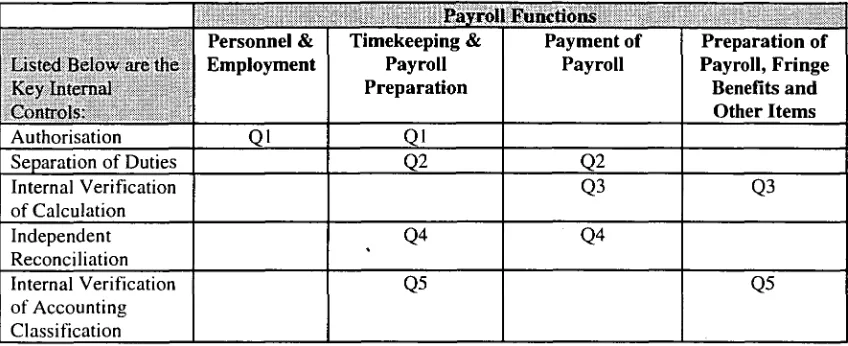
TABLE 2 CASE STUDY QUESTIONS EACH ADDRESSING TWO PAYROLL FUNCTIONS AND ONE KEY
INTERNAL CONTROLS 56
TABLE 3 THE QUESTIONS USED IN THE INSTRUMENT WHICH WAS DISTRIBUTED TO AUDITOR AND
STUDENT SUBJECTS 56
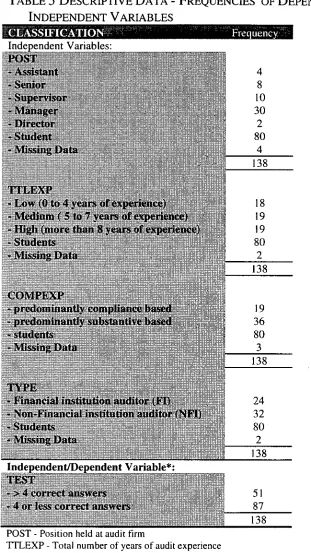
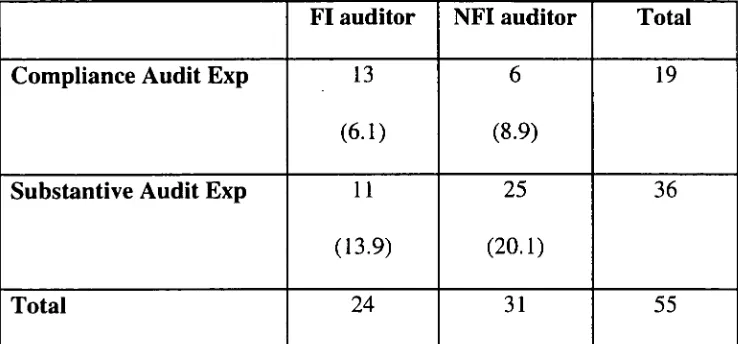
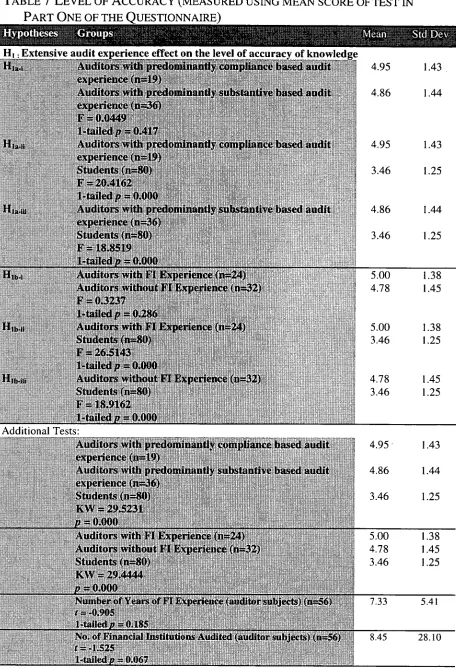
TABLE 4 DESCRIPTIVE DATA - INDEPENDENT AND DEPENDENT VARIABLES 62 TABLES DESCRIPTIVE DATA - FREQUENCIES OF DEPENDENT AND INDEPENDENT VARIABLES 65 TABLE 6 CONTINGENCY TABLE FOR EXTENSIVE AUDIT EXPERIENCE VARIABLES 67 TABLE 7 LEVEL OF ACCURACY (MEASURED USING MEAN SCORE OF TEST IN PART ONE OF THE
QUESTIONNAIRE) 69
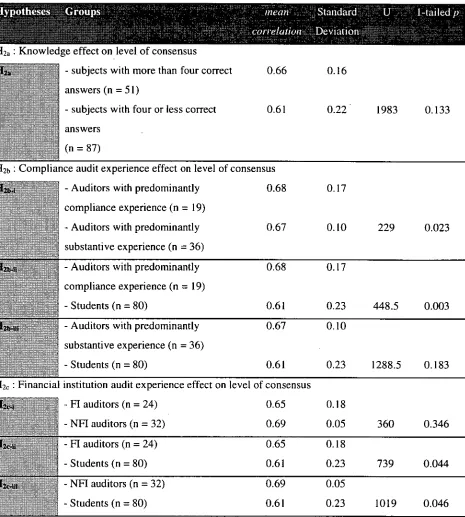
TABLE 8 LEVEL OF CONSENSUS FOR EACH SUBJECT GROUP CLASSIFIED ACCORDING TO THE
HYPOTHESES 74
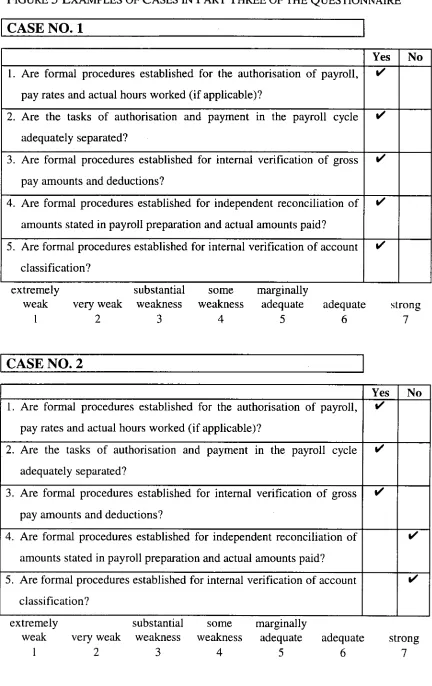
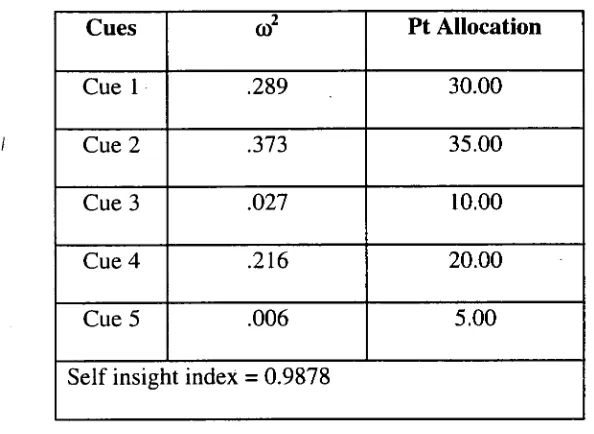
FIGURES EXAMPLES OF CASES IN PART THREE OF THE QUESTIONNAIRE 79 TABLE 9 CORRELATION BETWEEN THE (02 AND POINT ALLOCATION OF SUBJECT ONE 82 TABLE 10 THE SUBJECTS' OBJECTIVE JUDGEMENT MODEL ((02 FOR EACH OF THE FIVE CUES) 83 TABLE 11 LEVEL OF SELF INSIGHT FOR EACH GROUP CLASSIFIED ACCORDING TO EACH HYPOTHESIS 85 TABLE 12 o32 OF SUBJECTS WITH A HIGH/LOW CORRELATION COEFFICIENT (THE CORRELATION
COEFFICIENT IS COMPUTED BY CORRELATING THE FIVE (02 OF A PAIR OF SUBJECTS) 89
TABLE 13 SUMMARY OF RESULTS 94
ACKNOWLEDEGMENTS
My sincere appreciation extends to my supervisor, Professor Jayne Godfrey, from
whose comments, inputs and patience I have benefited immensely. My special thanks
also go to Professor Jim Lampe, Professor Alan Mayper and other members of the
Department who have provided helpful comments and invaluable assistance
throughout the process.
Many thanks go to the anonymous participants of the questionnaire, as well as the
participating institutions, all of whom made this study possible.
I would also like to take this opportunity to pay tribute to my family, especially my
parents, who saw me through the completion of this dissertation with their
ABSTRACT
This study investigates the effect of extensive internal control audit experience on
internal control evaluation. Prior studies have examined the effect of industry
experience on specific audit knowledge and the effect of general audit experience on
internal control knowledge/performance. However, there has been no known study
that examines the effect of extensive internal control audit experience on multiple
measures of internal control performance. Extensive internal control audit experience
includes compliance based audit experience and financial institution audit experience.
Auditors with predominantly compliance based audit experience perform a higher
level of compliance testing compared to auditors with predominantly substantive
based audit experience. Auditors with financial institution audit experience are more
frequently exposed to internal control review due to the audit requirement specified in
AGS 1008,
Audit Implications of Reserve Bank Prudential Reporting Requirements.Due to the frequent exposure to internal control review, auditors with these extensive
audit experiences are expected to attain a higher level of knowledge accuracy,
consensus between subjects and self insight within subjects. The study also examines
the effect of the level of knowledge on internal control evaluation. It is predicted that
subjects with a higher level of knowledge will attain a higher level of consensus and
self insight.
Results indicate that there are significant differences in the levels of knowledge
accuracy, consensus and self insight between student and auditor subjects except for
the level of consensus between auditors with predominantly substantive based audit
experience exhibit a significantly higher level of consensus compared to auditors with
predominantly substantive audit experience but neither a higher level of knowledge
accuracy nor self insight. There are no significant differences in the performance of
auditors with and without financial institution experience. Furthermore, there are no
significant differences in the level of accuracy of consensus and self insight between
the high knowledge group and the low knowledge group.
The results indicate that compliance based audit experience may be a useful factor in
training an auditor to become an expert in internal control evaluations, as evidenced
by firstly, the significant differences in the level of consensus between auditors with
compliance based audit experience and auditors with substantive based audit
experience; and secondly, the lack of significant difference in the level of consensus
between auditors with predominantly substantive audit experience and students.
Furthermore, it is clear that some experience as opposed to no experience plays a key
CHAPTER 1: INTRODUCTION
OBJECTIVE
This study evaluates whether extensive internal control experience enhances the
development of a more accurate internal control knowledge relative to internal control
knowledge acquired through general internal control experience. It also investigates if
a more accurate level of knowledge is associated with a higher level of consensus
between auditors' internal control evaluations and a higher level of self insight within
auditors' assessments of their internal control evaluations.
Accuracy refers to the correspondence between a decision maker's prediction and the
actual realization (Murray and Regel 1992, p. 127). In this study, accuracy is a
measure of internal control knowledge as derived from an internal control objective
test. The test requires respondents to determine which of the several responses
provides a correct evaluation of internal control adequacy. Accurate knowledge is
assessed as involving correct responses to the test. Consensus relates to the extent to
which different individuals agree in their assessments and is expressed as agreement
between pairs of subjects (Ashton 1985, pp. 174-175). Judgement insight relates to
the degree of self insight into the relative weighting of internal control indicators of
the internal control task within individual auditors (Hamilton and Wright 1982, p.
757).
1. audit experience where greater reliance is placed on the client's internal control
structure; and
2. audit experience with financial institutions in Australia.
According to Bedard (1989, P. 122 ), " ... through experience, expert auditors may
have developed more complete knowledge, better cross-reference and better memory
organisation ... ". Particularly, auditors of clients with reliable internal control
structures perform more internal control reviews compared to auditors of clients with
less reliable internal control structure. Furthermore, in view of the emphasis placed
on reporting internal control adequacy as required by Auditing Guidance Statements
AGS 1008, Audit Implications of Reserve Bank Prudential Reporting Requirements',
where there is an emphasis on compliance testing, auditors of financial institutions are
more exposed to internal control reviews than are auditors of non-financial
institutions. In view of the more frequent exposure to internal control evaluation,
auditors with either of the above extensive internal control audit experience should
develop a higher level of accuracy in internal control knowledge and possess greater
expertise to perform internal control evaluation compared to auditors with only
general audit experience. 2
Auditing Guidance Statement AGS 1008, Audit Implications of Reserve Bank Prudential Reporting Requirements, requires auditors of financial institutions to report specifically on internal control adequacy in addition to reporting the traditional opinions on the truth and fairness of the financial statements. Internal controls means management's philosophy and operating style, and all the policies and procedures adopted by management to assist in achieving the entity's objectives (Statement of Auditing Standard AUS 402, Risk Assessments and Internal Controls, para .10).
2
Hamilton and Wright (1982, P. 757) stated that:
"a major assumption made is that a primary determinant of improved expertise in an area of expert judgement is experience. Measures of improved expertise include consensus of judgements, stability of judgements, relative weighting of information, and subjects' degree of self insight into their relative utilisation of information".
This study does not directly adopt the Hamilton and Wright assumption, but applies
the model developed by Libby and Tan (1994). The Libby and Tan (1994) expertise
model assumes a direct experience effect on knowledge and subsequently, a direct
knowledge effect on performance. This study tests whether greater experience leads
to greater accuracy in knowledge and further evaluates the assumption of a knowledge
effect on consensus and self insight of the internal control task. Hamilton and Wright
(1982) tested for the existence of a direct experience effect on performance as
measured by the levels of consensus and self insight. This study extends Hamilton
and Wright (1982) by also testing for a direct experience effect on knowledge
accuracy and a consequential indirect knowledge effect on consensus and self insight.
Auditors who have extensive internal control experience are more exposed to internal
control reviews and therefore, are expected to be experts at internal control
evaluations. In contrast, auditors with general experience but lacking in extensive
internal control experience are less exposed to internal control reviews and are
expected to possess less expertise in internal control evaluations. Students with no
audit experience have no exposure to internal control reviews and are, by definition,
novices. Experts are expected to attain a higher level of accuracy in internal control
knowledge, a higher level of consensus and greater self insight in internal control
This study investigates the linkage between extensive internal control experience and
internal control knowledge/performance, which has not been examined in previous
studies. Extensive internal control experience includes audit experience of clients
with a reliable internal control structure and financial institution audit experience.
3
The effect of general experience is also examined. Students, who have less general
audit experience are expected to have less accurate internal control knowledge, a
lower level of consensus in their evaluations of internal controls and possess a lower
level of self insight in their internal control evaluations than auditors with general
experience.
MOTIVATION
The effect of extensive internal control experience on auditors' internal control
knowledge/performance has been selected as the focus of this study for three reasons.
First, the issue is important since internal control knowledge/performance has the
potential to significantly affect the effectiveness and efficiency of audits. Auditors
generally evaluate the strength of the internal control in order to determine the extent
of audit work necessary for a particular client engagement (Gaumnitz et al 1982, p.
745). The primary purpose of the internal control review is to enable the auditor to
determine the nature, the timing and the extent of audit procedures to be applied
(Ashton 1974, p. 144). In a competitive environment, it is important that an accurate
internal control assessment is conducted as the extent of the subsequent substantive
testing procedures is highly dependent on that review. An inaccurate assessment will
lead to audit inefficiencies and/or ineffectiveness. Substantive audit work performed
will be insufficient when the internal control risk is assessed as lower than actual; or
excessive when the internal control risk is assessed as higher than actual. 4 Therefore,
internal control assessment is a critical foundation of the audit process.
Second, recent bank failures and business losses have been attributed to the lack of
internal control within companies. The Barings debacle in Singapore 5 and the Daiwa
bank downfall in Tokyo6 have received worldwide attention, emphasizing the
importance of understanding the factors affecting internal control assessments. The
losses suffered by both of the above-mentioned financial institutions were caused by
unauthorised transactions in derivatives by single traders. The conventional wisdom
has been that internal controls in financial institutions were far too tight to permit such
scandals from occurring. As such, the events have stunned international financial
circles. These and other audit failures have rekindled professional and legislative
interest in auditors' responsibilities to assess and/or report on internal control
' It is recognised that there will be no resulting inefficiencies in the audit work performed when the actual internal control risk is higher than assessed and no errors have occurred. Less audit work has been performed as there was a low expectation of error occurrence. Refer to Gill G. S. and Cosserat G. W., 1993, p. 258.
5 Keen (1995, p. 5); Bloomberg and NY Times as reported in Financial Review, 12 September 1995. Nick Leeson, a trader with Barings Futures Singapore, incurred losses amounting to US$1.39 billion which brought down Barings, Britain's oldest merchant bank, in February 1995. The losses were uncovered by the auditors but were not identified as fraudulent transactions as the computer entries were faked, bank statements and confirmations were falsified. The apparent accuracy of the transactions and records led the auditors to issue an unqualified audit report. The management of Barings has been criticised for allowing an inexperienced trader such as Leeson to accumulate huge losses and continue to finance his operations despite danger signs.
6 The Mercury, 28 August 1995, p. 23. Toshihide Iguchi, an executive vice president at Daiwa Bank's
adequacies. 7 These cases indicate the significance of the external auditors' role in
relation to the adequacy of internal control over financial instrument trading.
Third, despite the importance of the issues examined in this study, they have not been
researched to date. Prior studies have examined the effect of industry experience on
specific audit knowledge 8 and the effect of general audit experience on internal
control knowledge/performance. 9 However, there have been no known studies that
examine the effect of extensive audit experience on multiple measures of internal
control performance. In this study, compliance based audit experience or financial
institution audit experience is used as a proxy for extensive internal control audit
experience. A reliable internal control structure allows the auditors to place reliance
on the client's internal control structure and thus, the audit procedure will be
compliance based. Financial institutions are generally assessed as having a higher
level of audit risk and thus, are subjected to more extensive compliance audit
requirements than are non-financial institutions as evident in the level of regulatory
7 Refer to Keen (1995, p. 5) whereby past and present personnel of financial institutions and audit firms addressed the important issues arising from the Barings case.
8Ashton (1991) investigated the effect of industry experience on error-frequency knowledge. In relation to financial institution, it was hypothesized that more experienced auditors in financial institution audits acquire more accurate financial institution error frequency knowledge through experience and thus, there will be a difference in the accuracy of that knowledge between the more and less experienced auditors. There were no significant results for the experience effect on error frequency knowledge within the banking industry.
9 Studies of the experience effect, as measured by number of years of experience or tenure, on internal control evaluation include Ashton (1974), Ashton and Brown (1980), Ashton and Kramer (1980), Gaumnitz et al (1982), Hamilton and Wright (1982) and Libby and Tan (1994). However, the results of these prior studies are not conclusive. For a review of studies examining internal control judgements, see Trotman and Wood (1991, pp. 186-187). Refer to Bedard (1989, pp. 117-118) and the literature review chapter of this thesis for the results of the prior research. Plausible reasons for the differing results could be due to differences in the ways in which knowledge was measured (Bonner, Davis and Jackson 1992); or the proxy used to represent expertise. These studies have routinely collected information relating to the years of audit experience that are used as a surrogate for expertise (Bedard,
monitoring and the level of reporting requirements. 1° Both the above mentioned types
of extensive internal control audit experience require more extensive/detailed internal
control reviews compared to general audit experience. Exposure to internal control
reviews is expected to affect the internal control knowledge and internal control
evaluation performance. This study investigates the effect of extensive audit
experience on internal control knowledge and performance.
OVERVIEW OF THE METHODOLOGY
The study compares the internal control evaluations of three subject groups:
1) auditors with extensive internal control experience (auditors with financial
institution audit experience or auditors with predominantly compliance based audit
experience),
2) auditors without extensive internal control experience (auditors with general
experience or auditors with predominantly substantive based audit experience); and
3) students with no practical audit experience.
Surveys are used for data collection. The instrument comprises four parts. The first
section obtains responses in relation to the internal control objective violated for each
of the eight errors/irregularities in an order entry/sales system. This section serves to
test the accuracy of the subjects' internal control knowledge by comparing the
responses collected from the subjects to the model answers derived by Tubbs (1992, p.
792). The second section requires the subjects to evaluate the strength of the internal
lu Refer to Auditing Guidance Statement AGS 1008 Audit Implications of Reserve Bank Prudential
control structure of sixteen independent cases on a scale of 1, extremely weak to 7,
strong. Each case contains a list of five control statements which have been
pre-answered "yes" or "no". There are sixteen responses, 1 per case, for each subject.
The responses of the subjects are correlated to determine the level of consensus for
each subject and the mean correlation is computed for each group. The levels of
consensus in each group are then compared. The third section requires subjects to
allocate 100 points across the five internal control statements used in section two.
The allocated points relate to the perceived level of importance of each control. The
allocation provided here is used to determine the level of self insight in relation to the
internal control evaluations made in each of the cases for the second section. The
fourth section collects demographic information about the subjects. This information
is used to determine each subject's experience, extensive or general, which facilitates
the analysis of the responses in the appropriate classification.
FINDINGS
Results indicate that auditors who audit clients with reliable internal control structure
(predominantly compliance based audit experience) attain significantly higher levels
of consensus in internal control evaluations compared to auditors who audit clients
without reliable internal control structure (predominantly substantive based audit
experience). The level of knowledge accuracy and self insight do not differ
significantly between these two groups of auditors. When compared to students, the
auditors with predominantly compliance based audit experience attain higher levels of
knowledge accuracy, consensus and self insight. Likewise, auditors with
knowledge accuracy and self insight but not significantly higher levels of consensus in
internal control evaluations than the students.
Although financial institution auditors do not out perform non-financial institution
auditors, both financial institution and non-financial institution auditors exhibit higher
levels of knowledge accuracy, consensus and self insight in internal control
evaluations compared to students.
Prior research indicates that experience is a factor in determining the level of
expertise. The results here not only confirm the findings of prior research but also
extend prior research by identifying compliance based audit experience as a
determinant of expertise in internal control evaluation.
SIGNIFICANCE
The outcome of the study has several implications. First, this study provides evidence
that auditors with extensive internal control experience, measured by compliance
based audit experience, exhibit a higher level of expertise in relation to the level of
consensus in their internal control evaluations. As such, auditors could be assigned to
clients whose audits are primarily compliance based, (i.e. with a reliable internal
control structure) to develop their internal control knowledge and internal control
evaluation capabilities.
Second, the results provide justification for accounting firms to supplement the
training needs of auditors with predominantly substantive based audit experience to
Third, equipped with a level of expertise in internal control evaluation, auditors with
predominantly compliance based audit experience could command a higher salary and
better promotional opportunities than auditors with predominantly substantive audit
experience,
ceteris paribus.ORGANISATION OF DISSERTATION
The rest of the thesis is organised as follows. Chapter 2 comprises a discussion of the
institutional background in relation to internal controls and financial institutions. This
is followed by the literature review in Chapter 3 and; the theoretical model and
hypotheses development in Chapter 4. The methodology is then outlined in Chapter 5
and the results are presented in Chapter 6. Chapter 7 provides a summary and
CHAPTER 2: INSTITUTIONAL BACKGROUND
INTRODUCTION
This chapter provides an overview of:
1) the regulatory auditing requirements in relation to internal control reviews,
2) the regulation of financial institutions, and
3) the reporting requirement of internal control adequacy in financial institutions.
This overview emphasizes the importance of internal controls within financial
institutions, thus emphasising the significance of the research issue to auditors,
auditees and other beneficiaries of the audit process.
INTERNAL CONTROL
In Australia, Statement of Auditing Standard AUS 402,
Risk Assessments and InternalControls,
states that" ... auditors shall obtain an understanding of the internal control
structure sufficient to plan the audit and develop an effective audit approach. The
auditor should use professional judgement to assess audit risk and to design audit
procedures to ensure it is reduced to an acceptable low level ... (para .02)". An
effective internal control structure assists management in ensuring that, as far as
practical, the conduct of business is orderly and efficient (para .15). Consequently,
auditors can rely on the client's internal control structure to reduce their substantive
The internal control structure consists of the control environment, accounting system
and control procedures (AUS 402, para .10). An understanding of each is required in
order to assess audit risk using the audit risk model, which is derived from AUS 306
and UAS 402), in which AR = IR X CR X DR where AR is audit risk, IR is inherent
risk, CR is control risk and DR is detection risk. Assuming auditors are prepared to
accept only a given level of audit risk, an understanding of the internal control
structure is required to determine the level of reliance on the auditee's internal control
structure and the amount of substantive testing required to form the audit opinion.
There is an inverse relationship between audit risk and the amount of evidence needed
to support the auditor's opinion on the financial report, i.e. the lower the level of audit
risk to be achieved, the greater the amount of evidence needed." Conversely, inherent
and control risks are directly related to the amount of evidence needed.
According to AUS 402 (para .34):
" ... When control risk is assessed as high, the auditor places emphasis on
obtaining evidence through the performance of substantive procedures...".
Furthermore, according to AUS 402 (para .39):
" ... The auditor should obtain audit evidence through tests of control to support
any assessment of control risk that is less than high. The lower the assessment
of control risk, the more support the auditor should obtain that the internal
control structure is suitably designed and operating effectively..."
Less evidence is needed when inherent and control risks are low because in such cases
detection risk can be high while a given level of audit risk is achieved, nonetheless, by
virtue of low detection or internal control risks. When control risk is accurately
assessed as high, the auditor is able to expand substantive procedures and, thereby,
reduce detection risk in order to maintain a proper level of total audit risk. On the
other hand, if control risk is accurately assessed to be low, the auditor can place
reliance on the client's internal control structure and perform less extensive
substantive procedures in order to achieve greater audit efficiency whilst keeping total
audit risk at an acceptably low leve1. 12
Benefits accrue to the client as the pricing of the audit service is dependent upon the
amount of work and level of tests that are performed by the auditors. Once the fee has
been set or a constraint on the amount of audit fee exists, auditors need to identify the
most cost efficient method of performing audit procedures to derive the best recovery
for the audit. Inaccurate assessments of control risk lead to more ineffective or
inefficient audits. The greater the accuracy of the control risk assessment, the greater
the benefits to both the client and the auditor.
Various studies and commissions in the area of corporate governance have also
addressed the internal control issue. In 1978, the Cohen Report recommended that
management should be required to report on internal control with attestation of the
report by auditors. Some ten years later, the Treadway Commission (US, 1987)
renewed the call for management reports on the effectiveness of internal control and
acknowledged management's responsibility for establishing, monitoring, evaluating
12 •
and reporting on the internal control structure. I3 In 1988, Statement of Accounting
Standard, SAS 55, which dealt specifically with internal control risk assessment
issues, was issued in the US. In 1992, there was also an abundance of interest in
internal control issues exhibited by organisations in various countries, such as the
Cadbury Committee (UK), the Ryan Commission (Ireland) and the report on Audit
Expectations Gap in the United Kingdom issued by The Institute of Chartered
Accountants in England and Wales (UK).
The Cadbury Committee attempted to allocate responsibility for ensuring the
existence of an adequate internal control structure between the Board of Directors and
auditors. The committee recommended that directors should report on the
effectiveness of the internal control system and that the auditors should attest to their
statement.I4 Extending the concept of director's responsibility, the Ryan Commission
asserted that the directors, regardless of the company size, have the responsibility of
maintaining a system of internal control which has been designed to give reasonable
assurance that transactions are executed in accordance with management's
authorisation, that assets are safeguarded, that fraud is prevented and that proper
financial records are maintained.I5 The Audit Expectations Gap in the United
Kingdom issued by The Institute of Chartered Accountants in England and Wales
expanded the auditor's scope of responsibility from a credibility assessment function
13 The Australian Society of CPAs and Institute of Chartered Accountants in Australia. 1993. A
Research Study on Financial Reporting and Auditing - Bridging the Expectation Gap. Australia: 76.
14 Committee on the Financial Aspects of Corporate Governance. 1992. Report of the Committee on the
Financial Aspects of Corporate Governance. Cadbury Committee. London: Gee and Co. Ltd: 5.
15 The Institute of Chartered Accountants in Ireland. 1992. Report of the Commission of Inquiry into the
to one of evaluating and reporting on the standards of a company's internal control
system and its operational performance. I6
Within Australia, the importance of internal control in the auditing environment is
reflected not only in professional guidance but also in the recent judgement in Daniels
& Ors v AWA Ltd. I7 In this case, the defendants and the banks submitted that "no
monitoring policy worthy of the name was laid down" such that there was a distinct
lack of an internal control structure relating to monitoring of foreign exchange
activities. 8 It was left wholly to senior management to determine and to implement
what they thought was appropriate in relation to the foreign exchange transactions.
Having determined the lack of an adequate internal control structure, the auditors did
not perform further compliance work. The defendants in this case conceded that a
duty may arise for the auditors to report on internal control weaknesses if to do so was
incidental to the performance of a statutory audit.
Given that there is no guidance on the requirements to inform the directors when
internal control weakness are uncovered during the audit process, the auditors were
thus not obligated to report on the internal control weaknesses. Roger C J (1992, p.
962) was of the opinion that:
" ... as a result of the auditor's study and evaluation of internal control and other audit procedures, the auditor may become aware of weaknesses in internal control. For the benefit of the client, the auditor should make management aware, on a timely basis, of material weaknesses which have come to his attention. Such weaknesses are usually communicated in writing. It is important to indicate in the letter addressed to the management that it discusses only weakness which have come to the attention of the auditor as a result of his
16 Humphrey et al (1992, p. 83).
audit and that his examination has not been designed to determine the adequacy of internal control for management purposes ... ".
In Australia, a potential benefit accrues to the shareholder from the reporting on
internal control procedures. The reporting requirement ensures at least an annual
review of the internal control structure. Any internal control weaknesses uncovered
during the review would be brought to the attention of the management which
provides an avenue for improvement of the internal control structure. This acts as an
added protection against the massive losses suffered when inadequate controls allow
for fraud. In turn, the reporting on internal control adequacy could mitigate the
eventual impact of the failure of organisations such as in the Barings and Daiwa cases.
However, it should be noted that rational investors are usually more concerned with
their dividend returns and capital gains than the well being of the company, per se.
Although institutional investors generally have resources to be equipped with more
information compared to the individual investors, institutional investors have
generally taken a non-interventionist approach to the management of public
companies and have deliberately chosen to "vote with their feet".19 This is in
accordance with portfolio theory whereby investors are likely to diversify their risk by
investing in a variety of firms.2° Furthermore, costs such as audit costs and lobbying
costs may deter investors from imposing any additional reporting requirements on the
company. Therefore, it is expected that the investors will not voluntarily require the
companies to be subjected to internal control audits and will leave the internal control
requirement in the hands of the legislators.
19
Tomasic and Bottomly (1993, p. 154).
FINANCIAL INSTITUTIONS
According to Jeffrey (1992,
P.
808), auditors are accountable for their judgements to
superiors, to the client and to the outside users of financial statements. In the case of
clients within a regulated industry, such as financial institutions, the auditors are not
only accountable to regulators such as the Australian Securities Commission and the
Australian Stock Exchange, they also accountable to other regulators such as the
Reserve Bank of Australia.
Various reasons for the increased monitoring imposed on financial institutions are
possible. First, the level of ignorance among managers of companies using complex
transactions puts shareholders in vulnerable positions should both the external
auditors and management lack understanding of the transactions and the risks
involved.
2I
Second, the banking system is perceived to be too important to the
Australian economy to be left unmonitored. The public is protected by close
monitoring
viaregulation.
22
Furthermore, there would be high levels of publicity and
associated firm (auditor and auditee) reputation damage should there be an audit
failure in this industry. There could also be adverse effects on the country's economy
and/or financial reputation as evident in the recent Barings case (Keen 1995, p. 5). In
The Report of the Board of Banking Supervision Inquiry into the Circumstances of the
Collapse of Baring,
it was acknowledged that" ... there is a need for improvement in
the existing framework of regulation in the UK ...
".23In Australia, the Barings
disaster has made companies and regulatory authorities wary of the use of derivatives.
21 The issue on the lack of understanding of the derivative products were raised in two articles, Heywood (1995) and Keen (1995).
A series of accounting exposure drafts and guidance papers have been released or
revised since the Baring collapse, reinforcing the intensity and urgency of this issue. 24
In view of the extent of public debate about the cause of derivative disasters attributed
to the lack of internal control and the increased attention paid to the internal control•
structures of regulated industries, it is likely that a more cautious approach would be
adopted in the conduct of audits in relation to internal control in financial institutions.
INTERNAL CONTROL ADEQUACY IN FINANCIAL INSTITUTIONS
Due to the high volume of similar transactions that takes place in financial
institutions, audit strategies tend to have a heavier emphasis on tests of controls than
on substantive testing. The focus of internal control in relation to the impact of its
reliance on audit work has now been expanded, thereby increasing its importance in
the audit process. Audit standards promulgated in the USA have extended the
purpose of the internal accounting control review to include consideration of material
internal accounting control weaknesses (IACWs) and communication of these IACWs
and their effects to the client's board of directors. Other standards also require the
auditor to disclose material IACWs in engagements in which an opinion concerning
the adequacy of IAC is rendered by the auditor (Mayper 1982, p. 773). There is a
similar requirement in Australia as stipulated in AGS 1008 but only in relation to
financial institutions.
23 Return to an Order of the Honourable The House of Commons (1996, P. 251).
24
One of the financial institution auditor's duties, according to AGS 1008 (para .12 and
.13(a)), is to "express an opinion as to whether, based on professional observation and
experience, the bank's internal management systems and controls are generally
adequate". The auditor's report to the client bank on this specific matter will then be
forwarded to the Reserve Bank. Furthermore, Auditing Guidance Statement AGS
1010,
Audit Obligations of the Financial Institutions Scheme,states that " ... the
Prudential Standards, pursuant to Section 285(10), require an auditor of a Building
Society or Credit Union to provide a report of compliance on ... internal controls
(annually) ... " (para .09b).
The 1989 prudential supervision provisions of the
Banking Actwere included to deal
with the protection of depositors, to ensure that the banks do not engage in excessively
risky behaviour and to keep the Reserve Bank informed of the operations of the
banks.
25
The prudential supervision of the banks is without doubt one of the most
important functions of the Reserve Bank.
26
Although the financial industry has undergone substantial deregulation, the financial
institutions are still subjected to a higher level of internal control review compared to
non-financial institutions. Continuing on this basis, several hypotheses in the current
study focus on the effects of financial institution experience on internal control
knowledge/performance.
Guidance provided in AGS 1008 requires auditors of financial institutions to report
specifically on internal control adequacy in addition to reporting the traditional
opinion on the truth and fairness of the financial statements. The auditors of
non-financial institutions are required only to review the internal control of their clients to
plan and determine the appropriate nature, timing, and extent of substantive testing.
The additional requirement for auditors to express an opinion on the adequacy of the
internal control within financial institutions is posited to reinforce the general internal
control knowledge and performance for those auditors.
In the USA, private sector financial institutions and corporations are required to
obtain annual audits but the auditors have the option of expanding the scope of the
control assessment procedures in order to derive an opinion on the adequacy of the
internal control procedures. By contrast, public sector organisations receiving more
than $100,000 federal financial assistance are required to obtain an audit that reports
opinions on the adequacy of internal controls, compliance with laws and regulations
as well as the opinion on the fairness of the financial statements. Other private and
public sector organisations have the option to expand audit scope and receive an
opinion on internal control but very few exercise the option to do so.
SUMMARY
The internal control reporting requirement of auditors or management has been
addressed and debated in various countries. The losses and failures such as those
suffered by Barings and Daiwa banks have escalated these common concerns. In view
auditors of financial institutions as possessing a level of internal control evaluation
expertise greater than that of other auditors.27
27
CHAPTER 3: LITERATURE REVIEW
INTRODUCTION
This chapter provides an overview of:
1) studies which examined the impact of general experience on internal control
performance; and
2) research which later progressed to examine not only the impact of general
experience on internal control performance but also the impact of general
experience on internal control knowledge and/or ability.
This review assists in the identification of the link between extensive internal control
experience and internal control knowledge/performance.
EXPERIENCE EFFECTS ON INTERNAL CONTROL PERFORMANCE
Ashton (1974) studied the judgements made by independent auditors relative to
internal control systems. The major purpose of his seminal research was to determine
the extent of judgement consistency in the evaluations by individual auditors of a
hypothetical internal control situation. It was expected that there would be variations
in the judgement by the same auditor at different points in time (consistency) and
differences across auditors (consensus). A descriptive model of each auditor's
judgements was constructed in order to provide a partial explanation for the extent of
inconsistent internal control judgements which might be observed. The experimental
task required the subjects to make thirty-two internal control judgements on a scale
different combinations of "yes" and "no" answers to six questions (26 combination
whereby there are two options for each of the six questions, of which only half are
selected for experimentation purposes based on fractional replication).28 Based on a
one-half fractional replication of a 26 factorial design, thirty two of the sixty four
combinations were chosen as case studies for inclusion in the questionnaire.
Ashton's six questions relate to six payroll internal control indicators (Table 1 reports
an internal control case utilised in his study). Subjects consisted of sixty-three
practising auditors who were employed by four accounting firms. The task was
administered twice in order to assess the consistency of judgement over time. Two
types of consistency were evaluated - consensus (consistency across auditors at the
same point in time) and stability (consistency over time for the same auditor using the
same data). Results provided experimental evidence that the judgements of the sixty
three subjects exhibited a fairly high level of consensus, 0.7. The mean correlation for
the high experience group and the low experience group were 0.72 and 0.68
respectively.
TABLE 1 AN EXAMPLE OF AN INTERNAL CONTROL CASE USED IN ASHTON (1974)
Yes No
1. Are the tasks of both timekeeping and payment of employees
adequately separated from the payroll preparation?
X
2. Are the tasks of both payroll preparation and payment of employee
adequately separated from the task of payroll bank account X
reconciliation?
3. Are the names on the payroll checked periodically against the active
employee file of the personnel department?
X
4. Are formal procedures established for changing names on the payroll,
pay rates and deductions?
X
5. Is the payroll audited by internal auditors?
X
6. Was the internal control over payroll found to be satisfactory during
the previous audit?
X
extremely very substantial some not quite adequate to
weak weak weakness weakness adequate strong
1 2 3 4 5 6
Source : Ashton (1974, An Experimental Study of Internal Control Judgements,
Ashton and Kramer (1980, P. 1) extended Ashton (1974) to assess whether students
are reasonable surrogates for the practising auditors in tasks involving decision
making. Analysis of results focused on the extent to which the two subject groups,
students and auditors with no more than three years of experience, differed on several
measures of judgement and the extent to which these differences could be explained
by experience. The experiment consisted of a student replication of the Ashton (1974)
study of internal control judgements by independent auditors. Thirty students were
the subjects in this study. The mean correlation for the level of consensus for the
student subjects was 0.58. Compared to the 0.72 and 0.68 mean correlation for high
and low experience subjects in Ashton (1974), the results implied that having some
experience, as opposed to no experience, was more important than the specific amount
(one, two or three years) of experience held by auditors. The self insight index for
auditor and student subjects were 0.89 and 0.77 respectively and there was a
significant positive correlation between years of experience and level of self insight.
However, according to Ashton and Kramer (1980, p. 11), " ... eleven of the thirty tests
reported revealed statistically significant differences while the other nineteen tests
suggest no differences ... If one goes beyond statistical tests and considers the general
directionality in the data, it appears that the students were adequate surrogates for the
auditors... ".
Ashton and Brown (1980) replicated and further extended this line of research by
examining changed cue sets. The task used in the 1980 study differed from that used
by Ashton (1974) and Ashton and Kramer (1980) in that two additional cues were
added to the six originally used by Ashton (1973), resulting in one hundred and
eight questions, whereby only half were adopted for the testing purposes based on the
factorial replication rationale).29 The analysis indicated that judgement consensus and
insight:
1) are greater for auditors having between one and three years of experience than for
auditing students,
2) did not differ for auditors in the one-to-three year experience range, and
3) are greater for auditors having more than three years of experience than for those
having less than three years of experience.
Hamilton and Wright (1982) extended studies of auditors' performance on
assessments of internal control for payroll systems by including a broader range of
experience levels and a larger percentage of relatively experienced auditors. Hamilton
and Wright (1982) used a task and situation similar to the one used in Ashton (1974),
Ashton and Kramer (1980) and Ashton and Brown (1980). Their study considered
explicitly the relationship between:
1. years of experience and
2. judgement consensus, the stability of judgements over time and; the degree of self
insight into the relative weighting of internal control indicators.
The consensus levels for the low and high experience groups were 0.73 and 0.71
respectively. The results indicated a low negative correlation between consensus and
years of experience (rs = -0.20), a low positive correlation between self insight and
years of experience (rs = 0.26) and a small difference in the weighting of internal
control indicators by the subjects (sum of average ETA coefficients is 0.703, 0.734
and 0.773 for student, inexperienced and experienced subjects respectively).
Of the four studies mentioned above, both positive and negative but generally weak
relationships between experience and consensus have been found. In relation to self
insight, only Hamilton and Wright (1982) found a low positive correlation between
experience and level of self insight within the auditor subjects. These prior studies
failed to provide consistent support for the belief that increasing audit experience
leads to higher levels of expertise in relation to internal control assessments among
auditors, although differences were detected between auditors and students.
EXPERIENCE EFFECTS ON KNOWLEDGE AND PERFORMANCE
Bonner and Lewis (1990) noted that most studies of expertise divided subjects into
groups of experts and novices on the basis of years of experience or tenure-based
titles. Bonner and Lewis (1990) explored a view of expertise in which specific
experiences and training create knowledge. They expected knowledge and ability to
explain more of the variation in performance than years of audit experience.
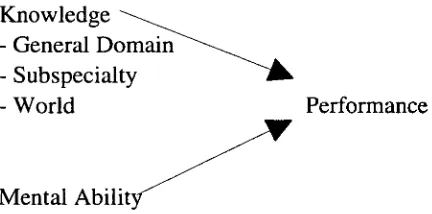
Using their model, Figure 1 illustrates the effect of knowledge and mental ability on performance whereby knowledge is combined with innate ability to perform specific
audit tasks. Three types of knowledge, general domain knowledge, subspecialty
knowledge and world knowledge; and an additional type of ability, general problem
solving ability, were identified as potential determinants of expertise. Bonner and
domain knowledge.
3°
Their study examined the specific types of knowledge and
ability necessary to perform accurately on each of the four audit tasks relating to
internal controls, ratio analysis, manipulation of earnings and interest rate swaps.
31
The results showed that more experienced auditors, on average, performed better in
the tasks and had more knowledge and ability related to the task. The results further
indicated, however, that the general experience variable explained less than 10% of
the variance in performance scores. Very specific measures of knowledge or task
specific experience and training often provided the best explanations of expertise. For
example, the variable that best explained variations in performance of tasks associated
with interest rate swaps was having the experience of auditing clients who engaged in
such swaps.
30
• According to Bonner and Lewis (1990, P. 3), general domain knowledge is defined as knowledge gained by most persons in a domain through instruction and experience. Subspecialty knowledge is acquired through formal instruction and experience, but only by persons in the subspecialty area. World knowledge is gained through life experience and instruction and is not likely to be possessed equally by persons of equal experience.
Knowledge
- General Domain
- Subspecialty
[image:36.551.56.272.109.216.2]- World
Performance
FIGURE 1 EFFECT OF KNOWLEDGE AND MENTAL ABILITY ON PERFORMANCE
Mental Abilit
The Bonner and Lewis (1990) conceptual model adapted from Libby and Luft (1993, Determinants of Judgement Performance in Accounting Settings : Ability, Knowledge, Motivation and Environment, Accounting, Organisations and Society, p. 433, Fig 2)
Libby and Luft (1993), in a descriptive paper, suggested a more complete model than
that examined in Bonner and Lewis (1990). The model recognised that:
1) there are only two classes of inputs in the model (abilities and experiences),
2) these two inputs cause the internal state of knowledge which is an intermediate
output variable, and
3) along with the direct effects of abilities, knowledge affects performance (an output
variable).
Consequently, one should not expect all experienced auditors to show superior
performance on all tasks. The level of expertise in a specific task is dependent on the
types of abilities and experiences an auditor possess.
Figure 2illustrates the effect of
experience and mental ability on knowledge and ultimately performance, as modeled
FIGURE 2 THE EFI-E,CT OF EXPERIENCE AND MENTAL ABILITY ON KNOWLEDGE AND PERFORMANCE
Experience
KnowledgeMental Ability Performance
Antecedents and consequences of knowledge (Libby and Luft, 1993, Determinants of Judgement Performance in Accounting Settings : Ability, Knowledge, Motivation and Environment, Accounting, Organisations and Society, p. 433, Fig 3)
Applying the model in Figure 2 whereby the audit judgement task allows different
knowledge and abilities to be acquired, Libby and Tan (1994) constructed separate
conceptual models for separate audit tasks. Libby and Tan (1994) extended the
Bonner and Lewis (1990) and Libby and Luft (1993) studies by developing a
framework to predict the structure and strength of knowledge, ability, experience and
performance for different tasks; the internal control task, ratio analysis task, earnings
manipulation task and the financial instrument task. The tasks in Libby and Tan
(1994) are similar to the tasks in Bonner and Lewis (1990). The internal control task
requires the detection of errors arising from deficiencies in the internal control system,
and identification of substantive tests that can be used to detect these errors. The ratio
analysis task requires the detection of a single low-frequency accounting error that can
explain the pattern of ratio changes. The earnings manipulation task requires the
identification of a reason for irregularities in the accounts, and the financial
instrument task requires the identification and specification of journal entries related
According to Libby and Tan (1994,
P.
703),
"... experience creates opportunities for the acquisition of knowledge, while
ability and effort determine the amount of knowledge acquired given that
experience. This knowledge acquired, along with ability and effort, then
directly affects performance. This performance in one period in turn affects
what an individual experiences in the next period ..."
In relation to the internal control task, Libby and Tan (1994) classified the knowledge
as moderately complex and as being acquired during the first three years of an
auditor's career. Therefore, knowledge and general experience are predicted to have
an effect on the performance of the internal control task. Furthermore, the task is
described as structured, the problem is well defined, the alternative solutions and
relevant information as well specified; and no computations or backward reasoning
are required. As such, no effects of problem-solving ability on knowledge or
performance are predicted in the model.
Figure 3describes the Libby and Tan (1994)
performance model in relation to the direct effects of general audit experience on
internal control knowledge and finally, on performance.
FIGURE
3 EFFECTS OF GENERAL AUDIT EXPERIENCE ON INTERNAL CONTROL KNOWLEDGE AND PERFORMANCEGeneral Experience -10. Knowledge
‘11! Performance
Model of Performance of Internal Control Evaluation Task (Libby and Tan, 1994, Modeling the Determinants of Audit Expertise, Accounting, Organisations and Society. p. 706, Fig 3a)
In Libby and Tan (1994),
specific results for the internal control model indicated that
on performance for the internal control evaluation task which suggested the possibility
of automaticity developing from experience. General experience also had an impact
on the development of knowledge relevant to task performance. Furthermore, the
ability-knowledge link and ability-performance link were not significant which
confirmed the prediction that there was no ability effect on performance and
knowledge in respect to the internal control task. The knowledge-performance link
was significant when self ratings were used as a measure of knowledge but was not
significant when knowledge was measured by an objective knowledge test.
The studies cited above classified internal control knowledge as general domain
knowledge. Furthermore, only general experience is predicted to have an effect on
internal control evaluation knowledge and performance. As indicated in the previous
chapter, this study continues to investigate internal control knowledge and
performance, but predicts that extensive internal control experience
-
reinforces the
internal control knowledge. The level of knowledge has an ultimate effect on the
performance of the internal control task. Audit experience of clients with reliable
internal control structures and financial institution audit experience serve as two
proxies for extensive internal control experience. This concept is explored in more
detail in the theoretical model development chapter.
SUMMARY
Early research has generally investigated the effect of experience operationalised by
years of experience on internal control judgement based on the instrument developed
to explain variances in internal control evaluations. To date, there has been no study
investigating the effect of extensive audit experience on internal control knowledge
and internal control evaluation, where extensive audit experience includes audit
experience of clients with reliable internal control structure and financial institution
audit experience.
The most predominant instrument that has been utilised in prior studies is the set of
hypothetical internal control situations developed by Ashton (1974), whether in the
original or modified form. A modified version of the instrument developed by Ashton
(1974) is used in this study. Its structure and content are described in detail in Chapter
V. The common measures of expertise, such as tenure and years of experience, are
also examined to determine the impact of general experience on internal control
knowledge/judgement. The following chapter develops hypotheses predicting the
CHAPTER 4: THEORETICAL MODEL AND
HYPOTHESES DEVELOPMENT
INTRODUCTION
This study extends the internal control model by Libby and Tan (1994) in at least three
ways. First, in addition to general experience, a second input variable (extensive
internal control experience) is predicted to affect the intermediate variable, internal
control knowledge, and the output variable, performance of the internal control task.
Second and as a consequence of the first extension, the experience variable is
operationalised using compliance based audit experience and financial institution
audit experience. These variables have not been operationalised as such in prior
research. It is proposed that both types of experience assist in explaining the factors
affecting internal control knowledge and performance. Third, consensus has
traditionally been treated as a surrogate for accuracy as a performance measure. This
study treats accuracy and consensus as different concepts. It links the level of
accuracy of internal control knowledge and level of consensus in internal control task
performance. It is predicted that high knowledge accuracy leads to high levels of
consensus and self insight in the performance of the internal control task.
Prior research has investigated the relation between general experience and internal
control knowledge and/or performance. In contrast, this study examines the effects of
extensive internal control experience on the internal control knowledge and
performance model. This relation is expected to exist due to the need for extensive
and the additional emphasis on compliance testing in financial institution audits due to
the additional reporting requirement on internal control adequacy in AGS 1008.
EXTENSIVE EXPERIENCE EFFECTS ON KNOWLEDGE AND PERFORMANCE
Most studies of expertise have divided subjects into groups of experts and novices on
the basis of years of experience or tenure-based titles (Bonner and Lewis 1990, p. 2).
Others have viewed auditor expertise in terms of the kinds of knowledge and ability
acquired through variations in:
1) the firm (Gaumnitz et al, 1982; Hamilton and Wright, 1982; Bonner, 1990; and
Spires, 1991),
2) industry experience (Ashton, 1991; and Libby and Tan, 1994),
3) client size (Ashton, 1991; and Hackenbrack, 1993).
Different clients present different challenges to their auditors. For clients with
adequate internal control structure in place, auditors place a greater reliance on the
internal control structure and perform more compliance testing relative to substantive
testing. The frequent exposure to internal control reviews is termed compliance based
audit experience. The compliance based audit experience, through emphasis on the
internal control structure will also reinforce the knowledge of the auditor and enhance
the performance of the auditor in relation to internal control audits.
Furthermore, the prudential supervision performed by the Reserve Bank of Australia
requires financial institutions to develop an adequate internal control structure. Due to