Pathways to graduate research
Quynh Lê
Department of Rural Health, University of Tasmania,
Australia
Abstract
Keywords: graduate research, academic research, research courses, research and higher degrees
Introduction
I could not help drawing an analogy between a graduate research student and a lively, active and youthful rivulet. If all these rivulets join together, what a dynamic and powerful river they would form! This imagination brings to me images of a mighty river which gives vigour and vitality to the land and makes it more fertile. Similarly, our students are a source of strength and inspiration which could easily create a dynamic river of academic research discourse. The challenge for staff as well as students is how to fully appreciate and cultivate this unique phenomenon, and turn imagination and hope into reality.
Graduate research is not a separate entity. It is a fundamental component of the context of university research. It maintains the vitality of a university in its quest for more knowledge and research impacts at various levels within and outside a university. This chapter examines aspects of graduate research such as rationale, pathway, and graduate research enhancement.
Why graduate research?
many reasons for undertaking graduate research courses. Individuals make decisions on the grounds which reflect their academic strengths, personal interest and cultural traditions. The reasons for undertaking a graduate research course can be summarised as:
A career in academia: A graduate research qualification is necessary.
Job requirement: A common requirement in the selection criteria for a lectureship is PhD qualification or substantial progress toward a PhD.
Intellectual challenge: The continued challenge and enjoyment of independent research are for many rewards in themselves.
Employment: Graduates from graduate research programmes are highly employable, particularly in research-orientated enterprises.
Common pathways to graduate research
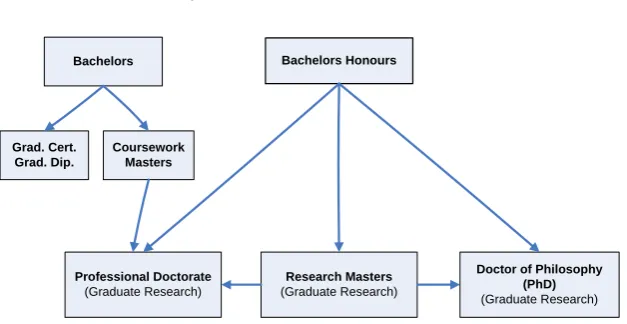
It appears that most Australian universities share a common pathway from undergraduate courses to research courses. There are some slight differences in terms of length, entry requirement, coursework and research component and assessment. Basically the pathways to graduate research can be illustrated as follows:
Bachelors Bachelors Honours
Coursework Masters Grad. Cert.
Grad. Dip.
Professional Doctorate
(Graduate Research)
Research Masters
(Graduate Research)
Doctor of Philosophy (PhD)
(Graduate Research)
[image:4.595.131.445.219.381.2]Pathways to Graduate Research
Figure 1: Common pathways to graduate research
categories of courses: research only, coursework only and courses with a mixture of research and coursework. This is referred to as “structural pathway”. Masters preliminary course is a kind of “bridging program” which suits those who are not quite ready for direct entry into the research masters course and need to improve their research ability.
There are two interesting issues here. First, the traditional pathway does not favour students who may not have outstanding academic results at the undergraduate or postgraduate levels but who have great interest in research and may wish to switch to a research pathway
later. Second, there is a difference between undertaking a research degree course and participating in a research discourse. The traditional structural research pathway, if not flexible enough, can create a rigid division between research and learning, while in reality these two aspects are not mutually exclusive.
In a few universities, there is also an alternative structural pathway with a research emphasis for outstanding students starting in the first year of their undergraduate courses. The Bachelor of Philosophy (Honours) is an initiative which attempts to incorporate research into the bachelor course from the beginning. It is a research focused degree first introduced in the Faculty of Science for intellectually ambitious students who want to study at the highest level. Each student receives intensive individual attention from an academic supervisor who acts as a research mentor. Gradually, other faculties have also introduced the Bachelor of Philosophy (Honours) into their undergraduate programs.
The Bachelor of Philosophy (PhB) degree is flexible in its structure, with a student’s program being determined each year in collaboration with the program convener. One quarter of studies in the first three years consists of individually tailored advance studies courses, specifically designed to provide students with a strong base in research (The Australian National University, 2007).
Australia. The BPhil's earliest form is graduate degree at the Oxford University. Other universities have introduced this model in their undergraduate course such as the University of Newcastle upon Tyne, Miami University, University of Pittsburgh, Northwestern University, and University of Birmingham.
Early research enhancement
In Australian universities, students tend to take a long pathway to reach the level of academic research, that is, from undergraduate, postgraduate either by coursework or coursework with some research, Masters Honours to research thesis. During undergraduate education, students are introduced to basic knowledge of a certain discipline and receive training for their chosen future profession. They enter postgraduate education for the purpose of professional and vocational qualification and enhancement and postgraduate programmes are mainly teaching based courses. Students have little access to research training or experience until they undertake Research Masters or PhD.
the previous years, particularly those who will not take the Honours course. However, those without outstanding results should be given opportunities to participate in research-orientated activities if they show great interest and potential.
The following strategies and activities can be incorporated into a research acculturation program for those who have not been included in the traditional graduate research pathway model. The acculturation program may not be an academic unit in itself but it should offer a research induction experience. Here are some suggestions:
Students are introduced to research methodology in
undergraduate courses.
Students are regularly informed of new research issues, particularly in education.
Each student will be paired with a staff member or a graduate research student (current or past) who acts as a research mentor.
Students are invited to attend research seminars.
Students are encouraged (and helped with editing) to publish their papers in journals and to participate in local and international seminars/conferences (if financially viable).
At the end of each academic year, participating students receive a letter commending their participation.
As some students could be discouraged by any extra programs and academic experiences which put more pressure and workload on their current undergraduate or postgraduate program, it is important to assure them that the program is flexible to accommodate their interests and changing situations.
Students should be guided to develop a research-orientated portfolio which may include the following items:
Developing a research pathway in close consultation with a mentor;
Developing a yearly portfolio which should include items such as: interesting/useful research articles, notes, questionnaire samples;
Writing reflective notes or journals on research ideas and issues;
Writing a list of references;
Attending regular research seminars specifically organised for this program;
Communicating regularly, face-to-face or by email, with others in the department/faculty;
Writing notes on various research seminars and conferences of interest.
“I doubt, therefore I think, and therefore I am”
The Latin expression “I doubt, therefore I think, and therefore I am” highlights the nature of research. I borrow Descartes’ (1637) statement in his book Discourse on Method “Je pense, donc Je suis” ( I think therefore I am) to describe a common phenomenon of graduate research as all research starts with doubt and questioning as the basis of Western philosophy with an emphasis on rationalism. The following graphics can be used to illustrate the initial stage of some graduate research students in many universities.
Source: Adapted from My PhD Study Life (Sempé, Bugeaud, Mignotte, & Normandin, 2006)
You spend hours and hours searching without finding anything.
Source: Adapted from My PhD Study Life (Sempé, Bugeaud, Mignotte, & Normandin, 2006)
Not everyone knows exactly what they will do for their research. While some students feel confident right at the beginning of their research journey, there are a few who find the first year a traumatic experience. Here is the frustrating voice of a graduate research student in a university.
years wishing they had put that year to better use. Unfortunately nobody ever warns you about this. In fact the Wasted First Year is just one of many PhD hazards that nobody ever warns you about - followed by loneliness, poverty, and tutors who think that it is their responsibility to ensure that you suffer as much as they did.
(Zuram, 2005)
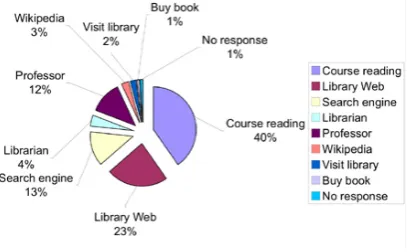
[image:12.595.185.389.290.416.2]The following diagram shows the first step in graduate research from an exploratory study (Head, 2007) on how students majoring in humanities and social sciences use the Internet and library resources for research.
Figure 2: The first step in the student research process.
Source: Beyond Google: How do students conduct academic research? (Head, 2007).
Emotional intelligence!
It is not uncommon to hear comments from some graduate research students such as:
I do not use quantitative methodology in my research because I am not good at statistics.
I have to follow the advice of my supervisors as I do not want to offend them and they are the ones who know best!
I am worried as my thesis has only 221 pages while others have much more. Is mine good enough?
I feel scared and want to give up if I hear that someone has done a similar research topic at another university. What is the point of doing something which has been done by others?
Developing a personal research profile
When students embark on a graduate research course, the main thing in their minds is to complete the thesis as soon as possible so that they can “go on with life” after years of research and thesis writing. In the current research context, students are encouraged to develop their research profile during their candidature.
Apart from focusing on writing and completing a research thesis which is the ultimate goal of all graduate research candidates, they should be encouraged to develop their research profile so that it enhances their research pathway or career opportunities before and after graduation. This includes conference presentations, session chairing, being a member of a conference organisation team, publications in a journal, book or conference proceedings, and so forth.
Traditionally graduate research students attend conferences to learn from experienced researchers and they tend to play a passive role. Nowadays in small research seminars as well as major conferences, we notice the prominent presence of graduate research students playing an active role in organising, presenting research papers, and conducting research-orientated activities. There are also conferences organised specifically by and for graduate research students.
are given special conference registration rates or granted conference travel awards.
An issue which may be confusing and uncomfortable to students is about joint authorship with their lecturers. When a student works in a team on a “team based” research project, joint authorship is not an issue. The names of the team members should be the joint authors’ names. The reason is that everyone in the team works closely together. However, conducting a PhD is a different matter. Students are the main agents responsible for the management of the research. Supervisors are academic mentors. Thus, joint authorship is not just an interpersonal matter between graduate research students and their supervisors. It can reveal problems and issues about social relationship, control power in the decision making process and unethical discursive practices which need to be critically examined. Students are often in a vulnerable position to negotiate this matter. My personal view is that students should acknowledge their supervisors in a statement, but not as joint authors unless the supervisors write half of the papers.
Enhancing research networking
intellectual isolation, which can be unhealthy intellectually, socially and emotionally.
It is important that students are active members of various research discourses. They should be encouraged to engage in networking with other research students, colleagues and experts locally, nationally and internationally. Isolation and lack of interaction can make your academic life unproductive. In a research context, the limit of our interaction is the limit of our research world. Thus, networking is important for expanding our research horizon in terms of professional relationship and knowledge enhancement.
Graduate research and early career researchers
The recent emergence of the Research Quality Framework (RQF) in tertiary education in Australia has created a need for a revision of or a fresh look at the way research is promoted, assessed and valued. The RQF is an initiative developed by the Australian Government’s Department of Education, Science and Training (DEST) with the main aim to assess the quality and impact of publicly funded research at Australian universities and other research-orientated institutions.
terms of research productivity, enhancement of research environment, cultural diversity, internalisation of research and finance. The long term gain for universities is the connection between graduate research and early career research.
Metaphorically, it is important to nurture young plants for maintaining the foundation and continuation of research in an institution. Both universities and the Australian Research Council recognise the potential contribution of budding researchers. They want to foster the careers of Australia’s bright and promising researchers. According to the Australian Research Council (2007) an early career researcher is onewho is currently within their first five years of academic or other research related employment allowing an interrupted or stable research development following completion of their postgraduate training, mainly PhD. Universities develop their own plans and strategies to ensure that graduate research students and early career researchers have opportunities to grow and later on become the mainstream of their research discourse.
Mentoring in research
fish. Parents coach their children how to cultivate their garden or rice field. Mentors act as a guide, a source of information, a sounding board and offer support and encouragement. This is natural mentoring. It is both a socialisation process and mentoring co-existence. However, in a university research discourse, natural mentoring is not enough. There should be a systematic approach to research mentoring for early career researchers as well as graduate research students.
Universities do take research mentoring seriously. However, their techniques, strategies and resources vary a great deal among these institutions. In some universities, the emphasis is on the research discourse of each academic unit such as department, school, division, faculty and inter-faculty collaboration. Research mentoring is about research capacity building, individually and collectively, and it is an important aspect of research discourse enhancement, particularly in a competitive research environment.
Conclusion
students not only think creatively and constructively but also feel positive about their research journey.
References
Australian Research Council (2007). Early Career Researcher. Retrieved 10 November, 2007, from
http://www.arc.gov.au/applicants/researcher_early.htm
Descartes, R. (1637). Discourse on Method. Retrieved 25 November, 2007, from
http://www.mala.bc.ca/~johnstoi/descartes/descartes1.htm
Gates, A., Teller, P. J., Bernat, A., Delgado, N., & Della-Piana, C. K. (1998). Meeting the Challenge of Expanding Participation in the Undergraduate Research Experience. In Proceedings of the 1998 Frontiers in Education Conference (Vol. 88, pp. 1133-1138). Tempe, Arizona.
Head, A. (2007). Beyond Google: How do students conduct academic research? [Electronic Version]. First Monday 12(8). Retrieved 20 November 2007, from
http://www.firstmonday.org/issues/issue12_8/head/#h2.
Sempé, J. J., Bugeaud, Y., Mignotte, M., & Normandin, F. (Artist). (2006). Cartoons cited from "My PhD Study Life", URL: http://www.macs.hw.ac.uk/~robertli/Academics/about%20my %20phd%20life.htm
The Australian National University. (2007). Study@ANU 2008, Bachelor of Philosophy (Honours) - Overview Retrieved 25 November, 2007, from
Zuram, D. (2005). PhD's, What they don't tell you Retrieved 25 November, 2007, from