Assessment: a tool for development and engagement in the first year of
university study.
Janet A Taylor
Learning and Teaching Support Unit The University of Southern Queensland
Abstract
For most students assessment often defines their study and learning practice, yet there are few discussions in the literature on the first year experience detailing how assessment can be mobilised to develop and engagement students in their first year of study. This paper presents the results of an audit undertaken at The University of Southern Queensland of the assessment associated with first year (termed level 1) courses. It is apparent that assessment is not been used to advantage to smooth the transition into university studies. The paper presents some examples of effective assessment practice to engage students and assist them in the development of self-regulatory skills, such as time management skills.
Introduction
Whether students study on campus or at a distance the transition into the culture of university can be complex and difficult (Lawrence, 2005). Krause, Hartley, James & McInnis (2005) indicate that although improvements have been made over the last ten years many students still have an uncertain start and one in four student will not stay at university. Contributing factors are those issues related to managing work and study. These issues have always been important for distance education students but are now also an issue for full time on campus students (McInnis &Hartley 2002) with at least 40% of students now working part-time while studying full time. Taylor and Bedford (2004) in a study of staff perception of students’ non-completion found that most staff believed the major contributing factors to non-non-completion were related to what students brought with them to university: their level of preparedness, motivation and abilities to manage study, especially self-regulatory behaviour. These
perceptions have been reinforced by Krause (2005) and confirmed by others investigating the predictability of performance of first year students (Zeeger, 2004; McKenzie, Gow &
Scweitzer, 2004; Byrne & Flood, 2005). In particular, Nunn, MacDonald and Lowen (1992) after interviewing adult students, held that it may take months for them to organise
It is generally believed and widely stated that assessment drives the student experience and hence student learning (Ramsden, 1992; Brown & Knight, 1994; Dunn, Morgan, O’Reilly and Parry, 2004). This was best stated by James, McInnis & Devlin (2002, p 7) in their definitive study of assessment practice with the Australian Higher Education sector.
For most students, assessment requirement literally defines the curriculum. Assessment is a potent strategic tool for educators with which to spell out the learning that will be rewarded and to guide students into effective approaches to study.
The central location of assessment within students’ perceptions of learning and studying means that it could be a powerful tool to engage students and address time management skills. Yet despite high levels of activity within the first year experience, assessment has rarely been mobilised to address recurrent concerns within the first year of study, with the exception of general statements indicating that assessment should be early and focussed on the formative rather than summative (Gibbs 2003; Thomas and Yorke 2003).
This paper reports on a preliminary analysis on the nature of assessment within the first year of undergraduate studies in a large regional transmodal university and presents some
examples of practice that allow for early student engagement and development.
Common practice in first year assessment
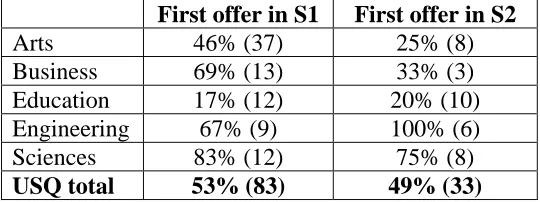
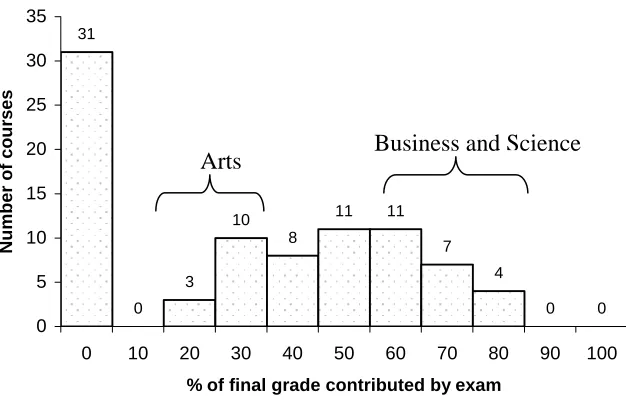
[image:2.595.163.433.555.656.2]This study was undertaken within the context of a large regional Australian university in which 70% of the 26 000 students study by distance and/or online learning. Each course at the university is required to define its curriculum, including assessment practice, using the course specification. This specification contains information on the mode of delivery, number, timing, weighting and nature of assessment. To investigate the nature of assessment within first year the course specifications of 118 level 1 courses were audited. The distribution of these courses audited between semester 1 and semester 2 and between faculties is detailed in Table 1. It was noted that of the 118 Level 1 courses surveyed 53% were assessed by final examination, with 13 courses including computer marked multiple choice types of questions in these final examinations.
Table 1: Percentage of Level 1 courses with examinations in 2005 out of total number of courses (in brackets)
First offer in S1 First offer in S2
Arts 46% (37) 25% (8)
Business 69% (13) 33% (3)
Education 17% (12) 20% (10)
Engineering 67% (9) 100% (6)
Sciences 83% (12) 75% (8)
USQ total 53% (83) 49% (33)
weightings for the examination in the final grade. These programs have significant numbers international students and students studying by distance education.
Figure 1: Number of level 1 courses in relation to the percentage weighting of the examination in the final grade,
31
0 3
10 8
11 11
7
4
0 0
0 5 10 15 20 25 30 35
0 10 20 30 40 50 60 70 80 90 100
% of final grade contributed by exam
Nu
mb
er of c
o
u
rse
s
Arts Business and Science
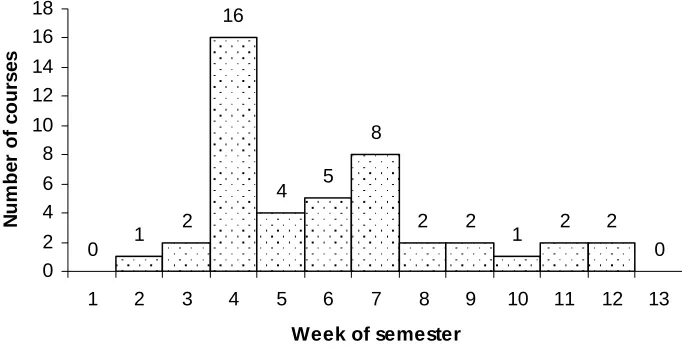
Continuous assessments (assignments) in the form of assignments were prevalent within in the first year courses audited, with the exception of one course within Business. The number of assignment tasks normally ranged between 2 to 4 with 47% of courses having 2 or less assignments, 32% having 3 assignments and 23% having 4 or more. Overall these assignment tasks were written tasks with the traditional essay still predominating, although some different practices were in place for the first assignment. For courses offered in the first semester of study the first assignment predominately occurred in week 4 (the week of the last day to drop course without financial or academic penalty – DEST census date), although some courses do delay this considerably into the semester (Figure 2).The assignment weightings ranged from 5% to 50%. Courses that had no examinations usually had higher weighting for the first assignments than course with examinations. The course audit did not reveal the extent to which formative assessment was used in first year course, but in an independent survey of staff only 7 out of 30 indicated that they used formative assessment tasks within their course.
Figure 2: Timing of the first assessment item for course offered in semester 1 of year 1.
0 1
2 16
4 5
8
2 2
1 2 2
0 0
2 4 6 8 10 12 14 16 18
1 2 3 4 5 6 7 8 9 10 11 12 13
Week of semester
N
u
m
b
e
r of
c
our
s
e
s
Assessment practice for engagement
The examples described here are from a large first year service mathematics course which in 2006 enrolled 800 students (250 on campus, 550 by distance education). The course has a complex curriculum structure which requires students to be well organised to be able to successfully complete the courses. The following assessments were solutions developed to assist students to manage themselves and this course during their transition to first year. Details of the course have been described in Taylor, McDonald and Mander (2004).
The early assignment
Although at the university under study the majority of courses have assignments by week 4 of the semester, assessments can be as early as week 1 or 2 if the assessment is designed to force engagement with the students. This strategy is especially important for distance education students who without this forced engagement have no external prompts to start their study (no lectures or tutorials etc). An early assessment task can take many forms it can be a reading or reflective task that gets students to reflect on their beliefs about the subject, how they have studied that subject in the past, alternatively it can be used to confirm essential information that should have cleaned from the introductory and web –based materials. Such an assignment requires very little marking time, but allows the staff to identify students who are uncertain or have poor attitudes to learning of the subject and to commence the development of their relationship. This latter point is particularly important to distance education students who often isolated in their learning. The first assignment can also be used to develop a personal plan of action for study in the course over the ensuring semester. The following assignment includes all three components within the one assignment.
This assignment task (Box 1) asks students to reflect on their past mathematical experiences, to confirm vital information about how the course operates and to develop a study plan for the course. It is compulsory and is completed in week 2. This assignment is designed to engage students early, ensure that students reflect upon their past mathematical experiences and commence self management of their tertiary environment. Through the reflective questions embedded within the assignment it confirms (or otherwise) to the tutors that
follow-up or identification of students at risk if necessary. Further, it commences the development of a relationship between the University (via the tutors) and the student; an important component of successful transition to university studies.
This assignment is a cross between summative and formative assessment types and is termed a ‘hurdle’ in that although students are required to complete it (compulsory) it will not contribute any weight to their final grade. Later assignments in the course follow up with further reflective activities to ensure that students are aware of how they are progressing.
Student have mixed feelings about this type of assessment and are of the surprised by its reflective and discursive nature especially in a mathematics subject. Yet in a course
evaluation undertaken 8 weeks after commencement of the course 69% of students indicated they were using their study plan to assist with their study requirements…for example.
Making us do a study plan. I thought it a bit stupid and irrelevant at first but was in fact the most useful and helpful thing for maintaining the workload evenly throughout the semester
Other strategies can be used in this first early assignment depending on the nature of the subject. But anything that gets students to actual stop and think about how they learn and then to produce a plan for the semester and allows personal contact between the lecturer and students (especially for distance education students) would achieve the aims.
Box 1
Assignment 1 Due end of week 2
This assignment involves a reflection on how you learn mathematics and formulation of a study plan. Details are included at the end of the study book. To complete the assignment you will need to read the sections on How To Study Maths Successfully and Producing A Plan For Study of Foundation Maths located in the Toolbox section of this book.
Part 1
Write a few words about your past mathematical experiences and how you feel about studying Foundation Mathematics. Do you think your past experiences might affect your learning in this subject?
Part 2
Develop a study plan for Foundation Mathematics by completing the proforma on the following page or using the plan you developed in Activity 2 in the Foundation Mathematics Toolbox.
Part 3 (11 questions, examples only given)
Answer the following questions:
• If you have any concerns about this course, who should you contact and how would you contact them?
• What does ‘due date for an assignment’ mean (see the Assessment Notes in the Course Specification)?
• Only under special circumstances are late assignments permitted. What do you need to do if you anticipate that you will be late submitting an assignment?
• List the assessments that you are required to complete for this course and give the corresponding due date for each. Make sure that you include this information in your Study Plan.
• Please confirm by signing the declaration below that you have access to the internet and are aware that participation in discussion groups is a compulsory part of the assessment for this course.
Signature: Date:
Students who are not able to fulfil this requirement should contact the course leader.
Student have mixed feelings to this type of assessment and are of the surprised by it especially in a mathematics subject , but in a course evaluation 69% of students indicated they were using their study plan to assist with their study requirements…for example
Making us do a study plan. I thought it a bit stupid and irrelevant at first but was in fact the most useful and helpful thing for maintaining the workload evenly throughout the semester
Other strategies can be used in this first early assignment depending on the nature of the subject. But anything that gets students to actual stop and think about how they learn and then to produce a plan for the semester would achieve the aims.
Assessments designed to keep students on task
Again these assignments can be a cross between formative and summative in the form of hurdles or purely summative. These assignments however, should focus on the course objectives, rather than skill development. The use of computer marked assessments (CMA) are a useful way to reduce or eliminate the marking times associated with these tasks. In this example mathematics skills are self-assessed by the student using a series of online quizzes (multiple choice and short answer questions). Immediate feedback is given following an online submission allowing students to monitor their progress. Students have access to
multiple alternative quizzes so that they can achieve mastery by attempting a different version of the quiz several times before progressing to the next module. Quizzes are completed online at times determined by each student and reported in their study plan in assignment 1. Some quizzes in the earlier modules are compulsory but do not contribute tho their final grade, quizzes later in the course are summative but only contribute to 6% of the final grade. Students are required to complete certain groups of quizzes by specific dates throughout the study, ensuring that the stay on task throughout the semester. Before this procedure was instituted quizzes were not completed until the final submission date. A mathematics skills are also assessed in other assignments and in the examination, but the purpose of these quizzes is to ensure that students complete and practice their mathematical skills regularly rather than leave it to final assignment or examination times.
Model of assessment for students in transition
The core of any assessment plan for a course involve three principles. One associated with development and learning, one associated with measurement of outcomes (validity and reliability) and one associated with academic standards (James, McInnis and Devlin 2002). Yet today issues associated with measurement and standards are more commonly addressed at the expense of the need to develop and engage effective student learning (Gibbs, 2003). This need is very high in first year students; especially those studying at a distance, yet few have developed strategies to fill this need in the area. This paper presents two brief examples of how this was achieved in a first year mathematics course. But there are many alternatives that can be taken up in other subject areas. These alternatives would have their own set of general principles associated with the nature of the task, the contribution to the final grade and the amount of effort required by markers. The principles described below are detailed in Figure 3.
This assignment should be brief, reflective, looking backwards and forwards, produce a plan for study or a learning contract. The assignment should have a zero weighting, but can be compulsory. Marking time would be minimal.
Second assignment
This assignment can be summative but developmental. It could have a low weighting, but be allocated higher levels of marking time so that significant feedback could be provided. The assignment could involve the production of a draft for a later assignment, a reflective reading log, components of a portfolio, laboratory reports or online discussion group submissions.
Later assessment tasks
These are the more traditional assessment tasks and could include examinations, final essay, complete portfolio. The weight for these assignments would be high, but marking time lower if significant feedback had been incorporated into earlier assignments.
Continuous self- assessment
To ensure that students continuously participate in the course and not just at assignment and examination due dates, continuous assessment should be incorporated in the course from week 4 (at least). Designed well and the marking time would be zero. These could be summative (with low weighting), formative or hurdles. Incorporation of such learning / assessment tasks is essential for students studying by distance education.
The pressure of resources, fears associated quality and fears induced by plagiarism have meant that assessment change as a strategy to improve first year experience has been largely unexplored. This paper commences that exploration.
Figure 3: Strategies for assessment
Low % - Summative High feedback
High %
Summative
Reduced to no feedback
0 %
Hurdle Low feedback
Examples:
Reflective activity Study Plan Contract
Examples
Draft essay Reading log
Notes on literature review Components of portfolio
Examples
Examination Final report / essay Portfolio
1 2 3 4 5 6 7 8 9 10 11 12 13
Self assessment either formative or partially summative - No marking time
Week from beginning of semester
Acknowledgements
References
Brown, S. & Knight, P. (1994) Assessing learners in higher education London, Kogan Page. Byrne, M. & Flood, B. (2005) A study of accounting students’ motives, expectations and
preparedness for higher education. Journal of Further and Higher Education 29(2), 111-124.
McInnis, C. & Hartley, R. (2002). Managing Study and Work: The impact of full time study and paid work on the undergraduate experiences in Australian universities,
Evaluations and Investigation Program, DEST (2002), Australia, Retrieved 22 October 2002, http://www.dest.gov.au/highered/eippubs/eip02_6/eip02_6.pdf
Dunn, L., Morgan, C., O’Reilly, M and Parry, S. (2004) The Student Assessment Handbook. London UK: RoutledgeFalmer.
Gibbs, G. (1999). Using assessment strategically to change the way students learn. In Brown, S and Glasner, A. (eds) Assessment Matters in Higher Education: Choosing and Using Diverse Approaches. Society and Research in Higher Education and Open University Press: Buckingham, UK. p 41-53.
Gibbs, G. (2003) Implementing learning and teaching strategies. National Coordination Team Teaching Quality Enhancement Fund. Open University press Retrieved March 2006 http://www.headacademy.ac.uk/documents/ilts.pdf
Hattie, J., Biggs, J. & Purdie, N. (1996) Effects of learning skills interventions on student learning: A meta-analysis. Review of Educational Research 66(2), 99-136
Taylor, J.A. & Bedford, T. (2004). Staff perceptions of factors related to non-completion in higher education, Studies in Higher Education, 29 (3), 375-394.
James, R. McInnis, C and Devlin, M. (2002) Assessing Learning in Australian Universities. Centre for Higher Education Studiers and Australian University Teaching Committee, Australian Accessed March 2006. http://www.cshe.unimelb.edu.au/assessingleanring Krause, K. (2005). Serious thoughts about dropping out in first year: Trends, patterns and
implications for higher education. Studies in Learning, Evaluation, Innovation and Development 2(3), 55-67. http://sleid.cqu.edu.au
Krause, K., Hartley, R., James, R. & McInnis, C (2005) The First Year Experience in
Australian Universities: Findings from a decade of national studies. Canberra: DEST. Lawrence, J. (2005) Re-conceptualising attrition and retention: integrating theoretical,
research and students perspectives. Studies in Learning, Evaluation, Innovation and Development 2(3), 16-33. http://sleid.cqu.edu.au
McKenzie, K., Gow, K. & Scweitzer, R. (2004) Exploring First-Year Academic Achievement Through Structural Equation Modelling, Higher Education Research and
Development 23(1), 95-112.
Nunn, P., MacDonald, C. & Lowden, K. (1992) Helping adults cope: mature students on science, mathematics and engineering courses. The Scottish Council for Research in Education Report 59 (1992), 1-52.
Cerrito, P.B. and Levi, I. (1999). An Investigation of Student Habits in Mathematics Courses.
The College Student Journal, 33(4): 584-588.
Ramsden, P. (1992) Learning to teach in higher education London, Routledge.
Environments, Proceedings of the 15th Australasian Conference for the Australasian Association for Engineering Education, Faculty of Engineering and Surveying, University of Southern Queensland, Australia, 27-29 September, 2004, p 164-172 Thomas, L & Yorke, M. (2003). Improving the retention of students from lower
socio-economic groups. Journal of Higher Education Policy and Management 25(1), 63-74. Zeegers, P. (2004). Student Learning in Higher Education: A Path Analysis of Academic