Rochester Institute of Technology
RIT Scholar Works
Theses
5-7-2019
Senso - A real-time interactive mobile system to
improve users’ overall skin condition
Wenyue Zhan
Follow this and additional works at:
https://scholarworks.rit.edu/theses
This Thesis is brought to you for free and open access by RIT Scholar Works. It has been accepted for inclusion in Theses by an authorized administrator of RIT Scholar Works. For more information, please [email protected].
Recommended Citation
Senso - A real-time interactive mobile system to
improve users’ overall skin condition
Wenyue Zhan
Visual Communication Design School of Design
College of Art and Design
Rochester Institute of Technology May 7, 2019
Thesis Committee Members
Chief Advisor Mike Strobert
Lecturer, Visual Communication Design Graduate Co-Director School of Design, College of Art and Design
Associate Advisor Daniel DeLuna
Associate Professor
School of Design, College of Art and Design
Associate Advisor Miguel A. Cardona Jr
Assistant Professor
Contents
Abstract
Introduction
Context
Situation analysis Proposed solutions Target Audience
Method
Ideation
Project implementation Design Exploration
Result
Final solutions
Evaluation
Conclusion
Abstract
Healthy skin is a critical part of overall health for everyone and not only important for appearance. Useful information about the skin is often overwhelming, misleading, or difficult to obtain. There are many factors that affect the skin’s condition, from environmental conditions like UV, humidity, or lifestyle factors like diet and the amount of sleep a person gets to specific ingredients in cosmetics. All this makes the effective management of skin health time consuming and inaccurate without knowing where to find the
right information.
This project explores a theoretical system that is designed to help users understand and manage their skin health by simplifying information and bringing it to the surface. This will enable be more aware of their skin health without being overwhelmed. Using environmental and biometric sensors, along with user generated data, my system is designed to collect a variety of information related to skin health and then present it to users in an accessible and digestible format. The system will perform an analysis to inform users of their overall skin health and of anything that may negatively affect it. Based on each user’s profile and collected data, the system will generate customizable, personal skin care solutions.
Introduction
The skin, our bodies’ largest organ, has multiple essential functions, such as protecting us from microorganisms and environmental stress, regulating body temperature, manufacturing vitamin D, and transmitting touch sensations to the brain.1 However, skin health can pose serious problems for people
everywhere. About 26 percent of people in the U.S. have been affected by skin problems ranging from common acne to skin cancer.2 The right skin care will effectively protect skin from disease and improve
overall skin condition, enhancing both quality of life and health.
Taking good care of skin is complex, as there are many factors that affect overall skin health. These include the environment, genetics, lifestyle, and skincare products. While there are many ways to access skin health information, it is easy to be misinformed or confused. Many products give misleading or inaccurate information, and there is much contradictory information. Often, the factors affecting skin conditions can only be observed in long-term studies. This makes it difficult to make connections on which behaviors, factors or products are contributing to a specific skin problem. For example, some cosmetic products may harm skin over the long term.3 Users may not fully understand what many of the ingredients
are and can be unaware of harmful effects. In some cases, even dermatologists cannot come to a conclusion or provide solutions to improve persistent skin conditions.
With access to better information and an increasing number of ways to measure and communicate metrics that affect skin health, people can make better choices to improve existing or persistent
conditions. The goal of this system is to present the user with customized solutions and useful data that will let them take control of their skin health without being overwhelmed.
My project is designed to use environmental and biometric sensors to collect data related to skin health. It will collect information on biometric and environmental conditions, such as skin hydration or UV
exposure. It will also connect with other apps to gather information on products currently in use, as well as weather and sleep data. The App will then represent that data to the user using graphs and other visuals to achieve better communication. The system will provide solutions based on each user’s profile and preference. The user will be recommended different options and choose the preferred ones to improve skin condition. Feedback will be sent back to the system to generate more personal solutions to improve the user’s experience in the future.
The research conducted for this project is:
- Determining the range of current portable sensors and which categories of data can be collected by those sensors.
- A listing of the categories of data that need to be collected and how they affect skin health.
Context
Situation analysis
As mentioned before, my project needs to collect both biometric and environmental data using a skin sensor. Therefore, the following text will discuss the current state of technology relating to similar sensors and what data needs to be collected.
The technology of sensors has developed rapidly in recent years and are used to gather data for
commercial and personal usage. For example, the average smartphone is a widely used device and may contain more than 15 types of sensors. It includes the accelerometer to detect movement and record walking distance for the day, heart rate sensors supported by optical sensors, and air sensors to report air temperature and humidity to users.
Supplementing the smartphone, there are many different types of sensor devices ranging from vests measuring heart-rate, breathing, stress, sleep, and activity levels, to small sensor modules that are connected to a smartphone to enable the user to check whether the user’s food is organic and other qualities.3,4 Wearable skin sensors are a current trend that enable both versatile and specific data
collection and are now made at a conveniently small size. They can measure stress hormones, alcohol, blood glucose levels, and even replace blood test for patients suffering from diabetes.5 The potential of
the skin sensors is huge and an expansion of their capabilities is on the way.
Due to the potential functions and the daily wearability of skin sensors, I will explore the use of a skin patch as my device of choice to collect both biometric and environmental data for building a personal skin profile.The following content will discuss the main factors that have a significant influence on skin health that will be collected to build a personal skin profile for my app.
Research of sensor
Factors affecting skin health
I will focus on four main factors that have a leading influences on skin health; nutrition, lifestyle factors, environmental factors, and cosmetics.
Nutrition
Nutritional factors have a close relationship with skin health. For example, vitamin A will be converted to retinoic acid that helps the body replace old damaged skin with healthy new skin and also plays other important roles in skin health.7 Antioxidants, which are obtained from different kinds of food
recommendation feature of the Apps system after analyzing the damage caused by other factors like lack of sleep or high UV exposure.
Lifestyle factor
Lifestyle factors mainly include stress, activity, and sleeping levels. Stress will negatively affect skin function and chronic stress will increase the process of skin aging.9 Proper physical exercise will increase
the blood flow to refresh the skin cells and keep them lively, which helps improve overall skin health.10
Sleep has a similar effect as exercise as it is the process the skin uses to repair the damage to cells accumulated during the day. The App’s system will monitor these crucial factors using the sensor patch and data input by the user, then address the problem, such as helping the user sleep earlier by playing relaxing music. However, it may be hard to improve lifestyle habits in a short time due to specific working or personal conditions. Wherever possible, the system will give other solutions to make up for the negative influence caused by unhealthy lifestyle factors.
Environmental factors
The leading environmental factors that cause skin problems includes UV radiation, air pollution, and unacceptable air humidity levels. UV is possibly the most important factor triggering serious skin disease. It can cause DNA damage in cells which can cause the development of skin cancer. Most environmental conditions cannot be changed but can be improved in many different ways. The App system will inform the user of potential harm from the environment and provide different solutions to prevent negative environmental influences on the skin.
Cosmetics
Applied factors are the chemical components of products that have been applied to the skin. Skin products can be helpful for improving skin condition but may also be harmful to the skin in the long term. Most users cannot fully understand what components on the labels mean and have possibly been misled into choosing products that are harmful in the long run but give short-term benefits.11 For example,
parabens have been used as preservatives in skin products like shampoo, makeup, and face cleanser. However, it has estrogen-mimicking properties that have been linked to an increased chance of breast cancer.12 Another example might be a sunscreen that protects against UV damage but has harmful
ingredients. It is hard to totally avoid using skin products that have a negative influence on the skin just by checking information online for each product, making it is difficult to figure out whether a skin product fits a specific skin condition. To solve this problem, the app will be designed to have functions that show which components a product contains and provide alternative products used by others who have similar skin conditions.
Proposed solutions
To record long-term skin data for further analysis, this project will use a skin patch to gather environmental and biometric data related to skin health. The data gathered by the sensor will be represented with graphs and standard values instead of pure units and numbers. The user will be warned of potential harm to the skin if the data moves out of an acceptable range. The system will also ask the user to scan the cosmetic products or automatically acquire a list of cosmetics the user is currently using from the Apps used to buy those products. An analysis report will be generated based on what components the products contain. It will also present whether the components are good for skin and how it fits the user’s skin condition. After data algorithm and analysis, the App will provide personal solutions to the user. The system will record what options are preferred by the user and improve the user experience in the future.
Target audience
Methods
Design Ideation
The idea of this project started with a desire to build a cosmetic product management app to help users record their product expiration dates. The original app could also help the user to pick products without harmful ingredients and help them to know what products really fit their skin condition to enhance skin health and reduce confusion.
To provide personal product recommendations, a customized skin profile needs to be established for individuals. This is where the concept of a biometric sensor came from. With the sensor, the project will be able to gather personal information related to skin health. Then, the data will be displayed to the users,letting them know what the data means and what is happening with their skin. After data interpretation, it will give both product and lifestyle recommendations to ensure holistic skin health.
Project implementation
Flowchart
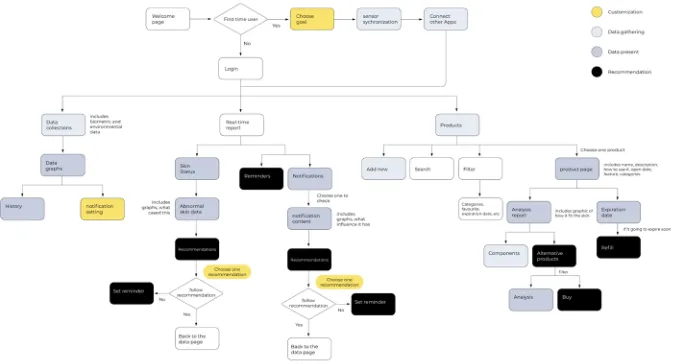
The flowchart shows the structure of the App. There are three main parts of the application; data
[image:10.612.141.478.522.704.2]collection, real-time reports, and product management. Data collection includes two parts; biometric data and environmental data. There is also the option to check history curves of the data. Reports include real-time skin status graphs and notifications. Users can check skin hydration, oil, hygiene, anti-aging, and pore-tightness from the graph. If anything can possibly harm skin in the short-term, the user will receive notifications. Through the notification the user will be able to determine the problem and decide what to do to prevent potential harm. Product management is the collection list of user’s currently used skin products. On the individual product page will be included basic information like product descriptions, instructions, purchase dates, and features. It will also show an analysis of how a product fits the user’s skin and whether the ingredient are safe. Users can purchase new products or refill the old ones through the App after they read the analysis.
Figure 1. Flowchart
The development of the App focuses on four main aspects; user customization, information gathering, information communicating, and recommendations of solutions and products. The four colors in the flow chart (Figure 1) distinguish different features and functions in the App structure as shown in the flowchart.
User customization
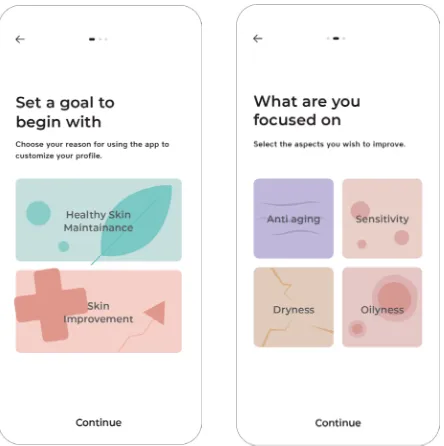
Users need to choose which skin features need to be improved and product preferences at the beginning of using the App. This customization process will help the system’s algorithm to generate product
[image:11.612.73.295.261.484.2]recommendations to meet the user’s stated purpose. I tried to simplify the customization process by giving multiple choices for each question. Colors and illustrations were applied to make this process more intuitive and fun.
Information gathering
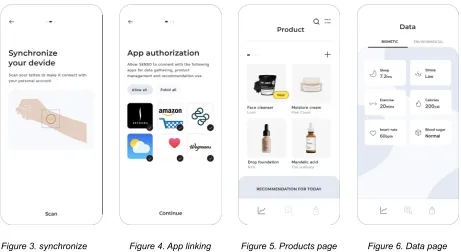
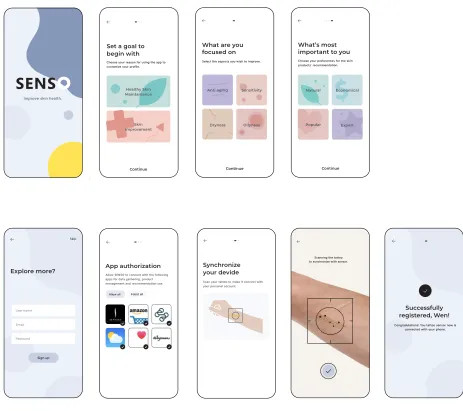
The system needs to get data from three resources--the sensor, links with other Apps, and products purchased by the user. Figure 4 shows the on-boarding process synchronizing the sensor with the phone. Figure 5 shows the permission request to allow the app to link to other Apps to gather information. Through the link, the App will be able to gather more than just environmental and biometric data
measured by the sensor in the phone. It will also know what skin products the user purchased online and put them into a product collection database. If the user buys them in a store, they can scan them or input the name into the system to add the product. After data gathering, the App will organize them in a skin products page and a data collection page. The user can then check a data graph for whatever factors they wish in the data collection page and view their history of the day, week and month. They can also search for a product through name, keyword or using the filter. The systems uses different ways to organize those products including date of purchase, expiration date, favourite and functions. All those features for searching are included in the filter.
Figure 3. synchronize page
Figure 4. App linking Figure 5. Products page Figure 6. Data page
[image:12.612.71.532.297.549.2]Data presenting
I used graphs to represent different types of data to directly communicate with users. For the skin status graph (Figure 7), I use orange to show abnormal hydration, while other indications are blue. The user can easily decide what to check from the graph and get more detailed information by clicking a button. The graph of product analysis (Figure 8) is similar to skin status. It compares the user’s personal skin condition with the functions that a product provide. I used white as the base color to represent skin condition and a transparent blue graph on the top layer to show the comparison. The graph of the UV curve (Figure 9) shows the UV exposure for the day. The solid line represent historical data and dashed line represents the future prediction. Compared to pure numbers, the curve more directly shows the trend and makes visualizing the future much easier. The horizontal line represents the divide between acceptable UV and high UV. The user can also drag the circular point to any point on the curve to get a detailed value for a specific point in time.
Figure 7. skin status graph
Recommendations
The app will give different recommendations to the user depending on the type of data gathered from the sensor or received directly by the user. For example, if data on skin hydration is gathered by the sensor patch, the app will recommend that the user drink more or less depending on the reading. The system will also remember the user’s lifestyle preferences and product interests. It can also suggest new or popular options to the user. For example, if the user has entered favorite foods into the app, new foods or recipes that are good for skin health will be given. The user can also set a filter from “Favourite” to “Popular” or “New” to try different food or recipes. Recommendations also include a customization feature to enhance the user’s experience.
Design Exploration
Visual style iteration
The subject of the App is skin health, so I planned to use light blue as the main color scheme because it’s calming and people associate it with hygiene.
I picked a similar content page as the demonstration of design iteration.
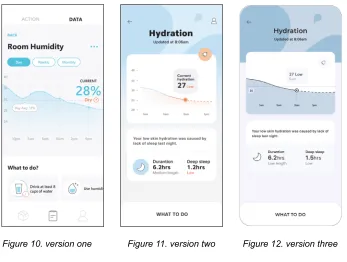
I used color contrast and a large font size to draw the user’s attention in the first version of my design. The background is a simple pure color with the intent to create a clinical feeling (Figure 10). I created a simple background illustration for my second version of design to make the design more vivid and involve the user’s attention. It also removes the grid of the graph to simplify the design. Instead, users can touch the curve the get the values of specific time points (Figure 11). The final version is a balance between the two previous versions of design. It reduces the use of color and has a sharper outline to create a cleaner feeling compared to version two (Figure 12).
Color usage
[image:14.612.70.417.292.554.2]The main color scheme of the design is in different shades of blue and slightly different saturation. Bright yellow and black have also been applied to buttons and tags. Several other colors are used in onboarding page or specific data pages to create an involving user experience and add fun to the user experience.
[image:14.612.69.287.657.697.2]Figure 10. version one Figure 11. version two Figure 12. version three
Figure 14. color scheme
Result
Final solutions
Four use case scenarios were created to show the main functions and features of the App.
On boarding
The user need to go through onboarding process to understand more about what the App does, clarify their goal, and initialize data gathering of the system. The onboarding scenario includes four main steps --goal and preference choices, email registration, linking with other Apps, and
sensor synchronization.
Set a goal to begin with
Continue Continue
Choose your reason for using the app to customize your profile.
Continue
What are you focused on
Select the aspects you wish to improve.
Sensitivity Anti aging
Dryness Oilyness
What’s most important to you
Choose your preferences for the skin products’ recommendation.
Natural Economical
Expert Popular Skin Improvement Healthy Skin Maintainance
SENS
O
Improve skin health.
App authorization Allow SENSO to connent with the following apps for data gathering, product
management and recommendation use. Scan your tattoo to make it connect with your personal account. Synchronize your devide
Congradulations! You tattoo sensor now is connected with your phone.
Successfully registered, Wen! Password Email User name Sign up Skip Explore more?
Scanning the tattoo to synchronize with sensor.
[image:15.612.76.539.289.700.2]Check skin status
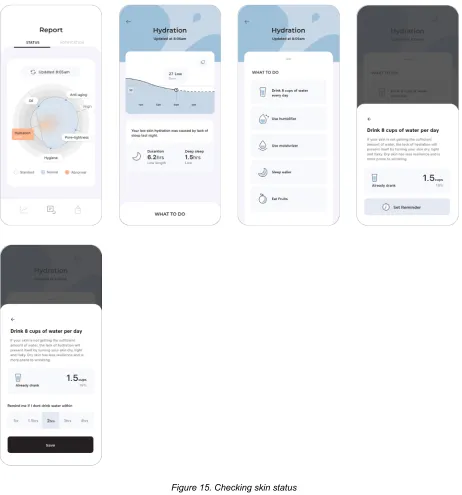
[image:16.612.72.534.200.695.2]This scenario mimics the process where the user wakes up in the morning and checks their skin status in a daily report. Here, the hydration reading is lower than the desired range so the user will check detailed information by clicking the icon. The system will show the hydration graph and the likely causes of low skin hydration. There are different options and the user can follow one or more recommendations. In this case, the user chooses to drink more than eight cups of water a day and sets a reminder for this goal.
Figure 15. Checking skin status
Check notifications
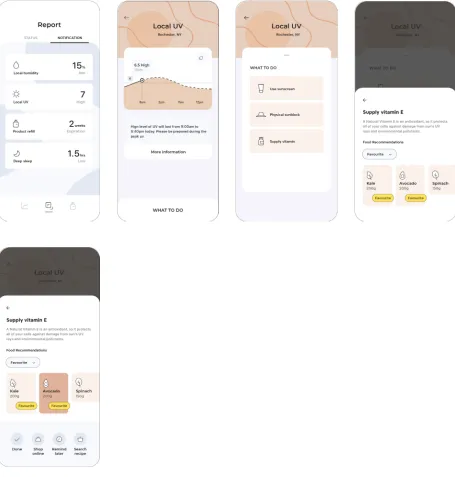
[image:17.612.74.529.210.687.2]The system will notify the user to what may have a negative influence on skin health during the day or week. After checking notifications in the daily report, the user found the UV that day will be higher than the safe range. The system will show the projected UV curve for the day and what the user needs to do to avoid harm. The user chose to supply vitamin E with breakfast as the solution. More options such as buying the food online and helpful recipes will also be provided if user needs further help.
Product refill
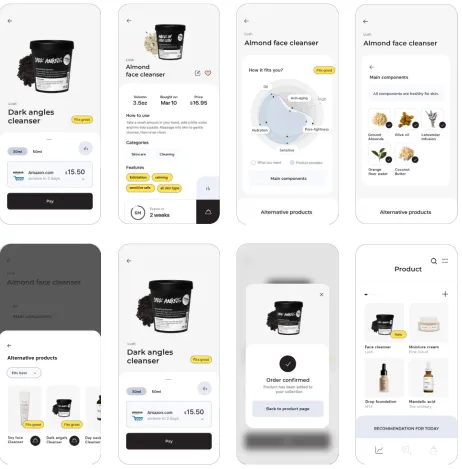
[image:18.612.73.535.225.694.2]The user noticed that a skin product is going to expired soon and needs to be refilled. The system leads the user to the product page after the user checks this notification. The user can choose to directly refill on the product page or check product analysis for more options. The analysis shows the user whether the product fits their current skin condition and whether the ingredients are good for the skin. It also provides alternative products if the user wants to try a different product. The user chose to look for a better fitting product for their skin condition and purchased the product using the app. The product was then added to the user’s product collection after the user made the order.
Figure 18. Refill product
Evaluations
Conclusion
This project creates a real-time mobile application to inform users of overall skin condition and generate meaningful solutions. It provides a long-term skin monitoring system and also helps users to improve skin health in daily use. It solves the problems of how to keep track of skin information over the long-term, how to find interrelationships between factors that affect the skin, and provides personalized skin solutions to users.
The proposed solution of the project is built on the conceptual sensor model to gather information. This process is also supported by linking with other Apps on the phone to gather product and other information. The project then focus on how to clearly communicate with users on what is happening with their skin using an information interpretation method. Through the system algorithm and analysis, it will provide preferred solutions to users to improve skin health.
The value of the project is that it will provide a possible solution by combining emerging technology and user interface methods to solve complex health problem. With the development of portable sensors and artificial intelligence, similar problems can be easily approached using similar methods. It is even possible to improve the whole quality of life starting by solving a single health problem.
Concerning further iterations of the app, the range of recommendations can be broadened in terms of both content and method. It can use versatile interaction methods like AR and VR to guide users to increase user experience and enjoyment in the process of improving skin health.
Reference
1. “Skin Information and Facts.” National Geographic. Last modified January 17, 2017. https://www.nationalgeographic.com/science/health-and-human-body/human-body/skin/
2. “Skin conditions by the numbers.” American Academy of Dermatology. Accessed April 24, 2019. https://www.aad.org/media/stats/conditions/skin-conditions-by-the-numbers
3. Barrett, Julia. “Chemical Exposures: The Ugly Side of Beauty Products.” Environmental health perspectives. Vol. 113, (2005)
4. “Hexoskin smart shirt reviewed: Measuring your vitals so you don’t have to.” Palladino Valentina. Arstechnica. Last modified February 28, 2016.
https://arstechnica.com/gadgets/2016/02/hexoskin-smart-shirt-reviewed-measuring-your-vitals-so-you-dont-have-to/
5. “With Wearable Devices That Monitor Air Quality, Scientists Can Crowdsource Pollution Maps.” Handwerk Brian. Smithsonian. Last modified March 12, 2015.
https://www.smithsonianmag.com/innovation/with-wearable-devices-that-monitor-air-quality-scientists-can-crowdsource-pollution-maps-180954556/
6. “Bioengineers Create Sensor That Measures Perspiration to Monitor Glucose Levels.” The University of Texas at Dallas. Last modified October 13, 2016
https://www.utdallas.edu/news/2016/10/13-32235_Bioengineers-Create-Sensor-That-Measures-Perspirat-_story-sidebar.html
7. “Vitamin A and Skin Health.” Linus Pauling Institute, University of Oregon. Accessed Accessed April 24, 2019. https://lpi.oregonstate.edu/mic/health-disease/skin-health/vitamin-A
8. Nguyen, Gloria and Torres, Abel. “Systemic antioxidants and skin health.” Journal of Drugs in Dermatology. Vol. 11, Issue 9, (2012)
9. Ying, Chen and Lyga John. “Brain-skin connection: stress, inflammation and skin aging.” Inflammation & allergy drug targets vol. 13,3 (2014): 177-90.
10. “Exercise for Healthy Skin.” Jaret Peter. WebMD. Last modified April 15, 2011 https://www.webmd.com/skin-problems-and-treatments/acne/features/exercise#1
11. Barrett, Julia R. “The ugly side of beauty products.” Environmental health perspectives vol. 113,1 (2005)