Exploring the Application of RSS
for Library Staff Professional Development
and SDI Services
Sandra Jeffries Manager Client Services
University of Southern Queensland Library [email protected]
Corey Wallis Electronic Services Officer
University of Southern Queensland Library [email protected]
Abstract:
Introduction
In mid-2005, the University of Southern Queensland (USQ) Library established a virtual professional Reading Room for Library staff that aggregated eXtensible Markup Language (XML) feeds into one central repository for staff searching, browsing, commenting and discussion. The idea for the Reading Room originated in think tank discussions in late 2004 with the then USQ Systems Librarian, Deidre Lowe, who believed that significant benefit could be derived for Library staff by streamlining feeds from a range of professional reading sources.
The intent was to provide a convenient, coordinated source of professional reading that would reduce the need for staff to maintain their own sources and reduce the amount of email traffic. The Reading Room was organised into a number of subject categories so that staff could access the feeds of most interest to them. The Reading Room also provided a discussion facility so that comments on readings could be shared and a learning community established. The Reading Room was developed at the Toowoomba Campus of USQ, with Library staff from the Wide Bay and Springfield Campuses also able to access the resource.
Project Goals
The Library had three key organisational goals for the Reading Room:
• To explore the applications of blog and XML feed technologies in an in-house environment before using them with clients
• To address some of the issues identified in the Library’s workforce planning
• To support the Library’s quality processes by encouraging a culture of reflective practice.
Firstly, we wanted to develop a prototype to experiment with, and learn from, before we rolled out these technologies to clients. Libraries, along with other organisations, are increasingly using blogs and XML feeds to provide information to, and communicate with, their clients. (Clyde 2004, Maxymuk 2005, Wallis 2005, Wusteman 2004). USQ had already established a Library blog in 2004 to notify Library staff of updates or problems with our electronic resources, or other general systems announcements. This had proved to be an effective way to notify staff of situations that they needed to know about, and to retain a record of postings.
We wanted to extend the use of blogs and XML feeds as a communication mechanism with our clients, to inform them of relevant Library information and to give them a convenient way of informing us of their needs. We developed proposals for a number of possible applications using blog and XML feed technologies, such as a Faculty Librarian blog, production of XML feeds of all new books added to the collection, and XML feed manipulation to support access to our electronic resources via our EZproxy server. We decided on a staged approach so that we could resource these developments adequately, learn as we went along, and use those learning outcomes in each new project.
in IT areas to deal with the changes occurring in the broader information environment. We used a scenario planning approach to identify the most likely library scenarios within the next three years, then identified the roles and skills needed to operate effectively in those scenarios. We conducted a skills audit, section by section, to identify quickly where our skill gaps were. The overwhelming gap across all Library sections related to IT knowledge and skills.
The outcomes of these activities were then used to develop a high-level Workforce Plan with key strategies to address the identified gaps. A more detailed schedule of how the gaps could be addressed by internal and external training, one-on-one coaching, staff exchanges, and distribution of the less-complex work of the Systems team, was derived from the Workforce Plan. Training sessions on blogs and XML feed technologies conducted by the Library’s Electronic Services Officer proved very popular with staff, to the extent that many staff wanted to immediately set up their own aggregators. Many could see uses of the technology in their work, and some could see uses of the technology to increase the effectiveness of the communication with our clients. It made sense to use this groundswell of interest to improve our staff’s IT knowledge and skills, and their confidence in using these technologies.
Thirdly, we wanted to develop a more evaluative, reflective component in our work. Over the last few years, Library staff members at all levels have been more and more involved in strategic planning, the previously-mentioned workforce planning and the Library’s quality processes. This has been a deliberate management strategy to involve staff in the bigger picture issues facing the Library. Events in mid-2005 reinforced the importance of this approach: the University was about to begin its new round of strategic planning, the Library was preparing for its ISO 9001 recertification audit in September, and an administrative review of the Library was scheduled for early 2006. These factors highlighted the need for more rigorous evaluation of our work and more thoughtful planning for the future.
The Reading Room, with relevant feeds centrally located and a common discussion space, provided a useful, coordinated mechanism for professional reading, contemplation and an exchange of views among staff. Work over the last two decades has stressed the importance of a learning culture in organisations, and individual and organisational learning opportunities, for optimal professional development and organisational growth. (Smith 2004) We hoped that the Reading Room would provide a mechanism for the development of a learning community within the Library.
Implementation
Organisational Aspects
Management support
We followed a structured process to establish the Reading Room. Our first step was to seek the support of the University Librarian and the Library Executive Team for this initiative. We also consulted with the University’s Information Technology Services department to ensure that our plans met the University’s IT guidelines. When the first Library blog had been established in 2004, we had found that the potential for blog and XML feed technologies was not well understood at a strategic level. Securing senior management support for the Reading Room was made easier because of the demonstrable success of the original Library blog. We developed a formal proposal for the Reading Room project, justifying the project mainly on the grounds of its alignment with the Library’s workforce planning and strategic direction.
Staff survey
Secondly, we surveyed a number of Library staff members to ascertain their professional reading practices. We wanted to establish a snapshot of staff professional reading activities before general release of the Reading Room so we could measure the impact of the Reading Room after some months of operation. We selected staff members from the Library’s Management Committee (Levels 6 – 9) and other staff members at Levels 4 and 5 from different sections to survey. The results of the survey clearly identified the importance of professional reading for Library staff. Summary results are outlined below:
• Staff used a wide range of mechanisms to keep up-to-date with professional reading, including print journals, subscriptions to email lists, favourite websites, favourite blogs, XML feeds, online journals, database alerts, and emails circulated by other staff.
• Lack of time was seen as the major difficulty in keeping up with professional reading. This issue was compounded by the wide range of media and formats that needed to be monitored.
• Staff reported spending between a few minutes and five hours per week on professional reading. The average time spent was one hour per week. All but a couple of staff thought that they spent too little time on professional reading.
• On a scale of 1 (not important) to 10 (extremely important), most staff rated professional reading at 7, in terms of its importance in their overall professional development.
• Topics of most interest to staff reflected their current positions in their respective sections; eg, the Senior Cataloguer was most interested in developments in cataloguing and e-resources.
• Most staff wanted blogs, websites, email discussion lists and journals as sources for the Reading Room, and many mentioned specific titles that they already found useful. • All staff thought the most useful structure for the Reading Room would be a series of
subject-based categories, so that they could easily access the most relevant sources for their needs.
• Many staff mentioned the importance of being able to discuss their professional reading so that team or Library-wide expertise could be developed rather than just individual expertise.
Test group
Thirdly, we established a test group of six staff with a brief to:
• Give feedback on the site as it was developed, eg structure, layout and wording
• Give feedback on the subject categories and the specific XML feeds to be aggregated into those categories
• Provide any other relevant comments.
Again, we involved staff from different HEW levels and different sections to ensure a representative group. We advised the group of their responsibilities and the anticipated time commitment that their involvement would take.
The test group proved valuable for giving the feedback outlined above. Having a formal group with specific assigned responsibilities meant that members took their responsibilities seriously and gave thoughtful feedback. The other key advantage was that test group members acted as unofficial promoters of the initiative with their other Library colleagues.
Communication strategy
The Reading Room was developed over a number of weeks. During the implementation phase, Library staff members were kept informed of progress via email and information sessions at section meetings. When the site was considered ready, a launch was held. This consisted of an information session and demonstration of the Reading Room to all Library staff at a general staff meeting. Follow-up sessions were held during section meetings over the following weeks.
Staff training
Training for staff focussed on three main areas:
• Basic principles of the technologies being used – so that staff understood the concepts of XML feeds and aggregators
• Scope of the Reading Room – its purpose, policies governing its use, its content and structure, plans to expand its scope as XML feeds become more commonly available
• Procedural issues of how to use the Reading Room, eg how to subscribe to feeds, how to participate in discussions, who to approach for support.
The test group was used to provide feedback on the planned training program, and to identify other training or information sessions that might be needed.
Technical Aspects
Choice of platform
The basis of the Reading Room is a website that aggregates disparate information sources into a central location using XML feeds. The XML feed technology is known by many names including “RSS feeds”, “Atom feeds”, and “Web feeds”. The name used to refer to the technology, and the differing standards of the technology, is not particularly relevant to the average user. The important thing is that they are all XML formats used to syndicate content into discrete elements using a defined structure.
aggregated by the Reading Room using one of the XML standards is simply referred to as an XML feed.
A number of web based aggregators were examined as part of the implementation phase to determine their suitability as a platform for the Reading Room. These included:
• Urchin, <http://urchin.sourceforge.net/> • Planet, <http://www.planetplanet.org/> • Gregarius, <http://www.gregarius.net/> • WordPress, <http://wordpress.org/>.
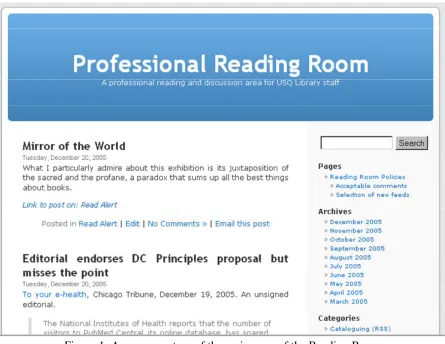
[image:6.595.75.520.309.653.2]Of the four platforms examined, only WordPress provided the functionality necessary to allow user interaction. At its core, WordPress is a platform used to build blogs, and as such has the ability to provide comments to posts built into the product. As user discussion was considered an essential criterion for the Reading Room, WordPress was the platform chosen. A screen capture of the main page of the Reading Room is outlined below in figure 1.
Figure 1: A screen capture of the main page of the Reading Room
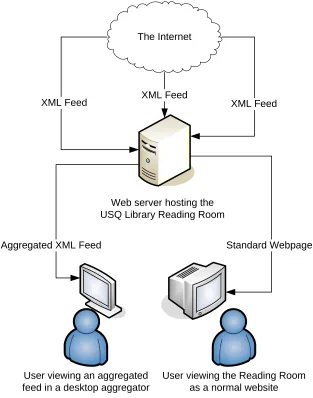
PHP, an open source application incorporated into the WordPress platform and leveraged by the FeedWordPress plugin <http://magpierss.sourceforge.net/>. A conceptual diagram of the Reading Room is outlined in figure 2.
The Internet
Web server hosting the USQ Library Reading Room
XML Feed
XML Feed XML Feed
User viewing an aggregated feed in a desktop aggregator Aggregated XML Feed
User viewing the Reading Room as a normal website
[image:7.595.141.454.127.525.2]Standard Webpage
Figure 2: A conceptual diagram of the reading room
Thirdly, the WordPress platform provided the underlying infrastructure necessary to implement the required SDI environment. This is explained in more detail below.
SDI environment
The need for the Reading Room to provide selective dissemination of information (SDI) services was highlighted during the initial stages of the project. The intention was to create a website that would allow staff members to select the information that was of most interest to them.
There are a number of parent categories in the Reading Room, some of which are:
• Cataloguing • Current Events • Journals
• Library Services • Management • New Technologies • Reference Services.
Every feed that is aggregated by the Reading Room is assigned a unique category. These child categories are associated with a parent category. For example, the New Technologies parent category contains “child category” feeds such as:
• hangingtogether.org <http://hangingtogether.org/> • Lorcan Dempsey's weblog <http://orweblog.oclc.org/> • Outgoing <http://outgoing.typepad.com/>
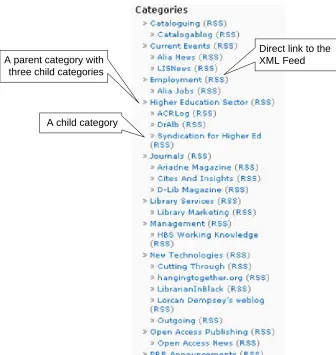
The WordPress platform provides the ability to have an XML feed containing the posts in a specific category. Therefore a user of the Reading Room has the ability to subscribe to the feeds of parent categories, or to individual feeds within those categories. For example a user could subscribe to the Journals parent category, the New Technologies parent category, and one feed from the Reference Services category. A feed of a parent category is an aggregation of the entire child categories in that parent category. By subscribing to only three feeds, the user is able to subscribe to the information contained in many feeds. A screen capture of how the categories are displayed to the user is outlined in figure 3.
There are two types of feeds that are particularly relevant to those users who are involved in a discussion on a particular post, or series of posts. The first is a feed of all of the comments posted on the Reading Room. The second is a feed of the comments about a specific post. A user can subscribe to the feed of comments related to a post they have commented on, and can therefore keep in touch with the discussion as it unfolds, without needing to repeatedly visit the Reading Room website.
A parent category with three child categories
A child category
[image:9.595.129.465.70.425.2]Direct link to the XML Feed
Figure 3: A screen capture of how the categories are displayed to the user.
Selection of aggregator
Effective use of XML feeds relies on the use of aggregator software, which converts the feeds into human readable format. There are two main types of aggregation software: online and desktop. Examples of online aggregators include:
• Bloglines <http://www.bloglines.com/> • Feedster <http://feedster.com/>
• NewsGator Online <http://www.newsgator.com/ngs/default.aspx>
One of the benefits of an online aggregator is that it can be accessed from anywhere and at any time, for example at work and at home. The Reading Room itself can be seen as an example of a web based XML aggregator, with additional features to enable discussion and professional development. An online aggregator was not a viable option for use with the Reading Room because access to the Reading Room is restricted to the USQ network only.
• Sage, an extension for Mozilla Firefox <http://sage.mozdev.org/>
• Pluck, a plugin for Microsoft Internet Explorer <http://www.pluck.com/> • Newsgator, integrates into Microsoft Outlook <http://www.newsgator.com/>
• Google Desktop, stand alone product that includes additional functionality and is in Beta <http://desktop.google.com/>
To enable effective use of the SDI environment provided by the Reading Room, a user needs to have an aggregator installed on their work PC. A side benefit of this is that users are able to aggregate feeds from other websites as well as feeds from the Reading Room.
At the time of implementation, a number of USQ Library staff were already using XML feeds for professional reading and current awareness, and were using a variety of different aggregators, eg Bloglines, Sage extension for Firefox, Pluck plugin with Internet Explorer. The range of platforms obviously has implications for the level of staff resources needed for installation and support. The Library is currently working on a policy for aggregator use, which is likely to recommend no more than two standard platforms.
Documentation
A number of policies needed to be developed for the Reading Room, specifically covering:
• Comments and discussion – guidelines on appropriate content
• Moderation process – the reasons for moderation, maximum length of time a comment may be held for moderation, deletion of comments if required.
• Selection of feeds – guidelines on acceptable standards for feeds and criteria for their selection.
• Aggregators – types supported by the Library and staff responsible for their installation and support.
These policies were included in a section of the Reading Room.
Challenges
We faced a number of challenges in implementing the Reading Room, both organisational and technical. The organisational challenges included ensuring the usefulness of the Reading Room, the effectiveness of the discussion space, and the integration of the Reading Room into normal Library operations. The technical challenges included locating appropriate sources of information, preventing comment and trackback spam, providing access from home, and clarifying technical support responsibilities.
Organisational Challenges
Information overload
Discussion space
A second challenge was to ensure that the discussion space was used effectively. We had some concerns about how comfortable our staff would feel about sharing their views on readings. We addressed this challenge through repeated communication with staff about the purpose of the Reading Room, and through encouragement from section managers. The Reading Room policy on “Acceptable comments” was kept deliberately brief and positive in tone, specifically to encourage, rather than inhibit, participation. Initial indications are that staff are more comfortable sharing their views within their specific topic categories, eg Reference staff discussing issues within the Reference Services category, rather than commenting on some of the more general categories. A screen capture of the way comments are displayed to the user is outlined in figure 4 below. Names have been deliberately obscured.
A third challenge related to the discussion space was the randomness of discussions, determined as they were by the feeds available and by whoever was making comments. There were benefits to this randomness as staff read and responded to items of interest, but the discussions didn’t necessarily relate to the bigger picture planning, management or evaluation issues that the Library might have been considering. We realise that we will need to give more consideration to this issue in the future. An option might be to adopt a more structured approach for organisational planning needs, whereby managers might request discussion on particular readings related to current Library projects with set duration times for comments. White (2002) gives an example of such a structured approach in a school setting.
Work processes
Related to this challenge was the issue of integrating the Reading Room into normal work processes. We were concerned that the Reading Room was seen as integral to building a Library learning community and developing staff knowledge. For that to occur, the Reading Room had to be viewed as a normal part of work rather than a nice-to-have optional extra. We worked with the Library Executive Committee and section managers to promote the role of the Reading Room in developing a learning community, based on the Library’s workforce planning and quality needs. We encouraged section managers to incorporate discussion about the Reading Room in their regular section meetings. In the near future, we hope to have concrete examples of Library decisions or actions based on Reading Room discussions.
Another way of integrating the Reading Room into normal work practices would be to incorporate its use as an element in the performance appraisal process for Library staff. We were reluctant to take such a formal approach in the early stages of the project, particularly as we were still developing the content sources of the Reading Room and training staff in RSS reader use. We would anticipate reconsidering this approach after the first year of the Reading Room’s operation.
Technical Challenges
Identifying appropriate sources of information
The primary sources of information for the Reading Room are those that have an XML feed. A small number of manual information sources were also included. These were announce-only email lists, ie those that have a small number of messages per month to alert subscribers to new content, and journal alerts via email. A post had to be manually generated for each new email received. Because of the time-consuming nature of this task, full email discussion lists were not included in the Reading Room. There was no way of satisfactorily importing them, ie converting the emails into XML feeds. This was a disappointment for some staff but was addressed in staff information and training sessions. This has been identified as an area for future investigation.
Unfortunately, not all of the feeds aggregated into the Reading Room provide all the information that is desirable. A notable example is a feed that does not include a published date for each item in the feed. Such a feed is possible under a strict interpretation of the RSS 2.0 specification <http://blogs.law.harvard.edu/tech/rss>. However, it does reduce the usefulness of the feed for users. Fortunately, the FeedWordPress plugin is able to deal with this deficiency by adjusting the date of the aggregated post in the Reading Room to the date the feed was aggregated. The downside of this type of solution is that the initial import of a feed can create numerous posts dated with the same date and swamp other posts.
Preventing comment and trackback spam
During the planning phase of the Reading Room project, the issue of trackback, and particularly comment, spam was identified. Our experiences with the Library Blog were called upon to assist in evaluating the threat posed by spam to the Reading Room. The two options available were to disable comments, in the way comments are disabled on the Library Blog, or restrict access to the Reading Room to the USQ network only.
When the USQ Library blog was launched in 2004, the issue of spam was considered and both comments and trackbacks were disabled. A WordPress plugin that blocks attempts by automated user agents attempting to post spam was also installed. The plugin is called Bad Behavior <http://www.ioerror.us/software/bad-behavior/>, and on average is successfully blocking over 1,000 attempts to post spam every week.
Disabling comments was not a viable solution for the Reading Room, and the best spam filters are not 100% effective. For this reason, the Library worked with USQ’s Information Technology Services department to restrict access to the Reading Room to the USQ campus network only. This mitigated the risk of automated comment and trackback spam. As a secondary measure, the Bad Behavior plugin was also installed in the Reading Room.
The possibility of users posting inappropriate comments to the Reading Room was addressed by enabling WordPress’ comment moderation features. A user wishing to comment on a post is required to enter their email address as part of the process; the email address is used to identify specific users. Any user who has not posted a comment before, based on their email address, would have their comment put into a moderation queue before it was displayed. To protect the privacy of users, email addresses are not displayed on the Reading Room. A user who had successfully posted a comment previously would not go through this moderation process again.
If a comment has more than two links in it, or contains a series of words identified as being common in spam messages, the comment would also be held for moderation. To make administering the moderation of comments more efficient, an email is sent to the Electronic Services Officer each time a comment goes into the moderation queue. The emails are designed to alert the Electronic Services Officer that a comment needs to be reviewed, and if applicable, allowed to appear on the Reading Room.
Any comment that requires moderation is evaluated against the “Acceptable comments” policy that is displayed on the Reading Room. The policy has the following three guidelines:
1. People posting comments are asked to interact with civility
2. Spam comments, duplicate comments, unsupported accusations or personal attacks of any kind will be deleted
3. Any link included in a comment should be an actual HTML link, not just a URL.
A staff member who feels their comment has been deleted unfairly is asked to speak to the Electronic Services Officer, or their supervisor, to resolve the issue. No staff member has expressed concern with this policy, and initial feedback has indicated that staff appreciate the intent of the policy.
Enabling access from home
Isolating the Reading Room from the Internet did introduce another challenge that needed to be resolved. USQ Library staff indicated during the initial consultation phase of the project that professional reading was an activity that, for some, was undertaken at home. By isolating the Reading Room from the Internet, the effectiveness of the Reading Room was reduced because users who preferred to do their professional reading at home were not able to do so. The resolution to this challenge was to make the Reading Room available to Library staff via our EZproxy server.
The EZproxy server had to be configured to work with the Reading Room website. EZproxy is software created by Useful Utilities <http://www.usefulutilities.com/>, which is used by USQ Library to provide access to the electronic resources that are available via paid subscriptions. Typically, access to these types of resources is restricted via IP address authentication.
Those staff wishing to undertake professional reading from home can access the Reading Room via the USQ Library EZproxy server. They are prompted for their USQConnect username and password before access is provided. USQConnect is an institution-wide authentication mechanism. In this way, the Reading Room is still isolated from the Internet, and access is still possible for those users who require access from home.
It is important to note that access to the various XML feeds provided by the Reading Room is not possible from outside the USQ network. This is due to the way our EZproxy server is configured and the way that it prompts for authentication. This was not considered a major problem. Library staff can subscribe to the feeds they require at work, which will serve to prompt them about posts they want to read at home.
Technical support
Responsibility for support of the Reading Room was a challenge because of the shared nature of IT responsibilities within the USQ Library. The Electronic Services Officer is primarily responsible for supporting the Library’s electronic resources, and staff and student access to them. The Microcomputer Support Officer is primarily responsible for staff desktop support. These two positions are currently in two different sections of the Library. The Electronic Services Officer has been responsible for the establishment of the Reading Room, but because of the set-up needed for aggregators on staff members’ PCs, this Officer has had to negotiate support from the Microcomputer Support Officer. It is hoped that the Library’s policy on aggregators will clarify this issue for these two key staff members, and for Library staff generally, who need to know who to approach for assistance when needed.
Outcomes
these technologies, and are now better informed about the issues to be considered in applying these technologies to other areas.
We are still at the very early stages of addressing our third goal of developing a culture of reflective practice. Certainly, the Reading Room has had the effect of making professional reading and discussion more visible or explicit within the Library. We will continue to work with section managers and staff on the enhancement of the Reading Room, so that it becomes more integrated into normal operations and continues to foster a learning culture.
We established a comprehensive statistical configuration for the Reading Room so that we could monitor which categories and feeds were being requested, the number of posts and comments, and the number of staff using the Reading Room. At this stage, the statistics are too few to be particularly meaningful, but over the next few months we will use them to evaluate the effectiveness of the selected feeds and categories, and make adjustments as necessary.
One pleasing, though unanticipated, outcome of the Reading Room establishment was the greater sense of community generated with our Wide Bay and Springfield Campus colleagues. Having a common, convenient discussion space made it easy for our Wide Bay and Springfield staff to contribute to discussions, and served to remind our Toowoomba staff of other campus perspectives.
Next Steps
Our next steps are focussed on increasing the coverage of the Reading Room, evaluating its structure and use, and ensuring that it contributes to the Library’s strategic needs.
As more resources with XML feeds become available, we intend to add more resources to the Reading Room. We will also investigate the inclusion of email lists, if that can be done in an effective way. We hope that, within the next couple of years, the Reading Room will be sufficiently comprehensive to meet almost all the professional reading needs of our staff.
We have been reviewing the subject categories of the Reading Room on an ongoing basis, but will conduct a thorough review after six months’ operation based on statistical monitoring and staff feedback.
We plan to consider ways of aligning Reading Room discussions more closely with Library planning needs, as mentioned earlier. We would not wish to restrict or replace ad hoc discussions, but we think it will serve the Library well if we can complement those with more strategically-aligned discussions.
Conclusion
References
Clyde, LA 2004, ‘Library weblogs’ Library Management, vol. 25, nos. 4/5, pp. 183-189, viewed 12 September 2005 EmeraldManagementXtra, item: 0150250403
Maxymuk, J 2005, ‘Blogs’ The Bottom Line: Managing Library Finances, vol. 18, no. 1, pp. 43-45, viewed 12 September 2005 EmeraldManagementXtra, item: 1700180107
Smith, I 2004, ‘Continuing professional development and workplace learning 6: HRD and organisational learning’, Library Management, vol. 25, nos.1/2, pp. 64-66, viewed 9 September 2005 Emerald, item: 0150250108
Wallis, R 2005, ‘Project Bluebird: research into better library communication’, Library Hi Tech News, vol. 22, no. 6, pp. 15-16, viewed 12 September 2005 EmeraldManagementXtra, item: 2390220605
White, T 2002, A Professional reading club: making reading a key part of your professional development programme, viewed 8 August 2005,
<http://nzplc.massey.ac.nz/print.asp?page=\docs\contracts\professionalreadingclub.htm>
Websites
Implementation of the Reading Room • Urchin, <http://urchin.sourceforge.net/> • Planet, <http://www.planetplanet.org/> • Gregarius, <http://www.gregarius.net/> • WordPress, <http://wordpress.org/>
• FeedWordPress, <http://projects.radgeek.com/feedwordpress/> • MagpieRSS parser for PHP, <http://magpierss.sourceforge.net/> • Bad Behavior, <http://www.ioerror.us/software/bad-behavior/> • RSS 2.0 specification, <http://blogs.law.harvard.edu/tech/rss> • EZproxy by Useful Utilities, <http://www.usefulutilities.com>
Examples of aggregated feeds
• hangingtogether.org <http://hangingtogether.org/> • Lorcan Dempsey's weblog <http://orweblog.oclc.org/> • Outgoing <http://outgoing.typepad.com/>
Online aggregators
• Bloglines <http://www.bloglines.com/> • Feedster <http://feedster.com/>
• NewsGator Online <http://www.newsgator.com/ngs/default.aspx>
Desktop aggregators
• Sage, an extension for Mozilla Firefox <http://sage.mozdev.org/>
• Pluck, a plugin for Microsoft Internet Explorer <http://www.pluck.com/> • Newsgator, integrates into Microsoft Outlook <http://www.newsgator.com/>