REVISITING THE CONTROL GROUP: PROBLEM-BASED
LEARNING'S IMPACT ON THE UNDERSTANDING OF
PLACE VALUE
David A. MartinFaculty of Education,
University of Southern Queensland
ABSTRACT
The use of a control group is an effective tool which afforded this researcher a gauge as to the effectiveness of his change in pedagogy. However, the ethical considerations regarding the control group’s continued lack of understanding could not go unattended. This study revisits that control group. In the original investigation, both a control group and an experimental group were used to determine the effect a problem-based learning (PBL) pedagogy versus the traditional teacher-centred instructional approach in a university course will have upon pre-service teacher’s understanding of place value (PV). At the end of the study, the results suggest that the majority of the control group possessed a prestructural or unistructural understanding of place value systems, while the experimental group was found to be mainly thinking at a unistructural and multistructural level. Two years later, the control group was re-taught using the PBL method after being pre-tested for incidental learning. The pre-test results indicated they were found to still be mainly thinking at a pre or unistructural understanding. However, after being treated to the PBL instruction, the control group participants were found to be thinking at a unistructural, multistructural and relational level. Therefore, it is suggested from this study that a PBL approach does provide deeper understanding in pre-service educators’ understanding of place value.
KEYWORDS
Problem-based learning, mathematics education, place value, control group, ethics.
INTRODUCTION
group and conclude whether the hypothesis could be rejected or accepted within a predetermined level of statistical significance. However, if the alternative hypothesis is accepted as a result of the treatment having a significant impact on the experimental group’s progress, what ethical considerations concerning the control group does that generate for the researchers?
It is this researcher’s contention that there can be serious disadvantages levied upon the participants of the control group if the treatment they were denied proved to be a more effective learning or teaching strategy. In the case of pre-service educators, the ethical consideration is how withholding the treatment from one group might then impact the teaching effectiveness of these future educators. Of course one may reason that through the ‘informed consent’ process the participants willingly agreed to be a part of the study. Another rationalization might be that researchers no longer have access to the control group once the study is completed. Nonetheless, it is an ethical responsibility for teachers and lecturers to place their students’ educational interests over their own educational research (MacLean & Poole, 2010).
This paper will outline the original 2009 study, its data collection techniques, method of analysis, and its conclusions. Subsequently, the paper will similarly outline the 2011 study which revisits the 2009 control group after presenting them with the same treatment the experimental group received.
BACKGROUND AND CONTEXT TO THE ORIGINAL STUDY
In the original study the researchers’ (Martin & Jamieson-Proctor, 2010) focus was on pre-service teachers’ conceptual understanding and Mathematical Content Knowledge (MCK) with respect to PV systems. The participants of the original study were first year Bachelor of Education students enrolled in a mathematics education course at a regional Australian university (N=58). The course, which I have taught since 2009, is based on two major curriculum strands, numeration and patterns & algebra. The data collected were from two end-of-semester exam questions collected from a control group (n=30) and an experimental group (n=28). In both groups, a two-hour whole group lecture was provided in traditional fashion in a lecture theatre followed by a two-hour tutorial session. The difference between the methods by which the students were educated is that during the tutorials the experimental group was taught using a student-centred, problem-based learning (PBL) approach while the control group was taught in a traditional instructor-centred capacity. Each method was designed to probe students’ MCK related to their conceptual understanding of PV systems and their symmetry.
Using these same two exam questions over the past two years, I have observed that my pre-service educator students, in class and in the exam, possess a limited conceptual and procedural understanding of number sense, in particular place value. This is an important point because teaching must begin with the teacher’s understanding of what is to be learned, the content, and then onto how the content is to be effectively delivered (Shulman, 1987).
reflections was a commitment to find an effective teaching strategy through prescribed research. The findings in the research guided me to modify my pedagogical approach from a traditional method of lecturing and tutorials to a constructivist, PBL workshop method.
The 2009 study reports the results obtained from an analysis of two exam questions using two different methods. The responses to Question 1 from both cohorts were first coded using the SOLO taxonomy to evaluate student responses and analysed using the Chi-square test. The students’ responses to exam Question 1 were coded (prestructural=1; unistructural=2; multistructural=3; and relational=4) and compared by year using the Chi-square test to investigate the relationship between the two cohorts. To remove or at least minimize researcher bias during the coding of the student responses, a cross check, interrater reliability method was utilized.
The responses from Question 2 were analyzed using an Independent-samples T-test to compare the means between the two trial groups.
It was hypothesized, based on observation of the students during the tutorial sessions, that the experimental group given instruction using a PBL approach would demonstrate a higher number of correct answers on the exam questions versus the control group taught using the teacher-centred approach.
METHOD OF ANALYSIS
The study compared the data obtained from students’ responses to two end-of-year semester exam questions, namely:
1. What is your understanding of the term “place value”?
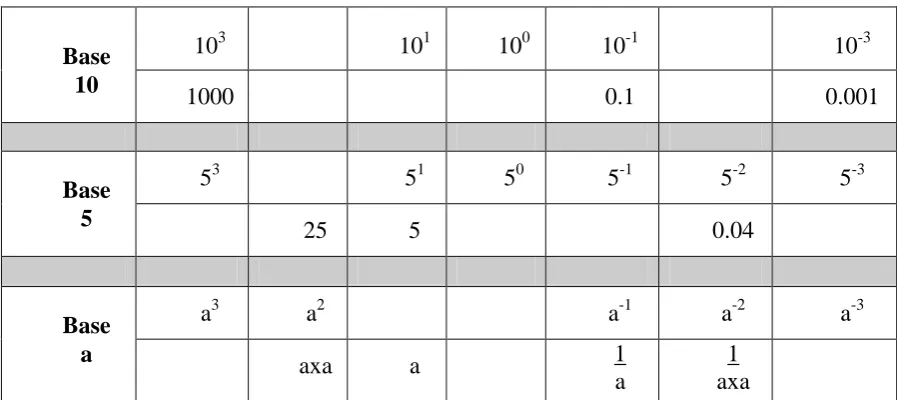
2. Demonstrate your understanding of the symmetry of any place value system by completing all 16 empty cells (Table 1).
Table1
Exam question investigating MCK of place value
Base 10
3
101 100 10-1 10-3
10 1000 0.1 0.001
Base 5
3
51 50 5-1 5-2 5-3
5
25 5 0.04
Base a
3
a2 a-1 a-2 a-3
a
axa a 1
a
[image:3.595.73.522.551.751.2]RESULTS
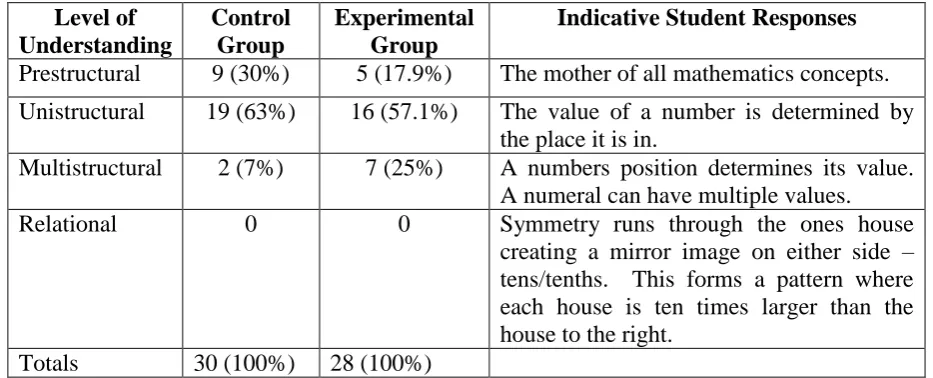
[image:4.595.67.534.222.411.2]Table 2 provides the percentage of responses, by group, at each of the first four SOLO levels as well as indicative student responses for each of the four levels.
Table 2
Student response levels for Question 1
Level of Understanding
Control Group
Experimental Group
Indicative Student Responses
Prestructural 9 (30%) 5 (17.9%) The mother of all mathematics concepts.
Unistructural 19 (63%) 16 (57.1%) The value of a number is determined by the place it is in.
Multistructural 2 (7%) 7 (25%) A numbers position determines its value. A numeral can have multiple values.
Relational 0 0 Symmetry runs through the ones house creating a mirror image on either side – tens/tenths. This forms a pattern where each house is ten times larger than the house to the right.
Totals 30 (100%) 28 (100%)
The Chi-square test indicated a non-significant difference between the two year groups’ level of understanding. As can be seen in Table 2 however, more students from the experimental cohort provided a multistructural response and less student responses were prestructural (meaning they provided a totally incorrect response). Therefore, it may be suggested that there was moderate evidence to support the alternative hypothesis that there was a difference in learning between the control and the experimental group.
Each of the 16 empty cells in Question 2 (Table 1) was given 1 mark for a correct answer and a 0 for an incorrect response. When the overall mean scores were compared by group using an Independent-samples t-test, the results again indicated a non-significant difference.
THE PRESENT STUDY
In 2011, I was presented with a second opportunity to re-test my hypothesis and once again teach to the control group, whom were now in their third year of their program. The testing environment was a third-year mathematics curriculum and pedagogy course which, by design, is the second of the two components to the students’ mathematics methods classes.
Additionally, to decrease the potential for insider researcher bias during the coding of the student responses to question 1, a colleague was again enlisted for interrater reliability purposes so the coding could be cross checked. Moreover, using a Paired-samples t-test to analyze the mean scores from Question 2 accounted for many of the lurking variables such as gender bias. Limitations of the study can be found in the sample size, the maturity of third year students versus first-year, and the fact the researcher was also the lecturer, hence possible lecturer bias.
Once again, it was hypothesized that the participants would demonstrate a higher number of correct answers on the exam questions after being taught using the PBL pedagogy.
METHOD OF ANALYSIS
The subsequent study again compared the data obtained from students’ responses to the same two semester exam questions. Once more, the responses to Question 1 from both the pre and post treatment of the group were coded using the SOLO Taxonomy to evaluate student responses but analysed using the Wilcoxon signed-ranks test.
The responses from Question 2 were analyzed using a Paired-samples t-test to compare the means between the pre and post treatment of the group.
RESULTS
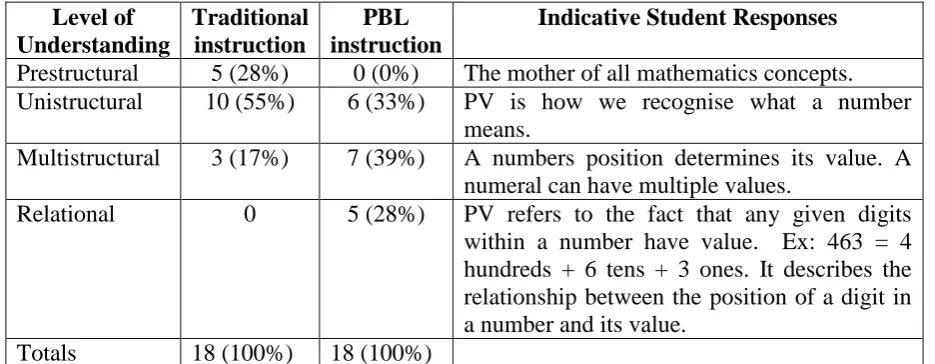
[image:5.595.68.536.512.694.2]Table 3 provides the percentage of students for each of the first four SOLO levels as well as indicative student responses for each of the four levels.
Table 3
Student response levels for Question 1
Level of Understanding
Traditional instruction
PBL instruction
Indicative Student Responses
Prestructural 5 (28%) 0 (0%) The mother of all mathematics concepts. Unistructural 10 (55%) 6 (33%) PV is how we recognise what a number
means.
Multistructural 3 (17%) 7 (39%) A numbers position determines its value. A numeral can have multiple values.
Relational 0 5 (28%) PV refers to the fact that any given digits within a number have value. Ex: 463 = 4 hundreds + 6 tens + 3 ones. It describes the relationship between the position of a digit in a number and its value.
Totals 18 (100%) 18 (100%)
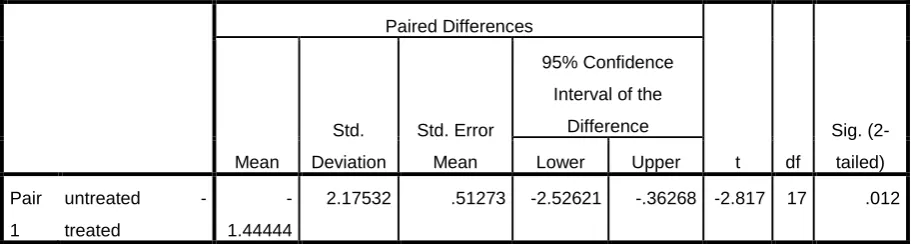
Similarly for question 2, each of the 16 empty cells was given 1 mark for a correct answer and a 0 for an incorrect response. When the overall means of the pre and post PBL treatment scores were compared, the results, as shown in Table 4, also indicated a significant difference p ≤ .012 between the untreated and treated participants.
Table 4
Paired-Samples T-Test
Paired Differences
t df
Sig.
(2-tailed) Mean
Std.
Deviation
Std. Error
Mean
95% Confidence
Interval of the
Difference
Lower Upper
Pair
1
untreated -
treated
-1.44444
2.17532 .51273 -2.52621 -.36268 -2.817 17 .012
CONCLUSION
It has been long recognised that “...the real mathematical thinking going on in a classroom, in fact, depends heavily on the teacher’s understanding of mathematics” (Ma, 1999). Unfortunately, many soon-to-be teachers, as these studies further demonstrate, have limited understanding of mathematical concepts such as place value. In both studies the participant’s MCK was weakest when working with decimal fractions and when generalising their understanding of place value to any base.
However, as indicated by the second study’s analysis, the problem-based learning pedagogy may be responsible for the increase in the number of students who’s MCK of place value was positively impacted. What can be stated clearly is that pre-service teachers have a less than desirable understanding of place value and ability to operationalise this understanding by naming the places in different bases. This lack of MCK with respect to place value needs to be addressed in order that their misconceptions are not transmitted to their students after they graduate. In teaching terms, one hopes that an intervention such as PBL will impact positively on student learning outcomes.
REFERENCES
Ma, L. (1999). Knowing and teaching elementary mathematics: Teachers' understanding of fundamental mathematics in China and the United States. Mahwah, NJ: Lawrence Erlbaum Associates
MacLean, M., & Poole, G. (2010). An introduction to ethical considerations for novices to research in teaching and learning in Canada. The Canadian Journal for the Scholoarship of Teaching and Learning, 1(2). Retrieved from http://ir.lib.uwo.ca/cjsotl_rcacea/vol1/iss2/7/
Martin, D., & Jamieson-Proctor, R. (2010). Problem-based learning's impact on the understanding of place value. Paper presented at the Enhancing Learning Experiences in Higher Education: International conference.
Miller, K. (2003). School, teacher, and leadership impacts on student achievement.
Retrieved December 20, 2010, from
http://www.mcrel.org/topics/TeacherPreparation/products/149/
Mills, G. E. (2007). Action research: A guide for the teacher researcher (3rd ed.). Upper Saddle River: Pearson.
National Commission on Teaching and America’s Future. (1996). What matters most: Teaching for America’s future.