“EVALUATION OF SMILE ESTHETICS USING DIMENSIONAL ANALYSIS – AN IN VIVO STUDY.”
Dissertation submitted to
THE TAMILNADU Dr. M.G.R. MEDICAL UNIVERSITY In partial fulfillment for the Degree of
MASTER OF DENTAL SURGERY
BRANCH V
CERTIFICATE
This is to certify that the dissertation titled “AN EVALUATION OF SMILE ESTHETICS USING DIMENSIONAL ANALYSIS – AN IN VIVO STUDY” is a bonafide work done by DR. NEERAJA KURUP under my guidance during her postgraduate study period between 2015 – 2018.
This dissertation is submitted to THE TAMILNADU Dr. M.G.R. MEDICAL UNIVERSITY, in partial fulfillment for the degree of Master of Dental Surgery in Branch V-Orthodontics and Dentofacial Orthopedics.
It has not been submitted (partially or fully) for the award of any other degree or diploma.
DR. R. K. VIJAYAKUMAR, MDS DR. V.PRABHAKAR, MDS
Guide and HOD Principal
Department of Orthodontics Sri Ramakrishna Dental College and Sri Ramakrishna Dental College and Hospital, Hospital, Coimbatore.
Coimbatore.
Date:
DECLARATION BY THE CANDIDATE
NAME OF THE CANDIDATE Dr. Neeraja Kurup
TITLE OF DISSERTATION Evaluation of smile esthetics using dimensional analysis – An In Vivo Study PLACE OF STUDY Sri Ramakrishna Dental College and Hospital
DURATION OF COURSE 2015-2018
NAME OF GUIDE Dr. R K Vijayakumar
HEAD OF THE DEPARTMENT Dr. R K Vijayakumar
I hereby declare that no part of the dissertation will be utilized for gaining financial assistance for research or other promotions without obtaining prior permission from the Principal, Sri Ramakrishna Dental College and Hospital. In addition, I declare that no part of this work will be published either in print or electronic without permission from the guide who has been actively involved in the dissertation. The author solely has the rights for publishing the work with prior permission from Principal, Sri Ramakrishna Dental College and Hospital, Coimbatore.
Principal Signature of Candidate
Sri Ramakrishna Dental College and Hospital
CERTIFICATE
This is to certify that the dissertation work titled “An evaluation of smile esthetics using dimensional analysis – An In Vivo Study” of the candidate Dr. Neeraja Kurup with registration number 241519352 for the award of Masters of Dental Surgery in the Branch of Orthodontics and Dentofacial Orthopedics. I personally verified the urkund.com website for the purpose of Plagiarism check. I found that the uploaded thesis file contains from introduction to conclusion pages and results shows 1 percentage of plagiarism in the dissertation.
ACKNOWLEDGEMENT
First and foremost I would like to thank my father, JagadeendraNatha Kurup; my mother, Jayalekshmi Kurup for having raised me to the present situation with great efforts, pain, sacrifices, their unceasing prayers, hard work and immense love. Without them, this would have not been possible.
I thank Lord Almighty for showering his blessings upon me infinitely at all times.
I consider it my honour to have Dr. R.K Vijayakumar, as my Guide and the Head of the Department. I am immensely pleased to place on record my gratitude and heartfelt thanks to Sir for his valuable advice in regard to this dissertation and during the course of my study.
I am very much thankful to Dr. Jagdeep Raju, for all his valuable suggestions during the course of my dissertation work.
I am thankful to Dr. Pradeep Kumar, for his help and ideas that he has shared with me during the course of my dissertation work.
I would like to express my gratitude to Dr. Fayyaz Ahmed, Dr. Aprose Khanna, Dr. Dhivya Kanya for their continuous support and encouragement.
At this juncture, I’d like to thank my friend Dr. Megha Madhusoodhanan for extending her whole hearted support to me at all times.
I am grateful to our beloved Director Lt.Gen.(Dr) Murali Mohan and Principal Dr. V. Prabhakar for their kind help and cooperation in completing this work.
I thank all the students of Sri Ramakrishna Dental College who were part of my
research for their patient cooperation throughout the study.
I thank Dr. Sekkizhar, Assistant Professor, P.S.G. institute of Management Studies for guiding me with the statistics.
I thank my fiancée Dr. Kannan Venugopal, for being my pillar of strength and for all the genuine support and encouragement to help me finish this dissertation work. I cannot forget to mention my sister and my niece who have helped me during course of my study.
A heartfelt thanks to my beloved Grandparents without whose immense blessings and love I wouldn’t have been what I am today.
CONTENTS
1. INTRODUCTION 1
2. REVIEW OF LITERATURE 3
3. MATERIALS AND METHODOLOGY 16
4. RESULTS 32
5. DISCUSSION 72
6. SUMMARY AND CONCLUSION 81
INTRODUCTION
Face depicts the overall attractiveness of an individual in which smile forms a fundamental role1. A Smile is an individual’s ability to express their emotion and is the sum of many attributes2.
The value of an attractive smile is indubitable. A smile is considered the universal friendly gesture in all cultures. An attractive smile in modern society is often considered an asset in interviews, work settings and social interactions3. Smile esthetics has become a primary concern for patients
and orthodontists, because it is a primary reason for which patients seek orthodontic treatment4.
Social perception of esthetics is the most valuable tool for assessing overall facial attractiveness. Facial attractiveness is best defined by an attractive smile. Hence achieving the best smile has often been very challenging for Orthodontists5. An esthetic smile is a result of various
components acting in unison with perfect balance of musculature and teeth. Therefore establishing ideal esthetics may be obstinate and requires tedious planning6. A number of variables affects the
attractiveness of smile which in turn influences the overall facial attractiveness7. Various authors
have contributed to the field of smile esthetics, however very few emphasizes the importance of smile in all three planes of space8.
The subjectivity of beauty makes it difficult to establish clear cut esthetic goals for diagnosis and treatment planning. It is often possible to formulate guidelines to optimize dentofacial esthetics while still satisfying other goals9. Major arena of research interest in terms
our knowledge, no studies has considered the difference in perception of smile esthetics from frontal and profile view shot simultaneously. This factor is addressed in this study.
Havens et al10 reported that tooth alignment is a more important factor than the eyes for
evaluating facial esthetics. Therefore, contemporary orthodontists must consider esthetic smiles by managing the dentition and soft tissues. In clinical orthodontics, patient-driven esthetic diagnosis and treatment planning have become important. Thus, smile analysis has become an essential element of diagnosis and treatment planning. The necessity to conduct this study is to find a correlation, if any between subjective and objective assessments of smile. In order to record the posed smile from frontal and profile view, digital cameras were used which were placed at right angles to each other a fixed predetermined distance from the sample. 11
Hence the aim of this study was to evaluate smile esthetics in all three planes of space and to relate it to overall facial attractiveness. The uniqueness of this study is the use of two digital cameras for recording smile simultaneously from frontal and profile view. Subjective and objective assessment of posed smile are done on the samples.
REVIEW OF LITERATURE
B. L Herzberg et al(1952)12 made an effort to show definite landmarks or features to be examined in faces so that treatment may be planned accordingly with the thought in mind of not distorting favorable facial esthetics and of improving poorly balanced faces. He states that not only does the orthodontist align teeth, but he can and does frequently improve the functional values of denture, the health of the teeth and soft tissues and created harmony of facial features where disharmony and imbalance previously existed. The role of orthodontists is not to make the tooth straighter, but rather that of the dentofacial orthopedist.
Harvey Peck and Sheldon Peck et al (1970)13 reviewed many refined concepts of facial esthetics from ancient Egypt through the Renaissance and Western civilization recorded in sculpture. They mentioned that society today possess ideals of facial esthetics and the disciplines of psychology and sociology helps in identifying popular esthetic preferences. It was also stated that the orthodontic community has neglected to study the publics esthetic view point.
T.G. Matthews et al (1978)15 stated that the anatomy of the smile is an integral part of dentistry. Its understanding involves close scrutiny of all elements of the oral region. It is not enough to establish the size of teeth based on the high and low lip lines, size of the mouth, and a shade to blend with the age and complexion. To create a harmonious smile the dentist must maintain or create the normal curvature of the lips, proper exposure of the red zone of the lips, an undistorted philtrum, and undisturbed nasolabial grooves. These entities, maintained in harmony with the exposed teeth, constitute the anatomy of a smile.
Sheldon Peck et al (1992)16 stated that the biological mechanism underlying gingival smile line appears to include the combined effects of several variables like anterior maxillary excess of 2 – 3 mm additionally, greater muscular capacity to raise the upper lip on smiling and supplemental associated factors, including excessive overjet, excessive interlabial gap at rest and excessive overbite.
Ronald J. Mackley et al (1992)17 stated that a profile photo is not a reliable source of information to determine what a person’s actual smile looks like. To maximize the potential for improving smile, one must include into treatment plan, an objective to move the anterior teeth vertically to improve their relationship to smiling lip line.
Julie C. Faure et al (2002)18 evaluated the effect of facial symmetry and inter-ocular distance on the assessment of facial aesthetics, factors that are often suggested as major contributors to facial aesthetics and concluded that symmetry and inter ocular enlargement had a negative effect on facial esthetics.
limitations. Using digital video and technology, the practitioner can evaluate the patient’s dynamic anterior tooth display and incorporate smile analysis into routine day practice. Esthetic smile design is a multifactorial decision-making process that allows the clinician to treat patients with an individualized, interdisciplinary approach.
Orlagh Hunt et al (2002)20 found that the attractiveness of a person’s smile is influenced by the amount of maxillary gingival exposure. More attractive ratings were awarded to those smiles where the amount of gingival exposure was within the range of 0–2 mm.
David M. Sarver and Marc B.Ackerman et al (2003)21 stated that the “art of the smile” lies in the clinician’s ability to recognize the positive elements of beauty in each patient and to create a strategy to enhance the attributes that fall outside the parameters of the prevailing esthetic concept. New technologies have enhanced our ability to see patients better and had facilitated the quantification and interaction of newer concepts of function and appearance. Visualization and quantification of the dynamics of the smile is a 2-stage process. The first crucial step is the clinical examination. The key element in this evaluation is the direct measurement of lip–tooth relationships both dynamically and in repose. Record taking is the second step in this process.
Jenny R. Maple et al (2005)28 evaluated the perception of facial attractiveness in profile digital photographs that were incrementally altered to produce different combinations of mandibular anteroposterior positions and lower anterior facial heights. Interactions of the anteroposterior and vertical dimensions and the magnitude of these changes in each dimension influence the perception of facial attractiveness; the more extreme deviations that result in the vertical dimension accentuating the horizontal dimension toward an extreme Class II or Class III were scored as the least attractive.
Roy Sabri et al (2005)23 stated that an optimal smile is characterized by an upper lip that reaches the marginal ginigiva, with an up or straight curvature between the philtrum and commissures; an upper incisal line which is coincident with the border of the lower lip; minimal or no lateral negative space; a commissural line and occlusal frontal plane parallel to the pupillary line; and pleasantly integrated dental and gingival components. These concepts of smile esthetics are not new, but are too often overlooked in orthodontic treatment planning. The eight components of the smile should be considered not as rigid boundaries, but as artistic guidelines to help orthodontists treat individual patients who are today, more than ever, highly aware of smile esthetics.
Theodore Mooreet al (2005)26 stated that having minimal buccal corridors is a preferred esthetic feature in both men and women, and large buccal corridors should be included in the problem list during orthodontic diagnosis and treatment planning.
Erdal Isıksal et al (2006)27 stated that subjects with ideal occlusions and Class I patients treated with or without extractions were not differentiated in smile esthetics by 6 panels of judges (orthodontists, plastic surgeons, artists, general dentists, dental professionals, and parents). Transverse characteristics of the smile appeared to be of little significance to an attractive smile. Maxillary gingival display and the ultimate positions of the anterior teeth have definite effects on smile esthetics. Treatment modality alone has no predictable effect on the overall esthetic assessment of a smile.
Sanjay Manhar Parekh et al (2006)25 evaluated changes in attractiveness on the basis of computerized variations of smile arcs and buccal corridors for male and female smiles judged by orthodontists and laypersons. They concluded that both laypersons and orthodontists prefers smiles in which the smile arc was consonant and buccal corridors were minimal. Significantly lower attractiveness ratings were found for smiles with flat smile arcs and excessive buccal corridors.
surgery treatment, irreversible procedures in dentofacial esthetics should be undertaken only when adequate information is obtained regarding the smile and functional tooth display.
Pieter Van der Geld et al (2007)31 stated that size of teeth, visibility of teeth, and upper lip position are critical factors in self-perception of smile attractiveness (social dimension). Tooth colour and exposure of ginigiva are considered critical factors in satisfying smile appearance (individual dimension). Smiles with disproportional gingival display are judged negatively and correlate with personality characteristics.
Laurie McNamara et al (2008)33 stated that the vertical lip thickness proved to be the most influential variable in smile esthetics. The significant relationship of protrusion of incisors with the vertical thickness of the vermilion border of upper lip should be considered when planning orthodontic treatment.
Pieter Van der Geld et al (2008)35 concluded that the upper premolars and first molar are part of the aesthetic zone in most patients. Lip – tooth relationships during spontaneous smiling, speech, and at rest follow a consistent pattern. The significant reduction in maxillary lip line heights with age should be taken into consideration in orthodontic treatment planning.
Vinod Krishnan et al (2008)34 stated that smile analysis should be an important aspect of orthodontic diagnosis and treatment planning. Orthodontists should not disturb consonant smiles but create them with proper bracket positioning.
Brian J. Schabel et al (2009)40 analyzed if any correlations could be found between subjective evaluations of posttreatment smiles captured with clinical photography and rated by a panel of orthodontists and parents of orthodontic patients, and objective evaluations of the same smiles from the Smile Mesh program and concluded that no objective measure of the smile could predict attractive or unattractive smiles as judged subjectively.
Brian J. Schabel et al (2009)39 stated that the Q-sort was more reliable than the VAS for measuring smile esthetics. Orthodontists and parents of orthodontic patients agreed with respect to grading of “attractive” and “unattractive” smiles. Laymen had less acceptance with respect to “attractive” and “unattractive” smiles.
Caroline de Deus Tupinamba´ Rodrigues et al (2009)38 stated that the absence of variations from beauty norms of a smile has a positive impact on its esthetic perception, but variations from the norms do not necessarily result in reduced attractiveness.
Hideki Ioi et al (2009)37 had modified the buccal corridor to judge the effects of buccal corridors on the smile attractiveness between the male and female raters for both the orthodontists and dental students and concluded that both the orthodontists and dental students preferred broader smiles to medium or narrow smiles.
Brian J. Schabel et al (2010)42 found that a positive correlation was noted between the measurements obtained from smiles captured by clinical photography and those captured with digital video clips. Hence he concluded that a standard digital photograph appears to be a valid tool for analyzing the posttreatment smile.
David C. Havens et al (2010)46 stated that the presence of a malocclusion has a negative impact on facial attractiveness. Orthodontic correction of a malocclusion affects overall facial esthetics positively. Laypersons and orthodontists agree on attractiveness ratings. Overall facial balance is the most important factor used in deciding facial attractiveness.
Elaine Brough et al (2010)41 stated that the morphology, size, and shade of the maxillary canine in patients having orthodontic space closure and lateral incisor substitution can have a marked effect on perceived smile attractiveness.
Elham S. J. Abu Alhaija et al (2010)49 showed that profession and gender affected buccal corridor spaces (BCS) and midline diastema attractiveness ratings. Wide BCSs, a gingival display of more than 2 mm, and the presence of a midline diastema of any size were rated as unattractive by all groups.
regard to pleasantness and extroversion in children with harmonious, as opposed to crowded or proclined anterior teeth.
Goutam Chakroborty et al (2010)43 aimed to determine the role of gingival component in designing a smile and concluded that different factors of central zone of smile have fair to good correlation with lip dynamics as assessed by smile index.
Mohan Bhuvaneswaran et al (2010)45 provided an organized and systematic approach is required to evaluate, diagnose and resolve esthetic problems predictably. It is of prime importance that the final result is not dependent only on the looks alone. The ultimate goal as orthodontists is to achieve pleasing constitution in the smile framework by creating an arrangement of various esthetic elements.
Nathalie Ghaleb et al (2010)44 stated that upper incisor inclination affects smile aesthetics in the profile view. There is significant interaction effect between appreciation of incisor inclination and the judge’s profession. Incisor inclination above normal standard values was preferred by all panels for optimum smile aesthetics. In the aesthetic photographic position, the preferred incisor is angulated 93 degrees to the horizontal line and +7 degrees to the lower facial third. Orthodontists tend to prefer labial crown torque in comparison with lingual crown inclination.
face heights were considered less attractive than corresponding images with Class III profile and reduced lower anterior facial heights. Gender had a limited influence on the perception of attractiveness. A difference in perception of profile attractiveness was found between dentists and lay people.
Ana B. Macías Gago et al (2011)52 designed a study to determine if the faces considered more beautiful in a young population exhibit the same parameters used by orthodontists to assess successful results. The findings show that the faces considered more attractive fulfilled the cephalometric and facial norms.
Catherine McLeod et al (2011)51 stated that individual perception of smile esthetics influenced by national/cultural background can affect multiple variables in unequal ways and must be considered in research and clinical settings.
Guilherme Janson et al (2011)55 stated that that smile attractiveness is similar in treatment protocols of one , three, and four premolar extractions and that widths of buccal and posterior corridors do not influence smile attractiveness in these groups.
Li Cao et al (2011)50 stated that both maxillary incisor labiolingual inclination and AP position play an essential role in the esthetics of the smiling profile. However, when formulating treatment plans, dentists should never underestimate the labiolingual inclination’s influence on the smiling profile.
Sabrina Elisa Zange et al (2011)53 determined the perception of orthodontists and laypersons regarding the size of the dark spaces in the buccal corridors and how that affects smile esthetics in individuals with long and short faces. The presence or absence of dark spaces in the buccal corridors has little influence over smile esthetics. Hence, while this aspect should be considered in the orthodontic diagnosis, there is no confirmation for expanding the buccal corridor to eliminate dark spaces unless they are extremely evident.
Hagai Miron et al (2012)56 stated that in in subjects with a high smile pattern: (1) short upper lip length, (2) low smiling/resting upper lip length ratio, (3) inferior attachment of the upper labial vestibule, and (4) prominent upper lip vermilion was found.
Hrushikesh Aphale et al (2012)1 presented the importance of smile characteristics in obtaining the desired results during orthodontic treatment. The characteristics of smile as a tool to orthodontic practice may aid in giving the dentist a successful clinical practice.
Angela I-Chun Lin et al (2013)57 Smile esthetics increased with increased recruitment of muscles involved in smile production. The results were healthy across the subjects, suggesting that objective rating methods for assessing dynamic smile esthetics could become an important clinical tool.
Bhavna Singh et al (2013)59 stated that with age, the smile gets narrower vertically, especially for the male population. The pattern of change observed in the present study must be considered and incorporated during treatment planning to deliver healthier and long-lasting results to patients of all age groups.
perception of smile attractiveness might be of help to clinicians for developing more satisfying treatment plans for their patients.
Joan F. Walder et al (2013)60 stated that esthetic considerations play an increasingly important role in patient care, and clinicians need a methodology that includes imaging techniques to capture the dynamic nature of the smile. Photographs of posed smile are used on a daily basis to help aid in diagnosis and treatment planning.
Anthony L. Maganzini et al (2014)61 stated that smile esthetics is improved by orthodontic treatment regardless of the initial severity of the malocclusion. In other words, patients with complex orthodontic issues or their counterparts with minor issues benefitted equally from treatment in terms of their smile attractiveness.
Bruna Dieder Correa et al (2014)62 stated that the perceptions of unilateral asymmetries in the gingival margin levels of the maxillary canines were 1.0 mm for orthodontists and 1.5 to 2.0 mm for laypersons.
Sercan Akyalcin et al (2014)63 stated that a harmonious smile arc relationship and less gingival display during a smile are significantly associated with smile attractiveness in patients considered successfully treated according to ABO standards.
Kyoko Hata et al (2015)65 had studied frontal posed smiles of 100 Japanese females after orthodontic treatment using a visual analogue scale (VAS). The photographs were ranked based on the VAS evaluations and 25 photographs with the highest evaluations were selected as group A, and the 25 photos with the lowest evaluations were designated group B. Then 12 dimensional items of objective analysis were measured; out of 7 parameters in transverse plane and 5 parameters in vertical plane. Means and standard deviations for measurements of the dimensional items were compared between the groups. It was found that significant differences were observed only in the vertical dimension, not in the transverse dimension. Dimensional diagnostic items were found to be correlated with subjective judgments of postorthodontic frontal smile attractiveness in Japanese female patients: interlabial gap, intervermillion distance, maxillary gingival display, maximum incisor exposure, and lower lip to incisor. All five items were in the vertical dimension only.
Machado RM et al (2016)66 verified whether different levels of maxillary incisal edges
exposure influenced the perception of smile esthetics and whether exposure of gingiva affects this perception among various groups of orthodontists, dentists, orthodontic patients, and laypersons. They concluded that most accepted vertical relationship of incisor edges was 1.0-mm step and that gingival exposure had a positive influence on smile attractiveness.
Chompunuch et al (2017)67 stated that the age of an individual impacts the perception of
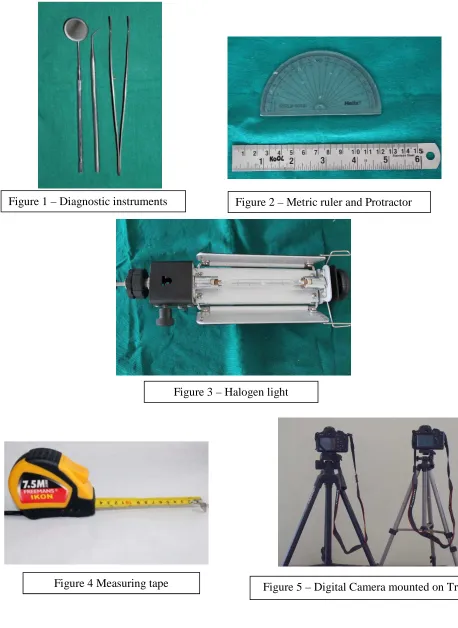
MATERIALS USED IN THE STUDY: (Fig 1 – 5)
1. Diagnostic Instruments – Mouth Mirror, Probe, Tweezer 2. Vivitar Tripod – 2
3. Canon DSLR 1200D Camera – 2 4. Measuring Tape - 1
5. Simplex Porta Light with 1000W halogen tube - 1 6. White Chart – 5
7. Smile DesignerPro Software 8. Microsoft Office Powerpoint 2013 9. Protractor
Figure 1 – Diagnostic instruments Figure 2 – Metric ruler and Protractor
Figure 3 – Halogen light
[image:28.595.69.527.105.733.2]METHODOLOGY:
The aim of this study was to evaluate smile esthetics in all three planes of space and relate it to overall facial attractiveness. A total of 20 subjects (10 males, 10 females) were selected from Sri Ramakrishna Dental College and Hospital, Coimbatore, Tamil Nadu based on Index Of Orthodontic Treatment Needs ( Dental Health Component : Grade 3).
Each subject reviewed and signed a consent form created in accordance with the rules and regulations of the Ethical Committee. The study was approved by the Ethical Committee of Sri Ramakrishna Dental College and Hospital, Coimbatore, Tamil Nadu.
DIVISION OF SAMPLES
The samples were divided equally into 2 groups based on gender as shown in the Figure.
SELECTION CRITERIA:
I. Inclusion Criteria;
1. Age group between 18-23 years
2. Untreated Patients classified on basis of Index of orthodontic treatment need (IOTN), dental health component Grade 312.
II. Exclusion Criteria;
1. Gross facial asymmetry
2. Previous orthodontically treated Patients 3. Unerupted or impacted supernumerary teeth
4. No active periodontal disease and no periodontal treatment except for routine scaling and root planing.
All the 20 subjects included in the study were selected based on the inclusion criteria and were undergraduate students from the institution with the age group between 18-23 years.
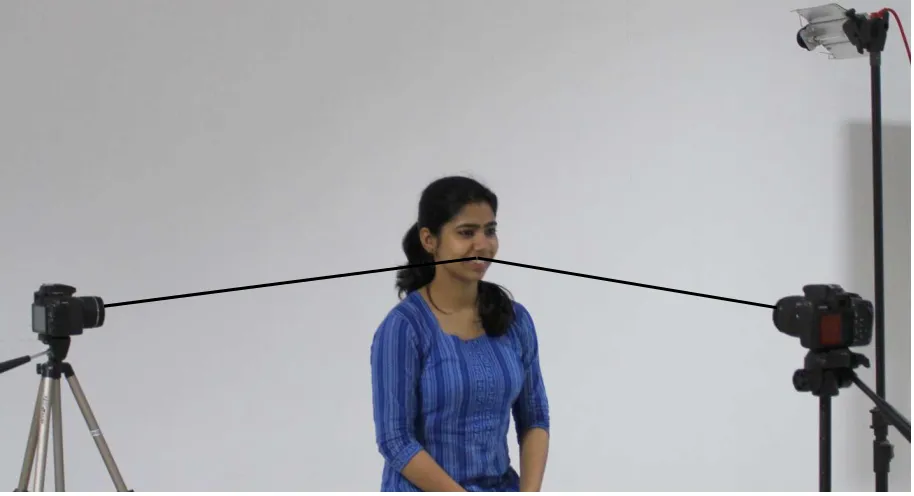
Two digital video cameras were used to record the posed smile of the subject in natural head position from the frontal and profile view at the same time. The cameras were placed at right angles to each other. The subjects were seated in natural head position with a distance of 3 feet from the camera lens. The cameras were mounted on a vivitar tripod, for recording the procedure and to prevent undesired operator movements depicted in Figure – 6.
A white background was standardized, before the video was recorded. Prior to the recording procedure, subjects were asked to rehearse the phrase “Chelsea eats cheesecake on the Chesapeake” for producing a relaxed posed smile13. The smile was recorded for a duration of 10
allowed the streaming video to be converted individual photographic frames at the rate of approximately 30 frames per second14. Thus, a 10 second video resulted in roughly 300 frames.
The frame best representing the subjects posed unstrained smile in both the views were selected. This frame was identified as “held smile”, which was one of the 15 consecutive frames in which the smile did not change14.The selected frames from both the views were uploaded to Smile
DesignerPro software for rotation calibration and millimeter scale measurements using the width of upper central incisors as landmark for calibration of scale to correct the magnification errors15.
Dimensional analysis were quantified for skeletal, dental and soft tissue structures in all three planes of space in frontal and profile view16. 2 parameters for skeletal, 5 parameters for dental and
7 parameters for soft tissue structures were selected in both the views (Table 1). The following parameters were measured using Smile DesignerPro software and Microsoft PowerPoint Office (2013 version) which comprised of Objective Evaluations done on the photograph in two views.
1. Profile(Fig 7): It is the relationship between two lines; one dropped from the bridge of nose to the base of upper lip and a second one extending from that point downward to the chin.17
2. Vertical thirds(Fig 8): The ideal face is divided vertically into equal thirds by horizontal lines adjacent to the hairline, the nasal base, and menton.18
4. Tooth Proportions (Golden Proportion, Lombardi): When viewed from frontal aspect, the width of each anterior tooth is 62% width of the adjacent tooth (mathematical ratio is 1.6:1:0.6).20
5. Dental Midline (Fig 13): The facial midline is identified using soft tissue nasion, nose base, philtrum. The facial midline should coincide with the maxillary and mandibular incisor midline or at least be minimally parallel.21
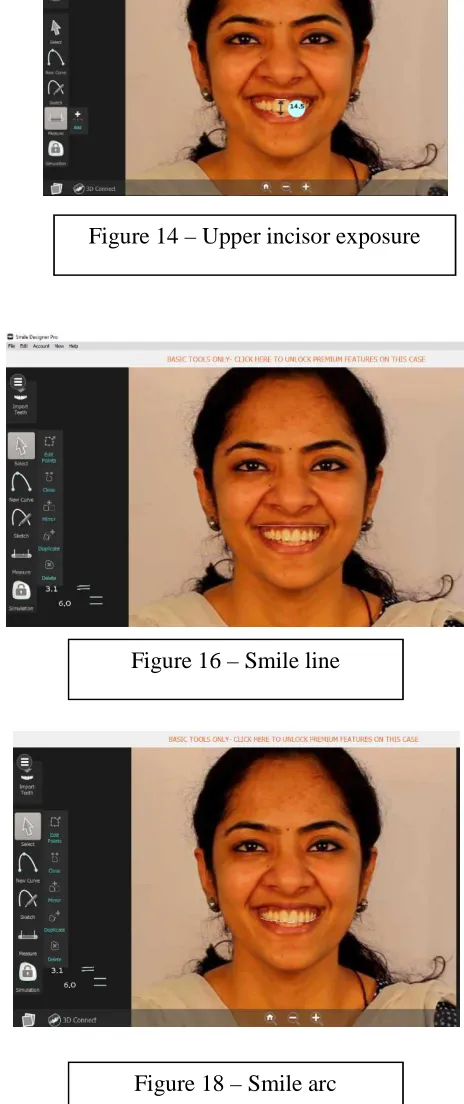
6. Maxillary incisor exposure(Fig 14): Maximum amount on vertical display of maxillary right central incisor during smile.22
7. Lower incisor exposure (Fig 15): Maximum amount of vertical display of lower right central incisor during smile.
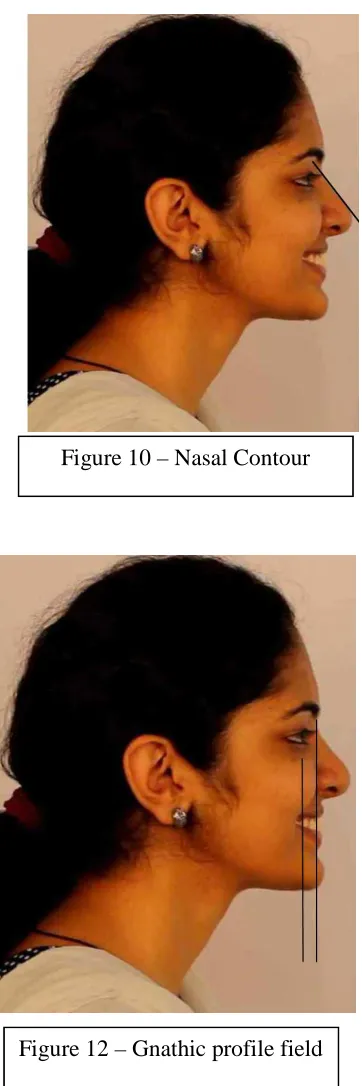
8. Nasal contour (Fig 10): It is classified into straight nose, convex nose in profile view. 23
9. Jaw profile field (Fig 12): Depending upon the location of subnasale point relative to the skin nasion perpendicular, there are typical profile variations: Average face – Subnasale lying on skin nasion perpendicular, anteface – subnasale lying in front of skin nasion perpendicular, retroface – subnasale lying behind skin nasion perpendicular. Based on the change of soft tissue pogonion relative to subnasale; nine different profile types can be seen.23
10.Slope of Forehead (Fig 11): The lateral forehead contour is steep, flat, protruding.23
11.Smile arc (Fig 18): It is the curvature of maxillary incisal edges and canines relative to the curvature of lower lip while smiling.26
13.Interlabial gap(Fig 17) : Distance between the most inferior portion of the tubercle of the upper lip and deepest midline point on the superior margin of lower lip to maxillary right central incisor edge.28
14. Smile line(Fig 16) : Divided into three categories as follows ; High smile – reveals the total cervicoincisal length of the upper anterior teeth and a continuous band of gingiva, Average smile – Reveals 75-100% of the maxillary anterior teeth and the interproximal gingiva only, Low smile line – Displays less than 75% of the anterior teeth.29
PARAMETERS ANALYSED ON PHOTOGRAPH – TABLE 1
SAGITTAL TRANSVERSE VERTICAL
SKELETAL 1.Profile 2.Vertical thirds
DENTAL 3.Anteroposterior position of maxillary incisors to forehead
4.Tooth proportions – Golden Proportion
5. Dental Midline
6. Upper Incisor exposure 7. Lower incisor exposure
SOFT TISSUE 8. Nasal contour 9. Gnathic profile field 10. Slope of Forehead
11. Smile arc 12. Buccal Corridor
13.Interlabial gap 14. Smile line
10 females) together with a template consisting of their own photographs in frontal and profile view. The questionnaire is presented on the facing page.
Grading scale is as follows:
Attractive Unattractive
1- Least attractive 1- Least unattractive
2- Little less attractive 2- Little less unattractive
3– Average 3– Average
4- Attractive 4- Unattractive
SRI RAMAKRISHNA DENTAL COLLEGE AND HOSPITAL
DEPARTMENT OF ORTHODONTICS AND DENTOFACIAL ORTHOPEDICS
EVALUATION OF SMILE ESTHETICS USING DIMENSIONAL ANALYSIS
INSTRUCTIONS: Answer all the questions and grade your answers from 1 to 5 with 1 being least and 5 being most
PATIENT NAME:
1. What do you feel about your smile and how would you relate it to the overall facial attractiveness?
a. Attractive b. Unattractive c. I don’t know
2. What do you feel about the arrangement of your teeth and how would you relate it to the overall facial attractiveness?
a. Attractive b. Unattractive
c. I don’t know
1 2 3 4 5
1 2 3 4 5
1 2 3 4 5
3. What do you feel about lower teeth exposure during smile and how would you relate it to overall facial attractiveness?
a. Attractive b. Unattractive c. I don’t know
4. What do you feel about the exposure of your gums during smile and how would you relate it to the overall facial attractiveness?
a. Attractive b. Unattractive c. I don’t know
5. What do you feel about size and position of lips with respect to nose and chin? a. Attractive
b. Unattractive c. I don’t know
1 2 3 4 5
1 2 3 4 5
1 2 3 4 5
1 2 3 4 5
1 2 3 4 5
6. What do you feel about the size and position of your nose and how would you relate it to overall facial attractiveness?
a. Attractive b. Unattractive c. I don’t know
7. What do you feel about the role of chin in overall facial attractiveness?
a. Attractive b. Unattractive c. I don’t know
8. How do you relate the symmetry of face on right and left side to overall facial attractiveness?
a. Attractive
b. Unattractive c. I don’t know
1 2 3 4 5
1 2 3 4 5
1 2 3 4 5
1 2 3 4 5
1 2 3 4 5
9. What is your opinion regarding the vertical proportions of upper, middle and lower one third of face and how would you relate it to overall facial attractiveness?
a. Attractive
b. Unattractive c. I don’t know
10.Which of the following structures do you wish to correct to improve overall facial attractiveness?
a. Teeth b. Lips c. Gums d. Nose e. Chin
f. All of the above g. None of the above
11. Which of the following structures do you find to be the most attractive in both the photographs?
Frontal Profile
Teeth Teeth
Lips Lips
Gums Gums
Nose Nose
Position of lower jaw Position of lower jaw 1 2 3 4 5
SRI RAMAKRISHNA DENTAL COLLEGE AND HOSPITAL
DEPARTMENT OF ORTHODONTICS AND DENTOFACIAL ORTHOPEDICS
CONSENT FORM
I Mr./Ms./Mrs. aged years was made aware by the doctor about the study that involves capturing a video to analyze my smile.
I hereby give my consent to use my records for educational purposes and for publication in articles or books. I agree to participate in this study and give my full consent for the videographic recording procedures.
Date:
Place:
[image:40.595.339.526.458.701.2]
Figure 6 – Standardization of sample – Cameras placed at right angles to each other.
[image:40.595.92.258.460.699.2]Figure 9 – AP relationship of upper incisors to forehead
Figure 10 – Nasal Contour
Figure 13 – Dental Midline Figure 14 – Upper incisor exposure
Figure 17 – Interlabial gap Figure 18 – Smile arc
[image:42.595.59.315.106.703.2] [image:42.595.322.554.140.692.2]RESULTS
A total of 20 samples were included in the study (10 males (Group A), 10 females (Group B)) with an age range of 18-23 years. Objective analysis was carried out on photographs in frontal and profile view. Subjective analysis was carried out by the subjects themselves using the questionnaire together with a template consisting of their own photographs in frontal and profile view for perception of their own smile and relating it to overall facial attractiveness.
STATISTICAL ANALYSIS:
Statistical analysis were done using the software SPSS version 22.0 for Windows 10. For continuous variables, means and standard deviations were calculated. Chi- square test, N – par test, ANOVA test, Percentage analysis, Cross tabulations were carried out to evaluate the statistical significance of each parameter in all three planes of space in frontal and profile view. For all tests, the significance level was set at 0.05.
PARAMETERS ASSESSED:
I. Intra group comparison of objective analysis - males II. Intra group comparison of objective analysis – females III. Intra group comparison of subjective analysis – males IV. Intra group comparison of subjective analysis – females
IX. Intergroup comparison for evaluating order of preference of facial structures from frontal and profile view - males
X. Intergroup comparison for evaluating order of preference of facial structures from frontal and profile view - females
XI. Intergroup comparison for correction of various structures between males and females
I. INTRAGROUP COMPARISON OF MALES (OBJECTIVE):
A. Frontal
1. Transverse Plane
i. Dental
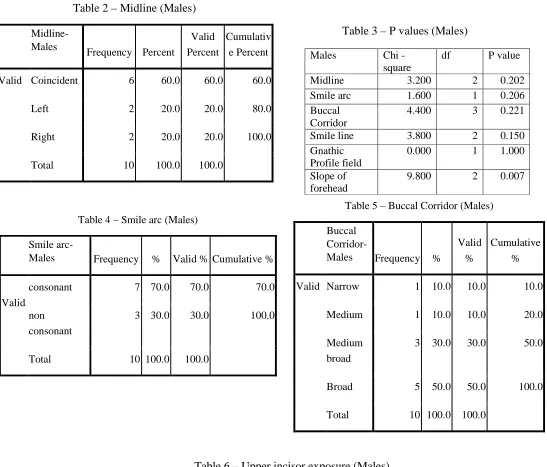
a. Midline - In group A, since P value > 0.05 there is no significant difference between midlines deviated to right, left or midlines that are coincident showing that 60% of samples had a coincident midline and 20% had their midlines deviated to right and left respectively.(Table -2,3; Graph-1)
b. Golden Proportion - It is disproportionate for all the samples, and hence a constant.
ii. Soft tissue
a. Smile Arc - In group A, since P value > 0.05, there is no significant difference between the consonant and non-consonant smile arc showing that 70% of samples had a consonant smile arc, 30% had a non-consonant smile arc.(Table-3,4; Graph 2)
II. Vertical Plane:
a. Skeletal
i. Vertical Thirds were disproportionate for all the samples and hence kept a constant.
b. Dental
i. Upper Incisor Exposure - In group A, mean (+/- SD) of upper incisor exposure is 10.14+/- 1.571mm. (Table 6, Graph 4).
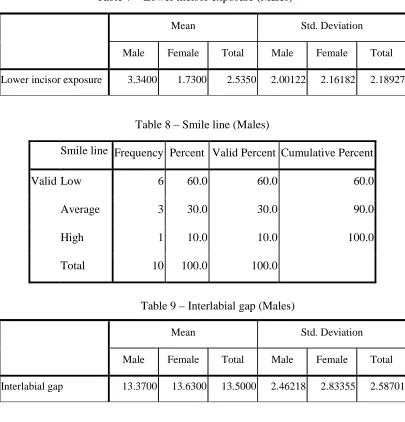
ii. Lower Incisor Exposure - In group A, mean (+/-SD) of lower incisor exposure is 3.34+/- 2.001. (Table 7, Graph 5)
c. Soft tissue
i. Smile line - Among group A, since P value > 0.05, there is no significant difference between low, average and high smile lines with 60% of samples having a low smile line, 30% having average and 10% having a high smile line.(Table - 3,8; Graph 6).
ii. Interlabial gap - In group A, mean(+/-SD) of interlabial gap is 13.37+/-2.462mm.(Table 9, Graph 7)
B. Profile View I. Sagittal a. Skeletal
b. Dental
i. Labiolingual inclination of upper incisors to forehead - In group A, the mean (+/-SD) labiolingual inclination was -0.25mm+/- 3.75mm showing that males had maxillary incisors positioned posterior to foreheads FFA point.(Table 10, Graph 8)
c. Soft tissue
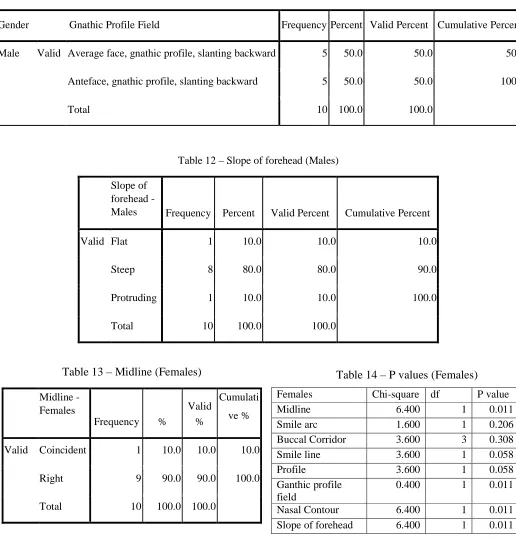
i. Gnathic Profile Field - Among group A, since P value > 0.05, there is no significant difference between those with average face, gnathic profile, slanting backward and anteface, gnathic profile, slanting backward showing that 50% of the samples had average and anteface chin respectively. (Table - 3, 11, Graph 9)
ii. Nasal Contour - Among group A, straight nasal contour is constant over all the samples.
iii. Slope of forehead - Among group A, since P value <0.05 there is a significant difference between flat, steep and protruding forehead showing that samples with steep forehead being 80% more prevalent than those with flat(10%) and protruding(10%) slopes of forehead. (Table-3, 12; Graph 10).
II. INTRAGROUP COMPARISON OF FEMALES (OBJECTIVE):
A. Frontal
1. Transverse Plane
i. Dental
b. Golden Proportion - It is disproportionate for all the samples and hence a constant.
ii. Soft tissue
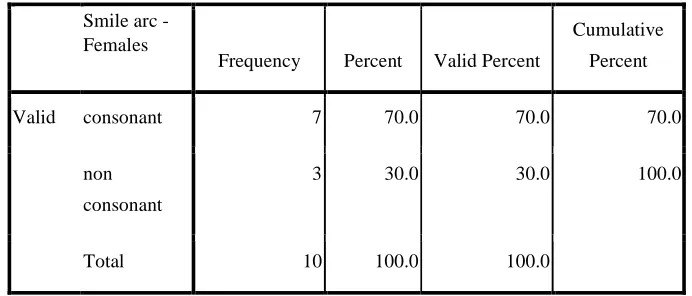
a. Smile arc - In group B, since P value > 0.05, there is no significant difference between consonant and consonant smile arc showing that females with consonant smile arc is 70% and non-consonant smile arc is 30%. (Table 14, 15; Graph 12)
b. Buccal corridor - In group B, since P value is >0.05, there is no significant difference between the categories of buccal corridor showing that females had medium and medium broad categories of buccal corridor of 40%, narrow(10%) and broad (10%). (Table-14, 16; Graph 13)
2. Vertical Plane
i. Skeletal
a. Vertical thirds – Vertical thirds proportions of the face were disproportionate for all and kept constant.
ii. Dental
a. Upper Incisor Exposure - In group B, mean (+/-SD) of upper incisor exposure is 11.4+/- 2.06mm. (Table 6, Graph 14)
iii. Soft tissue
a. Smile line - Among group B, since P value > 0.05, there is no significant difference between low, average and high smile lines with average smile line being 80% more prevalent followed by high smile line (20%). (Table-14, 17; Graph 16)
ii. Interlabial gap - In group B, mean of interlabial gap is 13.63+/-2.833. (Table 9, Graph 17)
B. Profile
1. Sagittal Plane
i. Skeletal
a. Profile - Among group B, since P value > 0.05, there is no significant difference between straight and convex profiles showing that 80% of the samples had a convex profile and 20% had a straight profile. (Table-14, 18; Graph 18)
ii. Dental
a. Labiolingual inclination of upper incisors to forehead - In group B, mean on upper incisor inclination to forehead is -2.3 +/- 1.251mm showing that showing that females had maxillary incisors positioned posterior to foreheads FFA point. (Table-10, 14; Graph 19)
iii. Soft tissue
b. Nasal Contour - Among group B, since P value < 0.05, there is a significant difference between those with straight and convex nose; with straight nose being 90% more prevalent. (Table-14, 20; Graph 21)
c. Slope of forehead - Among group B, since P value <0.05 there is a significant difference between flat, steep and protruding forehead indicating that samples in this group had flat forehead 90% more prevalent. (Table 14, 21; Graph 22)
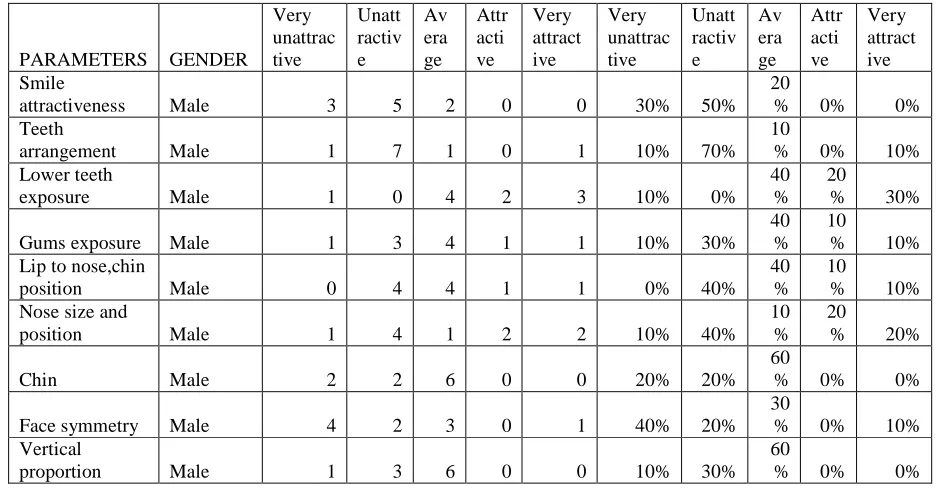
III. INTRA GROUP COMPARISON OF MALES FOR SUBJECTIVE ANALYSIS (Tables- 22, 23)
A. Frontal –
(1) Transverse Plane
a. Skeletal – Symmetry of face - In group A, 40% of samples said their face symmetry were very unattractive, 30% said it was average, 20% said it was unattractive, 10% said it was very attractive.( Graph 23)
b. Dental – Arrangement of teeth - In group A, 70% of samples said their teeth arrangement was unattractive, 10% each said their teeth arrangement was attractive, average and very unattractive.( Graph 24)
(2) Vertical Plane
a. Skeletal – Vertical Proportions of face - In group A, 60% of samples said vertical proportions of face their face was average, 30% said it was unattractive, 10% said it was very unattractive. (Graph 26)
b. Dental – Lower incisor exposure - In group A and B, 40% of samples said their lower teeth exposure was average, 30% of samples said their lower teeth exposure was very attractive and rest 20% and 10% said their lower teeth exposure was attractive and very unattractive.( Graph 27)
c. Soft tissue – Exposure of Gums - In group A, 40% of subjects had rated their gingival exposure as average, 30% as unattractive and 10% as attractive, unattractive and average respectively. (Graph 28)
B. Profile
(1) Sagittal – Soft tissue
a. Relationship of position of Lips to nose and chin position - Group A, evaluated the size and position of lips with respect to nose and chin as unattractive (40%), average (40%), 10% attractive and 10% very attractive. (Graph 29)
b. Size and position of Nose - In group A, 40% of subjects had rated the relationship of size and position of nose to overall facial attractiveness as unattractive, 20% as very attractive, attractive and 10% as average and very unattractive respectively. (Graph 30)
IV. INTRA GROUP COMPARISON OF FEMALES FOR SUBJECTIVE ANALYSIS (Table 24, Table 25)
A. Frontal –
(1)Transverse Plane
a. Skeletal – Symmetry of face - In group B, 50% of samples said their face symmetry was average, 30% said it was unattractive, 10% each said it was average and very unattractive respectively. (Graph 23)
b. Dental – Arrangement of teeth - In group B, 40% of samples said their teeth arrangement was average, 30% said it was unattractive, 20% said it was very unattractive and 10% said it is attractive. (Graph 24)
c. Soft tissue – Smile Attractiveness - In group B, 40% of samples rated their smile as unattractive, 30% of samples rated their smile as average, 20% of samples rated their smile as attractive and 10% of samples rated their smile as very unattractive. (Graph 25)
(2) Vertical Plane
a. Skeletal – Vertical Proportions of face - In group B, 30% of samples said vertical proportions of face their face was attractive, unattractive and average respectively and 10% said it was very attractive. (Graph 26)
c. Soft tissue – Exposure of Gums - In group B, 40% of subjects had rated their gingival exposure as attractive, 30% as unattractive, 20% as average and 10% as attractive. (Graph 28)
B. Profile -
(1) Sagittal – Soft tissue
a. Relationship of position of Lips to nose, chin position - In Group B, the size and position of lips with respect to nose and chin was unattractive (40%), average (40%), attractive (20%) respectively. (Graph 29)
b. Size and position of Nose - In group B, 80% of subjects had rated the relationship of size and position of nose to overall facial attractiveness as average, 10% rated it as attractive and unattractive respectively. (Graph 30)
c. Chin - In group B, 50% of subjects had rated the role of chin to overall facial attractiveness as average, 20% as average and unattractive; respectively and 10% as very attractive. (Graph 31)
V. INTER GROUP COMPARISON FOR OBJECTIVE ANALYSIS – FRONTAL
I. Dental Parameters – Transverse Plane
A. Midline - Since P value < 0.05 (5% level), there is a significant difference between the Coincident, Left and Right Percentages of Midline. Therefore the samples whose Midline is deviated to Right is more in percentage (55%) than those whose midlines are coincident (35%), deviated to left (10%). (Tables - 26, 27; Graph 32)
II. Soft tissue - Transverse Plane
a. Smile arc - Since P value > 0.05 (5% level), there is no significant difference between the Consonant and non-consonant of smile arc showing that 70% of samples had a consonant smile arc and 30% of sample had a non-consonant smile arc. (Table 28; Graph 33)
b. Buccal Corridor - Since P value > 0.05 (5% level), there is no significant difference among the samples showing that the sample had medium broad BC of 35%, broad BC of 30%, medium BC of 25%, narrow BC of 10%. (Table 29; Graph 34)
III. Vertical Plane
1. Skeletal
a. Vertical thirds were disproportionate and hence constant for all samples.
2. Dental
a. Upper Incisor exposure - Since P value is greater than 0.05 (5% level), there is no significant difference between Group A and B in the average score on this parameter. Group B had greater upper incisor exposure than group A. (Tables - 30,31; Graph 35)
3. Soft tissue
a. Smile Line - Since P value > 0.05 (5% level), there is a no significant difference between the low, average and high smile line. 55% of samples had an average smile line, followed by low smile line of 30% and High smile line of 15%. (Table 33; Graph 37)
b. Interlabial gap - Since P value > 0.05 (5% level), there is no significant difference between male and female in the average score on this parameter. Group A, had a mean interlabial gap of 13.37+/-2.462mm and Group B had a mean value of 13.63 +/-2.833mm. Group B had more interlabial gap than group A. (Tables - 9,34; Graph 38)
VI. INTER GROUP COMPARISON FOR OBJECTIVE ANALYSIS – PROFILE
I .SAGITTAL
1. Skeletal
a. Profile - Since P value < 0.05 (5% level), there is a significant difference between samples with straight profile and convex profile. Therefore the samples whose profile is convex was very high (90%) than those with straight profile. (Table 33, Graph 39)
2. Dental
3. Soft tissue
a. Gnathic Profile Field - Since P value > 0.05 (5% level), there is no significant difference between average face, gnathic profile, backward slanting and anteface, gnathic profile, backward slanting. 70% of the sample had average face, gnathic profile, 30% of the sample had anteface, gnathic profile, backward slanting. (Table 36, Graph-9,20)
b. Nasal Contour - Since P value < 0.05 (5% level), there is a significant difference between the straight and convex of nasal contour. Therefore, the samples with straight nose more in percentage (95%) than other sample. (Table 37, Graph 42)
c. Slope of forehead - Among group A, since P value <0.05 there is a significant difference between flat, steep and protruding forehead, with steep forehead being 80% more prevalent. Among group B, since P value <0.05 there is a significant difference between flat, steep and protruding forehead, with flat forehead being 90% more prevalent. (Table 38, Graph 43)
VII. INTER GROUP COMPARISON FOR SUBJECTIVE ANALYSIS – FRONTAL (Tables - 39, 42)
A. Frontal – (1) Transverse Plane
a. Skeletal – Symmetry of face - In group A, 40% of samples said their face symmetry were very unattractive, 30% said it was average, 20% said it was unattractive, 10% said it was very attractive. In group B, 50% of samples said their face symmetry was average, 30% said it was unattractive, 10% each said it was average and very unattractive respectively. (Graph 23) b. Dental – Arrangement of teeth - In group A, 70% of samples said their teeth arrangement was
unattractive. In group B, 40% of samples said their teeth arrangement was average, 30% said unattractive, 20% very unattractive and 10% said it is average.( Graph 24)
c. Soft tissue – Smile Attractiveness - In group A, 50% of samples rated their smile as unattractive, 30% of samples rated their smile as very unattractive and 20% rated their smile as average. In group B, 40% of samples rated their smile as unattractive, 30% of samples rated their smile as average, 20% of samples rated their smile as attractive and 10% of samples rated their smile as very unattractive. (Graph 25)
(2) Vertical Plane
a. Skeletal – Vertical Proportions of face
In group A, 60% of samples said vertical proportions of face their face was average, 30% said it was unattractive, 10% said it was very unattractive. In group B, 30% of samples said vertical proportions of face their face was attractive, unattractive and average respectively and 10% said it was very attractive. (Graph 26)
b. Dental – Lower incisor exposure - In group A and B, 40% of samples said their lower teeth exposure was average. In group A, 30% of samples said their lower teeth exposure was very attractive and rest 20% and 10% said their lower teeth exposure was attractive and very unattractive. In group B, 20% of samples said their lower teeth exposure was attractive, average and unattractive respectively. (Graph 27)
VIII. INTER GROUP COMPARISON FOR SUBJECTIVE ANALYSIS – PROFILE (Tables – 40,41)
A. Profile – (1) Sagittal – Soft tissue
a. Relationship of position of Lips to nose, chin position. - Both group A and group B, evaluated the size and position of lips with respect to nose and chin as unattractive (40%) and average (40%) respectively. (Graph 29)
b. Size and position of Nose. - In group A, 40% of subjects had rated the relationship of size and position of nose to overall facial attractiveness as unattractive, 20% as very attractive, attractive and 10% as average and very unattractive respectively. In group B, 80% of subjects had rated the relationship of size and position of nose to overall facial attractiveness as average, 10% rated it as attractive and unattractive respectively. (Graph 30)
c. Chin - In group A, 60% of subjects had rated the role of chin in overall facial attractiveness as average, 20% as unattractive and very unattractive respectively. In group B, 50% of subjects had rated the role of chin to overall facial attractiveness as average, 20% as average and unattractive; respectively and 10% as very attractive. (Graph 31)
B. Profile - From the profile view, 70% of males had chosen position of lower jaw as the best viewable parameter; after position of lower jaw, nose (40%) and teeth (10%) were the order preference in the profile view. (Graph 44)
X. INTERGROUP COMPARISON FOR EVALUATING ORDER OF PREFERENCE OF FACIAL STRUCTURES FROM FRONTAL AND PROFILE VIEW – FEMALES (Table 43)
A. FRONTAL - Females had chosen teeth as the best viewable structure (90%); after teeth; Gums (80%), Nose (70%), Lips (60%), Position of lower jaw (40%) was the order of preference of structures from the frontal view. (Graph 44)
B. PROFILE – Among females; 40% had chosen position of lower jaw as the best viewable structure from the profile view followed by nose (20%).
XI. INTERGROUP COMPARISON FOR CORRECTION OF VARIOUS STRUCTURES BETWEEN MALES AND FEMALES (Table 44, Graph 45)
Out of 20 samples, 16 of them wanted correction in any part of the face, to increase the facial attractiveness. Among these, 9 belonged to group A (males) and 7 belonged to group B(females).
Table 2 – Midline (Males)
Midline-Males Frequency Percent Percent Valid Cumulative Percent
Valid Coincident 6 60.0 60.0 60.0
Left 2 20.0 20.0 80.0
Right 2 20.0 20.0 100.0
Total 10 100.0 100.0
Males Chi - square
df P value
Midline 3.200 2 0.202
Smile arc 1.600 1 0.206
Buccal Corridor
4.400 3 0.221
Smile line 3.800 2 0.150
Gnathic Profile field
0.000 1 1.000
Slope of forehead
9.800 2 0.007
Table 4 – Smile arc (Males)
Smile
arc-Males Frequency % Valid % Cumulative %
Valid
consonant 7 70.0 70.0 70.0
non consonant
3 30.0 30.0 100.0
Total 10 100.0 100.0
Table 5 – Buccal Corridor (Males)
Buccal
Corridor-Males Frequency %
Valid %
Cumulative %
Valid Narrow 1 10.0 10.0 10.0
Medium 1 10.0 10.0 20.0
Medium broad
3 30.0 30.0 50.0
Broad 5 50.0 50.0 100.0
Total 10 100.0 100.0
Mean Std. Deviation
Male Female Total Male Female Total Upper incisor exposure 10.1400 11.4000 10.7700 1.57141 2.06344 1.89850
[image:60.595.21.568.104.571.2]Table 3 – P values (Males)
Table 7 – Lower incisor exposure (Males)
Table 9 – Interlabial gap (Males)
Mean Std. Deviation
Male Female Total Male Female Total
[image:61.595.95.500.93.515.2]Lower incisor exposure 3.3400 1.7300 2.5350 2.00122 2.16182 2.18927
Table 8 – Smile line (Males)
Smile line Frequency Percent Valid Percent Cumulative Percent
Valid Low 6 60.0 60.0 60.0
Average 3 30.0 30.0 90.0
High 1 10.0 10.0 100.0
Total 10 100.0 100.0
Mean Std. Deviation
Male Female Total Male Female Total
Interlabial gap 13.3700 13.6300 13.5000 2.46218 2.83355 2.58701
Table 10 – Labiolingual inclination (Males)
Mean Std. Deviation
Male Female Total Male Female Total Labiolingual
inclination
Table 11 – Gnathic Profile Field (Males)
Gender Gnathic Profile Field Frequency Percent Valid Percent Cumulative Percent
Male Valid Average face, gnathic profile, slanting backward 5 50.0 50.0 50.0
Anteface, gnathic profile, slanting backward 5 50.0 50.0 100.0
Total 10 100.0 100.0
Table 12 – Slope of forehead (Males)
Slope of forehead -
Males Frequency Percent Valid Percent Cumulative Percent
Valid Flat 1 10.0 10.0 10.0
Steep 8 80.0 80.0 90.0
Protruding 1 10.0 10.0 100.0
Total 10 100.0 100.0
Table 13 – Midline (Females) Midline -
Females
Frequency %
Valid %
Cumulati
ve %
Valid Coincident 1 10.0 10.0 10.0
Right 9 90.0 90.0 100.0
Total 10 100.0 100.0
Females Chi-square df P value
Midline 6.400 1 0.011
Smile arc 1.600 1 0.206
Buccal Corridor 3.600 3 0.308
Smile line 3.600 1 0.058
Profile 3.600 1 0.058
Ganthic profile field
0.400 1 0.011
Nasal Contour 6.400 1 0.011
[image:62.595.39.555.117.670.2]
Table 15 – Smile arc (Females)
Smile arc - Females
Frequency Percent Valid Percent
Cumulative
Percent
Valid consonant 7 70.0 70.0 70.0
non
consonant
3 30.0 30.0 100.0
Total 10 100.0 100.0
Table 16 – Buccal Corridor (Females)
Buccal corridor
- Females Frequency Percent Valid Percent Cumulative Percent
Valid Narrow 1 10.0 10.0 10.0
Medium 4 40.0 40.0 50.0
Medium broad 4 40.0 40.0 90.0
Broad 1 10.0 10.0 100.0
Total 10 100.0 100.0
Table 17 – Smile line (Females)
Smile line -
Females Frequency Percent Valid Percent
Cumulative
Percent
Valid Average 8 80.0 80.0 80.0
High 2 20.0 20.0 100.0
Total 10 100.0 100.0
Table 18 – Profile (Females)
Profile - Females
Frequency Percent Valid Percent
Cumulative
Percent
Valid Straight 2 20.0 20.0 20.0
Convex 8 80.0 80.0 100.0
Table 19 – Gnathic Profile Field (Females)
Gnathic Profile field - Females
Frequency % Valid % Cumulative %
Valid anteface, gnathic profile, slanting backwards 9 90.0 90.0 90.0
average face, gnathic profile, slanting backward 1 10.0 10.0 100.0
Total 10 100.
0
100.0
Table 20 – Nasal Contour ( Females)
Nasal Contour - Females
Frequ
ency Percent
Valid Percent
Cumulative Percent
Valid Straight 9 90.0 90.0 90.0
Convex 1 10.0 10.0 100.0
Total 10 100.0 100.0
Table 21 – Slope of forehead (Females)
Slope of forehead -
Females Frequency Percent
Valid Percent
Cumulative Percent
Valid Flat 9 90.0 90.0 90.0
Steep 1 10.0 10.0 100.0
Table 22 – Subjective assessments - Males
Table 23 – P value – Subjective assessment - Males
* P value significant at 5% level.
PARAMETERS GENDER Very unattrac tive Unatt ractiv e Av era ge Attr acti ve Very attract ive Very unattrac tive Unatt ractiv e Av era ge Attr acti ve Very attract ive Smile
attractiveness Male 3 5 2 0 0 30% 50%
20
% 0% 0%
Teeth
arrangement Male 1 7 1 0 1 10% 70%
10
% 0% 10%
Lower teeth
exposure Male 1 0 4 2 3 10% 0%
40 %
20
% 30%
Gums exposure Male 1 3 4 1 1 10% 30%
40 %
10
% 10%
Lip to nose,chin
position Male 0 4 4 1 1 0% 40%
40 %
10
% 10%
Nose size and
position Male 1 4 1 2 2 10% 40%
10 %
20
% 20%
Chin Male 2 2 6 0 0 20% 20%
60
% 0% 0%
Face symmetry Male 4 2 3 0 1 40% 20%
30
% 0% 10%
Vertical
proportion Male 1 3 6 0 0 10% 30%
60
% 0% 0%
Chi-Square df P value
Smile attractiveness 1.4 2 0.497
Teeth arrangement attractiveness 10.8 3 0.013*
Lower teeth exposure attractiveness 2 3 0.572
Gums exposure attractiveness 4 4 0.406
Lip to nose, chin position attractiveness 3.6 3 0.308
Nose size and position attractiveness 3 4 0.558
Chin attractiveness 3.2 2 0.202
Face symmetry attractiveness 2 3 0.572
Table 24 – Subjective assessments - Females
Table 25 – P values for subjective assessments - Females
Chi-Square df P value
Smile attractiveness
2.000 3 .572
Teeth arrangement attractiveness 2.000 3 .572
Lower teeth exposure attractiveness 1.200 3 .753
Gums exposure attractiveness 2.000 3 .572
Lip to nose,chin position attractiveness .800 2 .670
Nose size and position attractiveness 9.800 2 .007
Chin attractiveness 3.600 3 .308
Face symmetry attractiveness 4.400 3 .221
Vertical proportion attractiveness 1.200 3 .753
PARAMETERS GENDER Very unattrac tive Unatt ractiv e Av era ge Attr acti ve Very attract ive Very unattrac tive Unatt ractiv e Av era ge Attr acti ve Very attract ive Smile
attractiveness Female 1 4 3 2 0 10% 40%
30 %
20
% 0%
Teeth
arrangement Female 0 3 4 1 2 0% 30%
40 %
10
% 20%
Lower teeth
exposure Female 0 2 4 2 2 0% 20%
40 %
20
% 20%
Gums exposure Female 0 3 2 4 1 0% 30%
20 %
40
% 10%
Lip to nose,chin
position Female 0 4 4 2 0 0% 40%
40 %
20
% 0%
Nose size and
position Female 0 1 8 1 0 0% 10%
80 %
10
% 0%
Chin Female 0 2 5 2 1 0% 20%
50 %
20
% 10%
Face symmetry Female 1 3 5 1 0 10% 30%
50 %
10
% 0%
Vertical
proportion Female 0 3 3 3 1 0% 30%
30 %
30
[image:66.595.73.534.482.657.2]Table 27 – P values for objective assessments - Combined Table 26 – Midline - Combined
Midline
Frequency Percent Valid Percent
Cumulative Percent
Valid Coincident 7 35.0 35.0 35.0
Left 2 10.0 10.0 45.0
Right 11 55.0 55.0 100.0
Total 20 100.0 100.0
Chi - square
df P value
Midline 6.100 2 0.047
Smile arc 3.200 1 0.074
Buccal Corridor 2.800 3 0.423
Smile line 4.900 2 0.086
Profile 12.800 1 0.000
Gnathic profile field
3.200 1 0.074
Nasal Contour 16.200 1 0.000
Slope of forehead 7.3 2 0.026
Table 28 – Smile arc - Combined Smile arc
Frequency Percent Valid Percent
Cumulative Percent
Valid consonant 14 70.0 70.0 70.0
non consonant 6 30.0 30.0 100.0
[image:67.595.172.424.344.502.2]Table 31 – Numerical parameters – P values Table 29 – Buccal Corridor - Combined Buccal Corridor
Frequency Percent Valid Percent Cumulative Percent
Valid Narrow 2 10.0 10.0 10.0
Medium 5 25.0 25.0 35.0
Medium broad 7 35.0 35.0 70.0
Broad 6 30.0 30.0 100.0
[image:68.595.93.504.382.525.2]Total 20 100.0 100.0
Table 30 - Mean Values and Std. Deviations for UI and LI exposure
Mean Std. Deviation
Male Female Total Male Female Total Upper incisor
exposure
10.1400 11.4000 10.7700 1.57141 2.06344 1.89850
Lower incisor exposure
3.3400 1.7300 2.5350 2.00122 2.16182 2.18927
P value Upper Incisor Exposure 0.142 Lower Incisor Exposure 0.101
Table – 32 – Smile line (Combined) Smile line
Frequency Percent Valid Percent Cumulative Percent
Valid Low 6 30.0 30.0 30.0
Average 11 55.0 55.0 85.0
High 3 15.0 15.0 100.0
[image:69.595.90.506.90.422.2]Total 20 100.0 100.0
Table – 33 – Profile (Combined) Profile
Frequency Percent Valid Percent Cumulative Percent
Valid Straight 2 10.0 10.0 10.0
Convex 18 90.0 90.0 100.0