CHILD POVERTY
SIMON WAKEFIELD
This briefing provides an overview of child poverty in Scotland. The different methods of measuring child poverty are outlined, and figures are provided on the numbers of children living in poverty in Scotland. The causes and effects of child poverty, and the policy responses from the Scottish and UK governments, are discussed. The briefing also highlights some of the recent debate on child poverty, including previous parliamentary consideration and the views of stakeholders.
SPICe
briefing
29 January 2008
08/05
Scottish Parliament Information Centre (SPICe) Briefings are compiled for the benefit of the Members of the Parliament and their personal staff. Authors are available to discuss the contents of these papers with MSPs and their staff who should contact Simon Wakefield on extension 85372 or email
[email protected] . Members of the public or external organisations may comment on this briefing by emailing us at
[email protected]. However, researchers are unable to enter into personal discussion in relation to SPICe Briefing Papers. If you have any general questions about the work of the Parliament you can email the Parliament’s Public Information Service at [email protected].
Every effort is made to ensure that the information contained in SPICe briefings is correct at the time of publication. Readers should be aware however that briefings are not necessarily updated or otherwise amended to reflect subsequent
hanges. c
CONTENTS
KEY POINTS ...3
WAYS OF MEASURING CHILD POVERTY...4
HOW MANY CHILDREN ARE IN POVERTY IN SCOTLAND? ...4
SEVERE DEPRIVATION...7
INTERNATIONAL COMPARISONS...7
VARIATIONS WITHIN SCOTLAND...9
CAUSES AND EFFECTS OF CHILD POVERTY ...10
Health ...10
Education ...10
Lifelong poverty ...11
POLICY...12
SCOTTISH GOVERNMENT POLICY...12
UKGOVERNMENT POLICY...14
DEBATE ON CHILD POVERTY ...14
PARLIAMENTARY CONSIDERATION...14
VIEWS OF NON-GOVERNMENTAL ORGANISATIONS...15
Progress on achieving UK child poverty targets ...17
KEY POINTS
• There are three official measures of child poverty. These are based on the numbers in absolute low income households, the numbers in relative low income households, and the numbers experiencing material deprivation and low income combined
• Latest figures indicate there are:
o 130,000 children in Scotland in absolute poverty
o 210,000 children in Scotland in relative poverty
o 130,000 children in Scotland with a combination of relative low income and material deprivation
o over 90,000 Scottish children living in severe poverty, according to Save the Children
• Nationally, 21% of children are in families claiming out-of-work benefits. Within Scotland there are 83 local wards where the percentage of children in families on out-of-work benefits is at least twice the national average. Thirty seven of these wards are in Glasgow City
• The Scottish Affairs Committee recently concluded that poverty is caused primarily by low pay and low levels of benefits
• The effects of poverty on children include poorer health and lower levels of educational attainment
• At a UK level, Public Service Agreement 9 sets out the Government’s intention to “halve the number of children in poverty by 2010-11, on the way to eradicating child poverty by 2020”
• The Institute of Fiscal Studies states that “the Government could meet its target of
halving child poverty between 1998 and 2010 by spending an estimated £4 billion a year (0.3 per cent of GDP) more than currently planned on benefits and tax credits. Getting the second half of children out of poverty between 2010 and 2020 [would require] a further £28 billion (1.6 per cent of GDP) in addition to planned annual spending
• The Scottish Government has stated it is “committed to sharing the UK Government’s long-term target to eradicate child poverty by 2020 and will continue to do all [it] can to ensure that Scottish policies and programmes make the maximum contribution towards the milestone of halving child poverty by 2010”
• Target 5 of the Government’s National Performance Framework is “to increase overall income and the proportion of income earned by the three lowest income deciles as a group by 2017.” More specifically, Indicator 14 is to “decrease the proportion of individuals living in poverty
• Specific policies on child poverty identified by the Scottish Government include:
o Workforce Plus
o More Choices More Chances
o Free school meals pilots
o The skills strategy
o A forthcoming early years strategy
WAYS OF MEASURING CHILD POVERTY
“Attempts to explain the different approaches to defining and measuring poverty are often overtly technical and theoretical, written by academics and statisticians for ‘people like them’. However the ways in which we conceptualise and define poverty have implications for the number of people that are counted as living in poverty; the understanding that society in general has about those living in poverty; and about the policy solutions that we develop to address the problem. Therefore we must all be concerned about how poverty is defined and measured””
(Kelly P and McHendrick J, in Poverty in Scotland 2007; McHendrick et al)
The Department for Work and Pensions (DWP) measures child poverty using three tiers of statistics (Scottish Executive 2007a). This combined measure will be used to assess progress in achieving a joint DWP/ HM Treasury child poverty target of halving child poverty by 2010 and eradicating child poverty by 2020.
Measure of child poverty Stated purpose of measure
Tier 1, Absolute low income: Number and proportion of children in households whose equivalised income before housing costs is below 60% of inflation adjusted median income in 1998/99.
This is a measure of whether the poorest families are seeing their incomes rise in real terms.
Tier 2, Relative low income: Number and proportion of children in households whose equivalised income before housing costs is below 60% of median 1 income in the same year.
This is a measure of whether the poorest families are keeping pace with the growth of incomes in the economy as a whole.
Tier 3, Material deprivation and relative low income combined: Number and proportion of children that are both materially deprived (scoring 25 or more on a deprivation index) and are in households whose equivalised income before housing costs is less than 70% of the median in the current year.
This is to provide a wider measure of children's living standards. 21 questions on material deprivation are included in the UK Family Resources Survey. This composite indicator aims to exclude those with low incomes, who have high living standards, and to include those who would not be captured by the relative low-income measure but who face certain unavoidably high costs.
HOW MANY CHILDREN ARE IN POVERTY IN SCOTLAND?
The charts and table below provide statistics in relation to each of these three ‘tiers’ of measurement:
Figure 1: People in Scottish Households with Absolute Low Incomes (‘000s) (Source Scottish Executive 2007a)
350 370 370 340 300
280 230
170 170 160 130 130
300 320 310
230
230
200
150
120 130 110
110 100 580 550 540
490
450
470
470
350 410 350
[image:5.595.53.503.426.700.2]320 330 0 200 400 600 800 1000 1200 1400 199 4/95 1995/ 96 199 6/9 7 199 7/98 199 8/99 199 9/00 200 0/01 2001/ 02 200 2/0 3 200 3/04 200 4/05 200 5/06 Working Age Adults Pensioners Children
Figure 2: People in Scottish Households with Relative Low Incomes (‘000s) (Source Scottish Executive 2007a)
310 300 340 330 300 300 280 280 260 250
210 210 220 240
260
210 230 240
210 190 210
190
190 190 510
440
490
470 450 510 540
490 530 480 460 470 0 200 400 600 800 1000 1200 1994/ 95 199 5/96 1996/ 97 1997/ 98 1998/ 99 1999/ 00 2000 /01 2001/ 02 2002/ 03 2003/ 04 2004/ 05 2005 /06
Working Age Adults Pensioners
Children
• In 2004/05 16% of children (170,000 children) were in combined Low Income and Material Deprivation.
• In 2005/06 13% of children (130,000 children) were in combined Low Income and Material Deprivation.
[image:6.595.48.552.243.735.2]Further detail on some of the child specific questions in the Family Resources Survey (05/06) is provided below in Table 1:
Table 1: Responses to material deprivation questions from Scottish households (2005/06)
(Source: Scottish Executive 2007a)
% (000s) % (000s) % (000s) Bottom
Have this 74% 180 93% 120 85% 860
Don't have this 26% 60 7% 10 15% 150
Have this 62% 20 88% 20 76% 110
Want but can't afford this 32% 10 12% 0 22% 30 Don't want or need; doesn't
apply 6% 0 0% . 2% 0
Have this 90% 220 98% 130 96% 960
Want but can't afford this 8% 20 0% . 3% 30 Don't want or need; doesn't
apply 2% 0 2% 0 1% 10
Have this 85% 200 96% 120 91% 920
Want but can't afford this 9% 20 1% 0 4% 40 Don't want or need; doesn't
apply 6% 20 3% 0 4% 40
Have this 40% 100 91% 120 66% 660
Want but can't afford this 55% 130 3% 0 29% 290 Don't want or need; doesn't
apply 5% 10 6% 10 5% 50
Do this 73% 170 84% 110 84% 840
Would like to but can't afford
this 11% 30 1% 0 4% 40
Don't want or need; doesn't
apply 16% 40 15% 20 12% 120
Do this 60% 140 74% 100 69% 690
Would like to but can't afford
this 14% 30 1% 0 6% 60
Don't want or need; doesn't
apply 25% 60 25% 30 25% 250
Do this 66% 160 82% 110 77% 770
Would like to but can't afford
this 14% 30 1% 0 5% 50
Don't want or need; doesn't
apply 19% 50 17% 20 18% 180
Do this 83% 150 95% 100 91% 730
Would like to but can't afford
this 10% 20 0% 0 5% 40
Don't want or need; doesn't
apply 7% 10 4% 0 5% 40
Do this 63% 70 84% 40 75% 290
Would like to but can't afford
this 11% 10 0% . 4% 20
Don't want or need; doesn't
apply 26% 30 16% 10 21% 80
quintile Top quintile
Total number
Outdoor space / facilities to play safely Enough bedrooms for every child over 10
Celebrations on special occasions
Leisure equipment such as sports equipment or a bicycle
Go on school trip at least once a term
Go to a playgroup at least once a week
At least one week's holiday away from home with family
Hobby or leisure activity
Swimming at least once a month
Respondents were asked, from a prepared list of child specific questions, if they had an item or undertook an activity, if they wanted but could not afford the item/activity or they did not want the item/activity. Amongst the findings in Table 1 above are that:
• 60,000 children living in the lowest income households (26%) do not have outdoor space to play safely compared to 7% (10,000) children in the highest income households. • 130,000 children living in the lowest income households (55%), live in households that
would like, but cannot afford to go on at least one week’s holiday a year away from home, compared to 3% (less than 5,000) children in the highest income households.
SEVERE DEPRIVATION
An ‘unofficial’ analysis of the Family Resources Survey data by Save the Children (2007a) identified the number of children across the UK living in “severe poverty”. The threshold for this measure is a household with an income below 50% of the median, in combination with material deprivation (deprived of both adult and child necessities, at least one of which shows some degree of severity, ie two or more items). For a couple with one child this equates to an average income of £7,000 per year after housing costs (or £19 per day). Save the Children described those in households between 50% and 70% of median income as being in non-severe poverty.
On this definition a total of 1.4 million children are in severe poverty in the UK, some 10.2% of all UK children. Some 9.7% of Scottish children also fall into this category (just over 90,000 children).There are regional variations in severe poverty across the UK ranging from around 7% in the South-East/South-West to 17% in London. The likelihood of children experiencing severe poverty also increases when:
• Parents are out of work
• Parents have low educational attainments • The family is living in rented accommodation • Parents have no savings/assets
• The family is of four or more children
• The family is in an ethnic minority group, especially of Asian origin • The family includes a disabled adult(s)
In some cases non-receipt of welfare benefit in the family, for whatever reason, is also associated with high levels of severe child poverty.
INTERNATIONAL COMPARISONS
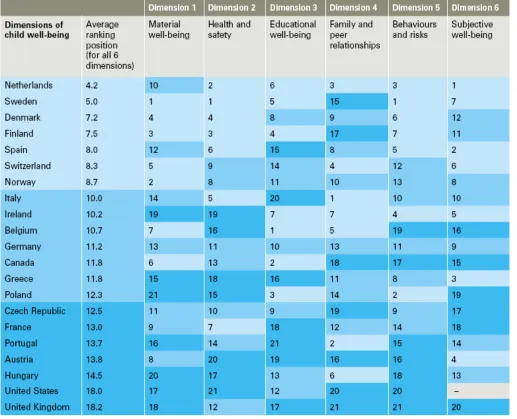
A recent report by the UNICEF (2007) attempted to provide a comparison of child welfare in a broader sense across 21 OECD countries. Rather than use income poverty as a proxy measure for overall child well-being in the OECD countries the report attempts to measure and compare child well-being under six different headings, or ‘dimensions’ (using 40 indicators): material well-being; health and safety; education; peer and family relationships; behaviours and risks and; young people’s own subjective sense of well-being.
UNICEF described the main findings as follows:
• The Netherlands heads the table of overall child well-being, ranking in the top 10 for all six dimensions of child well-being covered by this report.
• European countries dominate the top half of the overall league table, with Northern European countries claiming the top four places.
• All countries have weaknesses that need to be addressed and no country features in the top third of the rankings for all six dimensions of child well-being (though the Netherlands and Sweden come close to doing so).
• The United Kingdom and the United States find themselves in the bottom third of the rankings for five of the six dimensions reviewed.
• No single dimension of well-being stands as a reliable proxy for child well-being as a whole and several OECD countries find themselves with widely differing rankings for different dimensions of child well-being.
[image:8.595.43.560.331.750.2]• There is no obvious relationship between levels of child well-being and GDP per capita. The Czech Republic, for example, achieves a higher overall rank for child well-being than several much wealthier countries including France, Austria, the United States and the United Kingdom.
VARIATIONS WITHIN SCOTLAND
The Joseph Rowntree Foundation (JRF) has attempted to measure geographical variation in child poverty drawing on data measuring the percentage of children living in families claiming out of work benefits. This does not count all people who are ‘poor’, but is considered by JRF to be a good indicator of how bad poverty is in different areas. Latest available data is for 2005. The following 83 wards had twice the national average (21%) of children living in families receiving out-of-work benefits in 2005. Thirty seven of these wards are in Glasgow City.
Local Authority Ward % of
children
Local authority Ward % of
children
Aberdeen City Auchmill 48.5 Glasgow City Wyndford 52.8 Aberdeen City St. Machar 46.5 Glasgow City Merchant City 52.6
Aberdeen City Tullos Hill 43.6 Glasgow City Toryglen 52.0 Aberdeen City Woodside 42.6 Glasgow City Maryhill 51.4 Aberdeenshire Fraserburgh N 44.4 Glasgow City Ashfield 51.3 Clackmannanshire Alloa Mar 50.0 Glasgow City Springburn 49.6 Clackmannanshire St Serf's 46.4 Glasgow City Tollcross Park 49.6
Clackmannanshire Alloa East 42.4 Glasgow City Pollokshaws 49.5 Dundee City Pitkerro 47.1 Glasgow City Milnbank 48.9 Dundee City Longhaugh 46.3 Glasgow City Nitshill 48.3 Dundee City Hilltown 43.9 Glasgow City Cowlairs 47.9 Dundee City Bowbridge 42.5 Glasgow City Anderston 47.6 Dundee City Douglas 42.1 Glasgow City Gartcraig 46.0 East Ayrshire Shortlees 53.4 Glasgow City Wallacewell 45.9 East Ayrshire Onthank 47.7 Glasgow City Calton 45.8 East Ayrshire Dalmellington 43.2 Glasgow City Garthamlock 45.7 Edinburgh, Craigmillar 59.6 Glasgow City Crookston 44.4 Edinburgh, Muirhouse/ Drylaw 48.4 Glasgow City Yoker 44.3 Edinburgh, Kaimes 43.9 Glasgow City Dennistoun 44.1 Edinburgh, Murray Burn 42.7 Glasgow City Govanhill 44.0 Edinburgh, Parkhead 42.4 Highland Merkinch 47.2 Fife Methil 50.0 Inverclyde Ward 8 51.6
Fife Smeaton and Overton 46.8 Inverclyde Ward 2 50.8 Fife Ballingry and Lochore 45.9 Inverclyde Ward 14 44.7 Fife Methilhill 42.3 Inverclyde Ward 7 44.1
Glasgow City Parkhead 63.4 North Ayrshire
Irvine Vineburgh & Woodlands S 45.6 Glasgow City Keppochhill 63.1 North Ayrshire Stevenston South 43.1
Glasgow City Bridgeton/ Dalmarnock 62.2 N Lanarkshire Craigneuk 55.6
Glasgow City Ibrox 62.1 N Lanarkshire Mossend West and Thorndean 43.4
Glasgow City Royston 62.1 N Lanarkshire Shawhead 42.3 Glasgow City Barlanark 59.9 Renfrewshire St. James 58.1
Glasgow City Summerhill 59.4 Renfrewshire Ferguslie 51.0 Glasgow City Queenslie 59.2 Renfrewshire Paisley Central 48.5
Glasgow City Hutchesontown 59.0 South Ayrshire Ayr Lochside 50.9 Glasgow City Drumry 56.9 South Ayrshire Ayr Whitletts 42.9 Glasgow City Glenwood 56.3 S Lanarkshire Larkhall South 43.2
Glasgow City Braidfauld 55.5 S Lanarkshire Udston 42.0 Glasgow City Milton 55.5 Stirling Raploch 46.9 Glasgow City Easterhouse 55.1 W Dunbartonshire Faifley 44.1 Glasgow City Carntyne 54.3 W Dunbartonshire Dumbarton W 42.8
CAUSES AND EFFECTS OF CHILD POVERTY
The Scottish Affairs Committee’s recent report into Poverty in Scotland (2007) concluded as follows:
“Our evidence has shown that poverty is caused by low pay and low levels of benefits. Events such as family breakdown, low educational achievement or unemployment, are often cited as causes of poverty, but these factors are also to be found amongst those who are relatively well off. At root, poverty is caused by a lack of money. In 2000, our predecessor Committee found that poverty could only be tackled with quality work and generous wholehearted benefits for those unable to work. This remains the case.”
McHendrick and Dickie (2007 pp37-55) suggest that there are four broad causes of poverty: • The behaviour of individuals - the ‘failings of individuals’, which the authors argue is an
explanation of limited value in accounting for poverty in Scotland
• Social factors – characteristics which define groups of people, making them more vulnerable to poverty (for example at different stages of the life cycle, disability, the neighbourhood)
• Political factors – the nature and extent of government intervention
• Economic factors – the strength of the economy and income distribution within the economy.
The authors suggest that these factors are inter-related, and the ways in which they can influence individuals are complex, hidden and indirect. Some of the evidence of the effects of child poverty on health, education, life chances, and on local services and communities, is outlined below:
Health
The links between health and poverty in the general population have been well documented. In terms of child health one study (Levin et al 2007) examined the relationship between reported family affluence and aspects of adolescent health and well being. Amongst the main findings were:
• 20% of young people in Scotland live in ‘low affluence’ households: lower than for other countries in the study such as Hungary, Poland and Russia, but higher than for England (15%) Wales (14%) and Sweden (9%)
• Young people from low affluence families are less likely to be physically active and to eat fruit and vegetables daily and more likely to consume soft drinks
• Young people from low affluence families are more likely to report low life satisfaction and more frequent health complaints and are less likely to report their health as excellent
Education
The link between child poverty and education has often been highlighted. For example a report for the Child Poverty Action Group (Hirsch, 2007) provides the following summary:
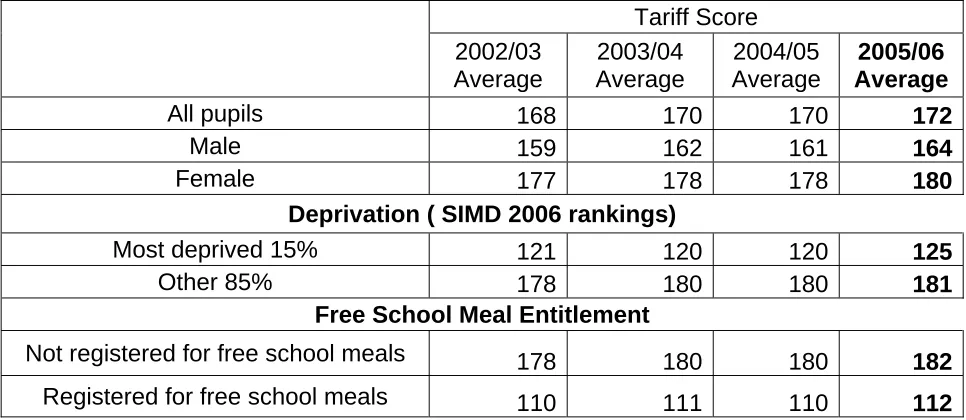
The Scottish Executive (2007b) measures educational attainment using average tariff scores (allowing different forms of certification to be compared). The average for all pupils in Scotland is 172. Table 3 below indicates that the average tariff score for S4 pupils living in the 15% most deprived areas of Scotland is 121 (some 70% of the average rate). For those S4 pupils registered for free school meals the score is 110 (64% of the national average).
Table 3: Average tariff score of S4 pupils, by characteristic of pupil
Tariff Score
2002/03
Average
2003/04 Average
2004/05 Average
2005/06 Average
All pupils 168 170 170 172
Male 159 162 161 164
Female 177 178 178 180
Deprivation ( SIMD 2006 rankings)
Most deprived 15% 121 120 120 125
Other 85% 178 180 180 181
Free School Meal Entitlement
Not registered for free school meals 178 180 180 182
Registered for free school meals 110 111 110 112
Lifelong poverty
A study by the London School of Economics (2005) compared the life chances of British children with those in other advanced countries for a study sponsored by the Sutton Trust. In summary the findings were that:
• “In a comparison of eight European and North American countries, Britain and the United States have the lowest social mobility
• Social mobility in Britain has declined whereas in the US it is stable
• Part of the reason for Britain's decline has been that the better off have benefited disproportionately from increased educational opportunity”
POLICY
Child poverty is a cross cutting issue influenced by most policy areas including education, the economy, justice, housing, social services and the welfare system. Some of the measures that most directly affect child poverty, particularly the welfare and tax systems are reserved. Other policy is devised and delivered by local government and local community planning partnerships.
SCOTTISH GOVERNMENT POLICY
It is understood that the current Administration is currently reviewing its approach to tackling poverty and intends to make an announcement in its intentions “shortly” (Scottish Government January 2008).
Background information on children’s services generally is set out in SPICe briefing SB 07-40 (Kidner 2007). An early years and childcare strategy is being developed by the Scottish Government. The intention is that the strategy will be comprehensive in scope, cover a period of 10 years and be published in 2008 (Scottish Government 2007y). Policy more specifically relating to child poverty is set out below.
Target 5 of the Government’s National Performance Framework, as set out in the Spending Review 2007, is concerned with ‘solidarity’ (Scottish Government 2007).
“To increase overall income and the proportion of income earned by the three lowest income deciles as a group by 2017.”
Indicator 14 in the National Performance Framework is to “Decrease the proportion of individuals living in poverty.”
In response to a parliamentary question by Jackie Baillie MSP (Scottish Parliament 2007a) Stewart Maxwell MSP, Minister for Communities and Sport, set out the new Administration’s commitment to the existing child poverty targets:
“We are committed to sharing the UK Government’s long-term target to eradicate child poverty by 2020 and will continue to do all we can to ensure that Scottish policies and programmes make the maximum contribution towards the milestone of halving child poverty by 2010”
The Minister also identified a number of specific actions being taken on child poverty (Scottish Parliament 2007b). These included:
• Workforce Plus (the Government’s employability framework)
• More Choices More Chances (an action plan to reduce the proportion of young people not in education, employment or training in Scotland)
• Free school meals – a six month pilot for Primary one to three pupils in the Borders, East Ayrshire, Fife, Glasgow and West Dunbartonshire
• A forthcoming skills strategy (since published in September 2007) • A forthcoming early years strategy
• Establishment of a Ministerial taskforce on health inequalities
• The Executive's Childcare Strategy (£44m funding in 2007-08) to provide ‘affordable, accessible, quality childcare for children aged 0-14 in all neighbourhoods’
• For lone parents wishing to undertake further and higher education there are lone parent and childcare grants
• Sure Start Scotland aims to provide broad based support for families with very young children. The aim is to expand the availability of support focussing on more deprived communities and vulnerable families. Funding for 2007/08 is £60m
• Working for Families funding has been allocated to 20 local authorities across Scotland with the highest concentration of children in workless households (2007-08 budget of £15m). The programme provides affordable, accessible childcare which enables parents in deprived areas or groups to access education, training or employment. The Working for Families budget for 2008/09 has been incorporated with six other funding streams into the Fairer Scotland Fund to be deployed by Community Planning Partnerships across Scotland (see below).
• Hungry for Success (HfS) was introduced in 2003, with the aim to ‘drive up nutritional standards and improve the diet of children and their achievement in by ensuring that healthy choices are available and attractively presented in schools and by improved links between healthy eating and the curriculum’.
The Scottish Budget Spending Review 2007 (Scottish Government 2007c) set out a new ‘Fairer Scotland’ fund of £145 million per annum, (bringing together the following seven existing funding streams), to be deployed by the Community Planning Partnerships and ring fenced for the next two years (Scottish Parliament 2007c)
Current Programme Budget (07/08)
(£m)
Community Regeneration Fund 108.4
Community Voices 3.3
Working for Families 15.0
Workforce plus (inc New Futures Fund) 5.6
More Choices More Chances 2.4
Financial inclusion 5.3
Changing Children’s Services (social inclusion element) 5.0
TOTAL 145.0
(Information from Scottish Government to SPICe 7/12/07)
Closing the Opportunity Gap (CtOG) is the title of the overarching approach of the previous Executive to ‘tackle poverty and disadvantage’. It is understood that the current administration is reviewing the CtOG targets. There were six broad objectives in CtOG relating in general terms to: employment opportunities; skills for school leavers; debt and financial exclusion; regeneration; health; and access to rural services. Specific targets on child poverty included those on:
• the proportion of 16-19 year olds who are not in education, training or employment • the provision of integrated packages of appropriate health, care and education support • the average tariff scores of the lowest attaining 20 per cent of S4 pupils by 5%
• the proportion of "looked after" young people leaving care entering education, employment or training
UK GOVERNMENT POLICY
PSA 9, one of the UK Government’s Public Service Agreements (HM Treasury 2007), is to: “Halve the number of children in poverty by 2010-11, on the way to eradicating child poverty by 2020”
The strategic priorities of the PSA are stated as being:
• Reducing poverty through work – making work a ‘sustainable route out of poverty’ and tackling barriers such as availability of childcare
• Reducing poverty through raising incomes – predominantly delivered through a combination of Child Tax Credit, Child Benefit and reform of the Child Support Agency • Tackling poor living conditions – focusing on housing, fuel poverty and financial inclusion • Focusing delivery on at-risk groups – including lone parents, large families, black and
minority ethnic families, and families with a disabled member
• Engaging with users – including delivery partners such as local government and the third sector, and with parents
• Establishing clear governance and accountability mechanisms throughout the delivery system.
The Department for Work and Pensions (DWP), one of the key delivery bodies, states that the UK government “strategy [on child poverty] has focused on increasing employment levels for parents, with most policy focus on lone parents, and increasing financial support through the tax system” (DWP child poverty web pages)
‘Working for Children’ is the DWP strategy on child poverty (2007). The strategy suggests that further action is now required in three areas:
• “building support through increased rights and responsibilities for lone parents; • helping people to stay in work and progress in employment;
• developing a family focus in our work with parents”
Some of the measures being considered include providing more incentives for lone parents to move into employment, streamlining the child maintenance payments system, improving basic skills for those on low wages, such as in literacy and numeracy, enhanced jobcentre plus
support to partners of ‘benefit customers’, enhanced childcare and more work with groups from some ethnic minorities.
DEBATE ON CHILD POVERTY
PARLIAMENTARY CONSIDERATION
Child poverty has been the subject of parliamentary consideration on a number of occasions. In Session 2 (2003) the Finance Committee published a report on cross cutting expenditure in relation to children in poverty. The Committee’s conclusions included that “the Executive has made progress in reducing the level of child poverty, but that a step-change in its approach is needed if the ambitious targets are to be met.”
“We believe that we are making clear progress on tackling child poverty in Scotland. Work is the best route out of poverty and the Executive is delivering this through training and skills development, supporting growth in the economy through Smart, Successful Scotland and building sustainable communities across Scotland”.
A Member’s debate on child poverty was held in November 2006 on the following motion (S2M-5172) lodged by Jackie Baillie MSP
“That the Parliament agrees that it is unacceptable that children living in severe poverty in Scotland are missing out on basic necessities such as fresh, nutritious food, new clothes and shoes and having a warm home in the winter; welcomes Save the Children's campaign to end child poverty, which highlights the effects for children and their families of living in severe and persistent poverty; acknowledges the progress made by the Scottish Executive in lifting 100,000 children in Scotland out of poverty and helping children in the Dumbarton constituency and across Scotland to improve their life chances, and believes that more needs to be done and that the Executive should prioritise the needs of the very poorest children and continue to work with the UK Government in implementing solutions, such as child seasonal grants, proposed as part of the Save the Children campaign.”
The Scottish Affairs Committee in Westminster held an inquiry into Poverty in Scotland in 2006 and 2007. An initial report was published in December 2007 whilst a further report, specifically on child poverty, is expected to follow. The initial report on wider poverty concluded:
“Poverty is still a reality in Scotland today. The UK Government's policy for combating poverty is characterised by ambitious targets, particularly for the reduction of child poverty. There is evidence to suggest that these policies have had a positive effect in reducing poverty in Scotland over the past ten years. Nevertheless, there is still more work to be done.
We believe that the recent progress on reducing poverty must continue over the next decade. To achieve this, more resources and an even greater effort will be needed to reach those groups that have not yet benefited from the economic growth enjoyed by the UK as a whole.
In order for this to happen, the Government needs to make a concerted effort to present a coherent anti-poverty strategy across all policy areas, joining up across Government departments as well as with the work of the Scottish Executive and of local government in Scotland. On present evidence, we do not believe that the Government is doing enough to 'poverty-proof' all of its policies and to exploit the available opportunities to integrate services.”
VIEWS OF NON-GOVERNMENTAL ORGANISATIONS
In a joint letter (June 2007) to the Convener of the Local Government and Communities Committee a number of Scottish children’s and poverty organisations requested an inquiry into child poverty. The letter from Barnardo’s, Child Poverty Action Group, Save the Children and the Poverty Alliance set out the policy issues as follows:
• supporting parents into, and remaining in, decently paid work, and • benefits and tax credits uptake.
Of particular importance is the need to examine whether current policies are reaching all children, and families, living in poverty. There is some evidence to suggest that current initiatives are not reaching those children living in the most acute poverty. Unless policies reach all those affected, child poverty will persist in Scotland.”
A number of issues are highlighted by Barnardo’s (2007) along with other groups in which there is a role for the devolved government:
• Improving employment opportunities and the provision of education, lifelong learning and skills
• A lack of convenient and affordable childcare remaining a barrier into work for some parents and the need to extend provision of free meals (to children with parents on the maximum working tax credit)
• Addressing the impact of poverty in the school holidays (which for low income families become a time of ‘survival’). Local authorities are encouraged to provide affordable holiday activities for all children
• Addressing fuel poverty, including the higher costs faced by those with pre-payment meters (PPMs). Gas customers with PPMs pay an average of £70 more per year than customers on direct debit, and electricity customers pay £103 per year more
• Addressing debt, amassed by households to cover costs of Christmas, birthdays, or the purchase of household items, with lenders, “including some reputable high street names”, charging between 160 and 800 per cent interest a year on loans
Barnardo’s also proposes that the Executive establishes an appropriate mechanism to mirror a proposed UK Commission on child poverty (the UK commission to be chaired by the Prime Minister or Chancellor setting out a road map to hit the 2020 targets).
More recently Save the Children (2008) has expressed some concerns regarding the Scottish Government’s policy on child poverty:
“Save the Children is extremely concerned that there is no national target or outcome to reduce child poverty in Scotland. Clarity is required on how the Government commitment to the 2020 target of ending child poverty relates to the National Performance Framework. Further detail is also required on how progress in reducing child poverty will be monitored and how Ministers will be held accountable. Interim targets or indicators would be useful in monitoring progress and therefore clarity is required on whether the Scottish Government, along with the UK Government, is committed to halving child poverty by 2010.
Progress on achieving UK child poverty targets
The Institute for Fiscal Studies (IFS) has undertaken modelling work for the Joseph Rowntree Foundation on the costs of the UK government achieving its child poverty targets. Amongst the conclusions (2006b) were that
• “The Government could meet its target of halving child poverty between 1998 and 2010 by spending an estimated £4 billion a year (0.3 per cent of GDP) more than currently planned on benefits and tax credits
• Getting the second half of children out of poverty between 2010 and 2020 will be far harder. If the Government relied primarily on tax credits and benefits to achieve this, it would have to add about a further £28 billion (1.6 per cent of GDP) to planned annual spending, an unlikely scenario
• The study concludes that, to make further inroads into child poverty, the Government will need to extend its policy of increasing redistribution to low-income families, but that this will not be enough on its own to meet the targets. In addition, this will require parents to fare better in the workplace, with improved pay and opportunities. Long-term policies working in this direction include better education and training for disadvantaged groups, improved childcare and the promotion of equal pay for women”
A recent article for the IFS (Shaw 2007) concluded:
“In order to hit the 2010/11 target, child poverty has to fall more than one-and-a-half times as fast between 2004/05 and 20010/11 than it did between 1998/99 and 2004/05. Recent work at IFS suggests that this could be achieved at a cost of around £4.3bn in 2010/11. Although this is only just over half the size of the increase in child-contingent support experienced between 1999/00 and 2003/04, it may nevertheless be difficult to achieve because the public finances are tight (making it hard to find more money to redistribute towards children). Moreover, by the time you read this, there will only be three years left for the government to announce policies aimed at meeting the 2010/11 target!
In all likelihood, the 2020 target will be even more challenging. Children further down the income distribution tend to be more difficult (and expensive) to reach using traditional tax and benefit policies since many are in workless families or families who are not claiming all the benefits and tax credits they are entitled to.
SOURCES
Barnardo’s et al. (2007a) Committee inquiry into child poverty in Scotland, letter to Convener of Local Government and Communities Committee 22 June 2007. Edinburgh, Scottish Parliament.
Department for Work and Pensions. Child poverty [online]. Available at
http://www.dwp.gov.uk/childpoverty [accessed 19 July 2007]
Department for Work and Pensions. (2003) Measuring child poverty consultation. London, Department for Work and Pensions. Available at:
www.dwp.gov.uk/consultations/consult/2003/childpov/final.pdf
Department for Work and Pensions. (2007) Working for Children. London: Department for Work and Pensions. Available at:
http://www.dwp.gov.uk/publications/dwp/2007/childpoverty/childpoverty.pdf
Hirsch, D. (2007) Chicken and egg: child poverty and educational inequalities - CPAG policy briefing. London: CPAG. Available at:
http://www.cpag.org.uk/campaigns/education/EducationBriefing120907.pdf )
HM Treasury. (October 2007) Public Service Agreements [online]. Available at
http://www.hm-treasury.gov.uk/pbr_csr/psa/pbr_csr07_psaindex.cfm . [Accessed 9 January 2008]
HM Treasury. (October 2007) PSA Delivery Agreement 9: Halve the number of children in
poverty by 2010-11, on the way to eradicating child poverty by 2020. London: HM Treasury.
Available at http://www.hm-treasury.gov.uk/media/B/9/pbr_csr07_psa9.pdf
House of Commons Scottish Affairs Committee (2007). Inquiry into Poverty in Scotland. London, House of Commons. Available at:
http://www.publications.parliament.uk/pa/cm/cmscotaf.htm
Institute for Fiscal Studies. (2007) Families and children [online]. Available at:
http://www.ifs.org.uk/publications.php?heading_id=6 [Accessed 19 July 2007]
Joseph Rowntree Foundation. (2006a) The persistence of poverty across generations. York, Joseph Rowntree Foundation. Available at:
http://www.jrf.org.uk/knowledge/findings/socialpolicy/0216.asp
Joseph Rowntree Foundation. (2006b) What will it take to end child poverty? (Executive
summary). York, Joseph Rowntree Foundation. Available at:
http://www.jrf.org.uk/knowledge/findings/socialpolicy/0366.asp
Joseph Rowntree Foundation. (2006c) A review of the comparative evidence on child poverty. York: Joseph Rowntree Foundation. Available at:
http://www.jrf.org.uk/child-poverty/publications.asp#bradshaw
Joseph Rowntree Foundation. (2007) Local Child Poverty Statistics [online]. Available at:
Kidner C. (2007) Children’s Services. SPICe briefing 07/40. Edinburgh: Scottish Parliament. Available at http://www.scottish.parliament.uk/business/research/briefings-07/SB07-40.pdf
Levin K et al. (2007) Family affluence and health among school children; HBSC briefing paper 11 Edinburgh: University of Edinburgh. Available at
http://www.education.ed.ac.uk/cahru/publications/BriefingPaper11.pdf
London School of Economics. (2005) Intergenerational Mobility in Europe and North America. London: London School of Economics,. Available at
http://cep.lse.ac.uk/about/news/IntergenerationalMobility.pdf
McHendrick, J and Dickie, J. ed. (2007) Poverty in Scotland 2007. London: Child Poverty Action Group.
Save the Children. (2008) Spending Review Debate 10.01.08 Parliamentary Briefing. Edinburgh: Save the Children.
Save the Children. (2007a) Living Below the Radar. Edinburgh.Save the Children. Available at
http://www.savethechildren.org.uk/en/50_693.htm
Save the Children. (2007b) Serving children? The impact of poverty on children’s experiences of
services. Edinburgh Save the Children
The Scotsman. (2007) Scottish Child Poverty [online]; Available at
http://news.scotsman.com/topics.cfm?tid=554 [Accessed 19 July 2007]
Scottish Executive. (2003) Executive's Response to 2nd Report on Cross-cutting Expenditure in relation to Children in Poverty. Edinburgh, Scottish Parliament. Available at
http://www.scottish.parliament.uk/business/committees/historic/finance/reports-03/fir03-02resp-01.htm
Scottish Government. (2007a) Scottish Households Below Average Income 2005/06; (30 May 2007). Edinburgh, Scottish Government. Available at
http://www.scotland.gov.uk/Publications/2007/05/30085716/0
Scottish Government. (2007a): Child Poverty Tier 3: Combined Material Deprivation and Low
Income. Edinburgh. Scottish Government. Available at
http://www.scotland.gov.uk/Topics/Statistics/Browse/Social-Welfare/IncomePoverty/CoreAnalysis
Scottish Government. (2007b) Table 6 SQA Attainment and School Leaver Qualifications in
Scotland: 2005/06 March 2007. Edinburgh, Scottish Government. Available at:
http://www.scotland.gov.uk/Publications/2007/03/20130930/0
Scottish Government. (2007c) Scottish Budget Spending Review 2007: Edinburgh, Scottish Government. Available online at
http://www.scotland.gov.uk/Publications/2007/11/13092240/0
Scottish Government. (2007d) Technical notes for the 2007 Spending Review. Edinburgh: Scottish Government.
Scottish Government. (2007e) Early years and childcare [Online]. Available at:
http://www.scotland.gov.uk/Topics/People/Young-People/Early-Education-Child-Care . Accessed 29 January 2008.
Scottish Government. Child Poverty [online]. Available at
http://www.scotland.gov.uk/Topics/People/Social-Inclusion/17414/8437 [accessed 19 July 2007] Scottish Government. (2008) Information provided to SPICe [Unpublished]. 22 January 2008.
Scottish Parliament (2003) Finance Committee: 2nd Report 2003 (Session 2); Report on cross
cutting expenditure in relation to children in poverty. SPP4. Edinburgh. Scottish Parliament.
Available at
http://www.scottish.parliament.uk/business/committees/historic/finance/reports-03/fir03-02-01a.htm
Scottish Parliament. (2006) Official Report 29 November 2006. Col 29801-29822. Edinburgh: Scottish Parliament. Available at
http://www.scottish.parliament.uk/business/officialReports/meetingsParliament/or-06/sor1129-02.htm#Col29801
Scottish Parliament. (2007a) Written answers Monday 25 June to Friday 29 June 2007. S3W-1135. Edinburgh, Scottish Parliament. Available at
http://www.scottish.parliament.uk/business/pqa/wa-07/wa0626.htm
Scottish Parliament. (2007b) Written answers Monday 25 June to Friday 29 June 2007. S3W-1137. Edinburgh, Scottish Parliament. Available at
http://www.scottish.parliament.uk/business/pqa/wa-07/wa0626.htm
Scottish Parliament Local Government and Communities Committee. (2007c) 11th Meeting 2007, Session 3 28 November 2007. Col 325. Edinburgh: Scottish Parliament. Available at
http://www.scottish.parliament.uk/s3/committees/lgc/or-07/lg07-1102.htm#Col325
Sharma, N. (2007) It doesn’t happen here; UK Report Executive Summary. Ilford: Barnardo’s. Available at: http://www.barnardos.org.uk/poverty_summary_07.pdf
Shaw J (2007) Eradicating child poverty. Institute for Fiscal studies. Available at
http://www.ifs.org.uk/publications.php?publication_id=3869
UNICEF Innocenti Research Centre (2007) Report Card 7; Child Poverty in Perspective: an
overview of Child Well-being in Rich Countries. Florence UNICEF. Available at.