NIST Big Data Interoperability
Framework: Volume 8, Reference
Architecture Interfaces
NIST Big Data Public Working Group
Reference Architecture Subgroup
June 2018
NIST Big Data Interoperability Framework:
Volume 8, Reference Architecture Interfaces
NIST Big Data Public Working Group (NBD-PWG)
Definitions and Taxonomies Subgroup
Information Technology Laboratory
National Institute of Standards and Technology
Gaithersburg, MD 20899
This publication is available free of charge from:
https://doi.org/10.6028/NIST.SP.1500-9
June 2018
U.S. Department of Commerce Wilbur L. Ross, Jr., Secretary
National Institute of Standards and Technology (NIST) Special Publication 1500-9
Natl. Inst. Stand. Technol. Spec. Publ. 1500-9, 92 pages (June 2018) CODEN: NSPUE2
This publication is available free of charge from: https://doi.org/10.6028/NIST.SP.1500-9
NIST Special Publication series 1500 is intended to capture external perspectives related to NIST
standards, measurement, and testing-related efforts. These external perspectives can come from industry,
academia, government, and others. These reports are intended to document external perspectives and do
not represent official NIST positions.
Certain commercial entities, equipment, or materials may be identified in this document to describe an
experimental procedure or concept adequately. Such identification is not intended to imply
recommendation or endorsement by NIST, nor is it intended to imply that the entities, materials, or
equipment are necessarily the best available for the purpose.
There may be references in this publication to other publications currently under development by NIST
in accordance with its assigned statutory responsibilities. The information in this publication, including
concepts and methodologies, may be used by federal agencies even before the completion of such
companion publications. Thus, until each publication is completed, current requirements, guidelines, and
procedures, where they exist, remain operative. For planning and transition purposes, federal agencies
may wish to closely follow the development of these new publications by NIST.
Organizations are encouraged to review all publications during public comment periods and provide
feedback to NIST. All NIST publications are available at http://www.nist.gov/publication-portal.cfm.
Comments on this publication may be submitted to Wo Chang
National Institute of Standards and Technology
Attn: Wo Chang, Information Technology Laboratory
100 Bureau Drive (Mail Stop 8900) Gaithersburg, MD 20899-8930
Reports on Computer Systems Technology
The Information Technology Laboratory (ITL) at NIST promotes the U.S. economy and public welfare by providing technical leadership for the Nation’s measurement and standards infrastructure. ITL develops tests, test methods, reference data, proof of concept implementations, and technical analyses to advance the development and productive use of information technology. ITL’s responsibilities include the development of management, administrative, technical, and physical standards and guidelines for the cost-effective security and privacy of other than national security-related information in federal information systems. This document reports on ITL’s
research, guidance, and outreach efforts in Information Technology and its collaborative activities with industry, government, and academic organizations.
Abstract
This document summarizes interfaces that are instrumental for the interaction with Clouds, Containers, and High Performance Computing (HPC) systems to manage virtual clusters to support the NIST Big Data Reference Architecture (NBDRA). The REpresentational State Transfer (REST) paradigm is used to define these interfaces, allowing easy integration and adoption by a wide variety of frameworks.
Big Data is a term used to describe extensive datasets, primarily in the characteristics of volume, variety, velocity, and/or variability. While opportunities exist with Big Data, the data characteristics can overwhelm traditional technical approaches, and the growth of data is outpacing scientific and technological advances in data analytics. To advance progress in Big Data, the NIST Big Data Public Working Group (NBD-PWG) is working to develop consensus on important fundamental concepts related to Big Data. The results are reported in the NIST Big Data Interoperability Framework (NBDIF) series of volumes. This volume, Volume 8, uses the work performed by the NBD-PWG to identify objects instrumental for the NIST Big Data Reference Architecture (NBDRA) which is introduced in the NBDIF: Volume 6, Reference Architecture.
Keywords
Adoption; barriers; implementation; interfaces; market maturity; organizational maturity; project maturity; system modernization.
This
publication
is
available
free
of
charge
from:
Acknowledgements
This document reflects the contributions and discussions by the membership of the NBD-PWG, cochaired by Wo Chang (NIST ITL), Bob Marcus (ET-Strategies), and Chaitan Baru (San Diego Supercomputer Center; National Science Foundation). For all versions, the Subgroups were led by the following people: Nancy Grady (SAIC), Natasha Balac (San Diego Supercomputer Center), and Eugene Luster (R2AD) for the Definitions and
Taxonomies Subgroup; Geoffrey Fox (Indiana University) and Tsegereda Beyene (Cisco Systems) for the Use Cases and Requirements Subgroup; Arnab Roy (Fujitsu), Mark Underwood (Krypton Brothers; Synchrony Financial), and Akhil Manchanda (GE) for the Security and Privacy Subgroup; David Boyd (InCadence Strategic Solutions), Orit Levin (Microsoft), Don Krapohl (Augmented Intelligence), and James Ketner (AT&T) for the Reference Architecture Subgroup; and Russell Reinsch (Center for Government Interoperability), David Boyd (InCadence Strategic Solutions), Carl Buffington (Vistronix), and Dan McClary (Oracle), for the Standards Roadmap Subgroup.
The editors for this document were the following:
• Version 1: This volume resulted from Stage 2 work and was not part of the Version 1 scope.
• Version 2: Gregor von Laszewski (Indiana University) and Wo Chang (NIST).
Laurie Aldape (Energetics Incorporated) and Elizabeth Lennon (NIST) provided editorial assistance across all NBDIF volumes.
NIST SP 1500-9, NIST Big Data Interoperability Framework: Volume 8, Reference Architecture Interfaces has been collaboratively authored by the PWG. As of the date of publication, there are over six hundred NBD-PWG participants from industry, academia, and government. Federal agency participants include the National Archives and Records Administration (NARA), National Aeronautics and Space Administration (NASA), National Science Foundation (NSF), and the U.S. Departments of Agriculture, Commerce, Defense, Energy, Census, Health and Human Services, Homeland Security, Transportation, Treasury, and Veterans Affairs. NIST would like to acknowledge the specific contributionsa to this volume, during Version 1 and/or Version 2 activities, by the following NBD-PWG members:
Wo Chang
National Institute of Standard and Technology
Geoffrey C. Fox Indiana University
Pratik Thakkar Philips
Gregor von Laszewski Indiana University
Badi Abdhul Wahid Indiana University
Fugang Wang Indiana University
Robert C. Whetsel DISA/NBIS
Alicia Zuniga-Alvarado Consultant
This
publication
is
available
free
of
charge
from:
T
ABLE OF
C
ONTENTS
EXECUTIVE SUMMARY ... IX
1 INTRODUCTION ... 1
1.1 BACKGROUND ... 1
1.2 SCOPE AND OBJECTIVES OF THE REFERENCE ARCHITECTURES SUBGROUP ... 2
1.3 REPORT PRODUCTION ... 3
1.4 REPORT STRUCTURE ... 4
1.5 FUTURE WORK ON THIS VOLUME ... 4
2 NBDRA INTERFACE REQUIREMENTS ... 5
2.1 HIGH-LEVEL REQUIREMENTS OF THE INTERFACE APPROACH ... 6
2.1.1 Technology- and Vendor-Agnostic ... 6
2.1.2 Support of Plug-In Compute Infrastructure ... 6
2.1.3 Orchestration of Infrastructure and Services... 7
2.1.4 Orchestration of Big Data Applications and Experiments ... 7
2.1.5 Reusability ... 7
2.1.6 Execution Workloads ... 7
2.1.7 Security and Privacy Fabric Requirements ... 7
2.2 COMPONENT-SPECIFIC INTERFACE REQUIREMENTS ... 8
2.2.1 System Orchestrator Interface Requirements ... 8
2.2.2 Data Provider Interface Requirements ... 8
2.2.3 Data Consumer Interface Requirements ... 9
2.2.4 Big Data Application Interface Provider Requirements ... 9
2.2.4.1 Collection ... 9
2.2.4.2 Preparation ... 9
2.2.4.3 Analytics ... 10
2.2.4.4 Visualization ... 10
2.2.4.5 Access ... 10
2.2.5 Big Data Provider Framework Interface Requirements ... 10
2.2.5.1 Infrastructures Interface Requirements ... 11
2.2.5.2 Platforms Interface Requirements ... 11
2.2.5.3 Processing Interface Requirements ... 11
2.2.5.4 Crosscutting Interface Requirements ... 11
2.2.5.5 Messaging/Communications Frameworks ... 11
2.2.5.6 Resource Management Framework ... 11
3 SPECIFICATION PARADIGM ... 13
3.1 LESSONS LEARNED ... 13
3.2 HYBRID AND MULTIPLE FRAMEWORKS ... 13
3.3 DESIGN BY RESEARCH ORIENTED ARCHITECTURE... 13
3.4 DESIGN BY EXAMPLE ... 13
3.5 INTERFACE COMPLIANCY ... 15
4 SPECIFICATION ... 16
4.1 IDENTITY... 16
4.1.1 Profile ... 16
4.1.2 User ... 17
4.1.3 Organization ... 17
4.1.4 Group/Role... 17
This
publication
is
available
free
of
charge
from:
4.2 DATA ... 18
4.2.1 TimeStamp ... 18
4.2.2 Variables ... 19
4.2.3 Default ... 19
4.2.4 File ... 20
4.2.5 Alias ... 21
4.2.6 Replica ... 21
4.2.7 Virtual Directory ... 22
4.2.8 Database ... 22
4.2.9 Stream ... 22
4.2.10 Filter ... 22
4.3 VIRTUAL CLUSTER ... 23
4.3.1 Virtual Cluster ... 23
4.3.2 Compute Node ... 24
4.3.3 Flavor ... 25
4.3.4 Network Interface Card ... 25
4.3.5 Key ... 25
4.3.6 Security Groups ... 26
4.4 IAAS... 26
4.4.1 LibCloud ... 26
4.4.1.1 Challenges... 26
4.4.1.2 LibCloud Flavor ... 27
4.4.1.3 LibCloud Image ... 27
4.4.1.4 LibCloud VM ... 27
4.4.1.5 LibCloud Node ... 28
4.4.2 OpenStack ... 30
4.4.2.1 OpenStack Flavor ... 30
4.4.2.2 OpenStack Image ... 30
4.4.2.3 OpenStack VM ... 31
4.4.3 Azure ... 31
4.4.3.1 Azure Size ... 32
4.4.3.2 Azure Image ... 32
4.4.3.3 Azure VM ... 33
4.5 COMPUTE SERVICES ... 33
4.5.1 Batch Queue ... 33
4.5.2 Reservation ... 34
4.6 CONTAINERS ... 34
4.7 DEPLOYMENT... 34
4.8 MAP/REDUCE ... 35
4.8.1 Hadoop ... 36
4.9 MICROSERVICE ... 37
5 STATUS CODES AND ERROR RESPONSES ... 38 APPENDIX A: SCHEMA ... A-1
This
publication
is
available
free
of
charge
from:
F
IGUREFIGURE 1:NISTBIG DATA REFERENCE ARCHITECTURE (NBDRA) ... 5
FIGURE 2:NISTBIG DATA REFERENCE ARCHITECTURE INTERFACES ... 16
FIGURE 3:BOOTING A VM FROM DEFAULTS ... 20
FIGURE 4:ALLOCATING AND PROVISIONING A VIRTUAL CLUSTER ... 23
T
ABLE TABLE 1:HTTPRESPONSE CODES ... 38O
BJECTS OBJECT 3.1:EXAMPLE OBJECT SPECIFICATION ... 14OBJECT 4.1:PROFILE ... 16
OBJECT 4.2:USER... 17
OBJECT 4.3:ORGANIZATION ... 17
OBJECT 4.4:GROUP ... 17
OBJECT 4.5:ROLE ... 18
OBJECT 4.6:TIMESTAMP ... 19
OBJECT 4.7:VARIABLES ... 19
OBJECT 4.8:DEFAULT ... 19
OBJECT 4.9:FILE ... 21
OBJECT 4.10:FILE ALIAS ... 21
OBJECT 4.11:REPLICA ... 21
OBJECT 4.12:VIRTUAL DIRECTORY ... 22
OBJECT 4.13:DATABASE ... 22
OBJECT 4.14:STREAM ... 22
OBJECT 4.15:FILTER ... 23
OBJECT 4.16:VIRTUAL CLUSTER ... 24
OBJECT 4.17:VIRTUAL CLUSTER PROVIDER ... 24
OBJECT 4.18:COMPUTE NODE OF A VIRTUAL CLUSTER ... 24
OBJECT 4.19:FLAVOR ... 25
OBJECT 4.20:NETWORK INTERFACE CARD ... 25
OBJECT 4.21:KEY ... 25
OBJECT 4.22:SECURITY GROUPS ... 26
OBJECT 4.23:LIBCLOUD FLAVOR ... 27
OBJECT 4.24:LIBCLOUD IMAGE ... 27
OBJECT 4.25:LIBCLOUD VM ... 28
OBJECT 4.26:LIBCLOUD NODE ... 28
OBJECT 4.27:OPENSTACK FLAVOR ... 30
OBJECT 4.28:OPENSTACK IMAGE ... 30
OBJECT 4.29:OPENSTACK VM ... 31
OBJECT 4.30:AZURE-SIZE ... 32
OBJECT 4.31:AZURE-IMAGE ... 32
OBJECT 4.32:AZURE VM ... 33
OBJECT 4.33:BATCH JOB ... 33
OBJECT 4.34:RESERVATION ... 34
OBJECT 4.35:CONTAINER ... 34
OBJECT 4.36:DEPLOYMENT ... 34
OBJECT 4.37:MAP/REDUCE ... 35
This
publication
is
available
free
of
charge
from:
OBJECT 4.38:MAP/REDUCE FUNCTION ... 36
OBJECT 4.39:MAP/REDUCE NOOP ... 36
OBJECT 4.40:HADOOP ... 37
OBJECT 4.41:MICROSERVICE ... 37
OBJECT A.1:SCHEMA ... A-1
This
publication
is
available
free
of
charge
from:
EXECUTIVE SUMMARY
The NIST Big Data Interoperability Framework (NBDIF): Volume 8, Reference Architecture Interfaces document was prepared by the NIST Big Data Public Working Group (NBD-PWG) Interface Subgroup to identify interfaces in support of the NIST Big Data Reference Architecture (NBDRA) The interfaces contain two different aspects:
• The definition of resources that are part of the NBDRA. These resources are formulated in JSON format and can be integrated into a REST framework or an object-based framework easily.
• The definition of simple interface use cases that allow us to illustrate the usefulness of the resources defined.
The resources were categorized in groups that are identified by the NBDRA set forward in the NBDIF: Volume 6, Reference Architecture document. While the NBDIF: Volume 3, Use Cases and General Requirements document provides application-oriented high-level use cases, the use cases defined in this document are subsets of them and focus on interface use cases. The interface use cases are not meant to be complete examples, but showcase why the resource has been defined. Hence, the interfaces use cases are only representative, and do not represent the entire spectrum of Big Data usage. All the interfaces were openly discussed in the working group. Additions are welcome and we like to discuss your contributions in the group.
The NIST Big Data Interoperability Framework consists of nine volumes, each of which addresses a specific key topic, resulting from the work of the NBD-PWG. The nine volumes are:
• Volume 1: Definitions [1]
• Volume 2: Taxonomies [2]
• Volume 3: Use Cases and General Requirements [3]
• Volume 4: Security and Privacy [4]
• Volume 5: Architectures White Paper Survey [5]
• Volume 6: Reference Architecture [6]
• Volume 7: Standards Roadmap [7]
• Volume 8: Reference Architecture Interfaces (this volume)
• Volume 9: Adoption and Modernization [8]
The NBDIF will be released in three versions, which correspond to the three development stages of the NBD-PWG work. The three stages aim to achieve the following with respect to the NBDRA.
Stage 1:Identify the high-level Big Data reference architecture key components, which are technology-, infrastructure-, and vendor-agnostic.
Stage 2: Define general interfaces between the NBDRA components.
Stage 3: Validate the NBDRA by building Big Data general applications through the general interfaces. This document is targeting Stage 2 of the NBDRA. Coordination of the group is conducted on the NBD-PWG web page (https://bigdatawg.nist.gov).
This
publication
is
available
free
of
charge
from:
1
INTRODUCTION
1.1 BACKGROUND
There is broad agreement among commercial, academic, and government leaders about the remarkable potential of Big Data to spark innovation, fuel commerce, and drive progress. Big Data is the common term used to describe the deluge of data in today’s networked, digitized, sensor-laden, and information-driven world. The availability of vast data resources carries the potential to answer questions previously out of reach, including the following:
• How can a potential pandemic reliably be detected early enough to intervene?
• Can new materials with advanced properties be predicted before these materials have ever been synthesized?
• How can the current advantage of the attacker over the defender in guarding against cybersecurity threats be reversed?
There is also broad agreement on the ability of Big Data to overwhelm traditional approaches. The growth rates for data volumes, speeds, and complexity are outpacing scientific and technological advances in data analytics, management, transport, and data user spheres.
Despite widespread agreement on the inherent opportunities and current limitations of Big Data, a lack of consensus on some important fundamental questions continues to confuse potential users and stymie progress. These questions include the following:
• How is Big Data defined?
• What attributes define Big Data solutions?
• What is new in Big Data?
• What is the difference between Big Data and bigger data that has been collected for years?
• How is Big Data different from traditional data environments and related applications?
• What are the essential characteristics of Big Data environments?
• How do these environments integrate with currently deployed architectures?
• What are the central scientific, technological, and standardization challenges that need to be addressed to accelerate the deployment of robust, secure Big Data solutions?
Within this context, on March 29, 2012, the White House announced the Big Data Research and Development Initiative.1 The initiative’s goals include helping to accelerate the pace of discovery in science and engineering, strengthening national security, and transforming teaching and learning by improving analysts’ ability to extract knowledge and insights from large and complex collections of digital data.
Six federal departments and their agencies announced more than $200 million in commitments spread across
This
publication
is
available
free
of
charge
from:
requirements, including interoperability, portability, reusability, extensibility, data usage, analytics, and
technology infrastructure. In doing so, the roadmap would accelerate the adoption of the most secure and effective Big Data techniques and technology.
On June 19, 2013, the NIST Big Data Public Working Group (NBD-PWG) was launched with extensive participation by industry, academia, and government from across the nation. The scope of the NBD-PWG involves forming a community of interests from all sectors—including industry, academia, and government— with the goal of developing consensus on definitions, taxonomies, secure reference architectures, security and privacy, and, from these, a standards roadmap. Such a consensus would create a vendor-neutral, technology- and infrastructure-independent framework that would enable Big Data stakeholders to identify and use the best analytics tools for their processing and visualization requirements on the most suitable computing platform and cluster, while also allowing added value from Big Data service providers.
The NIST Big Data Interoperability Framework (NBDIF) will be released in three versions, which correspond to the three stages of the NBD-PWG work. The three stages aim to achieve the following with respect to the NIST Big Data Reference Architecture (NBDRA).
Stage 1: Identify the high-level Big Data reference architecture key components, which are technology, infrastructure, and vendor agnostic.
Stage 2: Define general interfaces between the NBDRA components.
Stage 3: Validate the NBDRA by building Big Data general applications through the general interfaces. On September 16, 2015, seven NBDIFVersion 1 volumes were published
(http://bigdatawg.nist.gov/V1_output_docs.php), each of which addresses a specific key topic, resulting from the work of the NBD-PWG. The seven volumes are as follows:
• Volume 1, Definitions [1]
• Volume 2, Taxonomies [2]
• Volume 3, Use Cases and General Requirements [3]
• Volume 4, Security and Privacy [4]
• Volume 5, Architectures White Paper Survey [5]
• Volume 6, Reference Architecture [6]
• Volume 7, Standards Roadmap [7]
Currently, the NBD-PWG is working on Stage 2 with the goals to enhance the Version 1 content, define general interfaces between the NBDRA components by aggregating low-level interactions into high-level general interfaces, and demonstrate how the NBDRA can be used. As a result of the Stage 2 work, the following two additional NBDIF volumes have been developed.
• Volume 8, Reference Architecture Interfaces (this volume)
• Volume 9, Adoption and Modernization [8]
Version 2 of the NBDIF volumes, resulting from Stage 2 work, can be downloaded from the NBD-PWG website (https://bigdatawg.nist.gov/V2_output_docs.php). Potential areas of future work for each volume during Stage 3 are highlighted in Section 1.5 of each volume. The current effort documented in this volume reflects concepts developed within the rapidly evolving field of Big Data.
1.2 SCOPE AND OBJECTIVES OF THE REFERENCE
ARCHITECTURES SUBGROUP
Reference architectures provide “an authoritative source of information about a specific subject area that guides and constrains the instantiations of multiple architectures and solutions.” Reference architectures generally serve as a foundation for solution architectures and may also be used for comparison and alignment of instantiations of architectures and solutions.
This
publication
is
available
free
of
charge
from:
The goal of the NBD-PWG Reference Architecture Subgroup is to develop an open reference architecture for Big Data that achieves the following objectives:
• Provides a common language for the various stakeholders;
• Encourages adherence to common standards, specifications, and patterns;
• Provides consistent methods for implementation of technology to solve similar problem sets;
• Illustrates and improves understanding of the various Big Data components, processes, and systems, in the context of a vendor- and technology-agnostic Big Data conceptual model;
• Provides a technical reference for U.S. government departments, agencies, and other consumers to understand, discuss, categorize, and compare Big Data solutions; and
• Facilitates analysis of candidate standards for interoperability, portability, reusability, and extendibility. The NBDRA is a high-level conceptual model crafted to serve as a tool to facilitate open discussion of the requirements, design structures, and operations inherent in Big Data. The NBDRA is intended to facilitate the understanding of the operational intricacies in Big Data. It does not represent the system architecture of a specific Big Data system, but rather is a tool for describing, discussing, and developing system-specific architectures using a common framework of reference. The model is not tied to any specific vendor products, services, or reference implementation, nor does it define prescriptive solutions that inhibit innovation.
The NBDRA does not address the following:
• Detailed specifications for any organization’s operational systems;
• Detailed specifications of information exchanges or services; and
• Recommendations or standards for integration of infrastructure products.
The goals of the Subgroup will be realized throughout the three planned phases of the NBD-PWG work, as outlined in Section 1.1.
1.3 REPORT PRODUCTION
The NBDIF: Volume 8,References Architecture Interfaces is one of nine volumes, whose overall aims are to define and prioritize Big Data requirements, including interoperability, portability, reusability, extensibility, data usage, analytic techniques, and technology infrastructure to support secure and effective adoption of Big Data. The overall goals of this volume are to define and specify interfaces to implement the Big Data Reference Architecture. This volume arose from discussions during the weekly NBD-PWG conference calls. Topics included in this volume began to take form in Phase 2 of the NBD-PWG work. This volume represents the groundwork for additional content planned for Phase 3. During the discussions, the NBD-PWG identified the need to specify a variety of interfaces.
To enable interoperability between the NBDRA components, a list of well-defined NBDRA interfaces is needed. These interfaces are documented in this volume. To introduce them, the NBDRA structure will be followed, focusing on interfaces that allow bootstrapping of the NBDRA. The document begins with a summary of
requirements that will be integrated into our specifications. Subsequently, each section will introduce a number of objects that build the core of the interface addressing a specific aspect of the NBDRA. A selected number of
This
publication
is
available
free
of
charge
from:
This document is expected to grow with the help of contributions from the community to achieve a
comprehensive set of interfaces that will enable developers to build any Big Data applications based from the NBDRA Big Data Architecture. To achieve technical and high-quality document content, this document will go through a public comment period along with NIST internal review.
1.4 REPORT STRUCTURE
The organization of this document roughly corresponds to the process used by the NBD-PWG to develop the interfaces. Following the introductory material presented in Section 1, the remainder of this document is organized as follows:
• Section 2 presents the interface requirements;
• Section 3 summarizes the elementary objects that are important to the NBDRA;
• Section 4 presents several objects grouped by functional use; and
• Four appendices provide supplementary information.
1.5 FUTURE WORK ON THIS VOLUME
A number of topics have not been discussed and clarified sufficiently to be included in Version 2. Version 3 topics will be identified during discussions within the Reference Architecture Subgroup.
This
publication
is
available
free
of
charge
from:
2
NBDRA INTERFACE REQUIREMENTS
The development of a Big Data reference architecture requires a thorough understanding of current techniques, issues, and concerns. To this end, the NBD-PWG collected use cases to gain an understanding of current applications of Big Data, conducted a survey of reference architectures to understand commonalities within Big Data architectures in use, developed a taxonomy to understand and organize the information collected, and reviewed existing technologies and trends relevant to Big Data. The results of these NBD-PWG activities were used in the development of the NBDRA (Figure 1) and the interfaces presented herein. Detailed descriptions of these activities can be found in the other volumes of the NBDIF.
This
publication
is
available
free
of
charge
from:
[image:15.612.57.554.236.614.2]deployment model. The terms provider and consumer as used are descriptive of general roles and are meant to be informative in nature.
The NBDRA is organized around five major roles and multiple sub-roles aligned along two axes representing the two Big Data value chains: Information Value (horizontal axis) and Information Technology (IT; vertical axis). Along the Information Value axis, the value is created by data collection, integration, analysis, and applying the results following the value chain. Along the IT axis, the value is created by providing networking, infrastructure, platforms, application tools, and other IT services for hosting of and operating the Big Data in support of required data applications. At the intersection of both axes is the Big Data Application Provider role, indicating that data analytics and its implementation provide the value to Big Data stakeholders in both value chains. The term provider as part of the Big Data Application Provider and Big Data Framework Provider is there to indicate that those roles provide or implement specific activities and functions within the system. It does not designate a service model or business entity.
The DATA arrows in Figure 2 show the flow of data between the system’s main roles. Data flows between the roles either physically (i.e., by value) or by providing its location and the means to access it (i.e., by reference). The SW arrows show transfer of software tools for processing of Big Data in situ. The Service Use arrows represent software programmable interfaces. While the main focus of the NBDRA is to represent the run-time environment, all three types of communications or transactions can happen in the configuration phase as well. Manual agreements (e.g., service-level agreements) and human interactions that may exist throughout the system are not shown in the NBDRA.
Detailed information on the NBDRA conceptual model is presented in the NBDIF: Volume 6, Reference Architecture document. [6]
Prior to outlining the specific interfaces, general requirements are introduced and the interfaces are defined.
2.1 HIGH-LEVEL REQUIREMENTS OF THE INTERFACE
APPROACH
This section focuses on the high-level requirements of the interface approach that are needed to implement the reference architecture depicted in Figure 1.
2.1.1 T
ECHNOLOGY-
ANDV
ENDOR-A
GNOSTICDue to the many different tools, services, and infrastructures available in the general area of Big Data, an interface ought to be as vendor-independent as possible, while at the same time be able to leverage best practices. Hence, a methodology is needed that allows extension of interfaces to adapt and leverage existing approaches, but also allows the interfaces to provide merit in easy specifications that assist the formulation and definition of the NBDRA.
2.1.2 S
UPPORT OFP
LUG-I
NC
OMPUTEI
NFRASTRUCTUREAs Big Data is not just about hosting data, but about analyzing data, the interfaces provided herein must
encapsulate a rich infrastructure environment that is used by data scientists. This includes the ability to integrate (or plug-in) various compute resources and services to provide the necessary compute power to analyze the data. These resources and services include the following:
• Access to hierarchy of compute resources from the laptop/desktop, servers, data clusters, and clouds;
• The ability to integrate special-purpose hardware such as GPUs and FPGAs that are used in accelerated analysis of data; and
• The integration of services including micro services that allow the analysis of the data by delegating them to hosted or dynamically deployed services on the infrastructure of choice.
This
publication
is
available
free
of
charge
from:
2.1.3 O
RCHESTRATION OFI
NFRASTRUCTURE ANDS
ERVICESFrom review of the use case collection, presented in the NBDIF: Volume 3, Use Cases and General Requirements document [3], the need arose to address the mechanism of preparing suitable infrastructures for various use cases. As not every infrastructure is suited for every use case, a custom infrastructure may be needed. As such, this document is not attempting to deliver a single deployed NBDRA, but allow the setup of an infrastructure that satisfies the particular use case. To achieve this task, it is necessary to provision software stacks and services while orchestrating their deployment and leveraging infrastructures. It is not the focus of this document to replace existing orchestration software and services, but provide an interface to them to leverage them as part of defining and creating the infrastructure. Various orchestration frameworks and services could therefore be leveraged, even as part of the same framework, and work in orchestrated fashion to achieve the goal of preparing an infrastructure suitable for one or more applications.
2.1.4 O
RCHESTRATION OFB
IGD
ATAA
PPLICATIONS ANDE
XPERIMENTSThe creation of the infrastructure suitable for Big Data applications provides the basic computing environment. However, Big Data applications may require the creation of sophisticated applications as part of interactive experiments to analyze and probe the data. For this purpose, the applications must be able to orchestrate and interact with experiments conducted on the data while assuring reproducibility and correctness of the data. For this purpose, a System Orchestrator (either the data scientists or a service acting on behalf of the data scientist) is used as the command center to interact on behalf of the Big Data Application Provider to orchestrate dataflow from Data Provider, carry out the Big Data application life cycle with the help of the Big Data Framework Provider, and enable the Data Consumer to consume Big Data processing results. An interface is needed to describe these interactions and to allow leveraging of experiment management frameworks in scripted fashion. A customization of parameters is needed on several levels. On the highest level, high–level, application-motivated parameters are needed to drive the orchestration of the experiment. On lower levels, these high-level parameters may drive and create service-level agreements, augmented specifications, and parameters that could even lead to the orchestration of infrastructure and services to satisfy experiment needs.
2.1.5 R
EUSABILITYThe interfaces provided must encourage reusability of the infrastructure, services, and experiments described by them. This includes (1) reusability of available analytics packages and services for adoption; (2) deployment of customizable analytics tools and services; and (3) operational adjustments that allow the services and
infrastructure to be adapted while at the same time allowing for reproducible experiment execution.
2.1.6 E
XECUTIONW
ORKLOADSOne of the important aspects of distributed Big Data services can be that the data served is simply too big to be moved to a different location. Instead, an interface could allow the description and packaging of analytics
algorithms, and potentially also tools, as a payload to a data service. This can be best achieved, not by sending the detailed execution, but by sending an interface description that describes how such an algorithm or tool can be created on the server and be executed under security considerations (integrated with authentication and
This
publication
is
available
free
of
charge
from:
Although many of the interfaces and their objects to support Big Data applications in physics are similar to those in healthcare, they differ in the integration of security interfaces and policies. While in physics the protection of data is less of an issue, it is a stringent requirement in healthcare. Thus, deriving architectural frameworks for both may use largely similar components, but addressing security issues will be very different. In future versions of this document, the security of interfaces may be addressed. In the meanwhile, they are considered an advanced use case showcasing that the validity of the specifications introduced here is preserved, even if security and privacy requirements differ vastly among application use cases.
2.2 COMPONENT-SPECIFIC INTERFACE REQUIREMENTS
This section summarizes the requirements for the interfaces of the NBDRA components. The five components are listed in Figure 1 and addressed in each of the subsections as part of Section 2.2.1 (System Orchestrator Interface Requirements) and Section 2.2.6 (Big Data Application Provider to Big Data Framework Provider Interface) of this document. The five main functional components of the NBDRA represent the different technical roles within a Big Data system. The functional components are listed below and discussed in subsequent subsections.
• System Orchestrator: Defines and integrates the required data application activities into an operational vertical system (see Section 2.2.1);
• Data Provider: Introduces new data or information feeds into the Big Data system (see Section 2.2.2);
• Data Consumer: Includes end users or other systems that use the results of the Big Data Application Provider (see Section 2.2.3);
• Big Data Application Provider: Executes a data life cycle to meet security and privacy requirements as well as System Orchestrator-defined requirements (see Section 2.2.4);
• Big Data Framework Provider: Establishes a computing framework in which to execute certain transformation applications while protecting the privacy and integrity of data (see Section 2.2.5); and
2.2.1 S
YSTEMO
RCHESTRATORI
NTERFACER
EQUIREMENTSThe System Orchestrator role includes defining and integrating the required data application activities into an operational vertical system. Typically, the System Orchestrator involves a collection of more specific roles, performed by one or more actors, which manage and orchestrate the operation of the Big Data system. These actors may be human components, software components, or some combination of the two. The function of the System Orchestrator is to configure and manage the other components of the Big Data architecture to implement one or more workloads that the architecture is designed to execute. The workloads managed by the System Orchestrator may be assigning/provisioning framework components to individual physical or virtual nodes at the lower level, or providing a graphical user interface that supports the specification of workflows linking together multiple applications and components at the higher level. The System Orchestrator may also, through the
Management Fabric, monitor the workloads and system to confirm that specific quality of service requirements is met for each workload, and may elastically assign and provision additional physical or virtual resources to meet workload requirements resulting from changes/surges in the data or number of users/transactions. The interface to the System Orchestrator must be capable of specifying the task of orchestration the deployment, configuration, and the execution of applications within the NBDRA. A simple vendor-neutral specification to coordinate the various parts either as simple parallel language tasks or as a workflow specification is needed to facilitate the overall coordination. Integration of existing tools and services into the System Orchestrator as extensible interfaces is desirable.
2.2.2 D
ATAP
ROVIDERI
NTERFACER
EQUIREMENTSThe Data Provider role introduces new data or information feeds into the Big Data system for discovery, access, and transformation by the Big Data system. New data feeds are distinct from the data already in use by the system and residing in the various system repositories. Similar technologies can be used to access both new data feeds and existing data. The Data Provider actors can be anything from a sensor, to a human inputting data manually, to
This
publication
is
available
free
of
charge
from:
another Big Data system. Interfaces for data providers must be able to specify a data provider so it can be located by a data consumer. It also must include enough details to identify the services offered so they can be
pragmatically reused by consumers. Interfaces to describe pipes and filters must be addressed.
2.2.3 D
ATAC
ONSUMERI
NTERFACER
EQUIREMENTSLike the Data Provider, the role of Data Consumer within the NBDRA can be an actual end user or another system. In many ways, this role is the mirror image of the Data Provider, with the entire Big Data framework appearing like a Data Provider to the Data Consumer. The activities associated with the Data Consumer role include the following:
• Search and Retrieve,
• Download,
• Analyze Locally,
• Reporting,
• Visualization, and
• Data to Use for Their Own Processes.
The interface for the data consumer must be able to describe the consuming services and how they retrieve information or leverage data consumers.
2.2.4 B
IGD
ATAA
PPLICATIONI
NTERFACEP
ROVIDERR
EQUIREMENTSThe Big Data Application Provider role executes a specific set of operations along the data life cycle to meet the requirements established by the System Orchestrator, as well as meeting security and privacy requirements. The Big Data Application Provider is the architecture component that encapsulates the business logic and functionality to be executed by the architecture. The interfaces to describe Big Data applications include interfaces for the various subcomponents including collections, preparation/curation, analytics, visualization, and access. Some of the interfaces used in these subcomponents can be reused from other interfaces, which are introduced in other sections of this document. Where appropriate, application-specific interfaces will be identified and examples provided with a focus on use cases as identified in the NBDIF: Volume 3, Use Cases and General Requirements.
2.2.4.1 Collection
In general, the collection activity of the Big Data Application Provider handles the interface with the Data
Provider. This may be a general service, such as a file server or web server configured by the System Orchestrator to accept or perform specific collections of data, or it may be an application-specific service designed to pull data or receive pushes of data from the Data Provider. Since this activity is receiving data at a minimum, it must store/buffer the received data until it is persisted through the Big Data Framework Provider. This persistence need not be to physical media but may simply be to an in-memory queue or other service provided by the processing frameworks of the Big Data Framework Provider. The collection activity is likely where the extraction portion of the Extract, Transform, Load (ETL)/Extract, Load, Transform (ELT) cycle is performed. At the initial collection stage, sets of data (e.g., data records) of similar structure are collected (and combined), resulting in uniform security, policy, and other considerations. Initial metadata is created (e.g., subjects with keys are identified) to
This
publication
is
available
free
of
charge
from:
manipulations (e.g., deduplication) and indexing to optimize the analytics process. This activity may also aggregate data from different Data Providers, leveraging metadata keys to create an expanded and enhanced dataset.
2.2.4.3 Analytics
The analytics activity of the Big Data Application Provider includes the encoding of the low-level business logic of the Big Data system (with higher-level business process logic being encoded by the System Orchestrator). The activity implements the techniques to extract knowledge from the data based on the requirements of the vertical application. The requirements specify the data processing algorithms to produce new insights that will address the technical goal. The analytics activity will leverage the processing frameworks to implement the associated logic. This typically involves the activity providing software that implements the analytic logic to the batch and/or streaming elements of the processing framework for execution. The messaging/communication framework of the Big Data Framework Provider may be used to pass data or control functions to the application logic running in the processing frameworks. The analytic logic may be broken up into multiple modules to be executed by the
processing frameworks which communicate, through the messaging/communication framework, with each other and other functions instantiated by the Big Data Application Provider.
2.2.4.4 Visualization
The visualization activity of the Big Data Application Provider prepares elements of the processed data and the output of the analytic activity for presentation to the Data Consumer. The objective of this activity is to format and present data in such a way as to optimally communicate meaning and knowledge. The visualization
preparation may involve producing a text-based report or rendering the analytic results as some form of graphic. The resulting output may be a static visualization and may simply be stored through the Big Data Framework Provider for later access. However, the visualization activity frequently interacts with the access activity, the analytics activity, and the Big Data Framework Provider (processing and platform) to provide interactive visualization of the data to the Data Consumer based on parameters provided to the access activity by the Data Consumer. The visualization activity may be completely application-implemented, leverage one or more
application libraries, or may use specialized visualization processing frameworks within the Big Data Framework Provider.
2.2.4.5 Access
The access activity within the Big Data Application Provider is focused on the communication/interaction with the Data Consumer. Like the collection activity, the access activity may be a generic service such as a web server or application server that is configured by the System Orchestrator to handle specific requests from the Data Consumer. This activity would interface with the visualization and analytic activities to respond to requests from the Data Consumer (who may be a person) and uses the processing and platform frameworks to retrieve data to respond to Data Consumer requests. In addition, the access activity confirms that descriptive and administrative metadata and metadata schemes are captured and maintained for access by the Data Consumer and as data is transferred to the Data Consumer. The interface with the Data Consumer may be synchronous or asynchronous in nature and may use a pull or push paradigm for data transfer.
2.2.5 B
IGD
ATAP
ROVIDERF
RAMEWORKI
NTERFACER
EQUIREMENTSData for Big Data applications are delivered through data providers. They can be either local providers, data contributed by a user, or distributed data providers, data on the Internet. This interface must be able to provide the following functionality:
This
publication
is
available
free
of
charge
from:
• Interfaces to files,
• Interfaces to virtual data directories,
• Interfaces to data streams, and
• Interfaces to data filters.
The Big Data Framework Provider typically consists of one or more hierarchically organized instances of the components in the NBDRA IT value chain (Figure 1). There is no requirement that all instances at a given level in the hierarchy be of the same technology. In fact, most Big Data implementations are hybrids that combine
multiple technology approaches to provide flexibility or meet the complete range of requirements, which are driven from the Big Data Application Provider.
2.2.5.1 Infrastructures Interface Requirements
This Big Data Framework Provider element provides all the resources necessary to host/run the activities of the other components of the Big Data system. Typically, these resources consist of some combination of physical resources, which may host/support similar virtual resources. The NBDRA needs interfaces that can be used to deal with the underlying infrastructure to address networking, computing, and storage.
2.2.5.2 Platforms Interface Requirements
As part of the NBDRA platforms, interfaces are needed that can address platform needs and services for data organization, data distribution, indexed storage, and file systems.
2.2.5.3 Processing Interface Requirements
The processing frameworks for Big Data provide the necessary infrastructure software to support implementation of applications that can deal with the volume, velocity, variety, and variability of data. Processing frameworks define how the computation and processing of the data is organized. Big Data applications rely on various platforms and technologies to meet the challenges of scalable data analytics and operation. A requirement is the ability to interface easily with computing services that offer specific analytics services, batch processing capabilities, interactive analysis, and data streaming.
2.2.5.4 Crosscutting Interface Requirements
Several crosscutting interface requirements within the Big Data Framework Provider include messaging,
communication, and resource management. Often these services may be hidden from explicit interface use as they are part of larger systems that expose higher-level functionality through their interfaces. However, such interfaces may also be exposed on a lower level in case finer-grained control is needed. The need for such crosscutting interface requirements will be extracted from the NBDIF: Volume 3, Use Cases and General Requirements document.
2.2.5.5 Messaging/Communications Frameworks
Messaging and communications frameworks have their roots in the High Performance Computing environments
This
publication
is
available
free
of
charge
from:
technologies, Big Data introduces unique requirements for these tools. However, Big Data frameworks tend to fall more into a distributed computing paradigm, which presents additional challenges.
This
publication
is
available
free
of
charge
from:
3
SPECIFICATION PARADIGM
This section summarizes the elementary objects that are important to the NBDRA.
3.1 LESSONS LEARNED
Originally, a full REpresentational State Transfer (REST) specification was used for defining the objects related to the NBDRA [9]. However, at this stage of the document, it would introduce too complex of a notation framework. This would result in (1) a considerable increase in length of this document; (2) a more complex framework reducing potential public participation in the project; and (3) a more complex framework for
developing a reference implementation. Thus, in this version of the document, a design concept by example will be introduced, which is used to automatically create a schema as well as a reference implementation.
3.2 HYBRID AND MULTIPLE FRAMEWORKS
To avoid vendor lock-in, Big Data systems must be able to deal with hybrid and multiple frameworks. This is not only true for Clouds, containers, DevOps, but also for components of the NBDRA.
3.3 DESIGN BY RESEARCH ORIENTED ARCHITECTURE
A resource-oriented architecture represents a software architecture and programming paradigm for designing and developing software in the form of resources. It is often associated with RESTful interfaces. The resources are software components which can be reused in concrete reference implementations.
3.4 DESIGN BY EXAMPLE
To accelerate discussion among the NBD-PWG members, an approach by example is used to define objects and their interfaces. These examples can then be used to automatically generate a schema. The schema is added to Appendix A of the document. Appendix A lists the schema that is automatically created from the definitions. More information about the creation can be found in Appendix B.
Focusing first on examples allows acceleration of the design process and simplification of discussions about the objects and interfaces. Hence, complex specifications should not encumber the development. The processes and specifications used in this document will also permit automatic creation of an implementation of the objects that can be integrated into a reference architecture, such as the cloudmesh client and REST project [10] [9].
An example object will demonstrate this approach. The following object defines a JSON object representing a user.
This
publication
is
available
free
of
charge
from:
Object 3.1: Example Object Specification
{
"profile": {
"description": "The Profile of a user", "uuid": "jshdjkdh...",
"context:": "resource", "email": "[email protected]", "firstname": "Gregor",
"lastname": "von Laszewski", "username": "gregor",
"publickey": "ssh ...." }
}
Such an object can be translated to a schema specification while introspecting the types of the original example. All examples are managed in Github and links to them are automatically generated to be included into this document. The resulting schema object follows the Cerberus [11] specification and looks for the specific object, introduced earlier, as follows:
profile = { 'schema': {
'username': {'type': 'string'}, 'context:': {'type': 'string'}, 'description': {'type': 'string'}, 'firstname': {'type': 'string'}, 'lastname': {'type': 'string'}, 'publickey': {'type': 'string'}, 'email': {'type': 'string'}, 'uuid': {'type': 'string'} }
}
Defined objects can also be embedded into other objects by using the objectid tag. This is later demonstrated between the profile and the user objects (see Objects 4.1 and 4.2).
When using the objects, it is assumed that one can implement the typical CRUD actions using HTTP methods mapped as follows:
GET profile Retrieves a list of profile GET profile12 Retrieves a specific profile POST profile Creates a new profile PUT profile12 Updates profile #12
PATCH profile12 Partially updates profile #12 DELETE profile12 Deletes profile #12
In the reference implementation in this document, these methods are provided automatically.
This
publication
is
available
free
of
charge
from:
3.5 INTERFACE COMPLIANCY
Due to the easy extensibility of the objects in this document and their implicit interfaces, it is important to introduce a terminology that allows the definition of interface compliancy. The Subgroup defines three levels of interface compliance as follows:
• Full Compliance: These are reference implementations that provide full compliance to the objects defined in this document. A version number will be added to assure that the snapshot in time of the objects is associated with the version. This reference implementation will implement all objects.
• Partial Compliance: These are reference implementations that provide partial compliance to the objects defined in this document. A version number will be added to assure that the snapshot in time of the objects is associated with the version. This reference implementation will implement a partial list of the objects. A document will be generated during the reference implementation that lists all objects defined, but also lists the objects that are not defined by the reference architecture. The document will outline which objects and interfaces have been implemented.
• Full and Extended Compliance: These are interfaces that in addition to the full compliance also introduce additional interfaces and extend them. A document will be generated during the reference implementation that lists the differences to the document defined here.
The documents generated during the reference implementation can then be forwarded to the Reference
Architecture Subgroup for further discussion and for possible future modifications based on additional practical user feedback.
This
publication
is
available
free
of
charge
from:
4
SPECIFICATION
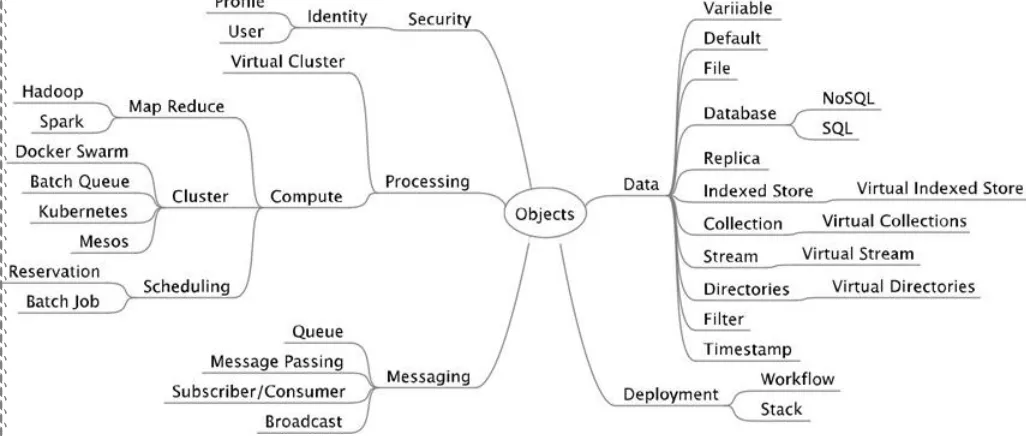
[image:26.612.54.567.175.393.2]Several objects defined in this document are used across the NBDRA. Therefore, the objects have not been organized by NBDRA components, as shown in Figure 1, but rather grouped by functional use as summarized in Figure 2.
Figure 2: NIST Big Data Reference Architecture Interfaces
4.1 IDENTITY
In a multiuser environment, a simple mechanism is used in this document for associating objects and data to a particular person or group. While these efforts do not intend to replace more elaborate solutions such as proposed by eduPerson [12] or others, a very simple way was chosen to distinguish users. Therefore, the following sections introduce a number of simple objects including a profile and a user.
4.1.1 P
ROFILEA profile defines the identity of an individual. It contains name and email information. It may have an optional unique user identification (uuid) and/or use a unique email to distinguish a user. Profiles are used to identify different users.
Object 4.1: Profile
1 {
2 "profile": {
3 "description": "The Profile of a user", 4 "uuid": "jshdjkdh...",
5 "context:": "resource", 6 "email": "[email protected]", 7 "firstname": "Gregor",
8 "lastname": "von Laszewski", 9 "username": "gregor",
10 "publickey": "ssh ...."
This
publication
is
available
free
of
charge
from:
11 } 12 }
4.1.2 U
SERIn contrast to the profile, a user contains additional attributes that define the role of the user within the multiuser system. The user associates different roles to individuals. These roles potentially have gradations of responsibility and privilege.
Object 4.2: User
{
"user": {
"profile": "objectid:profile", "roles": ["admin"]
} }
4.1.3 O
RGANIZATIONAn important concept in many applications is the management of a group of users in an organization that manages a Big Data application or infrastructure. User group management can be achieved through three concepts. First, it can be achieved by using the profile and user resources itself as they contain the ability to manage multiple users as part of the REST interface. The second concept is to create a (virtual) organization that lists all users within the virtual organization. The third concept is to introduce groups and roles either as part of the user definition or as part of a simple list similar to the organization.
Object 4.3: Organization
{
"organization": { "users": [
"objectid:user" ]
} }
The profile, user, and organization concepts allow for the clear definition of various roles such as data provider, data consumer, data curator, and others. These concepts also allow for the creation of services that restrict data access by role or organizational affiliation.
4.1.4 G
ROUP/R
OLEA group contains a number of users. It is used to manage authorized services.
This
publication
is
available
free
of
charge
from:
A role is a further refinement of a group. Group members can have specific roles. For example, a group of users can be assigned a role that allows access to a repository. More specifically, the role would define a user’s read and write privileges to the data within the repository.
Object 4.5: Role
{
"role": {
"name": "editor",
"description": "This role contains all editors", "users": [
"objectid:user" ]
} }
4.2 DATA
Data for Big Data applications are delivered through data providers. They can be either local data providers, data contributed by a user, or distributed data providers, data on the Internet. Currently, the focus is on an elementary set of abstractions related to data providers that offer the ability to utilize variables, files, virtual data directories, data streams, and data filters.
• Variables are used to hold specific contents that are associated in programming language as variables. A variable has a name, value, and type.
• Defaults are a special type of variables that allow adding of a context. Defaults can be created for different contexts.
• Files are used to represent information collected within the context of classical files in an operating system.
• Directories are locations for storing and organizing multiple files on a compute resource.
• Virtual Directories are collections of endpoints to files. Files in a virtual directory may be located on different resources. For this initial purpose, the distinction between virtual and non-virtual directories is nonessential, and the focus will be on abstracting all directories to be virtual. Therefore, the files could be physically hosted on different disks. However, it is important to note that virtual data directories can hold more than files; they can also contain data streams and data filters.
• Streams are services that offer the consumer a flow of data. Streams may allow the initiation of filters to reduce the amount of data requested by the consumer. Stream filters operate in streams or on files converting them to streams.
• Batch Filters operate on streams and on files, working in the background and delivering files as output. In contrast to streams, batch filters process the dataset and return an output after all operations have been applied.
• Indexed Stores are storage systems for objects that can be accessed by an index for each object. Search and filter functions are integrated into indexed stores to allow identification of objects.
• Databases refer to traditional databases but also to NoSQL.
• Collections are an agglomeration of any type of data.
• Replicas are duplication of data objects created to avoid overhead due to network or other physical restrictions on a remote resource.
4.2.1 T
IMES
TAMPOften data needs to be timestamped to indicate when it has been accessed, created, or modified. All objects defined in this document will have, in their final version, a timestamp.
This
publication
is
available
free
of
charge
from:
Object 4.6: TimeStamp
{
"timestamp": {
"accessed": "1.1.2017:05:00:00:EST", "created": "1.1.2017:05:00:00:EST", "modified": "1.1.2017:05:00:00:EST" }
}
4.2.2 V
ARIABLESVariables are used to store simple values. Each variable can have a type, which is also provided as demonstrated in the object below. The variable value format is defined as string to allow maximal probability.
Object 4.7: Variables
{
"var": {
"name": "name of the variable",
"value": "the value of the variable as string",
"type": "the datatype of the variable such as int, str, float, ..." }
}
4.2.3 D
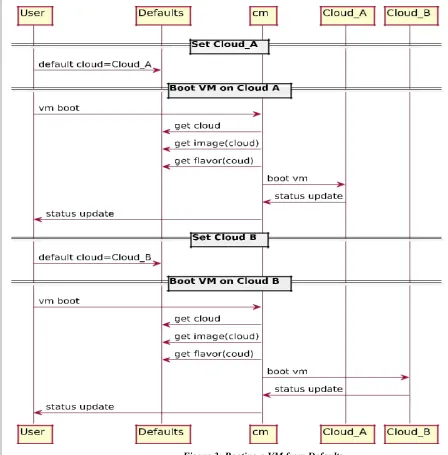
EFAULTA default is a special variable that has a context associated with it. This allows one to define values that can be easily retrieved based on the associated context. For example, a default could be the image name for a cloud where the context is defined by the cloud name.
Object 4.8: Default
{
"default": {
"value": "string", "name": "string",
"context": "string - defines the context of the default (user, cloud, ...)" }
}
This
publication
is
available
free
of
charge
from:
Figure 3: Booting a VM from Defaults
4.2.4 F
ILEA file is a computer resource allowing storage of data that is being processed. The interface to a file provides the mechanism to appropriately locate a file in a distributed system. File identification includes the name, endpoint, checksum, and size. Additional parameters, such as the last access time, could also be stored. The interface only describes the location of the file.
The file object has name, endpoint (location), size in GB, MB, Byte, checksum for integrity check, and last accessed timestamp.
This
publication
is
available
free
of
charge
from:
Object 4.9: File
{
"file": {
"name": "report.dat",
"endpoint": "file://[email protected]:/data/report.dat", "checksum": {"sha256":"c01b39c7a35ccc ...
ebfeb45c69f08e17dfe3ef375a7b"},
"accessed": "1.1.2017:05:00:00:EST", "created": "1.1.2017:05:00:00:EST", "modified": "1.1.2017:05:00:00:EST", "size": ["GB", "Byte"]
} }
4.2.5 A
LIASA data object could have one alias or even multiple ones. The reason for an alias is that a file may have a complex name but a user may want to refer to that file in a name space that is suitable for the user's application.
Object 4.10: File Alias
{
"alias": {
"name": "a better name for the object", "origin": "the original object name" }
}
4.2.6 R
EPLICAIn many distributed systems, it is important that a file can be replicated among different systems to provide faster access. It is important to provide a mechanism to trace the pedigree of the file while pointing to its original source. A replica can be applied to all data types introduced in this document.
Object 4.11: Replica
{
"replica": {
"name": "replica_report.dat", "replica": "report.dat",
"endpoint": "file://[email protected]:/data/replica_report.dat", "checksum": {
"md5": "8c324f12047dc2254b74031b8f029ad0" },
"accessed": "1.1.2017:05:00:00:EST", "size": [