Ames Laboratory Publications
Ames Laboratory
6-2002
The Melting Lines of Model Systems Calculated
from Coexistence Simulations
James R. Morris
Iowa State University
Xueyu Song
Iowa State University, [email protected]
Follow this and additional works at:
http://lib.dr.iastate.edu/ameslab_pubs
Part of the
Chemistry Commons
The complete bibliographic information for this item can be found at
http://lib.dr.iastate.edu/
ameslab_pubs/372
. For information on how to cite this item, please visit
http://lib.dr.iastate.edu/
howtocite.html
.
The Melting Lines of Model Systems Calculated from Coexistence
Simulations
Abstract
We have performed large-scale molecular dynamics simulations of coexisting solid and liquid phases using
4ε(σ/r)n interactions for n=9 and n=12, and for Lennard-Jones systems, in order to calculate the equilibrium
melting curve. The coexisting systems evolve rapidly toward the melting temperature. The P–Tmelting curves
agree well with previous calculations, as do the other bulk phase properties. The melting curve for the
Lennard-Jones system, evaluated using various truncations of the potential, converges rapidly as a function of
the potential cutoff, indicating that long-range corrections to the free energies of the solid and liquid phases
very nearly cancel. This approach provides an alternative to traditional methods of calculating melting curves.
Disciplines
Chemistry
Comments
The following article appeared in
Journal of Chemical Physics
116 (2002): 9352, doi:
10.1063/1.1474581
.
Rights
Copyright 2002 American Institute of Physics. This article may be downloaded for personal use only. Any
other use requires prior permission of the author and the American Institute of Physics.
The melting lines of model systems calculated from coexistence simulations
James R. Morris and Xueyu Song
Citation: The Journal of Chemical Physics 116, 9352 (2002); doi: 10.1063/1.1474581 View online: http://dx.doi.org/10.1063/1.1474581
View Table of Contents: http://scitation.aip.org/content/aip/journal/jcp/116/21?ver=pdfcov Published by the AIP Publishing
Articles you may be interested in
Crystal growth kinetics in Lennard-Jones and Weeks-Chandler-Andersen systems along the solid-liquid coexistence line
J. Chem. Phys. 143, 014702 (2015); 10.1063/1.4923340
Computer simulation study of surface wave dynamics at the crystal-melt interface J. Chem. Phys. 141, 034701 (2014); 10.1063/1.4886806
The melting lines of model silicon calculated from coexisting solid–liquid phases J. Chem. Phys. 120, 1654 (2004); 10.1063/1.1633754
Direct calculation of the crystal–melt interfacial free energies for continuous potentials: Application to the Lennard-Jones system
J. Chem. Phys. 118, 7651 (2003); 10.1063/1.1563248
Crystallization and melting in the Lennard-Jones system: Equilibration, relaxation, and long-time dynamics of the moving interface
J. Chem. Phys. 115, 9434 (2001); 10.1063/1.1413972
The melting lines of model systems calculated
from coexistence simulations
James R. Morrisa)
Metal and Ceramic Sciences Program, Ames Laboratory (USDOE), Iowa State University, Ames, Iowa 50011
Xueyu Song
Department of Chemistry, Iowa State University, Ames, Iowa 50011
共Received 19 December 2001; accepted 8 March 2002兲
We have performed large-scale molecular dynamics simulations of coexisting solid and liquid phases using 4⑀(/r)ninteractions for n⫽9 and n⫽12, and for Lennard-Jones systems, in order to calculate the equilibrium melting curve. The coexisting systems evolve rapidly toward the melting temperature. The P – T melting curves agree well with previous calculations, as do the other bulk phase properties. The melting curve for the Lennard-Jones system, evaluated using various truncations of the potential, converges rapidly as a function of the potential cutoff, indicating that long-range corrections to the free energies of the solid and liquid phases very nearly cancel. This approach provides an alternative to traditional methods of calculating melting curves. © 2002
American Institute of Physics. 关DOI: 10.1063/1.1474581兴
I. INTRODUCTION
The calculation of the melting line of materials is of fundamental interest,1 representing a fundamental under-standing of the equilibrium properties of both the solid and liquid phases, and the competition between them. Tradition-ally, these calculations have been made using free energy calculations: by calculating the Gibbs free energy of both phases, the melting line may be determined directly1 using the relationship
gs共P,Tm兲⫽gl共P,Tm兲, 共1兲
where g( P,T) is the Gibbs free energy per particle共with the subscripts s and l indicating the solid and liquid phases, respectively兲 and Tm( P) is the melting temperature at a
given pressure. The difficulty in the direct application of this is that the free energy is not trivially calculated. Typically, many simulations are required in order to calculate the dif-ference in free energy from a redif-ference system to the system of interest at some pressure and temperature, and then to map out the Gibbs free energy as a function of pressure and tem-perature. Although the Gibbs–Duhem integration method2,3 helps with this approach, a starting point, which is usually obtained from traditional thermodynamic integration, is still required.
An alternative is to simulate the coexistence directly with an explicit interface. This strategy had been used in the 1970s, but the calculated coexistence properties are not ac-curate compared with the thermodynamic integration due to small system size and short simulation time.4 – 6 Recently, with much larger system sizes and longer simulation times, melting temperatures have been calculated directly by simu-lating coexisting liquid and solid phases with molecular
dynamics,7,8utilizing the fact that a system with both phases will evolve toward the equilibrium melting point. Typically, the system evolves in a constant volume, particle number, and energy ensemble (NVE). In this case, we may under-stand the evolution in a straightforward fashion. If the sys-tem initially has a sys-temperature higher than the melting sys- tem-perature, then some of the solid phase will melt. This requires latent heat, and therefore converts some of the ki-netic energy into potential energy, reducing the temperature. Thus, the system approaches the melting temperature from above. A similar argument shows that if the initial tempera-ture is too low, it will evolve toward the melting temperatempera-ture from below. This approach is not limited to an NVE en-semble, but may be easily generalized.
The accuracy of the direct approach has not been com-pletely established, especially for systems for which reliable calculations have been made. In this paper, we demonstrate the approach for purely repulsive 4⑀(/r)n systems with n ⫽9 and n⫽12, and for the Lennard-Jones共LJ兲 interaction, which are well-studied condensed systems.9–12In both cases, the results agree well with previous calculations.11,12We note that there are potential complications associated with the long tail of the LJ potential. Simulations with the full poten-tial are prohibitively long, but truncation of the potenpoten-tial could 共in principle兲have a significant effect on the melting line, and therefore require corrections. We show that the melting line is surprisingly robust: truncation of the potential at distances as short as 2.1 has a minimal effect on the melting line.
II. TECHNIQUE
We begin by discussing the various model interactions used in this paper, and how we have truncated them smoothly in order to minimally affect the potential. The LJ interaction is specified by
a兲Electronic mail: [email protected]
JOURNAL OF CHEMICAL PHYSICS VOLUME 116, NUMBER 21 1 JUNE 2002
9352
0021-9606/2002/116(21)/9352/7/$19.00 © 2002 American Institute of Physics
LJ共r兲⫽4⑀
冋冉
r
冊
12⫺
冉
r
冊
6册
. 共2兲In Eq.共2兲,⑀specifies an energy scale, andspecifies a length scale. Similarly, we define the purely repulsive ‘‘soft-core’’ potentials by
n共r兲⫽4⑀
冉
r
冊
n, 共3兲
where we have included the factor of 4 in front in order to compare with the LJ system and with previous results.12This factor can easily be absorbed into the energy scale⑀.
We also define a cutoff function so that the potentials will be unaltered for distances less than a chosen distance
rm, and go smoothly to zero at distances greater than rc. We
do this using the truncation method used in Ref. 13. We first define x⫽(r⫺rm)/(rc⫺rm), so that the potential is unal-tered when x⬍0 and is 0 when x⭓1. Then the cutoff func-tion is chosen to be
f共x兲⫽
再
1, x⬍0
1⫺3x2⫹2x3, 0⭐x⬍1
0, x⭓1 .
共4兲
The function f (r) goes smoothly from 1 to 0 between the points rm and rc. We have chosen rm⫽0.95rc. We then
perform simulations using the strictly short-range potential
˜共r兲⫽共r兲f共r兲. 共5兲
In order to test how various ranges of interactions affect the results, we have performed the calculation of the LJ phase diagram using three values of the cutoff: rc/⫽2.1,
4.2, and 8.0. We show the graphs of˜LJ(r) for the first two
of these in Fig. 1. As we see, the shortest cutoff is quite dramatic. For the soft-core repulsive potentials, we have
cho-sen rc⫽2.5 for n⫽9 and rc⫽2.0 for n⫽12. In this case,
the potentials are less than 0.002⑀at rm. We have not tested
[image:5.612.77.271.50.252.2]in detail the effects of the cutoff for the soft core potentials; given that the results for the LJ potential converge rapidly FIG. 1. The truncated LJ potential energy function for rc⫽2.1 and rc
[image:5.612.366.508.61.651.2]⫽4.2. The truncation of the potential for the shorter cutoff distance is apparent; in the inset, we show the potential in the region rmⱗrⱗrc to demonstrate that the potential and its derivatives are continuous.
FIG. 2. A snapshot of a simulated coexisting LJ system, with a temperature
T⫽2.2⑀ and a total density of N/V⫽1.1495/3共intermediate between the solid and liquid densities兲. Solid atoms共as determined by the order param-eter described in the text兲are dark, while liquid atoms are light.
9353 J. Chem. Phys., Vol. 116, No. 21, 1 June 2002 Melting lines from coexistence simulations
with cutoff distance 共as we demonstrate in the following兲, and that the LJ potential has a tail that is significantly larger range than the soft-core potentials examined here, we believe that our results for the soft-core potential are essentially con-verged.
To begin the simulations, a simulation of the solid is first performed near the estimated melting temperature, to achieve an approximate equilibrated initial condition. Next, a liquid system is created, by combining large amplitude ran-dom displacements of the solid phase with a high tempera-ture simulation共⬃50% above the melting temperature兲. The
two systems are then brought into contact, by joining the two systems. Using fully periodic boundary conditions, this cre-ates two interfaces between the solid and liquid systems. We then equilibrate the system briefly关10 000 molecular dynam-ics共MD兲time steps兴near the melting temperature, with the temperature being adjusted using velocity rescaling. The sys-tem is then allowed to equilibrate using a NVE ensemble
共constant particle number, volume, and energy兲. As the sys-tem is closed, the sys-temperature and pressure will evolve. If the system is close to coexisting conditions, it naturally evolves to the equilibration. On the other hand, if the energy is too high 共or too low兲, the system will melt 共or solidify兲 com-pletely. The time required to equilibrate depends upon the size of the system, and on the difference between the initial and equilibrium conditions. Once a coexisting simulation has been equilibrated, the coexisting conditions 共average pres-sure and temperature兲can be calculated, as well as the single phase properties 共average internal energy and density兲. The system can then be perturbed by changing the volume and energy, and re-equilibrated, to calculating the coexisting properties at a different point in the phase diagram.
For most of the simulations presented here, we used a total of 16 000 atoms. However, it is important to note that this large number is not required for the coexisting simula-tions; in a previous work,7we used as few as 1024 atoms and achieved good results. The effects of system size are exam-ined for one choice of parameters below; we find little change in melting temperature and pressures as the system size is varied from 2000 to 16 000 atoms.
[image:6.612.327.547.48.316.2]We chose a molecular dynamics time step of 0.003⌬t, FIG. 3. The order parameter vs position along the direction z normal to the
interfaces, for the atoms shown in Fig. 2. The solid region extends from z
⬇⫺10to z⬇10, where the order parameter is largest.
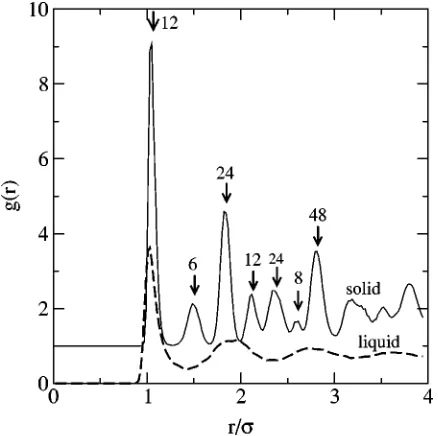
[image:6.612.64.286.50.267.2]FIG. 4. The pair distribution function g(r) calculated separately for the solid and the liquid atoms shown in Fig. 2. The solid phase g(r) curve has been shifted upward for clarity. For the solid phase, the positions and coor-dination number for different neighboring shells of atoms is shown, based upon an ideal fcc lattice.
FIG. 5. The pressure–temperature diagram for the LJ system. We have included results for all cutoffs of the LJ potential. The solid line is the fit from the results of Ref. 12, while the large open squares indicate the results of Ref. 9. Error bars for the calculations are approximately equal to the symbol size.
9354 J. Chem. Phys., Vol. 116, No. 21, 1 June 2002 J. R. Morris and X. Song
[image:6.612.66.285.485.703.2]where⌬t⬅
冑
m2/⑀, where m is the mass of an atom. This time step is sufficiently short that total energy is conserved to a high degree of accuracy. We typically used 100 000 time steps for the equilibration run, and another 50 000 for calcu-lating the average thermodynamic properties.III. RESULTS
We show a picture from the simulations in Fig. 2. We see that the system contains well-defined regions of solid and liquid, with a fairly sharp transition region between them. The atomic planes in the solid phase are clearly seen. In the Fig. 2, the interfacial plane has an average orientation along the 关001兴direction; however, it is clear that the interface is not faceted, but instead is rough. The roughness of the inter-face is a measure of the interfacial stiffness of the system.14,15In the Fig. 2, we have defined atoms as being in an instantaneous ‘‘solid’’ or ‘‘liquid’’ configuration. To do this, we define a local order parameter that provides a mea-sure of local fcc order. For this, we choose a set of Nq wave
vectors兵qi其 such that
exp共iq"r兲⫽1 共6兲 for any vector r connecting near neighbors in a perfect fcc lattice. We omit one of each pair of antiparallel wave vectors; thus, Nq⫽6. We then define the local order parameter as
⫽
冏
N1q
1
Z
兺
r兺
qexp共iq"r兲
冏
2
, 共7兲
where the sum on r runs over each of Z neighbors found within a distance rc of the atom, chosen to be between the first and second neighbor shells in the perfect lattice.
While Eq.共7兲is reasonably good at producing an order parameter that is small for the liquid phase and large for the solid phase, we have found a couple of methods that improve how well we can discriminate between these phases. First of all, instantaneous atomic positions include significant amounts of fast atomic vibrations that reduce the order of the solid phase. To overcome this, we average the atomic posi-tions over short periods of time 共100 MD time steps兲,
pro-ducing significantly more order in the solid phase. Second, we calculate an average order parameter¯ for each atom, by averaging over the neighboring values:
¯i⫽ 1
Z⫹1
冉
i⫹兺
j j冊
, 共8兲
where j runs over all Z neighbors of atom i.
[image:7.612.52.558.62.237.2]To demonstrate the effectiveness of Eq.共8兲, Fig. 3 shows the values of¯ for each atom shown in Fig. 2, as a function of distance along an axis oriented perpendicular to the inter-face. As seen in the Fig. 3, the liquid region has order pa-rameters with¯⬍0.05, while the solid region has atoms with order parameters usually satisfying¯⬎0.2. The two regions are clearly identifiable, and there are very few atoms away from the interface that have values satisfying 0.05⬍¯ ⬍0.2. In Fig. 2, we have defined all atoms with¯⬎0.08 as ‘‘solid,’’ and the remaining atoms as liquid. This designation is for demonstration purposes only, and plays no role in our evaluation of the properties of the coexisting system. As a separate test of this designation, and to demonstrate that these two distinct regions have properties closely reproduc-ing the separate, homogeneous liquid and solid phases, we have calculated the pair correlation function g(r) separately for the two regions. The results, shown in Fig. 4, show that the liquid region has a pair correlation function typical of a homogeneous LJ liquid. The solid phase shows much more structure. We have labeled the g(r) results for the solid
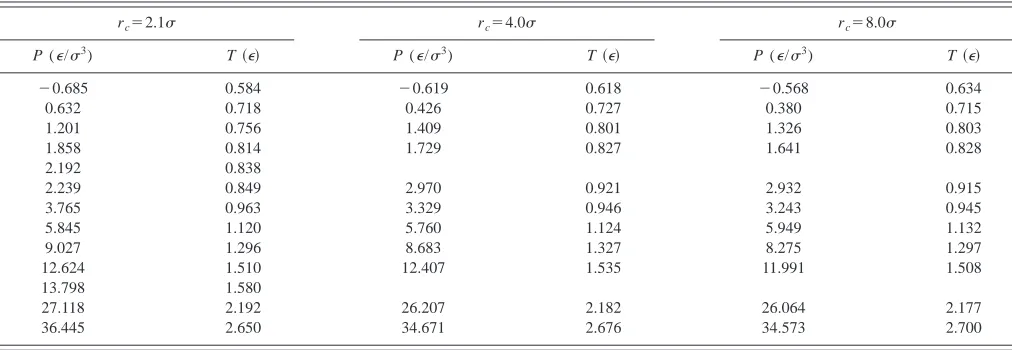
TABLE I. Results for the Lennard-Jones melting pressures and temperatures, with various cutoffs of the potential.
rc⫽2.1 rc⫽4.0 rc⫽8.0
P (⑀/3) T共⑀兲 P (⑀/3) T共⑀兲 P (⑀/3) T共⑀兲
⫺0.685 0.584 ⫺0.619 0.618 ⫺0.568 0.634
0.632 0.718 0.426 0.727 0.380 0.715
1.201 0.756 1.409 0.801 1.326 0.803
1.858 0.814 1.729 0.827 1.641 0.828
2.192 0.838
2.239 0.849 2.970 0.921 2.932 0.915
3.765 0.963 3.329 0.946 3.243 0.945
5.845 1.120 5.760 1.124 5.949 1.132
9.027 1.296 8.683 1.327 8.275 1.297
12.624 1.510 12.407 1.535 11.991 1.508
13.798 1.580
27.118 2.192 26.207 2.182 26.064 2.177
[image:7.612.315.561.652.757.2]36.445 2.650 34.671 2.676 34.573 2.700
TABLE II. Melting temperatures as a function of pressure for the LJ system, determined by interpolating from Table I.
P (⑀/3) T
m(⑀), rc⫽2.1 Tm(⑀), rc⫽4.2 Tm(⑀), rc⫽8.
0.0 0.654 0.683 0.683
5.0 1.056 1.068 1.066
10.0 1.354 1.401 1.395
15.0 1.635 1.657 1.651
20.0 1.865 1.891 1.889
25.0 2.095 2.125 2.126
30.0 2.334 2.403 2.419
35.0 2.579 2.695 2.726
9355 J. Chem. Phys., Vol. 116, No. 21, 1 June 2002 Melting lines from coexistence simulations
phase by calculating the position of neighboring shells of atoms from a fcc lattice, as well as the number of atoms in each shell. These positions and coordinations are indicated by the arrows in Fig. 4. There is a clear correlation between the position and heights of the peaks of g(r) and the calcu-lated neighboring shell distances and coordinations.
We begin by discussing the results for the LJ potential. Our primary results are shown in Fig. 5 and in Table I. In the Fig. 5, we have shown results for all three values of the cutoff distance. As we can see, the results for all three cutoff distances are in close agreement. We also show the results
from Refs. 9 and 12. Our simulation results are in close agreement with the results of Ref. 12 at all densities, while the highest density result of Ref. 9 departs significantly from these calculations.
In Table I, it is difficult to see how the results converge as a function of the potential cutoff, as each simulation evolves to slightly different pressures and temperatures. To better demonstrate the rapid convergence, Table II shows the predicted melting temperatures at selected pressures, calcu-lated by linear interpolation of the results given in Table I. Table II demonstrates that the results found using rc⫽2.1 have a typical error of about 4% too low 共compared to the largest value of rc兲, while those using rc⫽4.2differ by less
than 1%.
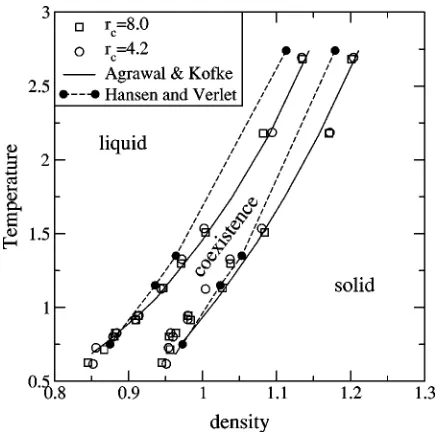
In Fig. 6 we show the phase diagrams for the LJ system as a function of density and temperature. We compare our results for rc⫽4.2 and rc⫽8.0 with those of Refs. 9 and
12. We see that our results are in very good agreement with those of Ref. 12, while those of Ref. 9 are off significantly, especially at higher pressures. The results for the liquid phase are particularly good. Our results for the solid phase show significant scatter, and suggest that at low pressures, the solid phase has a lower density than that predicted by Ref. 12.
In Fig. 7, we show the melting temperature for the soft core n⫽9 and n⫽12 systems for three different pressures. For the soft core systems, the equilibrium melting tempera-ture and pressures should satisfy9,10
P␣⫽Cn, 共9兲
where ⫽1/kBT and ␣⫽(3⫹n)/n, and Cn is a constant.
The results shown in Fig. 7 are consistent with this, with
C9⫽22.90⫾0.03 and C12⫽16.80⫾0.03. These latter results
are essentially consistent with the value of Ref. 12 found
C12⫽16.89, but somewhat higher than those of Ref. 9. The
melting pressures and temperatures are given in Tables III and IV for the two systems. In Tables III and IV, we also show the coexisting solid and liquid densities, scaled by
[image:8.612.65.285.49.265.2]Tm3/n. For a soft sphere system, these densities should scale with this behavior. As Tables III and IV demonstrate, our simulations closely agree with this scaling behavior. FIG. 6. The density–temperature relationship for the LJ system. We show
[image:8.612.315.560.75.132.2]our results for rc⫽4.2 and rc⫽8.0as open symbols. Results from Ref. 12 are shown as solid lines, and those from Ref. 9 are shown as closed circles connected by dashed lines. Error bars for the calculations are ap-proximately equal to the symbol size.
FIG. 7. The pressure–temperature diagram for the soft core systems. The dashed lines are fits to the soft-core results, to the form p⫽C with
⫽4
3 for n⫽9 and⫽ 5
4 for n⫽12. Error bars for the calculations are
ap-proximately equal to the symbol size.
TABLE III. Melting pressures, temperatures, and coexisting densities scaled by Tm
1/3for the soft core n⫽9 system.
P (⑀/3) Tm共⑀兲 sol/Tm
1/3
(⫺3) liq
/Tm
1/3
(⫺3)
23.14 0.99 0.915 0.892
30.59 1.21 0.918 0.897
[image:8.612.65.286.493.711.2]55.64 1.96 0.903 0.885
TABLE IV. Melting pressures, temperatures, and coexisting densities scaled by Tm
1/4
for the soft core n⫽12 system.
P (⑀/3) T
m共⑀兲 sol/Tm
1/4
(⫺3) liq/Tm
1/4
(⫺3)
23.19 1.29 0.857 0.825
33.01 1.73 0.852 0.821
68.48 3.07 0.855 0.823
9356 J. Chem. Phys., Vol. 116, No. 21, 1 June 2002 J. R. Morris and X. Song
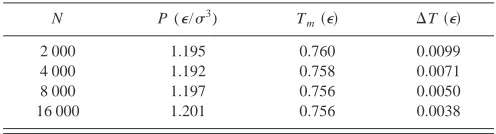
[image:8.612.315.560.701.757.2]In all of these results, we have used a large system size, with 16 000 atoms. This represents a significant computa-tional effort, especially for the larger cutoff distance. How-ever, such a large system size is not necessary. This has been demonstrated previously for a different potential.7 We also test this for the LJ system, with the smallest cutoff (rc
⫽2.1). We have performed simulations for N⫽2000, 4000, 8000 and 16 000 atoms, keeping N/V fixed, and per-forming the simulations at a specific total energy per particle. We list the results in Table V. Table V clearly demonstrates that the numbers are very close, essentially independent of system size. We also define the variation in temperature dur-ing the simulation as
⌬T⬅
具
共T⫺具
T典
兲2典
1/2and find that this decreases with system size as N⫺1/2 as expected.
IV. DISCUSSION
In this paper, we have calculated the melting curves of the LJ system, and of the soft-core potentials(r)⫽4/r9and
(r)⫽4/r12using molecular dynamics simulations of the co-existing systems. We find good agreement with previous re-sults. In particular, our phase diagram for the LJ system is close to that of Ref. 12. While the simulations performed here required a significant amount of computational effort, our system size studies demonstrate that this method does not require as large systems as required here. Moreover, the largest amount of effort was spent for the longest cutoff of the LJ system; as we have demonstrated here, the results are not sensitive to this cutoff. Presumably, this insensitivity is due to the relatively similar densities of the liquid and solid phases, and their small compressibility.
One difficulty in these simulations is that for the geom-etries used here, the system is not necessarily under hydro-static pressure: the stresses may differ along different axes. We have treated this problem by manually adjusting the sys-tem box sizes of our initial simulations so that the different stress components are approximately equal, and calculating the average pressure P⫽⫺1
3(xx⫹y y⫹zz) from the stress tensori j. This suffices for a small number of geometries,
where this may be accomplished by hand fairly rapidly. De-viations from hydrostatic pressure are likely to be our largest source of error. This problem could be addressed by equili-brating under stress conditions, allowing the box shape to evolve to achieve hydrostatic conditions. An alternative would be to perform a simulation where the solid is com-pletely bounded by liquid. In such a case, the system should
naturally evolve toward hydrostatic conditions. However, this would likely require significantly larger numbers of at-oms than are needed for the simpler geometry considered here.
An additional consideration is that the presence of the interface can produce stress in the system, even when the box size is optimized for the bulk crystal and liquid densities. This interface stress is due to the relaxations that the surface would like to undergo. However, we believe that this is small, in particular given the roughness of the interface. Where a flat interface may want to undergo relaxations or reconstructions to relieve the surface stress 共as happens in crystal-vapor surfaces兲, the rough interface has sufficient ‘‘defects’’ to relieve most of such stress. For small systems, this may be more significant. Moreover, for very small sys-tems, the crystal may eventually be sufficiently small that the free energy cost of the interface, and the stress from the interface, may outweigh the free energy gain of forming a solid region. In this case, the solid region may vanish en-tirely. We saw exactly this behavior in previous simulations.7 This is also likely to be the origin of difficulties in early coexistence simulations.4 – 6
We note that this technique is generalizable to Monte Carlo simulations as well. This may be done using a NVT ensemble, under conditions when N/V is between the liquid and solid densities of the pure phases at the given tempera-ture. This provides a restoring force that drives the system toward an equilibrium consisting of two phases. The ap-proach is not as useful for solid-vapor or liquid-vapor phase diagrams: in MD, the equilibration time is not sufficiently long. For liquid-vapor phase diagrams, existing MC simula-tions using a Gibbs ensemble are better suited.16,17 Within the MD simulations presented here, we may examine the melting curve into metastable regions, i.e., at pressures close to the triple point.
ACKNOWLEDGMENTS
This work is funded in part by a Department of Energy Computational Materials Science Network on ‘‘Microstruc-tural Evolution Based on Fundamental Interfacial Proper-ties.’’ Computer time was provided by the Scalable Com-puter Lab, Ames Laboratory, and by a grant from NERSC. This research was sponsored by the Division of Materials Sciences and Engineering, Office of Basic Energy Sciences, U.S. Department of Energy, under Contract No. W-7405-ENG-82 with Iowa State University.
1D. Frenkel and B. Smit, Understanding Molecular Simulation, 1st ed. 共Academic, San Diego, 1996兲.
2D. A. Kofke, Mol. Phys. 78, 1331共1983兲. 3
D. A. Kofke, Adv. Chem. Phys. 105, 405共1999兲. 4
A. Ladd and L. Woodcock, Chem. Phys. Lett. 51, 155共1977兲. 5A. Ladd and L. Woodcock, Mol. Phys. 36, 611共1978兲. 6J. Cape and L. Woodcock, Chem. Phys. Lett. 59, 274共1978兲.
7J. R. Morris, C. Z. Wang, K. M. Ho, and C. T. Chan, Phys. Rev. B 49,
3109共1994兲.
8A. B. Belonoshko, R. Ahuja, and B. Johansson, Phys. Rev. Lett. 84, 3638
[image:9.612.50.298.84.151.2]共2000兲.
TABLE V. Melting pressures and temperatures for rc⫽2.1 cutoff LJ
po-tential, calculated for various system sizes. We have also included the rms variation in temperature (⌬T) during the simulation.
N P (⑀/3) T
m共⑀兲 ⌬T共⑀兲
2 000 1.195 0.760 0.0099
4 000 1.192 0.758 0.0071
8 000 1.197 0.756 0.0050
16 000 1.201 0.756 0.0038
9357 J. Chem. Phys., Vol. 116, No. 21, 1 June 2002 Melting lines from coexistence simulations
9J.-P. Hansen, Phys. Rev. A 2, 221共1970兲.
10W. G. Hoover, S. G. Gray, and K. W. Johnson, J. Chem. Phys. 55, 1128
共1971兲.
11
R. Agrawal and D. A. Kofke, Mol. Phys. 85, 23共1995兲. 12R. Agrawal and D. A. Kofke, Mol. Phys. 85, 43共1995兲. 13J. Mei and J. W. Davenport, Phys. Rev. B 46, 21共1992兲.
14J. R. Morris, Y. Y. Ye, Z. Y. Lu, and K. M. Ho, Interface Sci.共submitted兲; J. R. Morris, Phys. Rev. B共submitted兲.
15J. J. Hoyt, M. Asta, and A. Karma, Phys. Rev. Lett. 86, 5530共2001兲. 16
A. Z. Panagiotopoulos, Mol. Phys. 61, 813共1987兲.
17B. Chen, I. Siepmann, and M. L. Klein, J. Phys. Chem. B 105, 9840
共2001兲.
9358 J. Chem. Phys., Vol. 116, No. 21, 1 June 2002 J. R. Morris and X. Song