
e-Science Gap Analysis
30 June 2003
Geoffrey Fox, Indiana University
David Walker, Cardiff University
Part I: Introduction and Summary... 6
1
Executive Summary... 6
2
Introduction ... 7
2.1 Charge... 7
2.2 Process ... 7
2.3 Overview of Report ... 7
2.4 Findings ... 9
2.4.1 Projects Surveyed (sections 3 and 4) ... 9
2.4.2 Grid Technology (section 5) ... 9
2.4.3 Grid Functions and Styles (section 6) ... 10
2.4.4 Gaps in Grid Styles and Functionalities (section 8.1) ... 10
2.4.5 Gaps in e-Science Runtime and Hosting Environment (section 8.2)... 10
2.4.6 Gaps in Security (section 8.3) ... 10
2.4.7 Gaps in Workflow (section 8.4) ... 10
2.4.8 Gaps in Notification Service (section 8.5) ... 11
2.4.9 Gaps in Meta-data and Semantic Grid (section 8.6)... 11
2.4.10 Gaps in Information Grid Technology (section 8.7)... 11
2.4.11 Gaps in Compute/File Grids (section 8.8)... 11
2.4.12 Gaps in other Grid Technology (section 8.9) ... 11
2.4.13 Gaps in Portals and Problem Solving Environments (section 8.10)... 11
2.4.14 Gaps in Grid-Network Interface (section 8.11) ... 11
2.4.15 Education and Support Gaps (section 9) ... 11
2.4.16 Research Gaps (section 10)... 11
2.4.17 Perception and Organizational Issues and Gaps (section 11) ... 11
2.5 Summary of Discussion in Sections 7, 8 and Appendix ... 13
2.5.1 Topics 1-6: Grid Types to Meta-data Services ... 13
2.5.2 Topics 7 to 11: Information Grid Services to Network Services ... 14
Part II: e-Science and its Technologies... 15
3
e-Science ... 15
3.1 Particle Physics EDG and GridPP ... 15
3.2 AstroGrid ... 15
3.3 NERC DataGrid... 16
3.4 DiscoveryNet ... 16
3.5 myGrid... 16
3.6 Comb-e-Chem... 17
3.7 RealityGrid ... 17
4
e-Business, e-Government, and e-Services ... 17
4.1 Campus Grids... 18
4.2 Military and defence grids... 18
4.3 Capital Radio Grid... 18
4.4 Bioinformatics Grids... 19
4.5 Distributed Aircraft Maintenance Environment (DAME)... 19
5
Grid and Cyberinfrastructure Technologies... 21
5.1 Basic architecture Principles... 21
5.2 Meta-data Rich Web Services Communicating by Messages... 21
5.3 Level 1: Hosting Environments... 21
5.4 OGSA and Level 2: OGSI Open Grid Service Infrastructure ... 22
5.5 Level 3: Permeating Principle and Policies ... 22
5.6 Levels 4, 5, and 6: System and Application Grid services ... 24
5.7 Grid Technology Suites... 24
6
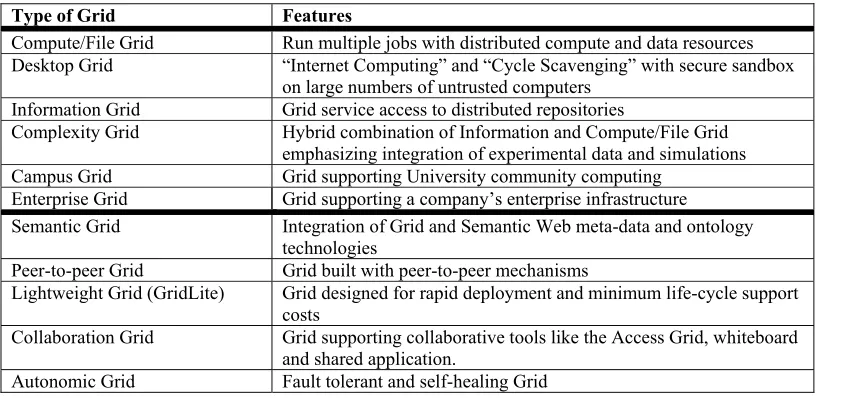
Functionalities and Styles of Grids ... 24
6.1 Introduction ... 24
6.2 Compute/File Grids ... 26
6.3 Desktop Grids... 26
6.4 Information Grids ... 26
6.5 Complexity Grids ... 27
6.6 Campus and Enterprise Grids ... 28
6.7 Grid Characteristics... 28
7
Status of e-Science Service Development... 29
7.1 Types of Grid ... 30
7.2 Core Infrastructure and Hosting Environment ... 31
7.3 Security Services ... 32
7.4 Workflow Services and Programming Model ... 33
7.5 Notification Services... 36
7.6 Registry, Metadata and Information Services ... 37
7.6.1 Introduction ... 37
7.6.2 Basic metadata including Registry ... 38
7.6.3 Information Aggregation Web Services... 39
7.6.4 Semantically rich Services and Ontologies... 39
7.6.5 Provenance ... 40
7.7 Information Grid Services ... 40
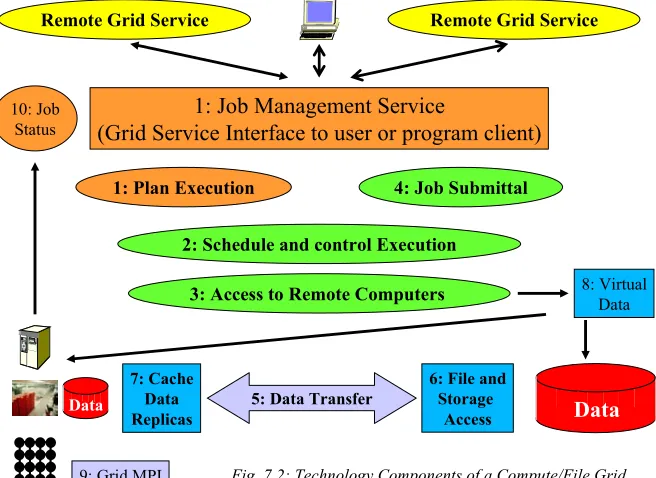
7.8 Compute/File Grid Services ... 41
7.8.1 Planning and Management ... 41
7.8.2 Scheduling ... 42
7.8.3 Access to Remote Computers... 42
7.8.4 Managing Job Submission ... 42
7.8.5 Compute/File Grid Shell: Data Transfer... 42
7.8.6 File and Storage Access ... 43
7.8.7 Replica Management and Caching Technology... 43
7.8.8 Virtual Data ... 43
7.8.9 Parallel Computing... 43
7.8.10 Job Status ... 43
7.9 Other Grid Services ... 43
7.9.1 Grid Shell ... 43
7.9.2 Accounting and Grid Economies ... 43
7.9.3 Fabric Management... 44
7.9.4 Visualization Datamining and Computational Steering... 44
7.9.5 Collaboration ... 44
7.9.6 Packaging ... 45
7.9.7 Other Technologies... 45
7.10 Portal Services and Problem Solving Environments... 45
7.11 Network Services ... 46
7.11.1 Network Performance, Monitoring and Information Systems... 46
7.11.2 Network Services and Operations ... 47
Part III: Gap Analysis ... 48
8
Grid Technology Gaps ... 48
8.1 Different Types of Grids and their Federation... 48
8.1.1 Introduction ... 48
8.1.2 Summary of Gaps... 48
8.1.3 Jini ... 49
8.1.3.1 Grid Prototypes Based on Jini... 49
8.1.3.2 Jini in Agent-Based Grids... 49
8.1.4 JXTA ... 50
8.1.4.1 Critique of JXTA for Building Peer-to-Peer Grids ... 50
8.1.4.2 Use of JXTA in a Grid for Capital Radio Group ... 51
8.1.4.3 JXTA GAT Binding for the Triana Project... 51
8.1.5 .NET ... 52
8.1.5.1 Overview of .NET... 52
8.1.5.2 Grid Middleware Based on .NET... 52
8.1.6 Grids and Virtual Private Networks... 52
8.1.7 Grid Federation... 53
8.1.8 Dynamic Configuration (Autonomic Computing) ... 54
8.2 e-Science Runtime and Hosting Environment ... 55
8.2.1 Introduction ... 55
8.2.2 Summary of Gaps... 56
8.2.3 Selected Snapshots of Current Activities ... 56
8.2.3.1 Invocation Framework from IT Innovation ... 56
8.2.3.2 ICENI From Imperial College ... 57
8.2.3.3 Messaging Infrastructure... 58
8.2.3.4 Lightweight Middleware... 58
8.3 Security Infrastructure... 59
8.3.1 Introduction ... 59
8.3.2 Summary of Gaps... 59
8.3.3 Current Globus and related (EDG GriPhyn Condor) Technology... 60
8.3.4 Possible Future Projects ... 60
8.3.4.1 Harden VOMS from EDG... 60
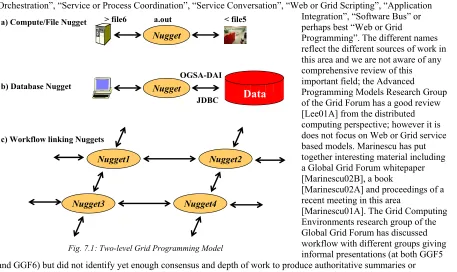
8.4 Workflow ... 61
8.4.1 Introduction ... 61
8.4.1.1 Workflow representation and composition... 61
8.4.1.2 Workflow enactment (Compilation and Execution) ... 62
8.4.2 Summary of Gaps... 62
8.4.3 Selected Snapshots of Current Activities ... 62
8.4.3.1 Workflow at Southampton ... 62
8.4.3.2 Workflow at Newcastle... 62
8.4.3.3 Workflow at Cardiff... 63
8.4.3.4 Workflow at IT Innovation... 63
8.4.4 Possible Future Projects ... 64
8.4.4.1 Newcastle Workflow Engine... 64
8.5 Notification Service... 64
8.5.1 Introduction ... 64
8.5.2 Summary of Gaps... 65
8.5.3 Selected Snapshots of Current Activities ... 65
8.5.3.1 myGrid and Wrapped JMS (Java Message Service) at Southampton... 65
8.5.3.2 Notification Grid Service at Newcastle ... 65
8.6 Meta-data and Semantic Grid... 66
8.6.1 Introduction ... 66
8.6.2 Summary of Gaps... 66
8.6.3 Globus Specific Gaps ... 67
8.6.4 Selected Snapshots of Current Activities ... 67
8.6.4.1 UDDI Evaluation ... 67
8.6.4.3 Relational Grid Monitoring Architecture... 69
8.6.4.4 Semantic Grid Work at Southampton... 69
8.6.4.5 SDT Semantic Discovery Toolkit... 70
8.6.4.6 Metadata Management ... 70
8.6.4.6.1 General Scientific Metadata Format ... 70
8.6.4.6.2 CCLRC Data Portal... 70
8.6.5 Possible Future Projects ... 71
8.6.5.1 Semantic Grid Expectations... 71
8.6.5.2 A Semantic Grid Service Registry from IT Innovation ... 71
8.6.5.3 Provenance Specification... 71
8.6.5.4 SRB Evaluation at CCLRC e-Science Centre ... 72
8.7 Information Grid Technology including OGSA-DAI ... 72
8.7.1 Introduction ... 72
8.7.2 Summary of Gaps... 73
8.7.3 Current OGSA-DAI... 73
8.7.3.1 North-East e-Science Centre OGSA-DAI Activities ... 74
8.7.4 Selected Snapshots of Current Activities ... 74
8.7.4.1 Environmental Grids ... 74
8.7.4.2 AstroGrid... 75
8.7.5 Possible Future Projects ... 76
8.7.5.1 Capital Radio ... 76
8.7.5.2 Futures of OGSA-DAI ... 76
8.7.5.3 Environmental DataGrid... 77
8.7.5.4 AstroGrid... 77
8.8 Compute/File Grids: Scheduling, Access to Mass Storage, Replica Management and Virtual Data ... 78
8.8.1 Introduction ... 78
8.8.2 Summary of Gaps... 78
8.8.3 Possible Future Projects ... 79
8.8.3.1 Hardening of EDG Replica Technology ... 79
8.8.3.2 Hardening of EDG Compute Resource Broker... 79
8.8.3.3 Hardening EDG Storage Element - Grid interface to mass storage resources ... 80
8.9 Other Technology areas ... 80
8.9.1 Introduction ... 80
8.9.2 Summary of Gaps... 80
8.9.3 Selected Snapshots of Current Activities ... 81
8.9.3.1 Grid Economies and Markets... 81
8.9.3.2 Improve collaboration (Access Grid) technology ... 81
8.9.4 Possible Future Projects ... 82
8.9.4.1 GridWeaver: an enhanced LCFG for e-Science wide fabric management ... 82
8.9.4.2 Development of a Gridmake ... 82
8.9.4.3 Debugging tools ... 83
8.9.4.4 Grid-Based Visualisation Services at Leeds... 83
8.9.4.5 Visualization and Computational Steering at Cardiff ... 83
8.9.4.6 Grid Visualisation Services at CCLRC ... 85
8.9.4.6.1 GAPtk visualisation server... 85
8.9.4.6.2 Application programming interfaces ... 85
8.9.4.6.3 Applications... 86
8.10 Portals and Problem Solving Environments ... 86
8.10.1 Introduction ... 86
8.10.2 Summary of Gaps... 87
8.11 Grid-Network Interface ... 87
8.11.1 Introduction ... 87
8.11.2 Summary of Gaps... 87
8.11.3 Selected Snapshots of Current Activities in Monitoring and management ... 87
8.11.3.1 Network Measurement and Monitoring ... 87
8.11.3.2 Network Information Services ... 89
9
Education and Support Gaps ... 90
9.1 Gaps ... 90
10
Research Gaps affecting near-term e-Science (issues where not enough is
known to allow “development” project)... 90
10.1 Gaps ... 90
11
Perception and Organizational Issues and Gaps ... 91
12
Acknowledgments ... 92
Part IV: UK Open Middleware Infrastructure Institute (OMII) ... 94
13
Core e-Science Middleware Action Plan ... 94
13.1 Elements of the Action Plan... 94
13.1.1 Grid Systems ... 94
13.1.2 Basic Technology... 94
13.1.3 Essential Services ... 95
13.1.4 Core Domain Grid Services ... 95
13.1.5 Programming Environments ... 95
13.1.6 Portals and User Interfaces ... 95
13.1.7 Other Grid Services... 95
13.2 Agile Development of Grid Middleware... 95
Part V: Appendices ... 96
14
Detailed Descriptions of UK Grid Services and Activities ... 96
[image:5.612.77.534.49.483.2]Caveat to Table 14.1 below ... 96
Table 14.1: Summary of Services, Tools and Utilities... 97
Tabular Classification of UK e-Science Services Tools and Utilities ... 97
15
Worldwide Grid Resources... 103
15.1 Glossary of Concepts ... 103
15.2 National and Regional Programmes... 105
15.3 Descriptions of Projects ... 106
15.4 Descriptions of Systems and Tools ... 117
Part I: Introduction and Summary
1 Executive
Summary
We present the results of personal interviews from mid February to early April 2003 of 80 scientists concerning the current state of Grid and Cyberinfrastructure technology with respect to their use in e-Science. The guiding theme of each interview was the identification of issues affecting the development by 2006 of robust e-Science infrastructure that would be generally usable by both large and small groups wishing to set up or join virtual organizations. Our coverage of the UK e-Science participants was reasonably thorough and we augmented this by discussions with some European and US Grid experts and, of course, attendance at meetings like GGF7. The study also included substantial material gathered both to cover specific topics for this report and to document current e-Science project progress with attention to Web and Grid services developed. The main body of this report is augmented by a public appendix listing the back up material with a tabular summary of the information gathered. Also included in the appendix is a glossary of concepts related to the Grid and e-Science, and brief summaries and URLs of projects, tools and infrastructure in these areas. The notes from the interviews have been kept confidential. The report has summarized the interviews as a set of over 120 comments (on issues or gaps) and used community understanding and these gaps to produce two taxonomies; one of Grid technologies and another of Grid functionalities. These taxonomies are consistent with OGSA – the Open Grid Service Architecture – of the Global Grid Forum. We have used them to classify issues directly connected to the technology and functionality of Grids. Some of the gaps were further classified under education and support, research and finally perception and organizational issues. The gaps, summaries and taxonomies can be read and interpreted by each reader of this report. The identification of gaps is further informed by a survey, presented in Section 7, of worldwide Grid developments relevant to e-Science, based on the literature and information on web sites.
However, we went further than just identifying the gaps, and developed a possible development program, presented in Section 13, which aims to deliver by 2006 Grid technologies supporting the e-Science functionalities identified in this report. This program is designed to support the full e-Science community including disciplines like particle physics needing highly robust large scale “Compute/File” Grids as well as the Information Grid based applications such as those in Bioinformatics and Virtual Observatories. Our plan will continue the UK leadership in areas like OGSA-DAIS and the Semantic Web; it covers Grids designed to support the activities of the current core e-Science projects, campus Grids and the military and commercial Grid areas we studied. Our software development program is structured as a central activity responsible for overall direction and the architecture and software engineering. Our report notes that many styles of Grids are needed with autonomic (fault-tolerant), lightweight and peer-to-peer characteristics being highlighted by our analysis. The central activity would be responsible for this core Grid infrastructure which could of course be developed with other groups in the UK or around the world. We identify the need for federation technology to allow Grids of different styles and suppliers to be integrated and suggest OGSA can be used for federation as well as interoperability. The central effort of the proposed software development program is accompanied by distributed activities. The total effort is divided into basic technology, essential services for any Grid, core Grid services for the two most important functions (Information and Compute/File), programming environments, portals and user interfaces, and the outer level discipline-specific services. Many of these services are under development in the current e-Science program but without central coordination and motivated largely by a particular application and near term demonstrations. We suggest that requirements and technical issues are well enough understood to allow, for example, the development of UK e-Science workflow, notification and information services – the capabilities identified under essential services. We emphasize the basic technology category including the so-called hosting and execution environments which includes asynchronous messaging, network monitoring, Grid federation, a security infrastructure supporting fine grain authorization, and a component model optimized for e-Science. Our study covered software engineering issues and this should be a major strength of the central coordinating activity.
Such a well-designed software development program would attract international attention and collaboration. It should be accompanied by a support and education program recognizing the inherent problems in supporting rapidly varying technology and informing the community about both today’s best practice and expected future directions of e-Science.
2 Introduction
2.1 Charge
The authors were asked to produce a detailed ‘Gap Analysis’ report of present and foreseen Grid middleware with the main aim of identifying the areas in which the middleware is lacking or poorly specified, i.e., the gaps. The report should also:
1) Recommend actions to be taken to deliver an alpha release of a UK open source/open standard Grid middleware stack by Q4 2004 with a production version by Q1 2006.
2) Explicitly address the issues identified at the Technical Discussion Meeting on Grid Middleware in December 2002.
3) Summarise the middleware products of the UK Core e-Science Programme. This includes services, XML schema, and tools.
4) Include a discussion of software engineering, interoperability, and federation issues.
2.2 Process
This gap analysis report is based mainly on interviews with members of the UK e-Science community. In addition, several members of the community have contributed to the report by writing short sub-sections on their particular area of expertise – these are acknowledged in Section 12. A third source of input was documentation from some of the e-Science projects. The transcripts of the interviews remain confidential, but all other material appears in this report.
Interviews were conducted with representatives of the following: 1) The UK e-Science Centres and the Grid Support Centre.
2) All the EPSRC and PPARC pilot projects, as well as the NERC-funded GODIVA project, the OGSA-DAI project, and the European DataGrid project.
3) Companies involved in producing Grid middleware, such as IBM and Hewlett-Packard.
4) Companies and organisations that are potential users of Grid middleware, such as the European Bioinformatics Institute, CERN, and Capital Radio Group.
5) Individuals with expertise in particular areas related to Grid middleware, such as security, networking, and software engineering.
2.3 Overview of Report
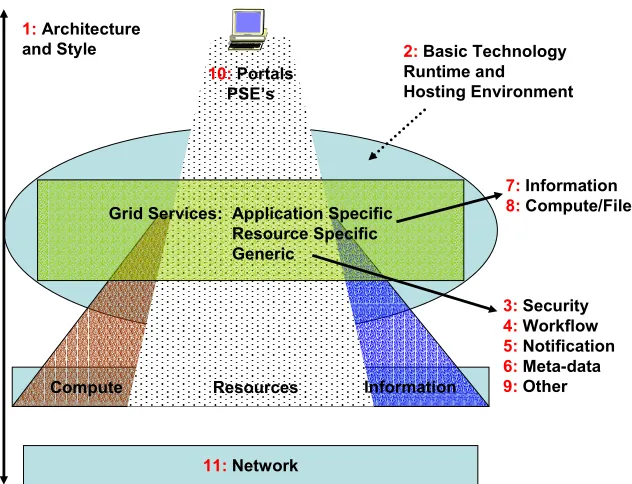
Sections 8 to 11 are devoted to the results of the gap analysis. The first describes the project management and software engineering issues that would be important if the UK (possibly in collaboration with a broader open middleware initiative) core e-Science activity mounted a major project to develop middleware. We note that for the purposes of this analysis, we define the software used for e-Science as Grid technology, whether it uses Globus, .NET, Jini or some other core infrastructure. Section 8 is the heart of the report and presents in 11 sub-sections those areas of Grid technology where gaps exist with enough understanding to warrant consideration in a middleware initiative. Figure 2.1 depicts Grid architecture at a high level in order to explain the different sub-sections of Section 8 which presents the gaps organized as explained in this figure. The gaps described in sub-section 8.x correspond to the world-wide service summary given in sub-section 7.x.
Section 8.1 notes that with our broad definition, there are many functions and styles of Grids differing in both size, heterogeneity, dynamics and needed functionality. This diversity is generated by different application requirements and different choice of base technologies. We describe the architectural implications of this and how it can be addressed by allowing multiple internal technologies and supporting a Grid formed by composition and federation of other Grids.
The middleware (services) must be supported by some run-time which can differ both between grids and in fact internally to a Grid. For example, if we link a PDA to a supercomputer in a Grid, these resources are likely to have different run-time environments even though the may connect through common protocols or API’s. Section 8.2 discusses this important topic both in terms of specific capabilities and broad technology choices.
[image:8.612.117.433.174.416.2]Sections 8.3 to 8.6 discuss four important services highlighted in OGSA and most distributed object systems like CORBA and Java RMI. These start with security where our treatment is incomplete, as there is a separate task force addressing this. We stress the analogies with Virtual Private Networks which are accepted practice and the value of a federated security architecture to provide the needed fine grain authorization for Grid resources. Section 8.5 describes notification which is part of the new OGSI standard but there is no clear consensus yet on application requirements here. Section 8.4 describes the very important workflow service (or distributed application/service integration) where there is probably good agreement on functionality but less consensus on how to express it. Many e-Science projects require a powerful workflow engine capable of dealing with the high service to service bandwidth and dynamic nature required in e-Science. The middleware effort here involves both supporting a language to express workflow and the enactment engine to efficiently implement it. As in conventional programming where one has multiple languages often supported by a single runtime, we can expect a good workflow runtime (enactment) to support substantial experimentation with workflow languages. Section 8.6 describes a major area that many projects highlighted as critical; this is area of generating, storing and accessing meta-data; we define this broadly to span both the simple look-up of
Fig. 2.1: Classification into 11 areas of the Grid middleware gaps identified
11:Network
Information Compute Resources
10:Portals PSE’s
Application Specific Resource Specific Generic Grid Services:
1:Architecture
and Style 2:Basic Technology
Runtime and Hosting Environment
7:Information
8: Compute/File
3:Security
4:Workflow
5:Notification
6:Meta-data
Web services as in UDDI to the richness of the Semantic Grid. The need for supporting semantic interoperation of services is a broad requirement although the design of meta-data/look-up services that span high and low levels of the Grid remains unclear.
Sections 8.7 and 8.8 focus on the capabilities needed to support information and compute/file grids respectively. Information grids have been a special focus of the UK e-Science program and building on the success of OGSA-DAI form an important set of activities where the requirements of the astronomy and bioinformatics communities are reasonably clear. Other application-specific services such as those in Earth and Environmental science can be expected to become clearer as projects in these areas mature. Section 8.8 is dominated by the needs of the particle physics community and here one finds the greatest overlap with existing European and US efforts. Campus (computing) Grids can also be expected to grow in importance. Replica management, access to storage, scheduling and virtual data are major compute/file Grid areas. The scale of the particle physics problem emphasizes the need for robust well-managed grids.
Section 8.9 is a gallimaufry of services that did not fit conveniently into the above categories; accounting, Grid fabric configuration and management, visualization, Grid economies and collaboration are discussed here.
Section 8.10 describes the technologies to support portals and problem solving environments. Here there are some emerging technologies that should allow greater sharing of portal and PSE components between different e-Science projects. This effort has been pursued by the GCE (Grid Computing Environments) working group of the GGF which has produced two “Grid Information” documents describing this area. We expect that the e-Science program could usefully adopt and extend some of these ideas.
Section 8.11 describes issues on the interface of Grids and the physical network. Grids require sophisticated monitoring, and good API’s to first query network performance and then reserve or predict network capacity. Further Grids demand end-to-end performance which requires coordination between backbone and regional network providers.
Sections 9 through 11 present less technical gaps starting with a discussion of education, training and support issues. The dynamic breadth of Grid technology is particularly challenging in this area. The research issues in section 9 could possibly be in section 8; they represent interesting areas where we felt that more research was needed before they could be part of the broad deployment. We emphasize that all areas of Grid and e-Science still need intense research and our division between sections 8 and 9 is rather arbitrary. Section 11 contains a set of interesting observations which represent the “confusion gap” caused by the many different views of the Grid and the rapidly changing state of its technology.
2.4 Findings
Here we summarize the major conclusions and features of the report labeled by particular sections
2.4.1
Projects Surveyed (sections 3 and 4)
We examined in detail several projects in detail including• Particle Physics: EDG (European Data Grid), GridPP and LCG (LHC Computing Grid)
• Bioinformatics: DiscoveryNet, myGrid and the European Bioinformatics Institute EBI
• Combinatorial Chemistry: Comb-e-Chem supporting the electronic laboratory
• Material Science: RealityGrid supporting simulations and computational steering
• AstroGrid: The important “Virtual Observatory” class
• Military and Defence: very heterogeneous Grids from logistics to dynamic combat situations
• Capital Radio Grid: Peer-to-peer environment for distributing multimedia material
• Real time diagnostic Grid: DAME with major industry (Rolls Royce) participation
• Engineering Design and Optimization Grid: Geodise with major aerospace industries
• Environmental Grids: the NERC Data Grid and GODIVA for oceanography
2.4.2
Grid Technology (section 5)
We classify the building blocks of a Grid into six layers starting with
• Level 1: meta-data rich Web services with message-based input and output
• Level 3: A set of “Grid permeating principles and policies” that characterise the execution run-time or enhanced hosting environment
• Level 4: The key Grid functionalities that “all Grids” should have with (emerging) OGSA specified interfaces
• Level 5: Somewhat unclear distinction from level 4 of other system Grid services
• Level 6: Applications formulated as Grid services
We briefly mention particular Grid technology suites including the Globus toolkits (GT2 and GT3) and Unicore.
2.4.3
Grid Functions and Styles (section 6)
We analysed the functionality and style of operation of Grids and identified six important broad functionalities.
• Compute/File: Grids largely aimed at supporting typical scientific jobs such as those used in particle physics data analysis
• Desktop: The internet computing style of Grids as used by Entropia and United Devices. The climateprediction.net Grid uses this functionality.
• Information: This type of Grid involves integration of large scale distributed data repositories and is a great strength of the UK e-Science program.
• Complexity: This hybrid Grid links Information and Compute/File Grids and can be expected to be of growing importance.
• Campus and Enterprise: We expect growing interest in Grids to drive institutional computing/information technology facilities.
We also identified several styles of Grid operation including Semantic, Peer-to-peer, Lightweight, Collaboration and Autonomic Grids.
2.4.4
Gaps in Grid Styles and Functionalities (section 8.1)
• The architecture and technology base for a Grid determines some of the important styles discussed in section 6 and we identify Autonomic, Lightweight and peer-to-peer as important Grid characteristics. These are either three separate Grids or customizations of one or two basic technologies
• Campus and Complexity (hybrid) Grids need attention with initial efforts focusing on Information and Compute/File Grids
• Federation is a natural way of linking Grids of different styles and functionalities
• It is important to have very good project management and software engineering in any such major software initiative.
2.4.5
Gaps in e-Science Runtime and Hosting Environment (section 8.2)
• Although one should move to Grid Service (OGSI) standards, it is important to maintain concurrence with W3C and GGF standards which will hopefully converge. Approaches that hide W3C and GGF differences should be investigated
• One could design and develop a community wide “ScienceBean” which would be better suited than Enterprise Javabeans for large data transfer in e-Science
• A powerful messaging layer is needed to support federation and robust management tools
• One needs a scalable fault-tolerant management framework including support of notification and provenance
• Support of languages like Perl is critical for many existing applications such as Bioinformatics
• There is an opportunity to use modern middleware technologies
2.4.6
Gaps in Security (section 8.3)
• This area is addressed by a separate task force but the need for better certificate infrastructure and fine grain dynamic authorization were common themes
• We elaborate on the generalization of VPN’s (Virtual Private Networks) to VPG (Virtual Private Grid)
• A Federated Security architecture can give fine grain authorization
2.4.7
Gaps in Workflow (section 8.4)
• Workflow or “orchestration/integration of Grid services” was emphasized and the UK e-Science has several activities which could together lead to development of a “production quality” community system
2.4.8
Gaps in Notification Service (section 8.5)
• OGSI notification simplistic but it is part of any robust Grid infrastructure
• As with workflow, current e-Science activities could be “combined” to lead to a production quality” community system
2.4.9
Gaps in Meta-data and Semantic Grid (section 8.6)
• The need for meta-data enabling semantic interoperability of services was identified as a major gap
• The current tools (UDDI, MDS and the improved RGMA) need to be enhanced
• Tools from the Semantic Grid will be valuable in generating and reasoning about meta-data
• There are of many non-Grid metadata organizations whose repositories need to be wrapped
• The new Service Data Element model of OGSI suggesting metadata is stored in the applicable services needs investigation
• Provenance will be very important
2.4.10
Gaps in Information Grid Technology (section 8.7)
• The work of OGSA-DAIT including distributed query and extended database support builds on the widely recognized success of OGSA-DAI
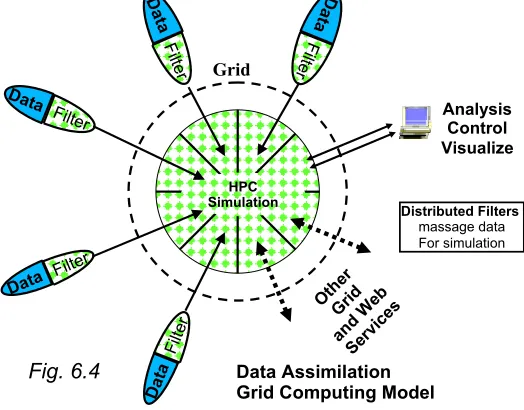
• Applications like Bioinformatics and Astronomy need “filters” (transformations) between the user and databases. Further OGSA-DAIT will need to integrate with workflow activities
• Peer-to-peer style Information Grids are interesting
• Many existing (non OGSA-DAI) databases will need to be wrapped
2.4.11
Gaps in Compute/File Grids (section 8.8)
• This is the best developed area of Grids but robust infrastructure is essential
• Compute/File Grids are critical in particle physics and Campus Grids
2.4.12
Gaps in other Grid Technology (section 8.9)
Several Grid services came up that do not fit neatly into previous categories – these include collaboration, accounting, visualization, fabric management and a possible “gridmake”
2.4.13
Gaps in Portals and Problem Solving Environments (section 8.10)
• We suggest a more coordinated approach across projects could lead to greater re-use of portal components.
• The portlet architecture endorsed by the Grid Computing Environment (GCE) research group of the GGF is promising
2.4.14
Gaps in Grid-Network Interface (section 8.11)
One needs end-to-end monitoring of the network supporting both performance measurements and reservation. This capability is best integrated with the low-level Grid runtime environment
2.4.15
Education and Support Gaps (section 9)
Two highlights in the education and support area were need for testbeds and the difficulties of supporting rapidly changing technology
2.4.16
Research Gaps (section 10)
There is much research needed in all areas of the Grid. Highlights include service management, fault tolerance, and Grid adaptability. Grid debugging and performance (benchmarking) also needs attention.
2.4.17
Perception and Organizational Issues and Gaps (section 11)
• There is intrinsic conflict between “demonstrator” projects (which characterises many current successful activities) and producing generally useable software
• There is a lot of confusion as to current and near future state of the Grid; for example the difference between OGSI and OGSA is not clear. Decision-making would be helped if current status and future Grid trends were communicated more widely
• The relative role of W3C, GGF and OASIS is unclear
• The difference between CORBA and the Grid and the uptake of CORBA lessons by the Grid was often commented on
• The Semantic Grid has clarified the relation of Semantic Web and Grid technologies; how do Digital Library technologies and Agents fit into the Grid?
2.5 Summary of Discussion in Sections 7, 8 and Appendix
Here we summarize in one place, the Grid services and features discussed in the following detailed discussion. Section 7 is the survey of Grid Services with world-wide scope; section 8 is the summary of gaps from the UK survey; the appendix is section 14 with further detail on UK Grid services. The table lists the section numbers where information can be found.
2.5.1
Topics 1-6: Grid Types to Meta-data Services
Topics Sect 7 Sect 8 Appendix
1: Types of Grid 7.1 8.1.1, 8.1.2
R3 7.1 8.1.8 A.2.1.4.1
Lightweight 7.1 8.1.3, 8.1.5 A.2.1.1, A.2.1.3
P2P 7.1 8.1.4 A.2.1.2
Federation and Interoperability 7.1 8.1.6, 8.1.7 A.2.1.4.2
2: Core Infrastructure and Hosting Environment 7.2 8.2.1, 8.2.2
Service Management
Component Model 7.2 8.2.3.2, 8.2.3.4 A.2.2.1.2, A.2.2.1.4
Service wrapper/Invocation 7.2 8.2.3.1 A.2.2.1.1
Messaging 7.2, 7.5 8.2.3.3, 8.2.3.4 A.2.2.1.3, A.2.2.1.4
3:Security Services 7.3 8.3.1, 8.3.2 A.2.3.1
Certificate Authority 7.3 A.2.3.1
Authentication 7.3 A.2.3.1, A.3.3.5, A.2.9.1.7
Authorization 7.3 8.3.4.1 A.2.3.1, A.2.3.2.1, A.2.9.1.7
Policy A.3.3.5
4:Workflow Services and Programming Model 7.4 8.4.1, 8.4.2
Composition/Development 7.4 8.4.1.1 A.2.4.1.3, A.3.4.1.7, A.7.2.3, A.7.3.2.7
Languages and Programming 7.4 8.4.1.1 A.2.6.1.2, A.3.3, A.4.1.1, A.7.2.6
Compiler 7.4 8.4.1.2 A.2.4.1.3
Runtime Engines (Enactment) 7.4 8.4.1.2 A.2.4.1, A.7.2.2
Miscellaneous 7.4 8.4.3, 8.4.4 A.3.1
5: Notification Services 7.5 8.5.1, 8.5.2
Miscellaneous 7.5 8.5.3 A.2.5.1, A.3.4.1.8
6: Metadata and Information Services 7.6 8.6.1, 8.6.2, 8.6.3
Basic Metadata including Registry 7.6.2 8.6.4.1, 8.6.4.2, 8.6.4.3 A.2.6.1.1, A.2.6.1.2, A.2.6.1.3 8.6.5.2, 8.6.5.4 A.2.6.2.2, A.2.6.2.4
Information Aggregation (events) 7.6.3 A.2.7.2.2
Semantically rich Services and meta-data 7.6.4 8.6.4.4, 8.6.4.5, 8.6.4.6 A.2.6.1.4, A.2.6.1.5, A.2.6.1.6 8.6.5.1, 8.6.5.2 A.2.6.2.1, A.2.6.2.2, A.3.4.1.9, A.7.3
Provenance 7.6.5 8.6.5.3 A.2.6.2.3
2.5.2
Topics 7 to 11: Information Grid Services to Network Services
Topics Sect 7 Sect 8 Appendix
7: Information Grid Services 7.7 8.7.1, 8.7.2
OGSA-DAI/DAIT 7.7 8.7.3, 8.7.3.1, 8.7.5.2 A.2.7.1, A.2.7.3.2, A.2.9.2.2(d), A.7.3.2.12
Integration with compute resources 7.7 8.7.1 A.2.7.3.3, A.2.7.3.4, A3.1
Miscellaneous 7.7 8.7.4, A.2.7.2, A.2.7.3.1, A.2.7.3.3,
8.7.5.1, 8.7.5.3, 8.7.5.4 A.2.7.3.4,A.2.9.2.2(e) A.3.1, A.3.2, A.3.4.1.6
8: Compute/File Grid Services 7.8 8.8.1, 8.8.2
Job Planning Scheduling Management 7.8.1, 7.8.2 8.8.3.2 A.2.8.1.2, A.3.4.1.3, A.3.4.1.4
Job Submission 7.8.4 A.3.4.1.1, A.3.4.1.2
Access to Remote Files, Storage and Computers 7.8.3, 7.8.5, 7.8.6 8.8.3.3 A.2.8.1.3
Replica (cache) Management 7.8.7 8.8.3.1 A.2.8.1.1
Virtual Data 7.8.8
Parallel Computing 7.8.9
Job Status 7.8.10
9: Other Services including 7.9 8.9.1, 8.9.2
Grid Shell 7.9.1
Accounting and Grid Economies 7.9.2 8.9.3.1 A.2.9.1.1, A.2.9.1.6
Fabric Management 7.9.3 8.9.4.1 A.2.9.2.1, A.2.9.2.2(a)
Visualization and Data-mining 7.9.4 8.9.4.4, 8.9.4.5, 8.9.4.6 A.2.9.2.2(c), A.2.9.2.5, A.2.9.2.6, A.2.9.2.7
Computational Steering 7.9.4 8.9.4.5 A.2.9.1.3, A.2.9.2.6
Collaboration 7.9.5 8.9.3.2 A.2.9.1.2
Packaging 7.9.6
Other Technologies 7.9.7 8.9.4.2, 8.9.4.3 A.2.9.1.5, A.2.9.1.7, A.2.9.2.2(b), A.2.9.2.3, A.2.9.2.4
10: Portals and Problem Solving Environments 7.1 8.10.1, 8.10.2
Miscellaneous A.2.6.1.6, A.2.9.1.4, A7.3
11: Network Services 7.11 8.11.1, 8.11.2, 8.11.3
Performance 7.11.1 8.11.3.1 A.2.11.1
Operations 7.11.2 8.11.3.2 A.2.11.1
Part II: e-Science and its Technologies
3 e-Science
e-Science refers to science that is enabled by the routine use of distributed computing resources by end-user scientists [UKeS-A] [UKeS-B] [UKeS-C]. Although e-Science can be used as a methodology by individual scientists, it is most effective when used to enable distributed global collaborations involving large numbers of people and large-scale resources. e-Science makes such collaborations more productive by breaking down barriers to communication and interaction, and by making valuable resources more accessible, both to people and other computing systems. Thus, the end result is better science.
e-Science is one of a number of broad application areas that are supported by the service-oriented Grid infrastructure [Berman03B] described in Section 5. Other examples include e-Business, e-Health, and e-Government. Developments in the field of meta-computing over the past decade have had a significant impact on the emergence of Science. e-Science can also be seen as having developed from the field of computational science. Since the late 1980’s computational science has become established as a third avenue of scientific discovery, alongside the theoretical and experimental methodologies, based mainly of large-scale computer simulations in areas such as physics and chemistry. e-Science subsumes this role, but also goes further by focusing not only on compute-intensive simulations, but also on the remote use of large-scale data and knowledge repositories, scientific instruments and experiments, and sensor arrays. Furthermore, in e-Science these distributed resources are typically used collectively to enable a new collaborative style of scientific endeavour that is changing the research ethos and driving research agendas in many areas. This broadening of scope from computational science to e-Science has led to the inclusion of fields such as bio-informatics, environmental science, and medical applications, in addition to the physical sciences.
To illustrate the range of applicability of e-Science some typical modes of use will now be considered by looking at some ongoing projects. Further information about Grid and e-Science projects can be obtained through the project URLs given in Section 15.
3.1 Particle Physics EDG and GridPP
The European DataGrid (EDG) project [EDG-C] involves researchers from several European countries. Its main aim is to design, implement, and exploit a large-scale data and computational Grid to allow distributed processing of the huge amounts of data arising in three scientific disciplines: high energy physics, biology, and Earth observation. These disciplines all have a common need for distributed, large-scale, data-intensive computing. The EDG project has an application bias focusing on the rapid development of testbeds, trans-national data distribution, and the demonstration of applications under production operation. Our analysis only studied the particle physics side of the EDG where it overlaps with goals of the UK GridPP [GridPP]. The GriPhyN project in the United States tackles a similar problem area, but over a longer time and with more emphasis on computer science research. Other US Projects iVDGL [iVDGL] and PPDG [PPDG] are addressing the nearer term data processing problem. Collectively with GriPhyn, they form the Trillium project [Trillium].
The Large Hadron Collider (LHC) [LHC] at CERN will become operational in 2005. The computational and data processing requirements of LHC experiments will be the main focus of the high energy physics component of the EDG project. The LHC will generate many petabytes of data that will require very large computational capacity to analyse. The LHC experiments will typically involve hundreds or thousands of individuals in Europe, North America, and Japan. The data volumes are so large that the data cannot be replicated at all the sites involved, nor can the data be distributed statically. Thus, collaborative access to dynamically distributed data is a key aspect of the EDG project [EDG-C]. The long-term aim is to do the LHC data processing in a number of large regional centres and the EDG will serve as a prototype implementation of this distributed computing environment. The latter forms the LHC Computing Grid [LCG].
3.2 AstroGrid
The AstroGrid project is mainly concerned with the management of and access to large volumes of astronomical data. Access to remote numerical computing power for large-scale simulation is not a focus of the project. Astronomical facilities that will come online in the next few years will lead to an explosion in data volume. Examples include the Wide Field Infrared Camera (WFCAM) that will be the most capable infrared imaging survey instrument in the world when it is commissioned in 2003, and the Visible and Infrared Telescope for Astronomy (VISTA) that will be in use by 2006. These types of instrument are capable of generating hundreds of gigabytes of data every night that will soon result in petabyte-scale databases. AstroGrid is motivated by the need to develop tools, techniques, and infrastructure to address the data handling problems that arise in the use of these very large astronomical databases. To this end the AstroGrid project will develop a data grid linking key astronomical databases and end users, and a suite of data mining and analysis tools for accessing, exploring, and interpreting the data. An important goal of the project is to make the federate the databases, in the sense that it will be possible to access them simultaneously and seamlessly, ideally through a single, easy-to-use interface. More details can be found in Section 8.7.4.2.
3.3 NERC
DataGrid
This [NERCDataGrid] environmental science Grid falls in the class of what we call Information Grids in Section 5 and is discussed in detail in Sub-section 8.7.4.1 with other environmental and earth science Grids. The data structure of GODIVA (an oceanography Grid linking Information and Compute/File Grids) [Godiva] is described in the appendix A.2.9.1.4.
3.4 DiscoveryNet
The DiscoveryNet project [DiscoveryNet-A] has a rather different aim than those of the other projects, in that it is focused on high throughput. It aims to design, develop and implement an advanced infrastructure to support real-time processing, interpretation, integration, visualization and mining of massive amounts of time critical data generated by high throughput devices. The project covers new technology devices and technology including biochips in biology, high throughput screening technology in biochemistry and combinatorial chemistry, high throughput sensors in energy and environmental science, remote sensing and geology. A number of application studies are included in the pilot – analysis of Protein Folding Chips and SNP Chips using LFII technology, protein-based fluorescent micro array data, air sensing data, renewable energy data, and geohazard prediction data.
Discovery Net provides a service-oriented computing model for knowledge discovery, allowing users to connect to and use data analysis software as well as data sources that are made available online by third parties. In particular, Discovery Net defines the standards, architecture and tools that:
Allow scientists to plan, manage, share and execute complex knowledge discovery and data analysis procedures available as remote services.
Allow service providers to publish and make available data mining and data analysis software components as services to be used in knowledge discovery procedures.
Allow data owners to provide interfaces and access to scientific databases, data stores, sensors and experimental results as services so that they can be integrated in knowledge discovery processes.
The appendix in section A.7.2 has substantially more detail on DiscoveryNet.
3.5 myGrid
The goal of myGrid [myGrid-A] is to design, develop and demonstrate higher level functionalities over an existing Grid infrastructure that support scientists in making use of complex distributed resources. An e-Scientist's workbench will be developed in this project. The workbench, not unlike that of Comb-E-Chem, aims to support: the scientific process of experimental investigation, evidence accumulation and result assimilation; the scientist's use of the community's information; and scientific collaboration, allowing dynamic groupings to tackle emergent research problems.
The appendix in section A.7.3 has substantially more detail on myGrid.
3.6 Comb-e-Chem
The Comb-e-Chem project [CombeChem] is concerned with the synthesis of new compounds by combinatorial methods. It is a collaboration between the Universities of Southampton and Bristol. The university consortium is working together with Roche Discovery, Welwyn, Pfizer, and IBM. Combinatorial methods provide new opportunities for the generation of large amounts of original chemical knowledge. To this end an extensive range of primary data needs to be accumulated, integrated and relationships modelled for maximum effectiveness. The project intends to develop an integrated platform that combines existing structure and property data sources within a grid-based information-and knowledge-sharing environment. The first requirement for this platform is to support new data collection, including process as well as product data, based on integration with electronic lab and e-logbook facilities. The next step is to integrate data generation on demand via grid-based quantum and simulation modelling to augment the experimental data. For the environment to be usable by the community at large, it will be necessary to develop interfaces that provide a unified view of resources, with transparent access to data retrieval, online modelling, and design of experiments to populate new regions of scientific interest. The service-based grid computing infrastructure required will extend to devices in the laboratory as well as data bases and computational resources.
The appendix in section A.3.2 has detail on Comb-e-Chem services.
3.7 RealityGrid
The goal of this pilot project [RealityGrid] is to enable the realistic modelling of complex condensed matter systems at the molecular and mesoscale levels, and to provide the setting for the discovery of new materials. Integration of high performance computing and visualisation facilities are critical to this pilot, providing a synthetic environment for modelling the problem that will be compared and integrated with experimental data. The RealityGrid involves the active collaboration of industry: AVS, SGI and Fujitsu are collaborating on the underlying computational and visualisation issues, Schlumberger and the Edward Jenner Institute for Vaccine Research will provide end-user scientific applications to evaluate and test the environment and tools produced by the project.
4 e-Business,
e-Government, and e-Services
e-Business is concerned with the streamlining of distributed business processes. This is distinct from e-Commerce, which is the buying and selling of goods via the Internet, and from the use of e-Science by the R&D sections of industrial and business organizations. It is the strategic approach that unites all steps in the business cycle, from initial product design and the procurement of raw materials, through production, shipping, distribution, and warehousing until a finished product is delivered to a customer. However, e-Science has adopted many e-Business concepts and technologies – primarily the use of services for providing access to resources, and workflow for describing and managing distributed applications. Just as the infrastructure for e-Science supports the formation of virtual organizations, e-Business can be used to enable “extended enterprises” that allow businesses to interact across organizational boundaries. A typical example of an e-Business application is supply chain management in which all steps in the business cycle are unified, from initial product design and the procurement of raw materials, through to production, shipping, distribution, and warehousing, until a finished product is delivered to a customer. The aim is to achieve high efficiency in process and information flow across the trading partners involved in the supply chain by managing inventory, scheduling labour, optimizing delivery, and improving productivity.
The aim of e-Government is to transform relations between government and citizens, businesses, and other arms of government through the use of Web technologies. Better delivery of government services to citizens, improved interactions with business and industry, and citizen empowerment through access to information are key aspects of e-Government. In many ways a national government is an extended enterprise, and so in this respect e-Government can be regarded as a form of e-Business, and these two areas share many concepts and technologies.
To illustrate the use of Grid technologies outside the e-Science arena a number of different Grid scenarios will now be presented. Further information about the projects mentioned in this section can be obtained from the citations and the project descriptions in section 15.3.
4.1 Campus
Grids
Grids are naturally applicable to run institutional and enterprise facilities and this is a major focus of IBM Grid efforts. Two examples were discussed for this report; the enterprise Grid for Capital Radio is discussed in section 4.3 and has a peer-to-peer structure. Here we focus on the White Rose Campus Grid [WhiteRose] which links computing resources at three universities: Leeds, Sheffield and York. This linkage of multiple heterogeneous resources promises more effective use of facilities. This Grid could also use P2P approaches for linking some resource and users but initially the major effort is a “Compute/File” Grid based on GT2. The focus is not “cycle scavenging” on “lightly used machines” (the Desktop Grid) but rather access to a few significant resources. Information Grid support could also be important. This type of installation has responsibility for a broad range of applications and so user support is a critical issue and is made particularly difficult by the rapidly changing Grid technology. Portals – seamless access to multiple resources – haves been identified as important. Commercial support for Grid technology would be attractive for this type of deployment. Security and networking are important issues for this of Grid which is pioneering the linkage of resources so that the combined facility adds value to constituent campuses.
4.2 Military and defence grids
Information Superiority and Decision Dominance are at the heart of new military thinking about the conduct of modern warfare. For example, Network-Centric Warfare [Netwarfare] “derives its power from the effective linking or networking of the warfighting enterprise.” Joint Vision 2020 [JV2020] emphasises the importance of collecting, processing and disseminating an uninterrupted flow of information while exploiting or denying an adversary’s ability to do the same. The UK has recently announced its Network Enabled Capability initiative with the aim of enhancing military capability through the better exploitation of information across the battlespace. As recent world events have shown, multi-national coalitions are playing an increasingly important role in military operations. Indeed, military coalitions are archetypal dynamic virtual organisations that have a limited lifetime, are formed from heterogeneous ‘come as you are’ elements at short notice, and need secure and partial sharing of information.
A common requirement across these programmes is the need to inter-operate and integrate heterogeneous distributed systems and to work with large volumes of information and high data rates. In these respects, they could benefit substantially from Grid computing concepts. However, security, resilience, flexibility and cost effectiveness are key considerations for the deployment of military Grids. It is also likely that there will be the need for multiple Grids supporting different aspects of the military enterprise, e.g. ‘heavyweight’ Grids for imagery data and ‘lightweight’ ubiquitous Grids running on the PDAs of military commanders in a headquartersthese Grids will need to be interoperable.
Currently, there are a number of US military programmes exploring Grid technologies in the context of Network-Centric Warfare, for example Joint Battlespace Infosphere [JBIGrid], Expeditionary Sensor Grid [ExpSensorGrid] and the Fleet Battle Experiments [FleetGrid]. In addition, the Coalition Agents Experiment [CoaxGrid] demonstrated how an agent-based Grid infrastructure could support the construction of a coherent command support system for coalition operations.
The appendix in section A.5.2 has more detail on military and defense Grids.
4.3 Capital Radio Grid
quality of service requirements. First, the stations need to be able to operate in isolation even in the event of network or server failures. Secondly, many data transfers are time critical that could not be met by a centralised architecture in peak conditions. These requirements to have collaborating islands of networks have lead to the consideration of data grid technologies to solve these problems.
4.4 Bioinformatics
Grids
Bioinformatics Grids clearly are very important in both academic government and commercial communities. The myGrid [myGrid-A] and DiscoveryNet [DiscoveryNet-A] projects, the EBI information resource at Hinxton [EBI] and European efforts coordinated at CERN [Jones03A] were surveyed by this report for Bioinformatics. This is a field which has exploited the web for many years with the Biology workbench (originally NCSA and now SDSC [BiologyWB]) being an early exemplar of web-access to a rich suite of database and simulation tools. These five year old capabilities build on communal databases set up some 20 years ago. The field can straightforwardly migrate to Web services with an obvious transition to Grid services. For example EBI considers that candidate technologies exist for almost everything they want to do with a goal of being able to traverse Life Sciences information space easily. As an initial step EBI has built SOAP interfaces to databases and portal interface at client end. Interoperability is a key problem as heterogeneity is universal. There are many autonomous Bioinformatics sources around the world with for example some using Excel; and some Oracle.
The field has developed very sophisticated “filters” (often in slightly archaic technologies like Perl) which allow much richer views of the databases than that provided by basic database query languages. These filters need to be converted to Web Services and integrated by workflow engines with the databases (converted to OGSA-DAIS [OGSA-DAIS]). myGrid is tackling the issue of using ontologies to annotate the many different Bioinformatics resources. One needs metadata to specify the provenance and reliability of data. There are important issues with evolving schemas and legacy data/schemas with could change many times per day. Further one needs to support the clean-up of the often rough raw data. Security needs attention with companies particularly concerned about need to keep their access patterns private. Further there must be a clear versioning model so claims of prior discovery can be reliably addressed.
4.5 Distributed Aircraft Maintenance Environment (DAME)
The theme of DAME project [DAME] is the design and implementation of a fault diagnosis and prognosis system based on the Grid computing paradigm and the deployment of Grid services. In particular DAME focuses on developing an improved computer-based fault diagnosis and prognostic capability and integrating that capability with a predictive maintenance system in the context of aero-engine maintenance. The term “predictive maintenance” implies that there is sufficient time interval between the detection of a behaviour that departs from normal and the actual occurrence of a failure. The DAME system will deploy Grid services within this time window to develop a diagnosis of why an engine has deviated from normal behaviour, to provide prognosis (understanding what will happen) and to plan remedial actions that may be taken a safe and convenient point when the impact of maintenance is minimized. A central challenge of the project is to develop a proof of concept demonstrator that will address the commercial and technical requirements of the industrial partners within the consortium (Rolls-Royce and Data Systems & Solutions). The commercial considerations of the project create a set of demanding technical requirements which will be addressed through Grid computing techniques. These include:
Transmission of high volumes of data from remote data repositories, to and from the maintenance points; Access to highly specialised data analysis and diagnosis software services;
Necessity to search extremely large volumes of data.
Virtual Organisations (VO) where the various members are located in various parts of the world and where complex interactions among multiple agents or stakeholders are needed and are facilitated by connection through the Grid
The need to provide supporting or qualifying evidence for the diagnosis or prognosis offered;
Addressing the business critical aspects of the commercial deployment, developing a Grid enabled system that can meet stringent dependability requirements, including Quality of Service and Security issues.
The appendix in sections A.3.1, A.5.1.1 and A.7.1 has substantially more detail on DAME.
4.6 Grid Enabled Optimisation and Design Search for Engineering (Geodise)
activities. Such systems typically require large-scale distributed simulations to be coupled with tools to describe and modify designs using information from a knowledge base. These tools are usually physically distributed and under the control of multiple elements in the supply chain. Whilst evaluation of a single design may require the analysis of gigabytes of data, to improve the process of design can require assimilation of terabytes of distributed data. Achieving the latter goal will lead to the development of intelligent search tools.
The focus of the Geodise project [GEODISE] is on the use of computational fluid dynamics with BAE Systems, Rolls Royce, and Fluent (world leading developers of CFD codes). Geodise is being developed by the Universities of Southampton, Oxford and Manchester in collaboration with other industrial partners working in the domains of hardware (Intel), software (Microsoft), systems integration (Compusys), knowledge technologies (Epistemics), and grid-middleware (Condor) [Condor].
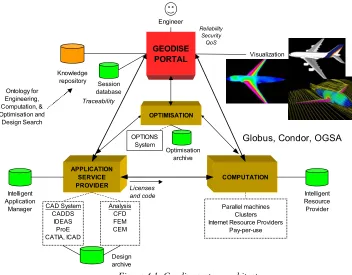
In summary, design optimisation needs integrated services shown in fig. 4.1.
• Design improvements driven by CAD tools coupled to advanced analysis codes (CFD, FEA, CEM etc.)
• On demand heterogeneous distributed computing and data spread across companies and time zones.
• Optimization “for the masses” alongside manual search as part of a problem solving environment.
• Knowledge based tools for advice and control of process as well as product.
Geodise will provide grid-based seamless access to an intelligent knowledge repository, a state-of-the-art collection of optimisation and search tools, industrial strength analysis codes, and distributed computing and data resources.
APPLICATION SERVICE PROVIDER
COMPUTATION
GEODISE PORTAL
OPTIMISATION Engineer
Parallel machines Clusters Internet Resource Providers
Pay-per-use Optimisation
archive
Intelligent Application
Manager
Intelligent Resource Provider
Licenses and code
Session database
Design archive
OPTIONS System Knowledge
repository
Traceability
Visualization
Globus, Condor, OGSA
Ontology for Engineering, Computation, & Optimisation and
Design Search
CAD System CADDS
IDEAS ProE CATIA, ICAD
Analysis CFD FEM CEM
[image:20.612.111.463.313.588.2]Reliability Security QoS
Figure 4.1: Geodise system architecture.
5 Grid
and
Cyberinfrastructure Technologies
5.1 Basic
architecture
Principles
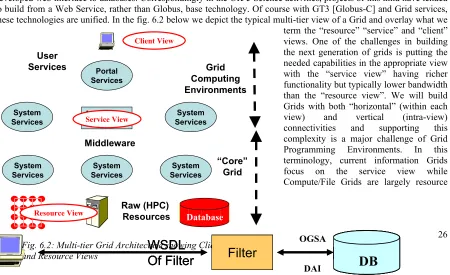
We will use the term Grid technology [Foster99A] [Berman03A] to describe the e-Science [UKeS-A] electronic infrastructure. In the USA some would agree with this terminology but others could use “Cyberinfrastructure” [NSF03A] to describe this. We need the technology to support distributed virtual organizations [Foster01A] with a mix of shared data and compute resources accessed both in asynchronous and synchronous mode. One must support high performance data and compute capability with matching communication networks and protocols. This requirement must be combined with high functionality interfaces for users and between Grid components. The emerging Grid infrastructure addresses these stringent and often conflicting goals by using a multi-tier architecture with a range of technologies.
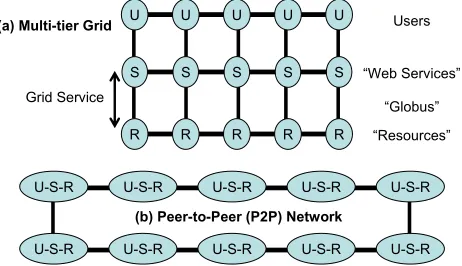
The current e-Science (Grid) infrastructure integrates (inherits) ideas and capabilities from many areas. These include: the Web [W3C]; Peer-to-peer (P2P) Networks [Oram01A] [JXTA]; distributed objects such as CORBA, Java/Jini [Jini], and COM; High Performance Computing activities such as Globus [Globus-A], Legion [Grimshaw03A], Condor [Condor], NetSolve [Agrawal03A], and Ninf [Ninf] [Nakada03A]. One can consider Web services as integrating Web and distributed objects and Grid Services as linking Web services with high performance computing technologies. The architecture is built in terms of users, services and resources which are illustrated in Fig. 5.1 for both P2P networks and a more traditional multi-tier architecture.
5.2 Meta-data Rich Web Services Communicating by Messages
The UK e-Science program “projects” reflect the multiple heritages of Cyberinfrastructure and currently reflect either the “Globus” or “Web Service” (distributed object) heritage. Of course the purpose of the Gap Analysis is partly to help the integration of these heritages into a common robust Grid Service environment. As we do this, it is necessary to carefully support capabilities at each tier in fig. 5.1(a) and the communication between tiers. In discussing the needed architecture, we need to consider not only specific services but also various implicit and explicit features of the overall environment. We find it convenient to initially consider the next generation of Grids as being based on meta-data rich Web services communicating by messages. We believe all e-Science applications would requires this minimum capability and further one can also discuss the P2P Networks of interest to e-Science in this fashion. There is a common
[image:21.612.91.322.383.516.2]service based architecture with important differences in implementation of services like meta-data registration and lookup for multi-tier and P2P Grids. These services need basic support from some distributed runtime environment such as .NET [OGSI.netUVA], Jini (pure Java), Apache Tomcat/Axis (Web Service toolkit) [Axis], Enterprise JavaBeans [EJB], WebSphere (IBM) [WebSphere] or GT3 (Globus Toolkit 3) [Globus-C]. These provide the distributed equivalent of core operating system support for processes on a conventional computer.
5.3 Level 1: Hosting Environments
There is no precise definition of Grid architecture and this is so for many reasons. It is not easy to describe the different approaches in a single architecture framework; the key work of the OGSA working group [OGSA] at the Global Grid Forum is still in process; finally much experience needs to be gathered and processed by W3C [W3C], GGF [GGF-A], Industry, academia and government. We show in fig. 5.2 an approximate representation of how Grid systems can be divided into 6 categories in an approximate layered stack. We start with some hosting environment which can be different in different parts of a Grid and in this report defines the run-time environment for the Grid services. There is currently no agreement on exactly what should be put in a hosting environment and other terms
R R R R R
S S S S S
U U U U U
“Globus” “Web Services”
“Resources” Users
Grid Service
U-S-R U-S-R U-S-R U-S-R U-S-R
U-S-R U-S-R U-S-R U-S-R U-S-R
(b) Peer-to-Peer (P2P) Network (a) Multi-tier Grid
Fig. 5.1: (a) Schematic of “classic’ (multi-tier) Grid showing Globus and Web Service style technologies merging to Grid Services (b)
Architecture of P2P Network. U represents user; S Service; R Resource
4: Key OGSA Services
5: OGSA-compliant System Grid Services 6: Domain-Specific (Application) Grid Services
1: Hosting Environment
WS WS WS WS
Fig. 5.2: Six OGSA Grid Architecture Layers
[image:21.612.333.563.565.733.2]used are execution environment (possibly larger than hosting environment) and resource environment as discussed by the Grid Protocol Architecture (GPA) working group of the GGF [GGFGPACoreGrid].
5.4 OGSA and Level 2: OGSI Open Grid Service Infrastructure
In general there is no clear dividing line between the different layers and features can be moved between (typically adjacent) layers. The runtime layer 1 of fig. 5.2, hosts a set of enhanced Web services with the level 2 OGSI (Open Grid Services Infrastructure) enhancements [OGSI]. OGSI changes the form of Web services to support state-full components and defines special ports – notably those for notification and information. One expects the work of the W3C and GGF on web services to eventually merge with a common standard – one example is the emerging IBM-Microsoft WS-Addressing specification [WSAddressing], which allows one to “hide” differences between state-less and state-full service models.
OGSA is designed to achieve two (related) goals. Firstly it defines common interfaces for all important services in a Grid; secondly it defines a set of common services that all Grids should offer. Levels 1 through 4 define this common set – we have used the word key in the label of level 4 to afford confusion with the OGSA core services still being discussed in the GPA [GGFGPA]. Note that a particular hosting environment might offer a certain Grid service (such as security or messaging) differently from other environments (which might not offer it at all). This is expected to be “corrected” at levels 3 and 4 so that one achieves a common set of capabilities at level 4. The complexity of a “real Grid” is illustrated by Fig. 5.3 taken from the work of the GPA.
5.5 Level 3: Permeating Principle and Policies
Level 3 of fig. 5.2 is particularly interesting as it gathered substantial comment in the Gap analysis if interpreted as enhancements to the hosting environment in the form of a set of "permeating" principles and capabilities of a Grid. These are typically not "just" services but rather features of the hosting implementation or the methods of interacting with it. We can identify ten such permeating principles of which the first is our basic Web service paradigm. The ten permeating features of a Grid are:
1) Meta-data rich Message-linked Web Services as the permeating paradigm
2) There could be a “User” Component Model such as “Enterprise JavaBean (EJB)” or .NET. If as expected we build an OGSA compliant Grid, this component model would implement OGSI features e.g. a Java EJB could have input and output channels whose XML specified interfaces were OGSI compliant.
[image:22.612.137.463.188.441.2]3) The Grid requires a Service Management framework including a possible Factory mechanism to create instances from a generic service.

![132 Oracle 10g Advanced Security Administrartors Guide Ww [ PUNISHER ] pdf](data:image/gif;base64,R0lGODlhAQABAIAAAP///wAAACH5BAEAAAAALAAAAAABAAEAAAICRAEAOw==)