SAAS: Attack Detection and Prevention with Forensic
in cloud environment
Sayeda A Rahila,
Shraddha Khonde
Abstract: Basically cloud computing security is essential nowadays, it has arisen as a technology to allow users as well as clients to access communications, data storage, software as well as exploitation Environment according to pay-as-what-use structure. Conventional digital forensic can’t be investigated due to some technical challenges like environmental as well as technical. The vibrant nature of cloud computing provides massive opportunities to identify malicious request using various security algorithms in cloud environment. Proposed research work identifies the current issues and provides solutions to reduce some challenges in the cloud environment. In this paper system proposed forensic investigation of cloud security for trusted and untrusted environments. System illustrated the various machine learning algorithms for eliminate the malicious request, and investigate the malicious user also. Proposed method generate the user log base snapshot during the active session and manual investigator can verify all logs and identify the malicious user. We offer a skilled technique for forensic examination in the cloud with the help of virtual machine (VM) and generate snapshots. The experimental analysis shows illustration of proposed security of system.
Keywords: Software as Services, Snapshot generation, Cloud Computing, VM, Cloud Service Provider.
I. INTRODUCTION
VMs are rapidly gaining popularity due to the simulation of computing environments, separating users, restoring previous states, and supporting remote initiation. All of these features have positive security side effects.Cloud is an emerging technology and cloud-based storage is a newly adopted idea that not only allows users to upload data to the web, but also allows quick access to the available resources and data sharing with anyone at any time is. But Cloud is a technique that creates a challenge for the person who is investigating and detecting forensic evidence that can help in forensic analysis, because the data stored on the cloud is from any system and any system can be accessed from and the scarf remains in very small quantities.The 21st century is called the age of the digital world. There have been adopted computers to a great extent. Today without computers and Internet one cannot survive as we are dependent on these machines for almost all our work. Taking into consideration starting from home to education till banking and even corporate functioning everything has now been automated to computers. Computers contain all our important data in the digital format. With this the need to store the digital data has increased and virtual environment has replaced the physical storage for storing all our credentials as shown in Fig. 1. …
Revised Manuscript Received on November 05, 2019.
Sayeda A Rahila, P.G. Student, Department of Computer Engineering, Modern Education Society of Engg, Pune, MH, India
Prof. Shraddha Khonde, Professor, Department of Computer Engineering, Modern Education Society of Engg, Pune, MH, India
The most destructive challenge in cloud is prevention the unauthorized extinction of the data stored on the cloud, because anyone can easily remove the stuff without any proper authority. Removing data on the virtual machine removes nodes pointing to some information is completely dependent on deletion.
VM's hardware abstracts and isolation limits the scope of the attack and formulate it muchcomplicated for external attacker to use not permitted data and resources on the physical machine. VM state restoration enables clients to come back to a state preceding assault or information calamity provides an easy way to remove malware and data protection. By allowing users to start and stop VM remotely, the attackers have short-time windows in which they should be prepared and attacked. This is a surprisingly effective security measure. Since the hypervisor runs out of Virtual Machine, Its having a ability to monitor malware. Due to such reasons, VM Infrastructure has the ability to secure than physical server infrastructure.
II. LITARATURE SURVEY
Cloud computing systems illustrates [1] a prototype to the distributed dispensation of digital data. Digital forensic investigations associated with such systems area unit doubtless to involve a lot of complicated digital proof acquisition and analysis. Some public cloud computing systems could embrace the storage and process of digital knowledge in several courts, and a few organizations could value more highly to encode their knowledge before getting into the cloud. Together with cloud design, these two factors will build rhetorical examination of such systems a lot of complicated and long. During this letter we tend to examine the legal aspects of the digital forensic investigation of the cloud computing system.
System [2] proposed the cloud automatic data processing system hosts most of today's industrial business applications, which provides it high revenue that makes it the target of cyber attacks.Here the necessity for a digital rhetorical system for the cloud surroundings is seen. Standard digital forensics can not be directly given as a cloud forlantic answer as a result of it's thanks to virtualization of multi-tenancy and resources within the cloud. whereas we have a tendency to do cloud forensics, information cloud element logs, virtual machine disk pictures, volatile memory dumps, console logs and network capture area unit to be inspected. during this letter, we've go together with a foreign proof assortment and preprocessing framework victimization Straits and Hadoop distributed filing system. the gathering of VM disk pictures, logs etc. is triggered by a pull model once triggered by the investigator, whereas the cloud node sporadically pushes network capture to HDFS. Pre-processing steps like bunch of logs and correlation and VM disk
implement Correction code in file distribution to produce redundancy and guarantee knowledge dependency. Intensive security analysis shows that the planned arrange are very economical and versatile against the failure of Byzantine, malicious data repatriation attacks and even the server collision attacks.
According to [4]Computing in cloud is booming as technology which allows its users to access infrastructure, storage, software as well as deployment environment based on a usability of user what users have been used model. The vibrant and multi-tenant environment of traditional digital forensic cloud environments cannot handle nature because it has to face numerous procedural, authorized and directorial challenges specific to the cloud system. The dynamic nature of cloud computing provides enormous opportunities for enabling digital check in the cloud environment. It has been addressed in the untrusted cloud situation to ease the challenges of digital forensics and some of the existing solutions. We offer a skilled approach to forensic examination in the cloud using virtual machine (VM) snapshots.
Identification of digital forensic in the cloud can add a new dimension to the process of creating confidence in the cloud in [5]. But Lots of cloud features such as transparency, virtualization, lack of legal issues etc., Challenges for the Cloud Forensics Whether it is a traditional digital forensic or cloud forensic, collecting comprehensive data for analysis is a major challenge in the investigation. Data gathering in exceptionally virtualized conditions like cloud is very tedious. The final goal of proof collection and analysis is to prove the official courtroom that they are forensic sound. We can use introspection techniques because they will not corrupt the source of evidence while collecting necessary data.
According to [6] Content is often repeated, modified or modified on primary storage systems, and users lose control over its dispersion on the system. The content identified with a specific venture from the framework in this way turns into a work escalated errand for the client. In this work system illustrates, a system that helps the user easily remove project interconnected content, but this does not require change in user behavior or any system component, Such as file system, kernel or application IRCUS is transparently integrated inside the client's framework, works in client space and stores the subsequent metadata with files. This work system describe evaluation of system and showed that its overhead and accuracy is acceptable for practical use and deployment.
III. PROBLEM STATEMENT
Objectives of System
The objectives of this research work include the following: 1. Explore the challenges and requirements of forensics in the virtualized environment of cloud computing
2. Design a digital forensic structure for the cloud computing systems from the view point of investigator and/or cloud architecture
3. Address the issues of dead/live forensic analysis within/outside the virtual machine that runs in a cloud environment
4. Using digital forensic triage in the examination and partial analysis phase of cloud forensics
IV. PROPOSED METHODOLOGY
Figure 1 : Proposed System Architecture
In this work with proposed privacy preservation architecture from external attackers in vulnerable environments. The system carried out attack detection and prevention module based on random request which is received from external attackers. In our proposed system we use three different entities data owner, group manager, cloud server and attacker is untrusted entity. In this module first data owner upload the data file to cloud server using cryptography algorithm once data has store into database, owner gets the notification about file storage successfully. The data owner having a full access of specific data file he can share or access, so data owner can share the any file to any group manager then it will automatically access to all group members. The shared group members can access each file to anytime by cloud server. In first phase if data owner revoke any user from access the file then he can’t access such file. If he can try to generate any collusion attack using SQL injection queries, even our system will system will prevent such attacks. Second data owner can share and revoke file to individual user to specific group, and third once any user revoke system will automatically generate proxy key generation that means existing keys will expired. The overall approach improves the system efficiency as well security on drastic level.
The Role Base Access Control (RBAC) Data share respective file to different number of users, the data owner can set the specific role to respective user for read, write, delete etc. The particular user can view the files which are shared by data owner in access control tab. According to the given credentials specific user can download the desired file. The data owner also eliminates file access of particular user using revocation function. The revocation function which removes file access to those users who watch the existing authenticated user. The same time system expired the existing case this strategy should be eliminate collusion attacks.
V. SYSTEM ANALYSIS
Algorithm:Elgamal Encryption Scheme Key Generation phase
Input: Random input data textMetadata Output: returns the keys {a,b,p,g}
1 :Initialized the arbitrary text input using text data
2: RestData[]= GetRandomP (text_Metadata.getbyte).bit length according to the feasible prime number.
3: P=ResData [first]
G=ResData [second] 4: produce a using P
a=Generate_A(p)
Its generates like p.bitLength()-1,Random.
Step 5: Generate values for B= calculate_B(G,A,P); so, B= g.mod_Pow(A,P);
6: All Keys generated successfully. Data Encryption Phase
Input: input string data D,B,P,G
Output : Dencrypted data CiperText1,and CipherText2. 1 : define Big_Integer [] Cipher_data = {null,null}; 2 : MsgData=D.getbytes.length();
3 : [] result_set = ElGamal.encryptdata (MsgData, P,B,G); 4 : kVal = ElGamal.generateRandomk(P);
5 : CiperText1= g.modPow(kVal, P);
6: CiperText2= M.multiply (b.modPow(kVal,
P)).modulus(P); Data Decryption Phase
Input : input CiperText1 and CiperText2 as encryptedData A, P has used as private keys
Output: Plain data Pdata.
1: Pdata = CiperText2.multiply (CiperText1.modPow (A.negate(), P)). modulus (P);
2: return Pdata.
SHA 256 for hash generation Input: input text data as inpData.
Output: hash string which is generated by one way hash function
1: Initialize the C 2: Shascore= SHA256(C) 3: Return Shascore
Step 2: Get data all features from training database. Policy_List = TPolicy[k]
m
𝑘=1
Step 3: Extract entire features from Trainset
Step 4 : calculate similarity weight of both feature set 𝑊 = (Receive_Command , Policy_List ) Step 5 : Verify Threshold
Selected_Instance_ result = Weight >ThVal ?1 : 0;
append every selected request into PageList, when n = empty or null
Step 6 : Return PageList Mathematical Expressions First we consider a
Asys={Asys1,Asys2,Asys3………..Asysn} all place holds the detailed element commotion of system.
Asys1={query generation and send to web portal} Asys2={text encryption and text decryption phase}
Asys1 define the first module which is user the upload the multiple documents
Data 𝑑 = 𝑑[𝑘] + (a1, a2 … … . . an) 𝑛
𝑘=0
d[k] {Att1,Att2……Attn} each documents contains the set of attributes
keys[] Keygen(RandomText)
Enc[c1] [c2] encryption(Data, keys[])
ANALYSIS
[image:4.595.309.545.339.424.2]To evaluate the performance analysis of system, done various experiments. The entire system is executed on java multi-tier architecture and heterogeneous hardware configuration INTEL 2.7 GHz i5 processing environment with 8 GB RAM with public cloud Amazon EC2 consol. For the system evaluation we create 2 machines on physical environment with Wi-Fi and 10 VM with Amazon EC2 as public cloud environment. After implementing some part of system we got system performance on reasonable level. In the first experimental we have calculated the accuracy of attack detection module using various number instances.
Table 1: System performance Test
Instances
Accurac y
Precision Recall
F-Measur e
10 0.90 0.91 0.94 0.95
20 0.91 0.92 0.95 0.96
50 0.89 0.90 0.93 0.94
100 0.90 0.93 0.92 0.95
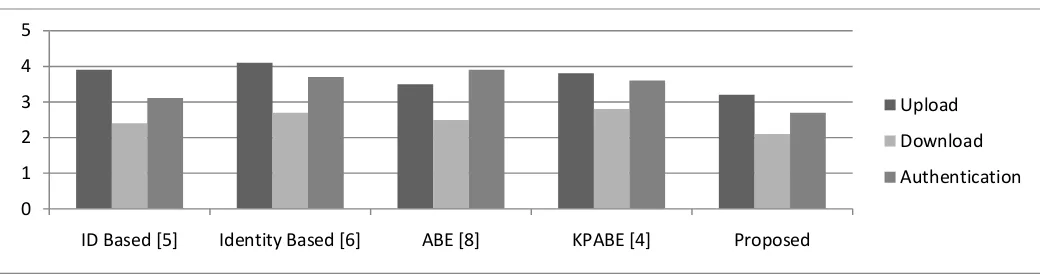
In second experiment evaluate performance time evaluation between propose as well as some existing approaches. Four different existing approaches has been evaluated in Figure 2 like [5,6,7,8], according to that experiment analysis system shows how propose system provides better results than classical approaches..
Fig. 2 : System Performance Measures proposed vs Existing approaches Graph Comparison
In The third and final experiment we evaluate the time complexity of proposed system with different size of data. The three functions as carried out in entire Encryption Algorithm like key generation, data encryption as well as decryption respectively. The encryption face should generate more than one keys, so it
can take a long time then classical key generation algorithms e.g. AES, DSA etc. But the propose system provides highest security than other algorithms. The below figure 3 illustrates how system fluctuates required time when input data is different.
0 1 2 3 4 5
ID Based [5] Identity Based [6] ABE [8] KPABE [4] Proposed
[image:4.595.49.569.495.632.2]Figure 3 :Data encryption performance base on data size VII. CONCLUSION
Proposed system provides the highest security from different type of attack in cloud environment to end users confidentiality data. In other hand AES 128 encryption algorithm also maintain the robust security mechanism. Access control and revocation maintain the security and efficiency of system. The system achieves Role Base Access control in single as well as multi cloud environment with this approach.
The proposed work also describe the efficiency of system in cloud environment, that able to detect the runtime investigation as well as malicious attacks. The secure revocation in RBAC module, provides the defence from collusion attacks as well as enhance the efficiency of system. Finally system able to work smoothly in trusted or unstrusted cloud environment due to drastic supervision of detection algorithms.
REFERENCES
1. Mr. DigambarPowar, Dr. G. Geethakumari “Digital Evidence Detection in Virtual Environment for Cloud Computing” ACM, 2012. 2. Saibharath S, Geethakumari G “Cloud Forensics: Evidence Collection
and Preliminary Analysis” IEEE, 2015
3. Mr. Chandrashekhar S. Pawar, Mr. Pankaj R. Patil, Mr. Sujitkumar V. Chaudhari “Providing Security and Integrity for Data Stored In Cloud Storage” ICICES, 2014.
4. DeeviRadha Rani, G. Geethakumari “An Efficient Approach to Forensic Investigation in Cloud using VM Snapshots” International Conference on Pervasive Computing (ICPC), 2015.
5. BKSP Kumar RajuAlluri, Geethakumari G“A Digital Forensic Model for Introspection of Virtual Machines in Cloud Computing” IEEE, 2015.
6. Hubert Ritzdorf, NikolaosKarapanos, SrdjanCapkun “Assisted Deletion of Related Content”ACM, 2014.
7. Liang X, Zhao J, Shetty S, Liu J, Li D. Integrating blockchain for data sharing and collaboration in mobile healthcare applications. InPersonal, Indoor, and Mobile Radio Communications (PIMRC), 2017 IEEE 28th Annual International Symposium on 2017 Oct 8 (pp. 1-5). IEEE.
8. Manoj R, Alsadoon A, Prasad PC, Costadopoulos N, Ali S. Hybrid secure and scalable electronic health record sharing in hybrid cloud. In2017 5th IEEE International Conference on Mobile Cloud Computing, Services, and Engineering (MobileCloud) 2017 Apr 6 (pp. 185-190). IEEE.
9. Khan SI, Hoque AS. Privacy and security problems of national health data warehouse: a convenient solution for developing countries. InNetworking Systems and Security (NSysS), 2016 International Conference on 2016 Jan 7 (pp. 1-6). IEEE.
10. Shrestha NM, Alsadoon A, Prasad PW, Hourany L, Elchouemi A. Enhanced e-health framework for security and privacy in healthcare system. InDigital Information Processing and Communications (ICDIPC), 2016 Sixth International Conference on 2016 Apr 21 (pp. 75-79). IEEE.
0 50 100 150 200 250 300
KeyGen Encryption Decryption