International Journal of Innovative Technology and Exploring Engineering (IJITEE) ISSN: 2278-3075, Volume-9 Issue-1, November 2019
Abstract: Image has an important role to play in our daily life. It has its applications from simple documentation to complicated surveillance and medical applications. In the area of image processing, denoising is one among the most studied areas. Many a times the captured image will be degraded. This can happen at the time of acquisition and/or transmission. Noise is one such degrading agent. The presence of noise will affect the performance of the applications like segmentation, recognition, object detection and medical as well as general applications. Hence denoising is a prerequisite in these applications. The proposed method utilizes both transform and spatial domains. Shrinkage technique is applied in wavelet domain and in spatial domain, non-local means is used. Simulation is conducted on standard test images. The tabulated results shows that, the proposed method performs comparatively better.
Keywords : Dual domain, Image denoising, Nonlocal means, Shrinkage.
I. INTRODUCTION
I
mage denoising is well studied concept and treated as ill-posed problem. Hence, it is difficult to recover/restore an image from its degraded version because the details regarding the noise is usually unknown. Past two decades experienced several methods that can improve the denoising performance. The denoising methods can be classified broadly in to Transform and Spatial domain denoising.A. Spatial domain denoising
In spatial domain denoising methods, the process acts directly on the intensity levels. Initial methods made use of local mean and variance. Local Wiener filter [1] considers that the gray level distribution is similar throughout the image. But, this criteria fails when edges are considered. Edges possess high variance and hence the method is not successful in removing the noise in the regions of sudden variation go gray level value [2]. Tomasi and Manduchi [3] introduced bilinear filter and is non-linear in nature. It makes use of photometric and geometric similarities among the neighbors and is non-iterative. The process can be made non-iterative by considering bigger spatial window, but, it tends to the smoothening of edges. Its efficiency increases if iterative process is deployed. In such case, good results can be obtained by fine tuning the parameters. [4]. Total variation (TV) [5] makes use of edge derivatives and graphs in order to
Revised Manuscript Received on November 05, 2019.
* Correspondence Author
Aravind B N*, Department of Electronics and Communication Engineering, Rajeev Institute of Technology, Hassan, India. Email: [email protected]
K. V. Suresh, Department of Electronics and Communication Engineering, Siddaganga Institute of Technology, Tumkur, India. Email: [email protected]
identify edges. TV is an iterative process and it requires to fine tuning of regularity and fidelity terms in order to obtain better quality of edge reconstruction and noise suppression [6]. Nonlocal means (NLM) [6]–[8] assumes that, there are several similar structures in an image and averaging those leads to reduction in the noise. This method is computationally intensive [9]. Markov random field (MRF) is used along with discontinuity adaptive (DA) method to achieve denoising [10]. This algorithm is an iterative process and fine tuning of the parameters is required to reach global minima.
B. Transform domain denoising
A survey of literature indicates the presence of many transforms; Fourier transform (FT), short time Fourier transform (STFT), cosine transform, wavelet transform, contourlets, curvelets etc. Amongst, the current interest of study in this paper is the wavelet transform based image denoising methods. Hence, the literature review is being limited to discrete wavelet transform. One of the popular methods in wavelet based denoising is thresholding. Donoho [11] introduced hard and soft thresholding. Soft thresholding is kill or shrink process, whereas, hard thresholding is kill or keep process. Eq. (1) and Eq. (2) represents soft and hard thresholding respectively.
and T ; where is the estimated standard
deviation of the noise and represents the total number of the wavelet coefficients present in the detailed subband. This algorithm has an advantage of smoothness and adaptivity. But, it tends to blur edges and introduces Gibbs phenomenon along the edges. To solve this, translation invariant (TI) denoising method is introduced [12]. It makes use of several cyclically shifted images and average over them after denoising individually. This will reduce the artifacts in denoised images. The concept of TI is utilized in multiwavelets in order to achieve better results [13]. Further, it is recognized that, in wavelets, considering neighboring coefficients will improve the performance of denoising. This is due to the fact that, the surrounding coefficients will have an impact on the centre coefficients to be thresholded. In comparison with term-by-term denoising, neighborhood based method [14] provided an improvement in the result. Similar improvement is also observed with respect to multiwavelets. [15]. Neighshrinksure [16] makes use of steins unbiased risk estimate (SURE) to achieve minimal error. Bivariate shrinkage [17] [18] uses child parent relationship among subbands. It utilizes the fact that, if a parent coefficient contains noise then child
coefficients also consist of noise. Multispinning [19], [20]
Denoising: A Dual Domain Method
uses multiple shifted version of image to perform denoising. This method provides an improvement in results. A hybrid denoising method is proposed in [21] uses an iterative method to perform denoising.
In denoising, there is always a negotiation between the amount of noise removed and the quality of denoised image. More smoothing indicates better noise removal and damage the edges. Less smoothing retain edges and also retain noise components. In this paper, dual domain denoising method is proposed. It involves neighshrinksure in wavelet domain as first stage and NLM in spatial domain as second stage of denoising.
II. IMPLEMENTATION
The denoising process is implemented in both transform and spatial domains. The first stage is implemented using shrinkage technique in transform domain using wavelet transform. Second stage of implementation is done using non-local means (NLM) in spatial domain. Both the stages are sequentially used in denoising process and is non-iterative in nature. Here, the working of shrinkage technique and NLM is being described.
A. Shrinkage technique
Shrinkage is applied on wavelet coefficients. In wavelet transform, higher value of coefficients carries most of the information and lower valued coefficients represents less information. This is the reason that the shrinkage concept is applicable for denoising process. Shrinkage is a rule that makes use of thresholding. If the coefficient value is lesser than threshold value, it is set equal to zero, otherwise it is either shrinked or retained as it is. To obtain this shrinkage rule, neighshrinksure is used. It derives different shrinkage value for each subband by calculating an optimum threshold value using the relation
where, is the wavelet coefficients in subband, threshold value, is size of window, is the final threshold value derived and is the window size from which the minimum threshold value is obtained. While calculating threshold various window sizes are used and it includes the sizes etc. The optimum value obtained from this calculation is considered as the threshold value or shrinkage value for that subband. The process is repeated for each subband except the approximation coefficients of the final stage of decomposition. At each subband the thresholding is applied and the coefficients obtained after thresholding is treated as denoised coefficients. But it has been observed that, the noise shows its presence along with artifacts as the amount of noise keep increasing. To overcome this problem one more stage of denoising is done in spatial domain.
B. Non-local means (NLM)
[image:2.595.324.526.156.331.2]The NLM is a spatial domain denoising method and the second stage of the proposed method. Usually, an image consists of smooth regions as well as edges. In most of the methods, if more denoising is required, then it also smoothens the edges also. On the other hand, if edges are preserved then, noise suppression will be less. But, NLM acts in a different way. It assumes that, in an image there are several self-similar structures and averaging over them leads to denoising effect.
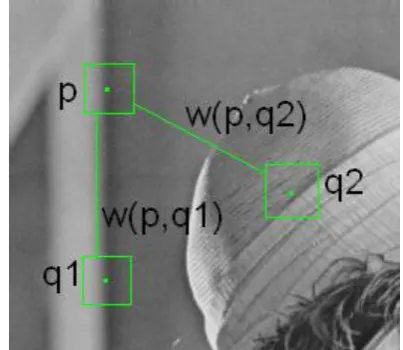
Fig. 1 realizes the concept of self-similarity. It indicates three pixels p, q1, and q2 along with their neighborhoods (square). It can be observed that the neighborhoods of pixels p and q1
appears alike, whereas that of p and q2 are dissimilar. It indicates that, a center pixel will usually have similar neighborhoods. In Fig. 1 it can be observed that, the pixels in the column same as that of p will have similar neighborhoods. The idea of self-similarity thus can be utilized for the purpose of denoising.
Fig. 1: Illustration of the concept of self-similarity in an image.
The NLM denoised image is computed using
where, indicated the weight function, is the noisy
representation and represents the denoised
realization of at location .
Both neighshrinksure and NLM consists of smoothing parameters. These parameters are used in a controlled manner to achieve denoising and also preserving edges. The values of smoothing parameter are obtained by adhoc method and the same value is used for all the test images.
III. RESULTSANDDISCUSSION
The results of the proposed denoising method is presented in this section. Results from other wavelet based denoising methods are used for comparison. An image corrupted with Gaussian noise is considered as input to these denoising methods. For the purpose of simulation, Lena, Barbara and Boat est images (all with size 512×512) are considered (Fig. 2). The noisy version of images are obtained by adding a known amount of Gaussian noise to these images. It is necessary to evaluate the denoised image quality and is achieved by objective quality analysis method. PSNR (Peak signal to noise ratio) and MSSIM (mean structural similarity index) [22] are used as evaluation criteria. The PSNR is calculated by,
International Journal of Innovative Technology and Exploring Engineering (IJITEE) ISSN: 2278-3075, Volume-9 Issue-1, November 2019
where, is the original clean image and is the denoised image.
For simulation, the test images corrupted with Gaussian noise of and are considered. For comparison, other wavelet based denoising methods are considered. It involves, soft thresholding, neighshrinksure, multispinning and hybrid method.
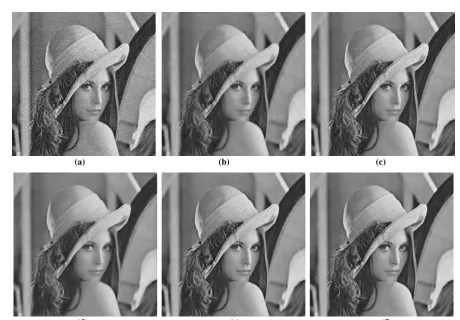
First, Lena image corrupted by is considered (Fig. 3(a)), various denoising techniques are applied on it to achieve denoisng. Soft thresholding is shrink or kill process. It removes the noise to a good extent. But, the smoothing operation leads to reduction in the quality of edges (Fig. 3(b)).
At constant gray level areas it exhibit artifacts. Neighshrinksure is applied to noisy Lena image and result is provided in Fig. 3(c). It makes use of neighbours to obtain thresholding value. It can be observed that, there is an overall improvement in the image quality compared to soft thresholding. But, as the amount of noise increases, this method also creates artifacts. Multispinning makes use of multiple shifted images. Denoising is applied on each of those images, inverse transform is applied, shifting is reverted and averaged. Averaging reduces the artifacts and improves the result (Fig. 3(d)). Further, an iterative hybrid method is applied and the results are shown in Fig. 3(e). It proceeds a step further in the quality of
result. To achieve better results, proposed dual domain method is applied. It can be observed that,
(a) (b) (c) Fig. 2: Images considered for simulation.
(a) (b) (c)
[image:3.595.75.536.246.566.2]
(d) (e) (f)
the denoised image is better than all other methods (Fig 3(f)). Simulation on Lena image with different amount of noise is also done. The simulation is also performed on other test images, Barbara and Boat for different amount of noise. Table-I shows the PSNR of various denoising methods. It can be observed that, at low noise levels, most of the denoising methods provide better PSNR. As the amount of noise increases, the proposed method stands higher in almost all the cases.
Table-II provides the Mean SSIM. It indicates that, the resultant values of proposed method are comparatively higher.
IV. CONCLUSION
Dual domain denoising method proposed in this paper to suppress Gaussian noise. It utilizes two steps; one in transform domain and another in spatial domain. Other denoising methods based on wavelet are used for comparison. It can be observed that the results of proposed method is visually better compared to other methods. PSNR and MSSIM are used for the purpose of quantitative analysis. Here also, the proposed method stands better.
REFERENCES
1. Jong-Sen. Lee, “Digital image enhancement and noise filtering by use of local statistics,” IEEE trans. on PAMI, Volume 2, pp. 165–168, 1980.
2. F. Jin, Paul Fieguth, L. Winger, and Ed Jernigan, “Adaptive wiener filtering of noisy images and image sequences,” IEEE conference on image processing, Volume 3, pp. 349–352, 2003.
3. Carlo Tomasi and Roberto Manduchi, “Bilateral filtering for gray and color images,” IEEE international conference on computer vision, pp. 839–846, 1998.
4. Michael Elad, “On the origin of the bilateral filter and ways to improve it,” IEEE trans. on image processing, Volume 11, pp. 1141–1151, 2002.
5. Tony F. Chen, Stanley Osher, and Jianhong Shen., “The digital TV filter and nonlinear denoising,” IEEE trans. on image processing, Volume 10, pp. 231–241, 2001.
6. Antoni Buades, Bartomeu Coll, and Jean-Michel Morel, “Image denoising methods, a new non-local principle,” SIAM Review, Volume 52, pp. 113–147, 2010.
Table-I: Quantitative Method of analysis. PSNR (dB) Noisy image Soft
thresholding Neighshrinksure Multispinning
Hybrid method
Proposed method Lena
28.1183 32.3150 33.9267 34.6043 34.3975 34.7921
22.1333 28.7052 31.5473 31.1886 31.7598 32.0116
18.7207 26.5465 28.5516 29.2425 30.0600 30.1682
Barbara
28.1164 29.9923 32.5273 32.8938 33.3422 33.1674
22.1839 26.2656 28.5785 28.9220 29.0048 29.6130
18.7871 24.2154 26.3926 26.7864 26.8362 27.4630
Boat
28.1519 30.7081 32.2860 32.8561 32.9473 32.7038
22.1871 27.3385 28.7584 29.3193 29.4225 29.7301
18.7455 25.3045 26.7026 27.3892 27.8590 27.9063
Table-II: Mean structural similarity index (MSSIM) Noisy image Soft
thresholding Neighshrinksure Multispinning
Hybrid method
Proposed method
Lena
0.8742 0.9274 0.9592 0.9615 0.9609 0.9625
0.6775 0.8675 0.9171 0.9198 0.9312 0.9318
0.5373 0.8129 0.8792 0.8797 0.8979 0.8991
Barbara
0.9137 0.9173 0.9649 0.9659 0.9694 0.9696
0.7654 0.8334 0.9179 0.9170 0.9236 0.9309
0.6349 0.7672 0.8737 0.8680 0.8780 0.8863
Boat
0.8993 0.9072 0.9556 0.9571 0.9593 0.9584
0.7362 0.8240 0.8975 0.9009 0.9039 0.9082
International Journal of Innovative Technology and Exploring Engineering (IJITEE) ISSN: 2278-3075, Volume-9 Issue-1, November 2019
7. Antoni Buades, Bartomeu Coll, and Jean-Michel Morel, “Image denoising by non-local averaging,” IEEE conference on acoustics, speech and signal processing, Volume 2, pp. 25–28, 2005.
8. Antoni Buades, Bartomeu Coll, and Jean-Michel Morel, “Non-local image and movie denoising,” Springer International journal of computer vision, Volume 76, No. 2, pp. 123–139, 2008.
9. Mona Mahmoudi and Guillermo Sapiro, “Fast image and video denoising via nonlocal means of similar neighborhoods,” IEEE signal processing letters, Volume 12, No. 12, pp. 830–842, 2005.
10. Aravind B. N and K. V. Suresh, “A discontinuity adaptive prior for image denoising,” International journal of computer applications, Volume 110,No. 2, pp. 13–19, 2015.
11. David L. Donoho, “Denoising by soft thresholding,” IEEE transaction on information theory, Volume 41, No. 3 pp. 613–627, 1995. 12. Ronald Raphael Coifman and David L. Donoho, “Translation invariant
denoising,” Wavelet and statistics, LNCS, Springer, Volume 103, pp. 125–150, 1995.
13. Tien D. Bui and Guangyi Chen, “Translation invariant denoising using multiwavelets,” IEEE transaction on signal processing, Volume 46, No. 12, pp. 3414–3420, 1998.
14. T. Tony Cai and Bernard Walter Silverman, “Incorporating information on neighboring coefficients into wavelet estimation,” Sankhya, Volume 63, No. 2, pp. 127–148, 2001.
15. Guang-Yi Chen and Tien D. Bui, “Multiwavelet denoising using neighboring coefficients,” IEEE signal processing letters, vol. 10, pp. 211–214, 2003.
16. Zhou Dengwen and Cheng Wengang, “Image denoising with an optimal thresholding and neighboring window,” Elsevier, PRL, Volume 29, No. 11, pp. 1694–1697, 2008.
17. Levent Sendur and Ivan W. Selesnick, “Bivariate shrinkage functions for wavelet-based denoising exploiting interescale dependency,” IEEE transaction on signal processing, Volume 50, No. 11, pp. 2744–2756, 2002.
18. Levent Sendur and Ivan W. Selesnick, “Bivariate shrinkage with local variance estimation,” IEEE signal processing letters, Volume 9, No. 12 pp. 438–441, 2002.
19. Aravind B. N and Suresh K V, “Multispinning for image denoising,” de Gruyter,International journal of intelligent systems, Volume 21, No.3. pp 271-291, 2012.
20. B. N. Aravind and Suresh K. V, “Wavelet based image denoising using multi-Spinning”, National conference on computer vision, Pattern recognition, image processing and graphics (NCVPRIPG 2011), BVB, Hubli, Karnataka, pp 118-121, December 15-17, 2011. 21. B. N. Aravind and Suresh K. V, “Hybrid image denoising,” IEEE
International conference on electronics, communication, computer technologies and optimization techniques (ICEECCOT 2017), Mysuru, India, pp 46-49, December 15-16, 2017.
22. Zhou Wang, Alan Conrad Bovik, Hamid Rahim. Sheikh and Eero P. Simoncelli, “Image quality assessment: From error visibility to structural similarity”, IEEE transactions on image processing, Volume 13, No. 4, April 2004.
AUTHORSPROFILE
Dr. Aravind B N is graduated from Visvesvaraya Technological University and post-graduation from Malnad College of Engineering. He completed PhD under Visvesvaraya Technological University. He published paper in four international journals. Presented paper in fifteen international conferences and eight national conferences. His field of interest includes Image processing, Machine learning and Embedded systems. He is having life time memberships in ISTE and IETE. He also conducted several workshops on Embedded systems in various institutions. He served as reviewer for several IEEE conferences. Currently he is working as Professor and HOD in the department of Electronics and Communication Engineering, Rajeev Institute of Technology, Hassan, Karnataka, India.