Abstract: Workplace distress, a common manifestation in different profession has been seen in all over the world. Occupation pressure among faculty has been documented to impact job satisfaction and job performance, thereby undermining student teacher relationship leads to the future of student at risk. The purpose of this study to get satisfaction index of faculty in an outcome based education system by using fuzzy based emotional intelligence (EI). Emotional expression is essential for survival. One can give his emotional expression in language (linguistic) only. As per literature the fuzzy logic is much more capable to handle linguistic variable in uncertain environment. Therefore, to analyze the satisfaction index of faculty fuzzy logic is used. Research findings indicate that emotional literacy plays an important role in thinking, learning, exhaustion, depersonalization and a sense of low personal adjustment that can occur among individuals who work with other people in some capacity in a University. In this study, 450 faculty satisfaction data are taken and analyzed, needing further investigation more data and more comparative analysis. Fuzzy based emotional intelligence was not as distinctive as previous literature has indicated.
Keywords: Emotional Intelligence, fuzzy logic, linguistic variable, satisfaction index
I. INTRODUCTION
Universities and institutions of higher education play a major role in the society advancement. Universities are the biggest source for the student teaching, which is the internal part of the economic, science and cultural progress. The biggest challenge facing by any Universities nowadays is to keep skilled staff exclusively in their faculties. The awareness of workplace emotion is growing in significance as they serve as an originator in evaluating the action of a person as well as attitude towards the workplace. Faculty member have many roles, tasks and obligations in terms of workload and research work. Longer hours of work under pressure which affect their level of job satisfaction and subsequent performance. Emotional intelligence plays a role in this matter by regulating their emotions and the emotion of other member in order to preserve a satisfactory output and improve the ability to cope with physiological pressure while carrying the research. This can result in higher performance at work and motivation. Job
Revised Manuscript Received on November 06, 2019.
Pooja Pathak, Mathematics, IAH, GLA University, Mathura U.P. India.
Email: [email protected]
Vijay Kumar Dwivedi, Mechanical Department, IET GLA University,
Mathura U.P. India. Email: [email protected]
performance has become an important aspect for members of the faculty as a dissatisfaction affecting the teaching process and influencing other responsibilities perform by faculty. Job performance is the state of intrinsic fulfillment and satisfaction achieved while doing a specific job. Among the various critical concepts of recognizing emotional intelligence, Aristotle describes emotional intelligence as those who have the rare ability to be angry with the right person, to the right degree, at right time, for the right purposes and the right way in any field of life.
The purpose of this study is therefore to investigate the relationship between emotional intelligence and employee satisfaction within GLA University faculty UP India. This paper include four section, Section 2 represent the summary of the emotional intelligence study based on EI model for four area knowledge. Section 3 presents a fuzzy modeling approach proposed for EI and a fuzzy logic based performance and satisfaction framework for faculties. Section 4 is a conclusion and also present studu guidelines for future work.
OVERVIEW OF EMOTIONAL INTELIGENCE For EI, there are various measuring tools available, with varying levels of complexity, skill and expense necessary for proper monitoring. The Emotional Quotient Inventory (EQ-i) developed by Reuven Bar-On, emotional and Social Competence Inventory (ESCI) and Mayer, Salovey, Carsuso Emotional Intelligence Test (MSCEIT) is the most well known and fairly difficult tests to conduct due to their excessive high cost [1].
A fuzzy-based model for the analysis of emotional intelligen ce is to be designed to recognize faculties which most requir e E.I interventions. [4].
II. OVERVIEWOFFUZZYLOGIC
Professor Lofali Asker Zadeh, University of California Berkley developed a Fuzzy logic concept in 1965. The fuzzy logic controller is considering a good methodology as it yields better outcomes to those obtained through conventional control algorithms.
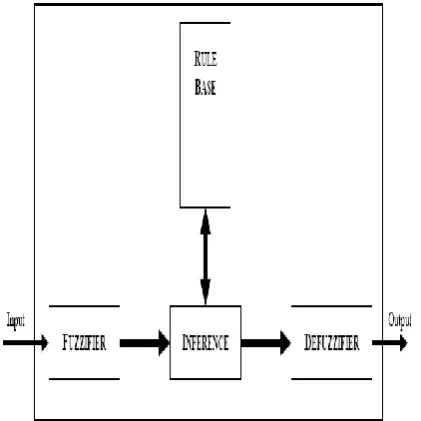
Fuzzy logic provides an alternative way to represent in processing the real world’s linguistic and subjective attributes. A basic fuzzy controller architecture is shown in Fig. 1.
Using a Fuzzy Logic-Based Emotional
Intelligence Framework for Testing Satisfaction
of Faculty in an Outcomes-Based Educational
System
Outcomes-Based Educational System
Fig. 1.Fuzzy logic based expert system
III. FUZZYBASEDFRAMEWORK
The present study is revealing the impact of emotional intelligence and its components, their educational and research performance and fatigue on job satisfaction for the faculty members of university. Emotional intelligence, performance and fatigue level are the independent variables i.e. input to the system and job satisfaction as the dependent variable i.e. output to the system.
In this research, questionnaires were given to the faculty member from varied streams including English department, Mathematics, Engineering and Management. The sample size is of 300 from different department of the University for session 2018-19. Participants age between 30-60. The faculty designation ranged from Assistant Professor to Professor. The maximum 300 respondent’s samples were picked from the department on the random basis. After adjusting for the international variables such as employment, income, industry, length of work experience, operational area, department size and other such variables by randomization and elimination, the final sample of 243 respondents were selected. 32.57 % of the respondents were males in the final sample and 68.43% were females. The respondent’s average age in this sample was 36 years.
Fuzzy parameter emotional intelligence is a combination of the following:
Self-Awareness: Getting to know yourself and identifying your current level of emotional intelligence
Self-Management: Accepting your own emotions and feelings and their impact on yourself and others,
Social Awareness: Use your own intelligence to strengthen your performance.
Relationship management: Recognition and understanding of others ' cognitive behaviors. Fuzzy input parameters for performance is a combination of the following:
1. Proficiency and Academic Ability:
Lectures, classes, seminars, practical, hours of contact to be taken as a proportion of allotted lectures.
Meetings or other teaching activities outside UGC guidelines.
Preparation and facilitation of expertise or knowledge according to curriculum.
Enrichment of Syllabus by producing additional resources to candidates. Using participatory and creative teaching-learning methodologies, updating content of subjects, developing courses, etc.
Examination duties (Invigilation, Question Paper Setting, Answer Script Evaluation / Evaluation) as per allocation.
Percentage of taking extra lectures.
Use of advanced tools for teaching learning.
Updation of additional questions in question bank.
Continuous Assessment (Sessional /Home
Assignment/Tutorial).
Percentage of syllabus covered. 2.Academic development:
Having Ph.D. degree.
Having degree of M. Tech./MCA/MBA/M.E./M.Phil. or equivalent.
Research Papers Presented in National Conference
Research Papers Presented in International Conference
Papers Published in National Journal.
Research Papers Published in International Journal
No. of Articles published in National or International Magazines/Periodicals
Text or Reference Books Published by International Publishers with an established peer review system.
Attended workshop or Faculty Development Program.
3.Professor personal and social characteristics:
An urge to express your love with subject to the students.
An ability to inspire and make the material taught interesting.
A facility to engage students at their level of intelligence.
A willingness to describe the content clearly.
A willingness to describe the content
A willingness to explain what needs to be understood at what point and why.
4.Showing concern and respect for students
Commitment to cultivate individuality.
Ability to improvise and adapt to new conditions. Use of teaching methods and learning activities requiring students to learn actively, responsibly and cooperatively.
Instead of covering the ground, concentrate on key concepts and students ' misunderstandings.
Feedback on student work of the highest quality. Instead of covering the ground, concentrate on key concepts and students ' misunderstandings.
5. Subject result of examination:
An essential component of the teaching and the learning process is the writing of effective and efficient exams. Exams are common approach to measure knowledge of student and the results are useful in a number of ways. The outcomes of the exams are most often used to provide student feedback on what they have learned and also measure a course learning effectiveness.
6. Feedback from students:
Having a record of faculty activities and observations from seeking reviews on teaching and units at the faculty is an important aid to reflection, particularly as memory eventually dims over time. These reports assist in the process of clarifying teaching objectives, defining strength and weakness in achieving these goals, narrowing down any area s for improvement, establishing courses of action for improvement, and reflecting on these improvements as they are implemented.
Fig. 2. Proposed Model
7. Other responsibilities:
Director / Institute Head shall describe accountability. The amount of work will be done on the basis of the hou
devoted by a team member to the particular task out of available 42 hours. Based on the survey a fuzzy model is proposed (Figure 2) and input and output variable were takes as listed in Table 1 along with their linguistic variables. The author is taken triangular membership function for all input and output variables as shown in Figure 3 to Figure 13.
Table I: Input /Output variable
Input/Output
Membership
Range
Linguistic
Variable Params
Self Awareness Fig 3. [0 40]
Low [ 0 10 20]
Average [10 20 30]
Self Aware [20 30 40
Self-Management
Fig 4.
[0 40]
Low [0 10 20]
Average [10 20 30]
Self Managed [20 30 40]
Social- awareness
Fig 6.
[0 50]
Low [0 0 15
25]
Average [10 15 35]
Socially aware [25 35 50]
Relationship Management
Fig 4.
[0 60]
Low [0 0 20
30]
Average [15 25
45] Skillful-in
Management
[30 35 60]
Proficiency and Academic Ability
Fig 5.
[0 18]
Poor [0 8 12]
Good [8 12 15]
very Good 12 15 18]
Academic development
Fig 7.
[0 18]
Poor [0 8 12]
Good [8 12 15]
very Good [12 15 18]
Professor personal and social characteristics
Fig 8.
[0 70]
Unsatisfactory [0 30 40]
Satisfactory [30 40 50]
Accomplished [40 50 60]
Exemplary [50 60 70
Showing concern and respect for
students
Fig 9.
[0 15]
Not Satisfactory [0 5 9]
Marginal [5 9 12]
Expected [9 12 15]
Excellence [12 15 15]
Subject result of examination
Fig 10.
[0 25]
Poor [0 10 15]
Good [10 15 20]
Excellent [15 20 25]
Feedback from students
Fig 11
[0 25]
Poor [0 8 12]
Fair [8 12 17]
Good [12 17 20]
Outstanding [17 20 25]
Other responsibilities
Fig 12
[0 45]
Worst [0 20 28]
Good [20 28 35]
Better [28 35 40]
Best [35 40 45]
Satisfaction Index Fig 13
[0 45]
Worst [0 20 28]
Good [20 28 35]
Better [28 35 40]
Best [35 40 45]
Emotional Intelligence
Self- Awareness Self-Management Social Awareness Relationship-manage ment
Performance
Proficiency and
Academic Ability Academic development Professor personal and social characteristics Showing concern and respect for students
Subject result of
examination
Feedback from students
Other responsibilities
F u z z y
e x p e r t
S y s t e m
Outcomes-Based Educational System
0 5 10 15 20 25 30 35 40
0 0.2 0.4 0.6 0.8 1
Self –aware linguistic variable
D e g re e o f m e m b e rs h ip
low skill-in-self average-low skill-in-relationship average- in--awareness
Fig.3. Self Awareness membership
0 5 10 15 20 25 30 35 40
0 0.2 0.4 0.6 0.8 1
Self –managment linguistic variable
D e g re e o f m e m b e rs h ip
[image:4.595.206.517.42.755.2]low skill-in-self average-low skill-in-relationship average- in--awareness
Fig. 4.Self-Management membership
0 2 4 6 8 10 12 14 16 18
0 0.2 0.4 0.6 0.8 1
Proficiency and Academic Ability
D eg re e of m em be rs hi p
[image:4.595.323.524.59.373.2]Poor Good Very Good
Fig. 5. Proficiency and Academic Ability membership
0 5 10 15 20 25 30 35 40 45 50
0 0.2 0.4 0.6 0.8 1
Social -awareness linguistic variable
D eg re e of m em be rs hi p
low skill-in average- skill-in average- managed
Fig. 6. Social- awareness membership
0 2 4 6 8 10 12 14 16 18
0 0.2 0.4 0.6 0.8 1 Academic development D e g re e o f m e m b e rs h ip
Poor Good Very Good
Fig. 7. Academic development membership
0 10 20 30 40 50 60 70
0 0.2 0.4 0.6 0.8 1
Professor personal and social characteristics
D e g re e o f m e m b e rs h ip
Unsat Sati AccomolishedExemplary
Fig. 8. Professor personal and social characteristics membership
0 5 10 15
0 0.2 0.4 0.6 0.8 1
Showing concern and respect for students
D e g re e o f m e m b e rs h ip
[image:4.595.341.511.418.558.2]Unsat Marginal Expected excellent
Fig. 9. Showing concern and respect for students membership
0 5 10 15 20 25
0 0.2 0.4 0.6 0.8 1
Subject result of examination
D e g re e o f m e m b e rs h ip
Poor Good excellent
[image:4.595.61.269.573.708.2] [image:4.595.322.526.583.740.2]0 5 10 15 20 25 0
0.2 0.4 0.6 0.8 1
Feedback from students
D
eg
re
e
of
m
em
be
rs
hi
p
[image:5.595.63.266.53.579.2]Poor fair Good Outstanding
Fig. 11. Feedback from students
0 5 10 15 20 25 30 35 40 45
0 0.2 0.4 0.6 0.8 1
Other responsibilities
D
e
g
re
e
o
f
m
e
m
b
e
rs
h
ip
worst good better best
Fig. 12. Other responsibilities
0 5 10 15 20 25 30 35 40 45
0 0.2 0.4 0.6 0.8 1
Satisfaction Index
D
e
g
re
e
o
f
m
e
m
b
e
rs
h
ip
worst good better best
Fig. 13. Satisfaction Index membership
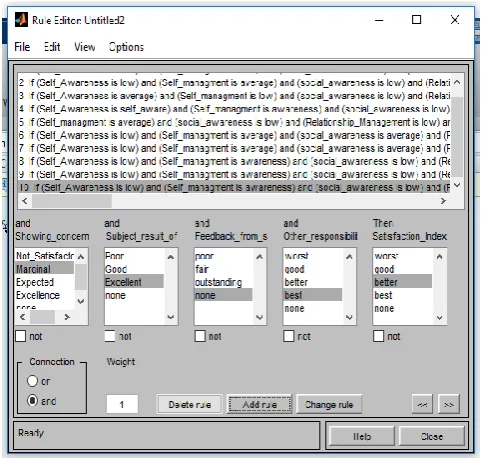
Fuzzy Rules and Defuzzification:
The method of inference in the fuzzy logic controller looks li ke the process of human reasoning. Artificial intelligence is associated with fuzzy logic.
We are developing module in the soft computing model for e valuating the overall satisfaction of teachers using fuzzy logi c, namely overall satisfaction of teachers with emotional inte lligence and performance.
The fuzzy laws are developed using experts ' knowledge and experience.
Degree of membership of the output fuzzy variable i.e., satisfaction is evaluated by calculating the input fuzzy sub variables in this case teaching feedback by students, teaching learning activity, subject result of university examination and the output fuzzy variable i.e., satisfaction is evaluated by these fuzzy subsets. In fuzzy model for evaluating teachers’ overall
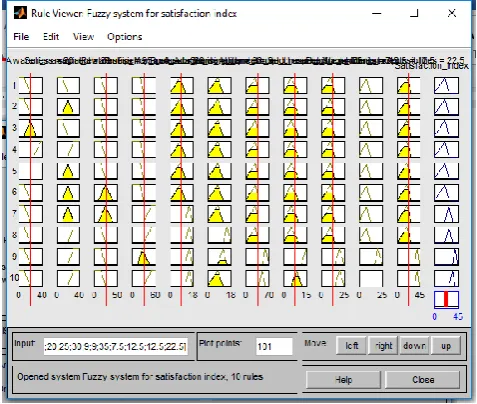
satisfaction fuzzy logic uses the max-min aggregation technique is used. The final output in terms of membership function for each rule is the fuzzy set assigned to that output by using the degree of the membership functions of the associated input fuzzy sub variables. Once the membership degree of each output fuzzy variable is determined all of the rules are fired are then after aggregating all the fuzzy output of each rule the actual crisp output is determined using defuzzification. Here centroid defuzzification method is used. The procedure of converting aggregated fuzzy output set into a single crisp value is called defuzzification.
[image:5.595.304.547.184.666.2]
Fig.14. Fuzzy rules for satisfaction index in MatLab
[image:5.595.304.546.191.420.2] [image:5.595.310.542.439.665.2]Outcomes-Based Educational System
[image:6.595.49.288.52.254.2]to
Fig. 16. Fuzzy rule viewer in MatLab.
IV. RESULT
The emotional intelligence fuzzy model for faculty overall satisfaction is mentioned in the previous sections is using the available graphical user interface resources Matlab's Math works fuzzy logic toolbox. The simulation is carried out using the inference min-max and the method of centroid defuzzification.
After carefully developing a soft computing model for evaluating the overall satisfaction of teachers we evaluate the framework and analyze the performance of the output variable. i.e. satisfaction index.
Job satisfaction acts as an important concept in organizational practice and research. It also acts as the main role in most personnel decisions such as merit-based payment, promotion and retention of employees by enabling people to nurture positive relationships at work, work effectively in teams, and builds social capital. Work performance often depends on the support, advice, and other resources provided by others. Employees with a high level of emotional intelligence can manage their emotions in terms of retaining a positive mental state which can lead to improved job satisfaction and better performance.
With the help of simulation, we show the effect of the emotional intelligence and other performance to the satisfaction of teachers.
V. CONCLUSION
Based on Results, it is recommended that management should include some faculty training programs in order to enhance emotional intelligence of faculty based on their job satisfaction index.
Such series will assist the faculties in developing better empathic and interpersonal relations with their peers, administrators, understanding student’s unique needs and hence in Good governance in their courses. These staff education programs should also provide guidance for new teachers to improve their understanding and knowledge of emotional intelligence, strategies and initiatives that could be used in teaching pedagogy resulting in enhanced effectiveness. The study has not involved the influence of gender, age, and experience on emotional intelligence.
It is observed that a soft computing system for assessing the overall satisfaction of teachers using fuzzy logic provides better results than traditional model A large number of factors have been identified and integrated into the process that affect the overall satisfaction of the teachers.
In this study, 450 faculty satisfaction data are taken and analyzed, needing further investigation more data and more comparative analysis. The proposed system can be further adapted and used to assess other staff's in the organization for identifying the satisfaction index. Some other methods of classification such as artificial neural networks (ANN), neuro-fuzzy systems and genetic algorithms (GA) may also be used to assess the overall performance of teachers effectively. From a managerial point of view, the results suggest that management should give priority to their employees ' emotions and emotional intelligence in order to increase job satisfaction apart from other parameters.
ACKNOWLEDGMENT
Authors is thankful to the management of GLA University, Mathura, one of the university located in Mathura UP, India for providing the data to develop a soft computing model for evaluating teachers’ overall satisfaction using fuzzy logic.
REFERENCES
1. S. Jensen, C.Kohn, R. Rilea, R. Hannon, G. Howells, “Emotional
Intelligence: A Literature Review”, University of the Pacific Department of Psychology, 2007.
2. A. Cartwright, A. Solloway, A. “Emotional Intelligence: Activities for
developing you and your business”, New York, Routledge. 2009
3. D. Goleman. “Emotional Intelligence: Why It Can Matter More than
IQ”, Proceedings of Annual Meeting of the Society for Industrial and Organizational Psychology, New Orleans, LA, April 15, 2000.
4. R. A. Fabes, N. Eisenberg, N.(1997) “Regulatory control and adults'
stress-related responses to daily life events”, Journal of Personality and Social Psycology, Vol. 73, No.5, , 1997 pp. 1107-1117.
5. J. Alam, M. K. Pandey, “A Soft Computing Model for Evaluating
Teachers’ Overall Performance using Fuzzy Logic”. Journal of Information Technology &Software Engineering, Vol. 7, No.3, 2017, pp. 02-09.
AUTHORSPROFILE
Dr. Pooja Pathak, Associate Professor,
IAH, GLA university, Mathura (India) has earn her PhD from BRA Agra University in Year 2010. She has published more than 20 paper and article in the area of soft computing (e.g. Fuzzy logic, ANN and Genetic Algorithm) She has 20 year of teaching
experience.
Dr. Vijay Kumar Dwivedi, Associate