International Journal of Innovative Technology and Exploring Engineering (IJITEE) ISSN: 2278-3075,Volume-9 Issue-1, November 2019
Abstract: Environment control is one of the critical difficulties for handicapped individuals who experience the ill effects of neuromuscular ailments. Brain-computer interface systems empower a subject to communicate with a PC machine without drawing down any solid action. This communication does not depend in light of any ordinary medium of correspondences like physical movement, talking, and motion and so forth. The most vital desire for a home control application is high accuracy and solid control. In this study, row-column–based (2 Row, 3 columns) P300 paradigm for home appliances control was designed. In this article, we analyze real-time EEG data for P300 speller using support vector machine and artificial neural network for high accuracy. Using this proposed method we are able to find the target appliance in the correct and fastest way. Four paralyzed people were participating in this study. The artificial neural network gives 85% accuracy within 10 flashes. The results show this paradigm can be used to select the option of a home appliances control application for paralyzed people with users convenient and reliable.
Keywords: Brain-computer interface, P300 signal, Classification, Home appliances
I. INTRODUCTION
Brain-Computer Interface (BCI) is a brief human-to-computer correspondence based entirely on the decoding of electroencephalographic (EEG) responses produced by a subject's stimuli. BCI systems enable a subject to interact with a PC device without any solid action being drawn down. This communication does not rely on normal correspondence, such as physical advances, voice, and movement, etc. Controlling and connecting with the living condition is one of the fundamental needs of individuals in day by day life. BCI gives a medium of correspondence to profoundly suffering patients like amyotrophic lateral sclerosis (ALS), brain stroke and other neurological problems. Through a BCI system, these disable people can control devices by brain activity. BCI –based appliances control system gives an opportunity to control TV/mobile-phone/door/fan/light-bulb/electric-heater by themselves. This manipulate functionality would possibly ensure to reduce dependence on caregivers and improves lifestyles for human beings with neuromuscular diseases.
Revised Manuscript Received on November 05, 2019.
* Correspondence Author
Praveen Shukla*, Dept. of Electronics & Communication, National Institute of Technology, Raipur India ([email protected])
R.K.Chaurasiya, Dept. of Electronics & Communication, Malaviya
National Institute of technology, Jaipur India
Shrish Verma, Dept. of Electronics & Communication, National
Institute of Technology, Raipur India ([email protected])
It is import to theses system classification accuracy should be high, so that classify signal convert into command signal and the device will activate into the desired time. P300 speller is one of BCI's most common uses that work on the odd-ball paradigm principal. A system of spellers obsessed with the P300 ERP is mostly called a P300 speller. P300 infers a positive-going ERP conveyed after 300 ms of prompting. Sutton recorded the first P300 ERP in 1965. In the event that a subject is inquired to recognize between two stimuli (displayed in an arbitrary arrange), wherever one amongst them rarely occurs (the “odd-ball”), then after 300ms the P300 wave is generated and this phenomenon is known as “odd-ball paradigms”. The first P300-based row-column speller was created by Farwell & Donchin, 1988 [1]. The size was English speller 6 ×6 matrix of latter. All six rows and six-column of the matrix were highlighted in random order while the subject was asked to concentrate on the specific character. The presence of P300 ERP in order to detect of target character through multi –trail approach is a common practice.
The first speller additionally referred to as Row-column (RC-primarily based) speller [2]. Later on row column-based paradigm English alphabet and number replace dummy faces and pictures [3, 4]. There are various other paradigms single character (SC) paradigm [5], which can spell only one character at a time, check Board (CB) paradigm [6], rapid serial visual presentation [7], Hex-o-Spell [8], cake speller [9], etc. Some limited research BCI–based P300 Speller home appliances control system like row column-based speller (RC) [10, 11], and region-based paradigm [12], Hoffman approach has been already implemented. Some researchers gave an idea about single and multiple appliances control through different approaches like Bluetooth, Arduino, infrared, web server, and microcontroller, for light [13], door [14], fan [15], music [16], buzzer [17] air conditioner [18], and multiple (fan, tv, blub, door etc.). In this paper, we designed a P300–based BCI home appliances control system. We used appliances in the place of number and dummy faces. In this article, we detect a P300 ERP signal for high classification and detect a correct target appliance using a
A Brain-Computer Interface–based P300 Speller
for Home Appliances Control System
Support Vector Machine (SVM) and artificial neural network (ANN) classification methodology. The remaining of the paper is divided into the following section: Section II proposed BCI-based P300 paradigms for home appliances control system Section, III describes the dataset and experimental analysis, Section IV shows experimental results, Section V describes discussion and finally concludes the paper.
II. PROPOSED BCI –BASED P300 PARADIGM FOR HOME APPLIANCES CONTROL SYSTEM
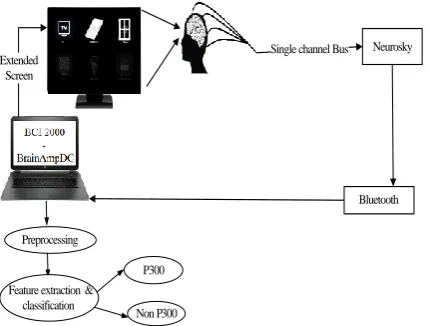
[image:2.595.309.547.196.368.2]In this paper, single-channel–based (Neurosky mind wave mobile headset) multiple appliances control system was designed. A BCI–based P300 Speller for home appliances control system consists of several stages data collection, pre-processing, extract features, classification and control translation. Correct classification is the main task for EEG – based home appliances control system. Once signal classified and converted into control signal appliances will activate. The proposed block diagram for the home appliances control system is depicted below in Figure 1.
Figure 1. Block representation of P300 speller for BCI-based home appliances control system.
There are many challenges factor of practical implementation of P300 speller 1) User convenient 2) High accuracy 3) System reliability. In this article, we have attempted to tackle the above challenging P300 spell-related factor. We have used support vector machine and artificial neural network classification algorithms to detect target appliance accurately respectively less number of trails. We took decimated and filtered amplitude EEG signal have been taken as a feature coefficient for classification. The method of decimation transforms high-dimensional information into a feature vector of lower dimensions.This reduced feature vector, as a result, required a lesser size of training and provides a high classification bit rate and classification accuracy.
III. DATA SET FOR EXPERIMENTAL ANALYSIS
The subjects are paralyzed and the age range between 25-35. The dataset was collected NeuroSky mind wave–mobile headset. It contains a single dry sensor that can be situated on the forehead and three other dry sensors on the left ear for references. It includes a microchip that tactics EEG signals
[image:2.595.53.268.314.477.2]and exchanges the information via Bluetooth. The NeuroSky Mind Wave has a wearable gadget for viewing the electrical signs created by neural development in the cerebrum. The gadget is involved eight primary parts; adaptable ear arm, ear cut, battery territory, control switch, customizable headband, sensor tip, sensor arm and inside think equip chipset. In the proposed main menu, the row column-based P300 paradigm consists of appliances (icons), TV, mobile, door, fan, light bulb, and electric heater. In RC–based paradigm the row and column flashes randomly, the subject was asked to focus on the particular appliance that he wants to pick. The main menu has 2 rows and 3 columns are depicted in Figure.2
Figure 2. The main menu of the architecture Proposed method
Once matrix finishes flickering, the selected command is performed; the user can access the specific submenu. All appliances have a specific submenu, user can select a particular submenu according to his needs. Subjects were asked to complete 20 selections. Figure.3 shows light submenu size of 2×3 matrix. Only one row and column can contain the target appliance in flashing of 5 different rows and columns, with the flashing equal to 2/5=0.4. The EEG signals recorded for four subjects in three sessions (Session 1, Session 2, and Session 3). Each session divided into number of runs. In every run row and column were intensified 100ms followed by 80ms dark time. The block randomization set was 5. 2 out of 5 such intensifications contains target appliance. For each target appliance, the random row and column method were repeated 10 times. Session 1 and session 2 was the training session, and session 3 was a testing session.
In session 1 and session 2 was training session real-time EEG signals at sampling rate 512-row column intensification and class level were provided and in the testing session, the class level was not provided. The subject task was predicted to target appliance for each run of session 3.
Neurosky Single channel Bus Extended
Screen
Bluetooth
Preprocessing
Feature extraction & classification
P300
Non P300
International Journal of Innovative Technology and Exploring Engineering (IJITEE) ISSN: 2278-3075,Volume-9 Issue-1, November 2019
Figure 3. The submenu of a light device
IV. PROPOSED METHODS
There are two tasks, first one detects the P300 ERP and second identify target appliance. For each block of intensification 5 row and column, we have to identify a target appliance. For detecting the P300 ERP component and identify target appliance, we have trained support vector machine and artificial neural network classification algorithms. Data were acquired in real-time because of background brain activity noises are included. It is very difficult to get the target appliance in a single trails approach. We have applied multi trail approach for detecting target appliance. For correct appliance detection, we are applying these steps which are following.
A. Pre-processing and feature extraction:
When the subject is available for the uncommon or amazing assignment, P300 signals are evoked after 300 ms, these signals are generated as a consequence of oddball paradigms in which the subject is asked to select a random sequence of stimuli. For detecting P300 ERP we fixed time windows signals 0 ms to 600ms which is large enough to collect response correctly. As we recorded data samples rate 512 Hz, 0-600 ms posterior gives 300 samples. After that, we introduced a Type 1 filter with a cut-off frequency of 8 orders Chebyshev 0.1 to 30 Hz.
Due to the decimation sample size was reduced 50 times (512/30 ). Hence sample size was 300/17 = 17 samples. Then we applied signal normalization to the interval [-1, 1]. Thus for a single appliance, the feature vector is 75 (5 intensifications × 15 trails) size of 17×1. Out of 75, 30 belongs to class +1, and remaining are 45 belongs to class -1. We have used all main and submenu appliance icons all the run of session 1 and session 2 to prepare a training set of subjects 1, 2, 3 and subject 4. There are 10 tasks were selected (20 selection for both levels) in session 1 and session 2. For training session feature vectors are 20×75 = 1,500 in the size of 17×1. Out of 1,500 features vectors 600 belongs to class +1 and the remaining 900 are class -1. We collected data for 20 selection as well as testing sessions.
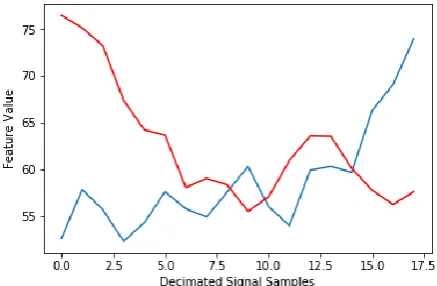
Figure 4. Shows P300 ERP signals in blue color (class +1) of raw data (300 samples) and Non –ERP signals in red color (class-1). Figure 5. Shows plot of all average value of class +1 and class-1 signal of run 1 of session 1. Blueline shows P300 ERP of class +1 and the red line shows non-P300 ERP of class-1.
[image:3.595.318.543.57.199.2]Figure 4. Sample variation with P300 ERP in Blue color
Figure 5. Plot of decimated signal sample verses features
B. Classification
SVM and ANN classifier has been used for P300-based home appliance control system.
(1) Support Vector machine:
SVM classifier gives good generalization capability. For liner separate data SVM classify in two hyperplanes in such a way separation margin between the dataset of two classes is maximized. For non linearly separable data points, the task involves the maximizing separation margin and controlling error point called stack variables which are allowed in the process. This problem called an optimization problem and solved by langraze’s theorem. As resultant, we found a linear discrete function for novel data points x as equation (1).
𝐅(𝐱) = ∑ 𝒚𝒊 𝝀𝒊(𝒙. 𝒙𝒊) + 𝐛 (𝟏) 𝒏
𝒊=𝟎
Where 𝑥𝑖 ,i=1,2……N are training data points with 𝑦𝑖 ∈
{−1,1} , 𝑖 = 1,2 … 𝑁, 𝜆𝑖 𝑖=1,2….N.
It is shown that replacing dot product (𝑥. 𝑥𝑖) by a Kernal
function K (𝒙. 𝒙𝑖). In this proposed work we have applied the
Radial Basis Function (RBF) to classify the data
[image:3.595.322.541.231.374.2]K (𝒙. 𝒙𝒊) = exp(−
||𝒙−𝑥𝑖||𝟐
(2) Artificial Neural Network :
In this EEG-based home control system dataset, the proposed multilayer feed-forward with three hidden layers with the sigmoid function was used for classification. The resilient back propagation method was used for the training purpose. As no thumb rule exited for the architecture of a multilayer perceptron (MLP). So this presented work three hidden layers (first layer consisted of 256 neurons and the second layer consisted of 5 neurons and third layers consisted 2 neurons based on mean square error) was selected trial and error basis.
In this proposed work we have trained for both the subjects full training dataset 1,500 feature vectors (i.e. 600 (class +1) and 900 (class -1)) feature vector using 5-fold cross-validation technique. Because data was too noisy so it can’t detect correct character in single trails. We applied a multi trail approach using both ANN and SVM classifiers in the test dataset and classified desire contains the target appliance.
V. RESULTS
In this study, accuracy was predicted in two ways. The first one is to determine the total of 20 selection predictions. The second one is to determine correct appliance selection respect to level wise. The total target selection accuracy for first flashes using ANN classifier is 60% to 65%. 85% average accuracy achieved using ANN classifier for main menu and submenu in 10 trails. SVM classifier gives total target selection accuracy for first flashes 55% to 60 %. SVM gives 82 % average accuracy achieved in just 10 trails. ANN classifier gives better results than SVM. Target appliance prediction accuracy with respect to menus using ANN classifier achieved 85.4%.
Table 1. Total target prediction and main and sub-menu level-wise accuracy in percentage using SVM and ANN classifier.
No.of flashes
Main menu
(ANN) Sub menu
(ANN) Main menu
(SVM) Sub menu
(SVM)
Total target predic tion
1 65 62 60 59 65
2 70 72 65 68 70
3 78 74 75 74 75
4 79 75 78 76 80
5 85 77 80 78 82
6 89 80 85 84 89
7 91 85 89 87 95
8 100 90 93 92 98
9 100 92 98 96 100
10 100 100 100 100 100
Averag e
85.5 85.0 82.3 81.4 85.4
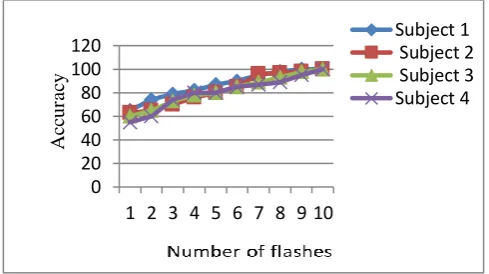
[image:4.595.310.557.48.111.2]In Figure 5. Describe overall average accuracy for all four subjects. Subject 1 shows 86 % average accuracy for the selection of both the level of appliance target menu. Subject 2 provides 83% average accuracy. Subject 3 and Subject 4 average accuracy is 82.1 and 80.5 respectively. Subject 1 performing well in all subjects.
Figure 6. Accuracy prediction versus the number of flashes graph of all subjects.
A. Statistical analysis:
The Friedman test was employed for statically comparison between different algorithms. It is a non-parametric test preferred over repeated-measure ANOVA. We can say that this test is equivalent to repeated measure ANOVA. This test concept is that different classification methods are ranked according to their performance. The best performing method gets ranked 1 the second one gets rank 2 and so on. The Friedman test is employed based on the average ranks obtained by different approaches. A null hypothesis is tested for finding the p-value. A p-value is compared to the confidence level. The condition is that if the p-value is less than the confidence level then there is no difference between individuals, the approach will reject. In this case, the post hoc Nemenyi test is employed.
The next condition is that if the p-value is greater than confidence level, then there is rank difference between a pair is larger than the critical difference (CD) at a certain confidence level, in this condition performance will be significantly different. The Friedman test was applied for three different classification approaches (SVM- rbf, ANN 1 layer, ANN 2 layer, SVM-linear) across all four different subjects (obtained using 10 trails). As per the experimental result, the computed P-value was 0.01874 less than the confidence level. As per rule null hypothesis was rejected and Post Hoc test was employed. The obtained CD value is 3.2135 greater than p-value 0.05. The result of the post hoc test for all three is shown in Figure 7. In the colored line average ranked of each method shown as ascending order.
0 20 40 60 80 100 120
1 2 3 4 5 6 7 8 9 10
Subject 1 Subject 2 Subject 3 Subject 4
A
cc
ur
a
[image:4.595.305.550.225.362.2]International Journal of Innovative Technology and Exploring Engineering (IJITEE) ISSN: 2278-3075,Volume-9 Issue-1, November 2019
Coloured line also shown that there is no significant difference between the approaches. From Figure. 7 it is observed that ANN 2 layer classifier average rank was one. This means this classification method best-performing methods for all subjects. It can be also observed that the ANN 2 layer method is best performing method than SVM-rbf and SVM-linear. Hence based on a statistical analysis we can say that ANN 2 layer classification method performs better than existing method.
Figure 7. Schematic diagram of Nemenyi post hoc test for comparison of different classification approaches.
V. DISCUSSION AND FUTURE SCOPE
The aim of our research work used to be providing a P300 speller for home appliances control system for purely disable people that solve the problem of user convenience, and poor accuracy. Regarding this, SVM and artificial neural network (ANN) classifier methods have been proposed. Firstly using the suggested classification schemes and captured data from neurosky mind wave mobile headset for purely disable people, we are able to predict the target appliance in 10 trails. The purpose of the correct target appliance fulfills in just 10 trails (provided 15 trails for classification) which ensures lesser execution time for recording the dataset. Secondly, the result shows the proposed classification achieved high classification accuracy with the new testing sample as well. Thirdly our work was design a paradigm for purely paralyzed people those results ensure that this paradigm is user convenient for purely paralyzed people. In the near future, we will work on control appliances in real Environment and include paralyzed patients to our study and increase the reliability of the system.
VI. CONCLUSION
The aim of this article provides a user convenient system, high accurate, less execution time, convenient design paradigm for paralyse patient. For fulfilling those purpose we proposed P300-based system design. By proper selection of features SVM and ANN classifier provides high accuracy with better transfer rate. ANN classifier gives better results than SVM. ANN Classifier gives 85% average accuracy with respect to levels and average target character prediction 86 % within 10 trails. The average classification accuracy of subject 1 is approximately 86%. Subject 1 performing well as compared to all four subjects.
REFERENCES
1. L. A. Farwell and E. Donchin, "Talking off the top of your head:
toward a mental prosthesis utilizing event-related brain potentials,"
Electroencephalography and Clinical Neurophysiology, vol. 70, pp. 510-523, 1988.
2. R. Fazel-Rezai, et al., "P300 brain computer interface: current
challenges and emerging trends," Frontiers in neuroengineering, vol.
5, p. 14, 2012.
3. J. D. Bayliss, "Use of the evoked potential P3 component for control
in a virtual apartment," IEEE transactions on neural systems and
rehabilitation engineering, vol. 11, pp. 113-116, 2003.
4. U. Hoffmann, et al., "An efficient P300-based brain–computer
interface for disabled subjects," Journal of Neuroscience methods, vol.
167, pp. 115-125, 2008.
5. C. Guan, et al., "High performance P300 speller for brain-computer
interface," in IEEE International Workshop on Biomedical Circuits
and Systems, 2004., 2004, pp. S3/5/INV-S3/13.
6. G. Townsend, et al., "A novel P300-based brain–computer interface
stimulus presentation paradigm: moving beyond rows and columns,"
Clinical neurophysiology, vol. 121, pp. 1109-1120, 2010.
7. L. Acqualagna and B. Blankertz, "Gaze-independent BCI-spelling
using rapid serial visual presentation (RSVP)," Clinical
neurophysiology, vol. 124, pp. 901-908, 2013.
8. B. Blankertz, et al., "A note on brain actuated spelling with the Berlin
brain-computer interface," in International Conference on Universal
Access in Human-Computer Interaction, 2007, pp. 759-768.
9. M. S. Treder, et al., "Gaze-independent brain–computer interfaces
based on covert attention and feature attention," Journal of neural engineering, vol. 8, p. 066003, 2011
10. R. Corralejo, et al., "A P300-based brain–computer interface aimed at
operating electronic devices at home for severely disabled people,"
Medical & biological engineering & computing, vol. 52, pp. 861-872, 2014.
11. F. Aloise, et al., "Asynchronous P300-based brain-computer interface
to control a virtual environment: initial tests on end users," Clinical
EEG and neuroscience, vol. 42, pp. 219-224, 2011.
12. E. A. Aydin, et al., "Region-based Brain Computer Interface for a
home control application," in Engineering in Medicine and Biology
Society (EMBC), 2015 37th Annual International Conference of the
IEEE, 2015, pp. 1075-1078.
13. N. Wahy and W. Mansor, "EEG based home lighting system," in 2010
International Conference on Computer Applications and Industrial Electronics, 2010, pp. 379-381.
14. W. Alrajhi, et al., "Smart home: toward daily use of BCI-based
systems," in Informatics, Health & Technology (ICIHT), International
Conference on, 2017, pp. 1-5.
15. M. Wang, et al., "A Fan Control System Base on Steady-State Visual
Evoked Potential," in Computer, Consumer and Control (IS3C), 2016
International Symposium on, 2016, pp. 81-84.
16. K. C. Tseng, et al., "Brain computer interface-based multimedia
controller," in Intelligent Information Hiding and Multimedia Signal
Processing (IIH-MSP), 2012 Eighth International Conference on, 2012, pp. 277-280.
17. A. M. Chowdhury, et al., "Brain controlled assistive buzzer system for
physically impaired people," in Electrical, Computer and
Communication Engineering (ECCE), International Conference on, 2017, pp. 666-669.
18. C.-T. Lin, et al., "Brain-computer interface-based smart living
environmental auto-adjustment control system in UPnP home
networking," IEEE Systems Journal, vol. 8, pp. 363-370, 2014.
AUTHORS PROFILE
Praveen Kumar Shukla received the degree in electronics and communication engineering and M.Tech. degree in control and automation from VIT Vellore, and currently pursuing Ph.D. in engineering from National Institute of Technology, Raipur. His research area includes Machine
Learning, Brain-Computer Interfacing, and
Rahul Kumar Chaurasiya received the B.Tech. degree from the Maulana Azad National Institute of Technology, Bhopal, India, in 2009, and the M.E. degree in System Science and Automation from the Indian Institute of Science, Bangalore, in 2011. He received his Ph.D. degree in 2017 from National Institute of Technology, Raipur. He was a Senior Software Engineer with Brocade Communications Systems, Bangalore, in 2011-12. During 2013-18, he was Assistant Professor at the National Institute of Technology, Raipur. Since 2019, he is with the Malviya National Institute of Technology Jaipur as Assistant Professor. His research area includes Machine Learning, Pattern Recognition, Brain-Computer Interfacing, Optimization, Biomedical Signal Processing.