International Journal of Innovative Technology and Exploring Engineering (IJITEE) ISSN: 2278-3075, Volume-8 Issue-10, August 2019
Abstract: In the normal quiz system, all questions are the same. However, the questions of an intelligent quiz system have different difficulty level, different response time, etc.This paper proposed a novel solution based on genetic algorithm (GA) to build an intelligent quiz system. This solution is experimented with website system via PHP and MySQL. The question bank for experiment is input into the system by lecturers. The experimental result obtains very good with the accuracy rate of 95%.
Index Terms: Evolutionary Algorithms, Genetic Algorithm (GA), Intelligent Quiz System, Learning Outcome (LO).
I. INTRODUCTION
The quiz system is increasingly popular in universities. However, the questions of the current quiz system are at the same difficulty level and response time. Current training programs are built based on learning outcomes (LOs). The program must be designed with the learning outcomes of the graduate. Each subject and lesson must include the learning outcomes of the program. Learning outcomes are often aims, goals or objectives of the program. Learning outcomes are the achievements of the learner which teacher need to help the learner to achieve [1, 2]. Each question of the quiz system should have different difficulty levels and different response time. Moreover, each question must cover some learning outcomes. Genetic algorithms are called evolutionary computation, optimization algorithm. They imitate the biological processes of reproduction and natural selection to find for the best optimal solutions [3, 4]. Genetic algorithm is built from Charles Darwin’s theory of natural evolution. Genetic algorithm search the best individuals from a population by natural selection. The process of natural selection selects the best individuals from a population. These individuals crossover to produce offspring which inherit the characteristics of the parents and the new generation is formed from new offspring. When parents are strong, offspring have a better chance at surviving and better strong. The above process is repeated until the optimum condition is reached and a generation with the fittest individuals will be found [5, 6]. Genetic algorithm includes five phases such as initializing population, calculating fitness function, selecting the best individuals, crossover to reproduce next generation and mutating some individuals to make diversity within the population [7].
Revised Manuscript Received on August 03, 2019.
Van Kiet Huynh, Ho Chi Minh City University of Transport, Vietnam.
Ba Lam To, Ho Chi Minh City University of Transport, Vietnam.
A population includes individuals. Each individual has a set of characteristics known as Genes. Each individual is a solution to the problem. Calculating fitness function for each individuals to determine how fit an individual. An individual with high fitness score will be selected for reproduction. Selecting the best parents based on their fitness scores, these parents help to reproduction better offspring. The selected parents will be mated in pairs by choosing at random from within the genes. This process is called crossover phase. Mutating some individuals to make diversity within the population and prevent premature convergence. The algorithm terminates if the optimal condition has met. The result of the genetic algorithm is a set of solutions to problem. In an intelligent quiz system, each question has different difficulty level, different response time and some learning outcomes. In order to generate an exam which meet the requirements of lecturers, an intelligent quiz system has to use evolutionary algorithms to find an optimal solution. This paper proposed a new solution based on genetic algorithm to generate an exam in the intelligent quiz system.. The remainder of the paper is organized as follows. The system design is discussed in Section 2. In section 3, the numerical results of experiment are illustrated. Finally, Section 4 concludes this paper and figures out the future works.
II. SYSTEMDESIGN
A. Database Model
Database model using for the intelligent quiz system includes the following main tables:
1) Table “Subject”
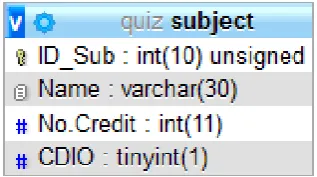
[image:1.595.347.506.618.706.2]This table contains information about subjects. Table structure is described in Figure 1.
Figure 1. Structure of Table “Subject”
Developing an Intelligent Quiz System Based on
Genetic Algorithm
2) Table “Learning Outcomes”
This table contains information about learning outcomes. Each learning outcome belongs to a subject. Table structure is described in Figure 2.
Figure 2. Structure of Table “Learning Outcomes”
3) Table “Question”
This table contains information about questions. Each question belongs to a subject. Table structure is described in Figure 3.
Figure 3. Structure of Table “Question”
4) Table “Answer”
This table contains information about answers. Each answer belongs to a question. Table structure is described in Figure 4.
Figure 4. Structure of Table “Answer”
5) Table “Question_LO”
This table describes the relationship between question and learning outcomes. Each question includes some learning outcomes. Table structure is described in Figure 5.
Figure 5. Structure of Table “Question_LO”
B. Proposed Algorithm
In the proposed system, there are three options to support lecturers choose to generate an exam. In the first option, lecturers choose exam time and difficulty level. All generated
questions include whole learning outcomes of subject. In the second option, lecturers choose exam time. All questions of generated exam have different difficulty levels. All generated questions include whole learning outcomes of subject.
In the third option, lecturers choose exam time and percentage of each difficulty level. All generated questions include whole learning outcomes of subject.
Three options to support lecturers choosing conditions is described in Figure 6.
Figure 6. Three options
The proposed algorithm is done in 2 steps. The first step, querying database to extract questions required, the second step uses GA algorithm to generate the questions of exam aim to meet the optimal condition. First, this algorithm queries database to extract the questions meet the requirements. For example, the first option, extracting all questions of chosen subject with chosen difficulty level. Second, the algorithm model is described in Figure 7. This algorithm is implemented with the following phase:
- Initial population phase: This phase creates a 2-dimensional array (MxN), M is the number of individuals, N is the number of extracted questions. M is the rows of array, N is the columns of array. Randomly generating values of 1 or 0 for elements in the array. - Calculating fitness function phase: this phase calculates the fitness function of each individual. The fitness function of each individual is calculated by sum of response time of each question. When the value of the elements in each individual is 1, adding the response time of the corresponding question to the fitness function of that individual.
- Optimized phase: This phase determines the optimal condition for stopping the algorithm. The optimal condition is "the value of fitness function of certain individual equals to the exam time and whole learning outcomes of all questions are also whole learning outcomes of subject".
International Journal of Innovative Technology and Exploring Engineering (IJITEE) ISSN: 2278-3075, Volume-8 Issue-10, August 2019
- Crossover phase: From half of the individual (M/2) with the most optimal fitness function, this phase create next population (M individuals) via crossover. Each pair of parents will be mated randomly to create new offspring. a new population generation is formed from these new offspring.
[image:3.595.69.271.201.444.2]- Mutation phase: This phase performs mutations for some genes of certain new offspring with a low random probability. Mutating some individuals to make diversity within the population and prevent premature convergence.
Figure 7. Proposed Algorithm
III. EXPERIMENTALRESULTS
A Website system is developed to conduct some experiments. This Website is designed and programmed via PHP and MySQL [8]. The optimal condition of these experiments is "the value of fitness function of certain individual equals to the exam time and whole learning outcomes of all questions are also whole learning outcomes of subject". If there is no fitness function value of individuals equal to the exam time, error rate less than 5% between the value of fitness function of certain individual and the exam time is the optimal condition.
A. The first Experiment
In this experiment, lecturers choose the first option with the exam time of 30 minutes. The exam generated with the exam time of 30 minutes and “Easy” level is described in Figure 8 in Vietnamese. The exam generated with the exam time of 30 minutes and “Medium” level is described in Figure 9 in Vietnamese. The exam generated with the exam time of 30 minutes and “Hard” level is described in Figure 10 in Vietnamese.
[image:3.595.139.474.469.641.2]Figure 9. Exam time of 30 minutes and “Medium” level
Figure 10. Exam time of 30 minutes and “Hard” level
[image:4.595.41.288.536.618.2]In this experiment, lecturers generated 50 exams with "easy" level and the exam time of 30 minutes for different subjects, 50 exams with "medium" level and the exam time of 30 minutes for different subjects, 50 exams with "hard" level and the exam time of 30 minutes for different subjects. The experimental results are shown in Table 1.
Table 1. The experimental result of the first experiment Level The number of
exams with exact time
The number of exams with error 5% time
Accur acy Rate
Easy 48 2 96%
Medium 49 1 98%
Hard 49 1 98%
As a result of table 1, it found that the accuracy rate of generating exams achieves 97.3%.
B. The second Experiment
In this experiment, lecturers generated 50 exams with the exam time of 30 minutes for different subjects, 50 exams with the exam time of 40 minutes for different subjects, 50 exams with the exam time of 50 minutes for different subjects, 50 exams with the exam time of 60 minutes for different subjects. The experimental results are shown in Table 2.
Table 2. The experimental result of the second experiment
Exam time (minutes)
The number of exams with
exact time
The number of exams with error 5% time
Accur acy Rate
30 50 0 100%
40 48 2 96%
50 48 2 96%
60 47 3 94%
As a result of table 2, it found that the accuracy rate of generating exams achieves 96.5%.
International Journal of Innovative Technology and Exploring Engineering (IJITEE) ISSN: 2278-3075, Volume-8 Issue-10, August 2019
[image:5.595.101.506.46.474.2]Figure 11. Exam time of 30 minutes
Figure 12. Exam time of 40 minutes
C. The third Experiment
[image:5.595.46.291.635.774.2]In this experiment, lecturers generated 50 exams with 50% "easy" level, 30% “medium” level, 20% “hard” level and the exam time of 30 minutes for different subjects; 50 exams with 20% "easy" level, 50% “medium” level, 30% “hard” level and the exam time of 30 minutes for different subjects; 50 exams with 30% "easy" level, 20% “medium” level, 50% “hard” level and the exam time of 30 minutes for different subjects. The experimental results are shown in Table 3.
Table 3. The experimental result of the third experiment
Level The number of
exams with exact time
The number of exams with error 5% time
Accurac y Rate
50% Easy, 30% Medium 20% Hard
48 2 96%
20% Easy, 50% Medium 30% Hard
48 2 96%
30% Easy, 20% Medium 50% Hard
47 3 94%
AS a result of table 3, it found that the accuracy rate of
generating exams achieves 95.3%.
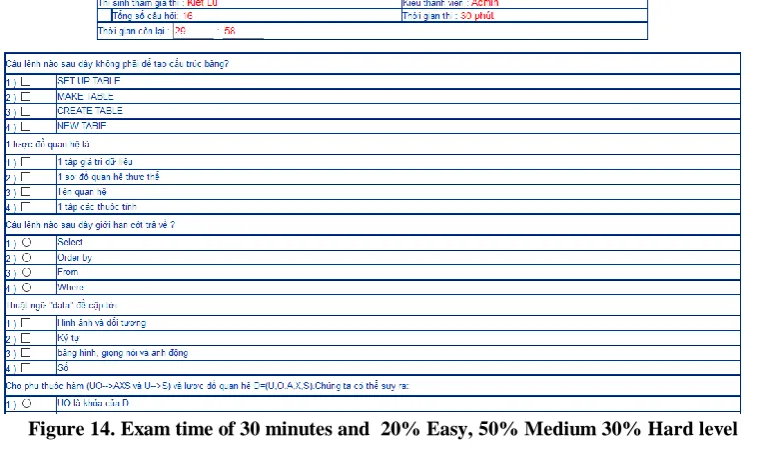
The exam generated with the exam time of 30 minutes and 50% Easy, 30% Medium, 20% Hard level is described in Figure 13 in Vietnamese. The exam generated with the exam time of 30 minutes and 20% Easy, 50% Medium, 30% Hard level is described in Figure 14 in Vietnamese. The exam generated with the exam time of 30 minutes and 30% Easy, 20% Medium, 50% Hard level is described in Figure 15 in Vietnamese.
D. Discussion
Figure 16. The accuracy rate of generating exams
IV. CONCLUSION
This paper proposed a novel solution based on genetic algorithm to develop an intelligent quiz system. This solution is experimented with website system via PHP and MySQL. The experimental result obtains very good with the accuracy
rate of 95%. In the near future, this work will be improve the proposed algorithm at crossover and mutation phase to increase the accuracy rate. Moreover, we also experiment with bigger datasets to evaluate the proposed algorithm exactly and overcome its disadvantages.
ACKNOWLEDGMENT
[image:6.595.112.486.297.479.2]The authors thank reviewers for their reading of our manuscript and their insightful comments and suggestions
Figure 13. Exam time of 30 minutes and 50% Easy, 30% Medium 20% Hard level
[image:6.595.111.494.510.734.2]International Journal of Innovative Technology and Exploring Engineering (IJITEE) ISSN: 2278-3075, Volume-8 Issue-10, August 2019
Figure 15. Exam time of 30 minutes and 30% Easy, 20% Medium, 50% Hard level
REFERENCES
1. Guide to AUN-QA Assessment at Programme Level, ASEAN University Network (AUN), Version No. 3.0, October 2015.
2. Learning Outcomes Available:
https://eua.eu/component/tags/tag/77-learning-outcomes.html
3. Haupt, R. L., & Haupt, S. E. (2004).Practical Genetic Algorithms(2nd ed.).
Hobo-ken: Wiley.
4. Simon, D. (2013).Evolutionary Optimization Algorithms: Biologically-Inspired andPopulation-Based Approaches to Computer Intelligence.Hoboken: Wiley.
5. R. Oftadeh et al. (2010), "A novel meta-heuristic optimization algorithm inspired by group hunting of animals: Hunting search", 60, 2087–2098. 6. Hasançebi, O., Kazemzadeh Azad, S. (2015), "Adaptive Dimensional
Search: A New Metaheuristic Algorithm for Discrete Truss Sizing Optimization", Computers and Structures, 154, 1–16.
7. Genetic Algorithm. Available:
https://towardsdatascience.com/introduction-to-genetic-algorithms-includi ng-example-code-e396e98d8bf3
8. Laura Thompson and Luke Welling, PHP and MySQL Web Development,
Addison-Wesley Professional; 4 edition (October 11, 2008).
AUTHORSPROFILE
Van Kiet Huynh received B.Sc. degree inComputer Science fromHo Chi Minh City University of Transport, Viet Nam.
Currently, He is preparing to get a M.Sc degree in Computer Science. His current research interests include optimal algorithm, Soft Computing and Artificial Intelligence.