“Today’s teenagers
are more engaged
with social issues
than ever …”
INTRODUCING GENERATION
CITIZEN
Jonathan Birdwell
Mona Bani
Every 15 to 20 years a new generation emerges. As the last of Generation Y moves into adulthood we are on the cusp of a new generation materialising. This report presents the first detailed look at the last cohort of Generation Y, young people between the ages of 14 and 17, to determine what we can learn about the next generation to come.
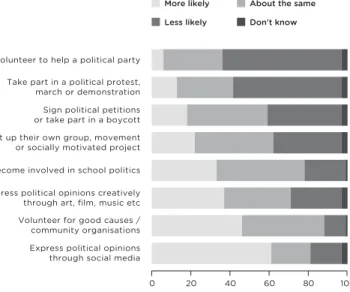
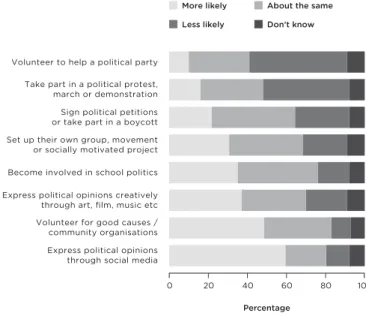
Headlines often focus on the difficult future that the next generation are facing; a future clouded by a competitive and fast-changing labour market, increasing housing and education costs, and new pressures from social media. Yet, instead of taking to the streets in anger, our research suggests that many young people are having a positive impact through social enterprise, social media and volunteering. Teachers, who know young people better than most, describe them as ‘caring’, ‘enthusiastic’ and ‘hard-working’ and believe that teenagers today are more likely to volunteer for good causes and set up their own group, movement or socially motivated project than previous generations.
This report calls for a new narrative around today’s young people. Teenagers and teachers believe that too often
policymakers and the media paint an unflattering portrait of teenagers. Four out of five young people feel that this impacts on their ability to get a job. Our research suggests that teenagers are motivated to make a difference in their
community but the tools they use and the approach they take is different from those of previous generations. They value bottom-up social action and enterprise over top-down politics. The report calls on policy makers to recognise these new forms of activism and engagement and ensure that all young people in the UK have an opportunity to take part in high quality social action.
Jonathan Birdwell is Head of the Citizenship and Political Participation programme at Demos. Mona Bani is a Demos Associate. Intr o ducing G eneration Citizen | Jonathan Bir
dwell · Mona Bani
ISBN 978-1-909037-53-3£10
This project was supported by:
thinkers and host thought-provoking events. We have spent 20 years at the centre of the policy debate, with an overarching mission to bring politics closer to people.
Demos is now exploring some of the most persistent frictions within modern politics, especially in those areas where there is a significant gap between the intuitions of the ordinary voter and political leaders. Can a liberal politics also be a popular politics? How can policy address widespread anxieties over social issues such as welfare, diversity and family life? How can a dynamic and open economy also produce good jobs, empower consumers and connect companies to the communities in which they operate?
Our worldview is reflected in the methods we employ: we recognise that the public often have insights that the experts do not. We pride
ourselves in working together with the people who are the focus of our research. Alongside
quantitative research, Demos pioneers new forms of deliberative work, from citizens’ juries and ethnography to social media analysis.
Demos is an independent, educational charity. In keeping with our mission, all our work is available to download for free under an open access licence and all our funders are listed in our yearly
First published in 2014 © Demos. Some rights reserved
Magdalen House, 136 Tooley Street, London, SE1 2TU, UK
ISBN 978 1 909037 53 3 Series design by modernactivity Typeset by Chat Noir Design, Charente Printed by Lecturis, Eindhoven
Set in Gotham Rounded and Baskerville 10
Open access. Some rights reserved.
As the publisher of this work, Demos wants to encourage the circulation of our work as widely as possible while retaining the copyright. We therefore have an open access policy which enables anyone to access our content online without charge.
Anyone can download, save, perform or distribute this work in any format, including translation, without written permission. This is subject to the terms of the Demos licence found at the back of this publication. Its main conditions are:
· Demos and the author(s) are credited
· This summary and the address www.demos.co.ukare displayed · The text is not altered and is used in full
· The work is not resold
· A copy of the work or link to its use online is sent to Demos
You are welcome to ask for permission to use this work for purposes other than those covered by the licence. Demos gratefully acknowledges the work of Creative Commons in inspiring our approach to copyright. To find out more go to
Acknowledgements 7
About NCS
9Foreword
11Executive summary
13INTRODUCTION
271
Defining Generation Y
31FINDINGS
432
The impact of negative media portrayals
453
Social versus political engagement
514
Issues facing teenagers and who they look
up to
615
New methods of engagement – social media
and social action
67RECOMMENDATIONS
83TECHNICAL APPENDIX
91Notes 99
Acknowledgements
This report would not have been possible without the support of NCS Trust. In particular we would like to thank Carole Breen, Natasha Kizzie, Michael Lynas, Tracey Paul and all
the other colleagues who provided support and helpful comments throughout.
Thank you very much to the teachers and students who took part in our focus groups, and everyone in the schools that assisted us in their organisation. Thanks as well to Schoolzone and Populus Data Solutions for the teacher and teenagers surveys, respectively.
At Demos we would like to thank Hannah Ashley, Alexandra Barker, Ayman Khokhar, Riccardo Liberatore, Asad Rahman, Neil Stephenson, Ian Wybron and especially Kate Kipling for all their hard work. We'd also like to thank Duncan O'Leary and Claudia Wood for helpful feedback, and Rob Macpherson and Ralph Scott for guiding the report through the publication process.
The views expressed in this report represent those of the authors and not necessarily the NCS Trust. As ever, any omissions and errors are solely the authors own.
About NCS
NCS (National Citizen Service) is a once–in-a-lifetime opportunity open to all 15 to 17 year olds across England and Northern Ireland. It is a unique two or three week full-time programme focused around fun and discovery, plus 30 hours committed to a community project that benefits both young people and society. On this government-backed programme, participants build skills for work and life, while taking on new challenges and adventures, making new friends, learning new skills and contributing to their community.
Government backing means that it costs just £50 or less to take part in NCS and bursaries are available on a case-by-case basis. Support is provided for young people with additional needs.
NCS represents great value for money for parents as participants spend up to two weeks away from home with all meals and activities covered. The first week is spent at an outward-bound facility participating in activities such as
abseiling, water rafting and canoeing. The second week teens live away from home, typically at local university halls of residence, learning how to be self-sufficient, developing new skills and finding out more about the needs of their local community.
In 2013, NCS Trust, an independent social enterprise, was established to manage NCS and execute the ambitious
expansion of the government backed programme.
Foreword
We’re on the cusp of a new generation. Today’s teenagers will shape the future of our country and our planet. If you believed the headlines, our outlook would look distinctly gloomy.
We know the next generation faces some real challenges. They’ve grown up in the shadow of the financial crash and live in a globally competitive world. From the media debate it some-times seems that our teens are at best feckless and at worst feral.
The teenagers I meet through National Citizen Service (NCS) couldn’t be further from these stereotypes. They are committed, connected and caring. They are responding to the challenges of the future not just by buckling down but also by giving back. During the three years of NCS, over 70,000 teens have come together in their holidays to put back over one million hours to make their mark in their communities.
When I spoke out against the stereotypes, the cynics told me that the people signing up for NCS were the exception: the good apples in a rotten basket. At NCS, we wanted to prove them wrong and that’s why we commissioned this report from Demos.
The report shows the true face of the next generation. On just about every indicator, the popular stereotypes are wrong. Today’s teenagers are shown to be behaving more responsibly when it comes to drink and drugs; caring more about social issues both at home and abroad; and being more willing to get out and take action to make their world a better place.
brings young people from different backgrounds together in common purpose – building bridges across divides and ladders to opportunity. That’s why more and more of us believe that NCS should be a national institution available to every teenager.
The false stereotypes about the next generation are not only grossly unfair, they are also holding them back. Something incredibly powerful is happening among the teenagers of our country. If we understand it and harness its power, then we will all reap the benefits. That’s why I’m proud to be setting the record straight and introducing Generation Citizen.
Michael Lynas CEO, NCS Trust
Executive summary
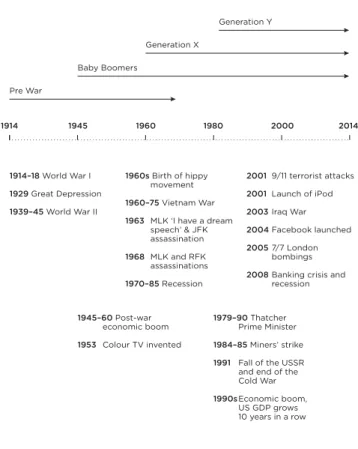
A new generation emerges every 15 to 20 years. Teenagers today (between the ages of 14 and 17) are the last cohorts of Generation Y (figure 1). In this report, we present the first ever look at this cohort in order to determine what insights we can derive about the next generation to come.
Teenagers today are ‘digital natives’. Social media and new technologies have transformed the way that they view the world, politics and possibilities for the future. At the same time, they are growing up in the ‘age of austerity’: they face increasing
education and housing costs as well as a rapidly changing and highly competitive labour market.
It has been argued that young people today are apathetic,
selfish and narcissistic.1And yet, the research presented in this
report shows that, contrary to negative stereotypes, today’s teenagers are characterised by their tolerance, compassion and motivation to tackle social issues.
Teachers are overwhelmingly positive about them, describ-ing teenagers as ‘cardescrib-ing’, ‘enthusiastic’ and ‘hard workdescrib-ing’. They are volunteering more. The Cabinet Office’s Community Life Survey for 2012–13 showed that 16–19-year-olds reported
substantial increases in annual formal and informal volunteering,
up 16 and 15 percentage points respectively from 2010 to 2011.2
They are also behaving more responsibly over alcohol and drugs than generations of teenagers over the past 15 years.
Our research suggests that teenagers are motivated to make a difference in their community but the tools they use and the approach they take is different from those of previous
and social enterprise over top-down politics. As digital natives, they are accustomed to speed and responsiveness and desire a politics that engages them at the same pace. If given the right opportunities and support, today’s teenagers might just transform our notions and expectations of active citizenship.
Some have referred to the next generation as ‘Generation C’ because they will be the most ‘connected’ generation in
history.3Our research suggests that the letter ‘C’ is apt for
another reason: because this cohort could include the most active citizenswe have seen in a generation. This report thus introduces the great generation that will shape the next century: Generation Citizen.
Executive summary
Figure 1 Timeline of Generation Y and the Generation Citizen
Findings
The research presented in this report is based on a new representative survey (n=1,000) and three focus groups of British teenagers between the ages of 14 and 17 years old. We also conducted a survey (n=500) and three focus groups with teachers.
Below we present the most interesting and surprising top ten findings to emerge from our research.
1 Today’s teenagers are more engaged with social issues both globally and locally than previous generations of teenagers
Their access to knowledge and news through social media suggests that teenagers are highly aware and concerned about social issues:
· Four out of five teenagers in our survey (80 per cent) thought that their generation was more concerned about social issues than previous generations of teenagers.
· This view was also held by a majority of teachers: 56 per cent of teachers thought that 14- and 15-year-olds were more engaged in social issues than their generation was, and 66 per cent of teachers thought this about 16- and 17-year-olds.
Teachers also thought that those in the current genera-tion of teenagers were more active volunteering than their own generation:
· A large majority –88 per cent – of teachers in our survey (two-thirds of whom were between 30 and 50 years old) thought that current teenagers were more likely or as likely as their generation was to volunteer for good causes and organisations, with almost half of teachers saying they were more likely to
do so.
2 Teenagers see themselves as less engaged with traditional politics than previous generations of teenagers, and teachers agree
While teenagers are seen as more engaged in social issues than previous generations, they do not think that traditional politics is the most effective means of tackling social issues:
Executive summary
· Only one in three teenagers (35 per cent) felt that their generation was more interested in politics than previous generations of teenagers.
· Teachers shared this view. Only one in five thought that 14- and 15-year-old teenagers were more engaged with politics, while just under one in three thought that 16- and 17-year-old teenagers were more engaged with politics.
· Moreover, only half of teenagers thought that traditional politics was ‘an effective way to respond’ to their concerns.
· At the same time, young people overwhelmingly disagreed with
Russell Brand’s recent call not to vote:484 per cent of teenagers
said they intended to vote when they turn 18.
Against the backdrop of falling turnout among first time voters in recent elections, some commentators have asserted that young people are irreversibly turned off politics. Our research confirms that Generation Citizen are less engaged with traditional politics. However, the research also suggests that young people are open to being engaged in politics and still see voting as a civic duty. Moreover, young people are committed to effecting change through digital engagement, social action and social enterprise.
3 Teenagers see charities and social enterprises, alongside personal volunteering and social action, as the most important agents for positive change in their local communities
Our survey suggests that teenagers have a stronger sense of individual responsibility and are looking to other actors in society instead of government to make a difference:
three out of five teenagers cited ‘charities and social enterprises’ compared with just one in ten who cited politicians.
· Approximately one in three teenagers felt that campaigners (32 per cent) and businesses (31 per cent) had the most positive impact in their communities.
· Moreover, two-thirds (64 per cent) of teenagers thought that by getting involved themselves they could make a positive
difference to social issues in their local community.
4 Today’s teenagers are highly active through volunteering and other forms of social action
The Community Life Survey for 2012–13 showed a significant increase in annual formal and informal volunteering rates among
16–19-year-olds compared with 2010–11.5While our figures are
not directly comparable for methodological reasons, our survey also demonstrates high levels of volunteering and civic
engagement among teenagers:
· Almost two-fifths (37 per cent) of teenagers reported that they had volunteered either formally (through an organisation or group) or informally (of their own initiative) in the past year. · Over half of teenagers (56 per cent) reported that they had raised
money for charity; 35 per cent had signed a petition to support a local or national issues; and a third (33 per cent) helped an organisation such as a local charity.
· Three out of four teenagers (76 per cent) – including many who did not report volunteering – expressed a desire to participate in a high quality social action and volunteering programme.
5 Teenagers who volunteered reported higher levels of wellbeing, social cohesion and employability
Our survey adds to the large body of evidence showing that young people who do volunteer overwhelmingly report a wide range of benefits:
‘work better in a team’ or ‘improved their self-confidence’. · Over 80 per cent said it improved their future employment
chances and made them want to volunteer more.
· Over 70 per cent thought it improved their motivation in school and desire for future education.
· The views of these teenagers also suggests that their experience volunteering helped forge social mixing and cohesion, by changing teenagers’ views of other groups in society (79 per cent) and helped to create friendships with people they would not have otherwise met (86 per cent). This is especially important because UK schools have been deemed among the
‘most socially segregated in the developed world’.6
Teachers also overwhelmingly see the benefit of volunteering and social action programmes for teenagers:
· Nearly all (90 per cent) of the teachers agreed that taking part in social action or volunteering has inherent benefits for teenagers’ personal and social development.
· Nearly as many (88 per cent) thought that social action or volunteering is the best way for their pupils to improve their soft skills and build character, which are beneficial for the workplace. · More than two-thirds (70 per cent) reported that taking part in
social action or volunteering led to better engagement with social issues, while over 60 per cent reported that it enhanced the school’s relationship with the community and led to stronger and more cohesive communities.
· Just under half of teachers (45 per cent) reported that social action made young people become better learners as a result of taking part.
While many teachers in our sample thought that their schools encouraged active citizenship, a very large majority expressed desire for further support in encouraging their students to participate in social action:
· Over 90 per cent said they would welcome more support with 35 per cent expressing a strong desire for more support.
6 Although teenagers prefer real world engagement in their communities, teenagers are increasingly using social media for social action
Young people are increasingly turning to social media for civic engagement. In our survey, substantial proportions of teenagers reported using social media for activities like raising awareness and funds for charity, and expressing support for political causes:
· More than one in three (38 per cent) said they had signed a petition online; 29 per cent had used Facebook or Twitter to raise awareness of a cause; 21 per cent had ‘liked’ a political cause or group that they agreed with; and 19 per cent had donated money online (eg through a JustGiving website). · This trend is already being noticed by teachers: 57 per cent say
that they noticed teenagers are using social media to become involved in politics and good causes.
The online space will become an increasingly important platform for young people to engage in politics and social issues:
· A large majority (87 per cent) of teenagers agreed that using social media was an effective way to gain momentum behind social issues, while 71 per cent believed that social media were just as important as more traditional ways for raising awareness of social issues.
· The majority of teachers (84 per cent) also believe that these new networks and forms of engagement are or can be just as effective as traditional forms of engagement (eg joining a political party or voting).
7 Getting a job, living costs and bullying concern teenagers the most
As noted above, there is increasing focus from media and policy makers about the challenges that younger generations are facing. For our research, we wanted to know which social issues
concerned teenagers the most. We found that the social issues that teenagers are most concerned about are:
· unemployment and access to work (43 per cent) · living costs (34 per cent)
· bullying (28 per cent) · crime (27per cent) · student debt (23 per cent)
However, there were notable differences across the different age groups:
· As teenagers grow older, concerns over getting a job and living costs steadily increase, with around 50 per cent of 16- and 17-year-olds citing getting a job as their number one concern and concerns over student debt also increasing.
· Bullying was the biggest concern among 14-year-olds, with over 40 per cent citing it as a top three concern, followed by crime and getting a job. Image pressures and drugs and alcohol abuse were also more likely to be cited by 14-year-olds than other ages. · The findings from our focus groups suggest that immigration
and integration concern young people, particularly in the northwest of England.
Teachers’ views about what teenagers are concerned about generally mirrors those of teenagers themselves:
· Teachers view image pressures and bullying as the biggest issues facing students between 14 and 15 years of age at key stage 4; they view student debt as one of the biggest issues facing 16- and 17-year-olds.
8 Teenagers see negative media portrayals as having a detrimental impact on their lives and future
Faced with these challenges it is important that teenagers do not feel they are on the margins of society. However, our research suggests that teenagers – and teachers – feel they are too often negatively stereotyped and this affects how they engage with the world around them:
· A large majority (81 per cent) of teenagers considered that they were negatively presented in the media and this was having an adverse impact on their lives:
· 85 per cent thought it affected employment opportunities · 62 per cent thought it made them less willing to reach out
to those outside of their peer group
· 58 per cent thought that it made them less actively engaged in their community.
Teachers also considered that the media portray young people in an exceedingly negative light:
· Two-thirds of teachers thought that the media portray teenagers as ‘lacking in respect’; 58 per cent thought that teenagers were portrayed as ‘lazy’; and just over half thought they were portrayed as ‘anti-social’.
Moreover, they disagreed strongly with these stereotypes and were much more likely to describe teenagers in compellingly positive terms:
· The most common characteristics of today’s teenagers according to teachers were ‘caring’ (48 per cent), ‘enthusiastic’ (44 per cent) and ‘hard working’ (43 per cent) – in direct contrast to media stereotypes.
9 Teenagers desire careers that change the world for the better and help people less fortunate and the majority are ethical consumers
In addition to their motivation to volunteer, teenagers continue to follow in the footsteps of Generation Y and express their social conscience through the choices they make as consumers and in the careers that they aspire to:
· Three out of four teenagers (77 per cent) said that being happy with the ethical record of their employer was essential.
· A further 70 per cent said that it was important that they were involved in a career that helped change the world for the better.
· Three out of five teenagers specifically aspired to a career that helped people less fortunate than themselves.
· While making money was still important to most (83 per cent of) teenagers, possibly reflecting their concerns about living costs, they are clearly still strongly motivated for careers that go above and beyond financial security.
Teenagers also continue to reflect a community conscience through their choices as consumers:
· Our survey also found that a majority of today’s teenagers (61 per cent) considers a company’s ethical record and reputation before buying a product or service.
10 British teenagers cite inspirational leaders and celebrities who use their fame for positive action as role models
Finally, we wanted to know who in the public eye teenagers look up to most as role models:
· Nelson Mandela was by far the most cited individual, followed by Barack Obama and David Beckham.
· While one in four teenagers mentioned celebrities, such as singers, actors, TV presenters, comedians and footballers as their role models, nearly two-thirds of them did not meet this preconception and those who were cited were primarily those who have used their fame to back worthwhile social
causes. The actress Jennifer Lawrence, for example, was often cited as promoting a healthy body image and David Beckham was described as being a family man alongside his thriving career.
· Teenagers also cited a wide variety of other role models,
including politicians, royals, parents, teachers, entrepreneurs and people who do something worthwhile for society.
· One in five teenagers stated that they had no role models in the public eye and many stated specifically that they did not admire celebrities.
Recommendations
With the right support, the next generation can become confident and active citizens with the motivation and know-how to effect real and lasting change. To facilitate this and capitalise on the positive shift we are seeing, Demos makes the following recommendations.
Policy makers and the media should lead the way in establishing a new, more positive narrative about the next generation
The findings of our research provide the basis for a more positive and true-to-reality narrative to describe the next generation. This is important because both teachers and teenagers believe that this negative portrayal is having a detrimental impact on how young people engage with the world around them and possibly prevents them from getting jobs. Politicians and the media can help to shift the narrative by more frequently and consistently highlighting the positive actions and attributes of the next generation. We challenge the media in particular to give young people more of a voice on the social issues of the day –
particularly those with relevance to young people. As the British
Youth Council puts it, ‘Talk to us not about us.’ The Evening
people that focuses on hope, empowerment and investment in their potential.
Social action should be at the heart of every young person’s experience
Our research shows that volunteering and social action can have huge benefits for teenagers’ confidence, motivation and personal development. It could also help to engage them with the
political process, build skills that will help them compete in a competitive labour market, and encourage more integrated communities. While many young people are already involved in social action, the opportunity to take part is still unevenly spread throughout the country. Some schools have embraced social action, but not all have the capacity to do so and our research shows that teachers want more support. The recently launched Step Up To Serve campaign, of which National Citizen Service (NCS) is a part, aims to increase the number of young people
taking part in social action to 50 per cent by 2020.7While all
three political parties have supported Step Up To Serve, it is vital that they commit sufficient and ambitious levels of investment in social action in their 2015 election manifestoes.
Teachers need more support and opportunities to take part in social action, and those that do should be given more recognition
As part of the Step Up To Serve campaign, Ofsted has pledged to ensure that schools are assessed on the provision of
opportunities for taking part in social action. While this type of signal from above is important, it has to be underlined by greater support for schools to take part in social action. Our research shows that there is also a significant desire among teachers to take part in social action, but that they need more support to do so. Part of this support can come from engagement with external organisations that specialise in delivering social action. This is important because, while schools have a key role to play in supporting social action, social action must also take part outside the school environment and in local communities. Past Demos
research suggests that schools that embrace social action stress the importance of forging partnerships with outside
organisa-tions providing social action, such as NCS and Citizens UK.8
More radical reforms should also be considered, such as embedding social action into school curriculums. The experience in Canada and Scotland, where social action has been integrated into the curriculum, suggests that this can lead to high levels of engagement, with both young people and teachers recognising the benefits.
Employers and the CBI should continue to champion the value of volunteering and social action and give greater emphasis to employer-supported volunteering schemes and integrating social action into apprenticeships
Government and political parties need to give greater recognition to the new methods of social engagement that appeal to younger generations, and consider reforms to channel this energy into traditional political engagement
As Universities Minister David Willets has argued, politicians need to find a way to speak directly to young people about the
issues they care about.9To do this, government and politicians
need to give greater recognition to the mechanisms that young people use to express their voice and make positive change in their communities. Our research suggests that this includes everything from participating in social action and volunteering, becoming involved in youth-led charities and political forums like the UK Youth Parliament, and participating in a variety of social media campaigns. All of these new forms of expression and engagement offer avenues for politicians to engage with young people through the methods that they believe will have greatest impact. Yet, while these new methods of engagement need to be given greater weight, the fact remains that voting and registering to vote is still the primary way in which citizens can ensure that their voice is heard. More needs to be done to ensure that young people are registering to vote and understanding the importance of doing so. Our research suggests that participating in social action, community organising and ‘pavement politics’ is essential to help bridge this gap and potentially motivate young people to engage in traditional politics.
The next generation is already presenting itself as having the potential to lead a revolution in active citizen engagement. We as a society must recognise this and give credit where credit is due, but also give support where support is needed. Doing this will help to ensure that those in the next generation live up to the name that we have given them in this report: Generation Citizen.
INTRODUCTION
This report is about teenagers today: the last cohort of Generation Y (also known as the ‘Millennials’). These young people – between the ages of 14 and 17 – are the link between Generation Y and the next generation (figure 2). Like every cohort at the beginning or the end of a generation, they share much in common with their peers in Generation Y but may also differ in important ways. Their defining feature is the fact that they are ‘digital natives’: unfamiliar with the world prior to Facebook, Google, Amazon, iPhones and Android devices. The internet, smartphones and other technological innovations have brought unlimited access to information and knowledge and an incredible ability to communicate, network and organise. This ability is having a huge impact on how people view and engage with the world around them. Some commentators have begun referring to the next generation as Generation ‘C’, because of
their connectedness.
Today’s teenagers are also facing significant challenges, in part because they are growing up in the shadow of the 2008 global recession. Following the fiscal crisis in the UK, and the Eurozone sovereign debt crisis across Europe, they are growing up in a ‘age of austerity’ where public services in particular are expected to do more with less. According to Duffy and Cameron, there is now ‘universal agreement that the youngest – Generation Y and those who come after them – are expected to bear the brunt of the current economic problems and now cannot expect
an automatically better future’.10
few opportunities in the middle.11A study conducted by the
London School of Economics and the Resolution Foundation found that the number of middle paid roles fell by 170,000 between 2008 and 2012, while the number of low and high paid workers rose by 190,000 to 7.76 million and 140,000 to 6.79
million respectively.12
As jobs in the middle tier have disappeared, and there is an increasing number of young people attending university, some graduates are ending up working in low paying and low skilled
jobs that are likely to be part time or temporary.13Those without
a university degree are having an even tougher time. According to the latest figures covering August to October 2013, over a quarter of a million 16–24-year-olds have been unemployed for 12 months or more, which is 28 per cent of all unemployed
16–24-year-olds.14Research shows that long periods of
Introduction
unemployment can have a scarring effect, which lasts well into adulthood and is estimated to cost the UK £2.9 billion per year
in the future.15As the Prince’s Trust and Macquarie recently
highlighted, long-term unemployment, and the stress related to getting a job, is impacting on many young peoples’ mental
health and leading to high rates of depression.16Teenagers also
have to contend with the consequences of increasingly living their lives online. Cyber bullying and image pressures are now pervasive issues, leading to increasing incidences of eating disorders, depression, self-harming and even suicide.
And yet, as we argue below, many young people appear to be responding to these challenges in an incredibly positive way, by volunteering more in their communities, working to create new businesses themselves, and turning away from alcohol and drugs.
Introducing Generation Citizen
In this report we present the most detailed picture to date of the youngest group of Generation Y. Our research builds on the recent generational research produced by Ipsos MORI’s Social Research Institute and published in October 2013. In their
paper in Understanding Society, Bobby Duffy and Daniel
Cameron make a compelling argument for the importance of generational research to inform policy making. They highlight a number of interesting findings about how Generation Y differs
from previous generations.17In this report we drill down even
further to determine what we can learn about those young people who are currently teenagers and who will serve as the bridge to the next generation.
Generation Y – and teenagers in particular – are often negatively characterised as narcissistic, selfish, apathetic and uninterested in politics and social issues. It is too often assumed that they are more concerned with themselves than with others.
reporting volunteering compared with 2010-11, suggesting that teenagers could be more motivated than ever to get involved
in their communities.18Data also suggest that teenagers and
young people are increasingly choosing to abstain from drugs and alcohol.
This report
In order to explore the defining attitudes, characteristics and aspirations of today’s teenagers, Demos has undertaken a review of existing evidence alongside new primary research with teenagers and teachers. In addition to asking teenagers
themselves, teachers are well placed to provide insights into the current generation of teenagers compared with previous
generations. We commissioned a new survey of 1,000 14–17-year-olds in England and Northern Ireland, as well as a survey of 500 secondary school teachers across the UK. We also conducted three focus groups with teenagers and three focus groups with teachers in order to explore issues in greater detail.
Our research suggests that teenagers are more tolerant, compassionate and likely to volunteer in their communities than previous generations. Yet, their conception of active citizenship differs from previous generations, and the practice of traditional party politics may need to undergo substantial reforms to keep pace.
It is time for society to reassess its image of young people today. They are not the lazy, apathetic, binge drinkers that they are often portrayed to be. This negative stereotype is not only incorrect; it is having a detrimental impact on the way that young people engage with the world around them. It may also be negatively impacting their chances of getting a job. Contrary to this image, they are sober, industrious, entrepreneurial and motivated to make society a fairer and more just place.
1
Defining Generation Y
In this chapter we briefly outline the defining characteristics of Generation Y and the generations that preceded them, including Generation X, Baby Boomers and the Prewar Generation, based on previous research. Figure 3 presents a timeline of the
generations – and the key events they faced – over the past 100 years.
As Skinner et al point out in a recent report, generations share values and characteristics as a result of their shared experiences. These are known as ‘cohort effects’ and are
distinctly different from the change of views, values and opinions that social scientists observe as people get older (known as
‘lifecycle effects’).19There are also changes in society that impact
on all generations, which are known as ‘period effects’, and include things like war or the introduction of the internet.
The dominant experience of those who grew up in the first half of the twentieth century, the so-called Prewar Generation (also known as the Lost Generation in the UK and the Traditionals or Great Generation in the US), was of war, hardship, sacrifice, death and loss. The wars and the Great Depression profoundly shaped their attitudes, values and aspirations. As a result, the Prewar Generation is considered to have worked hard, been unselfish and to have valued security and stability foremost.
rock’n’roll, counter cultural movements and the turmoil of the 1960s: Vietnam, civil rights, assassinations, birth control and ‘free love’. They also valued hard work and financial stability, but began questioning authority and traditional values.
Their children, born between 1960 and 1980, were too young to experience the heady, hippy 60s, and instead came of age in the 1970s and 1980s. Known as Generation X, their experience was not so much free love, but rather the fallout from the 1960s, with economic recessions in the 1970s, and the
Defining Generation Y
dominance of free market capitalism and individualism of the Reagan and Thatcher 1980s. For those who were not on the side of the market, there was radical politics: strikes, protests and punk rock. Those in Generation X were also the shapers of the affluence of the 1990s, when the Cold War ended and a new period emerged, which was famously referred to as the ‘end of history’ because of the triumph of liberal democracy and free market capitalism.
By the time of September 11 2001, the youngest cohort of Generation X was coming out of university and entering the labour market. The early 2000s were marked by turmoil and debate around al Qaeda and the Iraq War, but also a booming economy and the rise of the internet, which would change everything in an incredibly short space of time. Within a matter of years, completely new companies such as Facebook, Google, Twitter, eBay, Apple, Microsoft and Amazon came to dominate our lives in a way that could not have been foreseen.
This brings us to Generation Y, known in the US as the Millennials. Generation Y is the generation born between the years 1980 and 2000. The authors of this report are both members of Generation Y: children of the 1980s, teenagers of the 1990s, and young adults in the 2000s. Much like the youngest members of Generation X, the experience of Generation Y was shaped by affluence and the emergence of new technologies, primarily the internet. The world that those in Generation Y (and the generation that follows them) face is one of unprece-dented technological access and innovation and difficult challenges around unemployment.
The internet, smartphones and other technological innovations have brought unlimited information and knowledge and an incredible ability to communicate, network and organise. The ease with which we can access information, purchase or sell something, post a video for the world to see, or stay in touch with everyone we have ever known is shaping our attitudes and opinions in other areas. Because of these revolutions in
measured by voter turnout and party membership – has been in decline for decades. The frustration and relative apathy that young people have towards government is possibly driven by the fact that they believe they can change the world using these new tools at a greater speed, and government has not maintained the same pace.
The current cohort of teenagers has also grown up in the shadow of the 2008 recession. Between the ages of 14 and 17 now, they were between 9 and 12 years old when the 2008 recession occurred. Although youth unemployment has been on the rise for the past decade it has been exacerbated by the recession: the latest figures from September to November 2013 show that it currently stands at approximately 920,000, or 20 per cent of
16–24-year-olds.20It is worth noting that the increasing
percen-tage of young people remaining in full-time education pushes up the unemployment rate because the size of the economically active population is reduced, and therefore the unemployment rate increases. Nonetheless, commentators and policy makers alike agree that young people are facing challenges relating to high unemployment and under-employment, as well as the
increasing costs of education and housing.21
Before presenting our research in the following chapters, we first briefly outline what previous research has shown about the characteristics of Generation Y.
Who are Generation Y?
Like those in all generations, members of Generation Y have both positive and negative characteristics. On the positive side of the ledger, previous research suggests that those in Generation Y are considered to be much more liberal and tolerant than generations before them. Research by Pew Research Center in the US describes them as ‘confident,
self-expressive, liberal, upbeat and open to change’,22but other
articles have described Generation Y as narcissistic, selfish
and entitled.23
Of course, there is huge variation within these somewhat crude generational characterisations, and while most of them are
suggested as cohort effects, there are also period and lifecycle effects at play. Clearly, someone born in 1982 has very different life experiences from someone born in 1995 – in particular, the way in which they view and engage technology and social media varies considerably. Yet, both are considered Generation Y. There are also obviously differences within generations that emerge out of socio-economic background, regional and cultural variations, and personalities. Nonetheless, everyone of a same age or time has some similar experiences, and they are thus shaped to some extent by those overall societal shifts.
A recent article on Huffington Postby Tim Urban of the blog
Wait But Why struck a chord with a dissection of the Generation
Y cohort.24At the time of writing this report, the article had
almost 1.2 million ‘likes’ and over 250,000 ‘shares’ on Facebook and over 17,000 retweets.
Urban argues that many within Generation Y – partic-ularly those in the middle classes – are frustrated and suffer from depression because of the mismatch between their ambitious expectations and the reality they find themselves in. Urban argues that Baby Boomers – the parents of Generation Y – were focused on working hard over a long period of time with economic security as their primary goal. With many achieving this objective, they wanted more for their children and encouraged them to be more ambitious, ‘with a sense of optimism and unbounded possibility,’ argues Urban. It was assumed that the trend for the next generation to be better off than the previous one would simply continue. However, rising youth unemployment exacerbated by the 2008 recession is leading many commentators to conclude that the next two generations may be worse off than their parents.
Cal Newport, professor at Georgetown University, argues that those in Generation Y have been badly guided by older generations. She contends that excessive use of the career advice to ‘follow your passion’ directed at young people during the 1990s and 2000s was misleading, creating disappointment when perceptions of instant gratification in one’s chosen career
are not realised.25Social media, which allow us to track and
be more successful than us, exacerbates feelings of anxiety and
inadequacy for many, which can often lead to depression.26
However, research has shown that once in employment those in Generation Y are more likely to value teamwork and collective action, are adaptable to change, embrace diversity, are confident with independent working, and desire a good work–life balance.
Gen Y in the workplace
Much of the research into generational differences comes from the perspective of workplace management literature, which aims to help managers understand how best to motivate and work with colleagues of different ages. It often portrays Generation Y workers as a confident, highly educated generation,
entrepreneurial and result driven.27They also value constant and
immediate feedback more than previous generations, which suggests they have a greater resilience and willingness to self-reflect and develop.
A 2008 report by Anick Tolbize from the University of Minnesota found that job titles and authority do not hold the same sway over Gen Y as they did over previous generations. The oldest generation – Traditionals (or the Prewar Generation as described above) – are defined by their conservative views and reliance on structure and order. They believe in a hierarchy where respect is based on experience accrued
through age.28
Baby Boomers are also seen as more likely to respect authority and institutions, and to consider job security as most important when it comes to their career ambitions, similar to the Prewar Generation before them. Younger generations,
particularly Generation Y, are seen as less deferential towards authority, more sceptical about institutions, and desiring careers that offer fulfilment beyond financial security.
The report also stated that those in the younger generation are restless and see themselves as progressing through multiple companies, jobs and even occupations during the course of their lives. For example, only 20 per cent of Generation Y said
they wanted to stay with the same organisation for the rest of their life (versus 40 per cent of Generation X, 65 per cent of Baby Boomers and 70 per cent of the Prewar Generation). They
are also impatient for promotion and rapid advancement.29
Finally, unlike the Prewar Generation and Baby Boomers, who were likely to display blind loyalty to an organisation regardless of its values, Generation Y’s loyalty and commitment is more dependent on whether they believe in the idea, cause or
product of that organisation.30As we show in the following
chapters, the same is true of today’s teenagers although they face a highly competitive labour market.
Gen Y and politics
It is well known that views about and engagement with politics changes with age, but recent Ipsos MORI work has pointed out that there also appear to be specific ‘cohort effects’, which can
be seen in Generation Y’s views towards politics.31
One of the most cited characteristics of Generation Y is their increasing disillusionment in the political system and in public institutions. In his article ‘The Outsiders: How can Millennials change Washington if they hate it?’, Ron Fournier talks about the shift in attitudes towards politics among young people in the US. He describes Generation Y as more tolerant of
diversity and less politically ideological than their parents.32
Fournier argues that Millennials or Generation Y do not hold the same regard for the institutions of government as their parents and prefer more personal, entrepreneurial and less formalised ways of exercising their civic duty. As a result, Fournier discusses the very real possibility of ‘brain drain’ within politics and the civil service as Baby Boomers approach
retirement and Millennials or Generation Y look elsewhere in order to change the world.
The fact that Generation Y is less ideological and politically engaged than previous generations can be seen in the decline in political party membership and affiliation. While there is a generational gap among those who support a political party
part be because young people have the impression that politicians generally do not speak to their concerns. A survey
conducted for the Demos report Back to the Futureshowed the
extent to which young people believed that the government made policy with their age group in mind: 54 per cent of young people surveyed believed that the government considered 36–50-year-olds most when formulating policy, 35 per cent believed the government prioritised 21–35-year-olds, while just 7 per cent considered that the government primarily thought about their
own age group (11–20-year-olds) when making decisions.34As
David Willetts (who wrote about generations in his book The
Pinch) has admitted, ‘the challenge for us politicians is to directly speak to [young people] as a group and directly address
their interests’.35
Recent research from Demos and Ipsos MORI has also shown the extent to which those in Generation Y believe more in individual responsibility than those in previous generations and have more sceptical attitudes towards the welfare state. A survey
conducted for the report Generation Strains found that the
percentage of the population agreeing with the statement ‘the government should spend more money on welfare benefits for the poor, even if it leads to higher taxes’ peaked in 1989 and has
been on a downward trajectory ever since.36The report argues
that Generation Y is more likely than other cohorts to believe the role of the state should be less about managing the risks that individuals face and more about providing opportunities, but this appears less to do with younger generations being less compassionate and more with their scepticism towards whether top-down, centralised government can monitor social
requirements effectively and efficiently.
Another survey conducted by Ipsos MORI shows a shift in attitudes towards the welfare state. Pride in the welfare state, as expected, is highest among the Prewar Generation. The survey found that while seven in ten of the Prewar Generation say they are proud of the creation of the welfare state, this is only true of
one in four of those in of Generation Y,37but the same research
showed that these views were not driven by a lack of compassion. In fact, young people were more likely to prioritise spending on
pensions over unemployment benefits, the latter of course being
more relevant to their own situation.38
These findings are supported by the Demos report Back
to the Future, which found that young people prioritised welfare spending on the elderly, feeling that they had earned it after
years of paying taxes and working hard.39The fact that young
people gave precedence to the needs of the elderly above their own, despite being the generation hardest hit by the current economic climate, suggests that far from being selfish, Generation Y may be categorised by altruism and respect for the elderly.
Gen Y on alcohol and drugs
The other significant change we are seeing in young people is a decline in the rates of harmful drinking and drug taking. Despite various reports highlighting a youth culture characterised by
excess,40recent research has shown that alcohol consumption
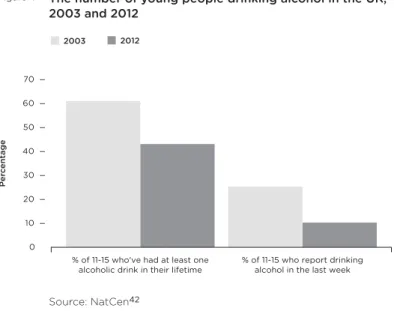
and drug use among young people is actually on a downward trend. Figure 4 shows research conducted by NatCen in 2012,
which found that 43 per cent of pupils aged 11–15 reported
having at least one alcoholic drink in their lifetime, which is a decline from 61 per cent in 2003. Similarly, only 10 per cent reported drinking alcohol in the last week compared with 25 per
cent in 2003.41
A survey by the Office for National Statistics (ONS) identified a similar trend among 16–24-year-old men and women (figure 5). In 2010, 17 per cent of women drank more than six units on their heaviest day of drinking, down from 27 per cent who drank at this level in 2005. The survey found that 24 per cent of men drank more than eight units on their heaviest drinking day in 2010, down from 32 per cent in 2005. Other research shows that some young people are choosing not to drink alcohol at all, as the result of factors including seeing its harmful effects, the prevalence of violence and fighting related to drinking, its high cost, past negative experiences and the media’s
While these trends have been occurring over the past ten years, there was a sharp drop in 2009 and 2010 among 11–15-year-olds, suggesting that lack of employment opportunities, low wages and rises in tuition fees may be contributing to the lower
levels of drinking by young people.45Professor Fiona Measham
from Durham University has argued that Generation Y simply
wants to be different from the one before.46Fraser Nelson of the
Spectatorrecently drew a parallel between these trends and the
TV programme Absolutely Fabulous, where the sober daughter
Saffy was constantly embarrassed by her mother’s drinking and drug taking. Declines in harmful drinking levels among younger age groups also coincide with the rise of social media and technology, which may be providing diversionary activities away from drinking. It is also notable that the percentage of under 16s who are British Muslim – and thus forbidden to drink by their religion – is now 8 per cent compared with 5 per cent in 2001.
Drug use among young people, particularly in the UK, is following a similar pattern. Over the past year reports and
Defining Generation Y
Figure 4 The number of young people drinking alcohol in the UK,
2003 and 2012
surveys have shown that drug use is ‘going out of fashion’.47
According to a 2012 NatCen survey drug use among 11–15-year-olds has also decreased from 29 per cent in 2001 to 17 per cent in
2012.48The 2011 European School Survey Project on Alcohol
and Other Drugs (ESPAD) report, based on surveys of 16-year-old students, found that between 1995 and 2011, there was a 13
per cent decrease in the number that had tried illicit drugs.49
Reports have pointed to the high cost of drugs, young people’s lack of money and the consequences of drug use as factors that are contributing to this decline, reasons similar to those given to explain the reduction in harmful drinking among young people
discussed above.50Demos analysis also suggests that changing
demographics and the rise of social media as a diversionary activity are potentially influential in this decline. Further research is needed, however, to determine if young people are actively choosing to abstain from alcohol and drugs as a
Figure 5 Indicators of heavy drinking among 16–24-year-olds,
2005 and 2011
conscious response to some of the challenges they face (highlighted above) around education and employment.
The next generation: Generation Citizen
With the last of Generation Y now entering adulthood, we are on the cusp of a new generation. While the research above highlights some of the defining characteristics of Gen Y, there has been little research looking at young people who are the last cohort of Generation Y and the first cohort of the next generation. At the tail end of Generation Y, they inevitably share many of the characteristics described above. But they may also be different in surprising and important ways. What we are told about the youngest cohort of Generation Y often comes from the media, and it tends to be negative.
In the chapters that follow we present some of the first research ever looking exclusively at the current generation of teenagers.
FINDINGS: INTRODUCING
GENERATION CITIZEN
In next four chapters we present the findings from our surveys and focus groups with teenagers and teachers. For teenagers, we commissioned Populus Data Solutions to undertake a bespoke survey of 1,000 14–17-year-olds in England and Northern Ireland. This was then supplemented by three focus groups with teenagers at three different schools in the UK: one authority-maintained school in South Yorkshire, one local-authority-maintained school in Liverpool and one independent girls school in London. In total, 38 teenagers took part in our focus groups: 13 boys and 25 girls.
In addition to our research with teenagers, we
commissioned a separate survey of teachers across the UK. This survey was undertaken by Schoolzone and obtained a sample size of 500. We also conducted three focus groups with teachers in the same schools in which we conducted focus groups with teenagers. In total, 10 teachers participated in our focus groups.
2
The impact of negative
media portrayals
As a society, our perception of the attitudes and characteristics of teenagers comes primarily from media. It is commonly stated that the media tend to present an unduly negative impression of teenagers.
A study by Ipsos MORI for Young People Now analysed newspapers for a week in 2005 and found that 57 per cent of stories about youth were negative, with 30 per cent neutral and only 12 per cent positive. The biggest proportion of stories (two out of five) were focused on crime, vandalism and anti-social
behaviour.51Women in Journalism conducted a more extensive
survey of newspapers over a year, focusing on stories about teenage boys. They similarly found a prevalence of negative stories, with more than half (4,374) of the 8,269 surveyed stories related to crime. According to the report ‘teenagers were referred to variously (in descending order of frequency) as yobs, thugs, sick, feral, hoodie [sic], louts, heartless, evil, frightening, scum,
monsters, inhuman and threatening’.52
To explore more recent descriptions of young people, we used word cloud software to explore UK newspaper articles online for the past ten years. We conducted a quick search of six
newspapers – the Guardian, the Telegraph, the Times, the Sun, the
Daily Mailand the Daily Mirror– for stories containing either ‘young people’ or ‘teenagers’. Out of the prominent words listed, those most common across publications included ‘crime (six mentions), those related to alcohol and drunkenness (eleven mentions), smoking and drugs (six mentions), and sex and pregnancy (five mentions). Some of the most frequently occurring words and phrases included ‘binge drinking’, ‘yobs’, ‘immature’, ‘riots’, ‘crime’ and ‘alcohol’.
recent concerns about young peoples’ primarily deal with ‘the decline in mutual respect and social cohesion, the dominance of
anti-social behaviour, materialism and the cult of celebrity’.53She
goes on to argue that all generations have ‘ardently believed that an unprecedented “crisis” in youth behaviour is taking place’ when in fact there is no evidence to suggest that youth are becoming more immoral. She argues that it is such views that often lead to mistrust between generations.
Negative stereotypes holding young people back
These views about young people are also problematic because our research shows that a majority of teenagers believe that negative stereotypes are having a detrimental impact on how they engage with the wider world and their employability.Among the teenagers who responded to our survey, the overwhelming majority (81 per cent) felt that they were
negatively presented in the media. Teachers also thought that the image of teenagers presented by the media was highly negative and contrary to the way teenagers actually behave. Most important is the impact that these negative stereotypes might be having on the way teenagers engage with the world around them.
Our survey found that over half of the teenagers thought that negative media portrayals made them less active in their communities (58 per cent) and less willing to reach out to those outside of their peer group (62 per cent). Most importantly, four out of five teenagers (85 per cent) considered that it harmed their opportunities for employment, and one in four teenagers felt strongly that this was the case (figure 6).
The same views were in evidence in our focus groups with teenagers. Participants unanimously agreed that the portrayal of teenagers was negative and largely incorrect, although some conceded that some stereotypes had some truth behind them. One pupil summed up the general consensus across the three schools by saying that ‘a majority are judged based on a minority’. They suggested that some teenagers were driven to some of the negative behaviours highlighted by the media (eg drugs and alcohol, crime, teen pregnancy) because ‘there’s
nothing to do at our age’. Others blamed these negative behaviours on the way that they were treated by adults and the media reflecting the views above about the self-reinforcing impact of negative stereotypes. One pupil said they were ‘aware that we face more problems now than previous generations’ but that the portrayal of young people as apathetic was not correct.
Teachers’ views
Teachers similarly believed that the media present teenagers in a highly negative light. The most frequently mentioned views offered by teachers on how the media portray young people were ‘lacking respect’ (68 per cent), ‘lazy’ (58 per cent), ‘anti-social’ (54 per cent), ‘lacking direction’ (53 per cent) and ‘apathetic’ (48 per cent). Only 3 per cent of teachers thought the media
Figure 6 The extent to which teenagers think the negative media
portrayal influences their involvement in the community, reaching out to people outside their peer group, and their employment opportunities
portrayed young people as either ‘empathetic’, ‘engaged’, ‘community minded’ or ‘enthusiastic’. Yet, as figure 7 demon-strates, this is precisely how teachers themselves tended to see them.
The same views were expressed in our focus groups with teachers. All of the teachers from the three schools believed that young people have a negative reputation that is not deserved; they also felt that where the reputation has some truth behind it, it is because young people have it tough at the moment with few opportunities or things to do. A teacher from the local-authority-maintained school in South Yorkshire summed up the consensus by commenting that in relation to young people, ‘the media belittles them’ and gives the impression everything is ‘all doom and gloom’. Teachers from the local authority school in
Liverpool took issue with the media descriptions of teenagers as ‘lazy’, ‘obnoxious’, ‘greedy’ and ‘expectant’.
In contrast with media stereotypes, in our survey the most common responses of teachers when asked to describe teenagers were overwhelmingly positive. The most common answers included ‘caring’ (48 per cent), ‘enthusiastic’ (44 per cent), ‘hard working’ (43 per cent) and ‘engaged’ (40 per cent). Figure 7 shows just how divergent the views of teachers on the
characteristics of teenagers are from media portrayals of them. In our focus groups, by far the most positive attribute given to teenagers by teachers was their tolerance of diversity.
We asked teachers to describe the negative characteristics of teenagers. The most common responses were that they lacked self-confidence (33 per cent) and direction (30 per cent). The least common, in direct contrast to the media’s portrayal, were that they were ‘violent’ (2 per cent) and ‘anti-social’ (3 per cent).
Our research suggests that participating in social action and volunteering can help to build confidence, direction and motivation among young people.
In our focus groups, teachers tended to describe teenagers positively and said they had energy, dynamism and potential, but that often this was not put to good use or they were perhaps discouraged. Teachers from one school with a higher proportion of disadvantaged students than the other schools included in our
research noted particular concern about their pupils lack of political understanding: ‘Young people in this area have very little knowledge, awareness or interest in politics.’ They
considered that their pupils did not fully understand the value of money and were more in tune with local issues than global ones.
While negative media stories are somewhat inevitable because of the nature of news, we argue below that more needs to be done to push back against negative stereotypes and highlight the more positive (and true) characteristics of young people. Given their views, there is clearly a role for teachers in this debate. Politicians and the media need to lead the way in creating a more positive narrative for the next generation.
Figure 7 The characteristics of teenagers as viewed by their teachers
compared with the media’s portrayal of them
n=500
3
Social versus political
engagement
One of the key questions that we aimed to uncover with our research was the relationship between young people’s
engagement with social issues on the one hand, and traditional politics on the other. One of the dominant narratives about younger generations is that they are disillusioned with politicians and forms of traditional political engagement. This has led some commentators to conclude that younger generations are lazy, apathetic and self-centred. Our research suggests that this is not the case but that there is instead a growing gap between young people’s interest in social issues (which is increasing) and their engagement via traditional politics (which is decreasing).
While we also reference objective measures of social and political engagement, we were interested to know the extent to which young people considered that they engage with social matters, and the teachers’ views on this. Notably, their views were largely consistent.
Four out of five teenagers in our survey (80 per cent) thought that their generation was more concerned about social issues than previous generations of teenagers and the majority of teachers shared this view: 56 per cent of teachers thought that 14- and 15-year-olds were more engaged in these issues than teenagers of their age in the past, and even more – 66 per cent – thought this of 16- and 17-year-olds (figure 8).
This higher level of engagement is very likely because young people are more aware about social issues affecting all parts of the world because of 24-hour news and the internet.
Many teenagers were also having these discussions online: half of teenagers said they discussed social issues online at least once a month, while one in five said they did so weekly (figure 9).
We discuss teenagers’ use of social media in this manner in more detail below.
Political engagement
As we hypothesised at the outset of this research, the high level of interest in social issues among teenagers is not mirrored by an interest or engagement in politics through traditional methods.
Social versus political engagement
Figure 8 Teenagers’ and teachers’ views on whether teenagers
engage with social issues and traditional party politics more than those of previous generations
Compared with the 80 per cent of teenagers who thought their generation was more interested in social issues than previous generations of teenagers, only one in three teenagers (35 per cent) thought that their generation was more interested in politics than previous generations of teenagers. Teachers agreed. Only one in five considered that 14- and 15-year-old teenagers were more engaged with politics than their generation was as teenagers, while just under one in three thought that 16-and 17-year-old teenagers were more engaged with politics than their generation was as teenagers (figure 8).
However, it is worth noting that disillusionment among young people towards politics is not necessarily as high as is sometimes assumed. Although half of teenagers do not consider politics to be ‘an effective way to respond to’ their concerns, almost two-thirds of teenagers thought they could make a positive difference by getting involved themselves (figure 10).
Figure 9 How often teenagers say they discuss social issues face
to face and on social media
Frequently cited recent research from the Hansard Society showed that only 12 per cent of 18–24-year-olds said they would definitely vote in an election if it were held tomorrow compared
with 40 per cent of the total population.54Our research posed
the question in a different manner and prese