This is the Accepted Version of a paper published in the journal : Molecular and Cellular Proteomics
Sotillo, J. et al, (In Press) Secreted proteomes of different developmental stages of the gastrointestinal nematode Nippostrongylus brasiliensis. Molecular and
Cellular Proteomics
http://dx.doi.org/10.1074/mcp.M113.032276
Secreted proteomes of different developmental stages of the
gastrointestinal nematode
Nippostrongylus brasiliensis
Javier Sotilloa, Alejandro Sanchez-Floresb,c, Cinzia Cantacessia,d, Yvonne Harcuse,
Darren Pickeringa, Tiffany Boucheryf, Mali Camberisf, Shiau-Choot Tangf, Paul
Giacomina, Jason Mulvennaa,g, Makedonka Mitrevah,i, Matthew Berrimanb, Graham
LeGrosf#, Rick M. Maizelse#, Alex Loukasa#
a Centre for Biodiscovery and Molecular Development of Therapeutics, Australian Institute
for Tropical Health and Medicine, James Cook University, Cairns, Queensland, Australia
b Parasite Genomics, Wellcome Trust Sanger Institute, Hinxton, Cambridge CB10 1SA, UK
c Current address: Unidad Universitaria de Apoyo Bioinformático; Instituto de Biotecnología
de la UNAM, México
d Department of Veterinary Medicine, University of Cambridge, Cambridge CB3 0ES, UK e Institute of Immunology and Infection Research, University of Edinburgh, Ashworth
Laboratories, West Mains Road, Edinburgh EH9 3JT, UK
f Malaghan Institute of Medical Research, Wellington 6012, New Zealand g Queensland Institute of Medical Research, Brisbane, Queensland, Australia
h The Genome Institute, Washington University School of Medicine, St. Louis, MO, USA h Department of Medicine, Washington University School of Medicine, St. Louis, MO, USA
# Equally contributing senior authors. Address correspondence to:
Prof. Alex Loukas: [email protected] Prof. Rick Maizels: [email protected] Prof. Graham LeGros: [email protected]
Abbreviations
BLAST, Basic Local Alignment Search Tool
CAP, Cysteine-rich protein, Antigen 5, Pathogenesis-related protein 1 domain DTE, Dithioerythritol
emPAI, exponential modified protein abundance index ESP, Excretory/secretory products
GO, Gene Ontology IAM, Iodoacetamide NEx, whole worm extract OGE, OFF-GEL electrophoresis SCP, Sperm coat protein
Summary
Introduction
Nematodes belonging to the suborder Strongylida are, from an epidemiological and a socio-economic perspective, amongst the most relevant parasites in the world. Within this suborder, species from the genera Necator and Ancylostoma (also known as hookworms) infect more than 700 million people in tropical areas, and are considered to cause one of the most important human helminth infections along with schistosomiasis in terms of disability-adjusted life year’s loss (1-3).
Nippostrongylus brasiliensis (order Strongylida, superfamily Trichostrongyloidea) is
a soil-transmitted nematode, also known as the ‘rodent hookworm’ because of the similarities in life cycle and morphology between this species and the human hookworms Necator americanus and Ancylostoma duodenale. For these reasons, N. brasiliensis has been extensively used as a model to study the immunobiology of
The N. brasiliensis-rodent model has been widely used as a model for human hookworm disease (4, 7-9). As a consequence of L3 migration through the tissues, N. brasiliensis stimulates a profound T helper type 2 (Th2) immune response in the skin,
lungs and intestine, including IgE production increased mucus production and inflammatory cell infiltrates consisting of eosinophils, mast cells, basophils and innate lymyphocytes (10-16). Despite an abundance of studies addressing the mechanistic aspects of rodent immunity to N. brasiliensis infections, there is a distinct paucity of molecular information about the parasite itself. A search of the NCBI database for N. brasiliensis retrieves only 116 proteins (most of them redundant), and an early
transcriptomic analysis (pre-Next Generation Sequencing technologies) described ~1300 expressed sequence tags corresponding to 742 distinct genes (17).
Experimental procedures
Parasite material
N. brasiliensis was maintained in Sprague-Dawley rats as previously described (4, 19)
and in accordance with UK Home Office and local Ethical Review Committee approvals. Infective L3s were prepared from two-week rat faecal cultures with careful preparation to ensure 100% viability. Adult worms were recovered from gastrointestinal tissue using a Baermann apparatus on day 6 post-infection following subcutaneous injection of 3,000 infective L3. In addition, eggs and lung-stage larvae were included in the transcriptomic analysis to ensure that transcripts encoding proteins present in the subsequent L3 and adult worm secretomes were fully represented.
RNA sequencing and transcript annotation
The RNA extraction was performed as described previously by Harcus et al. (17). Briefly, total RNA was extracted from different stages of N. brasiliensis (egg, L3, L4 and adult) and homogenized in 1 ml Trizol (Gibco Life Technologies). The
stages. Also, downstream analysis for transcript abundance estimation and differential expression between life stages was performed following the protocol described in (21). Reconstructed transcripts were annotated using the Trinotate pipeline (http://trinotate.sourceforge.net/), a blastx search against the NEMBASE4
(http://www.nematodes.org/nembase4/), and against the entire genome sequence of the human hookworm N. americanus (18) to confirm their origin and rule out contamination from host or bacterial sources. Proteins were then conceptually translated from the predicted coding domains of individual cDNA sequences.
Isolation of ESP
Adult worms and L3 were recovered in saline at 37°C, washed 6× in saline and 6× in RPMI-1640 containing 100 µg/mL penicillin and 100 U/mL streptomycin (complete medium), and viability was determined by microscopy. The collection of ESP from L3 larvae and adult worms in vitro followed previously described protocols (6, 22). Briefly, parasites recovered as above were cultured in complete medium supplemented with glucose (to 1%), at 37°C in an atmosphere of 5% CO2. Supernatants were collected daily from worms cultured for 2-7 days, pooled,
centrifuged at 400×g for 5 min to remove any eggs, passed through a 0.2 µm Millex filter, concentrated over a 10,000 Da Amicon membrane, and stored at ~1.0 mg/mL in
PBS at -80°C until required. N. brasiliensis adult worm somatic extract (NEx) was prepared by homogenisation on ice of freshly-isolated adult worms in PBS followed by centrifugation at 12,000×g for 30 min and recovery of the supernatant.
and extracts were combined and dried in a vacuum centrifuge. Samples were desalted and concentrated using Zip-Tip® (Merck Millipore) and eluted in ~5 µL of 50% acetonitrile 0.1% TFA before mass spectral analysis.
Two-dimensional differential in-gel electrophoresis
The adult and L3 ESP from N. brasiliensis (5 µg) were labelled with CyDye DIGE Fluor (minimal dyes) Cy3 (green) and Cy5 (red) respectively according to the manufacturer’s instructions. Samples were combined and subjected to IEF using IPG strips (7 cm, pH 3-10 - source) under the following settings: rehydration for 14 h at room temperature, 300 V for 30 min, 1000 V for 30 min and gradient to 5000 V for 2 h and followed by a second dimension separation in a NuPAGE Novex 4-12% Bis-Tris ZOOM protein gel. The gels were scanned using Fujifilm Image reader FLA-5000 series V1.0.
OFFGEL electrophoresis
24-well format) (Agilent Technologies) according to the manufacturer's protocols. The digested proteins were diluted in peptide-focusing buffer to a final volume of 3.6 mL and 150 µL of sample were loaded into each of the 24 wells. The sample was focused in a current of 50 µA until 50 kilovolt hours (kVh) was reached. Peptide fractions were collected, dried under a vacuum centrifuge and resuspended in 10 µL of 0.1% TFA. Finally, samples were desalted using Zip-Tip® (Merck Millipore) and dried again under a vacuum centrifuge.
Mass spectrometry and protein identification
An AB SCIEX TOF/TOF 5800 mass spectrometer (Applied Biosystems) was used for acquiring MALDI-MS/MS data from gel spots, and samples without a positive identification were analysed by LC-MS/MS. ESP separated by OFFGEL were analyzed by LC-MS/MS on a Shimadzu Prominance Nano HPLC coupled to an AB
SCIEX Triple Tof 5600 mass spectrometer (Applied Biosystems) equipped with a
nano electrospray ion source. Six microliters of sample was injected onto a 50 mm
300 µm C18 trap column (Agilent Technologies). The samples were desalted on the
trap column for 5 min using 0.1% formic acid (aq) at 30 µL/min. Peptides were then eluted onto an analytical nano HPLC column (150 mm x 75 µm 300SBC18, 3.5 µm, Agilent Technologies) at a flow rate of 300 nL/min and separated using a 35 min
gradient of 1-40% buffer B followed by a steeper gradient from 40%-80% buffer B in
5 min. Buffer B contained 90/10 acetonitrile/ 0.1% formic acid, and buffer A
consisted of 0.1% formic acid (aq). The mass spectrometer acquired 500 ms full scan
TOF-MS data followed by 50ms full scan product ion data in an Information
Dependent Acquisition, IDA, mode. Full scan TOFMS data was acquired over the
TOF-MS scan exceeding a threshold of 100 counts and a charge state of +2 to +5
were set to trigger the acquisition of product ion, ms/ms spectra of the resultant 20
most intense ions. The data was acquired and processed using Analyst TF 1.6.1
software (ABSCIEX, Canada).
Bioinformatic analysis of proteomic sequence data
Database searches were performed against NCBInr database (March 2013 version) to detect possible contamination and on the peptide sequences predicted from the N. brasiliensis transcriptomic data (20,136 entries) using MASCOT search engine v4.0
(Matrix- Science). The parameters used for MALDI-TOF/TOF were: enzyme; trypsin; precursor ion mass tolerance = ±0.8 Da; fixed modifications = methionine oxidation; variable modifications = carbamidomethylation; number of missed cleavages allowed = 2; charges states = +1. The parameters used for LC-TOF/TOF were similar except for the precursor ion mass tolerance = ±0.1 Da and for the charges states = +2, +3. The results from the Mascot searches were validated using the program Scaffold v.4.2.1 (Proteome Software Inc., USA) (28). Peptides and proteins were identified using the Peptide Prophet algorithm (29), using a probability cut-off of 95% (peptides) or 99% probability (proteins), and contained at least two identified peptides (proteins) (30). Proteins containing similar peptides that could not be differentiated based on MS/MS analysis were grouped to satisfy the principles of parsimony. A false discovery rate of <0.1% was calculated using protein identifications validated using the Scaffold program (v.4.2.1).
SignalP (34) and TMHMM (35), respectively. Putative mannose 6-phosphate glycosylation sites were identified using the NetNGlyc server (36).
The similarity analysis was based on the model described by Parkinson and Blaxter (37) using an in-house built script as previously described (38) with the N. americanus predicted proteome (18), the secreted proteome of Heligmosomoides
polygyrus adult worms (39) and the secreted proteome of Brugia malayi adult worms
(40).
Phylogenetic analyses
Homologues of Sperm-coating protein (SCP)-like extracellular proteins (SCP/TAPS) and astacins, respectively, were identified from sequence datasets available for species of parasitic nematodes from Clade I-V (41) in the NCBInr database (August 2013 version), as well as in the N. brasiliensis L3 and adult secretomes, the N. americanus predicted proteome (18) and the H. polygyrus adult secretome (39). The
trees of amino acid sequences for astacins and SCP/TAPS were constructed using the WAG model assuming uniform rates among sites (+G + I; i.e. including gamma, proportion of invariant sites, and +G respectively). For each ML analysis, the bootstrapped confidence interval was based on 1000 replicates. BI analyses alignments were run over 3,000,000 generations (‘ngen = 3,000,000’) with two runs each containing four simultaneous Markov Chain Monte Carlo (MCMC) chains (‘nchains = 4’) and every 100th tree being saved (‘samplefreq = 6000’). The parameters used were as follows: ‘nst = 6’, ‘rates = invgamma’, with MCMC left at default settings, ‘ratepr = fixed’ and ‘burnin = 5000’. Consensus trees were constructed, with ‘contype = allcompat’ nodal support being determined using consensus posterior probabilities. All trees were displayed using FigTree v1.4 (http://tree.bio.ed.ac.uk/software/figtree/).
Results
Transcriptomic database
A transcriptomic database was constructed from 245,874,892 Illumina reads derived from 4 developmental stages of N. brasiliensis. The initial assembly was filtered using read abundance criteria, where transcripts with at least 10 reads supporting the
reconstruction, in at least one of the four developmental stages, were retained. After filtering, a total of 18,426 unigenes producing 39,063 possible isoform transcripts were obtained. These transcripts were used for conceptual translation, resulting in 48,583 ORFs that were annotated. A more detailed analysis of annotation, GO, Pfam EGGNOG and SignalP analysis will be presented in a future publication, however we noted that a total of 2,025 (10%) proteins from the predicted proteome of N.
signal peptide, 10.17% of which were inferred to be astacins and 10.96% were predicted to contain a SCP/TAPS domain (n = 222).
2DE of adult N. brasiliensis ESP
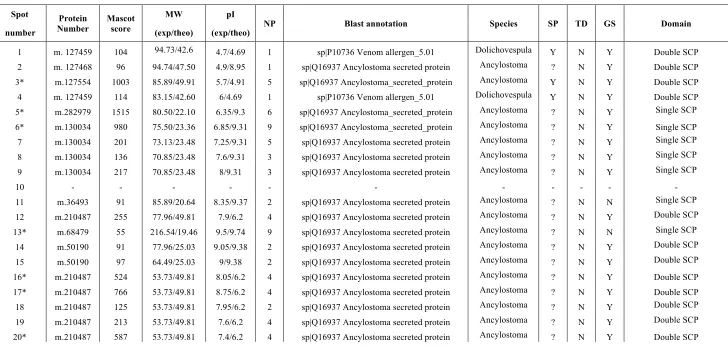
As an initial analysis of the secretome of N. brasiliensis, adult ESPs were electrofocused using 3-10 linear immobilized pH gradient strips and electrophoresed in NuPAGE 4-12% gels. After silver staining the gel, more than 100 spots could be differentiated, most of them located at a range of 8-216 kDa and a pH range of 4.4-10 (Fig. 1). Fifty-six spots detected in the 2D gel were analysed by MALDI-TOF/TOF and LC-MS/MS, one of which was discarded as human keratin. Subsequently, the search was performed using the proteome derived from transcriptomic analysis and only two of the spots (spots 10 and 34) were unable to be identified as their individual ions scores were below 38 (p<0.05). The result of the mass spectrometry analysis is shown in Table 1, and a more detailed analysis, including the Pfam analysis, sequence information and annotation with NEMBASE and N. americanus genome is provided in Supplemental Table SI.
esterases, kinases or metabolic enzymes were identified and only two spots contained a domain of unknown function (spots 32 and 55). A total of 27 spots contained proteins for which a signal peptide could be identified in the transcriptome assembly, although not all N-terminal amino acid sequences were available for inspection; in addition 3 spots included proteins with at least one transmembrane domain (Table 1). Following NetNGlyc analysis, proteins from 36 spots had at least one putative mannose 6-phosphate glycosylation site.
Proteomic analysis of ESP
For a more comprehensive analysis of the secretome, ESP from L3 and adult worms, as well as and adult NEx were fractionated using OGE, and the tryptic peptides were analysed by LC-MS/MS, generating a total of 57,079 and 54,529 spectra for L3 and adults, respectively and 32,878 for NEx. Mascot searches were performed against the predicted proteins from the generated transcriptome, and Scaffold software (v.4.2.1) was used to validate the protein identifications. Using Scaffold, 52 proteins for L3 ESP and 261 and 275 for adult ESP and NEx were identified, respectively, by at least two peptides at a 99.0% probability and an estimated false discovery rate <0.1% (Supplemental Tables SII-SVII).
were shared between adult ESP and adult NEx (Fig. 2a). Only 6 proteins were found in both L3 ESP and adult NEx. The complete lists of proteins and peptides identified for L3 ESP, adult ESP and NEx can be found in Supplemental tables SII-SVII, respectively.
The L3 and adult ESP proteome fractions were subjected to a Pfam analysis using HMMER v3.1b1 (32) and compared to the corresponding analysis of the transcripts from each stage that contained a signal peptide (Fig. 4). The greatest proportion (8 proteins) of the proteins from L3 belonged to the astacin peptidase family M12A (PF01400) (Fig. 4a), followed by a group of 5 proteins containing CAP domains (PF00188). In the adult ESP fraction, members of the SCP/TAPS family were the most highly represented (45 proteins), followed by astacin family M12A metallopeptidases (PF01400, 10 proteins) (Fig. 4b). The Pfam analysis of the L3 and adult predicted proteins from N. brasiliensis returned five major protein groups common to both samples, with protein kinase domain-containing proteins and tyrosine kinase proteins as the most highly represented (Fig. 4c, d). In contrast, the Pfam analysis of the predicted proteins containing a signal peptide showed a high representation of proteins with immunoglobulin domains, neurotransmitter domains and metallopeptidases in both L3 and adult (Fig. 4e, f). In addition, proteins with astacins and SCP/TAPS domains were abundant in the predicted secretome (Fig. 4e, f).
detected in the adult ESP. In the adult ESP, the most abundant proteins were two proteins belonging to the SCP/TAPS family (m.233248 Ancylostoma secreted protein (ASP) and m.68479 ASP) and a like protein (m.436569 transthyretin-like protein 15). Other SCP/TAPS proteins were represented in adult ESP but were less abundant (Fig 5b). For the adult NEx proteome, the highest emPAI-scoring proteins were tropomyosin (m.198775) and actin (m.242612), although other globin-, structural-related proteins and metabolic enzymes were also highly represented (Fig. 5c).
Phylogenetic analysis
The Maximum Likelihood (ML) and Bayesian Inference (BI) analyses of astacin and SCP/TAPS amino-acid sequence alignments resulted in consensus trees with clades supported by relatively high bootstrap values (ML) and posterior probabilities (pp; BI), respectively (Figs 6 and 7). For the astacins, the consensus tree consisted of two distinct monophyletic clades, with high bootstrap/pp support (i.e. 100/1.0), both including sequences from N. brasiliensis and N. americanus (Fig. 6). Within one of these clades, sequences from the rat and human hookworms formed paraphyletic clades, with one N. brasiliensis sequence (m72921) grouping to the exclusion of homologues from the free-living nematodes Caenorhabditis briggsae and Caenorhabditis brenneri (Fig. 6. The larger astacin monophyletic clade included
For the SCP/TAPS, the ML/BI consensus tree included one main clade comprising all sequences analysed to the exclusion of a T. spiralis homologue (Fig. 7). While sequences from free-living nematodes (i.e. C. elegans and C. remanei), spirurids (i.e. B. malayi) and ascaridids (i.e. A. suum) clustered to the exclusion of most SCP/TAPS
from strongylids, a single sub-clade included a conserved subset of SCP/TAPS from N. americanus and N. brasiliensis (Fig. 7); the latter clustered to the exclusion of other hookworm SCP/TAPS, as well as homologues from H. polygyrus (Fig. 7.
Comparative analysis of Nematoda ESP
To assess the similarity between N. brasiliensis and N. americanus ESP, a comparative analysis of the sequences based on the methodology described by Parkinson and Blaxter (37), but employing an in-house built script, was performed. A morphologically similar gastrointestinal nematode of rodents (H. polygyrus) and a non-related nematode (B. malayi) belonging to clades V and III, respectively (41) were included in order to determine the similarities between different nematodes and N. americanus. The results obtained are shown in Fig. 8. A total of 216 proteins were
uniquely homologous to N. brasiliensis ESP, whereas 100 and 27 ESP had unique homology to H. polygyrus and B. malayi respectively. Furthermore, 70 proteins had homology with N. brasiliensis and H. polygyrus proteins, and only one and 2 proteins were homologous with both N. brasiliensis and B. malayi and with H. polygyrus and B. malayi, respectively. Interestingly, no proteins from N. americanus matched a
common homologue in all three nematodes.
In the present study, we provide the first proteomic analysis of the two key developmental stages of the rodent hookworm N. brasiliensis, coupled with a high-density transcriptomic profile of this parasite. N. brasiliensis is characterised by a life cycle and morphological features that are very similar to N. americanus, and it has been extensively used as a model for the study of human hookworm infection (4, 7, 9, 47). The analysis of the transcriptome of N. brasiliensis shows that more than two-thirds of the sequences with homology to sequences present in the NEMBASE database had significant similarity to N. americanus genes, which is in accordance with the conserved morphological features and life history of these two strongylid nematodes.
Many of the proteins predicted from the N. brasiliensis transcriptome contain a signal peptide, which is in accordance with findings for other helminths (27, 48); of these putative secreted proteins, a total of 6.27% (127) sequences were identified in the ESP of N. brasiliensis, in line with findings from other parasitic helminths (26, 27, 49, 50). However, some of the proteins (56.2%) detected in ESP did not contain a classical signal peptide, suggesting alternative secretion pathways including the presence of non-classical secretory signals or release from the parasite via exosomes (51).
in a physiologically distinct niche, the gut. In the present work, we have identified 52 and 261 proteins in the ESP of the larval and adult stages of N. brasiliensis. In addition to this, we have shown that the proteins identified in the ESP are different to those identified in the NEx, suggesting their true secretory origin as opposed to leakage of intracellular and structural proteins from dead or damaged worms.
In our analysis of N. brasiliensis, only 8 proteins are detected in ESPs from both larval and adult stages, whereas in other nematodes such as Strongyloides ratti, more than 50% of the proteins identified in the ESP of parasitic adult females and infective larvae are common to both developmental stages. This intriguing finding suggests the need for different proteins as a consequence of adaptation to different niches; N. brasiliensis infective larvae and adult worms occupy distinct anatomical locations in
the host, whereas S. ratti L3 can develop in the intestine of the host, co-habiting with adults in the same niche.
From the proteins detected in L3 ESP, two particular proteins were also highly represented in the adult secretome (Fig. 5). Both proteins had homology to GH Family 25 lysozyme 2 (GH 25 muramidase superfamily). This family of proteins has been identified at the transcript level in other hookworms (26) and in the secretome of adult H. polygyrus (39). In addition, in the nematode C. elegans and the slime mould Dictyostelium discoideum lysozyme has been reported to exert an antimicrobial and
Other proteins that have been identified in both developmental stages include actin, a fatty-acid binding protein, two proteins of unknown function and proteases and other enzymes including cathepsin D, apyrase, acetylcholinesterase, cell death-related nuclease 7 and extracellular superoxide dismutase. Although actin is a cytoskeletal protein, it has been detected in the ESP of different helminths such as Echinostoma caproni or Angiostrongylus cantonensis (54, 55). Recently, parasitic trematodes were
shown to secrete extracellular microvesicles that resembled mammalian exosomes (51), and accounts for the secretion of some proteins that lack a signal peptide. While exosome-like microvesicles have not yet been reported from parasitic nematodes, this phenomenon is entirely plausible and might explain the presence of molecules lacking a signal peptide in the ESP of N. brasiliensis (and most other parasitic helminths). Superoxide dismutase is an anti-oxidative protein and is involved in protection of N. brasiliensis and Ancylostoma ceylanicum against reactive oxygen species from host
inflammatory cells (56). Different apyrases have been described also in the related nematode H. polygyrus (57), and they have been related with clot prevention in blood-feeding arthropods and nematodes (39, 58-60) and anti-coagulant. The protein acetylcholinesterase has been extensively described in N. brasiliensis and other nematodes and has a role in the inhibition of secretory responses by hydrolysing acetylcholine (61) and in the reduction of inflammation (62). The proteins detected in both developmental stages could be of importance in the development of future vaccines and treatments against N. brasiliensis, as it could reduce both the infection and the establishment of this nematode.
adult, different ASPs, globin-like proteins, transthyretin-like proteins and vitellogenins were stage-specific. The putative metalloproteinase-inhibitor was by far the most highly represented protein in L3. It shared greatest homology with tissue inhibitor of metalloproteinase from N. americanus and tissue inhibitor of metalloproteinase from A. caninum, and belongs to the MEROPS family I35 (TIMP family). Other TIMPs have been found to be upregulated in larval stages of N. americanus (63) and the adult stage of A. caninum and A. ceylanicum (64, 65).
Furthermore, these proteins are implicated in host-parasite relationships and modulation of the immune response (66). In contrast, the most abundant protein in adult worms was an ASP that shared sequence identity with N. americanus ASP-2. Na-ASP-2 is only expressed by hookworm L3 and not by the adult stages, and has
been extensively explored as a vaccine candidate (67, 68).
homologues from the parasitic nematodes H. contortus and B. malayi play important functions in parasite development (77, 78). A phylogenetic analysis of astacins from N. brasiliensis and other nematodes revealed a monophyletic clade formed
exclusively by selected sequences from adult N. brasiliensis ESP (i.e. m72921, m440287, m440290) and homologues from the predicted proteome of N. americanus and the free-living nematode C. brenneri, to the exclusion of sequences from all other nematode species included in the analysis, as well as other hookworm homologues (Fig. 6). The fact that, to the best of our knowledge, some members of the (parasite) astacin family are shared exclusively between N. americanus and N. brasiliensis raises questions about the specific roles that these proteins may play in the biology of these hookworm species, and serves to highlight the biological similarities between the human and the rat hookworm.
functional information is available despite the recent advances in the structural biology of this protein family (82). Due to the relative ease of genetic manipulation of C. elegans compared to parasitic nematodes, additional functional roles for
SCP/TAPS proteins have been identified, including antimicrobial activity, normal body formation and lifespan (83-85), highlighting the extensive array of functions that this intriguing protein family has adopted.
The phylogenetic analysis of SCP/TAPS proteins revealed that, while the vast majority of hookworm SCP/TAPS clustered together with homologues from other parasitic nematodes with varying bootstrap/posterior probabilities support (cf. Fig. 7), a small subset of sequences from the rat and human hookworms formed a separate clade (cf. Fig. 7), thus leading to the hypothesis that, within the SCP/TAPS family, these members might have evolved biological functions specific to N. brasiliensis and N. americanus only, and distinct from their homologous counterparts
To assess the overall sequence similarities between the secretomes of N. brasiliensis and related nematodes, we performed a similarity analysis using ESP from N. brasiliensis, H. polygyrus, B. malayi and N. americanus. This type of analysis plots in
a two-dimensional scale the relative similarities of protein sequences between one species (N. americanus) and three comparators as described previously for other nematodes (17, 37). As highlighted in Fig. 8, N. americanus ESP had more homologues in the ESP from N. brasiliensis than from either H. polygyrus or B. malayi. We selected these species as comparators because they can complete their life
identities between the secretomes of N. brasiliensis and N. americanus support the morphological and developmental similarities between these two species, and lends strong support for the use of N. brasiliensis as a model for human hookworm disease (7, 9, 39, 47).
This is the first study that provides an in-depth overview of the proteins secreted by N. brasiliensis, which could be of importance in unravelling the molecular architecture
References
1. Hotez, P. J., Brooker, S., Bethony, J. M., Bottazzi, M. E., Loukas, A., and Xiao, S. (2004) Hookworm infection. N Engl J 351, 799-807
2. Hotez, P. J., Fenwick, A., Savioli, L., and Molyneux, D. H. (2009) Rescuing the bottom billion through control of neglected tropical diseases. Lancet 373, 1570-1575
3. World Health Organization. Global Health Estimates (GHE) 2013: DALYs by age, sex and cause. DALY estimates, 2000-2011. Geneva: World Health Organization, November 2013
4. Camberis, M., Le Gros, G., and Urban, J., Jr. (2003) Animal model of Nippostrongylus brasiliensis and Heligmosomoides polygyrus. Current protocols in
immunology / edited by John E. Coligan ... [et al.] Chapter 19, Unit 19 12
5. Ehigiator, H. N., Stadnyk, A. W., and Lee, T. D. (2000) Extract of Nippostrongylus brasiliensis stimulates polyclonal type-2 immunoglobulin response
by inducing De novo class switch. Infect Immun 68, 4913-4922
6. Holland, M. J., Harcus, Y. M., Riches, P. L., and Maizels, R. M. (2000) Proteins secreted by the parasitic nematode Nippostrongylus brasiliensis act as adjuvants for Th2 responses. Eur J Immunol 30, 1977-1987
7. McSorley, H. J., and Loukas, A. (2010) The immunology of human hookworm infections. Parasite Immunol 32, 549-559
9. Ohnmacht, C., and Voehringer, D. (2010) Basophils protect against reinfection with hookworms independently of mast cells and memory Th2 cells. J Immunol 184, 344-350
10. Conrad, D. H., Ben-Sasson, S. Z., Le Gros, G., Finkelman, F. D., and Paul, W. E. (1990) Infection with Nippostrongylus brasiliensis or injection of anti-IgD antibodies markedly enhances Fc-receptor-mediated interleukin 4 production by non-B, non-T cells. J Exp Med 171, 1497-1508
11. Harvie, M., Camberis, M., and Le Gros, G. (2013) Development of CD4 T Cell Dependent Immunity Against N. brasiliensis Infection. Frontiers in Immunology 4, 74
12. Harvie, M., Camberis, M., Tang, S. C., Delahunt, B., Paul, W., and Le Gros, G. (2010) The lung is an important site for priming CD4 T-cell-mediated protective immunity against gastrointestinal helminth parasites. Infect Immun 78, 3753-3762 13. Kopf, M., Le Gros, G., Bachmann, M., Lamers, M. C., Bluethmann, H., and Kohler, G. (1993) Disruption of the murine IL-4 gene blocks Th2 cytokine responses. Nature 362, 245-248
14. Lebrun, P., and Spiegelberg, H. L. (1987) Concomitant immunoglobulin E and immunoglobulin G1 formation in Nippostrongylus brasiliensis-infected mice. J Immunol 139, 1459-1465
16. Shin, E. H., Osada, Y., Chai, J. Y., Matsumoto, N., Takatsu, K., and Kojima, S. (1997) Protective roles of eosinophils in Nippostrongylus brasiliensis infection. Int Arch Allergy Immunol 114, 45-50
17. Harcus, Y. M., Parkinson, J., Fernandez, C., Daub, J., Selkirk, M. E., Blaxter, M. L., and Maizels, R. M. (2004) Signal sequence analysis of expressed sequence tags from the nematode Nippostrongylus brasiliensis and the evolution of secreted proteins in parasites. Genome Biology 5, R39
18. Tang, Y. T., Gao, X., Rosa, B. A., Abubucker, S., Hallsworth-Pepin, K., Martin, J., Tyagi, R., Heizer, E., Zhang, X., Bhonagiri-Palsikar, V., Minx, P., Warren, W. C., Wang, Q., Zhan, B., Hotez, P. J., Sternberg, P. W., Dougall, A., Gaze, S. T., Mulvenna, J., Sotillo, J., Ranganathan, S., Rabelo, E. M., Wilson, R. K., Felgner, P. L., Bethony, J., Hawdon, J. M., Gasser, R. B., Loukas, A., and Mitreva, M. (2014) Genome of the human hookworm Necator americanus. Nat Genet doi: 10.1038/ng.2875
19. Lawrence, R. A., Gray, C. A., Osborne, J., and Maizels, R. M. (1996) Nippostrongylus brasiliensis: cytokine responses and nematode expulsion in normal
and IL-4-deficient mice. Exp Parasitol 84, 65-73
20. Grabherr, M. G., Haas, B. J., Yassour, M., Levin, J. Z., Thompson, D. A., Amit, I., Adiconis, X., Fan, L., Raychowdhury, R., Zeng, Q., Chen, Z., Mauceli, E., Hacohen, N., Gnirke, A., Rhind, N., di Palma, F., Birren, B. W., Nusbaum, C., Lindblad-Toh, K., Friedman, N., and Regev, A. (2011) Full-length transcriptome assembly from RNA-Seq data without a reference genome. Nat Biotechnol 29, 644-652
Orvis, J., Pochet, N., Strozzi, F., Weeks, N., Westerman, R., William, T., Dewey, C. N., Henschel, R., Leduc, R. D., Friedman, N., and Regev, A. (2013) De novo transcript sequence reconstruction from RNA-seq using the Trinity platform for reference generation and analysis. Nat Protoc 8, 1494-1512
22. Healer, J., Ashall, F., and Maizels, R. M. (1991) Characterization of proteolytic enzymes from larval and adult Nippostrongylus brasiliensis. Parasitology 103, 305-314
23. Hewitson, J. P., Harcus, Y. M., Curwen, R. S., Dowle, A. A., Atmadja, A. K., Ashton, P. D., Wilson, A., and Maizels, R. M. (2008) The secretome of the filarial parasite, Brugia malayi: proteomic profile of adult excretory-secretory products. Mol Biochem Parasitol 160, 8-21
24. Sotillo, J., Valero, L., Sanchez Del Pino, M. M., Fried, B., Esteban, J. G., Marcilla, A., and Toledo, R. (2008) Identification of antigenic proteins from Echinostoma caproni (Trematoda) recognized by mouse immunoglobulins M, A and
G using an immunoproteomic approach. Parasite Immunol 30, 271-279
25. Yan, J. X., Wait, R., Berkelman, T., Harry, R. A., Westbrook, J. A., Wheeler, C. H., and Dunn, M. J. (2000) A modified silver staining protocol for visualization of proteins compatible with matrix-assisted laser desorption/ionization and electrospray ionization-mass spectrometry. Electrophoresis 21, 3666-3672
26. Mulvenna, J., Hamilton, B., Nagaraj, S. H., Smyth, D., Loukas, A., and Gorman, J. J. (2009) Proteomics analysis of the excretory/secretory component of the blood-feeding stage of the hookworm, Ancylostoma caninum. Mol Cell Proteomics 8, 109-121
transcriptome and "excretory/secretory" proteome of adult Fascioloides magna. Mol Cell Proteomics 11, 1340-1353
28. Searle, B. C. (2010) Scaffold: a bioinformatic tool for validating MS/MS-based proteomic studies. Proteomics 10, 1265-1269
29. Keller, A., Nesvizhskii, A. I., Kolker, E., and Aebersold, R. (2002) Empirical statistical model to estimate the accuracy of peptide identifications made by MS/MS and database search. Anal Chem 74, 5383-5392
30. Nesvizhskii, A. I., Keller, A., Kolker, E., and Aebersold, R. (2003) A statistical model for identifying proteins by tandem mass spectrometry. Anal Chem 75, 4646-4658
31. Conesa, A., Gotz, S., Garcia-Gomez, J. M., Terol, J., Talon, M., and Robles, M. (2005) Blast2GO: a universal tool for annotation, visualization and analysis in functional genomics research. Bioinformatics 21, 3674-3676
32. Finn, R. D., Clements, J., and Eddy, S. R. (2011) HMMER web server: interactive sequence similarity searching. Nucleic Acids Res 39, W29-37
33. Marchler-Bauer, A., Lu, S., Anderson, J. B., Chitsaz, F., Derbyshire, M. K., DeWeese-Scott, C., Fong, J. H., Geer, L. Y., Geer, R. C., Gonzales, N. R., Gwadz, M., Hurwitz, D. I., Jackson, J. D., Ke, Z., Lanczycki, C. J., Lu, F., Marchler, G. H., Mullokandov, M., Omelchenko, M. V., Robertson, C. L., Song, J. S., Thanki, N., Yamashita, R. A., Zhang, D., Zhang, N., Zheng, C., and Bryant, S. H. (2011) CDD: a Conserved Domain Database for the functional annotation of proteins. Nucleic Acids Res 39, D225-229
35. Krogh, A., Larsson, B., von Heijne, G., and Sonnhammer, E. L. (2001) Predicting transmembrane protein topology with a hidden Markov model: application to complete genomes. J Mol Biol305, 567-580
36. Blom, N., Sicheritz-Ponten, T., Gupta, R., Gammeltoft, S., and Brunak, S. (2004) Prediction of post-translational glycosylation and phosphorylation of proteins from the amino acid sequence. Proteomics 4, 1633-1649
37. Parkinson, J., and Blaxter, M. (2003) SimiTri - visualizing similarity relationships for groups of sequences. Bioinformatics 19, 390-395
38. Cantacessi, C., Mitreva, M., Jex, A. R., Young, N. D., Campbell, B. E., Hall, R. S., Doyle, M. A., Ralph, S. A., Rabelo, E. M., Ranganathan, S., Sternberg, P. W., Loukas, A., and Gasser, R. B. (2010) Massively parallel sequencing and analysis of the Necator americanus transcriptome. PLoS Negl Trop Dis 4, e684
39. Hewitson, J. P., Harcus, Y., Murray, J., van Agtmaal, M., Filbey, K. J., Grainger, J. R., Bridgett, S., Blaxter, M. L., Ashton, P. D., Ashford, D. A., Curwen, R. S., Wilson, R. A., Dowle, A. A., and Maizels, R. M. (2011) Proteomic analysis of secretory products from the model gastrointestinal nematode Heligmosomoides polygyrus reveals dominance of venom allergen-like (VAL) proteins. J Proteomics
74, 1573-1594
42. Abascal, F., Zardoya, R., and Posada, D. (2005) ProtTest: selection of best-fit models of protein evolution. Bioinformatics 21, 2104-2105
43. Tamura, K., Peterson, D., Peterson, N., Stecher, G., Nei, M., and Kumar, S. (2011) MEGA5: molecular evolutionary genetics analysis using maximum likelihood, evolutionary distance, and maximum parsimony methods. Mol Biol Evol 28, 2731-2739
44. Miller, M. A., Pfeiffer, W., and Schwartz, T. Creating the CIPRES Science Gateway for inference of large phylogenetic trees" in Proceedings of the Gateway Computing Environments Workshop (GCE), 14 Nov. 2010, New Orleans, LA pp 1 - 8., 8
45. Hawdon, J. M., Jones, B. F., Hoffman, D. R., and Hotez, P. J. (1996) Cloning and characterization of Ancylostoma-secreted protein. A novel protein associated with the transition to parasitism by infective hookworm larvae. J Biol Chem 271, 6672-6678
46. Murray, J., Gregory, W. F., Gomez-Escobar, N., Atmadja, A. K., and Maizels, R. M. (2001) Expression and immune recognition of Brugia malayi VAL-1, a homologue of vespid venom allergens and Ancylostoma secreted proteins. Mol Biochem Parasitol 118, 89-96
47. Reece, J. J., Siracusa, M. C., Southard, T. L., Brayton, C. F., Urban, J. F., Jr., and Scott, A. L. (2008) Hookworm-induced persistent changes to the immunological environment of the lung. Infect Immun 76, 3511-3524
49. Garg, G., Bernal, D., Trelis, M., Forment, J., Ortiz, J., Valero, M. L., Pedrola, L., Martinez-Blanch, J., Esteban, J. G., Ranganathan, S., Toledo, R., and Marcilla, A. (2013) The transcriptome of Echinostoma caproni adults: further characterization of the secretome and identification of new potential drug targets. J Proteomics 89, 202-214
50. Soblik, H., Younis, A. E., Mitreva, M., Renard, B. Y., Kirchner, M., Geisinger, F., Steen, H., and Brattig, N. W. (2011) Life cycle stage-resolved proteomic analysis of the excretome/secretome from Strongyloides ratti - identification of stage-specific proteases. Mol Cell Proteomics 10, M111 010157 51. Marcilla, A., Trelis, M., Cortes, A., Sotillo, J., Cantalapiedra, F., Minguez, M. T., Valero, M. L., Sanchez del Pino, M. M., Munoz-Antoli, C., Toledo, R., and Bernal, D. (2012) Extracellular vesicles from parasitic helminths contain specific excretory/secretory proteins and are internalized in intestinal host cells. PLoS One 7, e45974
52. Boehnisch, C., Wong, D., Habig, M., Isermann, K., Michiels, N. K., Roeder, T., May, R. C., and Schulenburg, H. (2011) Protist-type lysozymes of the nematode Caenorhabditis elegans contribute to resistance against pathogenic Bacillus
thuringiensis. PLoS One 6, e24619
Pain, A., Lu, M., Harper, D., Lindsay, R., Hauser, H., James, K., Quiles, M., Madan Babu, M., Saito, T., Buchrieser, C., Wardroper, A., Felder, M., Thangavelu, M., Johnson, D., Knights, A., Loulseged, H., Mungall, K., Oliver, K., Price, C., Quail, M. A., Urushihara, H., Hernandez, J., Rabbinowitsch, E., Steffen, D., Sanders, M., Ma, J., Kohara, Y., Sharp, S., Simmonds, M., Spiegler, S., Tivey, A., Sugano, S., White, B., Walker, D., Woodward, J., Winckler, T., Tanaka, Y., Shaulsky, G., Schleicher, M., Weinstock, G., Rosenthal, A., Cox, E. C., Chisholm, R. L., Gibbs, R., Loomis, W. F., Platzer, M., Kay, R. R., Williams, J., Dear, P. H., Noegel, A. A., Barrell, B., and Kuspa, A. (2005) The genome of the social amoeba Dictyostelium discoideum. Nature 435, 43-57
54. Morassutti, A. L., Levert, K., Pinto, P. M., da Silva, A. J., Wilkins, P., and Graeff-Teixeira, C. (2012) Characterization of Angiostrongylus cantonensis excretory-secretory proteins as potential diagnostic targets. Exp Parasitol 130, 26-31 55. Sotillo, J., Valero, M. L., Sanchez Del Pino, M. M., Fried, B., Esteban, J. G., Marcilla, A., and Toledo, R. (2010) Excretory/secretory proteome of the adult stage of Echinostoma caproni. Parasitol Res 107, 691-697
56. Batra, S., Singh, S. P., Gupta, S., Katiyar, J. C., and Srivastava, V. M. (1990) Reactive oxygen intermediates metabolizing enzymes in Ancylostoma ceylanicum and Nippostrongylus brasiliensis. Free Radic Biol Med 8, 271-274
58. Nisbet, A. J., Zarlenga, D. S., Knox, D. P., Meikle, L. I., Wildblood, L. A., and Matthews, J. B. (2011) A calcium-activated apyrase from Teladorsagia circumcincta: an excretory/secretory antigen capable of modulating host immune
responses? Parasite Immunol 33, 236-243
59. Valenzuela, J. G., Charlab, R., Galperin, M. Y., and Ribeiro, J. M. (1998) Purification, cloning, and expression of an apyrase from the bed bug Cimex lectularius. A new type of nucleotide-binding enzyme. J Biol Chem 273, 30583-30590
60. Zarlenga, D. S., Nisbet, A. J., Gasbarre, L. C., and Garrett, W. M. (2011) A calcium-activated nucleotidase secreted from Ostertagia ostertagi 4th-stage larvae is a member of the novel salivary apyrases present in blood-feeding arthropods. Parasitology 138, 333-343
61. Hussein, A. S., Chacon, M. R., Smith, A. M., Tosado-Acevedo, R., and Selkirk, M. E. (1999) Cloning, expression, and properties of a nonneuronal secreted acetylcholinesterase from the parasitic nematode Nippostrongylus brasiliensis. J Biol Chem 274, 9312-9319
62. Lee, D. L. (1996) Why do some nematode parasites of the alimentary tract secrete acetylcholinesterase? Int J Parasitol 26, 499-508
63. Cantacessi, C., Hofmann, A., Pickering, D., Navarro, S., Mitreva, M., and Loukas, A. (2013) TIMPs of parasitic helminths - a large-scale analysis of high-throughput sequence datasets. Parasit Vectors 6, 156
65. Zhan, B., Badamchian, M., Meihua, B., Ashcom, J., Feng, J., Hawdon, J., Shuhua, X., and Hotez, P. J. (2002) Molecular cloning and purification of Ac-TMP, a developmentally regulated putative tissue inhibitor of metalloprotease released in relative abundance by adult Ancylostoma hookworms. Am J Trop Med Hyg 66, 238-244
66. Cuellar, C., Wu, W., and Mendez, S. (2009) The hookworm tissue inhibitor of metalloproteases (Ac-TMP-1) modifies dendritic cell function and induces generation of CD4 and CD8 suppressor T cells. PLoS Negl Trop Dis 3, e439
67. Bower, M. A., Constant, S. L., and Mendez, S. (2008) Necator americanus: the Na-ASP-2 protein secreted by the infective larvae induces neutrophil recruitment in vivo and in vitro. Exp Parasitol 118, 569-575
68. Diemert, D. J., Pinto, A. G., Freire, J., Jariwala, A., Santiago, H., Hamilton, R. G., Periago, M. V., Loukas, A., Tribolet, L., Mulvenna, J., Correa-Oliveira, R., Hotez, P. J., and Bethony, J. M. (2012) Generalized urticaria induced by the Na-ASP-2 hookworm vaccine: implications for the development of vaccines against helminths. J Allergy Clin Immunol 130, 169-176 e166
69. Bond, J. S., and Beynon, R. J. (1995) The astacin family of metalloendopeptidases. Protein Sci 4, 1247-1261
70. Baska, P., Wisniewski, M., Krzyzowska, M., Dlugosz, E., Zygner, W., Gorski, P., and Wedrychowicz, H. (2013) Molecular cloning and characterisation of in vitro immune response against astacin-like metalloprotease Ace-MTP-2 from Ancylostoma ceylanicum. Exp Parasitol 133, 472-482
72. Varatharajalu, R., Parandaman, V., Ndao, M., Andersen, J. F., and Neva, F. A. (2011) Strongyloides stercoralis excretory/secretory protein strongylastacin specifically recognized by IgE antibodies in infected human sera. Microbiol Immunol 55, 115-122
73. Williamson, A. L., Lustigman, S., Oksov, Y., Deumic, V., Plieskatt, J., Mendez, S., Zhan, B., Bottazzi, M. E., Hotez, P. J., and Loukas, A. (2006) Ancylostoma caninum MTP-1, an astacin-like metalloprotease secreted by infective
hookworm larvae, is involved in tissue migration. Infect Immun 74, 961-967
74. Hotez, P. J., Ashcom, J., Zhan, B., Bethony, J., Loukas, A., Hawdon, J., Wang, Y., Jin, Q., Jones, K. C., Dobardzic, A., Dobardzic, R., Bolden, J., Essiet, I., Brandt, W., Russell, P. K., Zook, B. C., Howard, B., and Chacon, M. (2003) Effect of vaccination with a recombinant fusion protein encoding an astacinlike metalloprotease (MTP-1) secreted by host-stimulated Ancylostoma caninum third-stage infective larvae. J Parasitol 89, 853-855
75. Gomez Gallego, S., Loukas, A., Slade, R. W., Neva, F. A., Varatharajalu, R., Nutman, T. B., and Brindley, P. J. (2005) Identification of an astacin-like metallo-proteinase transcript from the infective larvae of Strongyloides stercoralis. Parasitol Int 54, 123-133
76. Davis, M. W., Birnie, A. J., Chan, A. C., Page, A. P., and Jorgensen, E. M. (2004) A conserved metalloprotease mediates ecdysis in Caenorhabditis elegans. Development 131, 6001-6008
78. Guiliano, D. B., Hong, X., McKerrow, J. H., Blaxter, M. L., Oksov, Y., Liu, J., Ghedin, E., and Lustigman, S. (2004) A gene family of cathepsin L-like proteases of filarial nematodes are associated with larval molting and cuticle and eggshell remodeling. Mol Biochem Parasitol 136, 227-242
79. Cantacessi, C., Campbell, B. E., Visser, A., Geldhof, P., Nolan, M. J., Nisbet, A. J., Matthews, J. B., Loukas, A., Hofmann, A., Otranto, D., Sternberg, P. W., and Gasser, R. B. (2009) A portrait of the "SCP/TAPS" proteins of eukaryotes - developing a framework for fundamental research and biotechnological outcomes. Biotechnol Adv 27, 376-388
80. He, Y., Barker, S. J., MacDonald, A. J., Yu, Y., Cao, L., Li, J., Parhar, R., Heck, S., Hartmann, S., Golenbock, D. T., Jiang, S., Libri, N. A., Semper, A. E., Rosenberg, W. M., and Lustigman, S. (2009) Recombinant Ov-ASP-1, a Th1-biased protein adjuvant derived from the helminth Onchocerca volvulus, can directly bind and activate antigen-presenting cells. J Immunol 182, 4005-4016
81. Moyle, M., Foster, D. L., McGrath, D. E., Brown, S. M., Laroche, Y., De Meutter, J., Stanssens, P., Bogowitz, C. A., Fried, V. A., Ely, J. A., Soule, H. R., and Vlasuk, G. P. (1994) A hookworm glycoprotein that inhibits neutrophil function is a ligand of the integrin CD11b/CD18. J Biol Chem 269, 10008-10015
82. Osman, A., Wang, C. K., Winter, A., Loukas, A., Tribolet, L., Gasser, R. B., and Hofmann, A. (2012) Hookworm SCP/TAPS protein structure - A key to understanding host-parasite interactions and developing new interventions. Biotechnol Adv 30, 652-657
are induced by infection of C. elegans with M. nematophilum. Genome Res 16, 1005-1016
84. Ookuma, S., Fukuda, M., and Nishida, E. (2003) Identification of a DAF-16 transcriptional target gene, scl-1, that regulates longevity and stress resistance in Caenorhabditis elegans. Curr Biol 13, 427-431
85. Wang, J., and Kim, S. K. (2003) Global analysis of dauer gene expression in Caenorhabditis elegans. Development 130, 1621-1634
86. Navarro, S., Ferreira, I., and Loukas, A. (2013) The hookworm pharmacopoeia for inflammatory diseases. Int J Parasitol 43, 225-231
Footnotes
Figure legends
FIG. 1. Silver stained analytical 2-DE gel of N. brasiliensis adult excretory/secretory proteins. Numbered circles indicate the spots that were analysed by mass
spectrometry. Annotation of the individual spots can be found in Table 1.
FIG 2. Overlap between L3 and adult excretory/secretory proteins. A. Venn diagram showing the common proteins between L3 ESP, adult ESP and adult NEx N. brasiliensis. Abbreviations used: ESP- excretory/secretory products from N.
brasiliensis; NEx- whole worm extract from N. brasiliensis. B. 2D-DIGE image
comparing L3 ESP (green spots) and adult ESP (red spots) from N. brasiliensis.
FIG 3. Gene Ontology analysis. Bar graph showing the most abundantly represented gene ontology molecular function terms in excretory/secretory proteins derived from N. brasiliensis L3 (A) and adult (B).
FIG 4. Pfam analysis. Bar graph showing the most represented protein families (Pfam) in the excretory/secretory proteins of N. brasiliensis L3 (A) and adult (B), the predicted proteome from L3 (C) and adult (D), and the predicted proteome containing a signal peptide from L3 (E) and adult (F). Coloured bars represent the families present in more than two panels.
same proteins in adult ESP (centre) and adult NEx (right). Maximum values are coloured in red and minimum in blue. B. The 50 most abundant proteins in adult ESP ranked by total spectrum count (centre) compared to the same proteins in L3 ESP (left) and adult NEx (right). The 50 most abundant proteins in adult NEx ranked by total spectrum count (right) compared to the same proteins in L3 ESP (left) and adult ESP (centre).
FIG 6. Phylogenetic relationships of astacins based on Bayesian Inference (BI). The posterior probability supporting each clade is indicated. The accession numbers of each protein are shown.
FIG 7. Phylogenetic relationships of SCP/TAPS proteins based on Bayesian Inference (BI). The posterior probability supporting each clade is indicated. The accession
numbers of each protein are shown.
FIG 8. Similarity analysis. Relationships of ESP from Brugia malayi, Heligmosomoides polygyrus and Nippostrongylus brasiliensis were compared to the
TABLE 1.- Proteins identified in the 2D-PAGE of Nippostrongylus brasiliensis using MASCOT search engine. Asterisks (*) represent
proteins identified by LC-MS/MS. Abbreviations used: NP- number of peptides; SP- signal peptide; TD- transmembrane domain; GS-
glycosylation site. Individual ions scores > 38 indicate identity or extensive homology (p<0.05). ? represents sequences where absence of
signal peptide could not be confirmed.
Spot Protein
Number Mascot score
MW pI
NP Blast annotation Species SP TD GS Domain
number (exp/theo) (exp/theo)
1 m. 127459 104 94.73/42.6 4.7/4.69 1 sp|P10736 Venom allergen_5.01 Dolichovespula Y N Y Double SCP
2 m. 127468 96 94.74/47.50 4.9/8.95 1 sp|Q16937 Ancylostoma secreted protein Ancylostoma ? N Y Double SCP
3* m.127554 1003 85.89/49.91 5.7/4.91 5 sp|Q16937 Ancylostoma_secreted_protein Ancylostoma Y N Y Double SCP
4 m. 127459 114 83.15/42.60 6/4.69 1 sp|P10736 Venom allergen_5.01 Dolichovespula Y N Y Double SCP
5* m.282979 1515 80.50/22.10 6.35/9.3 6 sp|Q16937 Ancylostoma_secreted_protein Ancylostoma ? N Y Single SCP
6* m.130034 980 75.50/23.36 6.85/9.31 9 sp|Q16937 Ancylostoma_secreted_protein Ancylostoma ? N Y Single SCP
7 m.130034 201 73.13/23.48 7.25/9.31 5 sp|Q16937 Ancylostoma secreted protein Ancylostoma ? N Y Single SCP
8 m.130034 136 70.85/23.48 7.6/9.31 3 sp|Q16937 Ancylostoma secreted protein Ancylostoma ? N Y Single SCP
9 m.130034 217 70.85/23.48 8/9.31 3 sp|Q16937 Ancylostoma secreted protein Ancylostoma ? N Y Single SCP
10 - - - -
11 m.36493 91 85.89/20.64 8.35/9.37 2 sp|Q16937 Ancylostoma secreted protein Ancylostoma ? N N Single SCP
12 m.210487 255 77.96/49.81 7.9/6.2 4 sp|Q16937 Ancylostoma secreted protein Ancylostoma ? N Y Double SCP
13* m.68479 55 216.54/19.46 9.5/9.74 9 sp|Q16937 Ancylostoma secreted protein Ancylostoma ? N N Single SCP
14 m.50190 91 77.96/25.03 9.05/9.38 2 sp|Q16937 Ancylostoma secreted protein Ancylostoma ? N Y Double SCP
15 m.50190 97 64.49/25.03 9/9.38 2 sp|Q16937 Ancylostoma secreted protein Ancylostoma ? N Y Double SCP
16* m.210487 524 53.73/49.81 8.05/6.2 4 sp|Q16937 Ancylostoma secreted protein Ancylostoma ? N Y Double SCP
17* m.210487 766 53.73/49.81 8.75/6.2 4 sp|Q16937 Ancylostoma secreted protein Ancylostoma ? N Y Double SCP
18 m.210487 125 53.73/49.81 7.95/6.2 2 sp|Q16937 Ancylostoma secreted protein Ancylostoma ? N Y Double SCP
[image:45.842.47.775.178.528.2]21* m.394113 463 68.65/36.21 6/5.01 6 sp|Q16937 Ancylostoma_secreted_protein Ancylostoma ? N Y Single SCP
22 m.280800 87 70.85/64.96 4.45/4.74 1 Acetylcholinesterase 4 Caenorhabditis Y N Y Esterase lipase
23* m.425554 1566 47.81/94.55 4.5/5.43 11 sp|Q18673 Neprilysin-1 Caenorhabditis N Y Y Gluzincin superfamily
24 m.271310 74 49.20/49.04 6.7/6.95 1 sp|Q16937 Ancylostoma secreted protein Ancylostoma Y N Y Double SCP
25* m.210487 274 53.73/49.81 6.95/6.2 3 sp|Q16937 Ancylostoma secreted protein Ancylostoma ? N Y Double SCP
26 m.271310 81 47.81/49.04 7.3/6.95 2 sp|Q16937 Ancylostoma secreted protein Ancylostoma Y N Y Double SCP
27* m.271310 888 46.46/49.04 8/6.95 8 sp|Q16937Ancylostoma secreted protein Ancylostoma Y N Y Double SCP
28 m.209558 188 40.47/40.83 9.35/8.7 3 sp|Q16937 Ancylostoma secreted protein Ancylostoma ? N Y Double SCP
29* m.21970 1193 33.83/95.10 8.8/6.6 10 sp|O16796 Neprilysin-2 Caenorhabditis N Y Y Gluzincin superfamily
30* m.161819 1467 52.16/58.36 7.95/8.79 16 sp|Q7JLI1 Zinc_metalloproteinase_nas-31 Caenorhabditis Y Y Y Astacin
31 m.223466 97 42.73/46.89 7/6 2 sp|Q16937 Ancylostoma secreted protein Ancylostoma Y N Y Double SCP
32 m.285697 109 43.93/46.27 6.6/5.56 2 sp|Q16937 Ancylostoma secreted protein Ancylostoma Y N N DUF Superfamily
33* m.418883 1492 33.83/52.11 4.95/7.24 12 sp|O93428 Cathepsin_D Chionodraco N N Y Asp
34 - - - -
35* m.55433 980 33.83/43.33 6.6/6.32 10 sp|P46563 Fructose-bisphosphate_aldolase_2 Caenorhabditis Y N N Aldolase
36* m.55433 1603 33.83/43.33 8.75/6.32 13 sp|P46563 Fructose-bisphosphate_aldolase_2 Caenorhabditis Y N N Aldolase
37 Keratin 508 27.01/65.98 9.35/8.16 7 - Homo sapiens - - - -
38* m.127462 577 27.57/48.65 8.35/8.39 3 sp|Q16937 Ancylostoma_secreted_protein Ancylostoma Y N Y Double SCP
39* m.233248 2323 23.20/25.54 4.5/5.32 13 sp|Q16937 Ancylostoma secreted protein Ancylostoma Y N N Single SCP
40 m.122208 330 21.71/28.30 4.6/5.05 5 sp|Q86KC1 Probable_GH_family_25_lysozime Dictyostelum Y N GH25_muramidase
41 m.233248 223 23.20/25.54 4.9/5.32 5 sp|Q16937 Ancylostoma secreted protein Ancylostoma Y N N Single SCP
42 m.233248 88 23.61/25.54 5.25/5.32 1 sp|Q16937 Ancylostoma secreted protein Ancylostoma Y N N Single SCP
43 m.233248 61 23.61/25.54 5.45/5.32 1 sp|Q16937 Ancylostoma secreted protein Ancylostoma Y N N Single SCP
44 m.233245 163 22.06/19.40 6.25/7.23 4 sp|B2MVK7 Venom_allergen_5 Rhynchium Y N Y Single SCP
45 m.233245 121 22.06/19.40 6.5/7.23 2 sp|B2MVK7 Venom_allergen_5 Rhynchium Y N Y Single SCP
46 m.233245 80 22.06/19.40 6.7/7.23 3 sp|B2MVK7 Venom_allergen_5 Rhynchium Y N Y Single SCP
47* m.37549 1846 21.37/21.10 7.65/8.05 10 sp|Q16937 Ancylostoma_secreted_protein Ancylostoma ? N N Single SCP
48* m.233245 999 52.16/19.40 8.75/7.23 6 sp|B2MVK7 Venom_allergen_5 Rhynchium Y N Y Single SCP
51* m.229449 782 17.30/19.70 8.85/6.59 3 sp|P51535 Myoglobin Nippostrongylus Y N N Globin
52* m.417418 2990 16.83/20.32 8.2/6.32 6 sp|P48817 Nucleoside_diphosphate_kinase Nippostrongylus N N N kinase
53* m.229449 539 17.73/19.70 8.05/6.59 4 sp|P51535 Myoglobin Nippostrongylus Y N N Globin
54* m.123267 595 19.87/22.04 6.3/6.9 8 sp|Q9NL98 Peroxiredoxin Ascaris N N N Thioredoxin
55* m.285697 2022 45.17/46.15 6/5.56 11 sp|Q16937 Ancylostoma_secreted_protein Ancylostoma Y N N DUF Superfamily
LEGENDS TO SUPPLEMENTAL MATERIAL
FIG. S1. Gene Ontology. Gene Ontology terms relating to biological process (A, D), molecular function (B, E) and cellular component (C, F) assigned to the excretory/secretory proteins from L3 and adult from N. brasiliensis, respectively.
TABLE SI. Proteins identified in the 2D-PAGE of Nippostrongylus brasiliensis using MASCOT search engine. Asterisks (*) represent proteins identified by LC-MS/MS. Individual ions scores > 38 indicate identity or extensive homology (p<0.05).
TABLE SII. Scaffold generated protein reportof L3 ESP from N. brasiliensis.
TABLE SIII. Scaffold generated peptide report of L3 ESP from N. brasiliensis.
TABLE SIV. Scaffold generated protein report of adult ESP from N. brasiliensis.
TABLE SV. Scaffold generated peptide report of adult ESP from N. brasiliensis.
TABLE SVI. Scaffold generated protein report of adult NEx from N. brasiliensis.
TABLE SVII. Scaffold generated peptide report of adult NEx from N. brasiliensis.