Rochester Institute of Technology
RIT Scholar Works
Theses Thesis/Dissertation Collections
2010
Evolutionary spectral co-clustering
Nathan S. Green
Follow this and additional works at:http://scholarworks.rit.edu/theses
This Thesis is brought to you for free and open access by the Thesis/Dissertation Collections at RIT Scholar Works. It has been accepted for inclusion in Theses by an authorized administrator of RIT Scholar Works. For more information, please [email protected].
Recommended Citation
Evolutionary Spectral Co-Clustering
by
Nathan S. Green
A Thesis Submitted in Partial Fulfillment of the Requirements for the Degree of Master of Science in Computer Science
Supervised by
Dr. Manjeet Rege
Department of Computer Science
B. Thomas Golisano College of Computing and Information Sciences Rochester Institute of Technology
Rochester, New York July 2010
Approved By:
Dr. Manjeet Rege
Thesis Adviser, Department of Computer Science Primary Adviser
Dr. Xumin Liu
Committee Member, Department of Computer Science Reader
Sean Strout
c
Abstract
The field of mining evolving data is relatively new and evolutionary clustering is among the
latest in this trend. Presently, there are algorithms for evolutionary k-means, agglomerative
hierarchical, and spectral clustering. These have been excellent in showing the advantages
of using evolving data snapshots for better clustering results. From these algorithms the
key portion of the conversion from static data handling to evolving data handling has been
the addition of the historical cost function. The cost function is what determines whether
or not instances should be moved from one cluster to the next between time-steps based
on the historical cuts made between the instances in the dataset. These cost functions
are then the method by which evolutionary clustering provides smooth transitions as there
is a tunable tolerance for shifts in cluster membership. This also means that transitions
between clusters become much more significant. For example, if an author-word matrix
were clustered over ten years and an author changed clusters part way through the
time-line it is a likely indicator that the author has changed research topics.
Methods for mining evolving data have not yet expanded into co-clustering; for this
reason I have contributed a new algorithm for co-clustering evolving data. The algorithm
uses spectral co-clustering to cluster each time-step of instances and features. Using the
previous example, cluster changes in features (or words) for an author-word matrix is
sig-nificant in that it may indicate a change in meaning for the word. This contribution to the
Contents
Abstract . . . iii
1 Introduction. . . 1
2 Background and Related Work . . . 4
2.1 Evolutionary Clustering . . . 4
2.2 Spectral Co-Clustering . . . 5
3 ESCC . . . 8
3.1 RTC vs. RTH . . . 9
3.2 Handling Data Changes . . . 10
3.3 Piecing the algorithm together . . . 13
4 Experiments. . . 15
4.1 Synthetic Data . . . 15
4.1.1 Synthetic Demonstrations . . . 16
4.1.2 Synthetic Instance Drift . . . 17
4.1.3 Synthetic Feature Drift . . . 17
4.2 Real Data . . . 18
5 Conclusion . . . 23
List of Figures
1.1 ESCC uses information from the previous time-step (t − 1) to maintain
cluster membership into the present time (t) in order to provide a smoother transition. Here it can be seen that in order to maintain that membership, despite the evenly weighted cut in the present time, the past comes into effect to makecut 2the better choice at time-stept. . . 2
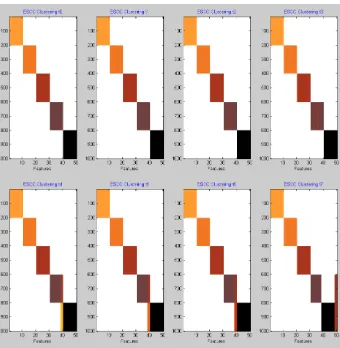
4.1 t0 is the original data in unclustered and clustered form. t1 shows consis-tency of clustering despite 50 instances of noise per cluster. t2 shows 10 instances added toC2.t3shows 10 instances removed fromC4(highlighted int2). t4 shows cluster stability through a time-step of no change.t5shows 2 features added toC4. t6 shows 1 feature removed from C1 (highlighted int5). t7shows again the stability through an unchanged time-step. . . 15 4.2 t0 is the original data from Figure 4.1. t1 -t3 show the downward shift of
theC4 features andt4 -t7 show the up shift inC5 features. Ultimately the 20 instances were shown to shift fromC4 toC5as expected. . . 17 4.3 t0 is the original data from Figure 4.1. t1 -t3 show the downward shift of
theC4 instances at 2 distinct features and t4 - t7 show the up shift inC5 instances at those features. Ultimately the 2 features were shown to shift fromC4 toC5 as expected. . . 18
4.4 measures for the ESCC clustering on PubMed data. The higher the
F-measure the higher the accuracy of the clustering. This shows that RTH is generally better at sorting out the different clusters. . . 19
4.5 Using the cost formulas from Section 3.1 the two algorithms are measured
List of Tables
3.1 Symbol Definitions . . . 8
4.1 An outline of the pubmed dataset. . . 19
4.2 ESCC clustering of PubMed. Year 2000. . . 20
4.3 ESCC clustering of PubMed. Year 2001. . . 20
4.4 ESCC clustering of PubMed. Year 2002. . . 20
4.5 ESCC clustering of PubMed. Year 2003. . . 20
4.6 ESCC clustering of PubMed. Year 2004. . . 20
4.7 ESCC clustering of PubMed. Year 2005. . . 21
4.8 ESCC clustering of PubMed. Year 2006. . . 21
4.9 ESCC clustering of PubMed. Year 2007. . . 21
4.10 ESCC clustering of PubMed. Year 2008. . . 21
1. Introduction
Clustering refers to the grouping of instances in a dataset based on some similarity criteria
when compared to other instances in the dataset. This is a key method for initial knowledge
mining as no further information is needed than the dataset itself to form clusters. This
pro-vides a way of relating instances in a dataset. Unfortunately, most of the focus in clustering
has been on clustering instances. Rather than focusing on the homogeneous data points
alone we can further our knowledge by including the features in our clustering through
co-clustering, creating a heterogeneous set of clusters. This research area has been trending
upward as there are many applications for relating heterogeneous types [10, 19, 7, 16].
Co-clustering of a dataset is a method by which instances and features can be
simul-taneously clustered in order to better relate the instances and features. In order to run a
co-clustering algorithm on a dataset the data needs to be well formed for the operation. In
this case “well formed” refers to a data set with data akin to an incidence matrix (having
more than one connection) or a co-occurrence matrixM where rows and columns represent
the types to be interrelated through co-clustering. In this case an entry in the matrix Mij
would have a value representing the relationship between the instance type at row i and
the feature type at column j. From this weight matrix I was able to manipulate the data to
shrink it into more manageable form, keeping instance and feature ties relative to the
orig-inal dataset. These manipulations are part of the co-clustering algorithm [14]. This also
allows the clustering algorithm to avoid the dimensionality curse [1, 11] as all dimensions
are considered. The co-clustering problem has also been modeled as a bipartite graph by
[7] and [17]. Optimizations for data handling of large datasets were found using matrix
factorization and block value decomposition as proposed in [4] and [13], respectively.
Fur-thermore, the problems addressed using co-clustering are wide spanning. In biology, gene
Dhillon [7] proposed a bipartite clustering algorithm tested with documents and words.
Lastly, in [16] image understanding problems were addressed using co-clustering allowing
researchers to further analyze image content. However, all of these efforts have been on
static data. None of these take into account the passage of time and knowledge that can be
[image:9.612.224.395.202.314.2]gained by observing data as it evolves.
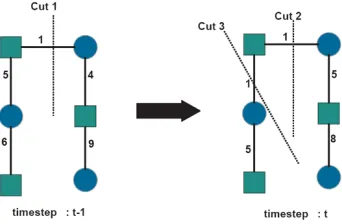
Figure 1.1: ESCC uses information from the previous time-step (t−1) to maintain cluster membership into the present time (t) in order to provide a smoother transition. Here it can be seen that in order to maintain that membership, despite the evenly weighted cut in the present time, the past comes into effect to makecut 2the better choice at time-stept.
To the best of my knowledge there are no efforts toward the creation of evolutionary
data mining algorithms for the purpose of co-clustering. In this thesis I present
evolution-ary spectral co-clustering (ESCC) for co-clustering of evolving data. An example of two
evolutionary time-steps is shown in Figure 1.1. This figure shows a decision swayed by
the incorporation of historical data. In order to incorporate historical data it is necessary to
develop an historical cost function. The cost function in this case is created to handle the
evolving instances and features for co-clustering. The resulting matrices formed from these
cost functions are decomposed using spectral value decomposition (SVD) and the k-means
clustering algorithm is then applied to obtain the desired number of clusters [14].
In order to show the features of this algorithm I perform extensive experiments on three
different synthetic datasets and a real world dataset from the PubMed database. The first
demonstrates the algorithm’s ability to handle noise, added and removed instances, added
and removed features, and the consistency across similar time-steps. The second synthetic
Finally, the third synthetic data set shows the algorithm’s ability to track features through
cluster shifts over time. Additionally, in order to show the accuracy of the algorithm a
real world data set is used. The dataset consists of authors and words from two separate
subjects in the PubMed database over the last ten years. This dataset is clustered and cluster
assignments are compared to the original subjects.
Thus the contributions of this thesis are outlined as follows:
• Anew algorithm (ESCC)to the field of evolutionary data mining.
• Two new historical cost functionsdesigned for co-clustering of heterogeneous data.
• The method forcreating and formattingheterogeneous data.
• Experimentally provingthe accuracy of ESCC.
The rest of the thesis is organized as follows. Chapter 2 provides a literature review of
papers relevant to the thesis. Chapter 3 will show the details of the algorithm for this thesis.
Chapter 4 details the experiments used in this thesis. Chapter 5 provides conclusions drawn
from the experiments and details potential future work in this new field. Finally, Chapter 6
2. Background and Related Work
While the concept of mining evolving data is relatively new, the concepts on which it is built
are very well researched. As outlined below, many of the concepts previously researched
and experimented upon will provide the building blocks for the algorithm and experiments
that follow within this thesis.
2.1
Evolutionary Clustering
The concept of evolutionary clustering came into being in 2006 with the publication by
Chakrabarti et al. [3]. This is not to be confused with any genetic algorithm[8] as the data
itself is evolving and the algorithm is simply clustering it. An additional disambiguation is
necessary in that many previous datasets have taken time into account with clustering, but
not as a smoothing feature. The difference lies in the objective: where previous clustering
efforts looked for information about the temporal data, Chakrabarti et al. looked for
infor-mation about data which was clustered over multiple time-steps. Further disambiguations
are necessary in regard to incremental clustering [18, 6] and constraint based clustering
[6, 2], also known as semi-supervised learning. Incremental clustering focuses on the up-dating of centroids [9] or other data structures through each iteration of the algorithm.
Through each update the focus is on the new clustering instead of the cluster membership
of previous data points. Constraint-based clustering requires further information beyond
simply having the data. In addition to the data some domain knowledge is needed to
inte-grate heuristic decisions within the algorithm. These heuristics can be presented as hard constraints[20] wherein instances must or cannot be linked orsoft constraints[12] wherein knowledge is used as an initial grouping.
handle evolving data. The addition to the field which will be used in this research includes
the cost functions to properly cluster at each time-step with respect to previous steps. These
were the history cost–how similar clustering attis tot−1–and the snapshot quality–how well the clusters match the desired clusters. These are extended in [5] wherein further work
is done to smooth the time shifts.
The authors of [5] extend the work in [3] to use the spectral clustering algorithm. Along
with this addition to evolutionary clustering, further work was done to produce historical
cost and snapshot cost functions. These are what drive decisions like the one shown in
Figure 1.1 and what will be implemented for co-clustering in this thesis.
In a recent unpublished work, Wang et al., use low level matrix factorization to achieve
a more efficient evolutionary clustering algorithm on large scale data. As stated in [11] all
clustering efforts suffer from potential dimensionality curse as the number of dimensions
exceed 16. The framework introduced in [21], Evolutionary Clustering based on
low-rank Kernel matrix Factorization (ECKF), is one which is claimed to be extensible to any
evolutionary clustering problem. This work also adds the intelligence to decide whether
or not a new clustering is necessary based on the underlying changes to the data at each
time-step.
2.2
Spectral Co-Clustering
Spectral clustering is intended to be a very simple algorithm for clustering many different
sized data sets with accuracy greater than that of the k-means algorithm and often greater
than many other traditional clustering algorithms. Its implementation relies heavily on
matrix computation, graph Laplacians, and the k-means algorithm [14].
There are multiple spectral clustering algorithms making use of unnormalized and
nor-malized Laplacians, graph cutting, random walks and perturbation all outlined in [14]. The
tutorial paper provides an excellent overview of the algorithm, it’s uses and how to
understanding of the spectral clustering algorithm and where to modify it to handle
evolv-ing data.
The development of co-clustering requires an understanding that the left and right
singular vector matrices will present differently when the weight matrix is normalized.
This normalization will properly incorporate the features. The following method from [7]
was used to normalize the weight matrix starting with the generalized eigenvalue problem
Lz =λDz.
L=
D1 −A
−AT D
2 (2.1) D =
D1 0
0 D2
(2.2)
from [7] equations 2.1 and 2.2 can be rewritten to obtain the normalization formula
Wn =D
−1 2
1 W D
−1 2
2 (2.3)
which creates the weight matrix used for co-clustering in ESCC.
The ability to cluster on multiple data sets at once is a most desirable faculty for a
clustering algorithm. This provides the ability to gain further insight concerning the
rela-tionship between separate data sets. The common one-way clustering effort works well,
but restricts what information can be gleaned from multiple data sets. The one-way
clus-tering effort also suffers from the dimensionality curse [1], wherein high dimensioned data
is much more difficult to cluster.
Co-clustering serves the purpose of clustering the individual data sets through relating
them to each other. This partially undoes the dimensionality curse in that further refinement
of clusters is made through relating the data points to the attributes and back again [11]. For
instance with text mining of document sets and word sets the two data sets can be clustered
shown further in [7].
Dhillon starts his research with the graph partitioning problem for the purpose of
clus-tering dyadic data sets. As of 2007 it was a novel concept to treat the data sets as vertices
in a graph. The edges connecting these different data sets would represent a relationship
between the two and the weight of the edge would represent the strength. With clustering
this graph the goal is to partition along the least weighted edges in order to best separate
the clusters.
Dhillon uses documents and words as the separate data sets the same way that was used
in [13]. The graph partitioning method for co-clustering works to relate words to documents
thus also clustering words to each other and the same for documents. As with previous
papers, this is the goal of co-clustering. The spectral partitioning method, however, is more
scalable than the previous work. Experiments from the paper show that the spectral graph
partitioning method can discern a small amount of documents from other clusters of larger
sets of documents.
From this research it has shown that there is a lack of co-clustering on evolving data.
The research by Chi et al. on spectral clustering of evolving data combined with the
re-search by Dhillon on using spectral clustering on bipartite graphs gives an excellent
3. ESCC
This is a novel algorithm to the field and will be described here in detail. First, the
algo-rithm not only handles the insertion and deletion of instances, but features as well. This is
necessary for changes over time concerning co-clustering. Next, the algorithm shows
re-sistance to changes between time-steps in the instances as shown before [5], and shows this
for changes in features as well. Finally, the algorithm shows movements of data between
time-steps in the instances as well as the features.
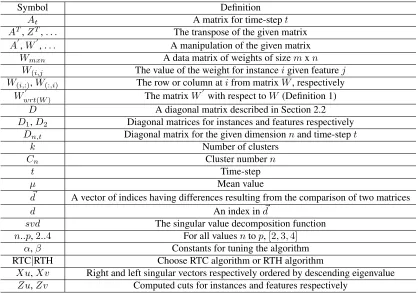
Symbol Definition
At A matrix for time-stept
AT,ZT,. . . The transpose of the given matrix A0,W0,. . . A manipulation of the given matrix
Wmxn A data matrix of weights of sizemxn W(i,j The value of the weight for instanceigiven featurej W(i,:),W(:,i) The row or column atifrom matrixW, respectively
Wwrt0 (W) The matrixW0 with respect toW (Definition 1)
D A diagonal matrix described in Section 2.2
D1,D2 Diagonal matrices for instances and features respectively
Dn,t Diagonal matrix for the given dimensionnand time-stept
k Number of clusters
Cn Cluster numbern
t Time-step
µ Mean value
~
d A vector of indices having differences resulting from the comparison of two matrices
d An index ind~
svd The singular value decomposition function
n..p,2..4 For all valuesntop,[2,3,4]
α,β Constants for tuning the algorithm RTC|RTH Choose RTC algorithm or RTH algorithm
Xu,Xv Right and left singular vectors respectively ordered by descending eigenvalue
[image:15.612.93.511.326.619.2]Zu,Zv Computed cuts for instances and features respectively
3.1
RTC vs. RTH
I present two methods for including past time-step clustering into the present. These
meth-ods are each referred to as the evolutionary method by which clusters are chosen from
time-step to time-step. The first of these methods is Respect To the Current (RTC), wherein
the present clustering quality (CQ) is of most importance and historical cost (HC) is
cal-culated with only one previous time-step. The second, is Respect To Historical (RTH).
RTH attempts to keep instances and features tied to the same clusters between time-steps,
therefore this method uses all previous time-steps when calculating historical cost. In this
case the best example can be given through Figure 1.1 where either evolutionary method
would choose cut 2, however if the weight of the edge on cut 2 were higher the two would
disagree. If making cuts with RTC the optimal clustering for the present time will be
cho-sen (cut 3) within a margin of tolerance dictated by the values chocho-sen for the constants,α
andβ, shown in Equation 3.1. On the other hand when making cuts with RTH within the
tolerance cut 2 would still be chosen as it reduces the error in historical clustering.
ECt =k−trace
XvtT (αCQt+βHCt)Xut
(3.1)
The accuracy of the clustering for each of these is determined by the cost of each
time-step, this is known as theevolutionary cost. The evolutionary cost (EC) is computed through a summation of the clustering quality and the historical cost. Historical cost being
the added negative weight for choosing a cut that causes a cluster change. RTC and RTH
have differing cost functions as each are modeled for different purposes. The CQ and HC
for RTC is defined as in Equation 3.2 and the CQ and HC for RTH is defined in equation
3.4. AsXu andXv are created from the left and right singular vectors from all previous
time-steps, the HC for RTH is more tightly connected to the past clustering choices. In
CQt=αD
−12
1,t WtD
−12
2,t
HCt=βD
−1 2
1,t−1Wt−1D
−1 2
2,t−1 (3.2)
(3.3)
CQt=αD
−1 2 1,t WtD
−1 2 2,t
HCt=βXut−1XvTt−1 (3.4)
(3.5)
The aim is to minimize these costs to give the best possible cut through the data. The
minimization is achieved by using the topk singular vectors from the left (Xut) and from
the right (Xvt) of the singular value decomposition performed in Algorithm 2. CQtrefers
to the cluster quality at time t, while HCt refers to the historical cost at time t. These
measures differ in thatCQmeasures the quality of the present clustering as if it were static
data andCH measures the cost of change from the previous time-step to the present.
3.2
Handling Data Changes
The balanced insertion discussed previously is meant to make the dimensions of each
time-step comparable while not compromising the cluster assignments of other instances. This
need to handle changes in the data dimensions over time requires a new construct to be
created. This new construct is the WRT construct.
of Algorithm 1.
In order to accomplish this when adding instances or features to the past different
meth-ods are used based on the selection of RTC or RTH. In the case of RTC, where present
quality is most important, the inserted row or column receives the average of the whole
matrix at present time for each cell. In the case of RTH the inserted row or column receives
the average of the new row or column in each cell.
The easier of the two operations is removal of instances or features from past
time-steps. This occurs when an instance or column in the past matrices is no longer present in
the current time-step. In this case the instance or column can be removed from the past in
Algorithm 1Generate WRT Matrices Algorithm
1: INPUT: W1:0t(history), Wt(present), RTC|RTH { // history contains all weight matrices previous to present,presentcontains the current time-step for which this With Respect To (WRT) Matrix is being created, RTC—RTH is the evolutionary method chosen}
2: OUTPUT:Wwrt:t
3: METHOD:{// Start with removal of differing rows and columns} 4: fort0 ←1..length of historydo
5: d~←Wt00 ∈/ W
6: Wt0
wrt(Wt)
←Wt00 −Wt,(d,~:)
7: d~←W0T
t ∈/WT
8: Wt0
wrt(Wt)
←Wt00T−WT t,(:, ~d)
T
9: end for
{// Make additions next, these will be based on the evolutionary method} {// Start with Row/Instance addition}
10: fort0 ←1..length of historydo
11: d~←W /∈W0 t0
12: ifRTCthen
13: for alldifferencesd~do
14: insert←µWt00
15: AddinserttoWt0
wrt(Wt),(d,:)based on its ID 16: end for
17: else ifRTHthen
18: for alldifferencesd~do
19: insert←µWt0,(r~
d)
20: AddinserttoWt0
wrt(Wt),(d,:)
based on its ID 21: end for
22: end if
23: end for
{// Column/Feature addition next} 24: fort0 ←1..length of historydo
25: d~←W /∈Wt00
26: ifRTCthen
27: for alldifferencesd~do
28: insert←µW0 t0
29: AddinserttoWt0
wrt(Wt)
based on its ID 30: end for
31: else ifRTHthen
32: for alldifferencesd~do
33: insert←µWt0,(c~
d)
34: AddinserttoWt0
wrt(Wt),(:,d)
based on its ID 35: end for
36: end if
3.3
Piecing the algorithm together
As stated previously, Xu and Xv are left and right singular vectors consisting of
infor-mation from all previous time-steps. These take different forms based on the evolutionary
method chosen. If working with RTC the calculations forXuandXv are shown in
Equa-tion 3.6 and similarly for RTH they are shown in EquaEqua-tion 3.7. The difference lies in the
statements tied to the coefficient β. Being connected with only the last time-step is the
role of RTC and shown in the calculation for EC as well. However, a connection with all
previous time-steps is shown with RTH through its recursive reference.
[Xut, Xvt] =svd
h
αWt+βD−
1 2 1,t−1W D
−1 2 2,t−1
i
(3.6)
[Xut, Xvt] =svd
αWt+βXut−1XvtT−1
(3.7)
wherein all references to time-steptare of the formtwith respect to the current time-step.
For example, if there is an instance increase between time-stept−1andt,t−1with respect totwould have the additional instances as a balanced insertion to the matrix.
The collected singular vectors must be passed to k-means in order to generate clusters
for each time-step. The final matrixZ is the result of the following
Z = D− 1 2
1,t Xut(2..dlog2ke)
D−
1 2
2,t Xvt(2..dlog2ke)
(3.8)
where Xut andXvt are comprised of all left and right singular vectors, respectively, for
time-stept, andk remains the number of clusters.
The result of putting all of this together is represented in the ESCC algorithm shown in
Algorithm 2ESCC Algorithm
1: INPUT:Wmxnxt,k, and RTC|RTH{//W is anmxnxtmatrix wheretis the number of time-steps,k
is the number of clusters}
2: OUTPUT:Cluster assignments for each time-step 3: METHOD:
4: forall time-stepsdo
5: forall time-steps previous to the currentdo
6: create corresponding past matrices with respect to the present time-step using Algorithm 1 7: end for
8: forall time-steps previous to the currentdo
9: ifRTCthen
10: use equation 3.6 for SVD 11: else ifRTHthen
12: use equation 3.7 for SVD 13: end if
14: combine left and right singular vector matrices using equation 3.8 15: runk-means on resulting matrix
16: end for
17: end for{// The firstmcluster values for each time-step represents the instance clustering and the trailing
4. Experiments
Two sets of experiments were run to determine the validity and effectiveness of this
al-gorithm. The first set of experiments involved a synthetic dataset designed to show the
different functions of the algorithm. The second shows the accuracy of the algorithm on
real world data using a dataset from the widely used PubMed database of medical research
[image:22.612.92.530.306.399.2]papers.
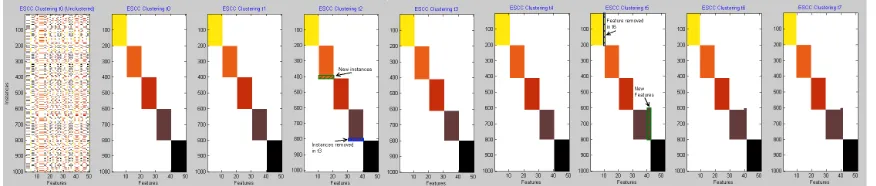
Figure 4.1: t0 is the original data in unclustered and clustered form. t1 shows consistency of clustering despite 50 instances of noise per cluster. t2shows 10 instances added toC2. t3 shows 10 instances removed fromC4 (highlighted int2). t4shows cluster stability through a time-step of no change. t5 shows 2 features added to C4. t6 shows 1 feature removed fromC1 (highlighted int5). t7 shows again the stability through an unchanged time-step.
4.1
Synthetic Data
Three different synthetic datasets were used to show the features of the algorithm. The
first, shown in 4.1.1, demonstrates the algorithm’s ability to handle noise, added instances,
removed instances, added features, and removed features as well as the consistency across
similar time-steps. The second (4.1.2) synthetic data set shows the algorithm’s ability to
track instances through cluster shifts over time. Finally, the third (4.1.3) synthetic data set
4.1.1
Synthetic Demonstrations
I have constructed a synthetic dataset with 8 time-steps and 5 clusters of 200 instances each
having 10 assigned features. The initial time-step and 5 clusters were formed by creating
5 ascending groups of data sampled from 5 normal distributions. Each normal distribution
was guaranteed to be distanced from the previous through an augmentedµvalue added to
the previousµ. Therefore, if a cluster,Cn, has an assignedµit is represented byµnwhere
n is the cluster number, then the distributions are determined by µn = µn−1 + 5·n +R whereRis a random integer bound by[0−100]. For all distributionsσ= 1.
To form time-stept1 Gaussian noise was added to 50 instances per cluster. It is shown
in Figure 4.1 that t0 and t1 are unchanged, despite the added noise. Next, int2 instances
were added toC2 using a selection of values from a normal distribution having aµ =µ2.
The figure shows that the additional instances were added and appropriately clustered as
indicated by the green shaded box. To show the opposing action int3instances are removed
from C4. From the figure it can be seen that all clusters remain unchanged andC4 has a
smaller block size. This was also indicated int3 as the instances that will be removed are
highlighted in blue. In t4 the data is unchanged, simulating the stability of the clustering
between time-steps.
Until this point the algorithm has behaved as any previous evolutionary algorithm
would, however with t5 features will be added to the dataset inC4 using values selected
from a normal distribution having aµ =µ4. The figure shows that the additional features
have not affected the clusters and the resulting new columns were correctly clustered as
in-dicated by the green box around the column of data in Figure 4.1 time-stept5. Int6features
were removed fromC1and the figure shows again that the clustering is unaffected and the
block for C1 is diminished. This was also indicated in t5 by the blue shading around the
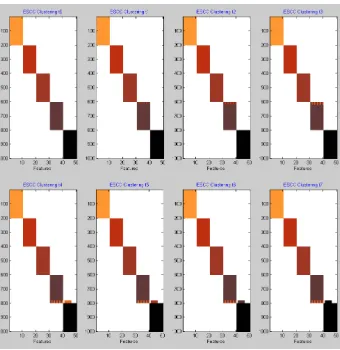
Figure 4.2: t0 is the original data from Figure 4.1. t1 -t3 show the downward shift of the
C4 features andt4 -t7 show the up shift inC5 features. Ultimately the 20 instances were shown to shift fromC4 toC5as expected.
4.1.2
Synthetic Instance Drift
Using the same initial time-step and 5 cluster distribution from section 4.1.1, a group of 20
instances were incrementally modified at each time-step, up to 8, to denote a cluster shift
of the instances. Figure 4.2 shows the time series of clustered data. It can be seen att3 that
the instances are discolored denoting a drop in value and int4the instances change clusters
when values for the next cluster’s features begin rising.
4.1.3
Synthetic Feature Drift
In the same manner as the previous example, a feature shift is shown. Two features were
chosen fromC4 to have their values lowered inC4 and raised inC5. Figure 4.3 shows the
progression over each time-step. As with the last experiment the color change indicates
diminished values and at t3 the values correlated withC5 begin increasing and the cluster
Figure 4.3: t0is the original data from Figure 4.1. t1-t3show the downward shift of theC4 instances at 2 distinct features andt4-t7show the up shift inC5instances at those features. Ultimately the 2 features were shown to shift fromC4toC5 as expected.
4.2
Real Data
To evaluate the accuracy of ESCC on real data, I selected a widely used database of medical
papers: PubMed1. The PubMed dataset was constructed from two searches of highly
re-searched topics in the medical field: schizophrenia treatment and stem cell research. Each
search was limited to English texts published between 1990 and 2009 having authors and
abstracts. The papers were then parsed by year to obtain author-word matrices for each
year containing both subjects. Common stop words were removed and all words were
stemmed using Porter’s suffix-stripping algorithm [15]. Authors and words were assigned
unique IDs tied to the first occurrence based on the year the author or word was used and
the subject matter, respectively. These unique ids are used in the generation of the WRT
matrices as demonstrated in Algorithm 1. Authors that had published less than three papers
in the time-span were removed from the dataset and words occurring less than 30 times
throughout the abstracts were also removed. This resulted in 10 data time-steps consisting
of information from 64,320 papers, 17,731 unique authors, and 8,541 unique words these
are described by year in Table 4.1.
Year # Papers # Authors # Words 2000 2817 4907 6750 2001 2792 5254 6860 2002 3486 6220 7117 2003 3698 6734 7205 2004 4059 7244 7327 2005 4059 8023 7452 2006 4376 7984 7286 2007 4690 8365 7302 2008 4962 8234 7328 2009 5074 7988 7304
Table 4.1: An outline of the pubmed dataset.
Figure 4.4: F-measures for the ESCC clustering on PubMed data. The higher the F-measure the higher the accuracy of the clustering. This shows that RTH is generally better at sorting out the different clusters.
Each year represented was run using the RTC and RTH framework. Theαandβvalues
were 0.7 and 0.3 respectively. The following series of confusion matrices and top words
from the respective clusters show the ability for ESCC to cluster authors appropriately as
well as the words through each time-step. As can be seen in Figure 4.4 RTH outperforms
RTC in nearly each time-step. This is because authors do not often change subjects, despite
the enormous amount of noise in the words utilized in each abstract. Furthermore, Figure
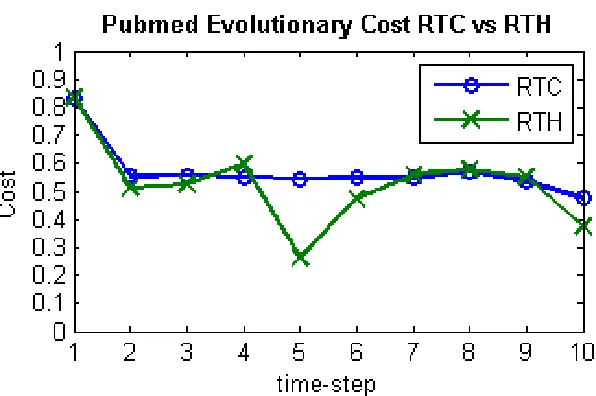
4.5 shows that RTH maintains historical cluster membership as expected and better than
the RTC counterpart.
[image:26.612.166.460.263.428.2]RTC SchizR StemCell
Auth1: 1558 432
Auth2: 52 2864
RTH
Auth1: 1558 432
Auth2: 52 2864
W1: disord drug mental psychiatri stress
W2: allogen repopul graftversushost leukem posttranspl
Table 4.2: ESCC clustering of PubMed. Year 2000.
RTC SchizR StemCell
Auth1: 1805 374
Auth2: 609 2465
RTH
Auth1: 1706 473
Auth2: 52 3022
RTC
W1: treatment schizophrenia disord depart human W2: colonyform gvh osteoclast transfus leukem RTH
W1: treatment effect schizophrenia disord psychiatr W2: marrow bone transplant blood hematopoiet
Table 4.3: ESCC clustering of PubMed. Year 2001.
RTC SchizR StemCell
Auth1: 1848 578
Auth2: 79 3714
RTH
Auth1: 1834 592
Auth2: 75 3718
RTC
W1: treatment effect schizophrenia univers depart W2: patient studi transplant bone stem
RTH
W1: treatment schizophrenia symptom clinic antipsychot W2: patient transplant bone stem blood
Table 4.4: ESCC clustering of PubMed. Year 2002.
RTC SchizR StemCell
Auth1: 2199 613
Auth2: 149 3772
RTH
Auth1: 2172 640
Auth2: 67 3854
RTC
W1: treatment schizophrenia result disord ptsd W2: patient studi bone univers depart
RTH
W1: treatment schizophrenia result disord ptsd W2: patient studi bone transplant univers
Table 4.5: ESCC clustering of PubMed. Year 2003.
RTC SchizR StemCell
Auth1: 2492 657
Auth2: 306 3788
RTH
Auth1: 2349 755
Auth2: 118 3976
RTC
W1: patient treatment result effect disord W2: studi bone transplant univers clinic RTH
W1: patient treatment disord symptom antipsychot W2: studi bone transplant univers clinic
RTC SchizR StemCell
Auth1: 2740 674
Auth2: 620 3988
RTH
Auth1: 2665 749
Auth2: 746 3862
RTC
W1: treatment disord group symptom antipsychot W2: cell patient studi bone result
RTH
W1: patient studi treatment schizophrenia mai W2: cell bone result marrow transplant
Table 4.7: ESCC clustering of PubMed. Year 2005.
RTC SchizR StemCell
Auth1: 2784 718
Auth2: 792 3689
RTH
Auth1: 2635 856
Auth2: 160 4332
RTC
W1: studi schizophrenia result ptsd effect W2: patient treatment bone stem marrow RTH
W1: patient treatment univers symptom clinic W2: cell studi bone result stem
Table 4.8: ESCC clustering of PubMed. Year 2006.
RTC SchizR StemCell
Auth1: 3074 641
Auth2: 1395 3254
RTH
Auth1: 3008 719
Auth2: 1400 3237
RTC
W1: treatment effect disord depart clinic W2: allogen epc gvhd osteoblast hmsc RTH
W1: treatment effect disord clinic symptom W2: studi bone result univers group
Table 4.9: ESCC clustering of PubMed. Year 2007.
RTC SchizR StemCell
Auth1: 2942 810
Auth2: 1273 3208
RTH
Auth1: 2996 756
Auth2: 1325 3156
RTC
W1: treatment result disord ptsd univers W2: epc bmsc engraft gvhd graftversushost RTH
W1: patient treatment result disord ptsd W2: cell studi bone effect univers
Table 4.10: ESCC clustering of PubMed. Year 2008.
RTC SchizR StemCell
Auth1: 3589 2
Auth2: 4381 15
RTH
Auth1: 2587 1004
Auth2: 133 4263
RTC
W1: patient studi treatment schizophrenia ptsd W2: colonyform thalidomid feeder bdlsc gfplabel RTH
W1: patient treatment disord group clinic W2: cell studi result effect msc
Figure 4.5: Using the cost formulas from Section 3.1 the two algorithms are measured for accuracy and maintaining historical clustering. A lower cost value indicates a better clustering in regard to maintaining history. As can be seen in the graph, I have found that RTH generally performs better than RTC.
within the medical field. The RTH algorithm shows a better clustering through the end
while the RTC algorithm did not finish as well as shown in Table 4.11. As more authors
are introduced to the set, the words are fairly constant because of the constraint that each
be used 35 or more times within the selected abstracts. This meant that the clusters became
more saturated and blended the lines making the distinctions more difficult over time.
How-ever, by the evolutionary cost graph in Figure 4.5 where a maximum cost has a value of 2,
the given costs show low changes in cluster membership, reducing noise. Observing the
selection of top words clustered with each set shows that the co-clustering element of this
5. Conclusion
I have presented a new algorithm to the field of evolutionary data mining. The research
shows it as novel and contributing a new direction to this field. Evolutionary co-clustering
will give a new option for mining of data collected over time with reduced noise and
aug-mented incorporation of past data. The synthetic experiments show that the algorithm
performs as it should for each of the features claimed and tested. Finally, the algorithm
shows that with enough time and resources clusters will form showing accurate
distinc-tions between separate groups of data.
Further research is necessary to determine the full range of uses for this new algorithm
as this is a new direction for the field of mining evolving data. This research may lead
to more datasets properly suited for the evolutionary mining process. Currently it is very
difficult to find a dataset with a focus on time-steps. An interesting direction would be
datasets with time-steps which are less than a year in length, something like a blog server
or a mashup of RSS feeds with daily updates, users, and words to be clustered. In any case,
more data well-formed for evolutionary data mining would be an excellent next step.
Additionally, there are far more efficient, much more complicated algorithms that could
also be converted to handle evolving data. This research provides a road map for those that
would venture to take on the endeavor of creating a novel algorithm in the evolving data
mining field. Incorporating matrix factorization or block value decomposition were outside
the scope of this research, but would make an excellent comparison for the research within
6. Acknowledgments
A grand thank you to Professor Rege, my committee, and Patrick Saeva and Peter Erhardt
of the RIT Office of Development for their assistance with this thesis. I was unable to use
the dataset provided by them for this research, however their assistance was most
appre-ciated. Additionally, much thanks to Vickie for making me sit down and work when all I
wanted to do was run CSH. My thanks also goes to the Research Computing group at the
Rochester Institute of Technology for the compute time that could not be accomplished by
Bibliography
[1] Charu C. Aggarwal. On k-anonymity and the curse of dimensionality. In VLDB
’05: Proceedings of the 31st international conference on Very large data bases, pages 901–909. VLDB Endowment, 2005. ISBN 1-59593-154-6.
[2] Mikhail Bilenko, Sugato Basu, and Raymond J. Mooney. Integrating
con-straints and metric learning in semi-supervised clustering. In ICML ’04:
Proceedings of the twenty-first international conference on Machine learning,
page 11, New York, NY, USA, 2004. ACM. ISBN 1-58113-828-5. doi:
http://doi.acm.org/10.1145/1015330.1015360.
[3] Deepayan Chakrabarti, Ravi Kumar, and Andrew Tomkins. Evolutionary clustering. In KDD ’06: Proceedings of the 12th ACM SIGKDD international conference on Knowledge discovery and data mining, pages 554–560, New York, NY, USA, 2006. ACM. ISBN 1-59593-339-5. doi: http://doi.acm.org/10.1145/1150402.1150467.
[4] Yanhua Chen, Lijun Wang, and Ming Dong. Non-negative matrix factorization for
semi-supervised heterogeneous data co-clustering. IEEE Transactions on Knowledge
and Data Engineering, 99(PrePrints), 2009. ISSN 1041-4347.
[5] Yun Chi, Xiaodan Song, Dengyong Zhou, Koji Hino, and Belle L. Tseng.
Evolution-ary spectral clustering by incorporating temporal smoothness. InKDD ’07:
Proceed-ings of the 13th ACM SIGKDD international conference on Knowledge discovery and data mining, pages 153–162, New York, NY, USA, 2007. ACM. ISBN 978-1-59593-609-7. doi: http://doi.acm.org/10.1145/1281192.1281212.
[6] Ian Davidson, S. S. Ravi, and Martin Ester. Efficient incremental constrained
cluster-ing. InKDD ’07: Proceedings of the 13th ACM SIGKDD international conference on
Knowledge discovery and data mining, pages 240–249, New York, NY, USA, 2007. ACM. ISBN 978-1-59593-609-7. doi: http://doi.acm.org/10.1145/1281192.1281221.
[7] Inderjit S. Dhillon. Co-clustering documents and words using bipartite
SIGKDD international conference on Knowledge discovery and data mining, pages
269–274, New York, NY, USA, 2001. ACM. ISBN 1-58113-391-X. doi:
http://doi.acm.org/10.1145/502512.502550.
[8] Michael Goebel and Le Gruenwald. A survey of data mining and knowledge
discov-ery software tools.SIGKDD Explor. Newsl., 1(1):20–33, 1999. ISSN 1931-0145. doi:
http://doi.acm.org/10.1145/846170.846172.
[9] Chetan Gupta. Genic: A single pass generalized incremental algorithm for
clustering. SIAM International Conference on Data Mining, 2004. URL
http://citeseerx.ist.psu.edu/viewdoc/summary?doi=?doi=10.1.1.1.5567.
[10] Daniel Hanisch, Alexander Zien, Ralf Zimmer, and Thomas Lengauer. Co-clustering
of biological networks and gene expression data. Bioinformatics, 18(1):145–154,
2002.
[11] Jacob Kogan, Charles Nicholas, and Marc Teboulle. A survey of clustering data
min-ing techniques. Springer Berlin Heidelberg, 2006.
[12] M. H. C. Law, A. Topchy, and A. K. Jain. Clustering with soft and group constraints.
LECTURE NOTES IN COMPUTER SCIENCE, 2004.
[13] Bo Long, Zhongfei (Mark) Zhang, and Philip S. Yu. Co-clustering by
block value decomposition. In KDD ’05: Proceedings of the eleventh ACM
SIGKDD international conference on Knowledge discovery in data mining, pages
635–640, New York, NY, USA, 2005. ACM. ISBN 1-59593-135-X. doi:
http://doi.acm.org/10.1145/1081870.1081949.
[14] Ulrike Luxburg. A tutorial on spectral clustering. Statistics and Computing, 17(4): 395–416, 2007. ISSN 0960-3174. doi: http://dx.doi.org/10.1007/s11222-007-9033-z.
[15] M. F. Porter. An algorithm for suffix stripping. Morgan Kaufmann Publishers Inc.,
San Francisco, CA, USA, 1997. ISBN 1-55860-454-5.
[16] Guoping Qiu. Image and feature co-clustering. Pattern Recognition, International
Conference on, 4:991–994, 2004. ISSN 1051-4651.
words using bipartite isoperimetric graph partitioning. In ICDM ’06: Proceed-ings of the Sixth International Conference on Data Mining, pages 532–541,
Wash-ington, DC, USA, 2006. IEEE Computer Society. ISBN 0-7695-2701-9. doi:
http://dx.doi.org/10.1109/ICDM.2006.36.
[18] Nachiketa Sahoo, Jamie Callan, Ramayya Krishnan, George Duncan, and Rema
Pad-man. Incremental hierarchical clustering of text documents. InCIKM ’06:
Proceed-ings of the 15th ACM international conference on Information and knowledge man-agement, pages 357–366, New York, NY, USA, 2006. ACM. ISBN 1-59593-433-2. doi: http://doi.acm.org/10.1145/1183614.1183667.
[19] K Schlter and D Drenckhahn. Co-clustering of denatured hemoglobin with band 3: its role in binding of autoantibodies against band 3 to abnormal and aged erythrocytes.
Proceedings of the National Academy of Sciences of the United States of America, 83 (16):6137–6141, 1986.
[20] K. Wagstaff and C. Cardie. Clustering with instance-level constraints.
PROCEED-INGS OF THE NATIONAL CONFERENCE ON ARTIFICIAL INTELLIGENCE, 2000.